

loka लोक – world; realm
substantive masculine · Word type unspecified
Dictionary sources
AYI dictionary substantive masculine
world; realm
Cappeller 1891 substantive masculine
Original text · English · substantive masculine
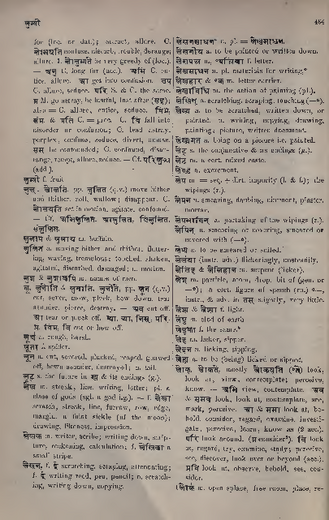
loká1 ·m. open splace, free room, place, region, world or one of the (imaginary 2, 3, or 7) worlds, esp. the earth; people, men or mankind (sgl. or pl.); company, community, troop or band of (--°); worldy life, ordinary practice or common usage (opp. to higher things, esp. knowledge).
Monier-Williams 1872 substantive masculine
Original text · English · substantive masculine
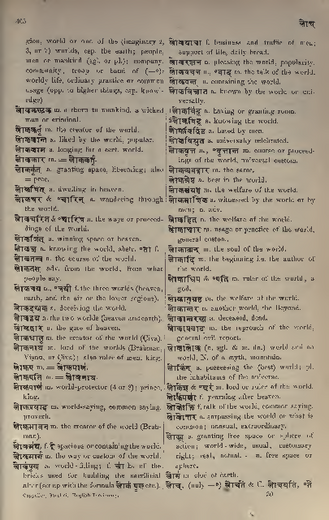
Loka, as, m. (cf. roka; in the oldest texts of the Ṛg-veda loka is generally preceded by u, which according to the Pada-pāṭha = the particle 3. u, and according to some may be an abbreviation of uru, wide, or derived from the prep. ava, cf. uru-loka, ava-kāśa), open space (Ved.), space, room, inter- mediate space (Ved.; in Ṛg-veda VIII. 100, 12, dehi lokam = avakāśam pra-yaccha, make room), the vast space, the wide world, sky, heaven; any division of the universe, (three Lokas are com- monly given, viz. heaven, earth, and the lower world, but the fuller classification enumerates four- teen, seven descending one below the other and constituting together the lower world, sometimes called hell [see pātāla], and seven higher regions rising one above the other, as follow, 1. Bhūr-loka, the earth; 2. Bhuvar-l˚, the space between the earth and the sun, the region of the Munis, Siddhas, &c.; 3. Svar-l˚, the heaven of Indra above the sun or between the sun and the polar star; 4. Ma- har-l˚, said to be one krore of Yojanas above the polar star and to be the abode of Bhṛgu and other saints who survive the destruction of the three worlds situated below; during the conflagration of these lower worlds the saints ascend to 5. Janar-l˚, which is described as the abode of Brahmā's sons Sanat- kumāra, &c.; 6. Tapar-l˚, where the deified Vai- rāgins reside; 7. Satya-l˚ or Brahma-l˚ or the abode of Brahmā, translation to which world exempts beings from further birth: the first three worlds are destroyed at the end of each Kalpa or day of Brahmā, the last three at the end of his life or of 100 of his years; the fourth Loka is equally permanent, but is uninhabitable from heat at the time that the first three are burning: another enumeration calls these seven worlds, earth, sky, heaven, middle region, place of births, mansion of the blest, and abode of truth, placing the sons of Brahmā in the sixth divi- sion and affirming the fifth or Janar-l˚ to be that where animals destroyed in the general conflagration are born again); a symbolical expression for the number seven; the world, earth, (iha loke, in this world, on the earth, opposed to paratra, para- loke, &c.); any place, region, tract, district, province; the inhabitants of the world, the human race, man- kind, folk, man, men (in this sense also ās, m. pl.), people, subjects (as contrasted with the king); a company, community; common life, ordinary prac- tice, (especially) common usage (as contrasted with ancient usage or idiom of the Veda; loke, ‘in ordi- nary usage, in the language of the people, ‘as opposed to vede, chandasi); seeing, looking, sight, regard; [cf. Lat. locus; Lith. laukas, ‘a plain.’]
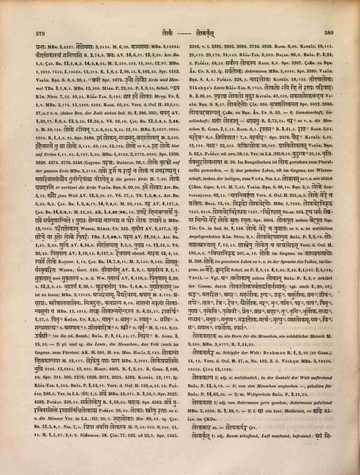
Petersburger 1855 substantive masculine
Original text · German · substantive masculine
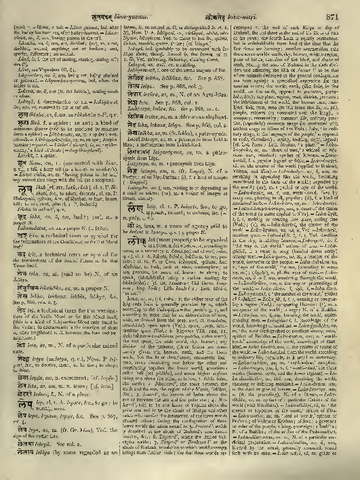
loká m. TRIK. 3,5,3. am Ende eines adj. comp. f. ā RAGH. 15,60. Spr. 4097. VARĀH. BṚH. S. 8,30. In den ältesten Texten finden wir regelmässig die Verbindung u̱ lo̱ka, sogar am Anfange eines Pāda ? (ṚV. 3,2,9. ṚV. 3,37,11. ṚV. 5,4,11. ṚV. 9,2,8). Im ṚV. erscheint das einfache loka nur ṚV. 8,89,12. ṚV. 9,113,7. ṚV. 9,113,9. ṚV. 10,14,9. ṚV. 10,85,20. ṚV. 10,90,14. VS. 11,22 wird missverständlich u in su verändert, obgleich diese Sammlung vereinzelt (VS. 12,35. VS. 18,52. VS. 18,58) auch u erhalten hat. Dieser Umstand führt auf die Vermuthung, dass uloka die ältere Form des Wortes gewesen, loka also durch Abfall des Anlauts entstanden sei. Vgl. Ind. St. 1,351. MÜLLER, Transl. I, LXXIV. uloka weist auf uroka, das auf ur, var (vgl. uru, vara, variman) zurückgeführt werden kann. Wer es vorzieht uroka von ruc abzuleiten, könnte u als Rest der Präposition ava (vgl. avakāśa) betrachten. 1〉 freier Raum, das Freie; Raum überh., Ort, Platz, Stelle: de̱hi lo̱kam mache Platz ṚV. 8,89,12. sīdà hota̱ḥ sva ù lo̱ke ṚV. 3,29,8. ṚV. 10,13,2. u̱ lo̱ko yastè adriva̱ indre̱ha tata̱ ā gàhi ṚV. 3,37,11. ṚV. 3,2,9. su̱ra̱bhā ù lo̱ke ṚV. 5,1,6. a̱smā e̱taṃ pi̱tarò lo̱kamàkran ṚV. 10,14,9. VS. 2,30. pitṛṣadana VS. 5,26. VS. 6,6. devà somai̱ṣa tè lo̱kaḥ VS. 8,26. lo̱kaṃ pṛ̀ṇa cchi̱draṃ pṛ̀ṇa VS. 12,54. VS. 19,54. VS. 35,1. VS. 35,2. VS. 35,6. pra̱jāṃ cà lo̱kaṃ cā̀pnoti so v. a. freies Gebiet, freie Bewegung AV. 4,11,9. AV. 6,123,2. AV. 12,2,1. AV. 14,2,13. AV. 18,2,25. atrā̀dadhu̱ryajàmānāya lo̱kam AV. 4,4,7. madhumant AV. 9,1,23. ye pṛ̀thi̱vyāṃ puṇyā̀ lo̱kāḥ AV. 15,13,1. TS. 5,7,5,3. AIT. BR. 3,18. AIT. BR. 1,24. PAÑCAV. BR. 17,13,1. ŚAT. BR. 6,2,2,28. yāvantaṃ lokaṃ jayati Strecke, Gebiet ŚAT. BR. 11,8,3,5. ŚAT. BR. 13,2,7,13. ŚAT. BR. 14,6,9,11. fgg. (vgl. BṚH. ĀR. UP. 3,9,10. fgg.). ŚAT. BR. 14,9,4,3. ātmā sarveṣāṃ bhūtānāṃ lokaḥ ŚAT. BR. 14,4,2,29. jagatīnāṃ loke triṣṭubhaḥ statt der J. ṢAḌV. BR. 3,7. Zwischenraum KAUŚ. 86. loko 'yam diese Stätte, dieses Land, das von uns bewohnte Land AK. 2,1,6. Besonders in der Verbindung lokaṃ kar oder uruṃ lokaṃ kar Raum —, Luft —, Freiheit schaffen: u̱ruṃ tṛtsùbhyo akṛṇodu lo̱kam ṚV. 7,33,5. ṚV. 1,93,6. ṚV. 2,30,6. ṚV. 4,17,7. ṚV. 5,4,11. yo vò vṛ̱tābhyo̱ akṛ̀ṇodu lo̱kam ṚV. 10,30,7. ṚV. 10,104,10. VS. 11,22. VS. 23,43. AV. 6,121,4. AV. 9,2,11. AV. 11,1,31. ĀŚV. ŚR. 4,13,5. jyoti̱ryadahne̱ akṛ̀ṇodu lo̱kam machte Platz ṚV. 9,92,5. ähnlich u̱ruṃ nò lo̱kamanù neṣi ṚV. 6,47,8. AV. 18,2,20. — 2〉 der grosse Raum, die Welt; Weltraum, jede imaginäre Welt AK. 3,4,4,2. H. 1365. H. an. 2,16. MED. k. 33. HALĀY. 1,133. VS. 32,11. fg. AV. 8,9,1. AV. 8,9,15. AV. 11,5,7. AV. 11,8,10. sūryàḥ sa̱dyaḥ sarvā̀ṃ lo̱kānparyèti̱ rakṣàn AV. 4,38,5. AV. 10,9,10. AV. 10,10,33. di̱vyāḥ, pārthìvāḥ AV. 9,5,14. sūryàvantaḥ AV. 8,9,18. TBR. 3,12,8,2. nāputrasya loko 'sti für den Sohnlosen ist die Welt nicht da AIT. BR. 7,13. kaumā̀ro lo̱ko àjaniṣṭa pu̱traḥ Kinderwelt AV. 12,3,47. Welt im ausgezeichneten Sinne: Himmel, Stelle im Himmel ŚAT. BR. 2,6,1,7. ŚAT. BR. 10,5,4,16. ŚAT. BR. 11,2,7,19. na kṛtaghnasya loko 'sti WEBER, KṚṢṆAJ. 225. lokebhyaḥ parikṛntati M. 4,219. lokāñjayati M. 9,137. Welten von verschiedener Art und Zahl ŚAT. BR. 14,6,6,1. fgg. ŚAT. BR. 14,7,1,36. fgg. ŚAT. BR. 14,9,1,18. ŚĀṄKH. BR. 20,1. KĀṬH. 26,4. M. 4,181. fgg. puṣkalāḥ M. 8,81. ātmaprabhāḥ MBH. 3,2227. tejomayāḥ MBH. 5,2454. M. 6,39. kāmagamāḥ MBH. 3,12034. kām̐llokāṃstvaṃ gamiṣyasi R. 2,74,9. trayaḥ AV. 10,6,31. AV. 12,3,20. AIT. BR. 1,5. ŚAT. BR. 13,1,7,3. ŚAT. BR. 14,4,3,24. M. 2,230. M. 2,232. M. 11,261. M. 12,97. MBH. 1,5910. MBH. 1,7642. MBH. 3,10660. MBH. 13,312. R. 1,6,2. R. 2,96,45. R. 6,102,23. Spr. 1512. VARĀH. BṚH. S. 6,6. VARĀH. BṚH. S. 26,4. ˚trayī Spr. 1079. u̱bhau lo̱kau Erde und Himmel TBR. 3,1,2,5. MBH. 12,366. MĀRK. P. 22,36. P. 1,3,54, Schol. ˚dvaya KĀM. NĪTIS. 7,55. KĀM. NĪTIS. 10,24. RĀJA-TAR. 5,184. sapta ime lokāḥ MUṆḌ. UP. 2,1,8. MBH. 3,175. MBH. 13,5288. MBH. 13,5292. RAGH. 10,22. Verz. d. Oxf. H. 49,b,11. Verz. d. Oxf. H. 57,a,3 v. u. (daher Bez. der Zahl sieben Ind. St. 8,386. Ind. St. 8,395). ayam AV. 5,30,17. AV. 8,8,8. AV. 12,5,38. AV. 19,54,5. VS. 19,46. ŚAT. BR. 13,5,1,2. ŚAT. BR. 13,2,11,2. M. 10,128. loke 'smin M. 7,3. M. 8,343. M. 9,24. M. 12,53. MBH. 3,2637. MBH. 3,2904. MBH. 3,2982. R. 1,1,2. R. 1,1,92 Spr. 5188. imaṃ lokam, madhyamam, brahmalokam M. 2,233. ihaivāste tu sā loke M. 3,141. M. 10,58. M. 12,102. loke so v. a. iha loke hier auf Erden M. 1,11. M. 1,84. M. 4,157. M. 5,50. MBH. 1,6122. MBH. 3,2776. MBH. 3,2980. Spr. 1539. Spr. 3626. Spr. 4374. Spr. 4759. Spr. 5346 (Gegens. paratra). DHŪRTAS. 96,7. loke kṛtsne auf der ganzen Erde MBH. 3,2119. tato durgaṃ ca rāṣṭraṃ ca lokaṃ ca sacarācaram . antarikṣagatāṃścaiva munīndevāṃśca pīḍayet .. die ganze Erde M. 7,29. lokaṃ prajahāti er verlässt die Erde VARĀH. BṚH. S. 69,36. ime lokāḥ AIT. BR. 3,15. asau jene Welt AV. 12,5,38. AV. 12,5,57. VS. 17,2. TS. 1,5,9,4. AIT. BR. 5,28. AIT. BR. 8,2. ŚAT. BR. 1,2,5,17. ŚAT. BR. 14,9,1,2. M. 10,128. para AV. 6,117,3. ŚAT. BR. 14,6,7,2. M. 11,26. AK. 3,4,32 (28), 16. uttare himavatpārśve puṇye sarvaguṇānvite . puṇyaḥ kṣemyaśca kāmyaśca sa paro loka ucyate .. MBH. 12,7010. parām̐llokān WEBER, RĀMAT. UP. 342. tṛtīya AV. 6,117,3. tṛ̱tīye̱ vā i̱to lo̱ke pi̱taràḥ TBR. 1,3,10,5. parama AV. 19,54,5. AIT. BR. 1,21. AIT. BR. 2,24. śuci AV. 4,34,2. jyotiṣmant AV. 9,5,6. puṇya AV. 4,34,16. AV. 19,54,5. VS. 20,25. pitṛyāna AV. 5,18,13. AV. 6,117,3. devayāna ebend. nāraka AV. 12,4,36. svarge loke KAṬHOP. 1,12. ŚAT. BR. 14,7,2,11. M. 3,140. M. 8,103. somasūryastṛcarita WEBER, JYOT. 110. jī̱vānā̀m AV. 2,9,1. a̱mṛtàsya AV. 8,1,1. sukṛtām und sukṛtasya s. u. d. Ww. ya̱masyà AV. 6,118,2. pi̱tṝ̱ṇām AV. 3,29,4. AV. 12,2,9. AV. 12,2,45. bha̱drasyà AV. 6,26,1. krū̱ra̱kṛtā̀m TBR. 1,4,6,5. puṇyakṛtām (so ist zu lesen) MBH. 3,12025. apsarasām, vaiśvadevasya, apām M. 4,183. brahmaghnaḥ, strībālaghātinaḥ, mitradruhaḥ, kṛtaghnasya M. 8,89. saptānāṃ marutāṃ lokānvasūnāṃ ca MBH. 13,5315. gaccha lokānmahendrasya R. 4,21,27. rājarṣi˚ R. 1,57,5. pitṛ˚ CHĀND. UP. 8,2,1. mātṛ˚ CHĀND. UP. 8,2,2. bhrātṛ˚ CHĀND. UP. 8,2,3. svasṛ˚ CHĀND. UP. 8,2,4. sakhi˚ CHĀND. UP. 8,2,5. gandhamālya˚ CHĀND. UP. 8,2,6. annapāna˚ CHĀND. UP. 8,2,7. gītavāditra˚ CHĀND. UP. 8,2,8. strī˚ CHĀND. UP. 8,2,9. bhartṛ˚ M. 5,165. M. 9,29. urvaśī˚ (so die ed. Bomb.) BHĀG. P. 9,14,44. BHĀG. P. 9,14,47. niraya˚ R. GORR. 2,15,23. — 3〉 pl. und sg. die Leute, die Menschen, das Volk (auch im Gegens. zum Fürsten) AK. H. 501. H. an. MED. HALĀY. 2,129. lokānāṃ hitakāmyayā M. 12,117. lokeṣu yaśaḥ prāpa MBH. 3,2081. lokeṣvapratimo bhuvi MBH. 3,2086. MBH. 13,6804. MBH. 15,900. HARIV. 4005. R. 1,2,39. R. GORR. 2,108,29. Spr. 311. Spr. 560. Spr. 1276. Spr. 1936. Spr. 2071. Spr. 2621. Spr. 4582. KATHĀS. 12,177. fg. RĀJA-TAR. 1,352. BHĀG. P. 3,14,11. Verz. d. Oxf. H. 156,a,23. Verz. d. Oxf. H. 156,a,25. PAÑCAT. 246,2. VET. in LA. (III) 1,3. sarve MBH. 15,871. R. 3,54,7. Spr. 3127. Spr. 4582. PAÑCAT. 256,25. sarvalokeṣu R. 1,59,20. bahavaḥ Spr. 4583. sarve puranivāsino rājasaṃnidhilokāśca PAÑCAT. 26,20. lokāḥ strīṣu ratāḥ so v. a. die Männer VET. in LA. (III) 30,9. gṛhalokāḥ HIT. 88,18. sg. ŚAT. BR. 11,5,7,1. NIR. 7,4. priyā bhavanti lokasya M. 8,42. M. 8,353. M. 9,324. M. 11,84. R. 1,1,87. R. 1,3,1. R. 1,1,9. SĀṂKHYAK. 58. ŚĀK. 77. ŚĀK. 192. ad ŚĀK. 25,7. Spr. 1443. Spr. 2316, v. l. Spr. 2331. Spr. 2602. Spr. 2684. Spr. 3734. Spr. 4958. RAGH. 6,30. KATHĀS. 10,113. KATHĀS. 21,116. KATHĀS. 29,179. KATHĀS. 34,143. RĀJA-TAR. 5,263. DAŚAK. 66,3. BHĀG. P. 5,24,3. PAÑCAT. 48,25. sarvasya lokasya RAGH. 4,8. Spr. 5207. ŚAṂK._zu_BṚH. ĀR. UP. S. 45. fg. sarvalokaḥ Jedermann MBH. 1,8051. Spr. 3580. VARĀH. BṚH. S. 4,8. PAÑCAT. 228,2. nagaralokaḥ KATHĀS. 18,122. tīkṣṇalokaḥ Tīkṣṇaʼs Leute RĀJA-TAR. 8,1743. lokato 'pi hi te rakṣyaḥ parivādaḥ R. 2,36,30. pṛṣṭācca lokato buddhvā KATHĀS. 43,139. sakalalokanandana VARĀH. BṚH. S. 8,47. lokahetoḥ ŚĀK. 104. kṛpaṇalokamata Spr. 1012. Spr. 2680. lokavadaśrāmyat ŚAṂK._zu_BṚH. ĀR. UP. S. 55. — 4〉 Gemeinschaft, Gesellschaft: satāṃ lokāt — bhraśyatu R. 2,75,34. nara˚ so v. a. die Menschen R. GORR. 2,1,42. RAGH. 6,1. rākṣasa˚ R. 3,41,3. rāja˚ RAGH. 5,64. naradeva˚ RAGH. 6,8. kṣitipāla˚ RAGH. 7,3. naravīra˚ Spr. 2476. paura˚ KATHĀS. 4,35. KATHĀS. 12,185. nāga˚ KATHĀS. 22,203. vaṇigloka KATHĀS. 29,107. jñātilokatas VARĀH. BṚH. S. 52,8. PAÑCAT. ed. orn. 58,13. VET. in LA. (III) 9,18. kuṭumba˚ VET. in LA. (III) 21,18. nṛtiryaksuralokabhāṣā H. 59. Im Bengalischen ist loka geradezu zum Pluralsuffix geworden. — 5〉 das gemeine Leben, oft im Gegens. zur Wissenschaft, insbes. der heiligen, zum Veda. NIR. 1,2. lokatas so v. a. wie üblich ŚĀṄKH. GṚHY. 4,19. M. 7,43. VARĀH. BṚH. S. 86,10. BṚH. 2,3. loke SARVADARŚANAS. 92,14. ˚mataṃnibarhaṇa Verz. d. Oxf. H. 251,a,3. loke vede ca prathitaḥ BHAG. 15,18. viruddho lokavedayoḥ MBH. 1,7258. lokavedaviruddha MBH. 1,7245. MBH. 1,6246. lokavedavirodhaka MBH. 1,7257. ˚virodhāt NĪLAK. 164. eṣa dharmaḥ striyā nityo vede loke śrutaḥ smṛtaḥ Spr. 3004. lokapūta neben vedapūta NṚS. TĀP. UP._in_Ind. St. 9,116. loke vede ca kuśalaḥ so v. a. in weltlichen Angelegenheiten KĀM. NĪTIS. 6,1. lokavedapathānuga BHĀG. P. 3,3,19. lokaśāstrābhyām BHĀG. P. 7,13,45. śāstreṣu lokeṣu ca yatprasiddham Verz. d. Oxf. H. 195,a,6. ˚vidyāviruddha Verz. d. Oxf. H. 207,a,16. loke im Gegens. zu kāvyanāṭyayoḥ H. 326. loke im gemeinen Leben so v. a. in der Sprache des Volkes, im Gegens. zu vede, chandasi Schol. zu P. 3,1,42. P. 4,1,30 P. 4,3,22 P. 6,1,181 P. 3,1,118, Vārtt. — Vgl. a˚ (alokān neben lokān BHĀG. P. 3,5,8 erklärt der Comm. durch lokālokaparvatādbahirbhāgān; vgl. auch BHĀG. P. 5,20,36), aṅga˚, antarikṣa˚, amara˚, aharloka, indra˚, uru˚, cakṣurloka, jana˚, jīva˚, tapo˚, tala˚, tri˚, deva˚, dyaurloka, nara˚, nṛ˚, pati˚, para˚, pāpa˚, pitṛ˚, puṇya˚, pṛthivi˚, pṛthivī˚, preta˚, bradhna˚, brahma˚, bhū˚, bhūmi˚, bhūrloka, madhya˚, madhyama˚, manuja˚, manuṣya˚, marulloka, martya˚, mṛtyu˚, yathālokam, yama˚, vi˚, sa˚, samāna˚, svarloka, svarga˚.
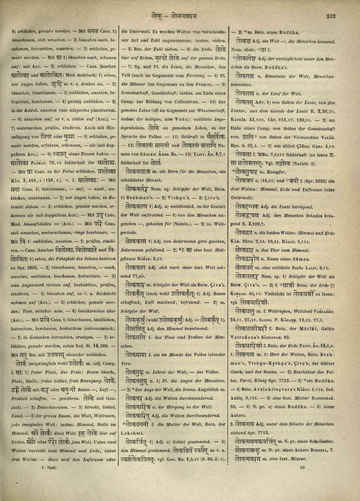
Böhtlingk 1879 substantive masculine
Original text · German · substantive masculine
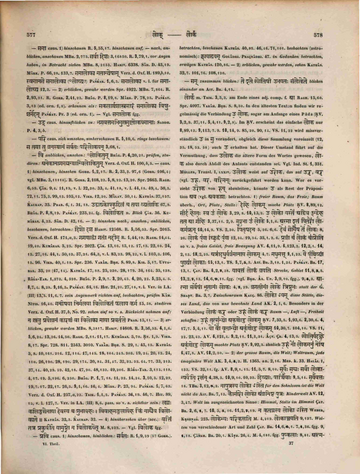
loká (ursprünglich wohl uloká) m. (adj. Comp. f. ā) — 1〉 freier Platz, das Freie; Raum überh., Platz, Stelle; freies Gebiet, freie Bewegung. lokáṃ urúṃ lokáṃ mit kar oder anu-nī Raum —, Luft —, Freiheit schaffen, — gewähren. loke mit Gen. statt. — 2〉 Zwischenraum. — 3〉 Strecke, Gebiet, Land. — 4〉 der grosse Raum, die Welt, Weltraum, jede imaginäre Welt; insbes. Himmel, Stelle im Himmel. ayáṃ lokáḥ diese Welt. iha loke hier auf Erden. asaú oder páro loká jene Welt. Unter zwei Welten versteht man Himmel und Erde, unter drei Welten — diese und den Luftraum oder [Page5-233-b] die Unterwelt. Es werden Welten von verschiedener Art und Zahl angenommen; insbes. sieben. — 5〉 Bez. der Zahl sieben. — 6〉 die Erde. loke hier auf Erden, kṛtsne loke auf der ganzen Erde. — 7〉 Sg. und Pl. die Leute, die Menschen, das Volk (auch im Gegensatz zum Fürsten) — 8〉 Pl. die Männer (im Gegensatz zu den Frauen.) — 9〉 Gemeinschaft, Gesellschaft; insbes. am Ende eines Comp. zur Bildung von Collectiven. — 10〉 das gemeine Leben (oft im Gegensatz zur Wissenschaft, insbes. der heiligen, dem Veda); weltliche Angelegenheiten. loke im gemeinen Leben, in der Sprache des Volkes. — 11〉 Sehkraft in cákṣurloka. — 12〉 lokānāṃ sāmanī und lokānāṃ vratāni Namen von Sāman ĀRṢ. BR. — 13〉 TAITT. ĀR. 6,7 fehlerhaft für logá.
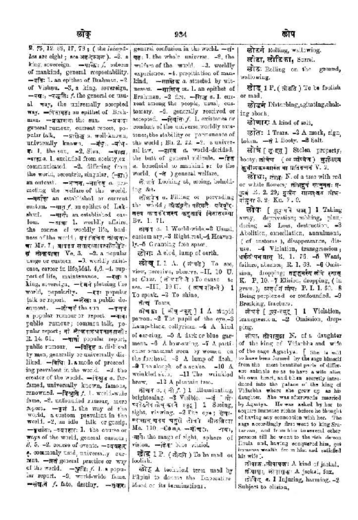
Apte 1890 substantive masculine
Original text · English · substantive masculine
lokaḥ [lokyate'sau lok-ghañ] 1 The world, a division of the universe; (roughly speaking there are three lokas svarga, pṛthvī and pātāla, but according to fuller classification the lokas are fourteen, seven higher regions rising from the earth one above the other, i. e. bhūrloka, bhuvarloka, svarloka, maharloka, janarloka, taparloka, and satyaloka or brahmaloka; and seven lower regions, descending from the earth one below the other; i. e. atala, vitala, sutala, rasātala, talātala, mahātala and pātāla). 2 The earth, terrestrial world (bhūloka); ihaloke in this world (opp. paratra). 3 The human race, mankind, men, as in lokātiga, lokottara &c. q. v. 4 The people or subjects (opp. the king); svasukhanirabhilāṣaḥ khidyase lokahetoḥ Ś. 5. 7; R. 4. 8. 5 A collection, group, class, company; ([Page 0933-b]) ākṛṣṭalīlān naralokapālān R. 6. 1; or śaśāma tena kṣitipālalokaḥ R. 7. 3. 6 A region, tract, district, province. 7 Common life, ordinary practice (of the world) lokavattu līlākaivalyaṃ Br. Sūt. II. 1. 33; yathā loke kasyacidāptaiṣaṇasya rājñaḥ &c. Ś. B. (and diverse other places of the same work). 8 Common or worldly usage (opp. Vedic usage or idiom); vedoktā vaidikāḥ śabdāḥ siddhā lokācca laukikāḥ, priyataddhitā dākṣiṇātyā yathā loke vede ceti prayoktavye yathā laukikavaidikeṣviti prayuṃjate Mbh.; (and in diverse other places); ato'smi loke vede ca prathitaḥ puruṣottamaḥ Bg. 15. 18. 9 Sight, looking. 10 The number ‘seven’, or ‘fourteen’. 11 Ved. Open space; space, room. (In compounds loka is often translated by ‘universally’, ‘generally’, ‘popularly’; as lokavijñāta; so ˚vidviṣṭa). Comp. — akṣaḥ space, sky. — atiga a. extraordinary, supernatural. — atiśaya a. superior to the world, extraordinary. — adhika a. extraordinary, uncommon; sarvaṃ paṃḍitarājarājitilakenākāri lokādhikaṃ Bv. 4. 44; Ki. 2. 47. — adhipaḥ 1 a king. 2 a god or deity. — adhipatiḥ a lord of the world. — anurāgaḥ ‘love of mankind’, universal love, general benevolenee, philanthropy. — aṃtaraṃ ‘another world’, the next world, future life; R. 1. 69; R. 6. 45; lokāṃtaraṃ gam. prāp &c. ‘to die.’ — apavādaḥ public scandal, popular censure; lokāpavādo balavānmato me R. 14. 40. — abhibhāvin a. 1 overcoming the world. 2 pervading the whole world (as light). — abhyudayaḥ public weal or welfare. — ayanaḥ N. of Nārāyaṇa. — alokaḥ N. of a mythical mountain that encircles the earth and is situated beyond the sea of fresh water which surrounds the last of the seven continents; beyond lokāloka there is complete darkness, and to this side of it there is light; it thus divides the visible world from the regions of darkness; prakāśaścāprakāśaśca lokāloka ivācalaḥ R. 1. 68; lokālokavyāhataṃ gharmarāśeḥ śālīnaṃ vā dhāma nālaṃ prasartuṃ Śi. 16. 83; Mv. 5. 10, Mv. 5. 45; (for further explanation see Dr. Bhāṇḍārkar's note on l. 79 of Māl. 10th Act.). — (kau) the ([Page 0933-c]) visible and the invisible world. — ācāraḥ common practice, popular or general custom, ways of the world; api śāstreṣu kuśalā lokācāravivarjitāḥ Pt. 5. 43. — ātman m. the soul of the universe. — ādiḥ 1 the beginning of the world. 2 the creator of the world. — āyata a. atheistical, materialistic. — (taḥ) a materialist, an atheist, a follower of Cārvāka. — (taṃ) materialism, atheism; (for some account see the first chapter of the Sarvadarśanasamgraha). — āyatikaḥ an atheist, a materialist. — īśaḥ 1 a king (lord of the world). 2 Brahman. 3 quick-silver. — uktiḥ f. 1 a proverb, popular saying; Pt. 1. 371. 2 common talk, public opinion. — uttara a. extraordinary, uncommon, unusual; lokottarā ca kṛtiḥ Bv. 1. 69, Bv. 1. 70; U. 2. 7. — (raḥ) a king. — ekabaṃdhuḥ an epithet of Śākyamuni. — eṣaṇā desire for heaven. — kaṃṭakaḥ 1 a troublesome or wicked man, the curse of mankind. 2 an epithet of Rāvaṇa; see kaṃṭaka. — kathā a popular legend. — kartṛ, -kṛt m. the creator of the world. — kalpa a. 1 resembling the world. 2 regarded by the world. — (lpaḥ) a period or age of the world. — kāṃta a. liked by the people, popular; V. 5. 21. — kāraṇakāraṇaḥ an epithet of Śiva. — gatiḥ f. actions of men. — gāthā a song handed down among people. — cakṣus n. the sun. — cāritraṃ the ways of the world. — jananī an epithet of Lakṣmī. — jit m. 1 an epithet of Buddha. 2 any conqueror of the world. 3 a sage. — jña a. knowing the world. — jyeṣṭhaḥ an epithet of Buddha. — tattvaṃ knowledge of mankind. — taṃtraṃ course of the world. — tuṣāraḥ camphor. — trayaṃ, -trayī the three worlds taken collectively; utkhātalokatrayaṃkaṭake'pi R. 14. 73. — dvāraṃ the gate of heaven. — dhānuḥ a particular division of the world. — dhātṛ m. an epithet of Śiva. — nāthaḥ 1 Brahman. 2 Viṣṇu. 3 Śiva. 4 a king, sovereign. 5 a Buddha. — netṛ m. an epithet of Śiva. — paḥ, -pālaḥ 1 a regent or guardian of a quarter of the world; lalitābhinayaṃ tamadya bhartā marutāṃ draṣṭumanāḥ salokapālaḥ V. 2. 18; ([Page 0934-a]) R. 2. 75, R. 12. 89, R. 17. 78; (the lokapālas are eight; see aṣṭadikpāla). 2 a king, sovereign. — paktiḥ f. esteem of mankind, general respectability. — patiḥ 1 an epithet of Brahman. 2 of Viṣṇu. 3 a king, sovereign. — pathaḥ, -paddhatiḥ f. the general or usual way, the universally accepted way. — pitāmahaḥ an epithet of Brahman. — prakāśanaḥ the sun. — pravādaḥ general rumour, current report, popular talk. — prasiddha a. well-known, universally known. — baṃdhuḥ, — bāṃdhavaḥ 1 the sun. 2 Śiva. — bāhya, — vāhya a. 1 excluded from society, excommunicated. 2 differing from the world, eccentric, singular. — (hyaḥ) an outcast. — bhāvana, -bhāvin a. promoting the welfare of the world. — maryādā an established or current custom. — mātṛ f. an epithet of Lakṣmī. — mārgaḥ an established cuslom. — yātrā 1 worldly affairs, the course of worldly life, business of the world; evaṃ kileyaṃ lokayātrā Mv. 7; yāvadayaṃ saṃsārastāvatprasiddhaiveyaṃ lokayātrā Ve. 3. 2 a popular usage or custom. 3 worldly existence, career in life; Māl. 4, Māl. 6. 4 support of life, maintenance. — rakṣaḥ a king, sovereign. — raṃjanaṃ pleasing the world, popularity. — ravaḥ popular talk or report. — lekhaḥ a public document. — locanaṃ the sun. — vacanaṃ a popular rumour or report. — vādaḥ public rumour; common talk, popular report; māṃ lokavādaśravaṇādahāsīḥ R. 14. 61. — vārtā popular report, public rumour. — vidviṣṭa a. disliked by men, generally or universally disliked. — vidhiḥ 1 a mode of proceeding prevalent in the world. 2 the creator of the world. — viśrutaṃ a. farfamed, universally known, famous, renowned. — viśruti f. 1 world-wide fame. 2 unfounded rumour, mere report. — vṛttaṃ 1 the way of the world, a custom prevalent in the world. 2 an idle talk or gossip. — vṛttāṃtaḥ, -vyavahāraḥ 1 the course or ways of the world, general custom; Ś. 5. 2 course of events. — vyayahāra a. commonly used, universally current. — vrataṃ general practice or way of the world. — śrutiḥ f. 1 a popular report. 2 world-wide fame. — saṃsṛti f. fate, destiny. — saṃkaraḥ ([Page 0934-b]) general confusion in the world. — saṃgrahaḥ 1 the whole universe. 2 the welfare of the world. 3 worldly experience. 4 propitiation of mankind. — sākṣika a. attested by witnesses. — sākṣin m. 1 an epithet of Brahman. 2 fire. — siddha a. 1 current among the people, usual, customary. 2 generally received or accepted. — sthitiḥ f. 1 existence or conduct of the universe, worldly existence; the stability or permanence of the world; Bh. 2. 22. 2 a universal law. — hāsya a. world-derided, the butt of general ridicule. — hita a. beneficial to mankind or to the world. — (taṃ) general welfare.

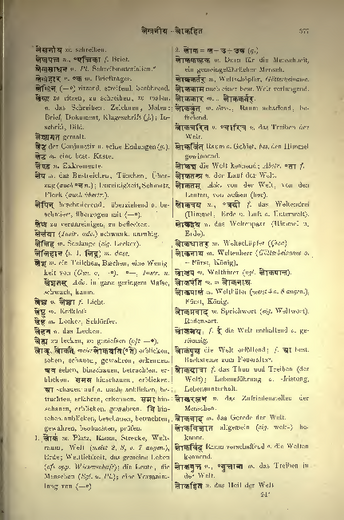
Cappeller 1887 substantive masculine · Word type unspecified
Original text · German · substantive masculine
1. loká m. Platz, Raum, Strecke, Weltraum, Welt (meist 2, 3, o. 7 angen.), Erde; Weltlichkeit, das gemeine Leben (oft opp. Wissenschaft); die Leute, die Menschen (Sgl. u. Pl.); eine Versammlung von (—˚).
Original text · German · Word type unspecified
2. loka = la +u +uka (g.).
Original text · German · Word type unspecified
2. loka = la +uka (g.).
Burnouf 1866 substantive masculine
Original text · French · substantive masculine
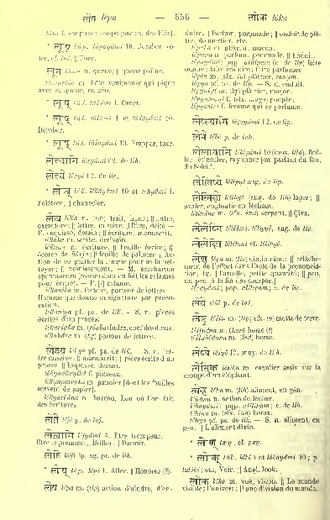
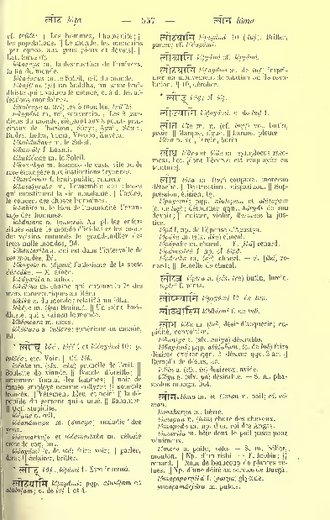
loka loka m. vue, vision. Le monde visible; l'univers; une division du monde, [Page557-1] cf. trilokī. Les hommes, l'humanité; les populations. Le monde, les mondains [par oppos. aux gens pieux et dévots]. Lat. locus (?). lokakṣaya m. la destruction de l'univers, la fin du monde. lokacakṣus m. le Soleil, œil du monde. lokajit m. (ji) un buddha, un saint buddhiste qui a vaincu le monde, c-à-d. les affections mondaines. lokatraya n. (tri) les 3 mondes, trilokī. lokapāla m. roi, souverain. Les 8 gardiens du monde, siégeant aux 8 points principaux de l'horizon, Sūrya, Agni, Soma, Rudra, Indra, Yama, Varuṇa, Kuvera. lokabāndhava m. le Soleil. lokamātṛ f. Lakṣmī. lokalocana m. le Soleil. lokavāhya m. homme de caste vile ou de race étrangère aux institutions âryennes. lokaviśruti f. bruit public, rumeur. lokasaṅgraha m. l'ensemble des choses qui constituent la vie mondaine; l'ordre, le concert des choses humaines. lokahita n. le bien de l'humanité, l'avantage des hommes. lokāntara n. (antara). Au pl. les enfers situés entre le monde d'ici-bas et les mondes voisins nommés le grand-millier des trois mille mondes, Bd. lokāntarika a. qui est dans l'intervalle de ces mondes, Bd. lokāyata n. (āyata) l'athéisme de la secte cārvāka. — M. athée. lokāyatika a. athée. lokāloka m. chaîne qui entoure la 7ᵉ des mers concentriques au Meru. lokika a. du monde; relatif à un loka. lokeśa m. (īśa) Brahmā. Un saint buddhiste, qui a vaincu le monde. lokeśvara m. mms. lokottara a. (uttara) supérieur au monde, Bd.
Derived words
Occurrences in source texts (30)
DYS 5 occurrences
HP 1 occurrence
IVU 1 occurrence
MAN 1 occurrence
SiSa 14 occurrences
8 more source pages
SS 1 occurrence
SVU 7 occurrences
SVU 3.13-3.18: In the Heart and in the World 2 occurrences
Direct occurrences
Continue with AYI Free
Image source: AYI archive.