
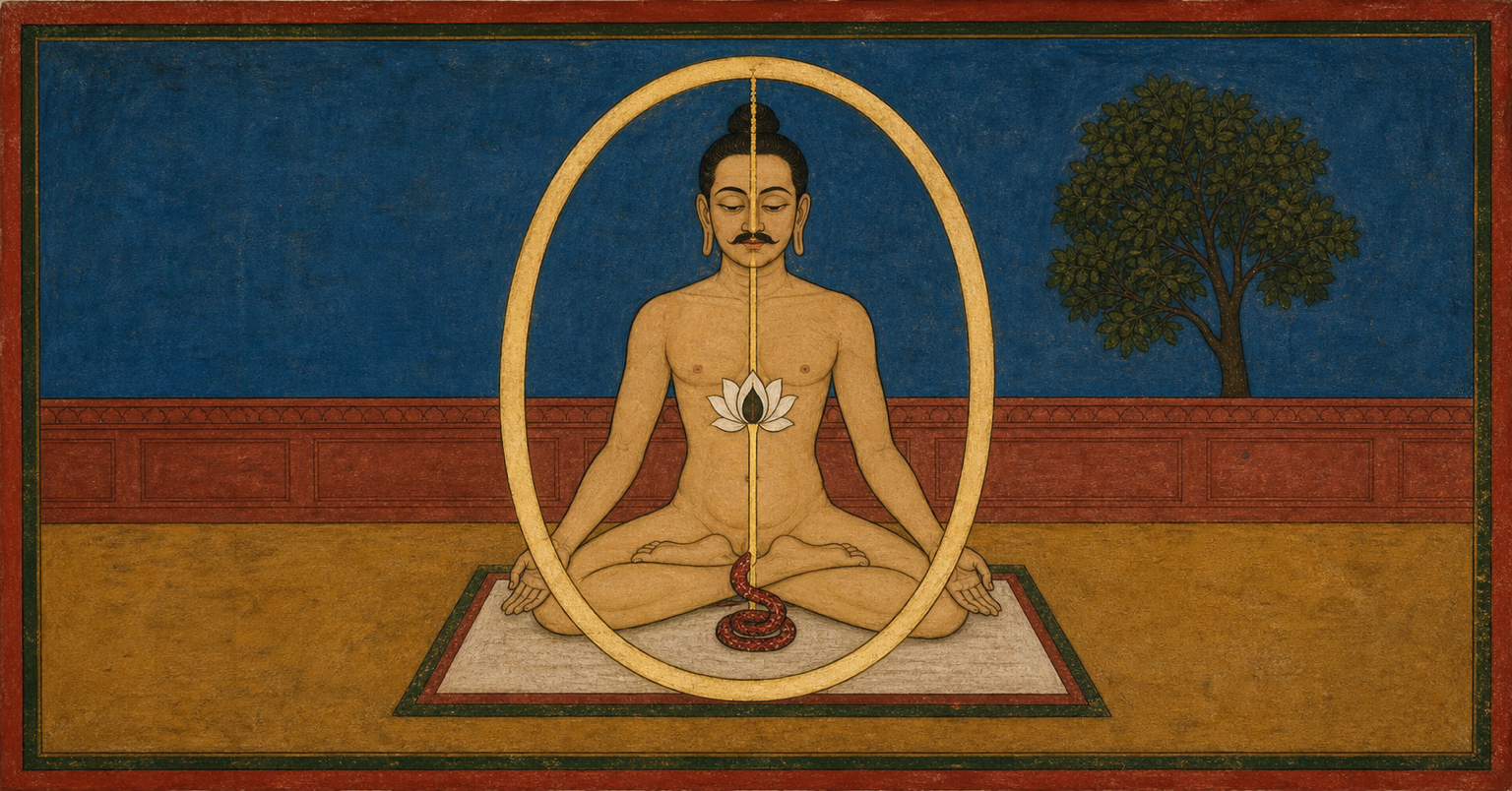
Illustration for the Haṭha Pradīpikā section “HP 2.72-2.78: Kevala-Kumbhaka”.

Haṭha Pradīpikā 2.72-2.78: Sahita and Kevala Kumbhaka

Prāṇāyāma is divided into Reca, Pūraka, and Kumbhaka; Kevala leads to Rājayoga and opens the gate through Kuṇḍalinī.

Dr. Ronald Steiner Dr. Ronald Steiner
Haṭha Pradīpikā 2.72
प्राणायामस्त्रिधा प्रोक्तो रेचपूरककुम्भकैः |
prāṇāyāmas tri-dhā prokto; reca-pūraka-kumbhakaiḥ | Analysis ▾ Analysis ▴
prāṇāyāmaḥ
nominative singular
substantive masculine
prāṇāyāma, breath regulation
tri
dvigu-compound
numeral
three
dhā
suffix
form, manner
proktaḥ
nominative singular masculine past participle passive
previx
verbal root
said, taught
reca
dvandva-compound
substantive masculine
exhalation
pūraka
dvandva-compound
substantive masculine
inhalation
kumbhakaiḥ
instrumental case plural
substantive masculine
retentions, kumbhakas
सहितः केवलश्चेति कुम्भको द्विविधो मतः ||72||
sahitaḥ kevalaś ceti; kumbhako dvi-vidho mataḥ ||72|| Analysis ▾ Analysis ▴
sahitaḥ
nominative singular masculine
adjective
accompanied, joined
kevalaḥ
nominative singular masculine
adjective
sole, absolute
ca
particle
and
iti
particle
thus
kumbhakaḥ
nominative singular
substantive masculine
kumbhaka, breath retention
dvi
dvigu-compound
numeral
two
vidhaḥ
nominative singular masculine
adjective
kinds
mataḥ
nominative singular masculine past participle passive
verbal root
regarded, understood
Metre: Anuṣṭubh
Breath control (prāṇāyāmaḥ | nom sg) is said (proktaḥ | nom sg m ppp) to be threefold (tridhā), through exhalation, inhalation, and retention (reca-pūraka-kumbhakaiḥ | ins pl); retention (kumbhakaḥ | nom sg) is considered (mataḥ | nom sg m ppp) twofold (dvi-vidhaḥ | nom sg m), accompanied (sahitaḥ | nom sg m) and unaccompanied (kevalaḥ | nom sg m), and so it is said (ceti).
Dr. Ronald Steiner - 2026 - historically literal
Prāṇāyāma consists of exhalation, inhalation, and breath retention. Retention itself is divided into two types: Sahita, which is connected with inhalation and exhalation, and Kevala, pure retention.
Dr. Ronald Steiner - 2026 - modern transfer

Brahmānanda offers two overlapping classifications. Prāṇāyāma is threefold according to Recaka, Pūraka, and Kumbhaka; Kumbhaka in turn is either Sahita or Kevala. Sahita itself has one form beginning with exhalation and another beginning with inhalation. He assigns the eight Kumbhakas described earlier to the inhalation-led Sahita form.

Brahmānanda's Jyotsnā - 19th c.
Considering Pûraka (Filling), Rechaka (expelling) and Kumbhaka (confining), Prâṇâyâma is of three kinds, but considering it accompanied by Pûraka and Rechaka, and without these, it is of two kinds only, i.e., Sahita (with) and Kevala (alone).
Pancham Sinh - 1915
There are three kinds of Pranayama: Rechaka Pranayama, Puraka Pranayama and Kumbhaka Pranayama. Kumbhaka is also of two kinds. Sahita and Kevala.
Srinivasa Iyangar - 1893
Vom Prâņâyâma wird gesagt, dass er aus drei Theilen bestehe: Recaka, Pûraka und Kumbhaka. Der Kumbhaka soll aus zwei Klassen bestehen, nämlich: Sahita und Kevala. (s. Einl. p. ΧΙΧ.)
Hermann Walter - 1893
Haṭha Pradīpikā 2.73
रेच्य चापूर्य यः कार्यः स वै सहितकुम्भकः |
recya cāpūrya yaḥ kāryaḥ; sa vai sahita-kumbhakaḥ | Analysis ▾ Analysis ▴
recya
absolutus
verbal root
having exhaled
ca
particle
and
āpūrya
absolutus
previx
verbal root
having inhaled, filled
yaḥ
nominative singular masculine
pronoun rel
which, that
kāryaḥ
nominative singular masculine future participle passive
verbal root
to be performed
saḥ
nominative singular masculine
pronoun dem
that, this
vai
particle
indeed
sahita
karmadhāraya-compound
adjective
accompanied, joined
kumbhakaḥ
nominative singular
substantive masculine
kumbhaka, breath retention
यावत्केवलसिद्धिः स्यात् तावत्सहितमभ्यसेत् ||73||
yāvat kevala-siddhiḥ syāt; tāvat sahitam abhyaset ||73|| Analysis ▾ Analysis ▴
yāvat
adverb
until
kevala
tatpuruṣa-compound genitive
adjective
sole, pure
siddhiḥ
nominative singular
substantive feminine
perfection, success
syāt
3rd person singular aktive optative
verbal root
becomes, arises
tāvat
adverb
so long
sahitam
accusative singular masculine
adjective
accompanied kumbhaka
abhyaset
3rd person singular aktive optative
verbal root
he should practise
Metre: Anuṣṭubh
The breath retention that is to be performed (yaḥ kāryaḥ | nom sg m pfp) after exhaling (recya | abs) and (ca) inhaling (āpūrya | abs) is indeed this (sa vai), the accompanied retention (sahita-kumbhakaḥ | nom sg). As long as (yāvat) perfection of Kevala (kevala-siddhiḥ | nom sg) has not arisen (syāt | 3p sg act opt), so long (tāvat) one should practise (abhyaset | 3p sg act opt) the accompanied retention (sahitam | acc sg m).
Dr. Ronald Steiner - 2026 - historically literal
Retention that remains connected with exhalation and inhalation is called Sahita. It is practised until Kevala, independent retention, becomes possible.
Dr. Ronald Steiner - 2026 - modern transfer

Sahita is practised until Prāṇa has opened Suṣumṇā and particular inner sounds become audible there; Brahmānanda takes this as the sign that Kevala Kumbhaka has arisen. Ten or twenty Sahita rounds are then retained each day, while the main count up to 80 increasingly consists of Kevala Kumbhakas.

Brahmānanda's Jyotsnā - 19th c.
recya cāpūrya yaḥ kāryaḥ sa vai sahitakumbhakaḥ MBHDL2026 ] om. NS1882

yāvat kevalasiddhiḥ syāt tāvat sahitam abhyaset MBHDL2026 ] transp. NS1882 ante HP 2.74a
Critical Apparatus
Exercise in Sahita should be continued till success in Kevala is gained. This latter is simply confining the air with ease, without Rechaka and Pûraka.
Pancham Sinh - 1915
As long as one does not get to Kevala Kumbhaka that consists in restraining the breath without Puraka and Rechaka, he should practise Sahita.
Srinivasa Iyangar - 1893
Man übe Sahita, bis Kevala geglückt ist, welcher darin besteht, dass man leicht den Athem hemmen kann, ohne Berücksichtigung von Recaka und Pûraka.
Hermann Walter - 1893
Haṭha Pradīpikā 2.74
रेचकं पूरकं मुक्त्वा सुखं यद्वायुधारणम् |
recakaṃ pūrakaṃ muktvā; sukhaṃ yad vāyu-dhāraṇam | Analysis ▾ Analysis ▴
recakam
accusative singular
substantive masculine
exhalation
pūrakam
accusative singular
substantive masculine
inhalation
muktvā
absolutus
verbal root
having relinquished, abandoned
sukham
nominative singular neuter
adjective
easy, comfortable
yat
nominative singular neuter
pronoun rel
which
vāyu
tatpuruṣa-compound genitive
substantive masculine
breath, wind
dhāraṇam
nominative singular
substantive neuter
holding, sustaining
प्राणायामो ऽयमित्युक्तः स वै केवलकुम्भकः ||74||
prāṇāyāmo 'yam ity uktaḥ; sa vai kevala-kumbhakaḥ ||74|| Analysis ▾ Analysis ▴
prāṇāyāmaḥ
nominative singular
substantive masculine
prāṇāyāma
ayam
nominative singular masculine
pronoun dem
this
iti
particle
thus
uktaḥ
nominative singular masculine past participle passive
verbal root
said, called
saḥ
nominative singular masculine
pronoun dem
that
vai
particle
indeed
kevala
karmadhāraya-compound
adjective
sole, pure
kumbhakaḥ
nominative singular
substantive masculine
kumbhaka
Metre: Anuṣṭubh
Having relinquished (muktvā | abs) exhalation (recakaṃ | acc sg) and inhalation (pūrakaṃ | acc sg), the comfortable holding of the breath (sukhaṃ vāyu-dhāraṇam | nom sg) that [then arises] (yad | nom sg n) is called (uktaḥ | nom sg m ppp) this breath control (ayam prāṇāyāmaḥ | nom sg), thus (iti); it (saḥ | nom sg m) is indeed (vai) Kevala Kumbhaka (kevala-kumbhakaḥ | nom sg).
Dr. Ronald Steiner - 2026 - historically literal
When the breath is held comfortably without deliberate inhalation or exhalation, the text speaks of Prāṇāyāma in its fullest sense: Kevala Kumbhaka.
Dr. Ronald Steiner - 2026 - modern transfer

For Brahmānanda, Kevala Kumbhaka is not an especially long, deliberate retention after inhalation or exhalation. It arises when Recaka and Pūraka fall away entirely and the breath becomes still without effort. This fundamentally distinguishes it from the two preparatory Sahita forms.

Brahmānanda's Jyotsnā - 19th c.
recakaṃ pūrakaṃ muktvā sukhaṃ yad vāyudhāraṇam prāṇāyāmo’yam ity uktaḥ sa vai kevalakumbhakaḥ MBHDL2026 ] transp. NS1882 post HP 2.73b
Critical Apparatus
In the practice of Kevala Prâṇâyâma when it can be performed successfully without Rechaka and Pûraka, then it is called Kevala Kumbhaka.
Pancham Sinh - 1915
This sort of Pranayama is called Kevala Kumbhaka. When this Kumbhaka has been mastered without any Rechaka or Puraka, there is nothing unattainable by him in the three worlds. He can restrain his breath as long as he likes through this Kumbhaka.
Srinivasa Iyangar - 1893
Dieser Kevalakumbhaka wird Prâņâyâma genannt, wenn Kumbhaka allein d. h. ohne Berücksichtigung des besonderen Recaka oder Pûraka, ausgeführt wird.
Hermann Walter - 1893
Haṭha Pradīpikā 2.75
केवले कुम्भके सिद्धे रेचपूरकवर्जिते |
kevale kumbhake siddhe; reca-pūraka-varjite | Analysis ▾ Analysis ▴
kevale
lokative absolutus singular masculine
adjective
in pure, sole
kumbhake
lokative absolutus singular
substantive masculine
kumbhaka
siddhe
lokative absolutus singular masculine past participle passive
verbal root
when perfected
reca
dvandva-compound
substantive masculine
exhalation
pūraka
dvandva-compound
substantive masculine
inhalation
varjite
lokative absolutus singular masculine past participle passive
verbal root
free from, without
न तस्य दुर्लभं किंचित् त्रिषु लोकेषु विद्यते ||75||
na tasya durlabhaṃ kiṃcit; triṣu lokeṣu vidyate ||75|| Analysis ▾ Analysis ▴
na
particle
not
tasya
genitive singular masculine
pronoun dem
for him
durlabham
nominative singular neuter
adjective
difficult to attain
kiṃcit
nominative singular neuter
pronoun quant
anything
triṣu
lokative plural
numeral
in the three
lokeṣu
lokative plural
substantive masculine
worlds
vidyate
3rd person singular medial present
verbal root
is present, exists
Metre: Anuṣṭubh
When unaccompanied retention (kevale kumbhake | loc absl sg) has been mastered (siddhe | loc absl sg m ppp), free from exhalation and inhalation (reca-pūraka-varjite | loc absl sg m ppp), then nothing (kiṃcit) difficult to attain (durlabham | nom sg n) in the three worlds (triṣu lokeṣu | loc pl) exists (vidyate | 3p sg med pres) for him (tasya | gen sg).
Dr. Ronald Steiner - 2026 - historically literal
Once Kevala Kumbhaka succeeds, nothing is considered unattainable. In this way, the text describes the supreme efficacy of pure breath retention.
Dr. Ronald Steiner - 2026 - modern transfer
kevale kumbhake siddhe recapūrakavarjite na tasya durlabhaṃ kiṃcit triṣu lokeṣu vidyate MBHDL2026 ] transp. NS1882 post HP 2.74b
Critical Apparatus
There is nothing in the three worlds which may be difficult to obtain for him who is able to keep the air confined according to pleasure, by means of Kevala Kumbhaka.
Pancham Sinh - 1915
Ist Einer durch den Kevalakumbhaka fähig geworden, nach Belieben den Athem anzuhalten, so gibt es für ihn nichts schwer Erreichbares in den drei Welten.
Hermann Walter - 1893
Haṭha Pradīpikā 2.76
शक्तः केवलकुम्भेन यथेष्टं वायुधारणम् |
śaktaḥ kevala-kumbhena; yatheṣṭaṃ vāyu-dhāraṇam | Analysis ▾ Analysis ▴
śaktaḥ
nominative singular masculine
adjective
capable, able
kevala
tatpuruṣa-compound instrumental case
adjective
pure, sole
kumbhena
instrumental case singular
substantive masculine
through Kevala Kumbhaka
yatheṣṭam
at will
vāyu
tatpuruṣa-compound genitive
substantive masculine
breath
dhāraṇam
accusative singular
substantive neuter
retention
राजयोगपदं चैव लभते नात्र संशयः ||76||
rāja-yoga-padaṃ caiva; labhate nātra saṃśayaḥ ||76|| Analysis ▾ Analysis ▴
rāja
tatpuruṣa-compound genitive
substantive masculine
royal, rāja
yoga
tatpuruṣa-compound genitive
substantive masculine
yoga
padam
accusative singular
substantive neuter
state, stage
ca
particle
and
eva
particle
indeed
labhate
3rd person singular medial present
verbal root
he attains
na
particle
not
atra
adverb
here
saṃśayaḥ
nominative singular
substantive masculine
doubt
Metre: Anuṣṭubh
One who is capable (śaktaḥ | nom sg m), through Kevala Kumbhaka (kevala-kumbhena | ins sg), of holding the breath (vāyu-dhāraṇam | acc sg) at will (yatheṣṭam), also indeed (caiva) attains (labhate | 3p sg med pres) the state of Rājayoga (rāja-yoga-padam | acc sg); here (atra) there is no (na) doubt (saṃśayaḥ | nom sg).
Dr. Ronald Steiner - 2026 - historically literal
One who masters Kevala Kumbhaka can retain the breath at will and reaches the state of Rājayoga. The text states explicitly that there is no doubt about this.
Dr. Ronald Steiner - 2026 - modern transfer
śaktaḥ kevalakumbhena yatheṣṭaṃ vāyudhāraṇam rājayogapadaṃ caiva labhate nātra saṃśayaḥ MBHDL2026 ] transp. NS1882 post HP 2.75b
Critical Apparatus
He obtains the position of Râja Yoga undoubtedly. Kuṇḍalinî awakens by Kumbhaka, and by its awakening, Suṣumnâ becomes free from impurities.
Pancham Sinh - 1915
He obtains the stage of Raja-yoga. Through this Kumbhaka, the Kundalini is roused, and when it is so-roused the Sushumna is free of all obstacles, and he has attained perfection in Hatha-yoga.
Srinivasa Iyangar - 1893
Er gelangt sicher zum Ziel des Râjayoga. Durch den Kumbhaka wird die Kundali geweckt, und in Folge des Erwachens der Kundalî wird die Sushumna von Hindernissen befreit und Hathayoga mit Erfolg gekrönt.
Hermann Walter - 1893
Haṭha Pradīpikā 2.77
हठं विना राजयोगो राजयोगं विना हठः |
haṭhaṃ vinā, rāja-yogo; rāja-yogaṃ vinā haṭhaḥ | Analysis ▾ Analysis ▴
haṭham
accusative singular
substantive masculine
Haṭha
vinā
adverb
without
rāja
tatpuruṣa-compound genitive
substantive masculine
royal, rāja
yogaḥ
nominative singular
substantive masculine
yoga
rāja
tatpuruṣa-compound genitive
substantive masculine
royal, rāja
yogam
accusative singular
substantive masculine
yoga
vinā
adverb
without
haṭhaḥ
nominative singular
substantive masculine
Haṭha
न सिध्यति ततो युग्मम् आ निष्पत्तेः समभ्यसेत् ||77||
na sidhyati tato yugmam; ā niṣpatteḥ samabhyaset ||77|| Analysis ▾ Analysis ▴
na
particle
not
sidhyati
3rd person singular aktive present
verbal root
succeeds, is perfected
tataḥ
adverb
therefore
yugmam
accusative singular
substantive neuter
the pair, both together
ā
particle
until
niṣpatteḥ
ablative singular
substantive feminine
perfection, completion
samabhyaset
3rd person singular aktive optative
previx
verbal root
he should practise
Metre: Anuṣṭubh
Rājayoga (rāja-yogaḥ | nom sg) does not succeed (na sidhyati | 3p sg act pres) without Haṭha (haṭhaṃ vinā | acc sg), and Haṭha (haṭhaḥ | nom sg) [does not succeed] without Rājayoga (rāja-yogaṃ vinā | acc sg); therefore (tataḥ), one should practise (samabhyaset | 3p sg act opt) both together (yugmam | acc sg) until completion (ā niṣpatteḥ | abl sg).
Dr. Ronald Steiner - 2026 - historically literal
Haṭha and Rājayoga belong together. Breath, body, and inner absorption should be practised together until perfection is reached.
Dr. Ronald Steiner - 2026 - modern transfer

For Brahmānanda, Haṭha and Rājayoga are mutually related as means and support for the goal. By Rājayoga practice, he means not only an abstract final state, but also the procedures described in the fourth chapter, such as Unmanī and Śāmbhavī, as well as various Vedāntic systems of Samādhi. The two paths are therefore continued together until the consummation of Rājayoga.

Brahmānanda's Jyotsnā - 19th c.
No success in Râja Yoga without Haṭha Yoga, and no success in Haṭha Yoga without Râja Yoga. One should, therefore, practise both of these well, till complete success is gained.
Pancham Sinh - 1915
One cannot obtain perfection in Rajayoga without Hatha-yoga and vice versa. So he should practise both till he attains perfection in Raja-yoga.
Srinivasa Iyangar - 1893
Ohne Hathayoga gelingt der Rajayoga nicht, ohne Râjayoga gelingt der Hathayoga nicht, daher soll man bis zum Ende Beide üben.
Hermann Walter - 1893
Haṭha Pradīpikā 2.78
कुम्भितप्राणरेचान्ते कुर्याच्चित्तं निराश्रयम् |
kumbhita-prāṇa-recānte; kuryāc cittaṃ nirāśrayam | Analysis ▾ Analysis ▴
kumbhita
karmadhāraya-compound past participle passive
verbal root
retained in kumbhaka
prāṇa
tatpuruṣa-compound genitive
substantive masculine
breath, prāṇa
recaka
tatpuruṣa-compound lokative
substantive masculine
exhalation
ante
lokative singular
substantive masculine
at the end
kuryāt
3rd person singular aktive optative
verbal root
he should make
cittam
accusative singular
substantive neuter
the mind
nirāśrayam
accusative singular neuter
adjective
unsupported
एवम् अभ्यासयोगेन राजयोगपदं व्रजेत् ||78||
evam abhyāsa-yogena; rāja-yoga-padaṃ vrajet ||78|| Analysis ▾ Analysis ▴
evam
adverb
thus, in this way
abhyāsa
tatpuruṣa-compound genitive
substantive masculine
practice
yogena
instrumental case singular
substantive masculine
through application
rāja
tatpuruṣa-compound genitive
substantive masculine
royal, rāja
yoga
tatpuruṣa-compound genitive
substantive masculine
yoga
padam
accusative singular
substantive neuter
state, stage
vrajet
3rd person singular aktive optative
verbal root
he should go, reach
Metre: Anuṣṭubh
At the end of exhaling the retained Prāṇa (kumbhita-prāṇa-reca-ante | loc sg), one should make (kuryāt | 3p sg act opt) the mind (cittam | acc sg) supportless (nirāśrayam | acc sg n); through practice in this way (evam abhyāsa-yogena | ins sg), one should reach (vrajet | 3p sg act opt) the state of Rājayoga (rāja-yoga-padam | acc sg).
Dr. Ronald Steiner - 2026 - historically literal
At the end of the exhalation following retention, let the mind rest without external support. This very practice leads into the state of Rājayoga.
Dr. Ronald Steiner - 2026 - modern transfer

Brahmānanda places making the mind “unsupported” after concentration upon an object. First, in Samprajñāta Samādhi, there is a mental form of Brahman; through the highest detachment, even this is subsequently brought to extinction. Rājayoga here therefore means transcending even the subtlest object of meditation.

Brahmānanda's Jyotsnā - 19th c.
kumbhitaprāṇarecānte MBHDL2026 ] kumbhakaprāṇarodhānte NS1882
Critical Apparatus
On the completion of Kumbhaka, the mind should be given rest. By practising in this way one is raised to the position of (succeeds in getting) Râja Yoga.
Pancham Sinh - 1915
At the end of Kumbhaka he should draw off his mind from any and every object whatever. By thus practising regularly he attains the stage of Raja-yoga.
Srinivasa Iyangar - 1893
Hat man das Athemhemmen vermittelst des Kumbhaka vollbracht, so mache man den Geist (von der Sinnenwelt) unabhängig (nirâşraya). Durch eine solche Uebungsmethode erreicht man das Ziel des Râjayoga.
Hermann Walter - 1893

Continue with AYI Free

Illustrations: AI-generated.

Editor

Dr. Ronald Steiner

From Ulm

The "Yoga Doc" - Dr. Ronald Steiner is the founder of the AYI method. This method links traditional Ashtanga Yoga with innovative Yogatherapy and living Philosophy. This forms a practice that is personal for each and... more ›

Messages and ratings
0 messages

Please log in to write a message. Go to login

No messages yet.