
na tasya kāryaṃ, karaṇaṃ ca vidyate; na tat-samaś, cābhyadhikaś ca dṛśyate | Analysis ▾ Analysis ▴
parāsya śaktir, vividhaiva śrūyate; svābhāvikī, jñāna-bala-kriyā ca ||8|| Analysis ▾ Analysis ▴
The Bhāṣya attributed to Śaṅkara denies body, senses, equals, and superiors to the non-dual Lord. His manifold power is inherent in his nature. It appears as knowledge, activity, and strength; his mere presence already orders every process.
Śaṅkarānanda can read kārya and karaṇa either as body and senses or as effect and the causal Avidyā. The natural power of Māyā unfolds knowledge, vital force, and action; powers of relation and impression are added. This manifold character of power requires neither a second Lord nor external aid.
Nārāyaṇa emphasises that the Lord needs neither means nor result and knows no equal. His powers of knowledge, strength, and action are essential to his nature. Several independent lords would produce contradictory acts of creation and dissolution at once; the ordered world therefore indicates a single director.
Vijñānabhagavat grounds the absence of body and senses in non-duality. The manifold natural power is Māyā; knowledge, strength, and action denote all-knowing consciousness, its sāttvic forms of appearance, and governance by mere presence. Power thus remains dependent, without ascribing any real change to the Self.
<5: Gott durchläuft nicht, wie der Mensch, mancherlei Zustände, weil die ganze Mannigfaltigkeit schon in ihm liegt; er braucht nicht, wie der Mensch, durch Erkenntnisorgane und Tatorgane die entsprechenden Wirkungen erst zu vollbringen, weil ihm die Wirkungen des Erkennens und Tuns schon angeboren sind.>
<5: Gott durchläuft nicht, wie der Mensch, mancherlei Zustände, weil die ganze Mannigfaltigkeit schon in ihm liegt; er braucht nicht, wie der Mensch, durch Erkenntnisorgane und Tatorgane die entsprechenden Wirkungen erst zu vollbringen, weil ihm die Wirkungen des Erkennens und Thuns schon angeboren sind.>
<1: “Effect” means, according to Śaṅkara, “body,” and “cause” an “organ.”>
sa kāraṇaṃ, karaṇādhipādhipo; na cāsya kaścij, janitā na cādhipaḥ ||9|| Analysis ▾ Analysis ▴
The Bhāṣya attributed to Śaṅkara denies any begetter, ruler, or inferable higher ground above the Lord. He is himself the cause of all things and Lord of the deities presiding over the senses. A further director would negate his supreme status and the unity of the world's ground.
Śaṅkarānanda understands the negations comprehensively: the Lord has neither a superior ruler nor a begetter or foreign body. He is not the effect of a further cause. As Lord of the sensory deities, he himself directs the powers through which embodied cognition becomes possible.
Nārāyaṇa stresses that the Lord is not inferred through an ordinary inferential mark, because he lies beyond Dharma. The world as an effect does not by itself prove the particular God of any one school; a higher begetter would also lead to a regress. The Lord himself creates and directs the deities of the inner organ.
Vijñānabhagavat grounds the Lord's uncreated character in independence, self-grounding, and non-duality. Neither a begetter nor a lord over the Lord is possible. Whoever knows the highest Lord as one's own Self, determined in this way, can cross the great ocean of Saṃsāra's suffering.
<1: Oder: keinen feinen Leib (liṅgam), weil er der Herr des feinen Leibes (des „Herrn der Sinne“) ist. Vgl. aliṅga Kāṭh. 6,8.>
<1: Oder: keinen feinen Leib (liṅgam), weil er der Herr des feinen Leibes (des „Herrn der Sinne“) ist. Vgl. aliṅga Kāṭh. 6,8.>
<2: If he could be inferred from a sign, there would be no necessity for the Veda to reveal him.>
<3: Karaṇa, instrument, is explained as organ of sense. The lords of such organs would be all living beings, and their lord the true Lord.>
<1: Śaṅkara explains “liṅga” by a sign, on whose cogency his existence could be inferred.>
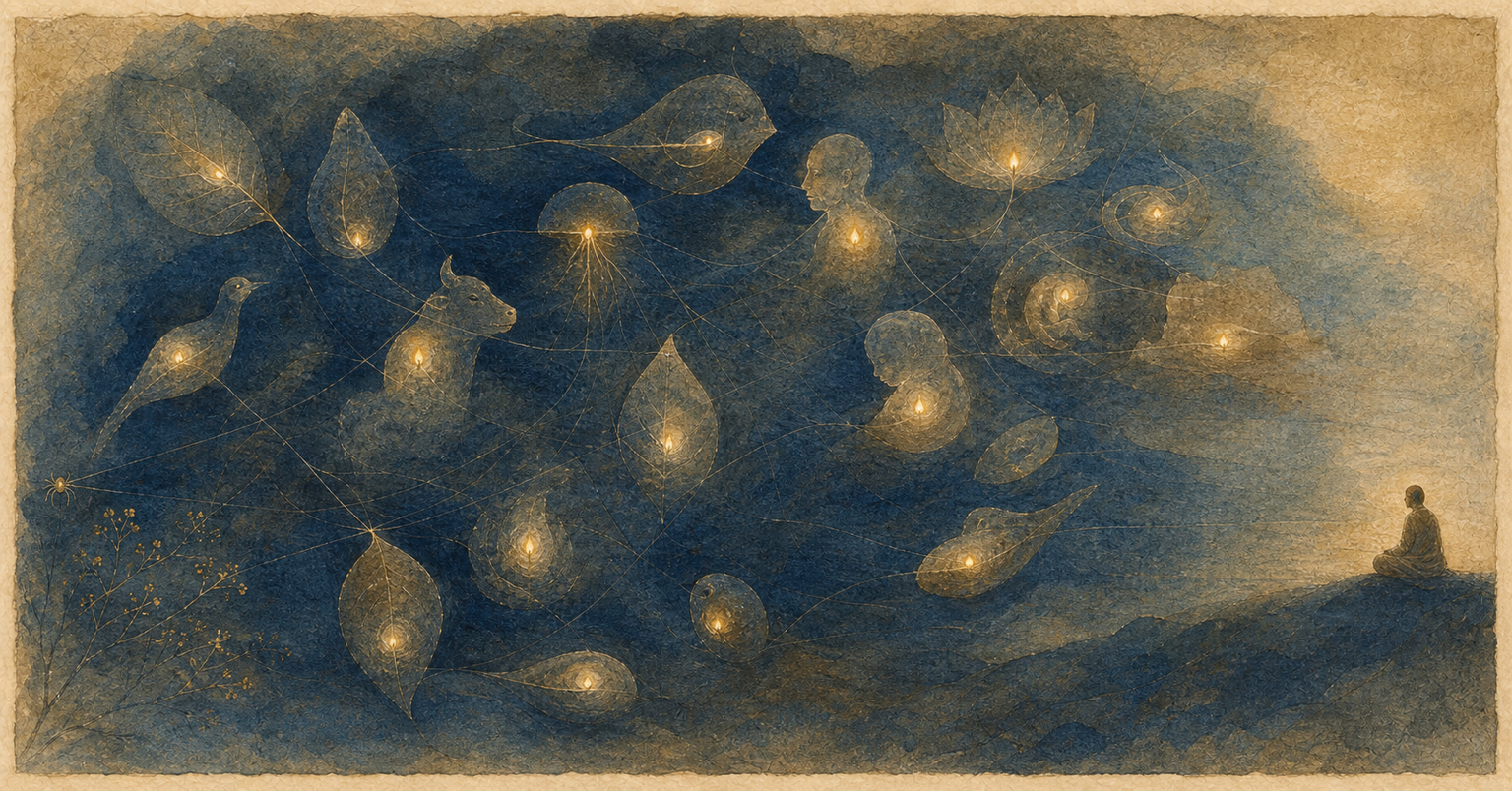
The Bhāṣya attributed to Śaṅkara reads the spider as an image of the Lord, who envelops himself in threads of name, form, and action arising from Pradhāna. The prayer asks him to dissolve this concealment and allow the seeker to enter imperishable, non-dual Brahman.
In the spider, Śaṅkarānanda emphasises creation without personal need. As milk unfolds, the Lord brings forth the threads of appearance from himself and conceals himself with them. The prayer aims at knowledge of Brahman and removal of concealment, not at another finite good.
Nārāyaṇa understands the threads as naturally arisen Vāsanās that conceal one's own Self. Through them, the Lord appears bound in the world he supports. He is asked to release the supplicant from this superimposition and grant the supplicant's own imperishable form as Brahman.
Vijñānabhagavat has the self-luminous Lord conceal his own Self as a dual world through threads of name and form arising from Māyā. He acts freely and without external dependence. The prayer asks either for knowledge of imperishable Brahman or for entry into Brahman through the destruction of Avidyā and its effects.
<4: Besides brahmāpyayam, i.e. brahmaṇy apyayam, ekībhāvam, another reading is brahmāvyayam, i.e. brahma cāvyayaṃ ca.>
karmādhyakṣaḥ, sarva-bhūtādhivāsaḥ; sākṣī cetā, kevalo nir-guṇaś ca ||11|| Analysis ▾ Analysis ▴
The Bhāṣya attributed to Śaṅkara unfolds the one hidden God as the innermost Self of all beings. He oversees karma, dwells in everything, and is the immediate witness. Cetā denotes his animating consciousness, kevala his freedom from Upādhis, and nirguṇa his being untouched by the guṇas.
Śaṅkarānanda has beginninglessness, Avidyā, and the notions of ‘I’ and ‘mine’ conceal the one Lord. As inner overseer of karma, he orders results without becoming an experiencer himself; as witness, he knows immediately. Kevala denies the body, and nirguṇa any real bond to the qualities of the phenomenal world.
Nārāyaṇa calls the one God the pre-eminent one. Karma depends upon him for its fruit; he is therefore Karmādhyakṣa. As witness, he beholds the projected world without intervening distance, while cetā indicates his gathering and consciousness-giving function.
Vijñānabhagavat explains hiddenness through the mutual superimposition of Self and world. The Lord dwells in all beings without changing through their transformations; as witness, he illumines them by mere presence. Self-luminous, independent, and nirguṇa, he only appears to bear powers that in fact belong to Māyā superimposed upon him.
<3: Reading cettā instead of the tautologous cetā, ‘observer.’>
<1: All the MSS. seem to read cetā, not cettā.>
<1: That is to say, thinking without any special thought.>
<2: The triad of qualities, goodness, activity, and darkness.>
tam ātma-sthaṃ, ye 'nupaśyanti dhīrās; teṣāṃ sukhaṃ, śāśvataṃ netareṣām ||12|| Analysis ▾ Analysis ▴
The Bhāṣya attributed to Śaṅkara calls the many Jīvas inactive because action properly takes place within the bodily complex. The one independent Lord turns the subtle seed into multiplicity. The wise recognise him in the Buddhi and attain everlasting happiness hidden from others.
Śaṅkarānanda equates the single seed with Avidyā, from which elements, bodies, and desires proceed. The Lord directs the many who are inert in themselves. After hearing and knowledge, the wise see within: we are Brahman; this insight alone opens the happiness that has always already been present.
Nārāyaṇa describes the Lord as director of inactive, unconscious entities such as space and the elements. The one Self appears in many forms. It does not dwell spatially, but as inner consciousness in the Buddhi; only inward-looking sages experience its everlasting joy of the Self there.
Vijñānabhagavat distinguishes two forms of the single seed: Māyā is the common ground of unconscious multiplicity, while the one reflection of consciousness is the ground of the many Jīvas. The Lord appears within the bodily complex as inner Self. By examining tat and tvam, the wise directly recognise ‘I am this Self’; no other means grants everlasting happiness.
<2: Der Vers ist Kāṭh. 5,12, angepaßt an die Śvet. 5,5. 6,4 herrschende Vorstellung des Īśvara als dessen, der die Werke der (ihrem ursprünglichen, gottgleichen Wesen nach) werklosen Seelen zur Entwicklung bringt.>
<4: This stanza = Kaṭha 5. 12 with slight variation in a and b.>
<2: Der Vers ist Kāṭh. 5,12, angepaßt an die Śvet. 5,5. 6,4 herrschende Vorstellung des Īśvara als dessen, der die Werke der (ihrem ursprünglichen, gottgleichen Wesen nach) werklosen Seelen zur Entwicklung bringt.>
<2: See Kaṭha-upanishad V, 12–15.>
<3: Śaṅkara explains that the acts of living beings are due to their organs, but do not affect the Highest Self, which always remains passive (niṣkriya).>
<1: Nature only, according to the Sānkhya, is active, and not the soul, which is merely witnessing.>
<2: Either the first nature, or, as Śaṅkara explains, the subtle elements of matter.>
nityo nityānāṃ, cetanaś cetanānām; eko bahūnāṃ, yo vidadhāti kāmān | Analysis ▾ Analysis ▴
tat kāraṇaṃ, sāṃkhya-yogādhigamyaṃ; jñātvā devaṃ, mucyate sarva-pāśaiḥ ||13|| Analysis ▾ Analysis ▴
The Bhāṣya attributed to Śaṅkara distinguishes the one who is truly eternal and conscious from the Jīvas, whose eternity and consciousness are only derivative. He allots them experiences conditioned by desire and karma. Their cause is known through Sāṃkhya and Yoga; liberation follows when Avidyā ends.
Śaṅkarānanda interprets Sāṃkhya as self-luminous knowledge and Yoga as insight into identity, eight-limbed practice, or Vedic action. The Lord distributes desired experiences but himself remains beyond every objectification. Apparently contradictory scriptural statements are resolved because Brahman is no object of word or mind and yet is known as the Self.
Nārāyaṇa's recension expands 6.13 with two additional stanzas: the vision of the eternal within one's own Self is followed by a statement about inexpressible supreme happiness and the question whether it shines. The commentary explains inference from effect, Sāṃkhya knowledge, and Yoga as approaches; Yoga can mean desireless action or restraint of the mind. The edition marks this expansion as commented upon only here.
Vijñānabhagavat has the one Lord distribute desired fruits according to merit and fault. The wise recognise him through Sāṃkhya, understood as Vedāntic knowledge of identity, and through Yoga, understood as hearing, reflection, and deep contemplation. Final freedom arises only from this direct insight.
<3: Die erste Hälfte = Kāṭh. 5,13. Unter sāṅkhyam und yoga können hier, wie schon die Parallele 1,3 dhyāna-yoga-anugatāḥ zeigt, nicht die spätern Systeme dieses Namens verstanden werden, da sie ja den Lehren unsrer Upanishad vielfach widersprechen, sondern nur, mit Śaṅkara (ad Brahmasūtra p. 417,6) zu reden, vaidikam jñānam dhyānaṃ ca.>
<1: These first two lines = Kaṭha 5. 13 a and b.>
<2: The last line of the stanza is repeated at 5. 13 d, etc.>
<3: Die erste Hälfte = Kāṭh. 5,13. Unter sāṅkhyam und yoga können hier, wie schon die Parallele 1,3 dhyāna-yoga-anugatāḥ zeigt, nicht die spätern Systeme dieses Namens verstanden werden, da sie ja den Lehren unsrer Upanishad vielfach widersprechen, sondern nur, mit Śaṅkara (ad Brahmasūtra p. 417,6) zu reden, vaidikam jñānam dhyānaṃ ca.>
<4: I have formerly translated this verse, according to the reading nityo ’nityānāṃ cetanaś cetanānām, the eternal thinker of non-eternal thoughts. This would be a true description of the Highest Self who, though himself eternal and passive, has to think (jīvātman) non-eternal thoughts. I took the first cetanaḥ in the sense of cettā, the second in the sense of cetanam. The commentators, however, take a different, and it may be, from their point, a more correct view. Śaṅkara says: ‘He is the eternal of the eternals, i.e. as he possesses eternity among living souls (jīvas), these living souls also may claim eternity. Or the eternals may be meant for earth, water, &c. And in the same way he is the thinker among thinkers.’ Śaṅkarānanda says: ‘He is eternal, imperishable, among eternal, imperishable things, such as the ether, &c. He is thinking among thinkers.’ Vijñānātman says: ‘The Highest Lord is the cause of eternity in eternal things on earth, and the cause of thought in the thinkers on earth.’ But he allows another construction, namely, that he is the eternal thinker of those who on earth are endowed with eternity and thought. In the end all these interpretations come to the same, viz. that there is only one eternal, and only one thinker, from whom all that is (or seems to be) eternal and all that is thought on earth is derived.>
<1: That is among the souls. This view of the Sānkhya, adopted by the author, entirely deviates from the Vedānta. Śaṅkara tries to guard against this interpretation by stating, that the souls are said to be eternal by partaking of the eternity of the supreme spirit.>
Continue with AYI Free
Illustrations: AI-generated.
Please log in to write a message. Go to login
No messages yet.