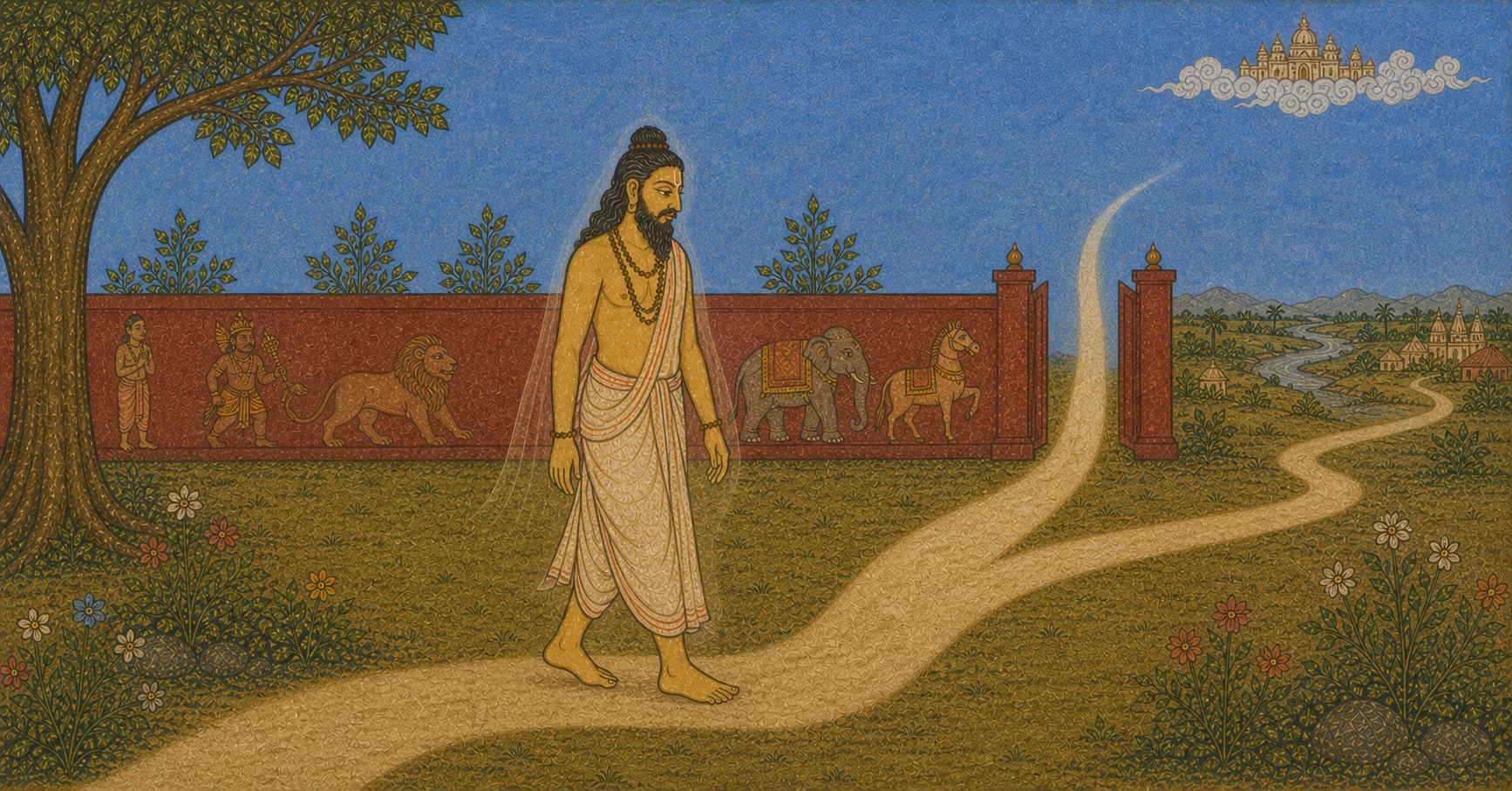
DYS 125–130: Liberation in Life

Dattātreyayogaśāstra 125–130: Freedom While Living and Conscious Use of the Body

Samādhi is defined as the identity of the individual and highest selves. The liberated yogi may leave or retain the body and move at will through different worlds and forms.

Dr. Ronald Steiner Dr. Ronald Steiner Nils Jacob Liersch Nils Jacob Liersch
Dattātreyayogaśāstra 125
दिनद्वादशकेनैव समाधिं समवाप्नुयात् |
dina-dvādaśakenaiva; samādhiṃ samavāpnuyāt | Analysis ▾ Analysis ▴
dina
tatpuruṣa-compound genitive
substantive neuter
days
dvādaśakena
instrumental case singular
substantive neuter
in twelve
eva
particle
alone
samādhim
accusative singular
substantive masculine
samādhi
samavāpnuyāt
3rd person singular aktive optative
previx
previx
verbal root
he should fully attain
वायुं निरुध्य मेधावी जीवन्मुक्तो भवेद्ध्रुवम् ||125||
vāyuṃ nirudhya medhāvī; jīvan-mukto bhaved dhruvam ||125|| Analysis ▾ Analysis ▴
vāyum
accusative singular
substantive masculine
breath
nirudhya
absolutus
previx
verbal root
having restrained
medhāvī
nominative singular
substantive masculine
the wise practitioner
jīvan
tatpuruṣa-compound lokative
adjective
while living
muktaḥ
nominative singular masculine past participle passive
verbal root
liberated
bhavet
3rd person singular aktive optative
verbal root
becomes
dhruvam
adverb
certainly
Metre: Anuṣṭubh
In just (eva) twelve days (dina-dvādaśakena | ins sg), he should completely attain (samavāpnuyāt | 3p sg act opt) samādhi (samādhim | acc sg). Having restrained (nirudhya | abs) the breath (vāyum | acc sg), the wise practitioner (medhāvī | nom sg) should certainly (dhruvam) become (bhavet | 3p sg act opt) liberated while alive (jīvanmuktaḥ | nom sg).
Dr. Ronald Steiner - 2026 - historically literal
The text says that samādhi can be fully attained in twelve days. With the breath restrained, the wise practitioner becomes liberated while still alive.
Dr. Ronald Steiner - 2026 - modern transfer
medhāvī JM2024 ] meghāvī DYŚ
Critical Apparatus
Dattātreyayogaśāstra 126
समाधिः समतावस्था जीवात्मपरमात्मनोः |
samādhiḥ samatāvasthā; jīvātma-paramātmanoḥ | Analysis ▾ Analysis ▴
samādhiḥ
nominative singular
substantive masculine
samādhi
samatā
nominative singular
substantive feminine
identity, equality
avasthā
nominative singular
substantive feminine
state
jīva
karmadhāraya-compound
substantive masculine
individual self
ātman
dvandva-compound
substantive masculine
Self
parama
karmadhāraya-compound
adjective
supreme
ātmanoḥ
genitive dual
substantive masculine
of the two selves
यदि स्वदेहमुत्स्रष्टुमिच्छा चेदुत्सृजेत्स्वयम् ||126||
yadi sva-deham utsraṣṭum; icchā ced utsṛjet svayam ||126|| Analysis ▾ Analysis ▴
yadi
particle
if
sva
karmadhāraya-compound
adjective
own
deham
accusative singular
substantive masculine
body
utsraṣṭum
infinitive
previx
verbal root
to cast off
icchā
nominative singular
substantive feminine
desire
cet
particle
if
utsṛjet
3rd person singular aktive optative
previx
verbal root
he should cast off
svayam
adverb
himself
Metre: Anuṣṭubh
Samādhi (samādhiḥ | nom sg) is the state (avasthā | nom sg) of identity (samatā | nom sg) of the individual and highest selves (jīvātma-paramātmanoḥ | gen du). If (yadi) the wish (icchā | nom sg) arises to cast off (utsraṣṭum | inf) his own body (sva-deham | acc sg), and if (ced) he himself (svayam) wishes to cast it off (utsṛjet | 3p sg act opt), he may do so.
Dr. Ronald Steiner - 2026 - historically literal
Samādhi is the identity of the individual self and the highest self. A yogi who wishes to leave the body may do so by choice.
Dr. Ronald Steiner - 2026 - modern transfer
svadeham utsraṣṭum icchā ced JM2024 ] syād deham utsraṣṭum icchā tad DYŚ
Critical Apparatus
Dattātreyayogaśāstra 127
परब्रह्मनि लीयेत त्यक्त्वा कर्म शुभाशुभम् |
para-brahmani līyeta; tyaktvā karma śubhāśubham | Analysis ▾ Analysis ▴
para
karmadhāraya-compound
adjective
supreme
brahmani
lokative singular
substantive neuter
Brahman
līyeta
3rd person singular medial optative
verbal root
he should dissolve
tyaktvā
absolutus
verbal root
having abandoned
karma
accusative singular
substantive neuter
action
śubha
dvandva-compound
adjective
good
aśubham
accusative singular neuter
previx
adjective
and bad
अथ नो चेत्समुत्स्रष्टुं स्वशरीरं यदि प्रियम् ||127||
atha no cet samutsraṣṭuṃ; sva-śarīraṃ yadi priyam ||127|| Analysis ▾ Analysis ▴
atha
adverb
now
na
particle
not
cet
particle
if
samutsraṣṭum
infinitive
previx
previx
verbal root
to cast off completely
sva
karmadhāraya-compound
adjective
own
śarīram
accusative singular
substantive masculine
body
yadi
particle
if
priyam
accusative singular neuter
adjective
dear
Metre: Anuṣṭubh
Having abandoned (tyaktvā | abs) action (karma | acc sg), both good and bad (śubhāśubham | acc sg), he should dissolve (līyeta | 3p sg med opt) into the supreme Brahman (parabrahmani | loc sg). But if (atha no cet) he does not wish to cast off (samutsraṣṭum | inf) his own body (sva-śarīram | acc sg), if (yadi) it is dear (priyam | acc sg), he may retain it.
Dr. Ronald Steiner - 2026 - historically literal
To leave the body, the yogi abandons both good and bad action and dissolves into the supreme Brahman. If the body remains dear, it may instead be retained.
Dr. Ronald Steiner - 2026 - modern transfer
līyeta JM2024 ] līyate DYŚ
Critical Apparatus
Dattātreyayogaśāstra 128
सर्वलोकेषु विचरेदणिमादिगुणान्वितः |
sarva-lokeṣu vicared; aṇimādi-guṇānvitaḥ | Analysis ▾ Analysis ▴
sarva
karmadhāraya-compound
adjective
all
lokeṣu
lokative plural
substantive masculine
worlds
vicaret
3rd person singular aktive optative
previx
verbal root
he should wander
aṇimā
dvandva-compound
substantive masculine
aṇimā, minuteness
ādi
tatpuruṣa-compound genitive
substantive masculine
and so forth
guṇa
tatpuruṣa-compound genitive
substantive masculine
powers
anvitaḥ
nominative singular masculine past participle passive
previx
verbal root
endowed with
कदा चित्स्वेच्छया देवो भूत्वा स्वर्गे ऽपि संचरेत् ||128||
kadā cit svecchayā devo; bhūtvā svarge 'pi saṃcaret ||128|| Analysis ▾ Analysis ▴
kadā
adverb
at some time
cit
suffix
perhaps
sva
tatpuruṣa-compound genitive
pronoun
own
icchayā
instrumental case singular
substantive feminine
at will, deliberately
devaḥ
nominative singular
substantive masculine
a god
bhūtvā
absolutus
verbal root
having become
svarge
lokative singular
substantive masculine
in heaven
api
particle
also
saṃcaret
3rd person singular aktive optative
previx
verbal root
he should roam
Metre: Anuṣṭubh
Endowed with powers beginning with becoming infinitesimal (aṇimādi-guṇānvitaḥ | nom sg), he should wander (vicaret | 3p sg act opt) through all worlds (sarva-lokeṣu | loc pl). At some time (kadā cit), according to his own wish (svecchayā | ins sg), he may become (bhūtvā | abs) a god (devaḥ | nom sg) and roam (saṃcaret | 3p sg act opt) even (api) in heaven (svarge | loc sg).
Dr. Ronald Steiner - 2026 - historically literal
Keeping the body, the yogi may roam through every world with powers such as becoming infinitesimal, and may even take divine form and move through heaven.
Dr. Ronald Steiner - 2026 - modern transfer
Dattātreyayogaśāstra 129
मनुष्यो वापि यक्षो वा स्वेच्छया हि क्षणाद्भवेत् |
manuṣyo vāpi yakṣo vā; svecchayā hi kṣaṇād bhavet | Analysis ▾ Analysis ▴
manuṣyaḥ
nominative singular
substantive masculine
a human being
vā
particle
or
api
particle
also
yakṣaḥ
nominative singular
substantive masculine
a Yakṣa
vā
particle
or
sva
tatpuruṣa-compound genitive
pronoun
own
icchayā
instrumental case singular
substantive feminine
at will, deliberately
hi
particle
indeed
kṣaṇāt
ablative singular
substantive masculine
in an instant
bhavet
3rd person singular aktive optative
verbal root
should become
सिंहो व्याघ्रो गजो वास्यादिच्छया जन्तुतां व्रजेत् ||129||
siṃho vyāghro gajo vāsyād; icchayā jantutāṃ vrajet ||129|| Analysis ▾ Analysis ▴
siṃhaḥ
nominative singular
substantive masculine
a lion
vyāghraḥ
nominative singular
substantive masculine
a tiger
gajaḥ
nominative singular
substantive masculine
an elephant
vā
particle
or
syāt
3rd person singular aktive optative
verbal root
should be
icchayā
instrumental case singular
substantive feminine
at will
jantutām
accusative singular
substantive feminine
animal state
vrajet
3rd person singular aktive optative
verbal root
he should enter
Metre: Anuṣṭubh
According to his own wish (svecchayā | ins sg), in an instant (kṣaṇāt | abl sg) he may become (bhavet | 3p sg act opt) a human (manuṣyaḥ | nom sg) or (vāpi) a Yakṣa (yakṣaḥ | nom sg). He may be (syāt | 3p sg act opt) a lion (siṃhaḥ), tiger (vyāghraḥ), or elephant (gajaḥ), or (vā) by choice (icchayā | ins sg) enter (vrajet | 3p sg act opt) the condition of an animal (jantutām | acc sg).
Dr. Ronald Steiner - 2026 - historically literal
At will, the yogi may appear as a human or a Yakṣa, as a lion, tiger, or elephant, or in another animal form.
Dr. Ronald Steiner - 2026 - modern transfer
jantutāṃ JM2024 ] jantunāṃ DYŚ
Critical Apparatus
Dattātreyayogaśāstra 130
यथेष्टमेवं वर्तेत योगी विद्वान्महेश्वरः |
yatheṣṭam evaṃ varteta; yogī vidvān maheśvaraḥ | Analysis ▾ Analysis ▴
yathā
adverb
as
iṣṭam
accusative singular neuter past participle passive
verbal root
desired
evaṃ
adverb
thus
varteta
3rd person singular aktive optative
verbal root
should live
yogī
nominative singular
substantive masculine
the yogi
vidvān
nominative singular masculine
adjective
wise
mahā
karmadhāraya-compound
adjective
great
īśvaraḥ
nominative singular
substantive masculine
lord
कविमार्गोऽयमुक्तस्ते सांकृते ऽष्टाङ्गयोगतः ||130||
kavi-mārgo'yam uktas te; sāṃkṛte 'ṣṭāṅga-yogataḥ ||130|| Analysis ▾ Analysis ▴
kavi
tatpuruṣa-compound genitive
substantive masculine
ancient seer
mārgaḥ
nominative singular
substantive masculine
path
ayam
nominative singular masculine
pronoun
this
uktaḥ
nominative singular masculine past participle passive
verbal root
taught
te
dative singular
pronoun pers 2p
to you
sāṃkṛte
vokative singular
substantive masculine
O Sāṃkṛti
aṣṭa
karmadhāraya-compound
numeral
eight
aṅga
tatpuruṣa-compound genitive
substantive neuter
limbed
yogataḥ
substantive masculine
suffix
as yoga
Metre: Anuṣṭubh
Thus (evam) the wise (vidvān | nom sg) yogi (yogī | nom sg) may live (varteta | 3p sg act opt) as he wishes (yatheṣṭam), a great lord (maheśvaraḥ | nom sg). O Sāṃkṛti (sāṃkṛte | voc sg), this (ayam | nom sg) ancient seers’ path (kavi-mārgaḥ | nom sg) has been taught (uktaḥ | nom sg) to you (te | dat sg) as eight-limbed yoga (aṣṭāṅga-yogataḥ).
Dr. Ronald Steiner - 2026 - historically literal
Thus the accomplished yogi lives freely as a great lord. Dattātreya has now explained to Sāṃkṛti the ancient seers’ path of eight-limbed yoga.
Dr. Ronald Steiner - 2026 - modern transfer
evaṃ varteta JM2024 ] evam vartteta DYŚ
Critical Apparatus

Continue with AYI Free

Illustrations: AI-generated.

Editor

Dr. Ronald Steiner

From Ulm

The "Yoga Doc" - Dr. Ronald Steiner is the founder of the AYI method. This method links traditional Ashtanga Yoga with innovative Yogatherapy and living Philosophy. This forms a practice that is personal for each and... more ›

Nils Jacob Liersch

Meine Begeisterung für Yoga, indische Philosophie und Sanskrit führte mich zum Studium der Indologie und Religionswissenschaft an der Universität Heidelberg. Seit 2004 befinde ich mich auf meinem persönlichen Yogaweg... more ›

Messages and ratings
1 messages Ø

Please log in to write a message. Go to login