DYS 73–78: Kevala Kumbhaka

Dattātreyayogaśāstra 73–78: From Assisted Retention to Spontaneous Stillness

Practice with inhalation and exhalation gives rise to a retention without either movement; as it stabilises, lightness and unusual abilities appear.

Dr. Ronald Steiner Dr. Ronald Steiner Nils Jacob Liersch Nils Jacob Liersch
Dattātreyayogaśāstra 73
ततः परं यथेष्टं तु शक्तः स्याद्वायुधारणे |
tataḥ paraṃ yatheṣṭaṃ tu; śaktaḥ syād vāyu-dhāraṇe | Analysis ▾ Analysis ▴
tataḥ
adverb
then
param
adverb
after that, further
yatheṣṭam
adverb
at will
tu
particle
but
śaktaḥ
nominative singular masculine past participle passive
verbal root
able
syāt
3rd person singular aktive optative
verbal root
would be
vāyu
tatpuruṣa-compound genitive
substantive masculine
breath, wind
dhāraṇe
lokative singular
substantive neuter
in holding
यथेष्टं धारणाद्वायोः सिध्येत्केवलकुम्भकः ||73||
yatheṣṭaṃ dhāraṇād vāyoḥ; sidhyet kevala-kumbhakaḥ ||73|| Analysis ▾ Analysis ▴
yatheṣṭam
adverb
at will
dhāraṇāt
ablative singular
substantive neuter
as a result of holding
vāyoḥ
genitive singular
substantive masculine
of the breath
sidhyet
3rd person singular aktive optative
verbal root
should be mastered
kevala
karmadhāraya-compound
adjective
unaccompanied, pure
kumbhakaḥ
nominative singular
substantive masculine
breath retention
Metre: Anuṣṭubh
After that (tataḥ param), he should be (syāt | 3p sg act opt) able (śaktaḥ | nom sg m) to hold the breath (vāyudhāraṇe | loc sg) as long as he wishes (yatheṣṭam | acc sg n ppp). By holding (dhāraṇāt | abl sg) the breath (vāyoḥ | gen sg) as long as desired (yatheṣṭam | acc sg n ppp), unaccompanied breath retention (kevalakumbhakaḥ | nom sg) should be mastered (sidhyet | 3p sg act opt).
Dr. Ronald Steiner - 2026 - historically literal
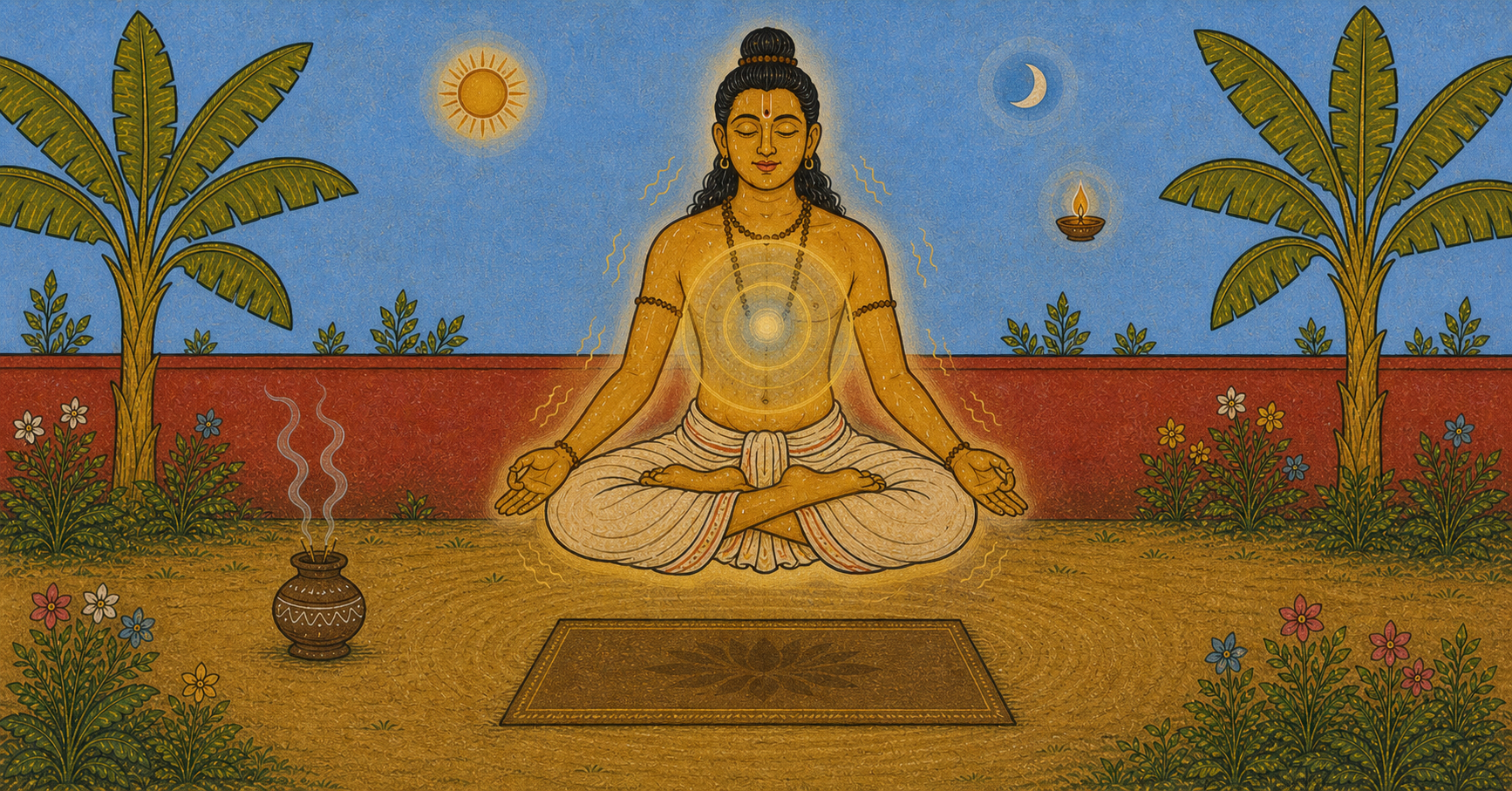
In time, the practitioner becomes able to hold the breath at will. This leads to unaccompanied breath retention.
Dr. Ronald Steiner - 2026 - modern transfer
śaktaḥ JM2024 ] śaktiḥ DYŚ
Critical Apparatus
Dattātreyayogaśāstra 74
केवले कुम्भके सिद्धे रेचपूरविवर्जिते |
kevale kumbhake siddhe; reca-pūra-vivarjite | Analysis ▾ Analysis ▴
kevale
lokative singular masculine
adjective
in the unaccompanied
kumbhake
lokative singular
substantive masculine
breath retention
siddhe
lokative singular masculine past participle passive
verbal root
when mastered
reca
dvandva-compound
substantive masculine
exhalation
pūra
dvandva-compound
substantive masculine
inhalation
vivarjite
lokative singular masculine past participle passive
previx
verbal root
free from
न तस्य दुर्लभं किंचित्त्रिषु लोकेषु विद्यते ||74||
na tasya durlabhaṃ kiṃcit; triṣu lokeṣu vidyate ||74|| Analysis ▾ Analysis ▴
na
particle
not
tasya
genitive singular masculine
pronoun
for him
durlabham
nominative singular neuter
adjective
difficult to attain
kiṃcit
nominative singular neuter
pronoun
anything
triṣu
lokative plural
numeral
in the three
lokeṣu
lokative plural
substantive masculine
worlds
vidyate
3rd person singular medial present
verbal root
exists, is found
Metre: Anuṣṭubh
When unaccompanied breath retention (kevale kumbhake | loc sg) has been mastered (siddhe | loc sg m ppp) and is without exhalation and inhalation (recapūravivarjite | loc sg m ppp), there does not (na) exist (vidyate | 3p sg med pres) anything (kiṃ cit | nom sg n) in the three worlds (triṣu lokeṣu | loc pl) that is difficult (durlabham | nom sg n) for him (tasya | gen sg m) to attain.
Dr. Ronald Steiner - 2026 - historically literal
When unaccompanied retention succeeds without inhalation or exhalation, the yogi is said to find nothing unattainable.
Dr. Ronald Steiner - 2026 - modern transfer
recapūravivarjite JM2024 ] recapūrakavarjite DYŚ
Critical Apparatus
Dattātreyayogaśāstra 75
प्रस्वेदो जायते पूर्वं मर्दनं तेन कारयेत् |
prasvedo jāyate pūrvaṃ; mardanaṃ tena kārayet | Analysis ▾ Analysis ▴
prasvedaḥ
nominative singular
substantive masculine
sweat
jāyate
3rd person singular medial present
verbal root
arises
pūrvam
adverb
at first
mardanam
accusative singular
substantive neuter
massage
tena
instrumental case singular masculine
pronoun
with it
kārayet
3rd person singular aktive optative causative
verbal root
he should cause, perform
ततो ऽपि धारणाद्वायोः क्रमेणैव शनैः शनैः ||75||
tato 'pi dhāraṇād vāyoḥ; krameṇaiva śanaiḥ śanaiḥ ||75|| Analysis ▾ Analysis ▴
tataḥ
adverb
then
api
particle
also
dhāraṇāt
ablative singular
substantive neuter
from retention
vāyoḥ
genitive singular
substantive masculine
of the breath
krameṇa
instrumental case singular
substantive masculine
step by step
eva
particle
precisely
śanaiḥ
adverb
gently, slowly
śanaiḥ
adverb
gently, slowly
Metre: Anuṣṭubh
At first (pūrvam) sweat (prasvedaḥ | nom sg) arises (jāyate | 3p sg med pres). He should have a massage (mardanam | acc sg) performed (kārayet | 3p sg act opt caus) with it (tena | ins sg m). Then (tataḥ api), as a result of the retention (dhāraṇāt | abl sg) of the breath (vāyoḥ | gen sg) being increased step by step (krameṇa | ins sg) only (eva) and very gently (śanaiḥ śanaiḥ), [the trembling named in the following verse arises].
Dr. Ronald Steiner - 2026 - historically literal
Sweat appears first, and the yogi massages it into the body. Retention is then increased very gently, one step at a time.
Dr. Ronald Steiner - 2026 - modern transfer
’pi dhāraṇād JM2024 ] ’tidhāraṇād DYŚ
Critical Apparatus
Dattātreyayogaśāstra 76
कम्पो भवति देहस्य आसनस्थस्य योगिनः |
kampo bhavati dehasya; āsana-sthasya yoginaḥ | Analysis ▾ Analysis ▴
kampaḥ
nominative singular
substantive masculine
trembling
bhavati
3rd person singular aktive present
verbal root
is
dehasya
genitive singular
substantive masculine
of the body
āsana
tatpuruṣa-compound lokative
substantive neuter
posture, seat
sthasya
genitive singular masculine
adjective
remaining, seated
yoginaḥ
genitive singular
substantive masculine
for the yogi
ततो ऽधिकतराभ्यासाद्दर्दुरी जायते ध्रुवम् ||76||
tato 'dhikatarābhyāsād; dardurī jāyate dhruvam ||76|| Analysis ▾ Analysis ▴
tataḥ
adverb
then
adhikatara
karmadhāraya-compound
adjective
further increased
abhyāsāt
ablative singular
substantive masculine
through practice
dardurī
nominative singular
substantive feminine
frog power
jāyate
3rd person singular medial present
verbal root
arises
dhruvam
adverb
certainly
Metre: Anuṣṭubh
Trembling (kampaḥ | nom sg) arises (bhavati | 3p sg act pres) in the body (dehasya | gen sg) of the yogi (yoginaḥ | gen sg) while he is seated in his posture (āsanasthasya | gen sg m). Through a further increase in practice (adhikatarābhyāsāt | abl sg), the frog power (dardurī | nom sg) is sure (dhruvam) to arise (jāyate | 3p sg med pres).
Dr. Ronald Steiner - 2026 - historically literal
As the duration increases, the seated yogi’s body begins to tremble. With further practice, the so-called frog power arises.
Dr. Ronald Steiner - 2026 - modern transfer
Dattātreyayogaśāstra 77
यथा तु दर्दुरो गच्छेदुत्प्लुत्योत्प्लुत्य भूतले |
yathā tu darduro gacched; utplutyotplutya bhūtale | Analysis ▾ Analysis ▴
yathā
adverb
just as
tu
particle
but
darduraḥ
nominative singular
substantive masculine
frog
gacchet
3rd person singular aktive optative
verbal root
it should move
utplutya
absolutus
previx
verbal root
having leapt, hopped
utplutya
absolutus
previx
verbal root
having leapt, hopped
bhūtale
lokative singular
substantive neuter
across the ground
पद्मासनस्थितो योगी तथा गच्छति भूतले ||77||
padmāsana-sthito yogī; tathā gacchati bhūtale ||77|| Analysis ▾ Analysis ▴
padma
tatpuruṣa-compound genitive
substantive neuter
lotus
āsana
tatpuruṣa-compound lokative
substantive neuter
posture, seat
sthitaḥ
nominative singular masculine past participle passive
verbal root
remaining
yogī
nominative singular
substantive masculine
the yogi
tathā
adverb
likewise
gacchati
3rd person singular aktive present
verbal root
he moves
bhūtale
lokative singular
substantive neuter
across the ground
Metre: Anuṣṭubh
Just as (yathā) a frog (darduraḥ | nom sg) moves (gacchet | 3p sg act opt) across the ground (bhūtale | loc sg) by repeatedly hopping (utplutyotplutya | abs), so (tathā) the yogi (yogī | nom sg), seated in the lotus posture (padmāsanasthitaḥ | nom sg m ppp), moves (gacchati | 3p sg act pres) across the ground (bhūtale | loc sg).
Dr. Ronald Steiner - 2026 - historically literal
Still in the lotus posture, the yogi moves across the ground like a frog repeatedly hopping.
Dr. Ronald Steiner - 2026 - modern transfer
Dattātreyayogaśāstra 78
ततो ऽधिकतराभ्यासाद्भूमित्यागश्च जायते |
tato 'dhikatarābhyāsād; bhūmi-tyāgaś ca jāyate | Analysis ▾ Analysis ▴
tataḥ
adverb
then
adhikatara
karmadhāraya-compound
adjective
further increased
abhyāsāt
ablative singular
substantive masculine
through practice
bhūmi
tatpuruṣa-compound genitive
substantive feminine
ground, earth
tyāgaḥ
nominative singular
substantive masculine
leaving, rising from
ca
particle
and
jāyate
3rd person singular medial present
verbal root
arises
पद्मासनस्थ एवासौ भूमिमस्पृश्य वर्तते ||78||
padmāsana-stha evāsau; bhūmim aspṛśya vartate ||78|| Analysis ▾ Analysis ▴
padma
tatpuruṣa-compound genitive
substantive neuter
lotus
āsana
tatpuruṣa-compound lokative
substantive neuter
posture, seat
sthaḥ
nominative singular masculine
adjective
remaining, seated
eva
particle
precisely
asau
nominative singular masculine
pronoun
that man
bhūmim
accusative singular
substantive feminine
the ground
aspṛśya
absolutus
previx
verbal root
without touching
vartate
3rd person singular medial present
verbal root
he remains
Metre: Anuṣṭubh
Through a further increase in practice (adhikatarābhyāsāt | abl sg), rising from the ground (bhūmityāgaḥ | nom sg) also (ca) occurs (jāyate | 3p sg med pres). Remaining in the lotus posture (padmāsanasthaḥ | nom sg m), that [yogi] (asau | nom sg m) abides (vartate | 3p sg med pres) without touching (aspṛśya | abs) the ground (bhūmim | acc sg).
Dr. Ronald Steiner - 2026 - historically literal
With more intensive practice, the yogi rises from the ground while remaining in the lotus posture and no longer touches it.
Dr. Ronald Steiner - 2026 - modern transfer
aspṛśya vartate JM2024 ] utsṛjya varttate DYŚ
Critical Apparatus

Continue with AYI Free

Illustrations: AI-generated.

Editor

Dr. Ronald Steiner

From Ulm

The "Yoga Doc" - Dr. Ronald Steiner is the founder of the AYI method. This method links traditional Ashtanga Yoga with innovative Yogatherapy and living Philosophy. This forms a practice that is personal for each and... more ›

Nils Jacob Liersch

Meine Begeisterung für Yoga, indische Philosophie und Sanskrit führte mich zum Studium der Indologie und Religionswissenschaft an der Universität Heidelberg. Seit 2004 befinde ich mich auf meinem persönlichen Yogaweg... more ›

Messages and ratings
4 messages Ø

Please log in to write a message. Go to login

Butter und Milch geben Anlass zur Diskussion mit veganem Lebensstil. Leckeres Essen ist überaus variabel zu interpretieren.......
Mäßiges Essen wird deutlich unterschätzt, gerade eine Pranayama Übungspraxis als Teil des täglichen Sadhana ist nur unter dieser Voraussetzung umsetzbar.
Danke für die Inspiration, ich verstehe das Prinzip "auf und neben der Matte".
Hallo Andreas,
ich denke man kann das nicht 1:1 nach heute Übertragen. Interessant ist viel mehr das Prinzip. Die Yogis haben sich schon damals (13. Jh) nicht nur um eine Praxis auf der "Yogamatte" bemüht, sondern gesunder Lebensstil gehörte für die Yogis schon damals zum Yogischen Leben. So ist es bei vielen, vermutlich den meisten Praktizierenden bis heute.
- Das verbindet die Tradition über die Zeit und miteinander.
Namaste und big hug
Ronald