

tu तु – but; however; rather; now; then; and
particle · verbal root · Word type unspecified · verb
Dictionary sources
AYI dictionary particle
but; however; rather; now; then; and
Cappeller 1891 Word type unspecified · verb
Original text · English · verb
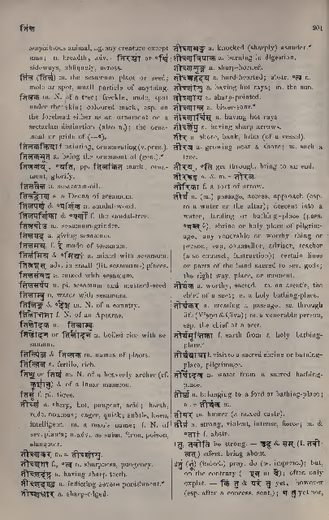
tu tavīti1 ·v be strong. -- ud & sam (1. távītvat) effect, bring about.
Original text · English · Word type unspecified
tú2 ·(tū́) (indecl.) pray, do (w. imperat.); but, on the contrary (±evá or vai); often only explet. -- kiṃ tu & paraṃ tu yet, however (esp. after a concess. sent.); na tu yet not, rather than (esp. after kāmam, bhūyas, varam etc.). tu--tu on the one hand -- on the other, indeed -- but.
Monier-Williams 1872 particle · Word type unspecified · verb
Original text · English · particle
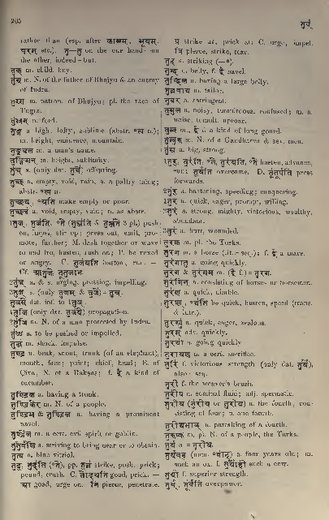
tu 3 . tu, ind. (a particle, perhaps connected with the pronom. base 2. ta, or with the Vedic pro- noun tva; never found at the beginning of a sentence or verse, and causing the verb with which it is con- structed to retain its accent). As a particle implying ‘earnest entreaty’ or ‘urgent request’ it is often used in the Veda, like Lat. dum, with an imperative, and may be translated by ‘pray!’ ‘I beg,’ ‘do’ (e. g. ā tveta, come here, do); or it may be rendered by ‘well,’ ‘now then,’ ‘now,’ ‘just.’ As an adversative particle it is equivalent to ‘but,’ ‘on the contrary,’ ‘on the other hand’ (e. g. na cchinati janayati tu, he does not destroy but he produces). The sense ‘but’ is most common in later Sanskrit.

Original text · English · Word type unspecified
tu 1 . tu, the base of some of the cases of the 2nd personal pronoun; [cf. tva.]
Original text · English · Word type unspecified
Tu is sometimes, however, used for ca, ‘and’ (e. g. ā samudrāt pūrvād ā samudrāt tu paści- māt, to the eastern sea and to the western sea); and even for vā, ‘or’ (e. g. uṣṭra-yānaṃ samāruhya khara-yānaṃ tu, having ascended a camel-carriage or one drawn by donkeys). Sometimes it appears to be incorrectly written for nu (e. g. kin tu for kin nu). Occasionally it seems to be used for tadā after cet (e. g. tāṃ ced na ditseyam pramathyaināṃ hareyus tu, if I were not willing to give her then they would take her by force). Not unfrequently tu is used as an expletive to fill out a verse or prevent the blending of vowels (e. g. īrṣyī ghṛṇī tv a-santuṣṭaḥ, &c., an envious man, one over-com- passionate, a discontented man, &c.). Tu — tu, although — yet; api-tu, moreover; kin tu, but, nevertheless, notwithstanding; paran tu, more- over, but, nevertheless; na tv eva tu, but by no means. According to lexicographers tu implies dis- junction, mutual opposition, alternative, asseveration, emphasis, conjunction, &c.
Original text · English · verb
tu 2 . tu, cl. 2. P., Ved. tavīti and tauti, tūtāva, totum and tavitum, to have authority or power, to be strong; to attain; to thrive or increase, to fill, become full; to go or move; to injure, hurt, kill: Caus., Ved. (only used in aor. tūtot), to make strong or efficient, make valid, accomplish; [cf. Zend tav, ‘to be able;’ tavan, ‘powerful:’ Pers. توان tuvân, ‘power;’ توانم tuvânam, ‘I can:’ Gr. τύλος, τύλη, τυλόω, ταΰς: Lat. tumor, tumere, tumidus, tu- mulus (?), tuber, tueri, totus: Umbr. Osc. tauta, tota, touta, ‘town;’ tut-icus, ‘townish:’ Goth. thiuda, thiuth, thiuthyan: Angl. Sax. thū-ma, ‘the thumb;’ theod, ‘people:’ Old Germ. dū-mo, ‘the thumb:’ Slav. ty-ti, ‘to grow fat;’ tu-kŭ, ‘fat:’ Lith. tau-ka-i, ‘fat;’ tunk-u, ‘I become fat:’ Old Pruss. tau-ta, ‘land, country:’ Cambro-Brit. tyv-u, ‘to increase.’]
Petersburger 1855 Word type unspecified
Original text · German · Word type unspecified
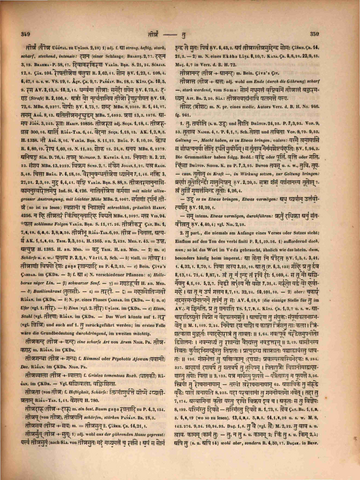
1. tu , tavīti (s. u. ud) und tauti DHĀTUP. 24,25. P. 7,3,95. VOP. 9,53. tūtāva NAIGH. 4,1. P. 6,1,7, Sch. totā und tavitā VOP. 8,79. VOP. 9,53. Geltung —, Macht haben, es zu Etwas bringen, valere: yasmai̱ tvamā̱yajàse sa sā̀dhatyana̱rvā kṣèti̱ dadhàte su̱vīryàm . sa tū̀tāva̱ nainàmaśnotyaṃha̱tiḥ ṚV. 1,94,2. Die Grammatiker haben folgg. Bedd.: vṛddhi oder pūrti, vṛtti oder gati, hiṃsā DHĀTUP. SIDDH. K._zu_P. 7,3,95. Davon tavas u. s. w., tuvi, tūya. — caus. tūtot in Kraft —, in Wirkung setzen, zur Geltung bringen: brahmā̀ tūto̱dindrò gā̱tumi̱ṣṇan ṚV. 2,20,5. sa̱trā śaṃsa̱ṃ yajàmānasya tūtot ṚV. 2,20,7. tvaṃ tujìṃ gṛ̱ṇantàmindra tūtoḥ ṚV. 6,26,4. — ud es zu Etwas bringen, Etwas vermögen: adha̱ cyavā̀na̱ uttàvī̱tyarthàm ṚV. 10,59,1. — sam intens. Etwas vermögen, durchführen: kratùṃ dadhi̱krā anù sa̱ṃtavī̀tvat ṚV. 4,40,4; vgl. NIR. 2,28.
Original text · German · Word type unspecified
2. tu part., die niemals am Anfange eines Verses oder Satzes steht; Einfluss auf den Ton des verbi finiti P. 8,1,39. P. 8,1,56. 1〉 auffordernd doch, nun; so ist das Wort im Veda gebraucht, ähnlich wie das latein. dum, besonders häufig beim imperat.: ā tvetā̱ ni ṣī̀data ṚV. 1,5,1. ṚV. 3,41,1. ṚV. 4,32,1. ṚV. 8,70,1. pibā̱ tvasya ṚV. 3,51,10. ā tū (P. 6,3,133) gàhi̱ pra tu dràva P. 8,13,14. P. 8,71,4. P. 9,87,1. tvaṃ tū nà indra̱ taṃ ra̱yiṃ dā̀ḥ P. 1,169,4. sa tū nò a̱gnirnàyatu P. 4,1,10. P. 5,2,7. vi̱ddhī tva1̱̀sya nò vaso P. 7,31,4. marùto̱ yaddhà vo̱ havā̀mahe . ā tū na̱ upà gantana P. 8,7,11. P. 8,32,24. P. 10,101,10. — 2〉 aber: ca̱kārà bha̱drama̱smabhyàmā̱tmane̱ tapàna̱ṃ tu sa; AV. 4,18,6 (die einzige Stelle für tu im AV.). na chinatti, pra tu janayati TS. 1,7,2,4. KĀTY. ŚR. 1,3,7 u. s. w. ācārādvicyuto vipro na vedaphalamaśnute . ācāreṇa tu saṃyuktaḥ saṃpūrṇaphalabhāgbhavet .. M. 1,109. M. 2,24. nimeṣā daśa cāṣṭau ca kāṣṭhā triṃśattu tāḥ kalā . triṃśatkalā muhūrtaḥ syādahorātraṃ tu tāvataḥ .. M. 1,64. bhavatpūrvaṃ caredbhaikṣamupatīto dvijottamaḥ . bhavanmadhyaṃ tu rājanyo vaiśyastu bhavaduttaram .. M. 2,49. āsītasya sthitaḥ kuryādabhigacchaṃstu tiṣṭhataḥ . pratyudgamya tvāvrajataḥ paścāddhāvaṃstu dhāvataḥ .. M. 196. māṃsabhettā tu ṣaṇṇiṣkān (daṇḍyaḥ) prakasyastvasthibhedakaḥ M. 8,284. M. 8,337. brāhmaṇaṃ daśavarṣaṃ tu śatavarṣaṃ tu bhūmipam . pitāputrau vijānīyādbrāhmaṇastu tayoḥ pitā .. M. 2,135. yatra nāryastu pūjyante — yatraitāstu na pūjyante M. 3,56. striyāṃ tu rocamānāyām — tasyāṃ tvarocamānāyām M. 62. ajāvike tu saṃruddhe vṛkaiḥ pāle tvanāyati M. 8,235. yadā parabalānāṃ tu gamanīyatamo bhavet . tadā tu M. 7,174. asvāminā kṛto yastu dāyo vikraya eva ca . akṛtaḥ sa tu vijñeyaḥ M. 8,199. yasmiṃstu divase — tasmiṃstu divase R. 1,73,1. tveva ŚAT. BR. 1,1,3,3. ŚAT. BR. 1,6,1,19 (wo so zu lesen). ŚAT. BR. 13,4,3,4. ŚAT. BR. 13,5,3,5. ŚAT. BR. 14,1,1,26 u. s. w. M. 8,143. M. 8,276. M. 9,34. M. 10,94. M. 10,95. DAŚ. 1,8. tu vai (vgl. tvai) M. 2,22. tu vāva s. u. tvāva. kāmam (kāmaṃ tu) — tu, na tu s. u. kāmam 2; kiṃ tu s. u. kim 2,λ; api tu (s. u. api 14) wohl aber, sondern R. 4,50,17. DAŚAK._in_BENF. Chr. 184,17. paraṃ tu nichtsdestoweniger ŚAK. 41,17. na hi tu DAŚ. 2,44. Häufig erscheint tu als blosses Flickwort im Verse, entweder eine fehlende Silbe ergänzend oder eine vorangehende kurze Silbe nur lang machend: yaccāsya sukṛtaṃ kiṃcidamutrārthamupārjitam . bhartā tatsarvamādatte parāvṛttahatasya tu .. M. 7,95. mā pitā rudra mā mātarmā svasastviti cābravīt BRĀHMAṆ. 3,22. R. 2,38,1. R. 4,61,10. Mit ca verbunden: na caivaināṃ prayacchettu M. 9,89. tvaṣṭistvāyogavasya ca M. 10,48. praṇamanti ca ye tvāṃ hi prabhāte tu narā bhuvi MBH. 4,197. ye cānye tūpayāsyanti MBH. 7,6406. kathaṃ ca tvayi caitena kathitaṃ syāttu N. 22,13. N. 23,9. kiṃ ca śeṣe tu bhūmau tvam DAŚ. 2,29. tveva ca M. 8,138. In einem und demselben Satze zwei tu, ohne dass etwa ein Satztheil einem andern gegenübergestellt würde: na tu nāmāpi gṛhṇīyātpatyau prete parasya tu M. 5,157. etāstisrastu bhāryārthe nopayacchettu buddhimān M. 11,172. bhīmasenaṃ tu (v. l. ca) jāgrataṃ tvaparājitam HIḌ. 2,17. tasmiṃśchinne rathāṅge tu sahadevastu MBH. 7,7473. dattvā tu kṣīrapānaṃ tu tasyai te VĀRĀHA-P._in_Z. d. d. m. G. 13,493. na tveva tu auf keinen Fall aber M. 4,173. M. 5,37. Mit punar ḥ sā cetpunaḥ praduṣyettu M. 11,177. — 3〉 bisweilen so v. a. vā oder caḥ uṣṭrayānaṃ samāruhya kharayānaṃ tu kāmataḥ . snātvā tu vipro digvāsāḥ prāṇāyāmena śudhyati .. M. 11,201. brāhmasya tu kṣapāhasya yatpramāṇaṃ samāsataḥ . ekaikaśo yugānāṃ tu kramaśastannibodhata .. M. 1,68. ā samudrāttu vai pūrvādā samudrāttu paścimāt . tayorevāntaraṃ giryoḥ M. 2,22. — 4〉 tu (= tāvat) - tu wohl — aber: saṃhatāstu harantīme mama jālaṃ vihaṃgamāḥ . yadā tu nipatiṣyanti vaśameṣyanti me tadā .. HIT. I, 32. — 5〉 bisweilen mit nu verwechselt: kiṃ tvataḥ paramaṃ duḥkham BRĀHMAṆ. 3,17. brāhmaṇasyāsya kiṃ tvaham . priyaṃ kuryām BRĀHMAṆ. 1,7. kiṃ tu duḥkhataraṃ śakyaṃ mayā draṣṭumataḥ param HIḌ. 1,35. Die Calc. Ausg. des MBH. hat hier überall nu st. tu. In der folg. Stelle dagegen hat auch die Calc. Ausg. tuḥ kathaṃ syātāṃ sutau bālau bhaveyaṃ ca kathaṃ tvaham BRĀHMAṆ. 2,9. — 6〉 = tadā im Nachsatz nach ced ḥ tāṃ cedahaṃ na ditseyam — pramathyaināṃ hareyustu BRĀHMAṆ. 2,17. Hier hat die Calc. Ausg. die richtige Lesart te st. tu. — Die Lexicogrr. geben folgende Bedd.: bheda AK. 3,4,32 (28), 3. MED. avy. 19. viśeṣa H. an. 7,9. pakṣāntara MED. avadhāraṇa AK. 3,5,15. AK. 3,4,32 (28), 3. H. an. MED. pādapūraṇa (Flickwort) AK. 3,5,5. H. an. MED. samuccaya H. an. MED. niyoga, vinigraha, praśaṃsā MED. Bei tu pūjāyām behalt nach P. 8,1,39 das verb. fin. seinen Ton: māṇavakastu bhuṅkte śobhanam Sch. — Man hat viell. mit Recht tu auf den Pronominalstamm ta zurückgeführt; vgl. ku und su.

Original text · German · Word type unspecified
3. tu Pronominalstamm der 2ten Person; s. 1. tva.
Original text · German · Word type unspecified
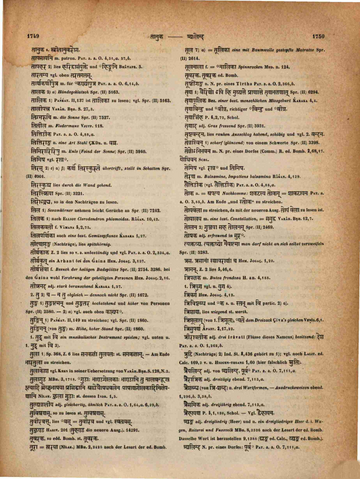
2. tu 2〉 ca — na tu obgleich — dennoch nicht Spr. (II) 1672.
Böhtlingk 1879 particle · verbal root · Word type unspecified
Original text · German · particle
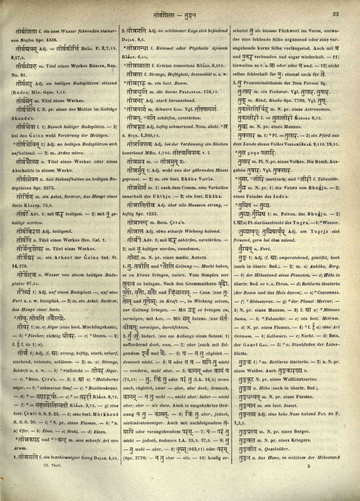
2. tú (tū́) Indecl. (nie am Anfange eines Satzes) — 1〉 auffordernd doch, nun. — 2〉 aber (auch mit folgendem evá und vai). — 3〉 ca — na tu obgleich — dennoch nicht. — 4〉 na oder na ca — api tu nicht — sondern, wohl aber. — 5〉 kāmam oder kāmaṃ ca (Chr. 71,28) — tu, kiṃ tu oder paraṃ tu (LA. 34,2) wenn auch, obgleich, zwar — aber, aber doch, dennoch. kāmam — natu wohl — nicht aber; lieber — nicht aber; eher — als dass. Auch in umgekehrter Ordnung na tu — kāmam. — 6〉 kiṃ tu aber, jedoch, nichtsdestoweniger. Auch mit nachfolgendem tathāpi oder vorangehendem param. — 7〉 na — paraṃ tu nicht — jedoch, indessen LA. 35,5. 37,8. — 8〉 tu — tu wohl — aber. — 9〉 bhūyas (Chr. 163,11) oder varam (Spr. 3778) — na tu eher — als. — 10〉 häufig erscheint [Page3-033-c] tu als blosses Flickwort im Verse, entweder eine fehlende Silbe ergänzend oder eine vorangehende kurze Silbe verlängernd. Auch mit ca und punar verbunden und sogar wiederholt. — 11〉 bisweilen so v. a. vā oder oder ca und. — 12〉 nicht selten fehlerhaft für nuḥ einmal auch für te.
Original text · German · verbal root
1. √tu , tavīti und *tauti Geltung —, Macht haben, es zu Etwas bringen, valere. Vom Simplex nur tūtāva zu belegen. Nach den Grammatikern vṛddhau, pūtau, vṛttau, gatau und hiṃsāyam. — Caus. (nur tūtot und tūtos) in Kraft —, in Wirkung setzen, zur Geltung bringen. — Mit ud es bringen zu, vermögen; mit Acc. — Mit sam Intens. (nur saṃtávītvat) vermögen, durchführen.
Original text · German · Word type unspecified
3. tu Pronominalstamm der 2ten Person Sg.
Whitney Roots 1885 verbal root
Original text · English · verbal root
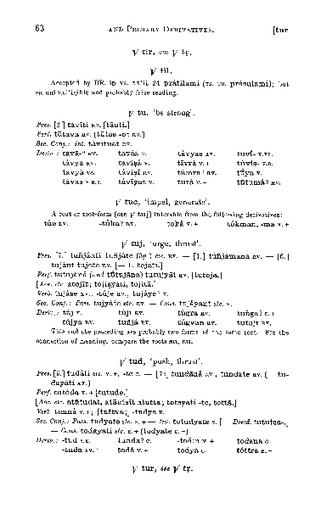
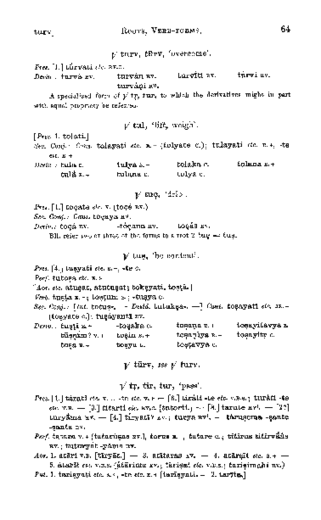
tu — be strong
Apte 1890 particle · verbal root
Original text · English · particle
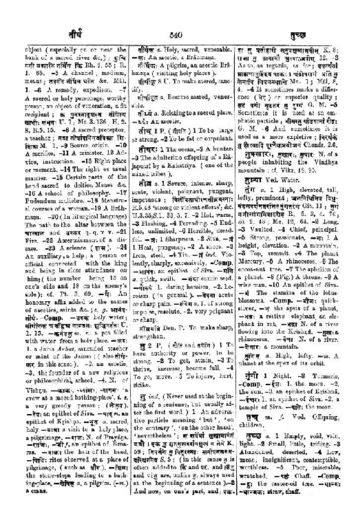
tu ind. (Never used at the beginning of a sentence, but usually after the first word) 1 An adversative particle meaning ‘but’, ‘on the contrary’, ‘on the other hand’, ‘nevertheless’; sa sarveṣāṃ sukhānāmaṃtaṃ yayau . ekaṃ tu sutamukhadarśanasukhaṃ na lebhe K. 59; viparyaye tu piturasyāḥ samīpanayanamavasthitameva Ś. 5; (in this sense tu is often added to kiṃ and paraṃ, and kiṃtu and paraṃtu are, unlike tu, always used at the beginning of a sentence). 2 And now, on one's part, and; ([Page 0540-c]) ekadā tu pratīhārī samupasṛtyābravīt K. 8; rājā tu tāmāryāṃ śrutvā'bravīt K. 12. 3 As to, as regards, as for; pravartyatāṃ brāhmaṇānuddiśya pākaḥ . caṃdroparāgaṃ prati tu kenāpi vipralabdhāsi Mu. 1; Māl. 8. 4. 4 It sometimes marks a difference (bheda) or superior quality; mṛṣṭaṃ payo mṛṣṭataraṃ tu dugdhaṃ G. M. 5 Sometimes it is used as an emphatic particle; bhīmastu pāṃḍavānāṃ raudraḥ G. M. 6 And sometimes it is used as a mere expletive; nirarthakaṃ tu hītyādi pūraṇaikaprayojanaṃ Chandr. 2. 6.
Original text · English · verbal root
tu 2 P. (tauti and tavīti) 1 To have authority or power, to be strong. 2 To get, attain. 3 To thrive, increase, become full. 4 To go, move. 5 To injure, hurt, strike.
Cappeller 1887 Word type unspecified · verb
Original text · German · Word type unspecified
2. tú (tū́) aber, doch, nun; oft explet. kiṃ tu o. paraṃ tu dennoch, gleichwohl. na tu nicht aber, dennoch nicht. bhūyas o varam—na tu eher — als.

Original text · German · verb
1. tu tavīti stark sein, vermögen.
Burnouf 1866 verbal root · Word type unspecified
Original text · French · verbal root
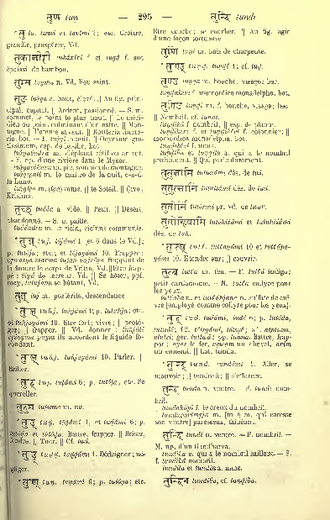
*tu tu. taumi et tavīmi 2; etc. Croître, grandir, prospérer, Vd.
Original text · French · Word type unspecified
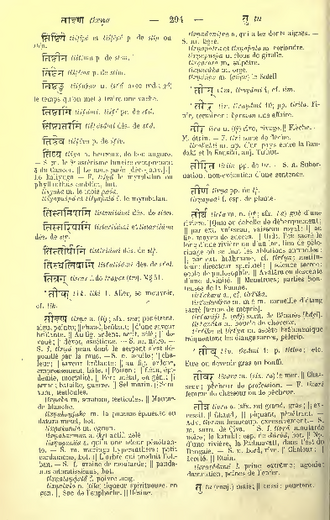
tu tu (conj.) mais; aussi; pourtant.
Occurrences in source texts (218)
DYS 50 occurrences
20 more source pages
DYS 112–121: Five Elements 4 occurrences
Direct occurrences
DYS 150–153*3: Vajrolī: Secret Teaching 3 occurrences
Direct occurrences
DYS 154–167: Vajrolī for the Male Yogi 8 occurrences
Direct occurrences
DYS 168–179*1: Vajrolī for the Yoginī 4 occurrences
Direct occurrences
GoS 22 occurrences
GoS 20–28: Setting Sarasvatī in Motion 2 occurrences
Direct occurrences
GoS 34–41: Sun, Sound and Cooling 2 occurrences
Direct occurrences
5 more source pages
GoS 50–63: Three Locks 6 occurrences
Direct occurrences
GoS 74–80: Through the Three Knots 2 occurrences
Direct occurrences
HP 56 occurrences
HP 1.17-1.32: Āsana 3 occurrences
Direct occurrences
HP 1.50–54: Siṃhāsana and Bhadrāsana 2 occurrences
Direct occurrences
-
HP 1.50–52 Segment 12
-
HP 1.50–52 Segment 15
26 more source pages
HP 3.10-3.18: Mahāmudrā 3 occurrences
Direct occurrences
HP 3.58-3.65: Uḍḍiyāna Bandha 3 occurrences
Direct occurrences
HP 3.73-3.78: Viparīta Karaṇī 4 occurrences
Direct occurrences
HP 3.79-3.86*1: Vajrolī 3 occurrences
Direct occurrences
HP 3.87-3.93*7: Sahajolī and Amarolī 2 occurrences
Direct occurrences
HP 3.94-3.102*1: Śakti Cālana 3 occurrences
Direct occurrences
HP 4.20-4.27: Four Stages of Nāda 2 occurrences
Direct occurrences
HP 4.47-4.55*4: Nāda Binds the Mind 2 occurrences
Direct occurrences
HP 4.56-4.66: The Middle Path 3 occurrences
Direct occurrences
HTK 3 occurrences
IVU 1 occurrence
PJH 1 occurrence
PYS 2 occurrences
SiSa 62 occurrences
SiSa 1.20-1.31: Karma und Erkenntnis 3 occurrences
Direct occurrences
SiSa 1.32-1.34: Selbst als Ursprung 3 occurrences
Direct occurrences
SiSa 1.65-1.70: Māyā-Aufhebung 2 occurrences
Direct occurrences
23 more source pages
SiSa 2.13-2.20: Suṣumṇā und Citrā 2 occurrences
Direct occurrences
SiSa 2.21-2.24: Ādhāra und Kuṇḍalī 2 occurrences
Direct occurrences
SiSa 2.44-2.48: Erkenntnisweg 2 occurrences
Direct occurrences
SiSa 3.21-3.31: Nāḍī-Reinigung 4 occurrences
Direct occurrences
SiSa 3.88-3.91: Padmāsana 2 occurrences
Direct occurrences
SiSa 4.1-4.8: Yonimudrā-Kreislauf 2 occurrences
Direct occurrences
SiSa 4.9-4.20: Yonimudrā-Geheimnis 3 occurrences
Direct occurrences
SiSa 4.31-4.36: Mahāmudrā-Wirkung 2 occurrences
Direct occurrences
SiSa 4.51-4.59: Khecarīmudrā 3 occurrences
Direct occurrences
SiSa 4.72-4.77: Uḍḍyānabandha 3 occurrences
Direct occurrences
SiSa 5.48-5.71: Innere Meditation 2 occurrences
Direct occurrences
SiSa 5.132-5.143: Innere Vārāṇasī 2 occurrences
Direct occurrences
-
SiSa 5.139 Segment 25
-
SiSa 5.142 Segment 15
SiSa 5.156-5.181: Sahasrāra 3 occurrences
Direct occurrences
-
SiSa 5.167 Segment 11
-
SiSa 5.169 Segment 9
-
SiSa 5.173 Segment 10
SiSa 5.234-5.252: Tripurā-Mantra 10 occurrences
Direct occurrences
-
SiSa 5.235 Segment 4
-
SiSa 5.238 Segment 13
-
SiSa 5.239 Segment 3
-
SiSa 5.241 Segment 7
-
SiSa 5.242 Segment 5
-
SiSa 5.246 Segment 5
-
SiSa 5.248 Segment 13
-
SiSa 5.249 Segment 9
-
SiSa 5.251 Segment 10
-
SiSa 5.252 Segment 3
SS 2 occurrences
SVU 12 occurrences
SVU 4.6-4.10: Two Birds and Māyā 3 occurrences
Direct occurrences
SVU 5.1–5.6: The Lord of Cosmic Origins 4 occurrences
Direct occurrences
1 more source page
VBT 7 occurrences
Continue with AYI Free
Image source: AYI archive.