

dṛś दृश् – see; behold; perceive
adjective · verbal root · substantive feminine · substantive neuter · Word type unspecified
Dictionary sources
AYI dictionary verbal root · substantive feminine · substantive neuter
verbal root
see; behold; perceive
substantive feminine
seeing; sight
substantive neuter
eye; sight
Cappeller 1891 substantive feminine · Word type unspecified
Original text · English · Word type unspecified
dṛś1 ·(cf. paś), pp. dṛṣṭá (q.v.) see, behold, know by (instr.); see with the mind, notice, observe, try, examine; find out, invent (esp. a sacred song). P. M. dṛśyáte (°ti) be seen or visible, appear or be regarded as, pass for (nom.); be found, occur. C. darśáyati cause a pers. (acc., gen., dat., or *instr.) to see (acc.), show, w. ātmānam one's self, i.e. appear, pretend to be; produce, point out, make known as or prove to be (2 acc.); -- pp. darśitam (impers.) appearance has been made by (instr.).* D. dídṛkṣate (°ti) desire or like to see. --anu look at (acc.), behold, see (manasā with the mind); P. M. be seen, appear; C. cause to see, teach, show (2 acc.). abhi behold, see; P. be seen, appear; C. cause to see, show, betray. ā M. appear; C. show. ud C. pp. uddarśitam = darśitam (v.S.). upa look on, notice, observe; P.M. be visible, appear; C. cause to see, show, explain; exhibit, pretend, feign. ni C. cause to see, show, point out, explain, teach, proclaim. pari see = visit; behold, notice, know, understand, find out; P. be visible, appear; C. show, explain. pra P. M. be visible, appear; C. make visible, show, point out, make known or clear, explain, teach. saṃpra behold; P. be seen, appear; C. cause to see, show, ātmānam pretend to be (adv. in vat), point out etc. = prec. prati behold, notice; P. M. be seen or visible, appear as (nom.); C. cause to see, show. vi P. M. be clearly visible, come forth, appear; C. = prec. sam A. M. behold, observe; P. M. be seen or appear (together), resemble; C. cause to see, make manifest, show; w. ātmānam etc. = saṃpra C. -- Cf. abhyuddṛṣṭa, uddṛṣṭa, saṃdṛṣṭa.
Original text · English · substantive feminine
dṛ́ś2 ·f. (nom. dṛk) seeing, looking; f. the action of seeing, --° look, appearance; n. eye.
Monier-Williams 1872 adjective · Word type unspecified
Original text · English · adjective
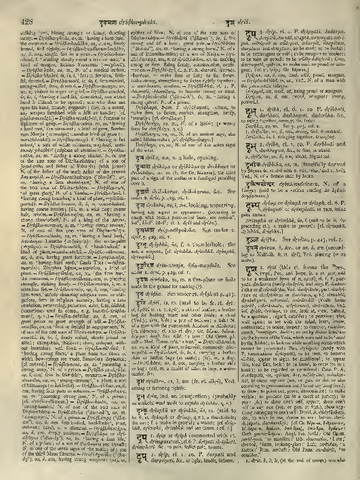
2. dṛś, k, k, k, (at the end of comp.) one who sees or views; seeing, viewing; a seer, overseer, super- intendent; seeing with the mind, discerning, knowing, looking like [cf. ī-d˚, tā-d˚, kī-d˚]; (k), f. seeing, viewing, perceiving; sight, view, the eye; the aspect of a planet, the place in which a planet is observed; [cf. dṛṣṭi, a-d˚, ahar-d˚, tri-d˚, &c.]
Original text · English · Word type unspecified
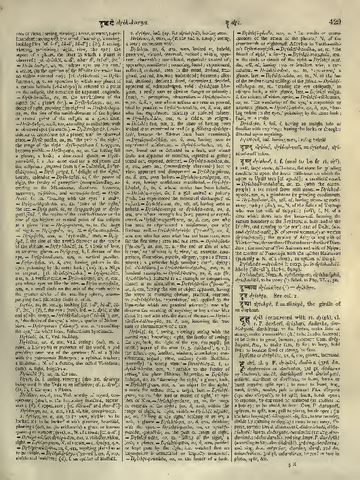
dṛś 1 . dṛś (this rt. forms the Pres., Impf., Pot., and Impv. fr. a rt. paś, said to be a weakened form of rt. spaś), cl. 1. P. paś- yati, dadarśa (rarely dadṛśe, 2nd sing. P. dadar- śitha or dadraṣṭha, Ved. dadṛkṣe, part. dadṛ- śvas or dadṛśivas or darśivas, q. v.), draṣṭā, drakṣyati, adarśat, adrākṣīt (Vedic forms adrāk, adṛkṣata, adṛśram), draṣṭum, Ved. inf. dṛśe, dṛśaye, to see, look at, view, behold, be a spectator; regard, consider; to perceive; visit, wait upon; to see with the mind, learn, know, understand; to notice, inspect; to discover, examine, search, investigate, decide; to see by divine intuition (as the hymns of the Veda, which were said to be ‘seen’ by the Ṛṣis); to look on while anything occurs which cannot be prevented: Pass. dṛśyate (rarely with P. terminations dṛśyati), to be seen, to become visible, appear in sight, be manifested; to appear like, look like, look; to be found, to occur (as in a book); to be regarded or considered: Caus. P. A. darśayati, -te, -yitum, Aor. adīdṛśat, adadar- śat, to cause any one (acc. or gen. or dat. or also according to grammarians inst.) to see anything (acc.); to show; to point out, prove, demonstrate; to make visible; to produce (as in a court of justice); to pay; (A.) to show one's self, appear, show one's self to any one (acc. or gen. or inst.), show any- thing belonging to one's self: Desid. A. didṛkṣate, &c., to wish to see, desire to see: Intens. darī- dṛśyate, dardarṣṭi; [cf. Gr. δέρκ-ω, ἔ-δρακ-ο-ν, δέ-κορκ-α, δράκος, ὑπό-δραξ, ὑπο-δρα, δράκων: Goth. ga-tarh-yan: Angl. Sax. torht: Old Germ. zorht-yan, ‘to manifest:’ Hib. dearcaim, ‘I see;’ dreach, ‘form, looking-glass:’ Lith. zerkolas, ‘a mirror:’ Russ. serkolo: Old Pruss. en-deirit, ‘to consider.’]
Petersburger 1855 adjective · substantive feminine · substantive neuter · Word type unspecified
Original text · German · adjective · substantive feminine
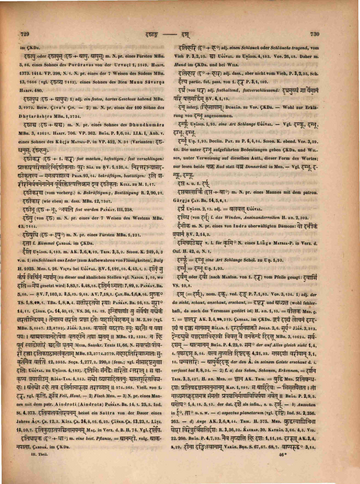
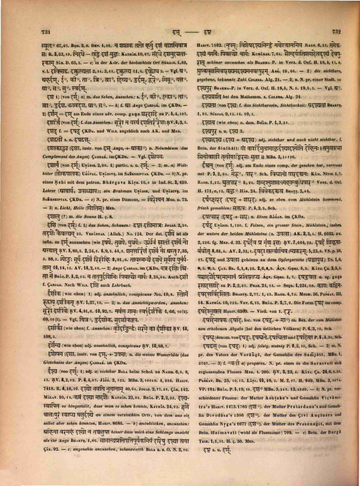
√dṛś (= darś), nom. dṛk, ved. dṛṅ P. 7,1,83. VOP. 3,134. 1〉 adj. der da sieht, schaut, anschaut, erschaut, = draṣṭar und adhyakṣa (wohl fehlerhaft, da auch das Versmaas gestört ist) H. an. 1,15. = vīkṣaka MED. ś. 7. = jñātar AK. 3,4,28,219. ŚABDAR._im_ŚKDR. rūpaṃ dṛśyaṃ locanaṃ dṛgdṛśyaṃ ca dṛkca mānasam BĀLAB. 1. dṛgdarśanaśaktī YOGAS. 2,6. sūrya˚ YĀJÑ. 3,312. aindradyumne yajñadṛśāvihāvāṃ vivakṣū vai janakendraṃ didṛkṣū MBH. 3,10624. sarvadṛśam — ātmānam BHĀG. P. 4,22,9. sama˚ der auf Alles gleich sieht BHĀG. P. 1,4,4. pṛthagdṛś BHĀG. P. 5,14. yasya tuṣyati diṣṭadṛk BHĀG. P. 4,21,22. mantradṛśāṃ varīyān BHĀG. P. 3,1,10. dhanvantariḥ — āyurvedadṛk der den Ā. in seinem Geiste erschaut d. i. verfasst hat BHĀG. P. 8,8,34. — 2〉 f. a〉 das Sehen, Schauen, Erkennen, = darśana TRIK. 3,3,427. H. an. MED. = jñāna AK. TRIK. = buddhi MED. pratibandhadṛśaḥ pratibaddhajñānamanumānam KAP. 1,101. sa ādidevaḥ — sisṛkṣayaikṣata . tāṃ nādhyagacchaddṛśamatra saṃmatāṃ prapañcanirmāṇavidhiryayā bhavet .. BHĀG. P. 2,9,5. amogha˚ BHĀG. P. 1,4,18. BHĀG. P. 1,5,13. der dat. dṛśe als infin., s. u. darś. — b〉 Aussehen in ī˚, tā˚ u. s. w. — c〉 aspectus planetarum (vgl. dṛṣṭi) Ind. St. 2,256. Ind. St. 2,263. — d〉 Auge AK. 2,6,2,44. TRIK. H. 575. MED. kruddhasyāgninibhā ghorā virejurviṃśatirdṛśaḥ R. 3,56,32. CAURAP. 30. KATHĀS. 3,66. KATHĀS. 4,5. VID. 22. VID. 260. BHĀG. P. 4,7,33. naiva tṛpyanti hi dṛśaḥ BHĀG. P. 1,11,26. dṛgruj AK. 3,4,5,29. dīnā dṛṅniḥsvānām VARĀH. BṚH. S. 67,67. VARĀH. BṚH. S. 68,7. vāṣparuddha˚ VARĀH. BṚH. S. 3,14. sthūla˚ VARĀH. BṚH. S. 67,67. BṚH. 2,8. DEV. 4,19. na śaśāka tato hartuṃ dṛśaṃ magnāmivātra saḥ R. 3,52,19. nidadhe — khaṅge dṛśaṃ muhuḥ KATHĀS. 10,67. saṃdadhe dṛśamudagratārakām SĀH. D. 65,3. — e〉 in der Astr. der beobachtete Ort SŪRYAS. 1,63, v. l. dṛksiddha, dṛktulyatā SŪRYAS. 2,14. SŪRYAS. 3,11. dṛktulya SŪRYAS. 11,6. dṛkkrodha SŪRYAS. 3. — Vgl. a˚, ahardṛś, ī˚, kī˚, tā˚, tri˚, tvā˚, divya˚, durdṛś, dūre˚, mithū˚, yakṣa˚, yā˚, sa˚, su˚, svardṛś.
Original text · German · substantive neuter
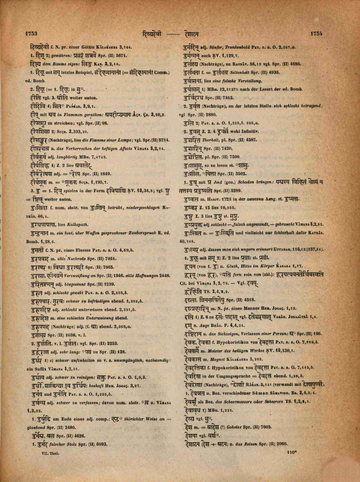
√dṛś n. Auge BHĀG. P. 4,4,24.
Original text · German · Word type unspecified
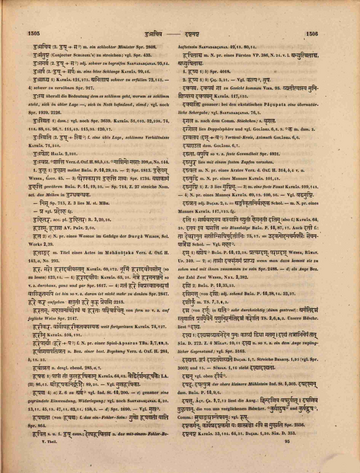
√dṛś 1〉 aśeṣa˚ BHĀG. P. 10,12,28. pratyagdṛś, parāgdṛś WEBER, RĀMAT. UP. 349. — 2〉a〉 tāsāṃ dṛksaṃgamaṃ prāpya wenn man dazu kommt sie zu sehen und mit ihnen zusammen zu sein Spr. 2488. — d〉 als Auge Bez. der Zahl Zwei WEBER, Nax. 2,382.
Böhtlingk 1879 adjective · substantive feminine · substantive neuter
Original text · German · adjective · substantive feminine · substantive neuter
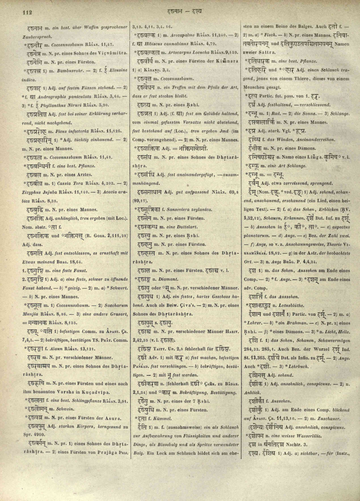
dṛ́ś (Nom. dṛk, *ved. dṛṅ) — 1〉 Adj. sehend, schauend, anschauend, erschauend (ein Lied, einen heiligen Text). — 2〉 f. — a〉 das Sehen, Erblicken (ṚV. 5,52,12), Schauen, Erkennen. dṛśé Dat. Inf. zu darś — b〉 Aussehen in ī˚, kī˚, tā˚. — c〉 aspectus planetarum. — d〉 Auge. — e〉 Bez. der Zahl zwei. — f〉 Auge, so v. a. Anschauungsweise, Theorie VIKRAMĀṄKAC. 18,82. — g〉 in der Astr. der beobachtete Ort. — 3〉 n. Auge BHĀG. P. 4,4,24.
Whitney Roots 1885 verbal root
Original text · English · verbal root
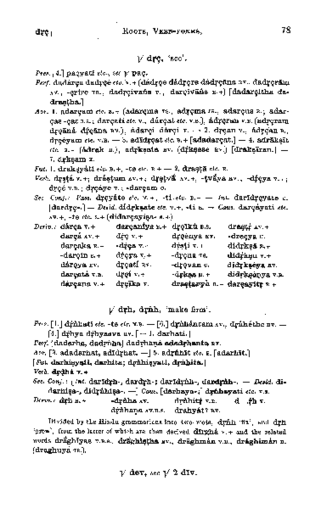
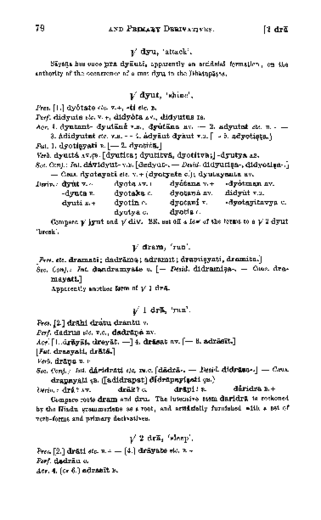
dṛś — see
Apte 1890 adjective · verbal root
Original text · English · adjective
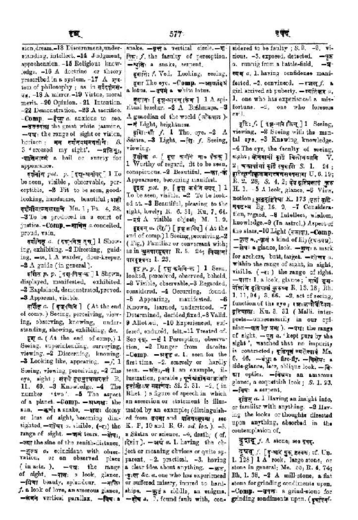
dṛś a. (At the end of comp.) 1 Seeing, superintending, surveying, viewing. 2 Discerning, knowing. 3 Looking like, appearing. — f. 1 Seeing, viewing, perceiving. 2 The eye, sight; saṃdadhe dṛśamudagratārakāṃ R. 11. 69. 3 Knowledge. 4 The number ‘two’. 5 The aspect of a planet. Comp. — adhyakṣaḥ the sun. — karṇaḥ a snake. — kṣayaḥ decay or loss of sight, becoming dimsighted. — gocara a. visible. — (raḥ) the range of sight. — jalaṃ tears. — kṣepaḥ, — jyā the sine of the zenith-distance. — tulya a. coincident with observation, or an observed place (in astr.). — pathaḥ the range of sight. — pātaḥ a look, glance. — priyā beauty, splendour. — bhaktiḥ f. a look of love, an amorous glance. — laṃbanaṃ vertical parallax. — viṣaḥ a ([Page 0577-b]) snake. — vṛttaṃ a vertical circle. — śaktiḥ f. the faculty of perception. — śrutiḥ a snake, serpent.
Original text · English · verbal root
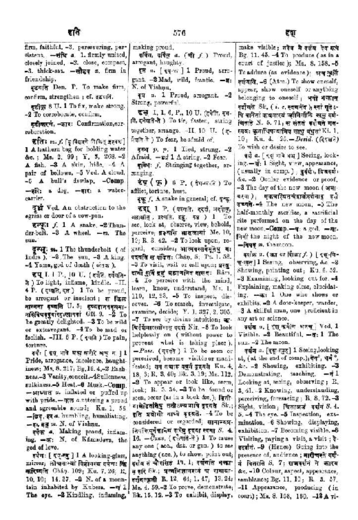
dṛś 1 P. (paśyati, dadarśa, adarśat, adrākṣīt, drakṣyati, draṣṭuṃ, dṛṣṭa) 1 To see, look at, observe, view, behold, perceive; drakṣyasi bhrātṛjāyāṃ Me. 10, Me. 19; R. 3. 42. 2 To look upon, regard, consider; ātmavatsarvabhūteṣu yaḥ paśyati sa paṃḍitaḥ Chāṇ. 5; Pt. 1. 58. 3 To visit, wait or call upon; pratyudyayau muniṃ draṣṭuṃ brahmāṇamiva vāsavaḥ Rām. 4 To perceive with the mind, learn, know, understand; Ms. 1. 110, Ms. 12. 23. 5 To inspect, discover. 6 To search, investigate, examine, decide; Y. 1. 327, Y. 2. 305. 7 To see by divine intuition; ṛṣirdarśanātstomān dadarśa Nir. 8 To look helplessly on (without power to prevent what is taking place). — Pass. (dṛśyate) 1 To be seen or perceived, become visible or manifested; tava taccāru vapurna dṛśyate Ku. 4. 18, Ku. 4. 3; R. 3. 40; Bk. 3. 19; Me. 112. 2 To appear or look like, seem, look; R. 3. 34. 3 To be found or seen, occur (as in a book &c.); dvitīyāmreḍitāṃteṣu tato'nyatrāpi dṛśyate Sk.; iti prayogo bhāṣye dṛśyate. 4 To be considered or regarded; sāmānyapratipattipūrvakamiyaṃ dāreṣu dṛśyā tvayā Ś. 4. 16. — Caus. (darśayati-te) 1 To cause any one (acc., dat. or gen.) to see anything (acc.), to show, point out; darśaya taṃ caurasiṃhaṃ Pt. 1; darśayati bhaktān hariṃ Sk.; pratyabhijñānaratnaṃ ca rāmāyādarśayatkṛtī R. 12. 64; R. 1. 47; R. 13. 24; Ms. 4. 59. 2 To prove, demonstrate; Bk. 15. 12. 3 To exhibit, display, ([Page 0576-c]) make visible; tadeva me darśaya deva rūpaṃ Bg. 11. 45. 4 To produce (as in a court of justice); Ms. 8. 158. 5 To adduce (as evidence); atra śrutiṃ darśayati. 6 (Atm.) To show oneself, appear, show oneself or anything belonging to oneself; bhavo bhaktān darśayate Sk. (i. e. svayameva); svāṃ gṛhe'pi vanitāṃ kathamāsyaṃ thīnimīli khalu darśayitāhe N. 5. 71; sa saṃtataṃ darśayate gatasmayaḥ kṛtādhipatyāmiva sādhu baṃdhutāṃ Ki. 1. 10; Ku. 4. 25. — Desid. (didṛkṣate) To wish or desire to see.
Cappeller 1887 substantive feminine · Word type unspecified
Original text · German · substantive feminine
2. dṛ́ś f. (Nom. dṛk) sehend, schauend; f. das Sehen, Schauen, Erkennen (dṛśé Dat. Inf.); Auge.
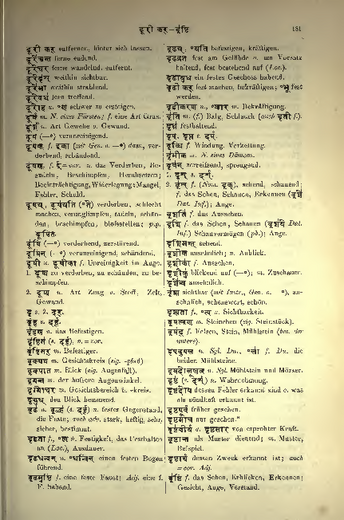
Original text · German · Word type unspecified
1. dṛś s. darś.
Burnouf 1866 verbal root · substantive feminine
Original text · French · verbal root
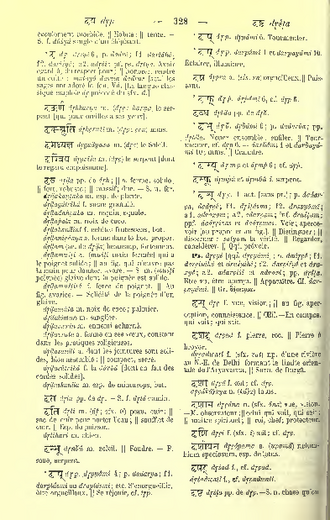
*dṛś dṛś. 1 act. [sans pr.]; p. dadarśa, dadṛśe; f1. dṛṣṭāsmi; f2. drakṣyāmi; a1. adrākṣam; a2. adarśam; inf. draṣṭum; ppf. dadṛśivas et dadṛśvas. Voir; apercevoir [au propre et au fig.]. Distinguer; discerner: satyam la vérité. Regarder, considérer. Qqf. prévoir. Ps. dṛśye [qqf. dṛśyāmi]; p. dadṛśe; f1. darśitāhe et draṣṭāhe; f2. darśiṣye et drakṣye; a2. adarśiṣi et adrakṣi; pp. dṛṣṭa. Etre vu, être aperçu. Apparaître. Cf. darśayāmi. Gr. δέρϰομαι.
Original text · French · substantive feminine
dṛś dṛś f. vue, vision; au fig. aperception, connaissance. Œil. — En compos. qui voit; qui sait.
Derived words
More direct derivatives (1)
Further derivatives (1)
Occurrences in source texts (116)
DYS 8 occurrences
DYS 101–102: Siddhi as Obstacle 2 occurrences
Direct occurrences
HP 12 occurrences
HP 1.15-1.16*2: Factors of Practice 1 occurrence
Occurrences through derived words
-
HP 1.16 Segment 7
5 more source pages
HP 4.5-4.8: Śāmbhavī and Khecarī 2 occurrences
Direct occurrences
HTK 2 occurrences
IVU 3 occurrences
MAN 2 occurrences
MandUp 3 occurrences
PJH 2 occurrences
PYS 22 occurrences
PYS 2.3–9: Five Kleśas 2 occurrences
Direct occurrences
-
PYS 2.6 Segment 1
Occurrences through derived words
-
PYS 2.6 Segment 2
PYS 2.12–14: The Karmic Store 2 occurrences
Direct occurrences
PYS 2.15–17: Everything Is Suffering 2 occurrences
Occurrences through derived words
PYS 2.18–19: The Evolution of Prakṛti 1 occurrence
Occurrences through derived words
-
PYS 2.18 Segment 11
9 more source pages
PYS 2.20–22: Puruṣa and the Seen 3 occurrences
Direct occurrences
-
PYS 2.20 Segment 2
Occurrences through derived words
PYS 3.29–34: Bodily Locations and Knowledge 1 occurrence
Occurrences through derived words
-
PYS 3.32 Segment 4
PYS 3.35–37: Knowledge of Puruṣa and Siddhis 1 occurrence
Occurrences through derived words
-
PYS 3.36 Segment 5
PYS 4.18–21: Puruṣa Knows Citta 2 occurrences
Occurrences through derived words
PYS 4.22-24: Citta as Mirror 2 occurrences
Occurrences through derived words
PYS 4.25–26: Citta Flows toward Kaivalya 1 occurrence
Occurrences through derived words
-
PYS 4.25 Segment 2
SiSa 34 occurrences
SiSa 1.20-1.31: Karma und Erkenntnis 1 occurrence
Occurrences through derived words
-
SiSa 1.28 Segment 7
SiSa 1.32-1.34: Selbst als Ursprung 2 occurrences
Direct occurrences
SiSa 1.82-1.90: Guṇas und Gegenstände 2 occurrences
Direct occurrences
15 more source pages
SiSa 2.44-2.48: Erkenntnisweg 3 occurrences
Direct occurrences
Occurrences through derived words
-
SiSa 2.47 Segment 6
SiSa 3.21-3.31: Nāḍī-Reinigung 2 occurrences
Direct occurrences
-
SiSa 3.28 Segment 4
Occurrences through derived words
-
SiSa 3.27 Segment 8
SiSa 3.41-3.48: Atemkraft und Hindernisse 1 occurrence
Occurrences through derived words
-
SiSa 3.44 Segment 5
SiSa 5.29-5.35: Pratīka-upāsanā 3 occurrences
Direct occurrences
-
SiSa 5.29 Segment 4
Occurrences through derived words
SiSa 5.48-5.71: Innere Meditation 2 occurrences
Direct occurrences
-
SiSa 5.68 Segment 4
Occurrences through derived words
-
SiSa 5.64 Segment 10
SiSa 5.108-5.112: Maṇipūra 3 occurrences
Occurrences through derived words
-
SiSa 5.112 Segment 5
-
SiSa 5.112 Segment 9
-
SiSa 5.112 Segment 13
SiSa 5.113-5.120: Anāhata 4 occurrences
Direct occurrences
-
SiSa 5.115 Segment 4
-
SiSa 5.115 Segment 5
Occurrences through derived words
-
SiSa 5.118 Segment 2
-
SiSa 5.118 Segment 6
SiSa 5.132-5.143: Innere Vārāṇasī 1 occurrence
Occurrences through derived words
-
SiSa 5.133 Segment 6
SiSa 5.182-5.190: Sahasrāra-Mond 1 occurrence
Occurrences through derived words
-
SiSa 5.189 Segment 7
SiSa 5.234-5.252: Tripurā-Mantra 1 occurrence
Occurrences through derived words
-
SiSa 5.242 Segment 10
SS 5 occurrences
SS 1.12–1.16: Stages of Wonder 3 occurrences
Direct occurrences
Occurrences through derived words
-
SS 1.15 Segment 6
SVU 16 occurrences
SVU 1.13-1.16: The Hidden Fire 3 occurrences
Direct occurrences
SVU 3.19-3.21: Beyond the Senses 2 occurrences
Direct occurrences
6 more source pages
VBT 7 occurrences
Continue with AYI Free
Image source: AYI archive.