

na न – not
adjective · adverb · Indeclinable word · particle · previx · pronoun · substantive masculine · Word type unspecified
Dictionary sources
AYI dictionary particle · previx
Cappeller 1891 Indeclinable word · pronoun
Original text · English · pronoun
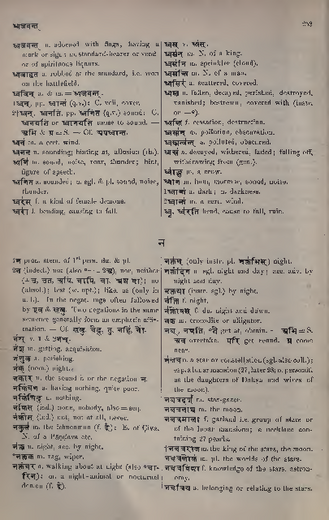
na1 ·pron. stem. of 1^st pers. du. & pl.
Original text · English · Indeclinable word
ná2 ·(indecl.) not (also °-- = a2), nor, neither (±u, utá, api, cāpi, vā, atha vā); no (absol.); lest (w. opt.); like, as (only in a. l.). In the negat. mgs often followed by eva & khalu. Two negations in the same sentence generally form an emphatic affirmation. -- Cf. khalu, ced, tu, nahí, nó.
Monier-Williams 1872 particle · substantive masculine · Word type unspecified
Original text · English · particle
na 2 . na, ind. a particle of negation equi- valent to ‘not,’ ‘no,’ ‘nor,’ ‘neither’ [cf. no, na- nu, na-hi, na-tarām], and in the Veda a particle of comparison; it is used as a negative particle in wishing, requesting, and commanding (e. g. na mā garan nadyaḥ, let not the waters swallow me; nāvaman- yeta kañcana, let him not despise any one), but not in prohibition before an imperative, and not before the aorist when it has lost its augment and stands for an imperative (in both which cases mā, q. v., is used). When joined with the potential, na may often have the sense of ‘that not,’ ‘lest,’ ‘for fear lest’ (e. g. na tvāṃ śapet, lest he should curse thee). In argumentative writings na often comes at the end of a hypothetical argument in the sense ‘not so’ (e. g. nanu na kiñcin mānam iti cen na, now if it be said that there is no proof, not so). Two nas are not unfrequently used in the same sentence to intensify an affirmation (e. g. na khalu na tat kariṣyāmi, I will most certainly do that; na tu jātu na, most assuredly), or any other negative particle may be joined with na with the same effect (e. g. nādaṇḍyo 'sti, he is not to go unpunished, i. e. he must cer- tainly be punished). When a negation has to be repeated in successive clauses of a sentence or in successive sentences, na may be simply repeated or may be strengthened by one of the particles uta, ca, api, cāpi, vā, athavā (e. g. nāham asyāraṇyasya devatā na cāpy asya gireḥ, I am not the deity of this forest nor of this mountain), or the negative is not expressed in the second clause but represented by vā or api vā or ca standing alone (e. g. na hṛṣ- yati glāyati vā, he neither rejoices nor desponds), or two clauses may have the negative particle and not a third (e. g. na deveṣu na Yakṣeṣu mānu- ṣeṣv api cānyeṣu tādṛg rūpavatī dṛṣṭa- pūrvā, neither among gods nor Yakṣas nor other mortals has so beautiful a female been before seen). Na is sometimes placed before round or collective numbers to denote a deficiency, the deficient number being prefixed in the inst. or abl. case (e. g. ekayā or ekena na viṃśatiḥ, not twenty by one, i. e. nine- teen; pañcabhir na catvāri śatāni, 395). When na is the negative of the simple idea expressed by a word, it may be regarded as compounded with it, and is then identical with 3. a, q. v. (e. g. na-vidvas, unwise; nādhīta, unread; na-kiñcana, q. v.) Na is often joined with other particles, e. g. na ca, na cāpi, nāpi, nota, na vā, naiva, na caiva, nāpi ca, na tu, na tveva, na tveva tu, na cet (see ced), na khalu, na ha (after this last a verb is said to retain its accent if used in the future with an imperative sense, Pāṇ. VIII. 1, 31). Na is frequently used in early Vedic composition as a particle of com- parison = ‘like,’ ‘as,’ ‘as it were’ (e. g. tvā nāvaṃ na dhīmahi, we meditate on thee like a boat; cf. 3. a, which also in a few instances = ‘like’); it is also found in this sense in the later artificial poems; [cf. Lat. ne, non; Gr. νη in νη-κηδής; Lith. ne; Slav. ne; Goth. ni, ne, nei; Angl. Sax. na; Old Germ. ni; Hib. ni.]

Original text · English · substantive masculine
na 3 . na, as, m. a N. of Buddha; binding, tying, a band; one who is praised; a N. of Gaṇeśa (= dvi-raṇḍa?); a jewel, pearl; war; giving, a gift; welfare, prosperity; (ā), f. the navel; a musical instrument; knowledge; (as, ā, am), thin, spare; vacant, empty; identical, same, like; unvexed, un- wearied; undivided, unbroken.
Original text · English · Word type unspecified
na 1 . na, the twentieth consonant of the alphabet, and the fifth letter of the fourth or dental class, having much the sound of the English n in tenth.
Original text · English · Word type unspecified
na 4 . na, (in prosody) a tribrach or foot of three short syllables.
Petersburger 1855 particle · substantive masculine · Word type unspecified
Original text · German · particle
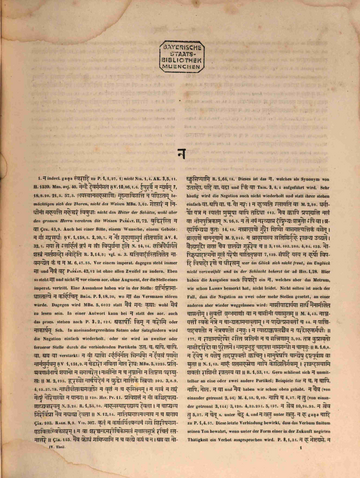
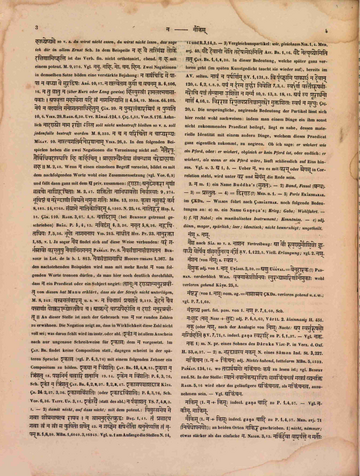
1. na indecl. gaṇa svarādi zu P. 1,1,37. 1〉 nicht NIR. 1,4. AK. 3,5,11. H. 1539. MED. avy. 40. nendràṃ de̱vamàmaṃsata ṚV. 10,86,1. ṚV. 10,86,6. ī̱yurartha̱ṃ na nya̱rtham ṚV. 7,18,9. ṚV. 7,18,20. ṚV. 7,21,5. ṚV. 7,57,3. (bhayasthānasahasrāṇi) mūḍhamāviśanti na paṇḍitam bemächtigen sich des Thoren, nicht des Weisen MBH. 3,62. goptāraṃ na nidhīnāṃ mahayanti maheśvaraṃ vibudhāḥ nicht den Hüter der Schatze, wohl aber den grossen Herrn verehren die Weisen PAÑCAT. II, 72. buddhirasti na vā ŚUK. 43,9. Auch bei einer Bitte, einem Wunsche, einem Gebote: na mā̀ garanna̱dyàḥ ṚV. 1,158,5. ṚV. 2,30,7. na nò gṛ̱hāṇā̱mupà tītapāsi AV. 6,32,1. mayā te 'ntarhitaṃ rūpaṃ na tvāṃ vidyurjanā iti N. 14,14. kṣatriyairdhāryate śastraṃ nārtaśabdo bhavediti R. 3,14,3; vgl. u. 3. ativādāṃstitikṣeta nāvamanyeta kaṃ ca na M. 6,47. M. 6,55. Vor einem imperat. dagegen steht immer mā und naivaṃ vada PAÑCAT. 42,12 ist ohne allen Zweifel zu ändern. Eben so steht mā und nicht na vor einem aor. ohne Augment, der die Stelle eines imperat. vertritt. Eine Ausnahme haben wir in der Stelle: śarmiṣṭhāmādhāstalpe na karhicit BHĀG. P. 9,18,30, wo mā das Versmaass stören würde. Dagegen wird MBH. 5,6032 statt naivaṃ manaḥ kṛthāḥ wohl maivaṃ zu lesen sein. In einer Antwort kann bei na statt des aor. auch das praes. stehen nach P. 3,2,121. akārṣīḥ kim na karomi oder nākārṣam Sch. In aneinandergereihten Sätzen oder Satzgliedern wird die Negation einfach wiederholt, oder sie wird an zweiter oder fernerer Stelle durch die verbindenden Partikeln uta, ca, api, cāpi, vā, atha vā verstärkt: na vā̱ṃ dyāvo 'hàbhi̱rnota sindhàvo̱ na dèva̱tvaṃ pa̱ṇayo̱ nānàśurma̱gham ṚV. 1,151,9. na cedbhāro bhavitā nota rodhaḥ MBH. 5,2225. pratiśravaṇasaṃbhāṣe śayāno na samācaret . nāsīno na ca bhuñjāno na tiṣṭhanna parāṅmukhaḥ .. M. 2,195. dūrastho nārcayedenaṃ na kruddho nāntike striyāḥ M. 202. M. 3,8. M. 3,9. M. 4,15. M. 4,37. M. 4,79. nādhīyītāśvamārūḍho na vṛkṣaṃ na ca hastinam . na nāvaṃ na kharaṃ noṣṭraṃ neriṇastho na yānagaḥ .. M. 120. HIT. Pr. 11. praviśantaṃ na māṃ kaścidapaśyannāpyavārayat N. 3,24. R. 1,54,10. nāhamasyāraṇyasya devatā . na cāpyasya girerviprā naiva nadyāśca devatā .. N. 12,54. nātiśramāpanayanāya na ca śramāya ŚĀK. 103. RAGH. 8,9. VID. 307. kṛtaṃ na karṇārpitabandhanaṃ sakhe śirīṣamāgaṇḍavilambikeśaram . na vā śaraccandramarīcikomalaṃ mṛṇālasūtraṃ racitaṃ stanāntare .. ŚĀK. 145. naiva krodhaṃ gamiṣyāmi na ca vakṣye kathaṃ ca na . atha vā nocchvasiṣyāmi R. 1,64,18. Dieses ist das na, welches als Synonym von utāho, yadi vā, yadvā und kiṃ vā TRIK. 3,4,4 aufgeführt wird. Sehr häufig wird die Negation auch nicht wiederholt und statt ihrer stehen einfach vā, api vā, ca. yo naraḥ . na hṛṣyati glāyati vā M. 2,98. dharmārthau yatra na syātāṃ śuśrūṣā vāpi tadvidhā M. 112. naiva kvāpi prapaśyanti nalaṃ vā bhīmaputrikām N. 16,5. na te bhayaṃ naravyāghra daṃṣṭribhyaḥ śatruto 'pi vā . brahmarṣibhyaśca kutaḥ N. 14,18. nābrāhmaṇe gurau śiṣyo vāsamātyantikaṃ vaset . brāhmaṇe cānanūcāne M. 2,242. na brāhmaṇasya tvatithirgṛhe rājanya ucyate . vaiśyaśūdrau sakhā caiva jñātayo gurureva ca .. M. 3,110. M. 3,103. M. 3,280. M. 4,84. M. 4,133. nocchidyādātmano mūlaṃ pareṣāṃ cātitṛṣṇayā M. 7,139. saṃpadi yasya na harṣo vipadi viṣādo raṇe ca dhīratvam wer im Glück sich nicht freut, im Unglück nicht verzweifelt und in der Schlacht beherzt ist ad HIT. I, 28. Hier haben die Ausgaben nach viṣādo ein na, welches aber das Metrum, wie schon LASSEN bemerkt hat, nicht leidet. Nicht selten ist auch der Fall, dass die Negation an zwei oder mehr Stellen gesetzt, an einer anderen aber wieder weggelassen wird: nāśnīyādbhāryayā sārdhaṃ naināmīkṣeta cāśnatīm . kṣuvatīṃ jṛmbhamāṇāṃ vā na cāsīnāṃ yathāsukham .. M. 4,43. nāñjayantīṃ svake netre na cābhyaktāmanāvṛtām . na paśyetprasavatīṃ ca M. 44. na pāṇipādacapalo na netracapalo 'nṛjuḥ . na syādvākcapalaścaiva na paradrohakarmadhīḥ .. M. 177. na rājñāmaghadoṣo 'sti vratināṃ na ca sattriṇām M. 5,93. tatra kuprāvato nāsīddaridro vā purottame . nāmṛṣṭabhuṅna cādātā nāsugandho na cānṛjuḥ .. R. 1,6,8. na deveṣu na yakṣeṣu tādṛgrūpavatī kvacit . mānuṣeṣvapi cānyeṣu dṛṣṭapūrvātha vā śrutā .. N. 1,13. nāhaṃ śatasahasreṇa nāpi koṭiśatairgavām . rājandāsyāmi śabalāṃ rāśibhī rajatasya vā .. R. 1,53,11. Geru schliesst sich na unmittelbar an eine oder zwei andere Partikel; Beispiele für na ca, na cāpi, nāpi, nota, na vā und naiva haben wir schon oben gehabt. na caiva (von einander getrennt R. 1,2,56) M. 4,55. M. 9,89. nāpi ca M. 4,47. na tu (von einander getrennt M. 3,144) M. 3,120. M. 4,33. M. 4,251. M. 5,157. na tveva M. 10,94. M. 10,95. na tveva tu M. 5,37. na cet s. unter ceṭ 4, und na khalu unter khalu. na ha gaṇa cāṭi zu P. 1,4,57. Diese letzte Verbindung bewirkt, dass das Verbum finitum seinen Ton bewahrt, wenn unter der Form einer in der Zukunft negirten Thätigkeit ein Verbot ausgesprochen wird. P. 8,1,31. na ha bhokṣyase, na hādhyeṣyase so v. a. du wirst nicht essen, du wirst nicht lesen, das sage ich dir in allem Ernst Sch. In dem Beispeile na ha vai tasmiṃśca loke dakṣiṇāmicchanti ist das Verb. fin. nicht orthotonirt, ebend. na ha mit einem potent. M. 9,270. Vgl. nanu, nahi, no, cana, hina. Zwei Negationen in demselben Satze bilden eine verstärkte Bejahung: na kathaṃciddhi me pāpā na vadhyā ye suradviṣaḥ ARJ. 10,17. na khalvetanna kuryāṃ ca vacanam R. 6,106,16. na tu jātu na (über Kurz oder Lang gewiss) hiṃsyustvāṃ rāmalakṣmaṇasāyakāḥ . apavṛttā mahāvegā yadi tvaṃ nāgamiṣyasi .. R. 4,54,19. MEGH. 64. MEGH. 105. neyaṃ na vakṣyati manogatamādhihetum ŚĀK. 59. na punaralaṃkāraśriyaṃ na puṣyati ŚĀK. 10,6. VIKR. 29. RAGH. 6,30. UTT. RĀMAC. 124,5. ŚIŚ. 1,55. VOP. S. 176. Aehnlich nādaṇḍyo nāma rājño 'sti soll nicht unbestraft bleiben so v. a. soll jedenfalls bestraft werden M. 8,335. na ca na paricito na cāpyaramyaḥ MĀLAV. 10. nāstyagatirmanorathānām VIKR. 26,3. In den folgenden Beispielen heben die zwei Negationen die Verneinung nicht auf: naitairapūtairvidhivadāpadyapi hi karhicit . brāhmānyaunāṃśca saṃbandhānna caredbrāhmaṇaḥ saha .. M. 2,40. Wenn na einen einzelnen Begriff verneint, bildet es mit dem nachfolgenden Worte wohl eine Zusammensetzung (vgl. VOP. 6,9) und fallt dann ganz mit dem a priv. zusammen: (daṇḍāḥ) anudvegakarā nṝṇāṃ satvaco nāgnidūṣitāḥ M. 2,47. śaktito nābhidhāvanto nirvāsyāḥ M. 9,274. bhūyiṣṭhaṃ ca narendrāṇāṃ vidyate naśubhā gatiḥ MBH. 13,3932. kṛtvā nasukaraṃ karma MBH. 8,185. MBH. 14,1768. saṃgrāme nātikovidam MBH. 4,1303. N. 25,16. nātidūre HIḌ. 1,51. ŚĀK. 110. RAGH. 3,67. RAGH. 4,8. natadvidām (bei BURNOUF getrennt geschrieben) BHĀG. P. 5,4,13. navidvaṃs BHĀG. P. 6,3,30. namṛta BHĀG. P. 5,8,26. nadūṣitadhiyaḥ BHĀG. P. 7,5,56. bhūyo nāgamanāya VID. 215. nādhīta HIT. Pr. 23. nānuraktā HIT. I, 85, v. l. Ja sogar naiva findet sich auf diese Weise verbunden: varaṃ garbhasrāvo varamṛtuṣu naivābhigamanam PAÑCAT. Pr. 8. naivasaṃjñānāsaṃjñāyatana BURNOUF_in_Lot. de la b. l. 813. naivasaṃjñāsamādhi HIOUEN-THSANG I, 367. In den nachstehenden Beispielen wird man mit mehr Recht na vom folgenden Worte trennen dürfen, da man hier noch deutlich durchfühlt, dass na ein Praedicat oder ein Subject negirt: (tān) na daṇḍyānmanurabravīt von diesen hat Manu erklärt, dass sie der Strafe nicht unterlägen, M. 8,242. vastramalaṃkāram u. s. w. na vibhājyaṃ pracakṣate M. 9,219. chedane caiva yantrāṇāṃ yoktraraśmyostathaiva ca . ākrande cāpyapaihīti na daṇḍaṃ manurabravīt .. An dieser Stelle ist auch der Gebrauch von na vor runden Zahlen zu erwähnen. Die Negation zeigt an, dass in Wirklichkeit diese Zahl nicht voll sei; was daran fehlt wird im instr. oder abl. (ekāṃ na ist allem Anschein nach nur ungenaue Schreibweise für ekānna) dem na vorgesetzt. im ŚAT. BR. findet keine Composition statt, dagegen scheint in der späteren Sprache ekānna (vgl. P. 6,3,76) mit einem folgenden Zehner ein Compositum zu bilden. e̱kayā na̱ viṃśati̱ḥ ŚAT. BR. 10,4,3,15. e̱kayā na̱ triṃśa̱t 18. pañca̱bhirna̱ catvā̱ri śatā̱ni ŚAT. BR. 19. ŚAT. BR. 14. ekena na viṃśatiḥ P. 6,3,76, Sch. e̱kāṃ na̱ triṃśa̱t ŚAT. BR. 6,2,2,37. ŚAT. BR. 9,2,3,47. ekānnapañcāśadrātra KĀTY. ŚR. 24. ŚR. 2,37. ŚR. 3,36. ekānnaviṃśatiḥ (oder ekādbhaviṃśatiḥ) P. 6,3,76, Sch. VOP. 6,36. TAITT. UP. 3,11. ekàsyai̱ (statt des abl.) na pàñcā̱śat TS. 7,4,7,3. TS. 7,4,7,1. — 2〉 damit nicht, auf dass nicht; mit dem potent.: pitustvameva me gatvā śīghramācakṣva rāghava . na tvāmanudahetkruddhaḥ DAŚ. 1,41. taṃ prasādaya gatvā tvaṃ na tvāṃ sa kupito śapet DAŚ. 1,42. na gacchema ṛṣerbhītā anuneṣyanti taṃ nṛpam R. 1,8,20. MBH. 1,6040. MBH. 3,16945. Vgl. u. 1 am Anfange die Stellen N. 14,14 und R. 3,14,3. — 3〉 Vergleichunspartikel: wie, gleichsam NIR. 1,4. MED. avy. 40. yadvai devānāṃ neti tadeṣāmo3miti AIT. BR. 1,16. yadvai netyṛcyomiti tat ŚAT. BR. 1,4,1,30. In dieser Bedeutung, welche später ganz verloren geht (im späten Kunstgedicht taucht sie wieder auf), bereits im AV. selten. nāva̱ṃ na pa̱rṣaṇìm ṚV. 1,131,2. vi pṛ̀cchāmi pā̱kyā̱3̱̀ na de̱vān ṚV. 120,4. ṚV. 6,2,1. ṚV. 1,8. ṚV. 1,9. yava̱ṃ na dàsma ju̱hvā̀ vivekṣi ṚV. 7,3,4. sva1̱̀rṇa vastòru̱ṣasā̀maroci ya̱jñaṃ tànvā̱nā u̱śijo̱ na manmà ṚV. 10,2. ṚV. 13,3. ṚV. 18,15. avà sya śū̱rādhvàno̱ nāntè ṚV. 4,16,2. virarāja ripukṣayapratijñāmukharo muktaśikhaḥ svayaṃ na mṛtyuḥ ŚIŚ. 20,4. Die ursprüngliche, negirende Bedeutung der Partikel lässt sich hier recht wohl nachweisen: indem man einem Dinge ein ihm sonst nicht zukommendes Praedicat beilegt, liegt es nahe, dessen materielle Identität mit einem andern Dinge, welchem dieses Praedicat ganz eigentlich zukommt, zu negiren. Ob ich sage: er wiehert wie ein Pferd, oder: er wiehert, obgleich er kein Pferd ist, oder endlich: er wiehert, als wenn er ein Pferd wäre, läuft schliesslich auf Eins hinaus. Vgl. u. 3. a 1,b. — Ueber na, wo es mit varam oder śreyas in Correlation steht, wird unter vara und śreyaṃs die Rede sein.
Original text · German · substantive masculine
2. na m. 1〉 ein Name Buddhaʼs (sugata). — 2〉 Band, Fessel (bandha). — 3〉 = prastuta. — 4〉 = dviraṇḍa (?) MED. n. 1. — 5〉 Perle EKĀKṢARAK._im_ŚKDR. — WILSON führt nach ŚABDĀRTHAK. noch folgende Bedeutungen an: a〉 m. ein Name Gaṇeśaʼs; Krieg; Gabe; Wohlfahrt. — b〉 f. nā Nabel; ein musikalisches Instrument; Kenntniss. — c〉 adj. -dünn, mager, spärlich; leer; identisch; nicht beunruhigt; ungetheilt.
Original text · German · Word type unspecified
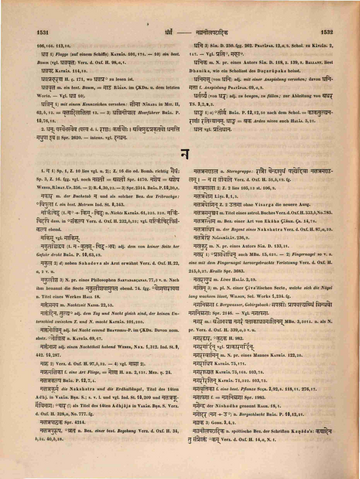
1. na 1〉 Sp. 1, Z. 10 lies vgl. u. 2〉; Z. 16 die ed. Bomb. richtig maivaṃ; Sp. 3, Z. 16. fgg. vgl. noch nasatī = asatī Spr. 4170. naśeṣa = aśeṣa WEBER, RĀMAT. UP. 356. — 2〉 R. 4,30,22. — 3〉 Spr. 2514. BHĀG. P. 10,20,8.
Böhtlingk 1879 adjective · adverb · particle · substantive masculine · Word type unspecified
Original text · German · adjective · substantive masculine
3. *na — 1〉 Adj. — a〉 dünn, mager, spärlich. — b〉 leer. — c〉 identisch. — d〉 nicht beunruhigt. — e〉 ungetheilt. — 2〉 m. — a〉 Band, Fessel. — b〉 Perle. — c〉 Krieg. — d〉 Gabe. — e〉 Wohlfahrt. — f〉 ein Name Buddhaʼs und Gaṇeśaʼs. — g〉 = prastuta. — h〉 = dviraṇḍa. — 3〉 f. nā — a〉 Nabel. — b〉 ein musikalisches Instrument. — c〉 Kenntniss.
Original text · German · adverb · particle
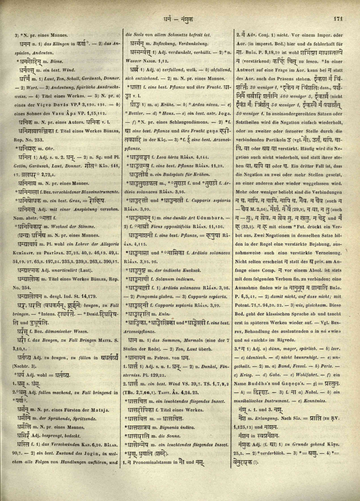
2. ná Adv. Conj. — 1〉 nicht. Vor einem Imper. oder Aor. (in imperat. Bed.) hier und da fehlerhaft für mā. BHĀG. P. 9,18,30 ist wohl śarmiṣṭhā mādhāstalpe na (verstärkend) karhi cit zu lesen. *In einer Antwort auf eine Frage im Aor. kann bei na statt des Aor. auch das Präsens stehen. ékayā ná viṃśatíḥ 20 weniger 1, *ekena na viṃśatiḥ dass., pañcábhíná catvā́ri śatā́ni 400 weniger 5, ékānná (nicht ékāṃ ná) triṃśát 30 weniger 1, ékasyai ná pañcāśát 50 weniger 1. In aneinander gereihten Sätzen oder Satztheilen wird die Negation einfach wiederholt, oder an zweiter oder fernerer Stelle durch die verbindenden Partikeln u (Vgl. nó), utá, api, cāpi, vā oder atha vā verstärkt. Häufig wird die Negation auch nicht wiederholt, und statt ihrer stehen vā, api vā oder ca. Ein dritter Fall ist, dass die Negation an zwei oder mehr Stellen gesetzt, an einer anderen aber wieder weggelassen wird. Mehr oder weniger beliebt sind die Verbindungen na ca, nāpi, na cāpi, nāpi ca, naiva, na caiva (auch na — caiva M. 2,56), nóta, návaí (Chr. 20,9), na vā, na tu (auch na — tu), na tveva, na tveva tu, na khalu, na ced und ná ha (Chr. 33,2). na ha mit einem *Fut. drückt ein Verbot aus. Zwei Negationen in demselben Satze bilden in der Regel eine verstärkte Bejahung, ausnahmsweise auch eine verstärkte Verneinung. Nicht selten erscheint na statt des a priv. am Anfange eines Comp. na vor einem Absol. ist stets mit dem folgenden Verbum fin. zu verbinden; einen Ausnahme finden wir in nānubhūya na jānāti BHĀG. P. 6,5,41. — 2〉 damit nicht, auf dass nicht; mit Potent. Chr. 71,7. Chr. 94,30. Chr. 94,32. — 3〉 wie, gleichsam. Diese Bed. geht der klassischen Sprache ab und taucht erst in späteren Werken wieder auf. Vgl. BENFEY, Behandlung des auslautenden a in ná «wie» und ná «nicht» im Rigveda.
Original text · German · substantive masculine
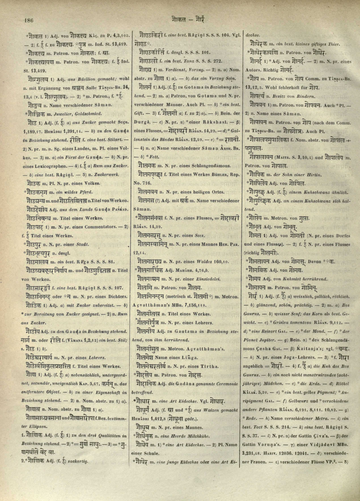
gauḍābhinanda oder na m. N. pr. eines Dichters.
Original text · German · Word type unspecified
1. na Pronominalstamm in nau und nas.
Original text · German · Word type unspecified
2. na III. auch nein. [Nachtrag, Band 7]
Apte 1890 adjective · particle · substantive masculine
Original text · English · adjective · particle · substantive masculine
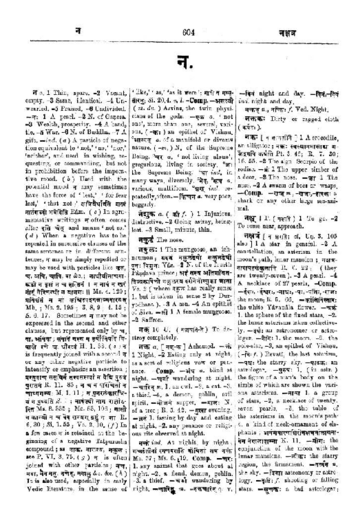
na a. 1 Thin, spare. 2 Vacant, empty. 3 Same, identical. 4 Unwearied. 5 Praised. 6 Undivided. — naḥ 1 A pearl. 2 N. of Gaṇeśa. 3 Wealth, prosperity. 4 A band, tie. 5 War. 6 N. of Buddha. 7 A gift. — ind. (a) A particle of negation equivalent to ‘not,’ ‘no,’ ‘nor,’ ‘neither’, and used in wishing, requesting, or commanding, but not in prohibition before the imperative mood. (b) Used with the potential mood na may sometimes have the force of ‘lest,’ ‘for fear lest,’ ‘that not;’ kṣatriyairdhāryate śastraṃ nārtaśabdo bhavediti Rām. (c) In agrumentative writings na often comes after iti cet and means ‘not so.’ (d) When a negative has to be repeated in successive clauses of the same sentence or in different sentences, na may be simply repeated or may be used with particles like uta, ca, api, cāpi, vā &c.; nādhīyītāśvamārūḍho na vṛkṣaṃ na ca hastinaṃ . na nāvaṃ na kharaṃ noṣṭraṃ neriṇattho na yānagaḥ .. Ms. 4. 120; praviśaṃtaṃ na māṃ kaścidapaśyannāpyavārayat Mb.; Ms. 2. 195; Ms. 3. 8, Ms. 3. 9; Ms. 4. 15; Ś. 6. 17. Sometimes na may not be expressed in the second and other clauses, but represented only by ca, vā, apivā; saṃpadi yasya na harṣovipadi viṣādo raṇe ca dhīratvaṃ H. 1. 33. (e) na is frequently joined with a second na or any other negative particle to intensify or emphasize an assertion; pratyuvāca tamṛṣirna tattvatastvāṃ na vedmi puruṣaṃ purātanaṃ R. 11. 85; na ca na paricito na cāpyagamyaḥ M. 1. 11; na punaralaṃkāraśriyaṃ na puṣyati Ś. 1; nādaṃḍyo nāma rājño'sti Ms. 8. 335; Me. 63, Me. 106; nāsau na kāmyo na ca veda samyag draṣṭuṃ na sā R. 6. 30; Śi. 1. 55; Ve. 2. 10. (f) In a few cases na is retained at the beginning of a negative Tatpuruṣa compound; as nāka, nāsatya, nakula; see P. VI. 3. 75. (g) na is often joined with other particles; naca, navā, naiva natu, naced, nakhalu &c. &c. (h) It is also used, especially in early Vedic literature, in the sense of ([Page 0604-b]) ‘like,’ ‘as,’ ‘as it were’; gāvo na gavyūtīranu; Śi. 20. 4. v. l. Comp. — asatyau (m. du.) Aśvins, the twin physicians of the gods. — eka a. ‘not one’, more than one, several, various. — (kaḥ) an epithet of Viṣṇu. ˚ātman a. of a manifold or diverse nature. ( — m.) N. of the Supreme Being. ˚cara a. ‘not living alone’, gregarious, living in society. ˚jaḥ the Supreme Being. ˚dhā ind. in many ways, diversely. ˚bheda, ˚rūpa a. various, multiform. ˚śas ind. repeatedly, often. — kiṃcana a. very poor, beggarly.
Cappeller 1887 pronoun · Word type unspecified
Original text · German · pronoun
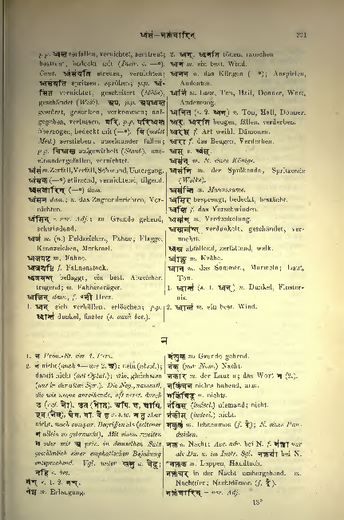
1. na Pron-St. der 1. Pers.
Original text · German · Word type unspecified
2. ná ná nicht (auch ˚— wie 2. a) nein (absol); damit nicht (mit Optat.); wie, gleichsam (nur in der alten Spr). Die Neg., namentl. die wie neque anreihende, oft verst. durch u (vgl. no), uta (nota), api, ca, cāpi, eva (naiva), caiva, vā, vai ha u.s.w. natu aber nicht, nach compar. Begriffen aks (seltener na alleun so gebraucht). Mit einem zweiten na oder mit a priv. in demselben Satz gewöhnlich einer emphatischen Bejahung entsprechend. Vgl. unter khalu u. ced; nahi s. bes.
Burnouf 1866 adjective · substantive masculine · Word type unspecified
Original text · French · adjective
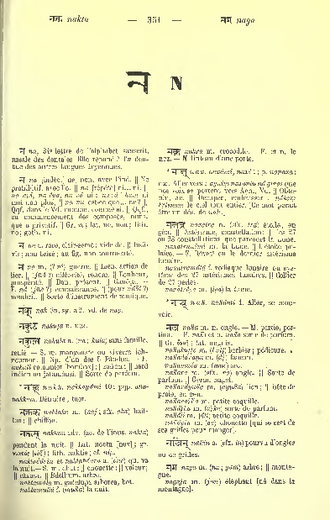
na na a. rare, clair-semé; vide de. Indivis; non brisé; au fig. non tourmenté.
Original text · French · substantive masculine
na na m. (? nī) guerre. Lien, action de lier. (jñā ?) célébrité, renom. Bonheur, prospérité. Don, présent. Gaṇeśa. — F. nā (jñā ?) connaissance. (pour nābhi ?) nombril. Sorte d'instrument de musique.
Original text · French · Word type unspecified
na na, 34ᵉ lettre de l'alphabet sanscrit, nasale des dentales. Elle répond à l' n dentale des autres langues âryennes.
Original text · French · Word type unspecified
na na [indéc.] ne, non, avec l'ind. Ne prohibitif, avec l'o. na [répété] ni..ni. na api, na eva, na vā ni: naivā' ham ni moi non plus, na nu est-ce qui...ne? Qqf. dans le Vd. comme, comme si. Qqf., au commencement des composés, mms. que a privatif. Gr. νη; lat. ne, non; lith. ne; goth. ni.
Occurrences in source texts (429)
DYS 45 occurrences
DYS 43–49: False Yogis 3 occurrences
Direct occurrences
16 more source pages
DYS 79–83: Power and Bhūcarasiddhi 2 occurrences
Direct occurrences
DYS 101–102: Siddhi as Obstacle 2 occurrences
Direct occurrences
DYS 103–105: Students as Obstacle 2 occurrences
Direct occurrences
DYS 112–121: Five Elements 7 occurrences
Direct occurrences
DYS 154–167: Vajrolī for the Male Yogi 6 occurrences
Direct occurrences
DYS 168–179*1: Vajrolī for the Yoginī 4 occurrences
Direct occurrences
DYS 184–187: Rāja Yoga and Perfection 3 occurrences
Direct occurrences
GoS 14 occurrences
GoS 1–8: Learning and Liberation 5 occurrences
Direct occurrences
HP 99 occurrences
HP 1.33-1.43: Siddhāsana 4 occurrences
Direct occurrences
27 more source pages
HP 2.54-2.56: Sītkārī 3 occurrences
Direct occurrences
HP 2.72-2.78: Kevala Kumbhaka 3 occurrences
Direct occurrences
HP 3.10-3.18: Mahāmudrā 3 occurrences
Direct occurrences
HP 3.33-3.48*1: Khecarī and Soma 12 occurrences
Direct occurrences
HP 3.58-3.65: Uḍḍiyāna Bandha 2 occurrences
Direct occurrences
HP 3.66-3.72: Jālandhara and the Bandhas 3 occurrences
Direct occurrences
HP 3.73-3.78: Viparīta Karaṇī 2 occurrences
Direct occurrences
HP 3.87-3.93*7: Sahajolī and Amarolī 3 occurrences
Direct occurrences
HP 3.103-3.107*2: Conclusion of the Mudrā Teaching 2 occurrences
Direct occurrences
HP 4.0*1-4.0*14: Samādhi and Laya 3 occurrences
Direct occurrences
HP 4.9-4.11*4: Gaze and Lunar Nectar 4 occurrences
Direct occurrences
HP 4.11*5-4.11*14: Khecarī in Space 4 occurrences
Direct occurrences
-
HP 4.11*6 Segment 14
-
HP 4.11*8 Segment 15
-
HP 4.11*12 Segment 13
-
HP 4.11*13 Segment 15
HP 4.11*15-4.11*28: Space and Laya 6 occurrences
Direct occurrences
-
HP 4.11*15 Segment 4
-
HP 4.11*16 Segment 7
-
HP 4.11*20 Segment 16
-
HP 4.11*22 Segment 3
-
HP 4.11*22 Segment 13
-
HP 4.11*25 Segment 14
HP 4.35*1-4.36: Signs of Samādhi 19 occurrences
Direct occurrences
-
HP 4.35*2 Segment 5
-
HP 4.35*3 Segment 13
-
HP 4.35*4 Segment 1
-
HP 4.35*4 Segment 6
-
HP 4.35*4 Segment 8
-
HP 4.35*4 Segment 12
-
HP 4.35*4 Segment 14
-
HP 4.35*5 Segment 1
-
HP 4.35*5 Segment 3
-
HP 4.35*5 Segment 6
-
HP 4.35*5 Segment 8
-
HP 4.35*5 Segment 12
-
HP 4.35*5 Segment 14
-
HP 4.35*7 Segment 2
-
HP 4.35*7 Segment 4
-
HP 4.35*7 Segment 7
-
HP 4.35*7 Segment 8
-
HP 4.35*7 Segment 12
-
HP 4.35*7 Segment 15
HP 4.37-4.46: Listening to Nāda 3 occurrences
Direct occurrences
HP 4.47-4.55*4: Nāda Binds the Mind 2 occurrences
Direct occurrences
HP 4.56-4.66: The Middle Path 5 occurrences
Direct occurrences
HTK 3 occurrences
IVU 5 occurrences
MandUp 9 occurrences
MandUp 3-7: Four modes of awareness 8 occurrences
Direct occurrences
PJH 2 occurrences
PYS 3 occurrences
SiSa 169 occurrences
SiSa 1.1-1.3: Das eine Wissen 2 occurrences
Direct occurrences
SiSa 1.10-1.16: Lehrmeinungen 2 occurrences
Direct occurrences
SiSa 1.20-1.31: Karma und Erkenntnis 3 occurrences
Direct occurrences
SiSa 1.32-1.34: Selbst als Ursprung 2 occurrences
Direct occurrences
SiSa 1.35-1.44: Täuschungs-Gleichnisse 4 occurrences
Direct occurrences
55 more source pages
SiSa 1.51-1.64: Selbst als Licht 11 occurrences
Direct occurrences
SiSa 1.65-1.70: Māyā-Aufhebung 4 occurrences
Direct occurrences
SiSa 1.71-1.81: Avidyā und Elemente 3 occurrences
Direct occurrences
SiSa 1.82-1.90: Guṇas und Gegenstände 3 occurrences
Direct occurrences
SiSa 1.91-1.92: Wahres Wissen 2 occurrences
Direct occurrences
SiSa 2.41-2.43: Māyā-Projektion 3 occurrences
Direct occurrences
SiSa 2.44-2.48: Erkenntnisweg 5 occurrences
Direct occurrences
SiSa 2.49-2.54: Befreiungswissen 4 occurrences
Direct occurrences
SiSa 3.1-3.10: Herzlotus und Prāṇa 2 occurrences
Direct occurrences
SiSa 3.11-3.16: Guru und Śraddhā 3 occurrences
Direct occurrences
SiSa 3.17-3.20: Praxisbeginn 3 occurrences
Direct occurrences
SiSa 3.21-3.31: Nāḍī-Reinigung 2 occurrences
Direct occurrences
SiSa 3.34-3.38: Förderliche Mittel 2 occurrences
Direct occurrences
SiSa 3.41-3.48: Atemkraft und Hindernisse 2 occurrences
Direct occurrences
SiSa 3.55-3.60: Ghaṭāvasthā 3 occurrences
Direct occurrences
SiSa 3.61-3.67: Paricaya und Niṣpatti 2 occurrences
Direct occurrences
SiSa 3.81-3.83: Freiheit von Wiederkehr 5 occurrences
Direct occurrences
SiSa 4.1-4.8: Yonimudrā-Kreislauf 3 occurrences
Direct occurrences
SiSa 4.9-4.20: Yonimudrā-Geheimnis 4 occurrences
Direct occurrences
SiSa 4.31-4.36: Mahāmudrā-Wirkung 2 occurrences
Direct occurrences
SiSa 4.43-4.50: Mahāvedha 3 occurrences
Direct occurrences
SiSa 4.51-4.59: Khecarīmudrā 2 occurrences
Direct occurrences
SiSa 4.81-4.90: Bindu-Bewahrung 2 occurrences
Direct occurrences
SiSa 4.95-4.100: Sahajolī und Amarolī 3 occurrences
Direct occurrences
-
SiSa 4.99 Segment 11
-
SiSa 4.100 Segment 4
-
SiSa 4.100 Segment 6
SiSa 4.101-4.104: Bindu-Siddhi 2 occurrences
Direct occurrences
-
SiSa 4.103 Segment 14
-
SiSa 4.104 Segment 6
SiSa 4.105-4.111: Śakticālana 4 occurrences
Direct occurrences
-
SiSa 4.110 Segment 6
-
SiSa 4.111 Segment 5
-
SiSa 4.111 Segment 7
-
SiSa 4.111 Segment 15
SiSa 5.17-5.20: Madhya und Layayoga 2 occurrences
Direct occurrences
SiSa 5.24-5.28: Adhimātratama 2 occurrences
Direct occurrences
SiSa 5.29-5.35: Pratīka-upāsanā 2 occurrences
Direct occurrences
SiSa 5.38-5.47: Nāda-Laya 4 occurrences
Direct occurrences
SiSa 5.48-5.71: Innere Meditation 4 occurrences
Direct occurrences
SiSa 5.94-5.101: Mūlādhāra-Siddhis 4 occurrences
Direct occurrences
-
SiSa 5.94 Segment 21
-
SiSa 5.97 Segment 11
-
SiSa 5.99 Segment 13
-
SiSa 5.101 Segment 13
SiSa 5.113-5.120: Anāhata 2 occurrences
Direct occurrences
-
SiSa 5.119 Segment 14
-
SiSa 5.120 Segment 5
SiSa 5.121-5.127: Viśuddha 2 occurrences
Direct occurrences
-
SiSa 5.124 Segment 14
-
SiSa 5.126 Segment 2
SiSa 5.144-5.155: Ājñā und Khecarī 2 occurrences
Direct occurrences
-
SiSa 5.153 Segment 14
-
SiSa 5.155 Segment 6
SiSa 5.156-5.181: Sahasrāra 7 occurrences
Direct occurrences
-
SiSa 5.161 Segment 12
-
SiSa 5.162 Segment 10
-
SiSa 5.163 Segment 5
-
SiSa 5.164 Segment 15
-
SiSa 5.175 Segment 15
-
SiSa 5.177 Segment 1
-
SiSa 5.177 Segment 12
SiSa 5.191-5.207: Kailāsa und Mahāśūnya 5 occurrences
Direct occurrences
-
SiSa 5.193 Segment 9
-
SiSa 5.203 Segment 14
-
SiSa 5.205 Segment 3
-
SiSa 5.206 Segment 6
-
SiSa 5.207 Segment 14
SiSa 5.208-5.222: Rājayoga 6 occurrences
Direct occurrences
-
SiSa 5.210 Segment 11
-
SiSa 5.211 Segment 7
-
SiSa 5.212 Segment 12
-
SiSa 5.213 Segment 18
-
SiSa 5.218 Segment 6
-
SiSa 5.222 Segment 10
SiSa 5.223-5.233: Praxis im Leben 8 occurrences
Direct occurrences
-
SiSa 5.223 Segment 6
-
SiSa 5.223 Segment 15
-
SiSa 5.224 Segment 7
-
SiSa 5.226 Segment 9
-
SiSa 5.227 Segment 14
-
SiSa 5.228 Segment 13
-
SiSa 5.229 Segment 12
-
SiSa 5.231 Segment 3
SiSa 5.234-5.252: Tripurā-Mantra 5 occurrences
Direct occurrences
-
SiSa 5.237 Segment 5
-
SiSa 5.237 Segment 7
-
SiSa 5.244 Segment 13
-
SiSa 5.247 Segment 5
-
SiSa 5.252 Segment 18
SVU 44 occurrences
SVU 1.13-1.16: The Hidden Fire 2 occurrences
Direct occurrences
SVU 2.12-2.13: Signs of the Fire of Yoga 3 occurrences
Direct occurrences
8 more source pages
SVU 3.7-3.9: The Supreme Puruṣa 4 occurrences
Direct occurrences
SVU 4.17-4.22: Knowledge and Protection 10 occurrences
Direct occurrences
SVU 5.7–5.11: The Wandering Self 4 occurrences
Direct occurrences
SVU 6.7–6.13: Lord of All Lords 8 occurrences
Direct occurrences
SVU 6.14–6.17: Light and Immortality 5 occurrences
Direct occurrences
VBT 36 occurrences
VBT 11–13: Fixations Rejected 7 occurrences
Direct occurrences
8 more source pages
VBT 93–100: Pain and Desire 5 occurrences
Direct occurrences
VBT 101–109: Śiva-Identity 5 occurrences
Direct occurrences
VBT 121–129: Devotion and Release 4 occurrences
Direct occurrences
VBT 130–138: Name and Fourfoldness 2 occurrences
Direct occurrences
Continue with AYI Free
Image source: AYI archive.