

ga ग – going; entering; situated
adjective · substantive masculine · substantive neuter · Word type unspecified
Dictionary sources
AYI dictionary adjective
going; entering; situated
Cappeller 1891 adjective
Original text · English · adjective
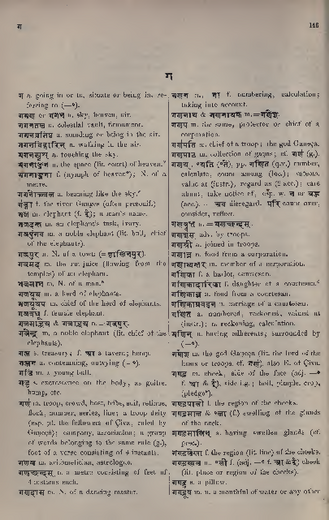
ga ·a. going in or to, situate or being in, referring to (--°).
Monier-Williams 1872 adjective · substantive masculine · Word type unspecified
Original text · English · adjective
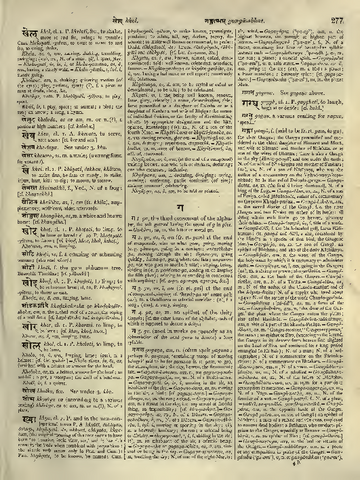
ga 2 . ga, as, ā, am (fr. rt. gam) at the end of compounds, who or what goes, going, moving (e. g. yāna-ga, going in a carriage; antarīkṣa- ga, moving through the air; śīghra-ga, going quickly; kāma-ga, going where one lists; anyastrī- ga, one who goes to another's wife); staying, being, abiding in (e. g. pañcama-ga, abiding in or keeping the fifth place); relating to or standing in connection with anything; [cf. a-ga, agra-ga, agre-ga, &c.]
Original text · English · adjective
ga 3 . ga, as, ī, am (fr. rt. gai) at the end of compounds, singing [cf. chando-ga and sāma-ga]; (as), m. a Gandharva or celestial musician; (ā), f. a song; (am), n. song, singing.
Original text · English · substantive masculine
ga 4 . ga, as, m. an epithet of the deity Gaṇeśa; [cf. the other letters of the alphabet, each of which is supposed to denote a deity.]
Original text · English · Word type unspecified
ga 1 . ga, the third consonant of the alpha- bet, the soft guttural having the sound of g in give.
Original text · English · Word type unspecified
ga 5 . ga, (used in works on prosody as an abbreviation of the word guru to denote) a long syllable.
Petersburger 1855 adjective · substantive masculine · substantive neuter · Word type unspecified
Original text · German · adjective
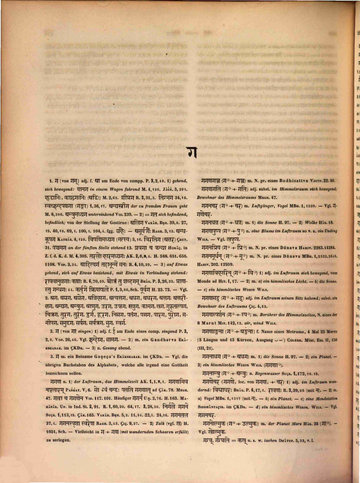
1. ga (von gam) adj. f. ā am Ende von compp. P. 3,2,48. 1〉 gehend, sich bewegend: yānaga in einem Wagen fahrend M. 4,120. YĀJÑ. 3,291. hṛdgābhiḥ, kaṇṭhagābhiḥ (adbhiḥ) M. 2,62. śīghraga R. 3,31,3. tigmaga R. 3,34,16. svacchandapathagā (gaṅgā) R. 1,36,17. anyastrīga der zu fremden Frauen geht M. 8,386. ambumadhyaga untersinkend VID. 239. — 2〉 = gata sich befindend, befindlich; von der Stellung der Gestirne: aliga VARĀH. BṚH. 39,8. VARĀH. BṚH. 27,19. VARĀH. BṚH. 40,10. VARĀH. BṚH. 69,1. VARĀH. BṚH. 100,1. VARĀH. BṚH. 104,4. fgg. grahaiḥ — asūryagaiḥ RAGH. 3,13. andhakūpaga KATHĀS. 4,128. vipaṇimadhyaga (matsya) KATHĀS. 5,16. viratiga (akṣara) ŚRUT. 31. pañcamaga an der fünften Stelle stehend ŚRUT. 12. plavagā ca kanyā HORĀŚ._in_Z. f. d. K. d. M. 4,305. taralo hāramadhyagaḥ AK. 2,6,3,4. H. 588. H. 651. H. 656. H. 1108. VOP. 3,34. ādityagaṃ tadābhūnme manaḥ R. 4,10,29. — 3〉 auf Etwas gehend, sich auf Etwas beziehend, mit Etwas in Verbindung stehend: rāghavānujagāḥ kathāḥ R. 6,70,59. śrotraṃ tu śabdagam BHĀG. P. 3,26,32. ghrāṇastu gandhagaḥ BHĀG. P. 44. kartṛge kriyāphale P. 1,3,86, Sch. pūrvaga H. 23. H. 72. — Vgl. 2. aga, agraga, agrega, ajihmaga, atyantaga, adhvaga, adhvaraga, antaga. antarīkṣaga, anyaga, ambuga, āśuga, uraga, uṣṇaga, ṛjuga, kāmaga, khaga, gurutalpaga, citraga, turaga, turaṃga, durga, dūraga, nimnaga, pataṃga, pannaga, pāraga, puroga, samīpaga, samudraga, sarvaga, sarvatraga, suga, svarga.
Original text · German · adjective · substantive masculine · substantive neuter
2. ga (von gā singen) 1〉 adj. f. ī am Ende eines comp. singend P. 3,2,8. VOP. 26,46. Vgl. chandoga, sāmaga. — 2〉 m. ein Gandharva EKĀKṢARAK._im_ŚKDR. — 3〉 n. Gesang ebend.
Original text · German · substantive masculine
3. ga m. ein Beiname Gaṇeśaʼs EKĀKṢARAK._im_ŚKDR. — Vgl. die übrigen Buchstaben des Alphabets, welche alle irgend eine Gottheit bezeichnen sollen.
Original text · German · Word type unspecified
2. ga 1〉 vgl. noch purāṇaga. — 2〉 hätte auch als blosse Abkürzung zu 3. ga gestellt werden können.
Original text · German · Word type unspecified
3. ga auch eine Abkürzung für gāndhāra (die 3te Note) Verz. d. Oxf. H. 200,b,8.
Böhtlingk 1879 adjective · substantive masculine · substantive neuter
Original text · German · adjective
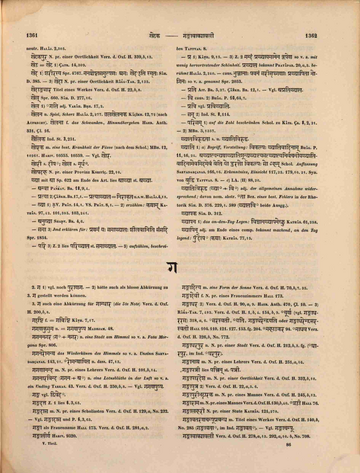
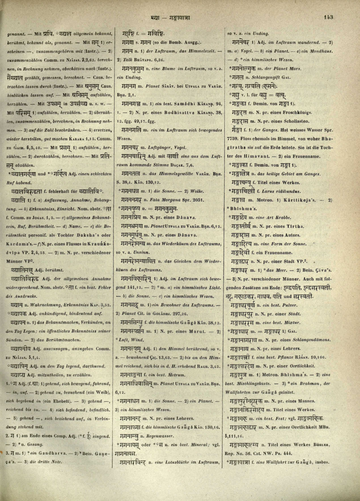
1. ˚ga Adj. (f. ā) — 1〉 gehend, sich bewegend, fahrend, — in, auf. — 2〉 gehend zu, besuchend (ein Weib), sich begebend in (ein Ehebett). — 3〉 gehend —, reichend bis zu. — 4〉 sich befindend, befindlich. — 5〉 gehend —, sich beziehend auf, in Verbindung stehend mit.
Original text · German · substantive masculine
3. ga m. — 1〉 *ein Gandharva. — 2〉 *Bein. Gaṇeśaʼs. — 3〉 die dritte Note.
Original text · German · substantive neuter
2. ga — 1〉 am Ende eines Comp. Adj. (*f. ī) singend. — 2〉 *n. Gesang.
Apte 1890 adjective · substantive masculine
Original text · English · adjective · substantive masculine
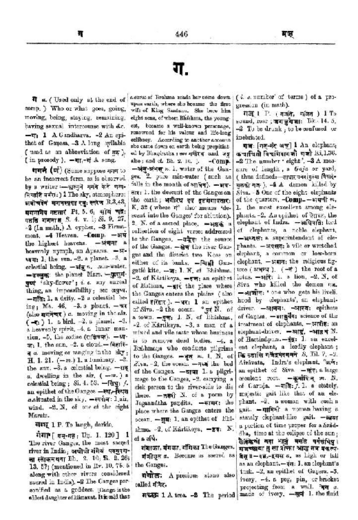
ga a. (Used only at the end of comp.) Who or what goes, going, moving, being, staying, remaining, having sexual intercourse with &c. — gaḥ 1 A Gandharva. 2 An epithet of Gaṇeśa. 3 A long syllable (used as an abbreviation of guru), (in prosody). — gā, -gaṃ A song.
Cappeller 1887 Word type unspecified
Original text · German · Word type unspecified
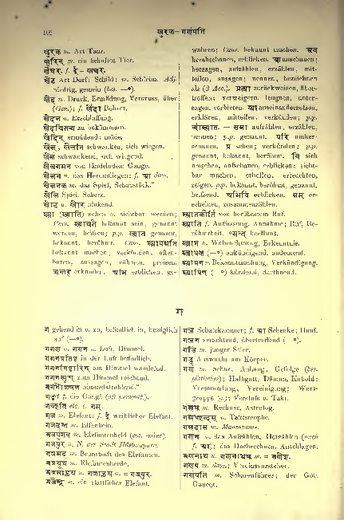
ga gehend in o. zu, befindlich in, bezüglich auf (—˚.)
Burnouf 1866 adjective · substantive masculine · substantive neuter · Word type unspecified
Original text · French · adjective
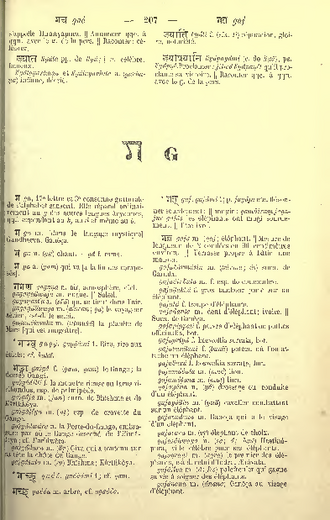
ga ga a. (gam) qui va [à la fin des composés].
Original text · French · substantive masculine
ga ga m. [dans le langage mystique] Gandharva, Gaṇeśa.
Original text · French · substantive neuter
ga ga n. (gai) chant. — gā f. mms.
Original text · French · Word type unspecified
ga ga, 17ᵉ lettre et 3ᵉ consonne gutturale de l'alphabet sanscrit. Elle répond ordinairement au g des autres langues âryennes, qqf. cependant au k, au d et même au b.
Occurrences in source texts (34)
DYS 1 occurrence
GoS 8 occurrences
GoS 20–28: Setting Sarasvatī in Motion 3 occurrences
Direct occurrences
GoS 50–63: Three Locks 3 occurrences
Direct occurrences
HP 9 occurrences
HP 3.33-3.48*1: Khecarī and Soma 2 occurrences
Direct occurrences
-
HP 3.33 Segment 6
-
HP 3.34*1–34*2 Segment 20
1 more source page
HTK 1 occurrence
HTK 10.30–33*1: Nāḍī-viśudhy-ākhyaka-kumbha and Nāḍīśuddhi 1 occurrence
Direct occurrences
-
HTK 10.32 Segment 8
SiSa 11 occurrences
SiSa 3.68-3.80: Vāyusādhana 2 occurrences
Direct occurrences
4 more source pages
SVU 1 occurrence
Continue with AYI Free
Image source: AYI archive.