
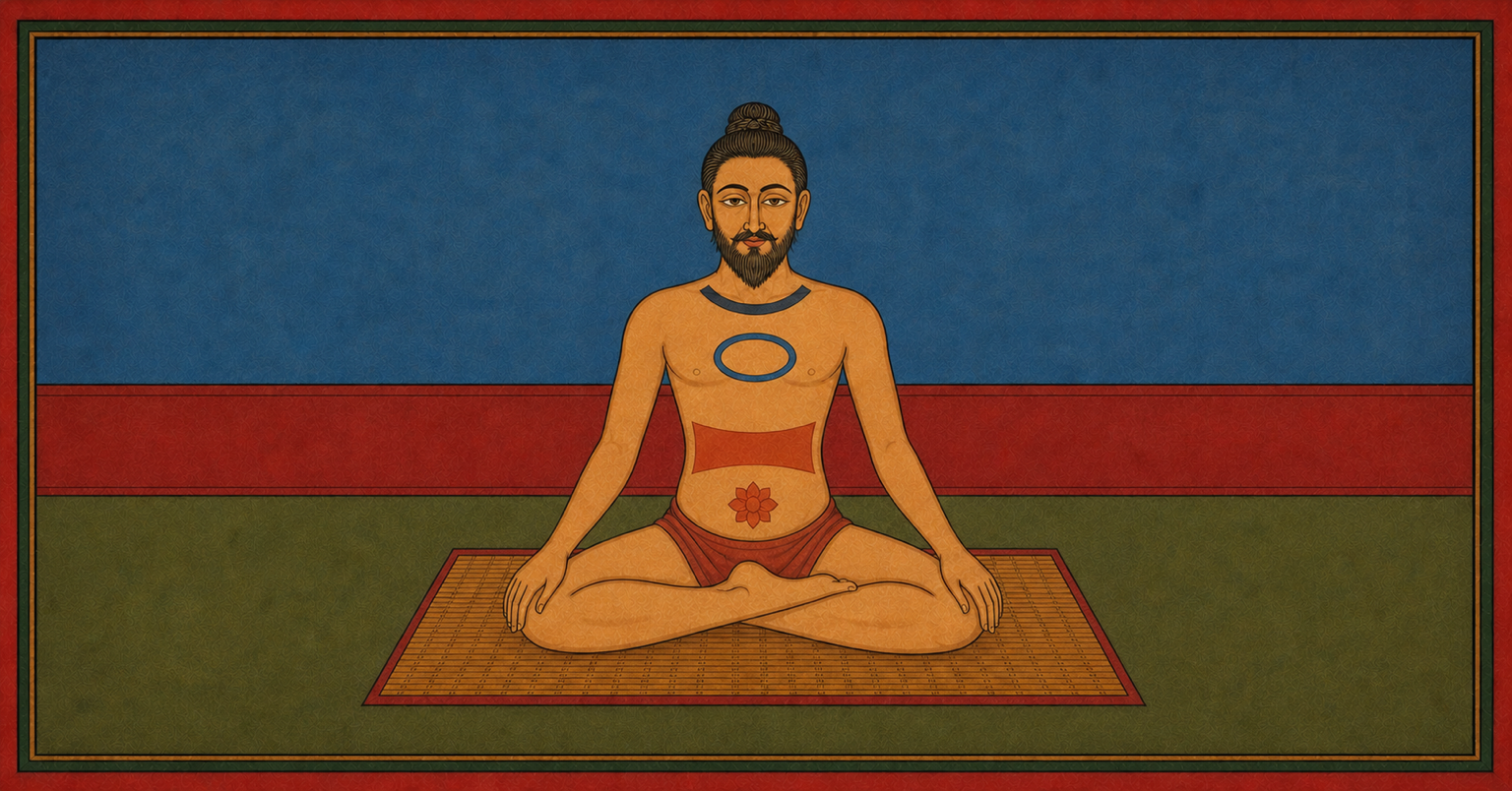

Jālandharabandha is applied immediately after a complete inhalation. According to Brahmānanda, Uḍḍiyānabandha begins at the end of Kumbhaka, while a small remainder of the retention is still present, and thus immediately before exhalation. Here he defines Uḍḍiyāna as the forceful drawing of the navel region back toward the spine.
madhye paścima-tāṇena; syāt prāṇo brahma-nāḍi-gaḥ ||46|| Analysis ▾ Analysis ▴
Brahmānanda transmits two ways of combining the Bandhas. One who securely knows the tongue lock taught by the guru can complete Prāṇāyāma with this and Jālandharabandha alone; otherwise Jālandhara, Mūla, and Uḍḍiyāna are all required.
For incorrectly performed Mūlabandha, he names loss of tissue, constipation, weak digestion, weak inner sound, and hard, pellet-like stool. Good nourishment of the tissues, clear elimination, strong digestion, and distinct Nāda are regarded as signs of correct performance. All three Bandhas should therefore be learned from the guru.
According to Brahmānanda, the verse primarily describes Mūlabandha, which raises Apāna, and Jālandharabandha, which directs Prāṇa downward. Uḍḍiyāna is not named separately because, according to his tradition, drawing in the region below the navel arises by itself when the other two locks are applied together.
Continue with AYI Free
Illustrations: AI-generated.

Please log in to write a message. Go to login
No messages yet.