
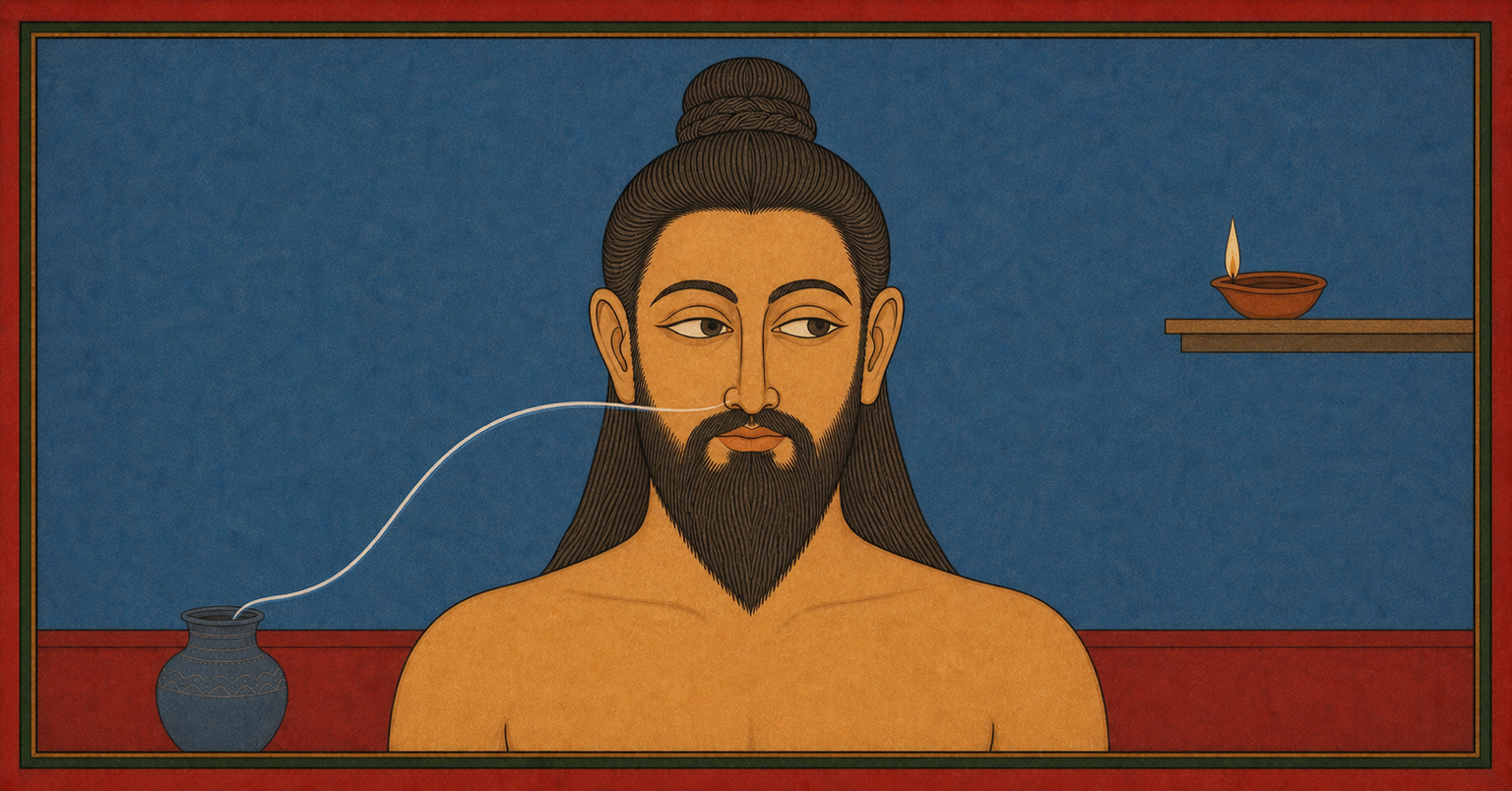
Illustration for the Haṭha Pradīpikā section “HP 2.30-2.33: Neti and Trāṭaka”.

Haṭha Pradīpikā 2.30-2.33: Neti and Trāṭaka

Neti cleanses the region of the skull and senses; Trāṭaka collects the gaze and protects against eye disorders and lethargy.

Dr. Ronald Steiner Dr. Ronald Steiner
Haṭha Pradīpikā 2.30
सूत्रं वितस्तिसुस्तब्धं नासानाले प्रवेशयेत् |
sūtraṃ vitasti-su-stabdhaṃ; nāsā-nāle praveśayet | Analysis ▾ Analysis ▴
sūtram
accusative singular
substantive neuter
thread, cord
vitasti
tatpuruṣa-compound accusative
substantive feminine
one hand-span
su
karmadhāraya-compound
previx
well, completely
stabdham
accusative singular neuter past participle passive
verbal root
stiffened, made rigid
nāsā
tatpuruṣa-compound genitive
substantive feminine
of the nose
nāle
lokative singular
substantive neuter
in the channel, passage
praveśayet
3rd person singular aktive optative causative
previx
verbal root
he should insert
मुखान्निर्गमयेच्चैषा नीतिः सिद्धैर्निगद्यते ||30||
mukhān nirgamayec caiṣā; nītiḥ siddhair nigadyate ||30|| Analysis ▾ Analysis ▴
mukhāt
ablative singular
substantive neuter
from the mouth
nirgamayet
3rd person singular aktive optative causative
previx
verbal root
he should draw out
ca
particle
and
eṣā
nominative singular feminine
pronoun dem
this
nītiḥ
nominative singular
substantive feminine
Nīti, cleansing technique
siddhaiḥ
instrumental case plural
substantive masculine
by the siddhas, adepts
nigadyate
3rd person singular passive present
previx
verbal root
is called
Metre: Anuṣṭubh
He should insert (praveśayet | 3p sg act opt caus) into the nasal passage (nāsā-nāle | loc sg) a thread (sūtram | acc sg) that has been well stiffened for one handspan (vitasti-su-stabdham | acc sg n ppp), and (ca) draw it out (nirgamayet | 3p sg act opt caus) through the mouth (mukhāt | abl sg). This (eṣā | nom sg f) technique is called (nigadyate | 3p sg pas pres) Nīti (nītiḥ | nom sg) by the Siddhas (siddhaiḥ | ins pl).
Dr. Ronald Steiner - 2026 - historically literal
In Nīti, a stiffened thread about one handspan long is passed through the nasal passage and brought out through the mouth.
Dr. Ronald Steiner - 2026 - modern transfer

The thread for Neti should be smooth, free from knots, firm, and twisted from nine, ten, or fifteen strands; the stated span is only a minimum indication. Brahmānanda describes both the route from one nostril to the mouth and a more difficult version from one nostril to the other. Repeated inhalation and exhalation move the end of the thread progressively onward.

Brahmānanda's Jyotsnā - 19th c.
vitastisustabdhaṃ MBHDL2026 ] vitastisusnigdhaṃ NS1882
Critical Apparatus
A cord made of threads and about six inches long, should be passed through the passage of the nose and the end taken out in the mouth. This is called by adepts the Neti Karma.
Pancham Sinh - 1915
Draw up through one of the nostrils a fine piece of thread 12 fingers long and draw it out through the mouth. This is Neti.
Srinivasa Iyangar - 1893
Eine recht glatte Schnur, eine Spanne lang, stecke man zu einem Nasenloch hinein und bringe sie zum Mund wieder heraus. Dies wird von den Vollendeten Neti genannt.
Hermann Walter - 1893
Haṭha Pradīpikā 2.31
कपालशोधनी चैव दिव्यदृष्टिप्रदायिनी |
kapāla-śodhanī caiva; divya-dṛṣṭi-pradāyinī | Analysis ▾ Analysis ▴
kapāla
tatpuruṣa-compound genitive
substantive neuter
of the skull
śodhanī
nominative singular feminine
substantive neuter
cleansing
ca
particle
and
eva
particle
indeed
divya
karmadhāraya-compound
adjective
divine, extraordinary
dṛṣṭi
tatpuruṣa-compound accusative
substantive feminine
sight, vision
pradāyinī
nominative singular feminine
adjective
bestowing, giving
जत्रूर्ध्वजातरोगौघं जयत्याशु सती नितिः ||31||
jatrūrdhva-jāta-rogaughaṃ; jayaty āśu satī nitiḥ ||31|| Analysis ▾ Analysis ▴
jatru
tatpuruṣa-compound ablative
substantive neuter
from the collarbone
ūrdhva
karmadhāraya-compound
adjective
above
jāta
karmadhāraya-compound past participle passive
verbal root
arisen
roga
tatpuruṣa-compound genitive
substantive masculine
of diseases
ogham
accusative singular
substantive masculine
multitude, flood
jayati
3rd person singular aktive present
verbal root
overcomes
āśu
adverb
quickly
satī
nominative singular feminine
adjective
excellent
nitiḥ
nominative singular
substantive feminine
Nīti, cleansing technique
Metre: Anuṣṭubh
The excellent (satī | nom sg f) Nīti technique (nitiḥ | nom sg) purifies the skull (kapāla-śodhanī | nom sg f), bestows divine sight (divya-dṛṣṭi-pradāyinī | nom sg f), and (ca) quickly (āśu) overcomes (jayati | 3p sg act pres) the host of diseases arising above the collarbone (jatru-ūrdhva-jāta-roga-ogham | acc sg).
Dr. Ronald Steiner - 2026 - historically literal
Niti is regarded as a cleansing of the skull region. The text attributes to it clearer vision and a rapid effect against disorders above the collarbones.
Dr. Ronald Steiner - 2026 - modern transfer
jayaty āśu satī nitiḥ MBHDL2026 ] netir āśu nihanti ca NS1882
Critical Apparatus
The Neti is the cleaner of the brain and giver of divine sight. It soon destroys all the diseases of the cervical and scapular regions.
Pancham Sinh - 1915
This purifies the skull and makes the sight very keen. Also it removes the diseases in the parts above the shoulders.
Srinivasa Iyangar - 1893
Neti reinigt den Kopf, verleiht einen scharfen Blick und bewältigt die Menge von Krankheiten, die oberhalb des Schlüsselbeines entstehen.
Hermann Walter - 1893
Haṭha Pradīpikā 2.32
निरीक्षेन्निश्चलदृशा सूक्ष्मलक्ष्यं समाहितः |
nirīkṣen niścala-dṛśā; sūkṣma-lakṣyaṃ samāhitaḥ | Analysis ▾ Analysis ▴
nirīkṣet
3rd person singular aktive optative
previx
verbal root
he should gaze at
niścala
karmadhāraya-compound
adjective
motionless, steady
dṛśā
instrumental case singular
substantive feminine
with the gaze
sūkṣma
karmadhāraya-compound
adjective
fine, small, subtle
lakṣyam
accusative singular
substantive neuter
target, focal point
samāhitaḥ
nominative singular masculine past participle passive
previx
previx
verbal root
collected, concentrated
अश्रुसंपातपर्यन्तमाचार्यैस्त्राटकं मतम् ||32||
aśru-saṃpāta-paryantam; ācāryais trāṭakaṃ matam ||32|| Analysis ▾ Analysis ▴
aśru
tatpuruṣa-compound genitive
substantive neuter
of tears
saṃpāta
tatpuruṣa-compound genitive
substantive masculine
of falling, flowing
paryantam
accusative singular
substantive neuter
up to the point
ācāryaiḥ
instrumental case plural
substantive masculine
by the teachers
trāṭakam
nominative singular
substantive neuter
Trāṭaka
matam
nominative singular neuter past participle passive
verbal root
regarded, accepted as a teaching
Metre: Anuṣṭubh
Composed (samāhitaḥ | nom sg m ppp), one should gaze (nirīkṣet | 3p sg act opt) with an unmoving gaze (niścala-dṛśā | ins sg) at a subtle target (sūkṣma-lakṣyam | acc sg) until tears fall (aśru-saṃpāta-paryantam | acc sg). This is regarded (matam | nom sg n ppp) by the teachers (ācāryaiḥ | ins pl) as Trāṭaka (trāṭakam | nom sg).
Dr. Ronald Steiner - 2026 - historically literal
In Trāṭaka, the yogi gazes with steady attention and unmoving eyes at a small target until tears flow.
Dr. Ronald Steiner - 2026 - modern transfer

In Trāṭaka, the subtle target is a small, clearly bounded object. The gaze remains motionless upon it until tears flow. Brahmānanda understands lethargy here as a particular tamasic movement of the mind. The practice is therefore intended to overcome not only visual impairment, but also the mind's dull heaviness.

Brahmānanda's Jyotsnā - 19th c.
matam MBHDL2026 ] smṛtam NS1882
Critical Apparatus
Being calm, one should gaze steadily at a small mark, till eyes are filled with tears. This is called Trataka by âchâryas.
Pancham Sinh - 1915
Look without winking the eyelids at a minute object with your mind concentrated till the tears come into the eyes. This is called Trataka by the Gurus.
Srinivasa Iyangar - 1893
Mit unbeweglichem Auge fixire man aufmerksam einen recht kleinen Gegenstand, bis Thränen kommen. Dies wird von den Lehrern Trâțaka genannt.
Hermann Walter - 1893
Haṭha Pradīpikā 2.33
मोटकं नेत्ररोगाणां तन्द्रादीनां कपाटकम् |
moṭakaṃ netra-rogāṇāṃ; tandrādīnāṃ kapāṭakam | Analysis ▾ Analysis ▴
moṭakam
nominative singular
substantive neuter
destroyer
netra
tatpuruṣa-compound genitive
substantive neuter
of the eyes
rogāṇām
genitive plural
substantive masculine
of diseases
tandrā
tatpuruṣa-compound genitive
substantive feminine
of lethargy, drowsiness
ādīnām
genitive plural masculine
adjective
and the like
kapāṭakam
nominative singular
substantive neuter
gate, closure, bolt
यत्नतस्त्राटकं गोप्यं यथा हाटकपेटकम् ||33||
yatnatas trāṭakaṃ gopyaṃ; yathā hāṭaka-peṭakam ||33|| Analysis ▾ Analysis ▴
yatnataḥ
adverb
carefully, diligently
trāṭakam
accusative singular
substantive neuter
Trāṭaka
gopyam
accusative singular neuter
adjective
to be kept secret
yathā
adverb
like
hāṭaka
tatpuruṣa-compound genitive
substantive neuter
of gold
peṭakam
nominative singular
substantive neuter
box, casket, chest
Metre: Anuṣṭubh
[Trāṭaka is] a destroyer (moṭakam | nom sg) of diseases of the eyes (netra-rogāṇām | gen pl) and a bolt (kapāṭakam | nom sg) against lethargy and the rest (tandrādīnām | gen pl); Trāṭaka (trāṭakam | acc sg) is to be kept secret (gopyam | acc sg n) carefully (yatnataḥ), like (yathā) a chest of gold (hāṭaka-peṭakam | nom sg).
Dr. Ronald Steiner - 2026 - historically literal
Trāṭaka is regarded as a powerful practice for clear eyes and an alert mind. It “shuts out” lethargy and is to be guarded like a precious treasure.
Dr. Ronald Steiner - 2026 - modern transfer
moṭakaṃ MBHDL2026 ] mocanaṃ NS1882
Critical Apparatus
Trâtaka destroys the eye diseases and removes sloth, etc. It should be kept secret very carefully, like a box of jewellery.
Pancham Sinh - 1915
By Trataka, all the diseases of the eye and sloth are removed. So it should be carefully preserved secretly as a golden casket.
Srinivasa Iyangar - 1893
Es verleiht Befreiung von Augenkrankheiten, und ist die Thüre für (das Fortgehen von) Trägheit u. s. w. Sorgfältig muss das Trâțaka verheimlicht werden gleich einem Korb, der Gold enthält.
Hermann Walter - 1893

Continue with AYI Free

Illustrations: AI-generated.

Editor

Dr. Ronald Steiner

From Ulm

The "Yoga Doc" - Dr. Ronald Steiner is the founder of the AYI method. This method links traditional Ashtanga Yoga with innovative Yogatherapy and living Philosophy. This forms a practice that is personal for each and... more ›

Messages and ratings
0 messages

Please log in to write a message. Go to login

No messages yet.