
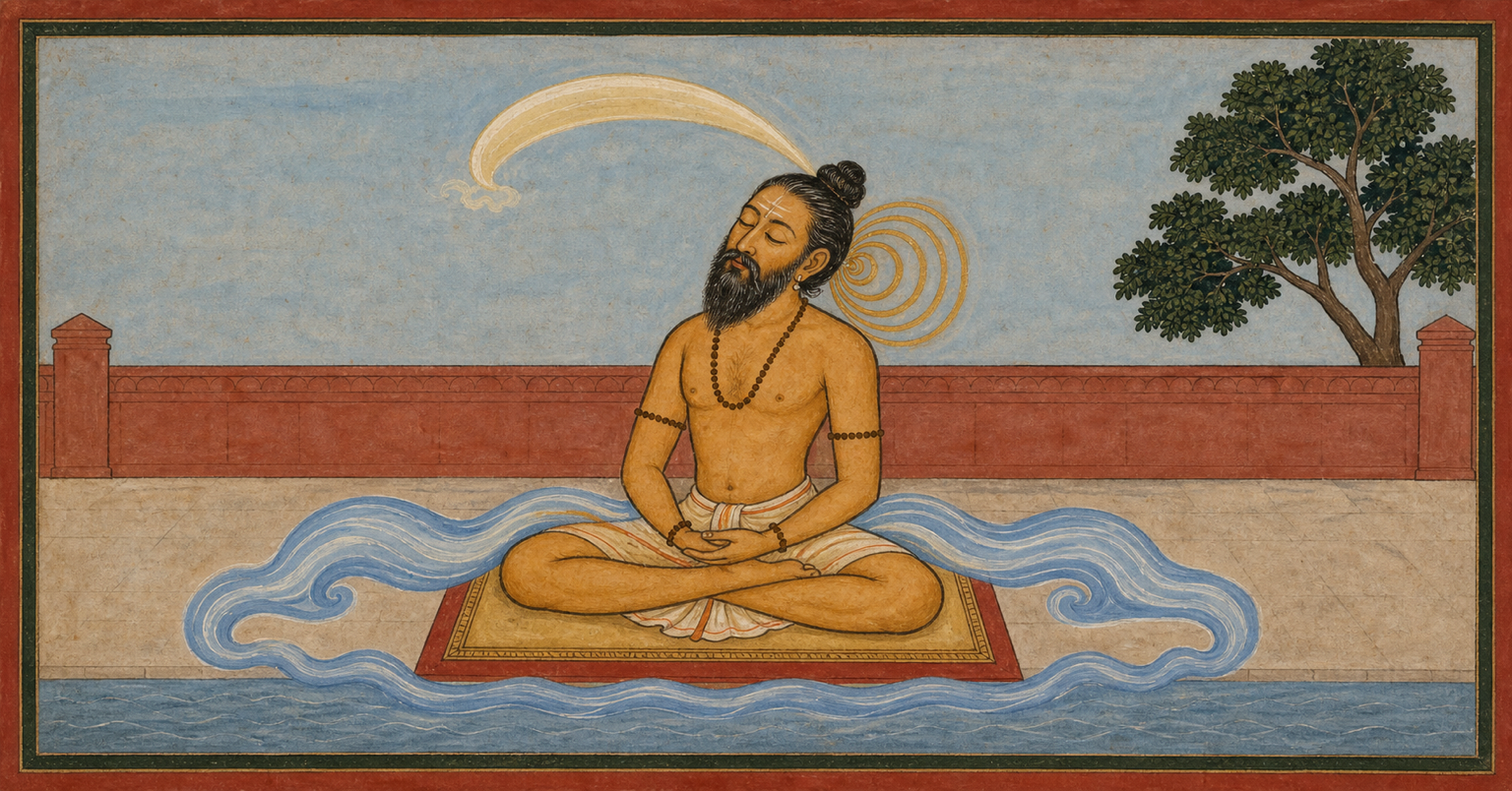
Illustration for the Haṭha Pradīpikā section “HP 2.69-2.71: Three Kumbhakas”.

Haṭha Pradīpikā 2.69-2.71: Bhrāmarī, Mūrchā, and Plāvanī

The three Kumbhakas are described concisely as humming, entrancing, and buoyancy-giving forms of breath.

Dr. Ronald Steiner Dr. Ronald Steiner
Haṭha Pradīpikā 2.69
वेगोद्घोषं पूरकं भृङ्गनादं भृङ्गीनादं रेचकं मन्दमन्दम् |
vegodghoṣaṃ, pūrakaṃ bhṛṅga-nādaṃ; bhṛṅgī-nādaṃ, recakaṃ manda-mandam | Analysis ▾ Analysis ▴
vega
tatpuruṣa-compound instrumental case
substantive masculine
force, intensity
udghoṣam
nominative singular neuter
substantive masculine
loud sound, humming
pūrakam
nominative singular neuter
substantive masculine
inhalation
bhṛṅga
tatpuruṣa-compound genitive
substantive masculine
male bee
nādam
nominative singular neuter
substantive masculine
sound
bhṛṅgī
tatpuruṣa-compound genitive
substantive feminine
female bee
nādam
nominative singular neuter
substantive masculine
sound
recakam
nominative singular neuter
substantive masculine
exhalation
manda
karmadhāraya-compound
adjective
slowly, gently
mandam
nominative singular neuter
adjective
very slowly, very gently
योगीन्द्राणामेवमभ्यासयोगाच्चित्ते जाता काचिदानन्दमूर्छा ||69||
yogīndrāṇām, evam abhyāsa-yogāc; citte jātā, kācid ānanda-mūrchā ||69|| Analysis ▾ Analysis ▴
yogīndrāṇām
genitive plural
substantive masculine
of the best yogins
evam
adverb
thus, in this way
abhyāsa
tatpuruṣa-compound genitive
substantive masculine
practice
yogāt
ablative singular
substantive masculine
through application, as a result of practice
citte
lokative singular
substantive neuter
in the mind
jātā
nominative singular feminine past participle passive
verbal root
arisen
kācit
nominative singular feminine
pronoun inter
a certain, special
ānanda
karmadhāraya-compound
substantive masculine
blissful, joyful
mūrchā
nominative singular
substantive feminine
rapture, absorption
Metre: Śālinī
The inhalation (pūrakam | nom sg n) is forcefully loud (vega-udghoṣam | nom sg n), sounding like a male bee (bhṛṅga-nādam | nom sg n); the exhalation (recakam | nom sg n) sounds like a female bee (bhṛṅgī-nādam | nom sg n) and is very slow (manda-mandam | nom sg n). Through practice in this way (evam abhyāsa-yogāt | abl sg), a certain (kācit | nom sg f) blissful absorption (ānanda-mūrchā | nom sg) arises (jātā | nom sg f ppp) in the minds (citte | loc sg) of the foremost yogis (yogīndrāṇām | gen pl).
Dr. Ronald Steiner - 2026 - historically literal
In Bhramarī, the forceful inhalation sounds like a male bee and the very slow exhalation like a female bee. This produces a distinctive, blissful rapture in the mind.
Dr. Ronald Steiner - 2026 - modern transfer
vegodghoṣaṃ MBHDL2026 ] vegād ghoṣaṃ NS1882

ānandamūrchā MBHDL2026 ] ānandalīlā NS1882
Critical Apparatus
By filling the air with force, making noise like Bhringi (wasp), and expelling it slowly, making noise in the same way; this practice causes a sort of ecstacy in the minds of Yogîndras.
Pancham Sinh - 1915
Fill in the air rapidly making the sound of a male bee, and again exhale it making the sound of a female bee humming. (Practise Kumbhaka.) The great Yogis by a constant practice of this feel an indescribable joy in their hearts. This is Bhramari.
Srinivasa Iyangar - 1893
So schnell, dass es hörbar wird, athme man mit dem Summen einer männlichen Biene ein, und langsam mit dem Summen einer weiblichen Biene athme man aus. Durch diese fleissige Uebung entsteht in der Seele der grossen Yogin eine gewisse selige Wonne.
Hermann Walter - 1893
Haṭha Pradīpikā 2.70
पूरकान्ते गाढतरं बद्ध्वा जालन्धरं शनैः |
pūrakānte gāḍhataraṃ; baddhvā jālandharaṃ śanaiḥ | Analysis ▾ Analysis ▴
pūraka
tatpuruṣa-compound lokative
substantive masculine
inhalation
ante
lokative singular
substantive masculine
at the end
gāḍhataram
adverb
very firmly, more strongly
baddhvā
absolutus
verbal root
having applied
jālandharam
accusative singular
substantive masculine
Jālandhara Bandha
śanaiḥ
adverb
slowly
रेचयेन्मूर्छनाख्येयं मनोमूर्छासुखप्रदा ||70||
recayen mūrchanākhyeyaṃ; mano-mūrchā-sukha-pradā ||70|| Analysis ▾ Analysis ▴
recayet
3rd person singular aktive optative
verbal root
he should exhale
mūrchanā
tatpuruṣa-compound nominative
substantive feminine
Mūrcchanā, fainting
ākhyeyam
nominative singular neuter future participle passive
previx
verbal root
to be called, called
manas
tatpuruṣa-compound genitive
substantive neuter
mind
mūrchā
tatpuruṣa-compound genitive
substantive feminine
fainting, swoon
sukha
tatpuruṣa-compound accusative
substantive neuter
joy, happiness
pradā
nominative singular feminine
adjective
giving
Metre: Anuṣṭubh
At the end of inhalation (pūrakānte | loc sg), having applied (baddhvā | abs) Jālandhara (jālandharam | acc sg) very firmly (gāḍhataram), one should exhale (recayet | 3p sg act opt) slowly (śanaiḥ); this practice is called Mūrcchā (mūrchanā-ākhyeyam | nom sg n) and bestows the pleasure of mental absorption (mano-mūrcchā-sukha-pradā | nom sg f).
Dr. Ronald Steiner - 2026 - historically literal
In Mūrcchā, Jālandhara is applied firmly after inhalation, followed by a slow exhalation. The practice leads into a kind of sweet faintness or rapture of the mind.
Dr. Ronald Steiner - 2026 - modern transfer
Closing the passages with Jâlandhar Bandha firmly at the end of Pûraka, and expelling the air slowly, is called Mûrchhâ, from its causing the mind to swoon and giving comfort.
Pancham Sinh - 1915
At the end of Puraka, practise the Jalandhara Bandha, and exhale the breath slowly. This is Murcha Kumbhaka, as it reduces the mind to a state of stupor and gives pleasure.
Srinivasa Iyangar - 1893
Nachdem man eingeathmet hat, nehme man allmählich die Jalandhara-Stellung ein, und athme langsam aus; dies wird Múrcchanâ genannt, betäubt den Geist und macht glücklich.
Hermann Walter - 1893
Haṭha Pradīpikā 2.71
अन्तःप्रवर्तितोद्गारमारुतापूरितोदरः |
antaḥ-pravartitodgāra;-mārutāpūritodaraḥ | Analysis ▾ Analysis ▴
antar
tatpuruṣa-compound lokative
adverb
inward
pravartita
karmadhāraya-compound past participle passive
previx
verbal root
set in motion, turned
udgāra
tatpuruṣa-compound genitive
substantive masculine
belching
māruta
tatpuruṣa-compound instrumental case
substantive masculine
wind, breath
apūrita
karmadhāraya-compound past participle passive
previx
verbal root
filled
udaraḥ
nominative singular masculine
substantive neuter
abdomen
पयस्यगाधे ऽपि सुखात्प्लवते पद्मपत्रवत् ||71||
payasy agādhe 'pi sukhāt; plavate padma-patravat ||71|| Analysis ▾ Analysis ▴
payasi
lokative singular
substantive neuter
in water
agādhe
lokative singular neuter
adjective
deep, unfathomable
api
particle
even
sukhāt
ablative singular
substantive neuter
easily, effortlessly
plavate
3rd person singular medial present
verbal root
he floats
padma
tatpuruṣa-compound genitive
substantive neuter
lotus
patravat
adverb
like a leaf
Metre: Anuṣṭubh
One whose abdomen has been filled by the wind of eructation directed inward (antar-pravartita-udgāra-māruta-āpūrita-udaraḥ | nom sg) floats (plavate | 3p sg med pres), even (api) in deep water (payasi agādhe | loc sg), with ease (sukhāt), like a lotus leaf (padma-patravat).
Dr. Ronald Steiner - 2026 - historically literal
Plāvanī describes a body whose abdomen is filled with inwardly directed breath, allowing the yogi to float effortlessly even in deep water like a lotus leaf.
Dr. Ronald Steiner - 2026 - modern transfer
pravartitodgāramārutāpūritodaraḥ MBHDL2026 ] pravartitodāramārutāpūritodaraḥ NS1882
Critical Apparatus
When the belly is filled with air and the inside of the body is filled to its utmost with air, the body floats on the deepest water, like the leaf of a lotus.
Pancham Sinh - 1915
Having filled the lungs completely with the air till they are distended, the Yogi moves upon waters of great depth like a lotus leaf.
Srinivasa Iyangar - 1893
Wenn der Yogin seinen Bauch mit eingeathmeter, vorzüglicher Luft füllt, so schwimmt er gleich einem Lotusblatt leicht auf tiefem Wasser.
Hermann Walter - 1893

Continue with AYI Free

Illustrations: AI-generated.

Editor

Dr. Ronald Steiner

From Ulm

The "Yoga Doc" - Dr. Ronald Steiner is the founder of the AYI method. This method links traditional Ashtanga Yoga with innovative Yogatherapy and living Philosophy. This forms a practice that is personal for each and... more ›

Messages and ratings
0 messages

Please log in to write a message. Go to login

No messages yet.