
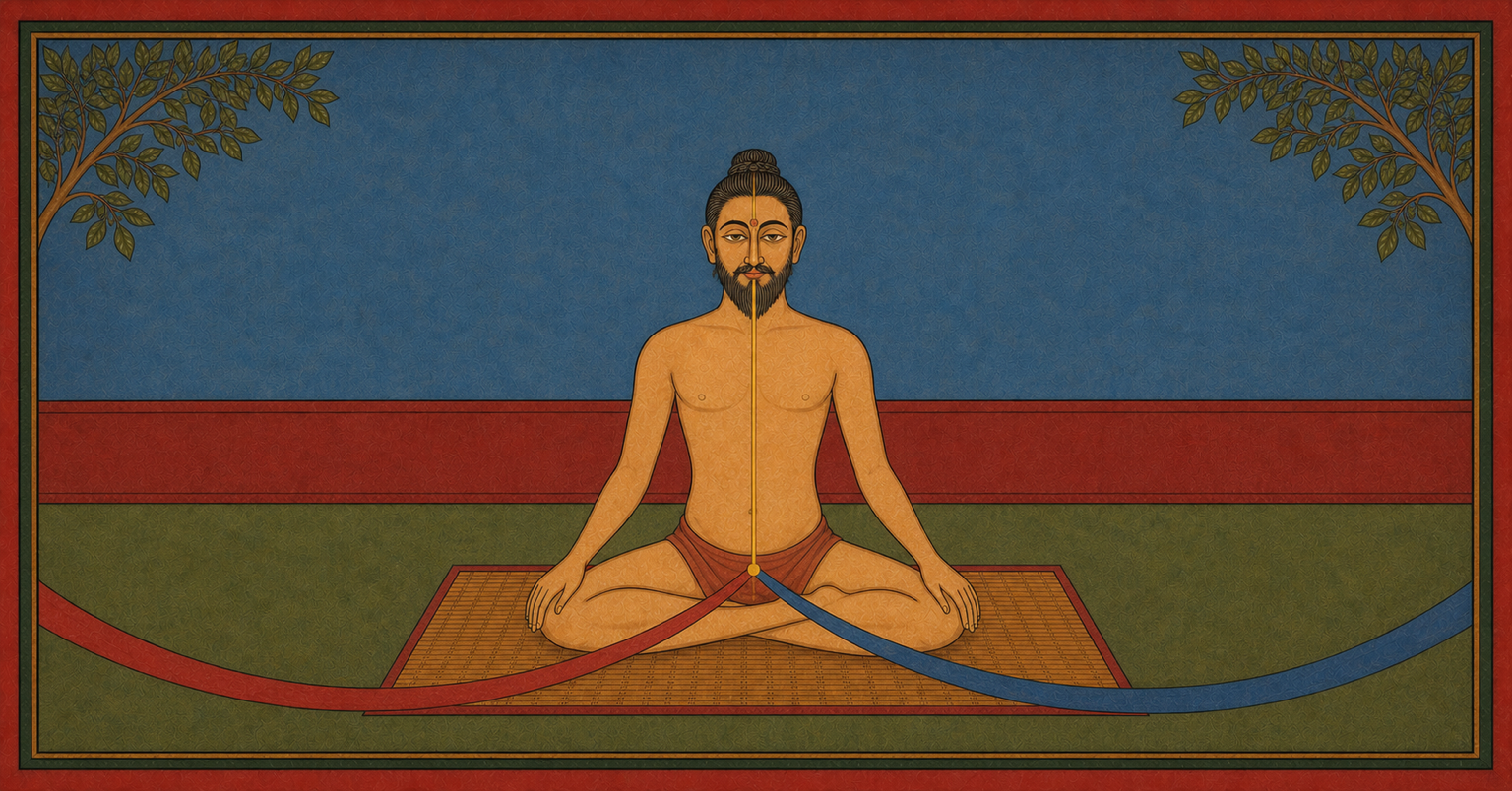

The six cleansings are disputed even within the tradition. Brahmānanda names teachers such as Yājñavalkya who do not accept them because Prāṇāyāma alone is said to dry up all impurities as well as excess fat and Doṣas. The text thus explicitly preserves two different methodological schools.
Brahmānanda understands the gaze between the eyebrows as the cognitive movement of the inner sense bound at that point. As long as Prāṇa is retained, the mind remains undistracted, and this inner orientation is preserved, the yogi is said not to be subject to time or death.
yo manaḥ-su-sthirī-bhāvaḥ; saivāvasthā manonmanī ||42|| Analysis ▾ Analysis ▴
When Prāṇa flows through Suṣumṇā to the crown, mental stability becomes for Brahmānanda an uninterrupted stream of conceptions in the form of the object of meditation. He calls precisely this stable continuity Manonmanī or Unmanī. The state is therefore more than a mere reduction in the number of thoughts.
tat-siddhaye vidhāna-jñaś; citrān kurvīta kumbhakān | Analysis ▾ Analysis ▴
Brahmānanda distinguishes the primary goal, Unmanī, from the accompanying Siddhis. Citing the Bhāgavata, he claims that yoga can produce abilities that otherwise arise individually through birth, medicinal herbs, Mantras, or asceticism. The different Kumbhakas lead through further stages of yoga to the main consummation, while their particular powers remain secondary results.
Continue with AYI Free
Illustrations: AI-generated.

Please log in to write a message. Go to login
No messages yet.