
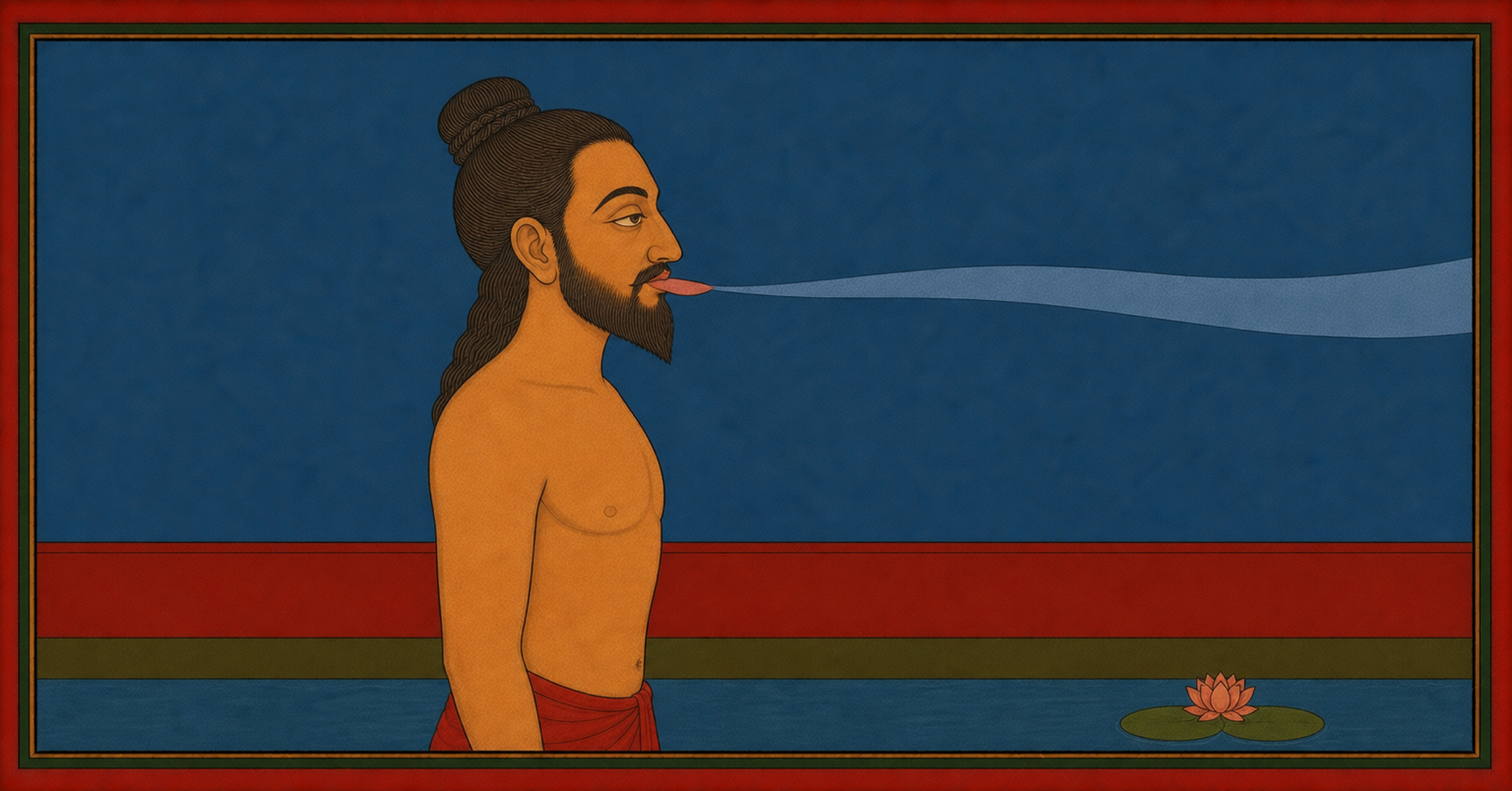
Illustration for the Haṭha Pradīpikā section “HP 2.57-2.59: Śītalī”.

Haṭha Pradīpikā 2.57-2.59: Śītalī

Śītalī draws the breath in through the tongue and mouth, exhales through the nose, and is said to cool Pitta and relieve hunger and thirst.

Dr. Ronald Steiner Dr. Ronald Steiner
Haṭha Pradīpikā 2.57
रसनातालुमूलेन यः प्राणं सततं पिबेत् |
rasanā-tālu-mūlena; yaḥ prāṇaṃ satataṃ pibet | Analysis ▾ Analysis ▴
rasanā
tatpuruṣa-compound genitive
substantive feminine
tongue
tālu
tatpuruṣa-compound genitive
substantive neuter
palate
mūlena
instrumental case singular
substantive neuter
through the root
yaḥ
nominative singular masculine
pronoun rel
whoever
prāṇam
accusative singular
substantive masculine
the breath
satatam
adverb
continually
pibet
3rd person singular aktive optative
verbal root
should drink, inhale
अब्दार्धेन भवेत्तस्य सर्वरोगपरिक्षयः ||57||
abdārdhena bhavet tasya; sarva-roga-parikṣayaḥ ||57|| Analysis ▾ Analysis ▴
abda
tatpuruṣa-compound genitive
substantive masculine
year
ardhena
instrumental case singular
substantive neuter
by half
bhavet
3rd person singular aktive optative
verbal root
becomes, arises
tasya
genitive singular masculine
pronoun dem
for him, his
sarva
tatpuruṣa-compound genitive
adjective
all
roga
tatpuruṣa-compound genitive
substantive masculine
disease
parikṣayaḥ
nominative singular
substantive masculine
complete disappearance, dissolution
Metre: Anuṣṭubh
For one who (yaḥ | nom sg m) constantly (satatam) drinks in (pibet | 3p sg act opt) Prāṇa (prāṇam | acc sg) through the root region of the tongue and palate (rasanā-tālu-mūlena | ins sg), there (tasya | gen sg) arises (bhavet | 3p sg act opt), after half a year (abda-ardhena | ins sg), the complete disappearance of all diseases (sarva-roga-parikṣayaḥ | nom sg).
Dr. Ronald Steiner - 2026 - historically literal
One who continually draws in the breath across the tongue and root of the palate is said to experience a profound freedom from disease after six months.
Dr. Ronald Steiner - 2026 - modern transfer
rasanātālumūlena yaḥ prāṇaṃ satataṃ pibet abdārdhena bhavet tasya sarvarogaparikṣayaḥ MBHDL2026 ] om. NS1882
Critical Apparatus
Haṭha Pradīpikā 2.58
जिह्वया वायुमाकृष्य पूर्ववत्कुम्भनादनु |
jihvayā vāyum ākṛṣya; pūrvavat kumbhanād anu | Analysis ▾ Analysis ▴
jihvayā
instrumental case singular
substantive feminine
with the tongue
vāyum
accusative singular
substantive masculine
the breath, wind
ākṛṣya
absolutus
previx
verbal root
having drawn in
pūrvavat
adverb
as before
kumbhanāt
ablative singular
substantive neuter
after retention
anu
particle
afterward
शनैस्तु घ्राणरन्ध्राभ्यां रेचयेदनिलं सुधीः ||58||
śanais tu ghrāṇa-randhrābhyāṃ; recayed anilaṃ sudhīḥ ||58|| Analysis ▾ Analysis ▴
śanaiḥ
adverb
slowly, gradually
tu
particle
but, now
ghrāṇa
tatpuruṣa-compound genitive
substantive neuter
of the nose
randhrābhyām
instrumental case dual
substantive neuter
through both openings
recayet
3rd person singular aktive optative
verbal root
he should exhale
anilam
accusative singular
substantive masculine
the breath, wind
sudhīḥ
nominative singular masculine
adjective
the wise, discerning one
Metre: Anuṣṭubh
Having drawn in (ākṛṣya | abs) the breath (vāyum | acc sg) with the tongue (jihvayā | ins sg), the wise one (sudhīḥ | nom sg m), after retaining the breath as before (pūrvavat kumbhanāt anu | abl sg), should slowly (śanaiḥ) exhale (recayet | 3p sg act opt) the air (anilam | acc sg) through both nostrils (ghrāṇa-randhrābhyām | ins du).
Dr. Ronald Steiner - 2026 - historically literal
In Śītalī, draw the breath in across the tongue, retain it as before, and then exhale slowly through both nostrils.
Dr. Ronald Steiner - 2026 - modern transfer
kumbhanād anu MBHDL2026 ] kumbhasādhanam NS1882
Critical Apparatus
As in the above (Sîtkári), the tongue to be protruded a little out of the lips, when the air is drawn in. It is kept confined, as before, and then expelled slowly through the nostrils.
Pancham Sinh - 1915
Protruding the tongue a little way from the lips, he should inhale the Prâṇa and having performed Kumbhaka should breathe out through the nostrils.
Srinivasa Iyangar - 1893
Mit (herausgestreckter, Com.) Zunge ziehe der Weise den Athem ein, führe den Kumbhaka wie oben beschrieben aus (Sûryabhedana, Com.) und lasse den Athem langsam durch die Nasenlöcher wieder heraus.
Hermann Walter - 1893
Haṭha Pradīpikā 2.59
गुल्मप्लीहादिकान्दोषान् ज्वरं पित्तं क्षुधां तृषाम् |
gulma-plīhādikān doṣān; jvaraṃ pittaṃ kṣudhāṃ tṛṣām | Analysis ▾ Analysis ▴
gulma
dvandva-compound
substantive masculine
tumour, swelling
plīha
dvandva-compound
substantive masculine
splenic disease, enlarged spleen
ādikān
accusative plural masculine
adjective
and the like
doṣān
accusative plural
substantive masculine
disorders, diseases
jvaram
accusative singular
substantive masculine
fever
pittam
accusative singular
substantive neuter
pitta, bile
kṣudhām
accusative singular
substantive feminine
hunger
tṛṣām
accusative singular
substantive feminine
thirst
विषाणि शीतली नाम कुम्भको ऽयं निहन्ति च ||59||
viṣāṇi śītalī nāma; kumbhako 'yaṃ nihanti ca ||59|| Analysis ▾ Analysis ▴
viṣāṇi
accusative plural
substantive neuter
poisons
śītalī
nominative singular
substantive feminine
Śītalī
nāma
adverb
by name, called
kumbhakaḥ
nominative singular
substantive masculine
kumbhaka
ayam
nominative singular masculine
pronoun dem
this
nihanti
3rd person singular aktive present
previx
verbal root
removes, destroys
ca
particle
and, also
Metre: Anuṣṭubh
This (ayam | nom sg m) retention (kumbhakaḥ | nom sg), called Śītalī (śītalī nāma | nom sg), removes (nihanti | 3p sg act pres) disorders such as swelling and splenic disease (gulma-plīha-ādikān doṣān | acc pl), fever (jvaram | acc sg), Pitta (pittam | acc sg), hunger (kṣudhām | acc sg), thirst (tṛṣām | acc sg), and also (ca) poisons (viṣāṇi | acc pl).
Dr. Ronald Steiner - 2026 - historically literal
The text attributes to Śītalī effects against swelling, disorders of the spleen, fever, excess Pitta, hunger, thirst, and poisons.
Dr. Ronald Steiner - 2026 - modern transfer
doṣān MBHDL2026 ] rogān NS1882

kumbhako’yaṃ MBHDL2026 ] kumbhikeyaṃ NS1882
Critical Apparatus
This Śîtalî Ḳumbhikâ cures colic, (enlarged) spleen, fever, disorders of bile, hunger, thirst, and counteracts poisons.
Pancham Sinh - 1915
This Kumbhaka called Sitali destroys Gulma, Pleeha, and other diseases as also fever, bilious complaints, hunger, thirst and the bad effects of poisons, i. e., snakebites, &c.
Srinivasa Iyangar - 1893
Krankheiten wie Gulma, Milzkrankheit, ferner Fieber, Gallsucht, Hunger, Durst, Gift überwindet der Şîtalî genannte Kumbhaka.
Hermann Walter - 1893

Continue with AYI Free

Illustrations: AI-generated.

Editor

Dr. Ronald Steiner

From Ulm

The "Yoga Doc" - Dr. Ronald Steiner is the founder of the AYI method. This method links traditional Ashtanga Yoga with innovative Yogatherapy and living Philosophy. This forms a practice that is personal for each and... more ›

Messages and ratings
0 messages

Please log in to write a message. Go to login

No messages yet.