
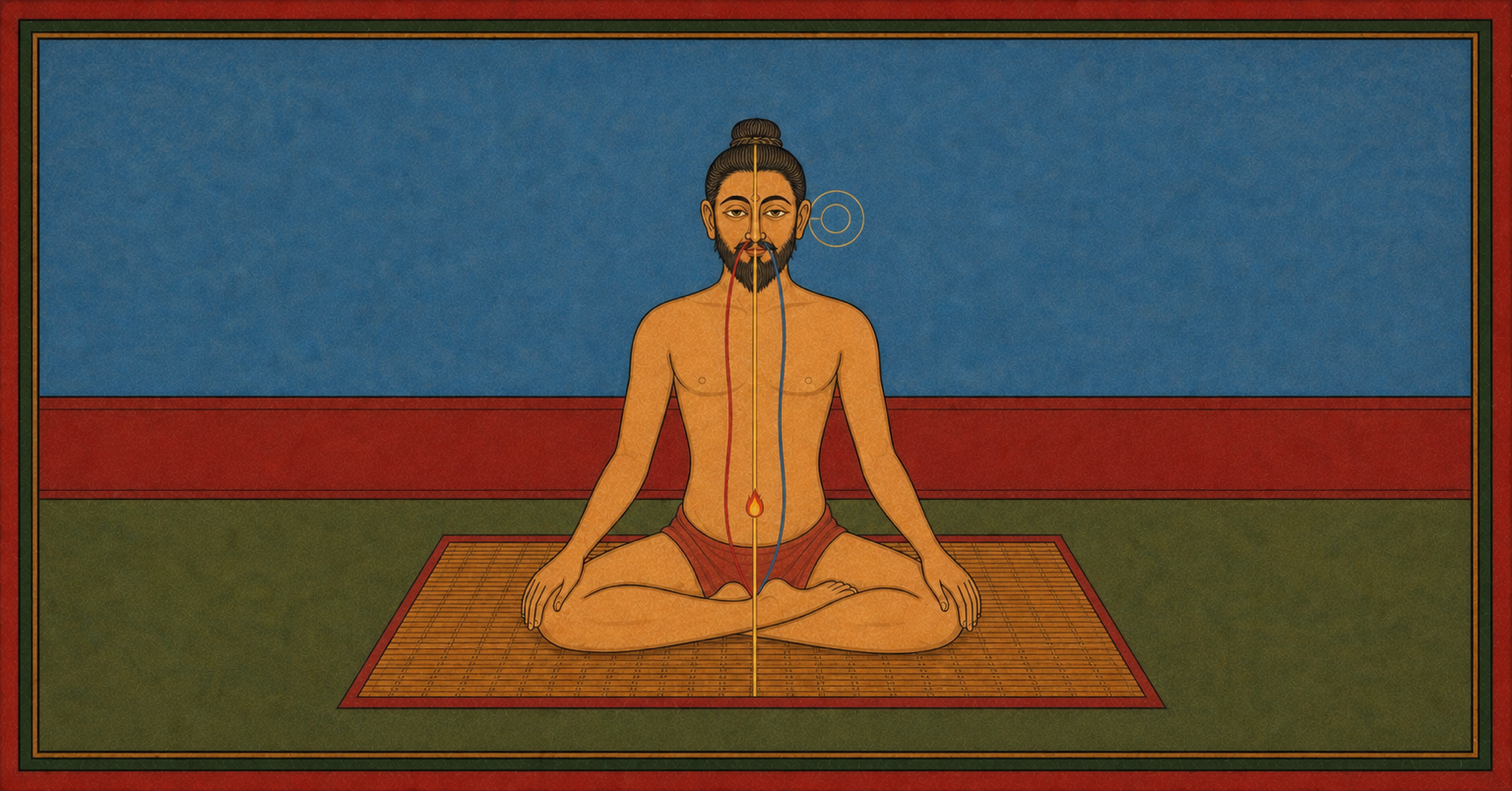
Illustration for the Haṭha Pradīpikā section “HP 2.79-2.80: Haṭha-Siddhi”.

Haṭha Pradīpikā 2.79-2.80: Signs of Haṭha Siddhi

The awakening of Kuṇḍalinī opens Suṣumṇā; slenderness, health, clarity of Nāda, and purification of the Nāḍīs indicate Haṭha Siddhi.

Dr. Ronald Steiner Dr. Ronald Steiner
Haṭha Pradīpikā 2.79
कुम्भकात्कुण्डलीबोधः कुण्डलीबोधतो भवेत् |
kumbhakāt kuṇḍalī-bodhaḥ; kuṇḍalī-bodhato bhavet | Analysis ▾ Analysis ▴
kumbhakāt
ablative singular
substantive masculine
from, through kumbhaka
kuṇḍalī
tatpuruṣa-compound genitive
substantive feminine
Kuṇḍalinī
bodhaḥ
nominative singular
substantive masculine
awakening, realization
kuṇḍalī
tatpuruṣa-compound genitive
substantive feminine
Kuṇḍalinī
bodhataḥ
ablative singular
substantive masculine
from, through awakening
bhavet
3rd person singular aktive optative
verbal root
becomes, arises
अनर्गला सुषुम्णा च हठसिद्धिश्च जायते ||79||
anargalā suṣumṇā ca; haṭha-siddhiś ca jāyate ||79|| Analysis ▾ Analysis ▴
anargalā
nominative singular feminine
adjective
free of bolts, unobstructed
suṣumṇā
nominative singular
substantive feminine
Suṣumṇā
ca
particle
and
haṭha
tatpuruṣa-compound genitive
substantive masculine
Haṭha
siddhiḥ
nominative singular
substantive feminine
perfection, success
ca
particle
and
jāyate
3rd person singular medial present
verbal root
arises
Metre: Anuṣṭubh
From retention (kumbhakāt | abl sg) arises the awakening of Kuṇḍalinī (kuṇḍalī-bodhaḥ | nom sg); from the awakening of Kuṇḍalinī (kuṇḍalī-bodhataḥ | abl sg), Suṣumṇā (suṣumṇā | nom sg) becomes (bhavet | 3p sg act opt) free from barriers (anargalā | nom sg f), and (ca) the accomplishment of Haṭha (haṭha-siddhiḥ | nom sg) arises (jāyate | 3p sg med pres).
Dr. Ronald Steiner - 2026 - historically literal
Kumbhaka awakens Kuṇḍalinī; through this awakening, Suṣumṇā becomes free. From this arises the true perfection of Haṭha Yoga.
Dr. Ronald Steiner - 2026 - modern transfer

Brahmānanda reads a chain of effects: Kumbhaka awakens Kuṇḍalinī, who rests at the base; her awakening removes the “barrier” of Kapha and other obstructions at the entrance to Suṣumṇā; this produces the consummation of Haṭha and, through the higher stages of yoga, finally Kaivalya.

Brahmānanda's Jyotsnā - 19th c.
kumbhakāt kuṇḍalībodhaḥ kuṇḍalībodhato bhavet anargalā suṣumṇā ca haṭhasiddhiś ca jāyate MBHDL2026 ] transp. NS1882 post HP 2.76b
Critical Apparatus
Haṭha Pradīpikā 2.80
वपुःकृशत्वं वदने प्रसन्नता नादस्फुटत्वं नयने च निर्मले |
vapuḥ-kṛśatvaṃ vadane prasannatā; nāda-sphuṭatvaṃ nayane ca nirmale | Analysis ▾ Analysis ▴
vapuḥ
tatpuruṣa-compound genitive
substantive neuter
body
kṛśatvam
nominative singular
substantive neuter
slenderness, leanness
vadane
lokative singular
substantive neuter
in the face
prasannatā
nominative singular
substantive feminine
clarity, serenity
nāda
tatpuruṣa-compound genitive
substantive masculine
inner sound
sphuṭatvam
nominative singular
substantive neuter
distinctness, clarity
nayane
lokative dual
substantive neuter
in the eyes
ca
particle
and
nirmale
lokative dual neuter
adjective
clear, pure
आरोग्यता बिन्दुजयोऽग्निदीपनं नाडीषु शुद्धिर्हठसिद्धिलक्षणम् ||80||
ārogyatā bindu-jayo'gni-dīpanaṃ; nāḍīṣu śuddhir haṭha-siddhi-lakṣaṇam ||80|| Analysis ▾ Analysis ▴
ārogyatā
nominative singular
substantive feminine
health, freedom from disease
bindu
tatpuruṣa-compound genitive
substantive masculine
bindu, semen
jayaḥ
nominative singular
substantive masculine
mastery, control
agni
tatpuruṣa-compound genitive
substantive masculine
fire
dīpanam
nominative singular
substantive neuter
kindling, strengthening
nāḍīṣu
lokative plural
substantive feminine
in the nāḍīs, channels
śuddhiḥ
nominative singular
substantive feminine
purity, purification
haṭha
tatpuruṣa-compound genitive
substantive masculine
Haṭha
siddhi
tatpuruṣa-compound genitive
substantive feminine
perfection, success
lakṣaṇam
nominative singular
substantive neuter
mark, characteristic
Metre: Vaṃśamālā
Slenderness of the body (vapuḥ-kṛśatvam | nom sg), clarity (prasannatā | nom sg) in the face (vadane | loc sg), distinctness of the inner sound (nāda-sphuṭatvam | nom sg), clear eyes (nayane ca nirmale | loc du), health (ārogyatā | nom sg), mastery of Bindu (bindu-jayaḥ | nom sg), kindling of the fire (agni-dīpanam | nom sg), and purity (śuddhiḥ | nom sg) in the channels (nāḍīṣu | loc pl) are the marks of accomplishment in Haṭha (haṭha-siddhi-lakṣaṇam | nom sg).
Dr. Ronald Steiner - 2026 - historically literal
The signs of successful Haṭha practice are a lean body, a clear face, a distinct inner sound, clear eyes, health, mastery over Bindu, a strengthened inner fire, and purified Nāḍīs.
Dr. Ronald Steiner - 2026 - modern transfer

Brahmānanda explains Bindu-jaya, “mastery of the drop,” as the absence of loss of Bindu, understood as bodily tissue or the reproductive substance. In his list of marks, it stands alongside visible signs such as a lean body and clear face, as well as inner signs such as Nāda, digestive fire, and purified Nāḍīs.

Brahmānanda's Jyotsnā - 19th c.
nayane ca nirmale MBHDL2026 ] nayane sunirmale NS1882

ārogyatā MBHDL2026 ] arogatā NS1882

nāḍīṣu śuddhir haṭhasiddhilakṣaṇam MBHDL2026 ] nāḍīviśuddhir haṭhayogalakṣaṇam NS1882
Critical Apparatus
When the body becomes lean, the face glows with delight, Anâhatanâda manifests, and eyes are clear, body is healthy, bindu under control, and appetite increases, then one should know that the Nâdîs are purified and success in Haṭha Yoga is approaching.
Pancham Sinh - 1915
The signs of perfection in Hatha-yoga are: the body becomes lean, the speech eloquent, the inner sounds are distinctly heard, the eyes are clear and bright, the body is freed from all diseases, the seminal fluid is concentrated, the digestive fire is increased and the Nadis are purified.
Srinivasa Iyangar - 1893
Schlankheit des Leibes, ruhiger Gesichtsausdruck, Offenbarung des Nâda, klare Augen, Gesundheit, Beherrschung der Elemente (bindu = dhâtu), Verdauungsfeuer, Reinheit der Nâdî; dies sind die Kennzeichen des Hathayoga.
Hermann Walter - 1893

Continue with AYI Free

Illustrations: AI-generated.

Editor

Dr. Ronald Steiner

From Ulm

The "Yoga Doc" - Dr. Ronald Steiner is the founder of the AYI method. This method links traditional Ashtanga Yoga with innovative Yogatherapy and living Philosophy. This forms a practice that is personal for each and... more ›

Messages and ratings
0 messages

Please log in to write a message. Go to login

No messages yet.