

iha इह – hier
Adverb · Partikel · Worttyp nicht bestimmt
Wörterbuchquellen
AYI Wörterbuch Adverb
hier
Cappeller 1891 Adverb
Originaltext · Englisch · Adverb
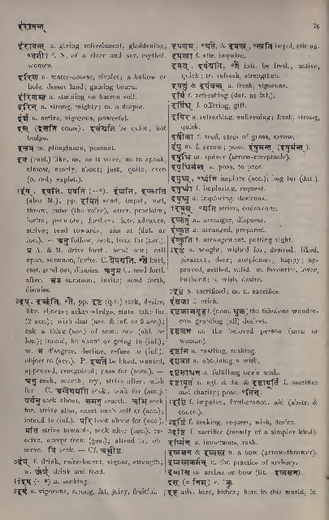
ihá ·adv. here, hither; here in this world, in this case, in this system or book, etc.; now, this moment. Also = loc. of a1. -- ihéha here and there, hence and thence, now and then.
Monier-Williams 1872 Partikel
Originaltext · Englisch · Partikel
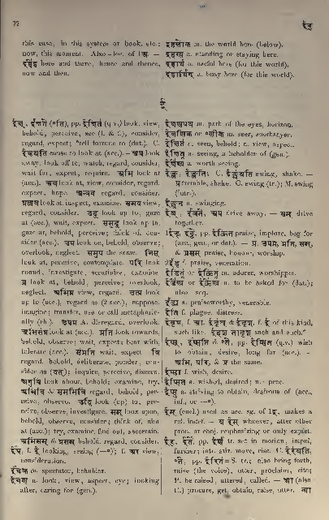
iha iha, ind. (fr. pronom. base 3. i), in this place, here; to this place; in this world; in this book or system; in this case (e. g. tena iha na, ‘therefore not in this case,’ i. e. the rule does not apply here); now, at this time; [cf. Zend idha, ‘here;’ Gr. ἰθᾱ or ἰθαι in ἰθα-γενής and ἰθαι-γενής; Goth. ith; perhaps Lat. igi-tur.]

Petersburger 1855 Adverb · Worttyp nicht bestimmt
Originaltext · Deutsch · Adverb
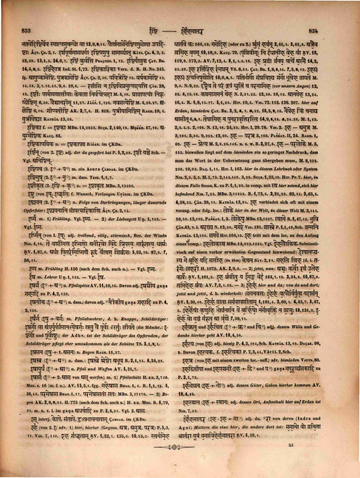
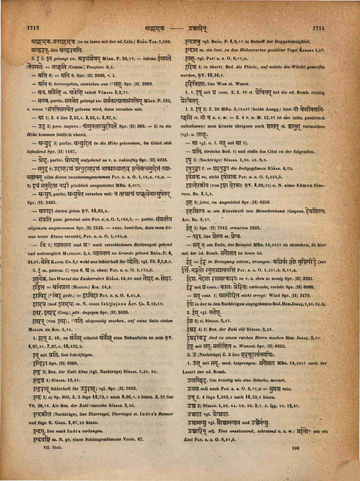
ihá (von 2. i) adv. 1〉 hier, hierher (Gegens. atra, amutra, paratra) P. 5,3,11. VOP. 7,110. eha gàcchatām ṚV. 1,22,1. ṚV. 1,135,5. ṚV. 10,15,3. stanàmi̱ha dhātàve kaḥ ṚV. 10,164,49. mamedi̱ha (oder zu 2.) śrùta̱ṃ havàm ṚV. 2,41,4. ṚV. 3,41,8. atrai̱va tvami̱ha va̱yam ṚV. 10,18,9. KAUŚ. 79. (pṛthivīm) ni dàdhānī̱ha ve̱ha vā̀ ṚV. 10,119,9. ṚV. 10,173,2. AV. 7,12,4. AV. 8,1,1. AV. 8,1,3. AV. 8,1,18. i̱ha pra̱jāṃ jànaya̱ a̱smai AV. 14,2,24. AV. 14,2,29. i̱ha ratìri̱ha ràmadhvam VS. 8,51. ŚAT. BR. 1,8,1,14. ŚAT. BR. 7,5,2,12. ihā3 ihā3 ityabhiṣuṇoti ŚAT. BR. 10,6,5,1. patirbhāryāṃ saṃpraviśya garbho bhūtveha jāyate M. 9,8. N. 9,32. dṛṣṭvaiva te paraṃ rūpaṃ dyutiṃ ca paramāmiha (vor unsern Augen) N. 12,52. N. 4,15. N. 4,16. kathamāgamanaṃ ceha N. 3,21. N. 3,22. N. 12,38. N. 18,12. ānayeha N. 13,24. N. 16,4. R. 1,8,15. R. 1,8,17. R. 5,1,20. HIT. 19,3. VID. 72. VID. 115. VID. 139. VID. 207. hier auf Erden, hienieden ŚAT. BR. 3,2,4,1. ŚAT. BR. 3,2,6,22. ŚAT. BR. 10,5,2,16. naiveha kiṃ canāgra āsīt ŚAT. BR. 10,6,5,1. teṣāmiha na punarāvṛttirasti ŚAT. BR. 14,9,1,18. ŚAT. BR. 14,9,4,24. ŚAT. BR. 14,9,1,28. M. 1,42. M. 2,2. M. 2,4. M. 2,5. M. 2,166. N. 13,18. N. 24,33. HIT. I, 29. HIT. I,78. VID. 2. iha — amutra M. 3,181. M. 5,55. M. 9,322. M. 12,89. iha — paratra M. 5,166. PAÑCAT. II, 24. RAGH. 1,69. iha — pretya M. 2,9. M. 2,26. M. 2,146. u. s. w. R. 2,27,6. iha — paraloke M. 5,153. bisweilen liegt auf dem hienieden ein so geringer Nachdruck, dass man das Wort in der Uebersetzung ganz übergehen muss, M. 8,222. M. 8,228. M. 10,93. DAŚ. 1,11. HIT. I, 163. hier in diesem Lehrbuch oder System NIR. 2,5. NIR. 5,5. M. 1,79. M. 2,143. M. 2,149. M. 3,25. SUŚR. 1,35,19. HIT. Pr. 7. hier, in diesem Falle SIDDH. K._zu_P. 1,1,28. in comp. mit stha hier seiend, sich hier befindend NIR. 7,23. MBH. 3,11322. R. 1,73,5. R. 2,21,23. R. 2,82,14. R. 3,63,5. R. 4,58,33. ŚĀK. 28,11. KATHĀS. 13,94. iha verbindet sich oft mit einem vorang. oder folg. loc.: loke hier in der Welt, in dieser Welt M. 3,141. M. 10,58. M. 12,102. PAÑCAT. I, 5. lokeṣu MBH. 13,1537. sthāne R. 1,47,13. bhuvi ŚĀK. 43, v. l. araṇya N. 12,20. nagare VID. 191. śāstre P. 1,1,49, Sch. janmani KATHĀS. 13,134. samaye HIT. 104,15. iha tritt mit dem loc. an den Anfang eines comp.: ihalokastha MBH. 14,953. MBH. 14,1324. Vgl. aihalaukika. Substantivisch auf einen vorher erwähnten Gegenstand hinweisend: doṣānapyasya me brūhi yadi santīha (in ihm) kecana SĀV. 2,21. mahati tviha (d. i. taraṃge) laharī H. 1075. AK. 2,9,9. — 2〉 jetzt, nun: aśva̱ḥ kartvo̱ rathà u̱teha kartvàḥ ṚV. 1,161,3. i̱ha bràvītu̱ ya ī̀ma̱ṅga vedà ṚV. 164,7. ṚV. 1,18. ṚV. 3,54,5. ṚV. 10,87,8. tami̱heha bràvaḥ AV. 7,2,1. AV. 7,2,55. — 3〉 i̱hehà hier und da; von da und dort; jetzt und jetzt, d. h. wiederholt: (samanavanta) i̱hehà va̱tsairviyùtā̱ yadāsàn ṚV. 5,30,10. i̱hehà jā̱tā samàvāvaśītām ṚV. 1,181,4. ṚV. 3,60,1. ṚV. 4,43,7. ṚV. 5,47,5. i̱hehaìṣāṃ kṛṇuhi̱ bhojànāni̱ ye ba̱rhiṣo̱ namòvṛkti̱ṃ na ja̱gmuḥ ṚV. 10,131,2. i̱hehà vo ya̱jñaṃ màruta̱ ā vṛ̀ṇe ṚV. 7,59,11.
Originaltext · Deutsch · Worttyp nicht bestimmt
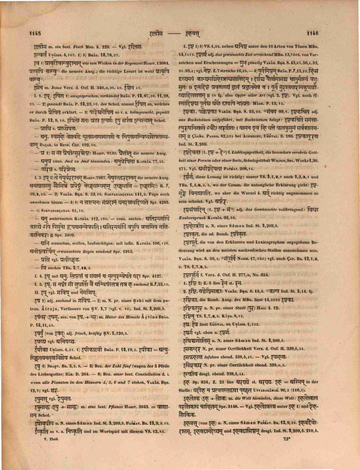
iha Sp. 834, Z. 23 lies araṇye st. araṇya. iha = asmin in der Stelle: yadīha na pratyayastadgatvā pṛcchata UTTARARĀMAC. 90,5 (116,1).
Originaltext · Deutsch · Worttyp nicht bestimmt
iha 2〉 jetzt, im Augenblick Spr. (II) 6359.
Böhtlingk 1879 Adverb
Originaltext · Deutsch · Adverb
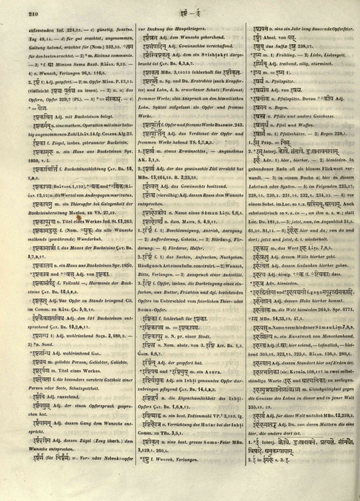
ihá Adv. — 1〉 hier, hierher. — 2〉 hienieden. In gebundener Rede oft als blosses Flickwort verwandt. — 3〉 in einem Buche — a〉 hier in diesem Lehrbuch oder System. — b〉 im Folgenden Chr. 225,27. Chr. 228,15. Chr. 230,2. Chr. 231,16. Chr. 232,1. Chr. 234,25. — 4〉 vor einem Subst. im Loc. so v. a. asmin, asyam. Auch substantivisch so v. a. in —, an ihm u. s. w.; statt Loc. Du. Chr. 181,2. — 5〉 jetzt, nun, im Augenblick Chr. 51,4. Chr. 61,20. Chr. 81,14. — 6〉 ihéha hier und da; von da und dort; jetzt und jetzt, d. i. wiederholt.
Apte 1890 Partikel
Originaltext · Englisch · Partikel
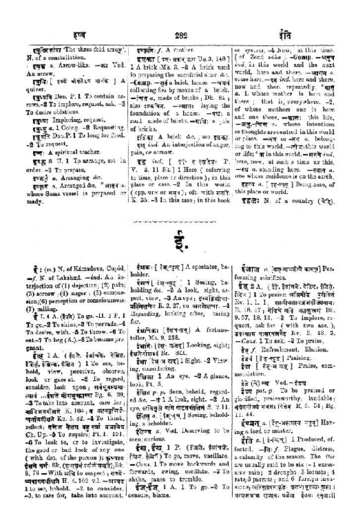
iha ind. [idaṃ-ha iśādeśaḥ P. V. 3. 11 Sk.] 1 Here (referring to time, place or direction); in this place or case. 2 In this world (opp. paratra or amutra); oft. with jagati; K. 35. 3 In this case; in this book ([Page 0282-c]) or system. 4 Now, at this time. [cf. Zend idha]. Comp. — amutra ind. in this world and the next world, here and there. — āgata a. come here. — iha ind. here and there, now and then, repeatedly. ˚mātṛ a. 1 whose mother is here and there; that is, everywhere. 2 of whose mothers one is here and one there. — kālaḥ this life. — kratu, -citta a. whose intentions or thoughts are centred in this world or place. — bhava or — tana a. belonging to this world. — lokaḥ this world or life; ˚ke in this world. — samaye ind. here, now, at such a time as this. — stha a. standing here. — sthāna a. one whose residence is on the earth.
Cappeller 1887 Worttyp nicht bestimmt
Originaltext · Deutsch · Worttyp nicht bestimmt
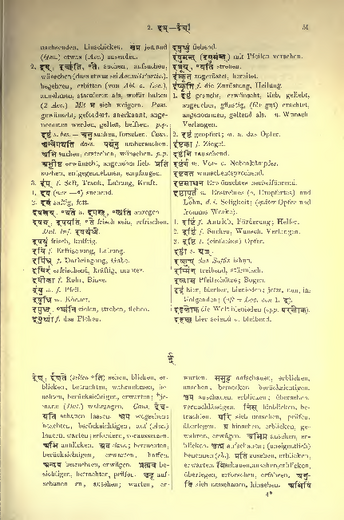
ihá hier, hierher, hienieden; jetzt, nun, im Folgenden; (oft = Loc. von 1. i).
Burnouf 1866 Adverb
Originaltext · Französisch · Adverb
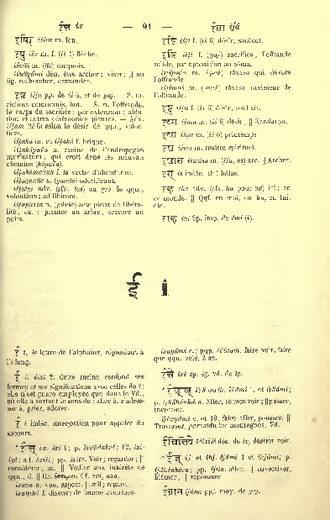
iha iha adv. (sfx. ha pour dha) ici; en ce monde. Qqf. en moi, en toi, en lui, etc.
Quelltextfundstellen (29)
DYS 4 Fundstellen
HTK 2 Fundstellen
IVU 1 Fundstelle
PJH 1 Fundstelle
SiSa 18 Fundstellen
Weitere 9 Quelltextseiten
SiSa 5.74-5.76: Nāḍī-Zirkulation 2 Fundstellen
Direkt belegt
SiSa 5.144-5.155: Ājñā und Khecarī 2 Fundstellen
Direkt belegt
-
SiSa 5.146 Segment 1
-
SiSa 5.150 Segment 3
SVU 2 Fundstellen
VBT 1 Fundstelle
Mit AYI Free weitermachen
Bildquelle: AYI Archiv.