

phala फल – Frucht; Ergebnis; im Kontext: Ejakulation
Substantiv Maskulin · Substantiv Neutrum · Worttyp nicht bestimmt
Wörterbuchquellen
AYI Wörterbuch Substantiv Neutrum
Frucht; Ergebnis; im Kontext: Ejakulation
Cappeller 1891 Substantiv Neutrum
Originaltext · Englisch · Substantiv Neutrum
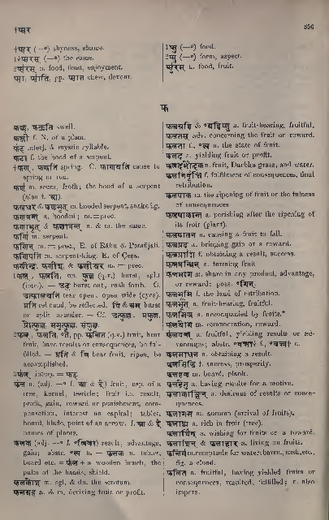
phála ·n. (adj. --° f. ā & ī) fruit, esp. of a tree, kernel, testicle; fruit i.e. result, profit, gain, reward or punishment, compensation, interest on capital; tablet, board, blade, point of an arrow. f. ā & ī names of plants.
Monier-Williams 1872 Substantiv Neutrum
Originaltext · Englisch · Substantiv Neutrum
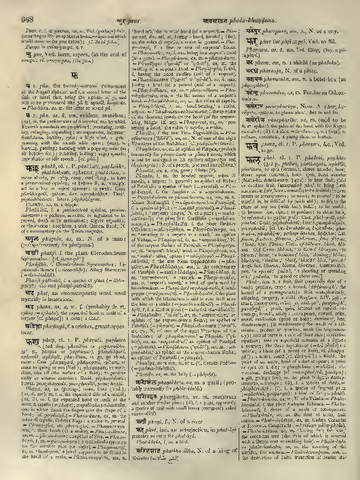
Phala, am, n. a fruit, fruit (especially that of a tree); produce, crop; a kernel, (dāḍima-ph˚, the kernel of a pomegranate); fruit metaphorically, offspring, progeny, a child (Raghu-v. XIV. 39); a result, consequence, effect [cf. niṣ-ph˚, puṇya-ph˚, puraḥ-ph˚]; profit, gain, interest on capital, ad- vantage, benefit, utility; recompense, reward, prize, meed, retribution (good or bad); detriment, loss, disadvantage; (in mathematics) the result of a cal- culation, product or quotient, result (in trigonome- try); second term in a rule of three sum; corrective equation; area or superficial contents of a figure; a nutmeg; the three myrobalans (= tri-phalā); a testicle; a blade (of a sword or knife, cf. khaḍga- ph˚); a tablet, board [cf. śāri-ph˚]; a shield; the point of an arrow, head of a dart or spear; a point or spot on a die; a ploughshare (= phāla); the menstrual discharge [cf. nava-phalikā, puṣpa]; a gift, giving; (as), m. the plant Wrightia Antidy- senterica, = kuṭaja; (ā), f. a species of shrub, = jhiñjhiriṣṭā; (ī), f. a species of fragrant plant (= phalinī, priyaṅgu); a kind of fish (= phali).
Petersburger 1855 Substantiv Neutrum · Worttyp nicht bestimmt
Originaltext · Deutsch · Substantiv Neutrum
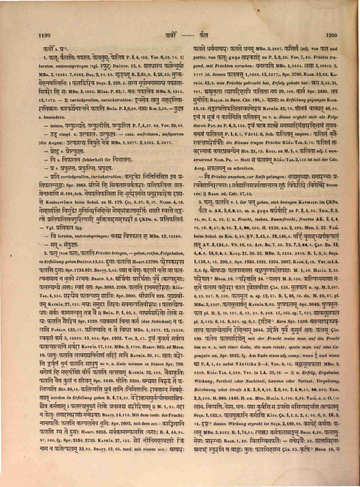
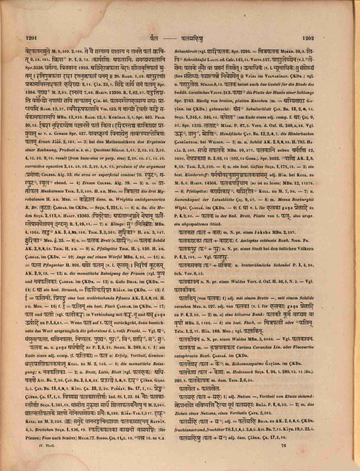
phála n. AK. 3,6,3,23. m.n. gaṇa ardharcādi zu P. 2,4,31. TRIK. 3,5,14. m.f.n. TRIK. 22. 1〉 n. Frucht, insbes. Baumfrucht, fructus AK. 2,4,1,15. AK. 2,4,1,19. AK. 2,4,2,47. AK. 2,4,5,35. AK. 3,4,26,203. H. 1130. H. an. 2,498. MED. I. 33. VAIJ. beim Schol. zu KIR. 4,21. ṚV. 3,45,4. ṚV. 10,146,5. yadì vṛ̱kṣāda̱bhyapàpta̱tphala̱ṃ tat AV. 6,124,2. VS. 10,13. AIT. BR. 7,30. TS. 7,3,14,1. ŚAT. BR. 13,4,4,8. ŚAT. BR. 14,9,4,1. KAUŚ. 21. KAUŚ. 30. KAUŚ. 33. MBH. 3,2534. MBH. 3,2816. R. 1,9,5. SUŚR. 1,158,8. SUŚR. 1,158,15. SUŚR. 1,209,3. Spr. 1930. Spr. 1931. Spr. 1934. Spr. 3887. RAGH. 1,49. VET. in LA. 2,5. fg. oṣadhyaḥ phalapākāntā bahupuṣpaphalopagāḥ M. 1,46. HALĀY. 2,25. pariṇata˚ MEGH. 18. ˚pariṇati MEGH. 24. ˚pātana M. 5,130. kalpiṣyamāṇā mahate phalāya vasuṃdharā kāla ivoptabījā ŚĀK. 151. mūlaphala n. sg. M. 3,267. M. 4,29. M. 4,247. M. 8,339. phalamūla n. sg. M. 12,67. R. 1,46,10. du. M. 10,87. pl. MBH. 3,2307. phalamūlārtham KATHĀS. 9,62. puṣpaphalam Spr. 3049. puṣpamūlaphala pl. M. 5,10. M. 5,157. M. 6,13. M. 6,21. M. 8,289. M. 11,165. sg. M. 7,131. śākamūlaphala pl. M. 5,119. M. 6,15. M. 8,331. sg. M. 6,5. dāḍima˚ Kern Spr. 1109. ātmāparādhavṛkṣasya phalānyetāni dehinām Spr. 2644. udeti pūrvaṃ kusumaṃ tataḥ phalam ŚĀK. 189. phalena phalamādiśet mit der Frucht weise man auf die Frucht hin so v. a. mit einer Gabe, die man reicht, spiele man auf eine Gegengabe an, Spr. 2632. fg. Am Ende eines adj. comp. wann ī und wann ā P. 4,1,64 nebst Vārttika 2—4. VOP. 4,15. bahumūlaphalā MBH. 3,8309. RĀJA-TAR. 4,295. VET. in LA. 35,19. — 2〉 n. Erfolg, Ergebniss, Wirkung, Vortheil oder Nachtheil, Gewinn oder Verlust, Vergeltung, Belohnung oder Strafe AK. 2,8,1,29. AK. 2,2,9,80. AK. 3,4,9,41. AK. 3,4,26,203. TRIK. 3,3,400. H. 869. H. 1446. H. an. MED. HALĀY. 1,118. HALĀY. 4,92. VAIJ. a. a. O. (= lābha, niṣpatti, yoga, dhana). yathā kurvanti sa upāyo yanniṣpādayanti tatphalam SUŚR. 1,152,2. phalayuktāni karmāṇi KĀTY. ŚR. 1,1,2. KĀTY. ŚR. 1,2,4. KĀTY. ŚR. 1,1,10. KĀTY. ŚR. 1,6,9. KĀTY. ŚR. 10,5,12. dṛṣṭa˚ dessen Wirkung erprobt ist SUŚR. 2,189,16. kasyedaṃ karmaṇaḥ phalam MBH. 3,2552. R. 1,74,11. tyaktvā karmaphalāsaṅgam BHAG. 4,20. phalānumeyāḥ prārambhāḥ RAGH. 1,20. vilambitaphalaiḥ — manorathaiḥ RAGH. 1,33. śāntamidamāśramapadaṃ sphurati ca bāhuḥ kutaḥ phalamihāsya ŚĀK. 15. kṛṣi˚ MEGH. 16. na vedaphalamaśnute M. 1,109. M. 2,160. te vai sasyasya jātasya na labhante phalaṃ kvacit M. 9,49. M. 9,161. kriyā˚ P. 1,3,72. (kāryāṇi) aphalāni, samavyayaphalāni Spr. 3538. dharmasya, vibhavasya Spr. 1933. agnihotraphalā vedāḥ śīlavṛttiphalaṃ śrutam . ratiputraphalā dārā dattabhuktaphalaṃ dhanam .. Spr. 20. RAGH. 1,29. āpurakṣṇāṃ prakāmavistāraphalaṃ hariṇyaḥ RAGH. 2,11. ŚĀK. 25,1. siddhe kārye samaṃ phalam Spr. 1364. puṇya˚ M. 3,95. dānasya M. 7,86. HARIV. 12590. R. 1,62,27. yaduttiṣṭhati varṇebhyo nṛpāṇāṃ kṣayi tatphalam ŚĀK. 46. phalamasyopahāsasya sadyaḥ prāpsyasi RAGH. 12,37. svapauruṣaphalāni VID. 153. na cānyāṃ devatāṃ kāṅkṣe sarvakāmaphalāmapi MBH. 13,829. RAGH. 12,6. KUMĀRAS. 5,1. Spr. 463. PRAB. 30,15. īśvarā bhūridravyeṇa yallabhante phalaṃ kila . daridrastacca kākiṇyā prāpnuyāt so v. a. Genuss Spr. 437. yāvacchasyaṃ vinaśyettu tāvatsyātkṣetriṇaḥ phalam Ersatz YĀJÑ. 2,161. — 3〉 bei den Mathematikern das Ergebniss einer Rechnung, Product u. s. w.; Quotient SŪRYAS. 1,61. SŪRYAS. 2,32. SŪRYAS. 2,42. SŪRYAS. 3,29. SŪRYAS. 4,13. SŪRYAS. 4,26. SŪRYAS. 9,10. result (from base-sine or perp. sine) SŪRYAS. 2,39. SŪRYAS. 2,40. SŪRYAS. 2,41. SŪRYAS. 2,44. SŪRYAS. 2,46. corrective equation SŪRYAS. 2,44. SŪRYAS. 2,48. SŪRYAS. 2,56. SŪRYAS. 3,29. SŪRYAS. 4,8. SŪRYAS. 4,15. produce of the argument (pramāṇa) COLEBR. Alg. 33. the area or superficial content 70. sphuṭa˚, asphuṭa˚, sthūla˚ ebend. — 4〉 Zinsen COLEBR. Alg. 39. — 5〉 n. = jātīphala Muskatnuss TRIK. 3,3,400. H. an. MED. = triphalā die drei Myrobalanen H. an. MED. = kakkola diess. m. Wrightia antidysenterica R. Br. (kuṭaja) ŚABDAR._im_ŚKDR. — SUŚR. 1,221,4. — 6〉 n. du. die Hoden SUŚR. 2,112,9. HARIV. 12363. (pitṛdevāḥ) aphalānbhuñjate meṣān phalaisteṣāmayojayan (indram) R. 1,49,11. — 7〉 n. Klange: su˚ (nistriṃśa) MBH. 4,1364. khaḍga˚ AK. 3,4,25,188. TRIK. 3,3,361. kṣurikā˚ H. an. 3,147. churikā˚ MED. j. 25. — 8〉 n. = phalaka Brett (s. śāri˚); = phalaka Schild AK. 2,8,2,58. TRIK. H. an. — 9〉 n. Pfeilspitze TRIK. H. ś. 150. H. an. ŚABDAR._im_ŚKDR. — 10〉 Auge auf einem Würfel MBH. 4,24. — 11〉 n. = phāla Pflugschar H. 891. atho phalam (v. l. halam) . nirīṣaṃ kūṭakam AK. 2,9,13. — 12〉 n. die monatliche Reinigung der Frauen (vgl. puṣpa und navaphalikā) ŚABDAR._im_ŚKDR. — 13〉 n. Gabe DHAR._im_ŚKDR. — 14〉 f. ā ein best. Strauch, = jhiñjhiriṣṭā RĀJAN._im_ŚKDR. — 15〉 f. ī = phalinī, priyaṅgu eine best. wohlriechende Pflanze AK. 2,4,2,36. H. an. MED. — 16〉 f. ī = phalin ein best. Fisch ŚABDAM._im_ŚKDR. — 17〉 phala und phalī (vgl. phalīkar) in Verbindung mit kar, bhū und as gaṇa ūryādi zu P. 1,4,61. — Wenn phala auf 1. phal zurückgeht, dann bezeich nete das Wort ursprünglich die geborstene d. i. reife Frucht. — Vgl. a˚, aṃśumatphalā, ajinaphalā, niṣphala, puṇya˚, puraḥ˚, vi˚, śāri˚, sa˚, su˚.
Originaltext · Deutsch · Worttyp nicht bestimmt
phala 3〉 Z. 4, corrective equation GOLĀDHY. 5,17. fgg. GOLĀDHY. 7,3. — 9〉 ŚĀRṄG. PADDH. 80,64_bei_AUFRECHT, HALĀY. Ind. u. ārāgra.
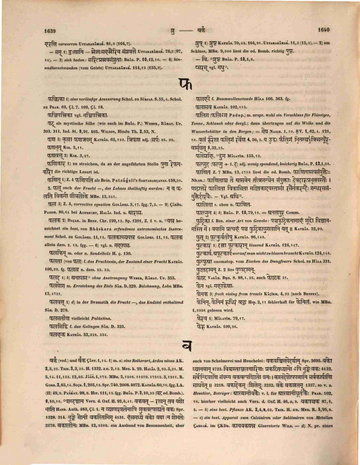
Böhtlingk 1879 Substantiv Maskulin · Substantiv Neutrum · Worttyp nicht bestimmt
Originaltext · Deutsch · Substantiv Maskulin · Substantiv Neutrum
phála — 1〉 n. (adj. Comp. f. ā und ī) — a〉 Frucht, insbes. Baumfrucht, fructus; auch Kern einer Frucht. phalena phalamādiśet mit der Frucht weise man auf die Frucht, so v. a. mit einer Gabe, die man reicht, spiele man auf eine Gegengabe an. — b〉 Muskatnuss SUŚR. 1,221,4. — c〉 *die drei Myrobalanen. — d〉 Hode. — e〉 *die monatliche Reinigung der Frauen. — f〉 Frucht in übertr. Bed. so v. a. Erfolg, Ergebniss, Wirkung, Lohn, Vergeltung, Vortheil oder Nachtheil, Gewinn oder Verlust, Belohnung oder Strafe. — g〉 Gewinn, so v. a. Genuss. — h〉 Ersatz. — i〉 bei den Rhetorikern der Ausgang einer Handlung DAŚAR. 1,13. SĀH. D. 296. SĀH. D. 318. — k〉 bei den Mathematikern — α〉 das Ergebniss einer Rechnung, Product u. s. w. — β〉 Quotient. — γ〉 corrective equation. — δ〉 Flächeninhalt ĀRYABH. 2,2. 7. — ε〉 das dritte Glied in der Regel de tri Comm. zu ĀRYABH. 2,26. — l〉 Zinsen ĀRYABH. 2,25. — m〉 *Gabe; vgl. u. 1〉a〉 am Ende. — n〉 Brett, Spielbrett MBH. 4,1,25. — o〉 Klinge. — p〉 Pfeilspitze KUMĀRAS. 4,25. R. 6,92,45. — q〉 *Schild. — r〉 *Pflugschar. — 2〉 *m. Wrightia antidysenterica. — 3〉 f. phalā — a〉 eine best. Pflanze CARAKA. 6,21. — b〉 HEMĀDRI 1,228,4. 229,14 fehlerhaft für tulā. — 4〉 *f. phalī — a〉 Aglaia odorata RĀJAN. 12,144. — b〉 ein best. Fisch.
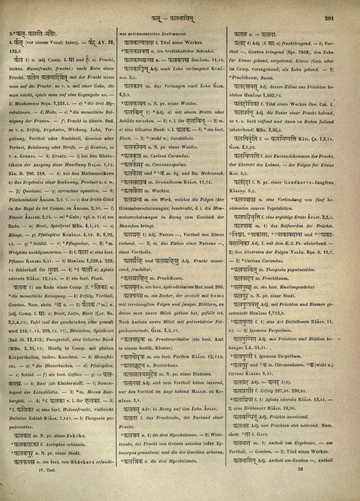
Originaltext · Deutsch · Worttyp nicht bestimmt
phala IV. 1〉p〉 KAUŚ. 28,3. [Nachtrag, Band 7]
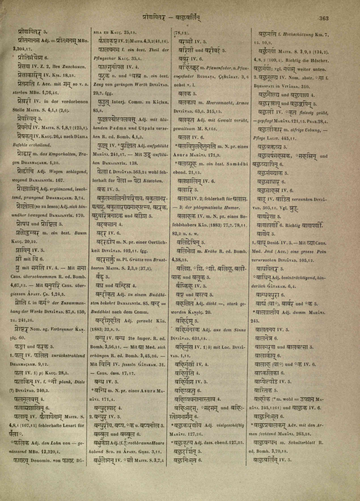
Apte 1890 Substantiv Neutrum
Originaltext · Englisch · Substantiv Neutrum
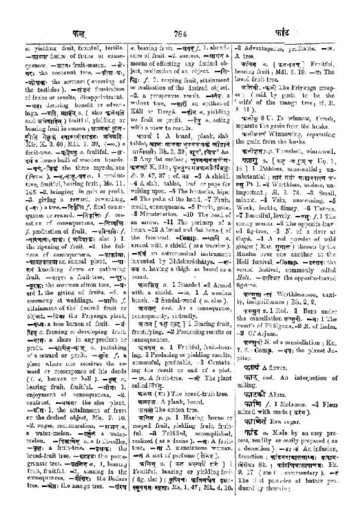
phalaṃ [phal-ac] 1 Fruit (fig. also) as of a tree; udeti pūrvaṃ kusumaṃ tataḥ phalaṃ Ś. 7. 30; R. 4. 33; R. 1. 49. 2 Crop, produce; kṛṣiphalaṃ Me. 16. 3 A result, fruit, consequence, effect; atyutkaṭaiḥ pāpapuṇyairihaiva phalamaśnute H. 1. 83; phalena jñāsyasi Pt. 1; na navaḥ prabhurāphalodayāt sthirakarmā virarāma karmaṇaḥ R. 8. 22; R. 1. 33. 4 (Hence) Reward, recompense, meed, retribution (good or bad); phalamasyopahāsasya sadyaḥ prāpsyasi paśya māṃ R. 12. 37. 5 A deed, an act (opp. words); bruvate hi phalena sādhavo na tu kaṃṭhena nijopayogitāṃ N. 2. 48 ‘good men prove their usefulness by deeds, not by words’. 6 Aim, object, purpose; pareṃgitajñānaphalā hi buddhayaḥ Pt. 1. 43; kimapekṣya phalaṃ Ki. 2. 21 ‘with what object in view’; Me. 54. 7 Use, good, profit, advantage; jagatā vā viphalena kiṃ phalaṃ Bv. 2. 61. 8 Profit or interest on capital. 9 Progeny, offspring; R. 14. 39. 10 A kernel (of a fruit). 11 A tablet ([Page 0783-c]) or board (śāriphala). 12 A blade (of a sword). 13 The point or head of an arrow, dart &c.; barb; Mu. 7. 10. 14 A shield. 15 A testicle. 16 A gift. 17 The result of a calculation (in Math.). 18 Product or quotient. 19 Menstrual discharge. 20 Nutmeg. 21 A ploughshare. 22 Loss, disadvantage. 23 The second term in a rule-of-three sum. 24 Correlative equation. 25 The area of a figure. 26 The three myrobalans (triphalā). 27 A point on a die. Comp. — adanaḥ = phalāśana q. v. — anubaṃdhaḥ succession or sequence of fruits or results. — anumeya a. to be inferred from the results or consequences; phalānumeyāḥ prāraṃbhāḥ saṃskārāḥ prāktanā iva R. 1. 20. — anusaraṇaṃ 1 rate of profits. 2 following or reaping consequences. — aṃtaḥ a bamboo. — anveṣin a. seeking for reward or recompense (of actions). — apekṣā expectation of the fruits or consequences (of acts), regard to results. — apeta a. useless, unfertile, unproductive. — amlaḥ a kind of sorrel. — (mlaṃ) tamarind. — aśanaḥ a parrot. — asthi n. a cocoa-nut. — ākāṃkṣā expectation of (good) results; see phalāpekṣā. — āgamaḥ 1 production of fruits, load of fruits; bhavaṃti namrāstaravaḥ phalāgamaiḥ Ś. 5. 12. 2 the fruit season, autumn. — āḍhya a. full of or abounding in fruits. — (ḍhyā) a kind of plantain. — ārāmaḥ a fruit-garden, orchard. — āsakta a. 1 fond of fruits. 2 attached to fruits, fond of getting fruit (of actions done). — āhāraḥ feeding or living on fruits, fruit-meal. — uccayaḥ a collection of fruits. — uttamā 1 a kind of grapes (having no stones). 2 = triphalā. — utpattiḥ f. 1 production of fruit. 2 profit, gain. — (ttiḥ) the mango tree (sometimes written phalotpati in this sense). — udayaḥ 1 appearance of fruit, production of results or consequences, attainment of success or desired object; āphalodayakarmaṇāṃ R. 1. 5; R. 8. 22. 2 profit, gain. 3 retribution, punishment. 4 happiness, joy. 5 heaven. — udgamaḥ appearance of fruits; Ś. 5. 12 (v. l.). — uddeśaḥ regard to results; see phalāpekṣā. — upajīvin a. living by cultivating or selling fruits. — upeta ([Page 0784-a]) a. yielding fruit, fruitful, fertile. — kāmanā desire of fruits or consequences. — kālaḥ fruit-season. — kesaraḥ the cocoanut tree. — kośaḥ -ṣaḥ, — kośakaḥ the scrotum (covering of the testicles). — khaṃḍanaṃ frustration of fruits or results, disappointment. — grahaḥ deriving benefit or advantage. — grahi, grāhin a. (also phalegrahi and phalegrāhin) fruitful, yielding or bearing fruit in season; ślādhyatāṃ kulamupaiti paitṛkaṃ syānmanorathataruḥ phalegrahiḥ Kīr. K. 3. 60; Māl. 9. 39. ( — m.) a fruit-tree. — grahiṣṇu a. fruitful. — chadanaṃ a house built of wooden boards. — trayaṃ, -trikaṃ the three myrobalans (triphalā). — da, -dātṛ, -prada a. 1 productive, fruitful, bearing fruit; Ms. 11. 143. 2 bringing in gain or profit. 3 giving a reward, rewarding. — (daḥ) a tree. — nirvṛtti f. final consequence or reward. — nivṛttiḥ f. cessation of consequences. — niṣpattiḥ f. production of fruit. — pariṇatiḥ f. — pariṇāmaḥ, -pākaḥ (phalepākaḥ also) 1 the ripening of fruit. 2 the fulness of consequences. — pākāṃtā, — pākāvasānā an annual plant. — pātanaṃ knocking down or gathering fruit. — pādapaḥ a fruit-tree. — pūraḥ, — pūrakaḥ the common citron tree. — pradānaṃ 1 the giving of fruits. 2 a ceremony at weddings. — prāptiḥ f. attainment of the desired fruit or object. — priyā the Priyaṅgu plant. — vaṃdhyaḥ a tree barren of fruit. — baṃdhin a. forming or developing fruit. — bhāgaḥ a share in any product or profit. — bhāgin -bhāj a. partaking of a reward or profit. — bhūmiḥ f. a place where one receives the reward or recompense of his deeds (i. e. heaven or hell). — bhṛt a. bearing fruit, fruitful. — bhogaḥ 1 enjoyment of consequences. 2 usufruct. — matsyā the aloe plant. — yogaḥ 1 the attainment of fruit or the desired object, Mu. 7. 10. 2 wages, remuneration. — rājan m. a water-melon. — vartulaṃ a watermelon. — vikrayin a. a fruit-seller. — vṛkṣaḥ a fruit-tree. — vṛkṣakaḥ the bread-fruit tree. — śāḍavaḥ the pomegranate tree. — śālin a. 1 bearing fruit, fruitful. 2 sharing in the consequences. — śaiśiraḥ the Badara tree. — śreṣṭhaḥ the mango tree. — saṃstha ([Page 0784-b]) a. bearing fruit. — saṃpad f. 1 abundance of fruit. 2 success. — sādhanaṃ a means of effecting any desired object, realization of an object. — siddhiḥ f. 1 reaping fruit, attainment or realization of the desired object. 2 a prosperous result. — snehaḥ a walnut tree. — hārī an epithet of Kālī or Durgā. — hīna a. yielding no fruit or profit. — hetu a. acting with a view to results.
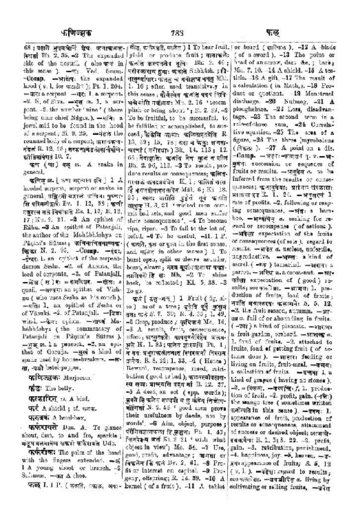
Cappeller 1887 Substantiv Neutrum
Originaltext · Deutsch · Substantiv Neutrum
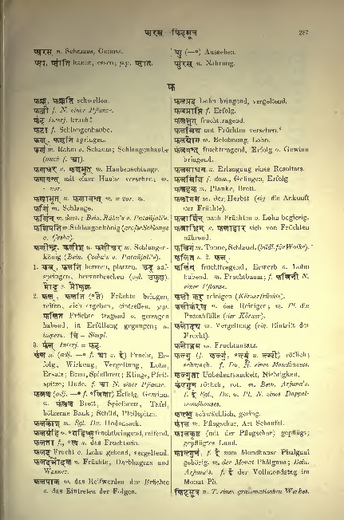
phála n. (adj. —˚ f. ā u. ī) Frucht, Erfolg, Wirkung, Vergeltung, Lohn, Ersatz; Brett, Spielbrett; Klinge, Pfeilspitze; Hode. f. ā N. einer Pflanze.
Burnouf 1866 Substantiv Neutrum
Originaltext · Französisch · Substantiv Neutrum
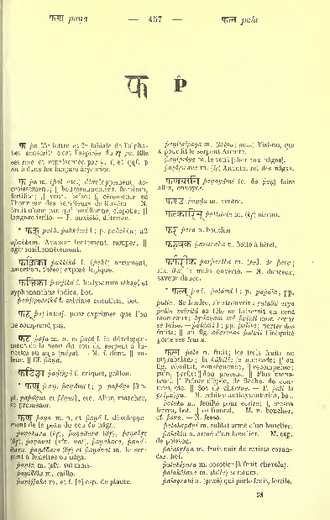
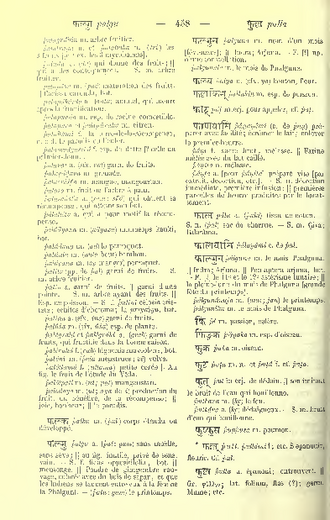
phala phala n. fruit; les trois fruits ou myrobalans; la kākolī; la muscade; au fig. résultat, conséquence; récompense; gain, profit; don, présent. Flux menstruel. Pointe d'épée, de flèche, de couteau, etc. Soc de charrue. — F. phalī la priyaṅgu. — M. echites antidysenterica, bot. phalaka m. feuille pour écrire; mesua ferrea, bot. os frontal. — M. n. bouclier, cf. phara. — N. fesse. phalakapāṇi m. soldat armé d'un bouclier. phalakin a. armé d'un bouclier. — M. esp. de poisson. phalakṛṣṇa m. fruit noir du carissa carondas, bot. phalakeśara m. cocotier [à fruit chevelu]. phalakoṣaka m. (koṣa) scrotum. phalagrahi a. (grah) qui porte fruit, fertile. [Page458-1] phalagrāhin m. arbre fruitier. phalatraya n. et phalatrika n. (tri) les 3 fruits [par ex. les 3 myrobalans]. phalada a. (dā) qui donne des fruits; qui a des conséquences. — S. m. arbre fruitier. phalapāka m. (pac) maturation des fruits. Carissa caronda, bot. phalapākānta a. (anta) annuel, qui meurt après la fructification. phatapuccha m. esp. de racine comestible. phalapūra et phalapūraka m. citron. phalabhūmi f. la terre-de-la-récompense, c-à-d. le paradis ou l'enfer. phalamudgarikā f. esp. de datte [? celle du palmier-doum]. phalavat a. (sfx. vat) garni de fruits. phalaśāḍava m. grenade. phalaśreṣṭha m. mangue, mangoustan. phalasa m. fruit de l'arbre-à-pain. phalasaṃstha a. (sam; sthā) qui obtient sa récompense; qui atteint son but. phālahetu a. qui a pour motif la récompense. phalādhyakṣa m. (adhyakṣa) mimusops kauki, bot. phalādana m. (ad) le perroquet. phalānta m. (anta bout) bambou. phalāśanta m. (aś manger) perroquet. phalita (pp. de phal) garni de fruits. — S. m. arbre fruitier. phalin a. garni de fruits. garni d'une pointe. — S. m. arbre ayant des fruits. Esp. de poisson. — S. f. phalinī célosia cristata; echites dichotoma; la priyaṅgu, bot. phalina a. (sfx. ina) garni de fruits. phalūṣa m. (sfx. ūṣa) esp. de plante. phalegrahi et phalegrāhi a. (grah) garni de fruits, qui fructifie dans la bonne saison. phaleruhā f. (ruh) bignonia suaveolens, bot. phaloni m. (phala menstrues; ve) vulve. phalottamā f. (uttama) petite corde Au fig. le fruit de l'étude du Veda. phalotpati m. (ut; pat) mangoustan. phalodaya m. (ut; aya de i) production du fruit, du bénéfice, de la récompense; joie, bonheur; le paradis.
Quelltextfundstellen (29)
DYS 6 Fundstellen
HP 3 Fundstellen
HTK 1 Fundstelle
HTK 10.34*2–38*1: Asvaṅgaśṛṅkhalā und Kumbhāntaraśṛṅkhalā 1 Fundstelle
Direkt belegt
-
HTK 10.38 Segment 15
PYS 4 Fundstellen
SiSa 14 Fundstellen
SiSa 1.20-1.31: Karma und Erkenntnis 4 Fundstellen
Direkt belegt
SiSa 3.11-3.16: Guru und Śraddhā 2 Fundstellen
Direkt belegt
Weitere 4 Quelltextseiten
SVU 1 Fundstelle
Mit AYI Free weitermachen
Bildquelle: AYI Archiv.