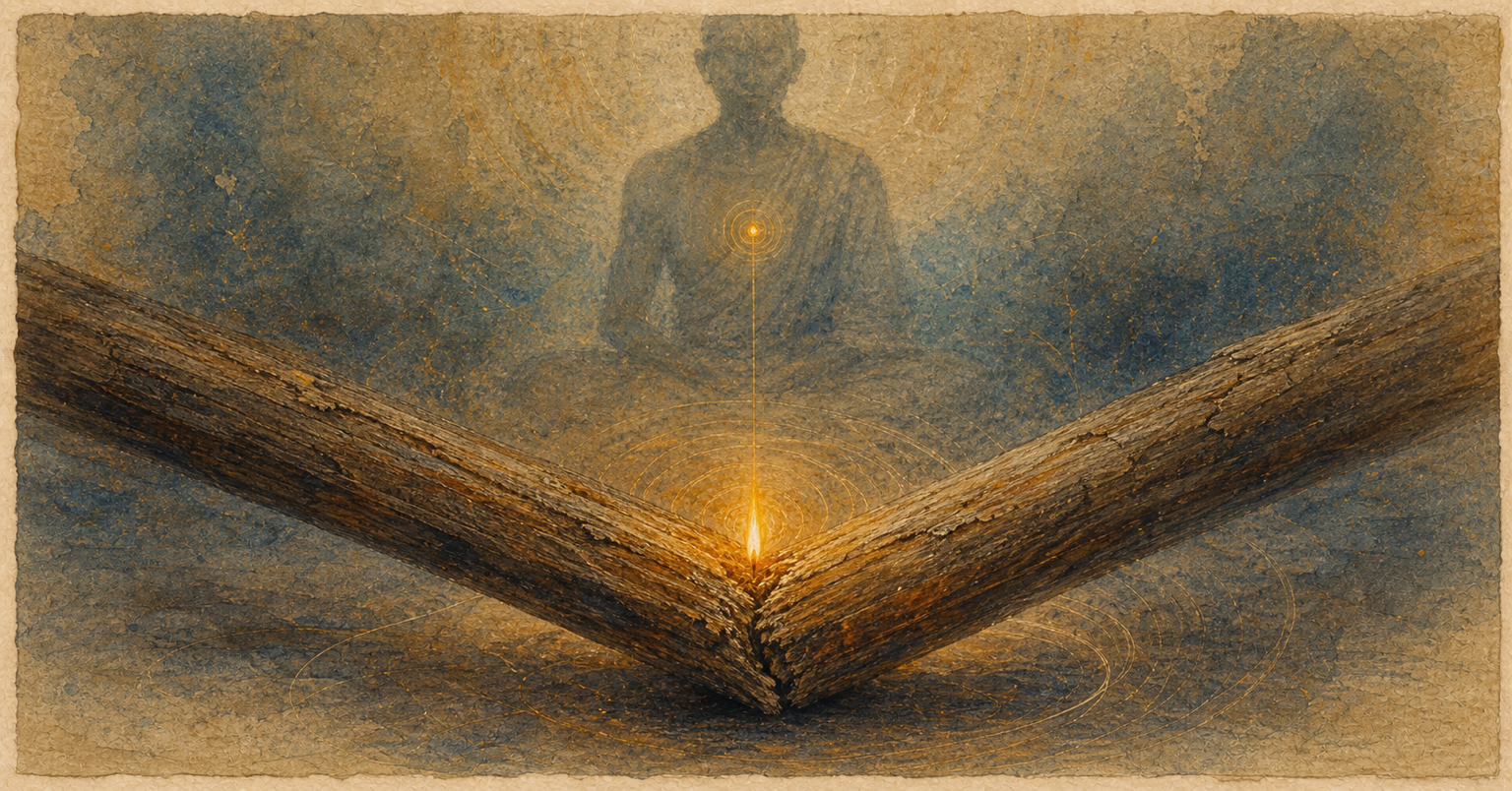
SVU 1.13-1.16: The Hidden Fire

SVU 1.13-1.16: Om, Meditation and Knowledge of the Self

As fire lies hidden in the fire-sticks and butter in milk, the Self lies hidden within; truthfulness, austerity, meditation and Om reveal it there.

Dr. Ronald Steiner Dr. Ronald Steiner Nils Jacob Liersch Nils Jacob Liersch
Śvetāśvatara Upaniṣad 1.13
वह्नेर्यथा योनिगतस्य मूर्तिर्न दृश्यते नैव च लिङ्गनाशः |
vahner yathā, yoni-gatasya mūrtir; na dṛśyate, naiva ca liṅga-nāśaḥ | Analysis ▾ Analysis ▴
vahneḥ
genitive singular
substantive masculine
of fire
yathā
adverb
as, just as
yoni
tatpuruṣa-compound lokative
substantive feminine
in the source
gatasya
genitive singular masculine past participle passive
verbal root
having entered, situated within
mūrtiḥ
nominative singular
substantive feminine
the form, manifestation
na
particle
not
dṛśyate
3rd person singular passive present
verbal root
is seen
na
particle
not
eva
particle
indeed, also
ca
particle
and
liṅga
tatpuruṣa-compound genitive
substantive neuter
of the mark, seed
nāśaḥ
nominative singular
substantive masculine
disappearance, destruction
स भूय एवेन्धनयोनिगृह्यस्तद्वोभयं वै प्रणवेन देहे ||13||
sa bhūya eve,ndhana-yoni-gṛhyas; tad vobhayaṃ vai, praṇavena dehe ||13|| Analysis ▾ Analysis ▴
saḥ
nominative singular masculine
pronoun dem
it, this
bhūyas
adverb
again
eva
particle
precisely, indeed
indhana
dvandva-compound
substantive neuter
fuel, fire-stick
yoni
upapada-compound
substantive feminine
lower fire-stick, source
gṛhyaḥ
nominative singular masculine future participle passive
verbal root
to be grasped, perceived
tat
nominative singular neuter
pronoun dem
this
vā
particle
or, rather
ubhayam
nominative singular neuter
numeral
both
vai
particle
certainly, indeed
praṇavena
instrumental case singular
substantive masculine
through Praṇava, the sound Om
dehe
lokative singular
substantive masculine
in the body
Metre: Triṣṭubh with Vajrā ending
As (yathā) the form (mūrtiḥ | nom sg) of fire (vahneḥ | gen sg) that has entered its source (yonigatasya | gen sg m ppp) is not (na) seen (dṛśyate | 3p sg pas pres), yet its mark does not (naiva), in fact (ca), disappear (liṅganāśaḥ | nom sg), so it (saḥ | nom sg m) is indeed (eva) grasped again (bhūyas) in fuel and source (indhanayonigṛhyaḥ | nom sg m pfp). This (tat | nom sg n), or rather (vā) both (ubhayam | nom sg n), are certainly (vai) [to be grasped] through Praṇava (praṇavena | ins sg) in the body (dehe | loc sg).
Dr. Ronald Steiner - 2026 - historically literal
When fire has entered its source, the fuel, its form is no longer visible, yet its hidden mark has not been extinguished. Friction can make it appear again. In the same way, the sound Om reveals both states within the human body: hidden reality and its manifestation.
Dr. Ronald Steiner - 2026 - modern transfer

The Bhāṣya attributed to Śaṅkara structures the analogy of fire precisely: fire is hidden in wood, inferred from its mark and grasped through repeated friction. In the same way, the Self hidden in the body becomes visible through meditation on Praṇava, which corresponds to the friction.

Śaṅkara's Bhāṣya on the Śvetāśvatara Upaniṣad

Śaṅkarānanda takes perceptible heat as a sign of the still-invisible fire. Friction makes it manifest. Correspondingly, higher and lower Brahman are inferred through Praṇava in the space of the heart and brought from concealment into direct experience.

Śaṅkarānanda's Śvetāśvataropaniṣaddīpikā

Nārāyaṇa explains that hidden fire remains recognisable by its sign and emerges between two fire-sticks. In the same way, Brahman lies hidden in the body and is known through Praṇava. The simile thus establishes a concrete method of meditation.

Nārāyaṇa's Śvetāśvataropaniṣaddīpikā

Vijñānabhagavat sees hidden fire as an existing power whose type of wood provides a sign and which friction reveals. Likewise, the Self concealed by Māyā can be inferred from infinity and timelessness and is directly realised through Praṇava as the unity of Brahman and Self.

Vijñānabhagavat's Śvetāśvataropaniṣadvivaraṇa
Wie Feuer, eingekehrt in seine Heimstatt, Unsichtbar fortbesteht nach seinem Wesen, Und aus der Reibholzheimstatt neu aufleuchtet, So flammt’s, in beidem gleich<2>, im Leib durch Om auf.
<2: Das Brahman, in beidem, dem Latentfortbestehen und dem Neuaufleuchten, dem Feuer vergleichbar, kommt durch den Praṇava, den heiligen Laut Om, im Leibe zum Aufflammen.>
Paul Deussen - 1921
As the material form (mūrti) of fire when latent in its source [i.e. the fire-wood] Is not perceived—and yet there is no evanishment of its subtile form (liṅga)— But may be caught again by means of the drill in its source, So, verily, both [the universal and the individual Brahma] are [to be found] in the body by the use of Om.
Robert Hume - 1921
The form of fire present in the fire-producing wooden stick is not seen; yet there is no destruction of the form. Just as that (form of the fire), again, can be obtained by means of (another) wooden stick; like this, both (forms of Brahm) (can be grasped) in this body by means of Om.
Siddhesvar Varma Shastri - 1916
Wie Feuer, eingekehrt in seine Heimstatt, Unsichtbar fortbesteht nach seinem Wesen, Und aus der Reibholzheimstatt neu aufleuchtet, So flammt’s, in beidem gleich<26>, im Leib durch Om auf.
<26: Das Brahman, in beidem, dem Latentfortbestehen und dem Neuaufleuchten, dem Feuer vergleichbar, kommt durch den Praṇava, den heiligen Laut Om, im Leibe zum Aufflammen.>
Paul Deussen - 1897
As the form of fire, while it exists in the under-wood,<5> is not seen, nor is its seed destroyed, but it has to be seized again and again by means of the stick and the under-wood, so it is in both cases, and the Self has to be seized in the body by means of the praṇava (the syllable Om).
<5: This metaphor, like most philosophical metaphors in Sanskrit, is rather obscure at first sight, but very exact when once understood. Fire, as produced by a fire drill, is compared to the Self. It is not seen at first, yet it must be there all the time; its liṅga or subtle body cannot have been destroyed, because as soon as the stick, the indhana, is drilled in the under-wood, the yoni, the fire becomes visible. In the same way the Self, though invisible during a state of ignorance, is there all the time, and is perceived when the body has been drilled by the Pranava, that is, after, by a constant repetition of the sacred syllable Om, the body has been subdued, and the ecstatic vision of the Self has been achieved. Indhana, the stick used for drilling, and yoni, the under-wood, in which the stick is drilled, are the two aranis, the fire-sticks used for kindling fire. See Tylor, Anthropology, p. 260.>
F. Max Müller - 1884
As the nature of fire, when concealed in its cause (the wood) is not perceived, nor also a destruction of its subtle body, as it is again (and again) perceived in its cause, the wood, (by rubbing),—as both is (perceived and not perceived), so (the soul is perceived) within the body by the sacred word (Om).
Edward Röer - 1853
Śvetāśvatara Upaniṣad 1.14
स्वदेहमरणिं कृत्वा प्रणवं चोत्तरारणिम् |
sva-deham araṇiṃ kṛtvā; praṇavaṃ cottarāraṇim | Analysis ▾ Analysis ▴
sva
karmadhāraya-compound
adjective
own
deham
accusative singular
substantive masculine
one's body
araṇim
accusative singular
substantive feminine
the lower fire-stick
kṛtvā
absolutus
verbal root
having made
praṇavam
accusative singular
substantive masculine
Praṇava, the sound Om
ca
particle
and
uttara
karmadhāraya-compound
adjective
upper
araṇim
accusative singular
substantive feminine
fire-stick
ध्याननिर्मथनाभ्यासाद्देवं पश्येन्निगूढवत् ||14||
dhyāna-nirmathanābhyāsād; devaṃ paśyen nigūḍhavat ||14|| Analysis ▾ Analysis ▴
dhyāna
tatpuruṣa-compound genitive
substantive neuter
meditation
nirmathana
tatpuruṣa-compound genitive
substantive neuter
churning, friction
abhyāsāt
ablative singular
substantive masculine
through practice, repetition
devam
accusative singular
substantive masculine
God
paśyet
3rd person singular aktive optative
verbal root
one should see, recognise
nigūḍhavat
adverb
like something hidden, like hidden fire
Metre: Anuṣṭubh
Having made (kṛtvā | abs) one's own body (svadeham | acc sg) the lower fire-stick (araṇim | acc sg), and (ca) Praṇava (praṇavam | acc sg) the upper fire-stick (uttarāraṇim | acc sg), through the practice of churning in meditation (dhyānanirmathanābhyāsāt | abl sg) one should see (paśyet | 3p sg act opt) God (devam | acc sg), as something hidden (nigūḍhavat).
Dr. Ronald Steiner - 2026 - historically literal
Make your own body the lower fire-stick and Praṇava, Om, the upper one. Kindle the inner fire through the steady friction of meditation, and you will recognise the God hidden there.
Dr. Ronald Steiner - 2026 - modern transfer

The Bhāṣya attributed to Śaṅkara makes one's own body the lower fire-stick, Praṇava the upper, and repeated meditation the act of friction. Its result is the vision of the luminous Self, which does not arise anew but was previously hidden like fire in fuel.

Śaṅkara's Bhāṣya on the Śvetāśvatara Upaniṣad

Śaṅkarānanda identifies the body or heart and Om as the two fire-sticks. Meditation must continue like unbroken friction until direct vision occurs. Merely occasional reflection does not fulfil the logic of the mantra's image.

Śaṅkarānanda's Śvetāśvataropaniṣaddīpikā

Nārāyaṇa understands the body as the lower fire-stick and Praṇava as the upper, which is led upwards through the six cakras. Repeated meditation kindles the vision of the luminous Self along this inner path.

Nārāyaṇa's Śvetāśvataropaniṣaddīpikā

Vijñānabhagavat calls the body and psychophysical complex the lower fire-stick, Praṇava the upper, and sustained Nididhyāsana the friction. This burns Avidyā and does not make self-luminous consciousness real for the first time, but renders it directly visible.

Vijñānabhagavat's Śvetāśvataropaniṣadvivaraṇa
Den Leib machend zum Reibholze, Und den Om-Laut zum obern Holz, Schaut man, nach fleiß’ger Denkquirlung, Verstecktem Feuer gleich, den Gott.
Paul Deussen - 1921
By making one’s own body the lower friction-stick And the syllable Om the upper friction-stick, By practising the friction of meditation (dhyāna), One may see the God (deva) who is hidden, as it were.
Robert Hume - 1921
Having made one’s body (as it were) the (first) fire-producing wooden stick, and the syllable Om as the second wooden stick, (one) should see, by means of repeated friction in the form of meditation, the Luminous God like fire (which was) extremely hidden (before friction).
Siddhesvar Varma Shastri - 1916
Den Leib machend zum Reibholze, Und den Om-Laut zum obern Holz, Schaut man, nach fleiß’ger Denkquirlung, Verstecktem Feuer gleich, den Gott.
Paul Deussen - 1897
By making his body the under-wood, and the syllable Om the upper-wood, man, after repeating the drill of meditation, will perceive the bright god, like the spark hidden in the wood.<1>
<1: Cf. Dhyānavindūpan. verse 20; Brahmopanishad, p. 256.>
F. Max Müller - 1884
Having made his own body the lower piece of wood, and the sacred word the upper piece, a person by practice of abstract meditation, which serves as rubbing, will behold god, as the concealed (fire becomes visible to him by rubbing).
Edward Röer - 1853
Śvetāśvatara Upaniṣad 1.15
तिलेषु तैलं दधनीव सर्पिरापः स्रोतःसु अरणीषु चाग्निः |
tileṣu tailaṃ, dadhanīva sarpir; āpaḥ srotaḥsu*, araṇīṣu cāgniḥ | Analysis ▾ Analysis ▴
tileṣu
lokative plural
substantive masculine
in sesame seeds
tailam
nominative singular
substantive neuter
oil
dadhani
lokative singular
substantive neuter
in curds, sour milk
iva
particle
as, like
sarpiḥ
nominative singular
substantive neuter
butter, ghee
āpaḥ
nominative plural
substantive feminine
waters
srotaḥsu
lokative plural
substantive neuter
in watercourses, riverbeds
araṇīṣu
lokative plural
substantive feminine
in the fire-sticks
ca
particle
and
agniḥ
nominative singular
substantive masculine
fire
एवमात्मा आत्मनि गृह्यते ऽसौ सत्येनैनं तपसा यो ऽनुपश्यति ||15||
evam ātmā, ātmani gṛhyate 'sau; satyenainaṃ, tapasā yo 'nupaśyati ||15|| Analysis ▾ Analysis ▴
evam
adverb
thus, in this way
ātmā
nominative singular
substantive masculine
the Self
ātmani
lokative singular
substantive masculine
in the Self, in oneself
gṛhyate
3rd person singular passive present
verbal root
is grasped, recognised
asau
nominative singular masculine
pronoun dem
that one there
satyena
instrumental case singular
substantive neuter
through truth, truthfulness
enam
accusative singular masculine
pronoun dem
him, this one
tapasā
instrumental case singular
substantive neuter
through austerity, inner heat
yaḥ
nominative singular masculine
pronoun rel
who, whoever
anupaśyati
3rd person singular aktive present
previx
verbal root
he beholds, recognises
Metre: Pāda 1: Triṣṭubh with Vajrā ending; Pāda 2: Triṣṭubh with Vajrā ending; Pāda 3: Triṣṭubh with Vajrā ending; Pāda 4: Jagatī
In sesame seeds (tileṣu | loc pl) [lies] oil (tailam | nom sg); in curds (dadhani | loc sg), as in a comparison (iva), [lies] butter (sarpiḥ | nom sg). Water (āpaḥ | nom pl) [lies] in riverbeds (srotaḥsu | loc pl), and (ca) fire (agniḥ | nom sg) in the fire-sticks (araṇīṣu | loc pl). Thus (evam) the Self (ātmā | nom sg), that one there (asau | nom sg m), is grasped (gṛhyate | 3p sg pas pres) in oneself (ātmani | loc sg) by whoever (yaḥ | nom sg m) beholds (anupaśyati | 3p sg act pres) him (enam | acc sg m) through truthfulness (satyena | ins sg) and austerity (tapasā | ins sg).
Dr. Ronald Steiner - 2026 - historically literal
As oil lies hidden in sesame seeds, butter in curds, water in riverbeds and fire in the fire-sticks, so the Self is to be found within oneself. Whoever contemplates it with truthfulness and disciplined concentration recognises it there.
Dr. Ronald Steiner - 2026 - modern transfer

The Bhāṣya attributed to Śaṅkara assigns one means of access to each of the four images: pressing, churning, digging and rubbing. Correspondingly, one apprehends the Self within through reflection, truthful and wholesome speech, and one-pointed concentration of senses and mind.

Śaṅkara's Bhāṣya on the Śvetāśvatara Upaniṣad

Śaṅkarānanda reads the four examples as different methods of disclosure. Just as every hidden substance requires its appropriate means, the self-luminous Self is directly recognised in the heart-mind through Praṇava, truthfulness and tapas.

Śaṅkarānanda's Śvetāśvataropaniṣaddīpikā

Nārāyaṇa emphasises finding within the mind: as water becomes accessible through digging, the Self appears in inner concentration. Truthfulness and tapas are the means, and repeated contemplation is the actual process of this discovery.

Nārāyaṇa's Śvetāśvataropaniṣaddīpikā

Vijñānabhagavat differentiates oil, butter, water and fire by pressing, churning, digging and rubbing. Correspondingly, the inwardly present Self is recognised as one's own Self through hearing and deepening reflection, truthfulness, and concentration of the outer and inner senses.

Vijñānabhagavat's Śvetāśvataropaniṣadvivaraṇa
dadhanīva LV1958 ] dadhnīva ASS1927, LV1958-app, TO1995
Critical Apparatus
Wie im Ölsamen Öl, in Milch die Butter, In Strömen Wasser, im Reibholze Feuer, So findet im eignen Selbste jenen [Ātman], Wer ihn erschaut durch Wahrheit und Kasteiung,
Paul Deussen - 1921
As oil in sesame seeds, as butter in cream, As water in river-beds, and as fire in the friction-sticks, So is the Soul (Ātman) apprehended in one’s own soul, If one looks for Him with true austerity (tapas).
Robert Hume - 1921
As oil in sesamum seeds, clarified butter in curd, water in hidden springs, and fire in fire-producing wooden-sticks (is obtained), so the (supreme) Self is grasped in one’s own mind (by him) who tries to see It with truth and mental concentration, and control of the senses.
Siddhesvar Varma Shastri - 1916
Wie im Ölsamen Öl, in Milch die Butter, In Strömen Wasser, im Reibholze Feuer, So findet im eignen Selbste jenen [Ātman], Wer ihn erschaut durch Wahrheit und Kasteiung,
Paul Deussen - 1897
As oil in seeds, as butter in cream, as water in (dry) river-beds,<2> as fire in wood, so is the Self seized within the self, if man looks for him by truthfulness and penance;<3>
<2: Srotas, a stream, seems to mean here the dry bed of a stream, which, if dug into, will yield water.>
<3: The construction is correct, if we remember that he who is seized is the same as he who looks for the hidden Self. But the metre would be much improved if we accepted the reading of the Brahmopanishad, evam ātmā ātmani grihyate ’sau, which is confirmed by B. The last line would be improved by reading, satyenainam ye ’nupasyanti dhīrāḥ.>
F. Max Müller - 1884
As oil in sesam seed (is found by pressing it), butter in curds (by churning them), water in a river (by digging the ground), and fire in the two pieces of wood (by rubbing them),—so is that (absolute soul) perceived within his own self (soul) by a person who beholds him by truth and by austerity (characterized by the subduing of the senses and the mind),
Edward Röer - 1853
Śvetāśvatara Upaniṣad 1.16
सर्वव्यापिनमात्मानं क्षीरे सर्पिरिवार्पितम् |
sarva-vyāpinam ātmānaṃ; kṣīre sarpir ivārpitam | Analysis ▾ Analysis ▴
sarva
karmadhāraya-compound
pronoun quant
all, all-
vyāpinam
accusative singular masculine
adjective
all-pervading
ātmānam
accusative singular
substantive masculine
the Self
kṣīre
lokative singular
substantive neuter
in milk
sarpiḥ
nominative singular
substantive neuter
butter, ghee
iva
particle
like, as
arpitam
accusative singular masculine past participle passive
verbal root
embedded, contained
आत्मविद्यातपोमूलं तद्ब्रह्मोपनिषत्परं तद्ब्रह्मोपनिषत्परम् इति ||16||
ātma-vidyā-tapo-mūlaṃ; tad brahmopaniṣat-paraṃ; tad brahmopaniṣat-param; iti ||16|| Analysis ▾ Analysis ▴
ātma
tatpuruṣa-compound genitive
substantive masculine
of the Self
vidyā
dvandva-compound
substantive feminine
knowledge, insight
tapas
bahuvrīhi-compund
substantive neuter
of austerity, inner heat
mūlam
accusative singular masculine
substantive neuter
root, foundation
tat
nominative singular neuter
pronoun dem
this, that
brahma
tatpuruṣa-compound genitive
substantive neuter
Brahman
upaniṣad
tatpuruṣa-compound genitive
substantive feminine
of the Upaniṣad, secret teaching
param
nominative singular neuter
adjective
the highest, ultimate goal
tat
nominative singular neuter
pronoun dem
this, that
brahma
tatpuruṣa-compound genitive
substantive neuter
Brahman
upaniṣad
tatpuruṣa-compound genitive
substantive feminine
of the Upaniṣad, secret teaching
param
nominative singular neuter
adjective
the highest, ultimate goal
iti
particle
thus, so
Metre: Pāda 1: Anuṣṭubh; Pāda 2: Anuṣṭubh; Pāda 3: Anuṣṭubh; Pāda 4: Anuṣṭubh; Pāda 5: Anuṣṭubh; iti: extrametrical
[One beholds] the all-pervading (sarvavyāpinam | acc sg m) Self (ātmānam | acc sg), embedded (arpitam | acc sg m ppp) like (iva) butter (sarpiḥ | nom sg) in milk (kṣīre | loc sg), and rooted in knowledge of the Self and austerity (ātmavidyātapomūlam | acc sg m). That (tad | nom sg n) is the highest goal of the Brahman Upaniṣad (brahmopaniṣatparam | nom sg n); that (tad | nom sg n) is the highest goal of the Brahman Upaniṣad (brahmopaniṣatparam | nom sg n)—thus (iti).
Dr. Ronald Steiner - 2026 - historically literal
The Self pervades everything yet remains hidden like butter in milk; it is rooted in knowledge of the Self and inner discipline. This is the highest goal of the Brahman Upaniṣad—the highest goal of the Brahman Upaniṣad.
Dr. Ronald Steiner - 2026 - modern transfer

The Bhāṣya attributed to Śaṅkara has the Self pervade everything from Prakṛti to the visible world and be present in all as its essential core, like butter in milk. Knowledge of the Self and tapas serve its manifestation; truthfulness and concentration prepare a person for knowledge of this highest Upaniṣadic Brahman.

Śaṅkara's Bhāṣya on the Śvetāśvatara Upaniṣad

Śaṅkarānanda describes the witnessing Self as more extensive than space and ever present, yet without the proper method it remains as hidden as butter in milk. Knowledge of the Self and tapas disclose the ground of the world. The repetition deliberately closes both the course of teaching and the chapter.

Śaṅkarānanda's Śvetāśvataropaniṣaddīpikā

Nārāyaṇa connects the all-pervading Self with the body without limiting it to the body. Brahman is the highest Upaniṣadic secret; knowledge of the Self and tapas form both root and means of knowledge. The repetition marks the close of the chapter.

Nārāyaṇa's Śvetāśvataropaniṣaddīpikā

Vijñānabhagavat sees the all-pervading Self as the essential reality in everything, like butter in milk. Knowledge and tapas do not produce it but uncover it. Non-dual Brahman is the highest Upaniṣadic secret; the repetition concludes the chapter and the movement of instruction.

Vijñānabhagavat's Śvetāśvataropaniṣadvivaraṇa
iti LV1958 ] om. ASS1927

tad brahmopaniṣatparam iti LV1958 ] om. TO1995
Critical Apparatus
Den alldurchdringenden Ātman, Wie Butter in der Milch versteckt, In Selbstkenntnis, Selbst-Zucht wurzelnd, Das Endziel der Upanishad, — das Endziel der Upanishad.
Paul Deussen - 1921
The Soul (Ātman), which pervades all things As butter is contained in cream, Which is rooted in self-knowledge and austerity— This is Brahma, the highest mystic teaching (upaniṣad)!<1> This is Brahma, the highest mystic teaching!
<1: Or ‘This is the highest mystic teaching concerning Brahma (brahmopaniṣad)!’>
Robert Hume - 1921
One should know that All-pervading Spirit who is present like clarified butter in milk, the means of whose obtaining are Spiritual Science and concentration (of mind and body) and who is that Brahm, Supreme, and present inside (as the Self of all); and present inside (as the Self of all).
Siddhesvar Varma Shastri - 1916
Den alldurchdringenden Ātman, Wie Butter in der Milch versteckt, In Selbstkenntnis, Selbst-Zucht wurzelnd, Das Endziel der Upanishad, — das Endziel der Upanishad.
Paul Deussen - 1897
(If he looks) for the Self that pervades everything, as butter is contained in milk, and the roots whereof are self-knowledge and penance. That is the Brahman taught by the Upanishad.
F. Max Müller - 1884
(Who beholds) as the all-pervading soul, like butter contained in milk, as the root of the knowledge of the soul and of austerity, that Bramha, upon whom the last end<1> is founded, upon whom the last end is founded.
<1: Weber (I. S. vol. I. p. 424), instead of “Upanishad-param” reads “Upanishad-padam”; in this case the rendering of the passage is: “That Bramha who is the last end of the Upanishads.” Śankara explains “Upanishad-param,” literally by “upanishadāṁ asmin paraṁ śreya iti.”>
Edward Röer - 1853

Continue with AYI Free

Illustrations: AI-generated.

Editor

Dr. Ronald Steiner

From Ulm

The "Yoga Doc" - Dr. Ronald Steiner is the founder of the AYI method. This method links traditional Ashtanga Yoga with innovative Yogatherapy and living Philosophy. This forms a practice that is personal for each and... more ›

Nils Jacob Liersch

Meine Begeisterung für Yoga, indische Philosophie und Sanskrit führte mich zum Studium der Indologie und Religionswissenschaft an der Universität Heidelberg. Seit 2004 befinde ich mich auf meinem persönlichen Yogaweg... more ›

Messages and ratings
0 messages

Please log in to write a message. Go to login

No messages yet.