

mūla मूल – root
adjective · substantive masculine · substantive neuter
Dictionary sources
AYI dictionary substantive masculine · substantive neuter
Cappeller 1891 substantive neuter
Original text · English · substantive neuter
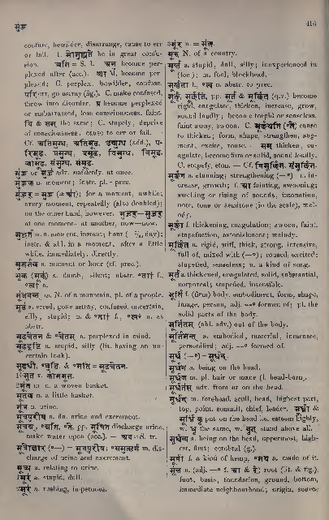
mū́la ·n. (adj. --° f. ā & ī) root (lit. & fig.), foot, basis, foundation, ground, bottom, immediate neighbourhoud; origin, source commencement, cause; the chief person or thing, e.g. text (opp. commentary), capital (opp. interest), also capital = chief city, holder (opp. owner); N. of a lunar mansion (also m.). -- mūlaṃ kṛ or bandh take root; mūla (--°) sprung from, rooted in, resting on; (°--) original, chief, first, also = (±ā) mūlāt or mūlatas & mūlādārabhya from the bottom or the beginning.
Monier-Williams 1872 substantive neuter
Original text · English · substantive neuter
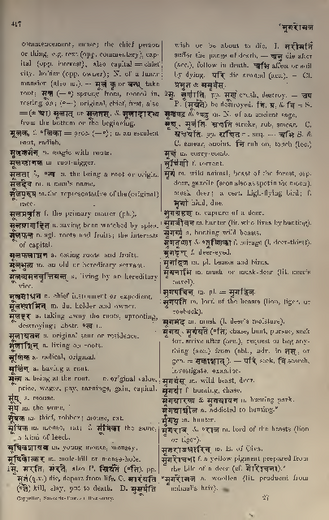
Mūla, am, n. a root (literally and metaphorically); the root of any plant or tree, (mūlaṃ kṛ, to take or strike root); the root of Arum Campanulatum; the root of long pepper and of Costus Speciosus or Ara- bicus; basis, groundwork, beginning, origin, com- mencement, cause, (mūlād ārabhya, having com- menced at the beginning); the bottom of anything, foot, (śailasya mūlam, the foot of a mountain); basis, lower part, lower end, (vīṇāyā mūlam, the lower end of a lute which rests against the body of a player); the end or juncture of anything by which it is joined to anything else [cf. bāhu-m˚, karṇa- m˚]; outermost edge or border; original, original text of any work (as distinguished from the scholia or commentary); an old or hereditary servant or dependant, an aboriginal native or inhabitant; ori- ginal property, capital, principal, stock; a chief or capital city; square root; the twenty-fourth or, according to some, seventeenth or nineteenth lunar asterism containing eleven stars, (in this sense as, am, m. n.; cf. nakṣatra); immediate neigh- bourhood or proximity; a copse, thicket; a vendor not a true owner, (according to Kullūka on Manu VIII. 202. mūlam = a-svāmī vikretā); a particular position of the fingers [cf. mūla-bandha]; (as), m. an epithet of Sadā-śiva; (ā), f. Asparagus Race- mosus; the asterism Mūla; (ī), f. a species of small house-lizard; (as, ā, am), original, first; own, proper, peculiar, (in Manu VII. 184. mūla is said to mean a king's own territory.)

Petersburger 1855 adjective · substantive masculine · substantive neuter
Original text · German · adjective · substantive masculine · substantive neuter
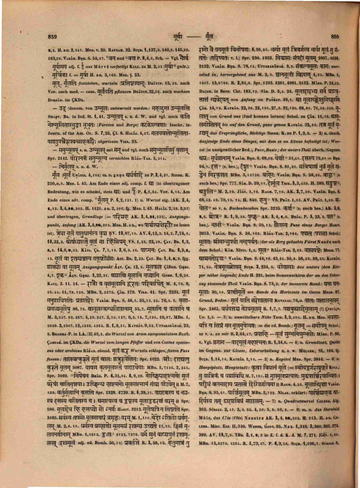
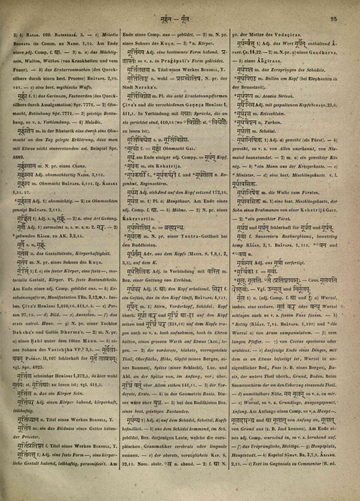
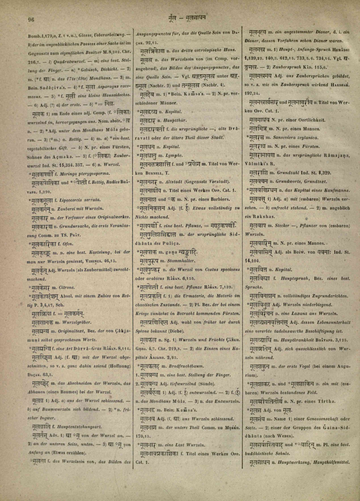
mū́la (mūlá UṆĀDIS. 4,108) m.n. gaṇa ardharcādi zu P. 2,4,31. SIDDH. K. 250,a,8. MED. l. 45. Am Ende eines adj. comp. f. ā (in übertragener Bedeutung, wie es scheint, stets ā) und ī́ P. 4,1,64. VOP. 4,15. Am Ende eines adv. comp. ˚mū́lam P. 6,2,121. 1〉 n. Wurzel eig. (AK. 2,4,1,12. AK. 3,4,16,202. H. 1121. H. an. 2,506. fg. MED. l. 45. HALĀY. 2,28. HALĀY. 5,23) und übertragen, Grundlage (= parigraha AK. 3,4,31,239), Ausgangspunkt, Anfang (AK. 3,4,26,202. MED. H. an., wo pārśvādyayoruḍau zu lesen ist), tre̱dhā mūlàṃ yātu̱dhānàsya vṛśca ṚV. 10,87,10. AV. 6,13,3. AV. 6,14,2. AV. 7,74,1. AV. 19,32,3. oṣàdhyāste̱ mūla̱ṃ mā hìṃsiṣam VS. 1,25. VS. 22,28. ŚAT. BR. 1,2,5,8. ŚAT. BR. 14,6,9,33. KĀTY. ŚR. 7,1,19. KĀTY. ŚR. 2,6,9. KĀTY. ŚR. 2,6,46. pāpmanaḥ ŚAT. BR. 8,5,1,13. mūlaṃ vā etadyajñasya yattūṣṇīṃśaṃsaḥ AIT. BR. 2,32. ŚAT. BR. 1,4,4,9. fgg. śāktyo vā mūlam Ausgangspunkt ĀŚV. ŚR. 12,2. mūlaphala ŚĀṄKH. GṚHY. 4,7. eka˚ ĀŚV. GṚHY. 1,22,21. agrāṇi mūlāni madhyāni GOBH. 1,8,28. KAUŚ. 3. KAUŚ. 11. KAUŚ. 14. — rātrau ca vṛkṣamūlāni dūrataḥ parivarjayet M. 4,73. M. 6,26. M. 6,44. M. 11,78. M. 11,128. MBH. 3,2373. ŚĀK. 179. VIKR. 41. Spr. 2231. mūlaṃ manujādhipatiḥ prajātaroḥ VARĀH. BṚH. S. 48,1. VARĀH. BṚH. S. 55,13. VARĀH. BṚH. S. 55,22. VARĀH. BṚH. S. 76,4. VARĀH. BṚH. S. 76,9. vṛkṣāgramadhyamūleṣu VARĀH. BṚH. S. 86,73. āmūlaskandhaliptānām VARĀH. BṚH. S. 55,7. mūlāni ca phalāni ca M. 3,227. M. 3,82. M. 3,267. M. 4,29. M. 4,247. M. 5,10. M. 5,157. M. 6,5. M. 6,15. M. 7,131. M. 10,87. MBH. 1,5889. MBH. 3,2307. MBH. 12,4256. MBH. 12,4262. R. 1,9,31. KATHĀS. 9,62. UTTARARĀMAC. 25,9. BRAHMA-P. in LA. (II) 49,8. die Wurzel von Arum campanulatum Roxb. ŚABDAC._im_ŚKDR. die Wurzel vom langen Pfeffer und von Costus speciosus oder arabicus RĀJAN. ebend. mūlaṃ kar Wurzeln schlagen, festen Fuss fassen: tālavatkurute mūlaṃ bālaḥ śatrurupekṣitaḥ Spr. 1022. (śrīḥ) dākṣyāttu kurute mūlam Spr. 5087. yāvanna kṛtamūlāste pāṇḍaveyāḥ MBH. 1,7426. MBH. 2,244. Spr. 3169. ˚niṣecana BHĀG. P. 4,31,14. BHĀG. P. 8,9,29. nocchidyādātmano mūlaṃ pareṣāṃ cātitṛṣṇayā . ucchindya hyātmano mūlamātmānaṃ tāṃśca pīḍayet .. M. 7,139. karturmūlāni kṛntati Spr. 1529. Spr. 4739. R. 6,39,21. kaṇṭakasya ca bhagnasya dantasya calitasya ca . amātyasya ca duṣṭasya mūlāduddharaṇaṃ varam .. Spr. 586. mūlādeva hi hantavyo so 'narthaḥ HARIV. 3213. mūleṣvapi na tiṣṭhati Spr. 3165. sarvasya tapaso mūlamācāraṃ jagṛhuḥ param M. 1,110. vedo 'khilo dharmamūlam M. 2,6. M. 2,11. dharmasya brāhmaṇo mūlamagraṃ rājanya ucyate M. 11,83. chinnaṃ mūlamanarthānām MBH. 1,1615. duḥkha˚ MBH. 1,6122. MBH. 1,7876. dharmaṃ śubhaṃ vāpyaśubhaṃ rājamūlāt (rājamūlaṃ adj. ed. Bomb. 50,10) pravartate R. 3,56,19. hetumātraṃ tu rāmo vai jayamūlaṃ vibhīṣaṇaḥ R. 6,95,55. bhāryā mūlaṃ trivargasya bhāryā mūlaṃ tu saṃtateḥ (tariṣyataḥ v. l.) Spr. 230. Spr. 1933. viśvāsaḥ saṃpadāṃ mūlam Spr. 2857. Spr. 4658. Spr. 5152. VARĀH. BṚH. S. 78,14. UTTARARĀMAC. 3,3. saṃkalpamūlaḥ kāmaḥ wurzelnd in, hervorgehend aus M. 2,3. jñānamūlāṃ kriyām M. 4,24. MBH. 1,1607. MBH. 13,5788. R. 2,81,6. Spr. 1293. Spr. 4261. Spr. 4981. Spr. 5152. MĀRK. P. 24,22. DAŚAK._in_BENF. Chr. 183,12. SĀH. D. 5,4. SĀH. D. 5,24. mūlādārabhya sarvaṃ prāgvṛttāntaṃ nyavedayat von Anfang an PAÑCAT. 49,1. ā mūlācchrotumicchāmi ŚĀK. 14,19. KATHĀS. 22,98. KATHĀS. 25,195. KATHĀS. 27,3. KATHĀS. 32,130. KATHĀS. 68,61. KATHĀS. 71,58. KATHĀS. 71,228. mūlāt von Grund aus (Jmd kennen lernen) Schol. zu ŚĀK. 11,16. āmūlamīkṣitam bis auf den Grund, ganz genau KATHĀS. 32,83. tatra mūlaṃ mṛgyam das Ursprüngliche, Richtige SIDDH. K._zu_P. 1,2,6. — 2〉 n. überh. dasjenige Ende eines Dinges, mit dem es an Etwas befestigt ist; Wurzel (in uneigentlicher Bed.), Fuss, Basis; der untere Theil überh. (Gegens. agra): mūrdhajānām VARĀH. BṚH. S. 68,82. veṇī˚ VARĀH. BṚH. S. 51,40. dantasya VARĀH. BṚH. S. 79,20 = BṚH. 94,1. danta˚ (s. bes.), daṃṣṭrā˚ VARĀH. BṚH. S. 81,23. saviṣāṇaṃ bhujaṃ mūle khaḍgena nirakṛntata MBH. 3,15736. bāhoḥ VARĀH. BṚH. S. 58,26. bāhu˚ (s. auch bes.) Spr. 777. SĀH. D. 59,11. dormūla TRIK. 3,3,435. H. 589. aṅguṣṭha˚, aṅguli˚ M. 2,59. YĀJÑ. 1,19. RAGH. 7,10. AK. 2,7,50. VARĀH. BṚH. S. 68,42. VARĀH. BṚH. S. 68,49. VARĀH. BṚH. S. 70,13. VARĀH. BṚH. S. 70,14. H. 840. hanu˚ VS. PRĀT. 1,83. AV. PRĀT. 1,20. kapola˚ so v. a. Backenknochen Spr. 3235. karṇa˚ (s. auch bes.) AK. 2,8,2,6. śrotra˚ R. 1,9,38. puccha˚ AK. 3,4,1,6. BHĀG. P. 5,23,5. pakṣa˚ (s. bes.). nābhī˚ VARĀH. BṚH. S. 50,13. śailasya Fuss eines Berges HARIV. 3953. VARĀH. BṚH. S. 54,102. RĀJA-TAR. 2,164. papāta (papātā Schol.) mūlataḥ śrīmānsuparvā nandaparvataḥ (der als Berg gedachte Fürst Nanda nach dem Schol.) KĀM. NĪTIS. 1,4. śūla˚ RĀJA-TAR. 2,85. vāsayaṣṭeḥ MEGH. 77. āśramatoraṇa˚ VARĀH. BṚH. S. 44,16. VARĀH. BṚH. S. 43,64. VARĀH. BṚH. S. 50,8. VARĀH. BṚH. S. 56,25. VARĀH. BṚH. S. 58,53. KATHĀS. 71,60. netramūlasrotas SUŚR. 2,234,5. vīṇāyāḥ das untere (dem Körper näher liegende) Ende H. 291. beim Sonnenschirm der an den Ueberzug stossende Theil VARĀH. BṚH. S. 73,2. der äusserste Rand: ghanā ghanamūlāḥ VARĀH. BṚH. S. 30,18. prācīmūle am Rande des Horizonts im Osten MEGH. 87. Grund, Boden: mūlaṃ yāti sarojalasya KUVALAY. 76,a. yātaḥ pātālamūlam Spr. 2462. vardhayantaśca koṣamūlam R. 1,7,7. pañcabuddhyādimūlām(?) ŚVETĀŚV. UP. 1,5. — 3〉 n. unmittelbare Nähe TRIK. 3,3,404. H. an. MED. bhavantāvapi ca kṣipraṃ mama mūlamupeṣyathaḥ (so die ed. Bomb.; mūlam = samīpam Schol.) so v. a. zu mir R. 2,64,47. prayāhi — mūlaṃ śumbhaniśumbhayoḥ MĀRK. P. 86,6. Vgl. jagāma — pādamūlaṃ mahātmanaḥ R. 1,54,6. — 4〉 n. Grundtext, Quelle im Gegens. zur Glosse, Ueberarbeitung u. s. w. MÜLLER, SL. 104. fg. SUŚR. 1,14,14. KATHĀS. 1,10. — 5〉 n. Kapital MED. Spr. 3844. — 6〉 n. Hauptplatz, Hauptstadt: kṛtvā vidhānaṃ mūle (= svīyadurgarāṣṭrarūpe KULL.) tu yātrikaṃ ca yathāvidhi M. 7,184. sa guptamūlapratyantaḥ śuddhapārṣṇirayānvitaḥ . ṣaḍvidhaṃ balamādāya pratasthe digjigīṣayā .. RAGH. 4,26. mūlābhirakṣā VARĀH. BṚH. S. 95,61. pārṣṇimūlam MBH. 2,192. NĪLAK. erklärt: pārṣṇigrāhaka ādiryasya tat dvādaśavidhaṃ maṇḍalam. — 7〉 n. Quadratwurzel COLEBR. Alg. 363. SŪRYAS. 2,41. SŪRYAS. 3,8. SŪRYAS. 3,33. SŪRYAS. 4,20. SŪRYAS. 5,6. SŪRYAS. 10,8. — 8〉 m.n. das Sternbild Mūla, das 17te (19te) Nakṣatra AK. 3,4,26,202. H. 113. H. an. COLEBR. Misc. Ess. II, 340. WEBER, JYOT. 95. Nax. 1,310. Nax. 2,300. Nax. 2,303. Nax. 2,374. Nax. 2,389. AV. 19,7,3. TBR. 3,1,2,3_in_Z. f. d. K. d. M. 7,271. YĀJÑ. 1,80. MBH. 13,3275. MBH. 13,4264. R. 5,73,57. P. 4,3,28. SUŚR. 1,106,7. SŪRYAS. 8,19. SŪRYAS. 9,14. VARĀH. BṚH. S. 4,5. VARĀH. BṚH. S. 6,11. VARĀH. BṚH. S. 6,12. VARĀH. BṚH. S. 7,11. VARĀH. BṚH. S. 23,7. VARĀH. BṚH. S. 55,31. VARĀH. BṚH. S. 98,7. VARĀH. BṚH. S. 98,15. VARĀH. BṚH. S. 100,1. VARĀH. BṚH. S. 101,10 (= BṚH. 16,10). VARĀH. BṚH. S. 102,5. VARĀH. BṚH. S. 102,7. VARĀH. BṚH. S. 105,1. VARĀH. BṚH. S. 105,6. BHĀG. P. 5,23,6. MĀRK. P. 33,13. VET. in LA. (II) 13,11. — 9〉 n. Gebüsch, Dickicht H. an. — 10〉 in der Stelle atha mūlamanāhāryaṃ prakāśakrayaśodhitaḥ . adaṇḍyo mucyate rājñā nāṣṭiko labhate dhanam .. M. 8,202 wird mūlam von KULL. durch asvāmī vikretā erklärt und von den Uebersetzern durch Verkäufer wiedergegeben. Es ist wohl vikrayasya aus dem Zusammenhange zu ergänzen und zu übersetzen der Veranlasser (des Verkaufs). — 11〉 n. eine best. Stellung der Finger (vgl. 1. mūlabandha): samānīya svavāmena mūlena prokṣaṇaṃ caret Verz. d. Oxf. H. 103,a,26. dhyātvā mūlena tasmai ca dadyātpādyādikaṃ mudā PAÑCAR. 1,5,6. — 12〉 m. Bein. Sadāśivaʼs Verz. d. B. H. No. 1346. — 13〉 f. ā a〉 Asparagus racemosus Willd. RĀJAN._im_ŚKDR. — b〉 das Sternbild Mūla ŚABDAR. ebend. — 14〉 f. ī eine kleine Hauseidechse TRIK. 2,5,23. — 15〉 adj. f. ā a〉 der erste Verz. d. Oxf. H. 56,a,5. Vielleicht ist mūlāttataḥ zu lesen. — b〉 = nija eigen AJAYAPĀLA_im_ŚKDR. — Vgl. a˚, ado˚, arkamūlā, ākāśamūlī, ātma˚, unmūla, upamūlam, kṛṣṇamūlī, jihvāmūla, jyeṣṭhā˚, tapo˚, tāmramūlā und ˚mūlī, dantamūla, nimūlam, nirmūla, pañca˚, pāda˚, puṣkara˚, baddha˚ (auch PAÑCAT. 232,18. abaddhamūlaḥ kṣupakaḥ SUŚR. 1,88,10), bahu˚, bāhu˚, billamūlā, bhujamūla, bhūri˚, madhu˚, mantra˚, mahā˚, mūlakamūlā, yatomūla, laghu˚, śūnya˚, sa˚, sarasvatī˚, maula, maulika, maulya.
Böhtlingk 1879 adjective · substantive masculine · substantive neuter
Original text · German · adjective · substantive masculine · substantive neuter
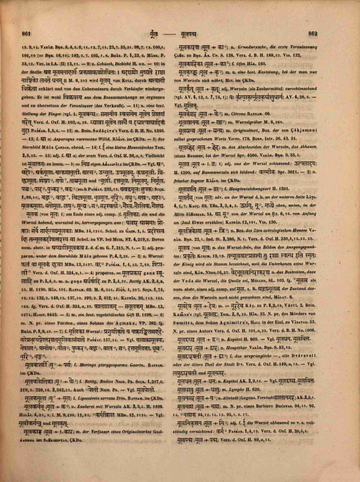
mū́la — 1〉 n. (adj. Comp. f. ā) und ī — a〉 Wurzel insbes. eine essbare. mūlaṃ kar oder bandh Wurzel schlagen auch so v. a. festen Fuss fassen. — b〉 Rettig (RĀJAN. 7,14. BHĀVAPR. 1,290) und die Wurzel. — α〉 von Arum campanulatum. — β〉 vom langen Pfeffer. — γ〉 von Costus speciosus oder Costus arabicus. — c〉 dasjenige Ende eines Dinges, mit dem es an Etwas befestigt ist, Wurzel in un eigentlicher Bed. Fuss (z. B. eines Berges), Basis, der untere Theil überh., Grund, Boden. Beim Sonnenschirm der an den Ueberzug stossende Theil. — d〉 unmittelbare Nähe. mama mūlam so v. a. zu mir. — e〉 Wurzel, so v. a. Grundlage, Ausgangspunct, Anfang. Am Anfange eines Comp. so v. a. Haupt-. mūlādārabhya und ā mūlāt von Anfang an, mūlāt von Grund aus (z. B. Jmd kennen). Am Ende eines adj. Comp. wurzelnd in, so v. a. beruhend auf. — f〉 das Ursprüngliche, Richtige. — g〉 Hauptplatz, Hauptstadt. — h〉 Kapital SĀMAV. BR. 3,7,9. ĀRYABH. 2,25. — i〉 Text im Gegensatz zu Commentar [Page5-096-a] (R. ed. Bomb. I,179,a, Z. 1 v. u.), Glosse, Ueberarbeitung. — k〉 der im augenblicklichen Possess einer Sache ist im Gegensatz zum eigentlichen Besitzer M. 8,202. Chr. 216,7. — l〉 Quadratwurzel. — m〉 eine best. Stellung der Finger. — n〉 Gebüsch, Dickicht. — 2〉 m. (f. ā) n. das 17te (19te) Mondhaus. — 3〉 m. Bein. Sadāśivaʼs. — 4〉 f. mūlā Asparagus racemosus. — 5〉 f. mūlī eine kleine Hauseidechse. — 6〉 Adj. (?) — a〉 der erste. — b〉 = nija.
Apte 1890 substantive neuter
Original text · English · substantive neuter
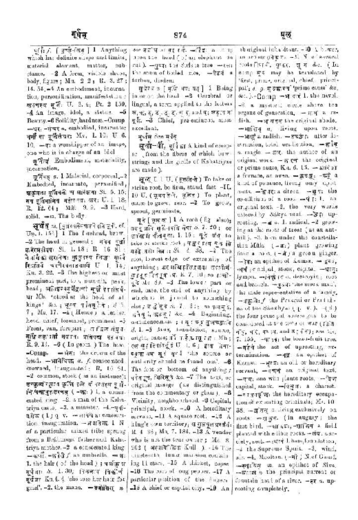
mūlaṃ [mūl-ka] 1 A root (fig. also); tarumūlāni gṛhībhavati teṣāṃ Ś. 7. 20; or śākhino dhautamūlāḥ Ś. 1. 15; mūlaṃ baṃdh to take or strike root; baddhamūlasya mūlaṃ hi mahadvairataroḥ striyaḥ Śi. 2. 38. 2 The root, lowest edge or extremity of anything; kasyāścidāsidraśanā tadānīmaṃguṣṭhamūlārpitasūtraśeṣā R. 7. 10; so prācīmūle Me. 89. 3 The lower part or end, base, the end of anything by which it is joined to something else; bāhvormūlaṃ Śi. 7. 32; so pādamūlaṃ, karṇamūlaṃ, ūrumūlaṃ &c. 4 Beginning, commencement; āmūlācchrotumicchāmi Ś. 1. 5 Basis, foundation, source, origin, cause; sarve gārhasthyamūlakāḥ Mb.; rakṣogṛhe sthitirmūlaṃ U. 1. 6; iti kenāpyuktaṃ tatra mūlaṃ mṛgyaṃ ‘the source or authority should be found out’. 6 The foot or bottom of anything; parvatamūlaṃ, girimūlaṃ &c. 7 The text, or original passage (as distinguished from the commentary or gloss). 8 Vicinity, neighbourhood. 9 Capital, principal, stock. 10 A hereditary servant. 11 A square root. 12 A king's own territory; sa guptamūlapratyaṃtaṃ: R. 4. 26; Ms. 7. 184. 13 A vender who is not the true owner; Ms. 8. 202 (asvāmivikretā Kull.). 14 The nineteenth lunar mansion containing 11 stars. 15 A thicket, copse. 16 The root of long pepper. 17 A particular position of the fingers. 18 A chief or capital city. 19 An ([Page 0874-c]) aboriginal inhabitant. 20 A bower, an arbour (nikuṃja). 21 N. of several roots. pipyalī, puṣkara, śūraṇa &c. (In comp. mula may be translated by ‘first, prime, original, chief, principal’; e. g. mūlakāraṇaṃ ‘prime cause’ &c. &c.). Comp. — ādhāraṃ 1 the navel. 2 a mystical circle above the organs of generation. — ābhaṃ a radish. — bhāyatanaṃ the original abode. — āśin a. living upon roots. — āhvaṃ a radish. — ucchedaḥ utter destruction, total eradication. — karman n. magic. — kāraḥ the author of an original work. — kāraṇaṃ the original or prime cause; Ku. 6. 13. — kārikā a furnace, an oven. — kṛcchraḥ -cchraṃ a kind of penance, living only upon roots. — keśaraḥ a citron. — guṇaḥ the co-efficient of a root. — graṃthaḥ 1 an original text. 2 the very words uttered by Śākyamuni. — chedaḥ uprooting. — ja a. 1 radical. 2 growing at the roots of trees (as an anthill). 3 born under the constellation Mūla. — (jaḥ) plant growing from a root. — (jaṃ) a green ginger. — devaḥ an epithet of Kaṃsa. — dravyaṃ, — dhanaṃ principal, stock, capital. — dhātuḥ lymph. — nikṛṃtana a. destroying root and branch. — puruṣaḥ ‘the stock-man’, the male representative of a family. — prakṛtiḥ f. the Prakṛti or Pradhāna of the Sāṃkhyas (q. v.). -(pl.) the four principal sovereigns to be considered at the time of war ( vijigīṣu, ari, madhyama, and udāsīna); see Ms. 7. 155. — phaladaḥ the bread-fruit tree. — barhaṇaṃ the act of uprooting, extermination. — bhadraḥ an epithet of Kaṃsa. — bhṛtyaḥ an old or hereditary servant. — vacanaṃ an original text. — vāpaḥ one who plants roots. — vittaṃ capital, stock. — vibhujaḥ a chariot. — vyasanavṛttiḥ the hereditary occupation of executing criminals; Ms. 10. 38. — vratin a. living exclusively on roots. — śakunaḥ (in augury) the first bird. — śākaṭaḥ, -śākinaṃ a field planted with edible roots. — saṃghaḥ a society, sect. — sthānaṃ 1 base, foundation. 2 the Supreme Spirit. 3 wind, air. 4 Mooltan. — (nī) N. of Gaurī. — sthāyin m. an epithet of Śiva. — srotas n. the principal current or fountain-head of a river. — hara a. uprooting completely.
Cappeller 1887 adjective
Original text · German · adjective
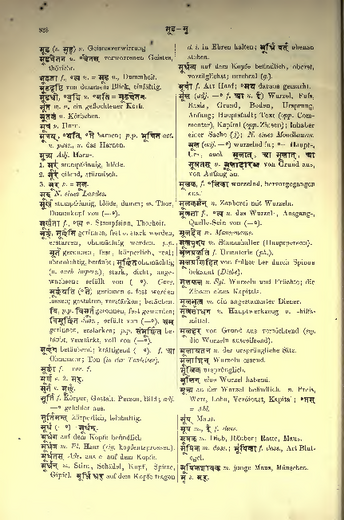
mū́la (adj.—˚ f. ā u. ī) Wurzel, Fuß, Basis, Grund, Boden, Ursprung, Anfang; Hauptstadt, Text (opp. Commentar), Kapital (opp. zinsen); Inhaber einer Sache (j); N. eines Mondhauses. mūla (adj. —˚) wurzelnd in; ˚— Haupt-, Ur-, auch = mūlāt, ā mūlat, ā mūlatas u. mūlādārabhya von Grund aus, von Anfang an.
Burnouf 1866 substantive neuter
Original text · French · substantive neuter
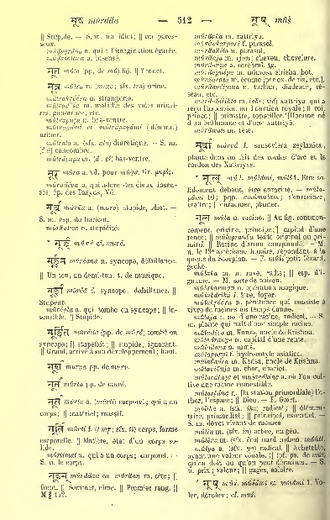
mūla mūla n. racine. Au fig. commencement, origine, principe; capital d'une rente; mūlagrantha texte original ou primitif. Racine d'arum campanulé. — M. n. le 19ᵉ astérisme lunaire, répondant à la queue du Scorpion. — F. mūlī petit lézard, gecko. mūlaka m. n. rave, radis; esp. d'igname. — M. sorte de poison. mūlakarman n. opération magique. mūlakārikā f. âtre, foyer. mūlakṛcchra n. pénitence qui consiste à vivre de racines un temps donné. mūlagrantha texte original ou primitif. mūlaja a. né d'une racine, radical. — S. m. plante qui naît d'une simple racine. mūladeva m. Kaṃsa, oncle de Kṛṣṇa. mūladravya n. capital d'une rente. mūladhana n. mms. mūlaparṇī f. hydrocotyle asiatica. mūlabhadra m. Kaṃsa, oncle de Kṛṣṇa. mūlavibhuja m. char, chariot. mūlaśākaṭa et mulaśākina a. où l'on cultive une racine comestible. mūlasṭhāna n. [la station primordiale] l'éther, l'espace; Dieu. — F. Gaurī. mūlika a. (sfx. ika) radical; élémentaire, primordial; principal, essentiel. — S. m. dévot vivant de racines. mūlin m. (sfx. in) arbre, en gén. mūlera m. (sfx. era) nard indien, māṃṣī. mūlya a. (sfx. ya) radical. Achetable, ayant une valeur vénale. (pf. ps. de mūl) qu'on doit ou qu'on peut déraciner. — S. n. prix; valeur; gages, salaire.
Occurrences in source texts (55)
DYS 4 occurrences
GoS 5 occurrences
HP 14 occurrences
4 more source pages
HP 3.49-3.57: Mūlabandha 5 occurrences
Direct occurrences
HTK 2 occurrences
PYS 2 occurrences
SiSa 23 occurrences
SiSa 3.84-3.87: Siddhāsana 2 occurrences
Direct occurrences
9 more source pages
SiSa 4.64-4.68: Mūlabandha 2 occurrences
Direct occurrences
SiSa 5.156-5.181: Sahasrāra 7 occurrences
Direct occurrences
-
SiSa 5.156 Segment 4
-
SiSa 5.156 Segment 11
-
SiSa 5.157 Segment 2
-
SiSa 5.157 Segment 9
-
SiSa 5.159 Segment 4
-
SiSa 5.159 Segment 15
-
SiSa 5.166 Segment 9
SVU 2 occurrences
Continue with AYI Free
Image source: AYI archive.