

vat वत् – comparative suffix -vat: like; as; possessive suffix -vat: possessing; endowed with
adjective · particle · verbal root · suffix · Word type unspecified · verb
Dictionary sources
AYI dictionary suffix
comparative suffix -vat: like; as; possessive suffix -vat: possessing; endowed with
Cappeller 1891 verb
Original text · English · verb
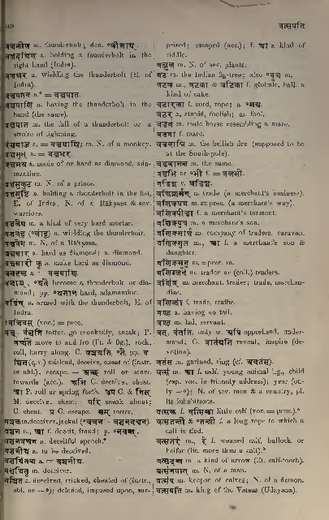
vat vátati ·v only w. api apprehend, understand; C. vātáyati reveal, inspire (devotion).
Monier-Williams 1872 particle · Word type unspecified
Original text · English · particle
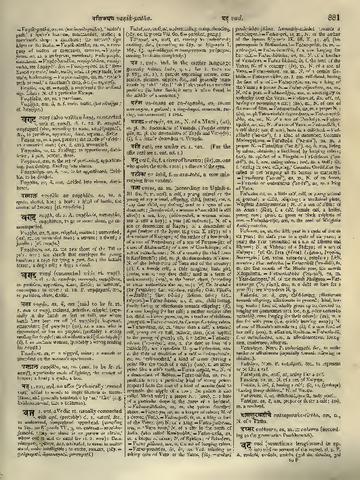
vat 1 . vat, ind. an affix (technically termed vati) added to words to imply likeness or resem- blance, and generally translatable by ‘as,’ ‘like’ (e. g. brāhmaṇa-vat, like a Brāhman).
Original text · English · Word type unspecified
vat 2 . vat, a Vedic rt. usually connected with api, (probably) cl. 1. vatati, &c., to understand, comprehend, apprehend, (according to Sāy. on Ṛg-veda VII. 3, 10. vatema = sambha- jemahi, ‘may we share in or possess or obtain,’ where vat is said to stand for rt. 1. van): Caus. vātayati, -yitum, Aor. avīvatat, to cause to under- stand, make intelligible; to excite, awaken, (Sāy. = prāpayati, āgamayati, prerayati.)
Petersburger 1855 Word type unspecified
Original text · German · Word type unspecified
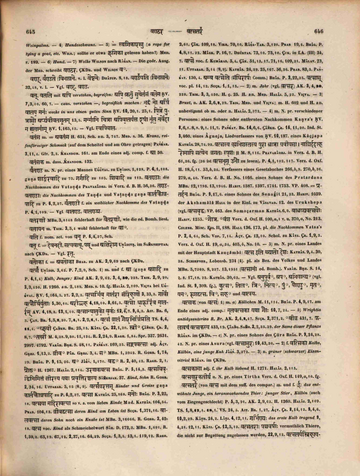
vat , vatati mit api verstehen, begreifen: api̱ kratùṃ su̱cetàsaṃ vatema ṚV. 7,3,10. ṚV. 7,60,7. — caus. verstehen —, begreiflich machen: bha̱draṃ no̱ apì vātaya̱ manàḥ wecke in uns einen guten Sinn ṚV. 10,20,1. ṚV. 10,25,1. pi̱tre pu̱trāso̱ apyàvīvatannṛ̱tam ṚV. 10,13,5. manmā̀ni citrā apivā̱tayànta e̱ṣāṃ bhū̀ta̱ navèdā ma ṛ̱tānā̀m ṚV. 1,165,13. — Vgl. svapivāta.
Böhtlingk 1879 verbal root · Word type unspecified
Original text · German · verbal root
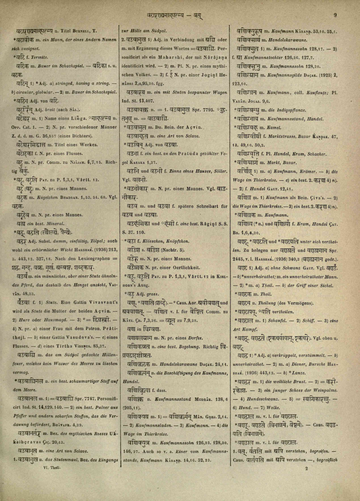
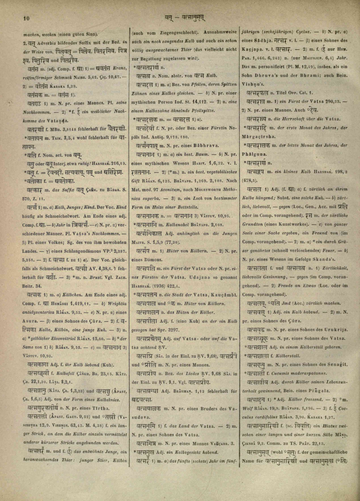
1. √vat , vátati mit api verstehen, begreifen. — Caus. vātáyati mit api verstehen —, begreiflich [Page6-010-a] machen, wecken (einen guten Sinn).
Original text · German · Word type unspecified
2. vat Adverbia bildendes Suffix mit der Bed. in der Weise von. pitṛvat = piteva, pitaramiva, pitraiva, pituriva und pitarīva.
Whitney Roots 1885 verbal root
Original text · English · verbal root
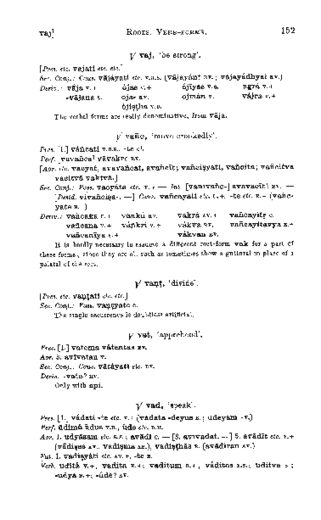
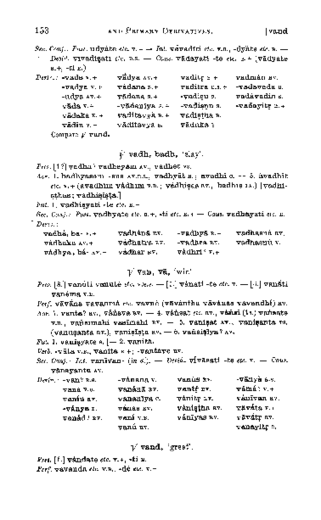
vat — apprehend
Apte 1890 adjective · particle
Original text · English · adjective · particle
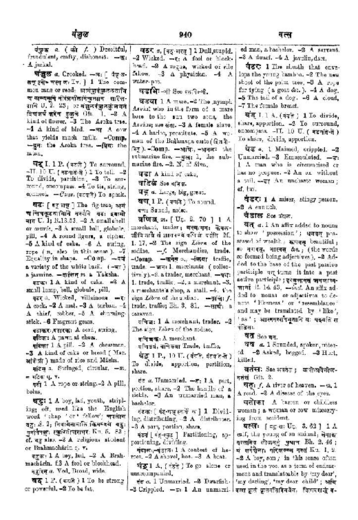
vat a. 1 An affix added to nouns to show ‘possession’; dhanavat possessed of wealth; rūpavat beautiful; so bhagavat, bhāsvat &c.; (the words so formed being adjectives). 2 Added to the base of the past passive participle vat turns it into a past active participle; ityuktavaṃtaṃ janakātmajāyāṃ R. 14. 43. — ind. An affix added to nouns or adjectives to denote ‘likeness’ or ‘resemblance’ and may be translated by ‘like’, ‘as’; ātmavatsarvabhūtāni yaḥ paśyati sa paṃḍitaḥ.
Cappeller 1887 verb
Original text · German · verb
vat, vátati, nur mit api verstehen, begreifen. Caus. vātáyati mit api verstehen machen, wecken (übertr.), ein- flößen.

Burnouf 1866 Word type unspecified
Original text · French · Word type unspecified
vat vat (sfx. adverbial) comme.
Derived words
Further derivatives (1)
Occurrences in source texts (37)
DYS 1 occurrence
GoS 9 occurrences
GoS 34–41: Sun, Sound and Cooling 2 occurrences
Direct occurrences
GoS 89–94: Body, Names and Reality 3 occurrences
Direct occurrences
HP 11 occurrences
HP 3.103-3.107*2: Conclusion of the Mudrā Teaching 1 occurrence
Direct occurrences
-
HP 3.107 Segment 6
5 more source pages
PJH 1 occurrence
PYS 5 occurrences
SiSa 3 occurrences
SiSa 1.35-1.44: Täuschungs-Gleichnisse 2 occurrences
Direct occurrences
SiSa 5.144-5.155: Ājñā und Khecarī 1 occurrence
Occurrences through derived words
-
SiSa 5.146 Segment 14
SS 2 occurrences
SVU 1 occurrence
VBT 4 occurrences
Continue with AYI Free
Image source: AYI archive.