
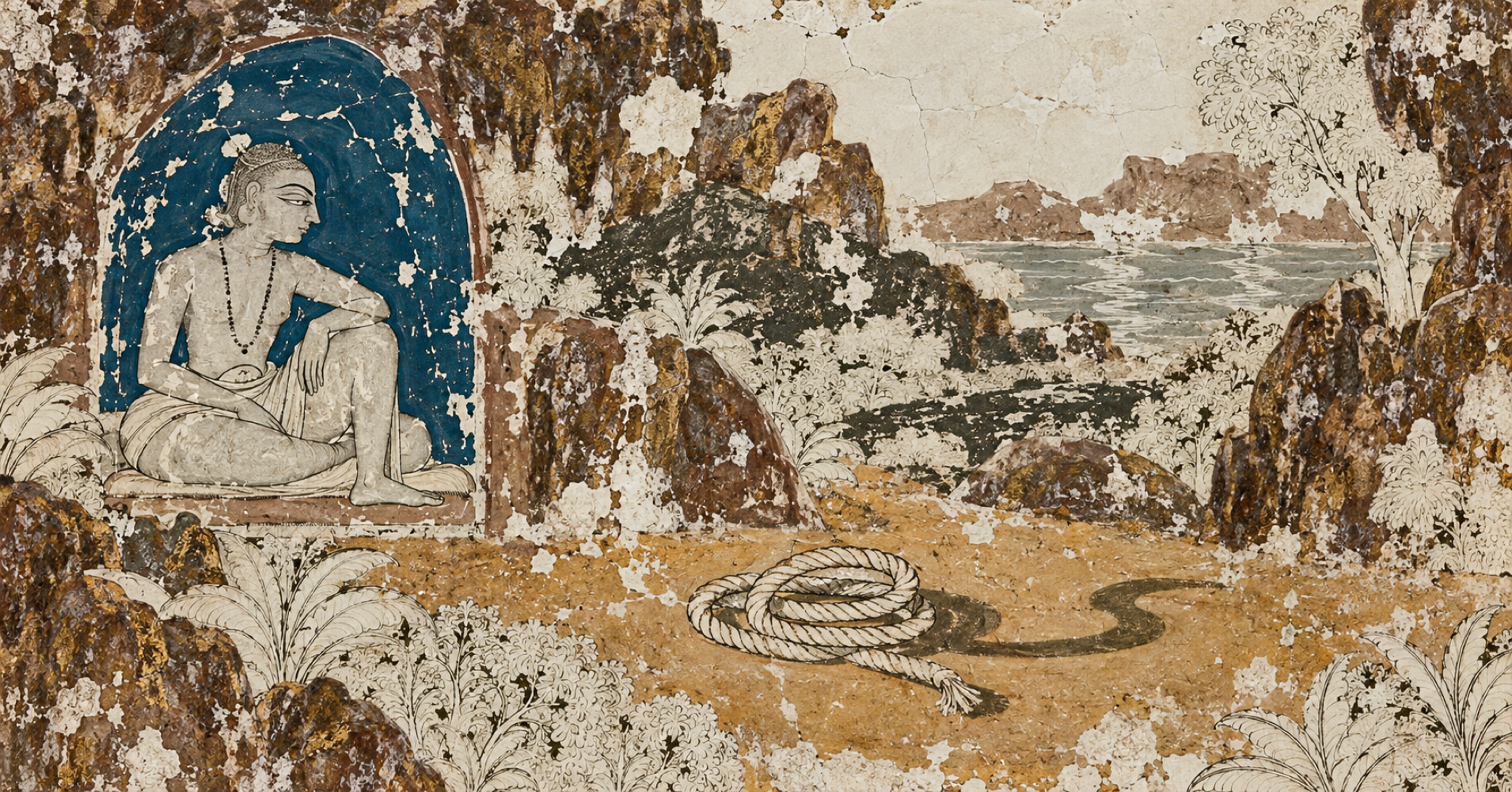
A figure studies a rope and its snake-like shadow.

Gorakṣaśataka 89–94: What Sustains a Conception of the Body?

The closing passages question forms of the body and their relation to consciousness and naming. Rope, snake and a hare’s horn provide images.

Dr. Ronald Steiner Dr. Ronald Steiner
Gorakṣaśataka (Original) 89
आधिभौतिकदेहे तु चाधिदेविकविग्रहे |
ādhibhautika-dehe tu; cādhidevika-vigrahe | Analysis ▾ Analysis ▴
ādhibhautika
karmadhāraya-compound
adjective
pertaining to the elements
dehe
lokative singular
substantive masculine
in the body
tu
particle
however
ca
particle
and
ādhidevika
karmadhāraya-compound
ādhidevika
adjective
pertaining to the gods
vigrahe
lokative singular
substantive masculine
in the form
देहो ऽतिविमलं याति तद्वक्ष्याम्य् अधुना स्फुतम् ||89||
deho 'ti-vimalaṃ yāti; tad vakṣyāmy adhunā sphutam ||89|| Analysis ▾ Analysis ▴
dehaḥ
nominative singular
substantive masculine
body
ati
karmadhāraya-compound
previx
extremely
vimalam
accusative singular neuter
adjective
pure
yāti
3rd person singular aktive present
verbal root
goes, reaches
tat
accusative singular neuter
pronoun dem
whose
vakṣyāmi
1st person singular aktive future
verbal root
I shall explain
adhunā
adverb
now
sphutam
sphuta
adjective
clearly; unusual spelling
When the body composed of the elements (ādhibhautika-dehe | loc sg), however (tu), [merges] in the divine form (ādhidevika-vigrahe | loc sg), the body (dehaḥ | nom sg) reaches (yāti | 3p sg act pres) utmost purity (ati-vimalam | acc sg n). And (ca) I shall explain (vakṣyāmi | 1p sg act fut) this (tat | acc sg n) clearly (sphutam) now (adhunā).
Dr. Ronald Steiner - 2026 - historically literal
You can experience your body from different perspectives. No single description has to encompass everything.
Dr. Ronald Steiner - 2026 - modern transfer

With Mallinson (2012, p. 271), I understand the two locatives as an abbreviated account of a transition: the elemental body merges in the divine form. The necessary verb is supplied in the translations. ādhidevika retains the working text’s divergent spelling. I render ativimalam as the destination, “utmost purity”. The sequence 89–91 contains an arrangement of half-verses not conclusively resolved in the working text; the translated sentence connections do not settle its transmission history.

Apparatus Comment
Gorakṣaśataka (Original) 90
जाड्यभावविनिर्मुक्तम् अमलं चिन्मयात्मकम् ||90||
jāḍya-bhāva-vinirmuktam; amalaṃ cin-mayātmakam ||90|| Analysis ▾ Analysis ▴
jāḍya
tatpuruṣa-compound genitive
substantive neuter
insentience, rigidity
bhāva
tatpuruṣa-compound ablative
substantive masculine
condition
vinirmuktam
nominative singular neuter past participle passive
previx
previx
verbal root
liberated
amalam
nominative singular neuter
adjective
stainless
cit
tatpuruṣa-compound genitive
substantive feminine
consciousness
maya
tatpuruṣa-compound genitive
suffix
consisting of
ātmakam
nominative singular neuter
adjective
having the nature
[This body is] freed from the condition of insentience (jāḍya-bhāva-vinirmuktam | nom sg n ppp), stainless (amalam | nom sg n), and essentially composed of consciousness (cit-maya-ātmakam | nom sg n).
Dr. Ronald Steiner - 2026 - historically literal
Clarity can emerge as rigid ideas grow quieter. Notice what then changes in your experience.
Dr. Ronald Steiner - 2026 - modern transfer

The two surviving pādas form a metrically fitting Anuṣṭubh half-verse. Their number does not require supplementation to identify the metre. A further line that previously stood here in the manuscript is commented out in the working text and partly incorporated into 91. I retain the active extent; the arrangement across the verse boundaries and the nominative interpretation remain provisional.

Apparatus Comment
Gorakṣaśataka (Original) 91
तदातिवाहिकं मुख्यं सर्वेषां च मदात्मकम् |
tad ātivāhikaṃ mukhyaṃ; sarveṣāṃ ca mad-ātmakam | Analysis ▾ Analysis ▴
tat
nominative singular neuter
pronoun dem
this
ātivāhikam
nominative singular neuter
adjective
carrying across
mukhyam
nominative singular neuter
adjective
excellent
sarveṣām
genitive plural masculine
pronoun quant
of all
ca
particle
and
asmad
tatpuruṣa-compound genitive
pronoun pers 1p
of me
ātmakam
nominative singular neuter
adjective
having the nature of “I”
जाड्यभावविनिर्मुक्तिः कालरूपस्य विभ्रमः ||91||
jāḍya-bhāva-vinirmuktiḥ; kāla-rūpasya vibhramaḥ ||91|| Analysis ▾ Analysis ▴
jāḍya
tatpuruṣa-compound genitive
substantive neuter
insentience, rigidity
bhāva
tatpuruṣa-compound ablative
substantive masculine
condition
vinirmuktiḥ
nominative singular
substantive feminine
liberation
kāla
tatpuruṣa-compound genitive
substantive masculine
time
rūpasya
genitive singular
substantive neuter
of form
vibhramaḥ
nominative singular
substantive masculine
error
That (tat | nom sg n) is the subtle [body] (ātivāhikam | nom sg n), foremost (mukhyam | nom sg n) among all (sarveṣām | gen pl m), and (ca) having the nature of “I” (asmad-ātmakam | nom sg n). “Freedom from the condition of insentience (jāḍya-bhāva-vinirmuktiḥ | nom sg)” and “error (vibhramaḥ | nom sg) concerning the form of time (kāla-rūpasya | gen sg)” …
Dr. Ronald Steiner - 2026 - historically literal
Not every familiar idea will carry you further. It can be worthwhile to question the images you take most for granted.
Dr. Ronald Steiner - 2026 - modern transfer

ātivāhika here denotes the subtle body, literally one that carries across. With Mallinson (2012, p. 271), I interpret madātmakam as having the nature of “I”; mad- is the first-person pronoun, not a personal name. The two nominatives in the second half-verse are connected as quoted conceptions to iti and matī in 92. This sentence construction is provisional and is not secured by changing the Sanskrit.

Apparatus Comment
Gorakṣaśataka (Original) 92
इति तं सस्वरूपा हि मती रज्जुभुजंगवत् |
iti taṃ sa-sva-rūpā hi; matī rajju-bhujaṃga-vat | Analysis ▾ Analysis ▴
iti
particle
thus
tam
accusative singular masculine
pronoun dem
that one
sa
bahuvrīhi-compund
previx
with
sva
tatpuruṣa-compound genitive
adjective
own
rūpā
nominative singular feminine
substantive neuter
having the form
hi
particle
for
matī
unclear: thought or conception
rajju
dvandva-compound
substantive feminine
rope
bhujaṅga
avyayībhāva-compund
substantive masculine
snake
vat
suffix
like
तत्त्वरूपस्य सन्देहः कालेनेत्य् उदितस्थितिः ||92||
tattva-rūpasya sandehaḥ; kālenety udita-sthitiḥ ||92|| Analysis ▾ Analysis ▴
tattva
tatpuruṣa-compound genitive
substantive neuter
reality
rūpasya
genitive singular
substantive neuter
of form
sandehaḥ
nominative singular
substantive masculine
doubt
kālena
instrumental case singular
substantive masculine
through time
iti
particle
thus
udita
karmadhāraya-compound past participle passive
previx
verbal root
risen
sthitiḥ
nominative singular
substantive feminine
condition
… thus (iti), indeed (hi), is the conception (matī) of it (tam | acc sg m), which takes a form of its own (sa-sva-rūpā | nom sg f), as with a rope and a snake (rajju-bhujaṅga-vat). [There is] doubt (sandehaḥ | nom sg) about the form of reality (tattva-rūpasya | gen sg). “Through time (kālena | ins sg)”: thus (iti) [one explains] the condition that has arisen (udita-sthitiḥ | nom sg).
Dr. Ronald Steiner - 2026 - historically literal
In uncertain light, a rope can look like a snake. Examine how your interpretation contributes to what you perceive.
Dr. Ronald Steiner - 2026 - modern transfer
kālenety ] kālenāty R7874apJM
Critical Apparatus

I read iti as referring back to the conceptions named in 91, and tam as their reference to the body. The rope-and-snake image illustrates a deceptive conception. sasvarūpā and matī cannot be securely construed together in the transmitted wording; the translated verbs supply the chosen interpretation. The ending is also elliptical. I understand kāleneti as the quoted explanation “conditioned by time” for a state that has arisen. kāleneti is already Mallinson’s conjecture against kālenāty. His printed translation (2012, p. 271) supports the connection between conceptions, doubt and time, without providing a secure Sanskrit sentence.

Apparatus Comment
Gorakṣaśataka (Original) 93
आधिभौतिकरूपो ऽयं मृगतृष्णाम्बुवद्दृढः |
ādhibhautika-rūpo 'yaṃ; mṛga-tṛṣṇāmbu-vad dṛḍhaḥ | Analysis ▾ Analysis ▴
ādhibhautika
karmadhāraya-compound
adjective
pertaining to the elements
rūpaḥ
nominative singular masculine
substantive neuter
having the form
ayam
nominative singular masculine
pronoun dem
this
mṛga
tatpuruṣa-compound genitive
substantive masculine
wild animal
tṛṣṇā
nominative singular
substantive feminine
thirst; mirage
ambu
avyayībhāva-compund
substantive neuter
water
vat
suffix
like
dṛḍhaḥ
nominative singular masculine
adjective
firm
कालरूपेण देहेन मध्ये समवलोकितम् ||93||
kāla-rūpeṇa dehena; madhye samavalokitam ||93|| Analysis ▾ Analysis ▴
kāla
tatpuruṣa-compound genitive
substantive masculine
time
rūpeṇa
instrumental case singular masculine
substantive neuter
having the form
dehena
instrumental case singular
substantive masculine
through the body
madhye
lokative singular
substantive neuter
in the middle
samavalokitam
nominative singular neuter past participle passive
previx
previx
verbal root
contemplated
This [body] (ayam | nom sg m) has the form of the elements (ādhibhautika-rūpaḥ | nom sg m) and [appears] firm (dṛḍhaḥ | nom sg m), like water (ambu-vat) in a mirage (mṛga-tṛṣṇā | nom sg). It is contemplated (samavalokitam | nom sg n ppp) within (madhye | loc sg), through the body (dehena | ins sg) in the form of time (kāla-rūpeṇa | ins sg m).
Dr. Ronald Steiner - 2026 - historically literal
What appears solid and real may contain a deception. Pause before equating perception with reality.
Dr. Ronald Steiner - 2026 - modern transfer
mṛgatṛṣṇāmbuvad ] mṛgatṛṣṇā ambuvad JMoJ
samavalokitam ] śamavalokitam R7874apJM
Critical Apparatus

I join mṛgatṛṣṇā ambuvad into mṛgatṛṣṇāmbuvad. This editorial sandhi conjecture relative to Mallinson’s working text contracts ā + a to ā, giving the first line sixteen syllables instead of seventeen. The second pāda, mṛgatṛṣṇāmbuvad dṛḍhaḥ, has the pattern LLGGLGLG and the regular even Anuṣṭubh cadence. The change appears in IAST and Velthuis. No asterisk is used because no syllable is added. No divergent Gorakṣaśataka reading is claimed as witness evidence for this change.

mṛgatṛṣṇā, literally “thirst of a wild animal”, denotes a mirage. Following Mallinson (2012, p. 271), I connect the words as the image of apparently firm water in a mirage. The nominative form mṛgatṛṣṇā and the references in the second half-verse remain unusual; “in a” and the pronoun referring to the body are translation supplements. I choose the body of 89–91 as the referent. The metrical sandhi conjecture does not settle these syntactic questions.

Apparatus Comment
Gorakṣaśataka (Original) 94
विश्वंभरादि तस्यैव कृतं नामाधिभौतिकम् |
viśvaṃbharādi tasyaiva; kṛtaṃ nāmādhibhautikam | Analysis ▾ Analysis ▴
viśvaṃbhara
tatpuruṣa-compound genitive
substantive masculine
world-bearer
ādi
nominative singular neuter
substantive masculine
and so on
tasya
genitive singular masculine
pronoun dem
whose
eva
particle
indeed; precisely
kṛtam
nominative singular neuter past participle passive
verbal root
made
nāma
nominative singular
substantive neuter
name
ādhibhautikam
nominative singular neuter
adjective
pertaining to the elements
न शब्दार्थस्वरूपाभ्यां सत्यं तच्छशशृङ्गवत् ||94||
na śabdārtha-sva-rūpābhyāṃ; satyaṃ tac chaśa-śṛṅga-vat ||94|| Analysis ▾ Analysis ▴
na
particle
not
śabda
dvandva-compound
substantive masculine
word
artha
tatpuruṣa-compound genitive
substantive masculine
meaning
sva
tatpuruṣa-compound genitive
adjective
own
rūpābhyām
instrumental case dual
substantive neuter
through both forms
satyam
nominative singular neuter
adjective
true
tat
nominative singular neuter
pronoun dem
this
śaśa
tatpuruṣa-compound genitive
substantive masculine
hare
śṛṅga
avyayībhāva-compund
substantive neuter
horn
vat
suffix
like
“World-bearer” and similar [designations] (viśvaṃbhara-ādi | nom sg n) are created (kṛtam | nom sg n ppp) as its (tasya | gen sg m) very (eva) name (nāma | nom sg) pertaining to the elements (ādhibhautikam | nom sg n). That (tat | nom sg n), in the forms of word and meaning (śabda-artha-sva-rūpābhyām | ins du), is not (na) real (satyam | nom sg n), like a hare’s horn (śaśa-śṛṅga-vat).
Dr. Ronald Steiner - 2026 - historically literal
A name does not make something real. Ask whether you are describing an experience or simply repeating a familiar word.
Dr. Ronald Steiner - 2026 - modern transfer

A hare’s horn is an image of something that can be named without existing. I relate tasya to the body considered previously and understand viśvaṃbharādi as its names, beginning with “world-bearer”. Mallinson (2012, p. 271) more freely connects the expression to earth and other constituents. I retain the recognisable formation of a name in the working text; its precise philosophical referent remains open.

Apparatus Comment

Continue with AYI Free

Illustrations: AI-generated.

Editor

Dr. Ronald Steiner

From Ulm

The "Yoga Doc" - Dr. Ronald Steiner is the founder of the AYI method. This method links traditional Ashtanga Yoga with innovative Yogatherapy and living Philosophy. This forms a practice that is personal for each and... more ›

Messages and ratings
0 messages

Please log in to write a message. Go to login

No messages yet.