
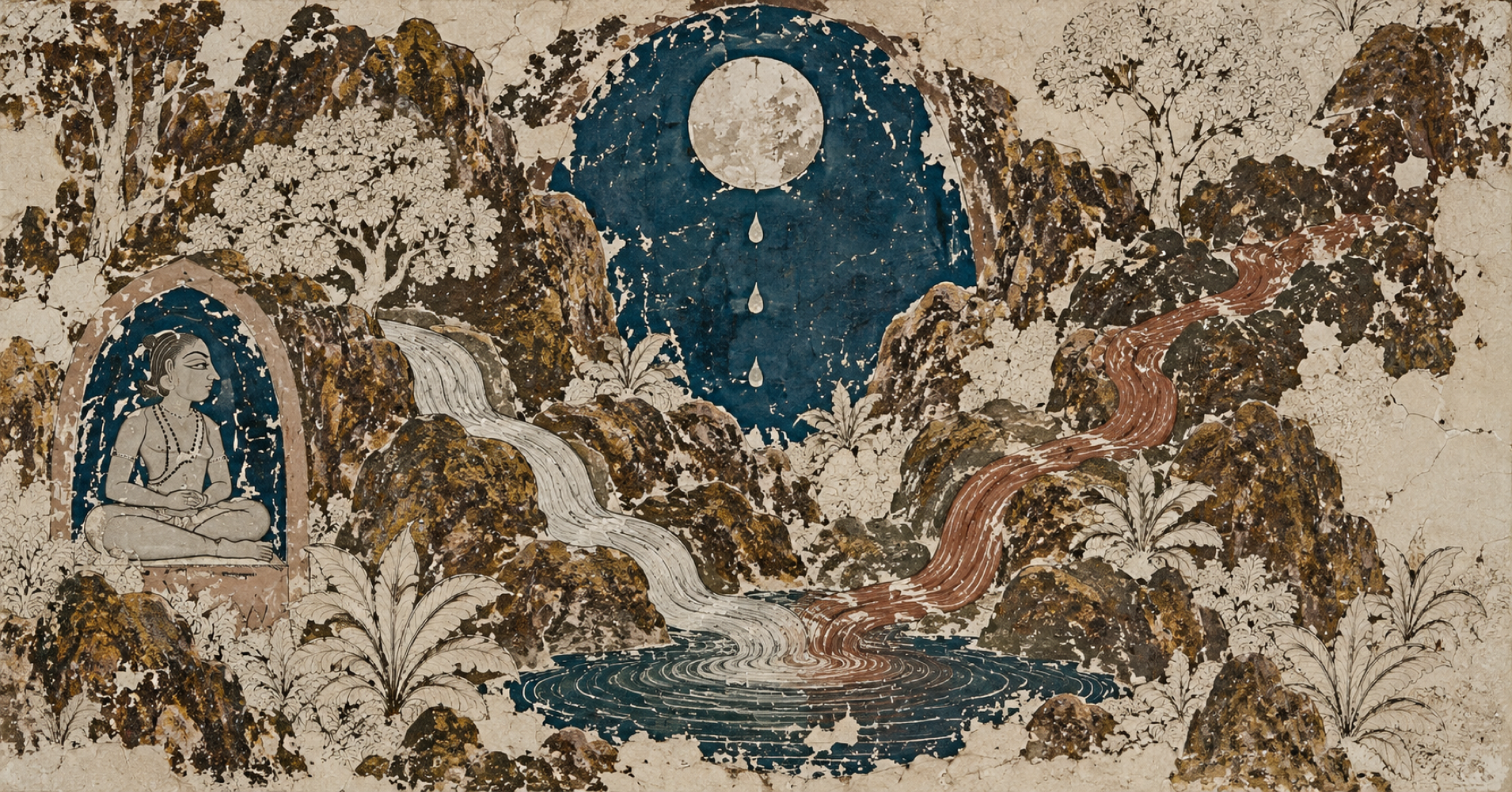
Two streams merge beneath a moon.

Gorakṣaśataka 81–88: An Unusual Path to Śiva

The lunar region, fluids and the embrace of Śiva shape the path ahead. The bodily map and several clause connections still need explanation.

Dr. Ronald Steiner Dr. Ronald Steiner
Gorakṣaśataka (Original) 81
भ्रुवोर् मध्यं तु संभिद्य याति शीतांशुमण्डलम् |
bhruvor madhyaṃ tu saṃbhidya; yāti śītāṃśu-maṇḍalam | Analysis ▾ Analysis ▴
bhruvoḥ
genitive dual
substantive feminine
of the eyebrows
madhyam
accusative singular
substantive neuter
the centre
tu
particle
however
saṃbhidya
absolutus
previx
verbal root
having pierced
yāti
3rd person singular aktive present
verbal root
goes, reaches
śītāṃśu
tatpuruṣa-compound genitive
substantive masculine
moon
maṇḍalam
accusative singular
substantive neuter
region
अनाहताख्यं यच्चक्रं दलैः षोडशभिर् युतम् ||81||
anāhatākhyaṃ yac cakraṃ; dalaiḥ ṣoḍaśabhir yutam ||81|| Analysis ▾ Analysis ▴
anāhata
upapada-compound
adjective
unstruck
ākhyam
nominative singular neuter
adjective
called
yat
nominative singular neuter
pronoun rel
which
cakram
nominative singular
substantive neuter
wheel
dalaiḥ
instrumental case plural
substantive neuter
with petals
ṣoḍaśabhiḥ
instrumental case plural neuter
ṣoḍaśan
numeral
sixteen
yutam
nominative singular neuter past participle passive
verbal root
furnished
Having, however (tu), pierced (saṃbhidya | abs) the centre (madhyam | acc sg) of the eyebrows (bhruvoḥ | gen du), she goes (yāti | 3p sg act pres) to the lunar region (śītāṃśu-maṇḍalam | acc sg): [to] the wheel (cakram | nom sg) which (yat | nom sg n) is called Anāhata (anāhata-ākhyam | nom sg n) and is furnished (yutam | nom sg n ppp) with sixteen (ṣoḍaśabhiḥ | ins pl n) petals (dalaiḥ | ins pl).
Dr. Ronald Steiner - 2026 - historically literal
Not every inner map has the same structure. Meet these images openly before placing them within a familiar scheme.
Dr. Ronald Steiner - 2026 - modern transfer

The working text explicitly names a sixteen-petalled wheel called Anāhata in the lunar region. I do not adapt it to a common later cakra scheme. The construction shifts from accusative to nominative.

Apparatus Comment
Gorakṣaśataka (Original) 82
तत्र शीतांशुसंजातं द्रवं शोषयते स्वयम् |
tatra śītāṃśu-saṃjātaṃ; dravaṃ śoṣayate svayam | Analysis ▾ Analysis ▴
tatra
adverb
there
śītāṃśu
tatpuruṣa-compound genitive
substantive masculine
moon
saṃjātam
accusative singular masculine past participle passive
previx
verbal root
arisen
dravam
accusative singular
substantive masculine
fluid
śoṣayate
3rd person singular medial present causative
verbal root
dries up
svayam
adverb
of itself
चालिते प्राणवेगेन रक्तपित्तं रवौ गृहात् ||82||
cālite prāṇa-vegena; rakta-pittaṃ ravau gṛhāt ||82|| Analysis ▾ Analysis ▴
cālite
lokative absolutus singular masculine past participle passive causative
verbal root
when moved
prāṇa
tatpuruṣa-compound genitive
substantive masculine
breath
vegena
instrumental case singular
substantive masculine
with speed
rakta
dvandva-compound
substantive neuter
blood
pittam
accusative singular
substantive neuter
bile
ravau
lokative singular
substantive masculine
in the sun
gṛhāt
ablative singular
substantive neuter
from the house
There (tatra) she herself (svayam) dries up (śoṣayate | 3p sg med pres caus) the fluid (dravam | acc sg) produced by the moon (śītāṃśu-saṃjātam | acc sg m ppp). When the sun (ravau | loc sg) has been moved (cālite | loc absl sg m ppp caus) by the force of the breath (prāṇa-vegena | ins sg) from its house (gṛhāt | abl sg) towards blood and bile (rakta-pittam | acc sg) …
Dr. Ronald Steiner - 2026 - historically literal
Flowing and drying offer contrasting images. They can make you more attentive to how differently inner states are experienced.
Dr. Ronald Steiner - 2026 - modern transfer

cālite and ravau can be read together as a temporal subordinate construction: “when the sun has been moved”. With Mallinson (2012, p. 271), I interpret rakta-pittam as the destination of this movement, “towards blood and bile”, rather than a new subject. The Sanskrit supplies no separate expression for their location; its compressed construction remains unusual. The sentence continues into 83. śoṣayate means “dries up” and is not reinterpreted as “drinks”.

Apparatus Comment
Gorakṣaśataka (Original) 83
यातेन्दुचक्रं यत्रास्ते शुक्लश्लेष्मद्रवात्मकम् |
yātendu-cakraṃ yatrāste; śukla-śleṣma-dravātmakam | Analysis ▾ Analysis ▴
yātā
nominative singular feminine past participle passive
verbal root
having reached
indu
tatpuruṣa-compound genitive
substantive masculine
moon
cakram
accusative singular
substantive neuter
wheel
yatra
adverb
where
āste
3rd person singular medial present
verbal root
resides
śukla
karmadhāraya-compound
adjective
white
śleṣma
tatpuruṣa-compound genitive
substantive masculine
phlegm
drava
tatpuruṣa-compound genitive
substantive masculine
fluid
ātmakam
accusative singular neuter
adjective
having the nature
तत्र सिक्तं ग्रसत्य् उष्णं कफं शीतस्वभावकम् ||83||
tatra siktaṃ grasaty uṣṇaṃ; kaphaṃ śīta-sva-bhāvakam ||83|| Analysis ▾ Analysis ▴
tatra
adverb
there
siktam
accusative singular masculine past participle passive
verbal root
poured out
grasati
3rd person singular aktive present
verbal root
consumes
uṣṇam
accusative singular masculine
adjective
hot
kapham
accusative singular
substantive masculine
phlegm
śīta
karmadhāraya-compound
adjective
cold
sva
tatpuruṣa-compound genitive
adjective
own
bhāvakam
accusative singular masculine
adjective
having the nature
… [Kuṇḍalinī] has reached (yātā | nom sg f ppp) [the place] where (yatra) the lunar wheel (indu-cakram | acc sg) resides (āste | 3p sg med pres), consisting of white phlegmatic fluid (śukla-śleṣma-drava-ātmakam | acc sg n). There (tatra) she consumes (grasati | 3p sg act pres) the poured-out (siktam | acc sg m ppp), hot (uṣṇam | acc sg m) phlegm (kapham | acc sg), whose nature is cold (śīta-sva-bhāvakam | acc sg m).
Dr. Ronald Steiner - 2026 - historically literal
Warmth and coolness can meet in your perception. Explore the transition without equating the image with a fixed bodily function.
Dr. Ronald Steiner - 2026 - modern transfer

I read yātenducakram as yātā + indu-cakram: Kuṇḍalinī has reached the lunar wheel. The relative clauses in both translations rearrange this connection. I relate the masculine accusatives siktam and uṣṇam to kapham: Kuṇḍalinī consumes the poured-out, heated phlegm, whose nature is cold. “The hot” is therefore not a separate subject. This reading accords with Mallinson 2012, p. 271. The double role of the lunar wheel as a destination and as the referent of yatrāste remains syntactically compressed.

Apparatus Comment
Gorakṣaśataka (Original) 84
तथैव रभसा शुक्लं चन्द्ररूपं हि तप्यते |
tathaiva rabhasā śuklaṃ; candra-rūpaṃ hi tapyate | Analysis ▾ Analysis ▴
tathā
adverb
thus
eva
particle
indeed; precisely
rabhasā
instrumental case singular
substantive neuter
with violence
śuklam
nominative singular neuter
adjective
the white
candra
tatpuruṣa-compound genitive
substantive masculine
moon
rūpam
nominative singular neuter
substantive neuter
having the form
hi
particle
for
tapyate
3rd person singular passive present
verbal root
is heated
ऊर्ध्वं प्रवहति क्षुब्धा तथैवं स्रवतेतराम् ||84||
ūrdhvaṃ pravahati kṣubdhā; tathaivaṃ sravatetarām ||84|| Analysis ▾ Analysis ▴
ūrdhvam
adverb
upwards
pravahati
3rd person singular aktive present
previx
verbal root
flows
kṣubdhā
nominative singular feminine past participle passive
verbal root
agitated
tathā
adverb
thus
evam
adverb
thus
sravatetarām
3rd person singular medial present
verbal root
flows still more strongly
For (hi), in just (eva) the same way (tathā), the white [fluid] (śuklam | nom sg n) in the form of the moon (candra-rūpam | nom sg n) is heated (tapyate | 3p sg pas pres) violently (rabhasā | ins sg). Agitated (kṣubdhā | nom sg f ppp), [Kuṇḍalinī] flows (pravahati | 3p sg act pres) upwards (ūrdhvam); likewise (tathā), in this way (evam), [the fluid] flows still more strongly (sravatetarām | 3p sg med pres).
Dr. Ronald Steiner - 2026 - historically literal
Some processes intensify each other. Notice whether a growing momentum supports you or overwhelms you.
Dr. Ronald Steiner - 2026 - modern transfer

Following Mallinson (2012, p. 271), I distinguish two subjects: feminine kṣubdhā, “agitated”, belongs to Kuṇḍalinī; the intensified flowing concerns the white fluid. Subjects supplied in the translations make these references visible. sravatetarām remains an unusual intensified formation from the verb of flowing. No equivalence with a modern bodily process is inferred.

Apparatus Comment
Gorakṣaśataka (Original) 85
तस्यास्वादवशाच्चित्तं बहिष्ठं विषयेषु यत् |
tasyāsvāda-vaśāc cittaṃ; bahiṣṭhaṃ viṣayeṣu yat | Analysis ▾ Analysis ▴
tasya
tatpuruṣa-compound genitive
pronoun dem
whose
āsvāda
tatpuruṣa-compound genitive
substantive masculine
taste
vaśāt
ablative singular
substantive masculine
through the power
cittam
nominative singular
substantive neuter
mind
bahiṣṭham
nominative singular neuter
bahiṣṭha
adjective
situated outside
viṣayeṣu
lokative plural
substantive masculine
with sense objects
yat
nominative singular neuter
pronoun rel
which
तदेव परमं भुक्त्वा स्वस्थस्यात्मरतो युवा ||85||
tad eva paramaṃ bhuktvā; svasthasyātma-rato yuvā ||85|| Analysis ▾ Analysis ▴
tat
accusative singular neuter
pronoun dem
this
eva
particle
indeed; precisely
paramam
accusative singular neuter
adjective
the highest
bhuktvā
absolutus
verbal root
having enjoyed
svasthasya
genitive singular masculine
adjective
of one established in oneself
ātma
tatpuruṣa-compound lokative
substantive masculine
self
rataḥ
nominative singular masculine past participle passive
verbal root
delighting
yuvā
nominative singular masculine
adjective
young
Through the power of its taste (tasya-āsvāda-vaśāt | abl sg), the mind (cittam | nom sg), which (yat | nom sg n) [was occupied] with sense objects (viṣayeṣu | loc pl), stands outside [them] (bahiṣṭham | nom sg n). Having enjoyed (bhuktvā | abs) that (tat | acc sg n) very (eva) highest [state] (paramam | acc sg n) of one established in oneself (svasthasya | gen sg m), the young person (yuvā | nom sg m) delights in the self (ātma-rataḥ | nom sg m ppp).
Dr. Ronald Steiner - 2026 - historically literal
A satisfying experience can turn your attention inwards. Explore what nourishes you without continually demanding new stimulation.
Dr. Ronald Steiner - 2026 - modern transfer

I provisionally follow Mallinson’s sentence construction (2012, p. 271): the taste of the fluid releases the mind from its attachment to sense objects; the young person delights in the self. I understand bahiṣṭham as “outside” those objects. The supplied indication of a previous state and the first sentence’s verb make this interpretation readable. I connect the genitive svasthasya to paramam: the highest [state] of one who rests in oneself. This closer correspondence to the words remains awkward compared with Mallinson’s freer interpretation as inward enjoyment; the syntactic connection is uncertain. yuvā remains “the young person”. The replacement with bhavet considered in the working text is not adopted.

Apparatus Comment
Gorakṣaśataka (Original) 86
प्रकृत्यष्टकरूपं च स्थानं गच्छति कुण्डली |
prakṛty-aṣṭaka-rūpaṃ ca; sthānaṃ gacchati kuṇḍalī | Analysis ▾ Analysis ▴
prakṛti
tatpuruṣa-compound genitive
substantive feminine
nature
aṣṭaka
tatpuruṣa-compound genitive
substantive neuter
eight
rūpam
accusative singular neuter
substantive neuter
having the form
ca
particle
and
sthānam
accusative singular
substantive neuter
place
gacchati
3rd person singular aktive present
verbal root
goes
kuṇḍalī
nominative singular
substantive feminine
Kuṇḍalī
क्रोडीकृत्य शिवं याति क्रोडीकृत्य विलीयते ||86||
kroḍīkṛtya śivaṃ yāti; kroḍīkṛtya vilīyate ||86|| Analysis ▾ Analysis ▴
kroḍīkṛtya
absolutus
kroḍī
base
verbal root
having embraced
śivam
accusative singular
substantive masculine
Śiva
yāti
3rd person singular aktive present
verbal root
goes, reaches
kroḍīkṛtya
absolutus
kroḍī
base
verbal root
having embraced
vilīyate
3rd person singular medial present
previx
verbal root
dissolves
And (ca) Kuṇḍalī (kuṇḍalī | nom sg) goes (gacchati | 3p sg act pres) to the place (sthānam | acc sg) in the form of eightfold nature (prakṛti-aṣṭaka-rūpam | acc sg n). Embracing [it] (kroḍīkṛtya | abs), she goes (yāti | 3p sg act pres) to Śiva (śivam | acc sg); embracing [him] (kroḍīkṛtya | abs), she dissolves (vilīyate | 3p sg med pres).
Dr. Ronald Steiner - 2026 - historically literal
Entering an experience can soften the firm boundary between you and it. The image of an embrace offers a way to explore this.
Dr. Ronald Steiner - 2026 - modern transfer

prakṛtyaṣṭaka names eightfold nature without listing its constituents here. The objects of the two occurrences of kroḍīkṛtya are supplied from context; no fixed attribution to a philosophical system is inferred.

Apparatus Comment
Gorakṣaśataka (Original) 87
इत्य् अधोर्द्ध्वरजःशुक्ले शिवे तदनु मारुतः |
ity adho-rddhva-rajaḥ-śukle; śive tadanu mārutaḥ | Analysis ▾ Analysis ▴
iti
particle
thus
adhas
dvandva-compound
adverb
below
ūrdhva
karmadhāraya-compound
adjective
above
rajaḥ
dvandva-compound
substantive neuter
red substance
śukle
nominative dual
substantive neuter
red and white substances
śive
lokative singular
substantive masculine
in Śiva
tadanu
adverb
after
mārutaḥ
nominative singular
substantive masculine
wind
प्राणापानौ समायाति सहजातौ तथैव च ||87||
prāṇāpānau samāyāti; saha-jātau tathaiva ca ||87|| Analysis ▾ Analysis ▴
prāṇa
dvandva-compound
substantive masculine
Prāṇa
apānau
accusative dual
substantive masculine
Prāṇa and Apāna
samāyāti
3rd person singular aktive present
previx
previx
verbal root
comes together
saha
karmadhāraya-compound
adjective
together
jātau
accusative dual masculine past participle passive
verbal root
born
tathā
adverb
thus
eva
particle
indeed; precisely
ca
particle
and
Thus (iti) the red below and the white above (adhas-ūrdhva-rajaḥ-śukle | nom du) [merge] in Śiva (śive | loc sg). Indeed (eva), after that (tadanu), the wind (mārutaḥ | nom sg) also (ca) comes together (samāyāti | 3p sg act pres) in the same way (tathā) [with] Prāṇa and Apāna (prāṇa-apānau | acc du), which have arisen together (saha-jātau | acc du m ppp).
Dr. Ronald Steiner - 2026 - historically literal
Opposites can belong to a larger whole. Look for what connects them as well as what sets them apart.
Dr. Ronald Steiner - 2026 - modern transfer

For the red below and the white above, I supply “merge” from the preceding vilīyate. Thereafter mārutaḥ, the wind, is the subject of samāyāti; I read prāṇāpānau and sahajātau as accusative dual, not as a second subject. The forms permit both cases. This yields the sense that the wind comes together with the jointly arisen pair Prāṇa and Apāna. Mallinson (2012, p. 271) supports this connection. Red and white remain historical bodily substances without a modern biological identification.

Apparatus Comment
Gorakṣaśataka (Original) 88
भूते चाल्पे अनल्पत्वे वाचके वापि वर्धते |
bhūte cālpe analpatve; vācake vāpi vardhate | Analysis ▾ Analysis ▴
bhūte
lokative singular
substantive neuter
in the element, what has become
ca
particle
and
alpe
lokative singular neuter
adjective
in the small
analpatve
lokative singular
substantive neuter
in not being small
vācake
lokative singular masculine
adjective
in the one who speaks
vāpi
vāpi
particle
or also
vardhate
3rd person singular medial present
verbal root
increases
द्रावयत्य् अखिलान् वातान् अग्निमूषाहिरण्यवत् ||88||
drāvayaty akhilān vātān; agni-mūṣā-hiraṇya-vat ||88|| Analysis ▾ Analysis ▴
drāvayati
3rd person singular aktive present causative
verbal root
melts
akhilān
accusative plural masculine
adjective
all
vātān
accusative plural
substantive masculine
winds
agni
tatpuruṣa-compound lokative
substantive masculine
fire
mūṣā
tatpuruṣa-compound lokative
substantive feminine
crucible
hiraṇya
avyayībhāva-compund
substantive neuter
gold
vat
suffix
like
And (ca) when the material element (bhūte | loc sg) is small (alpe | loc sg n), or also (vāpi) when the speaker (vācake | loc sg m) is in a state of greatness (analpatve | loc sg), [the breath] increases (vardhate | 3p sg med pres). It melts (drāvayati | 3p sg act pres caus) all (akhilān | acc pl m) the winds (vātān | acc pl), like gold in a crucible over fire (agni-mūṣā-hiraṇya-vat).
Dr. Ronald Steiner - 2026 - historically literal
The image of melting shows a change of form. What seems fixed can become mobile under suitable conditions.
Dr. Ronald Steiner - 2026 - modern transfer

I provisionally read the locatives as conditions: the material element becomes small; the speaker gains greatness. As the subject of vardhate and drāvayati, I supply the breath mentioned in the preceding verse. This interpretative aid follows Mallinson (2012, p. 271), who himself marks the first half-verse as a crux. What “small” and “greatness” mean here remains open. The comparison in the second half-verse is clearer: the winds melt like gold in a heated crucible. The translation introduces no Sanskrit conjecture.

Apparatus Comment

Continue with AYI Free

Illustrations: AI-generated.

Editor

Dr. Ronald Steiner

From Ulm

The "Yoga Doc" - Dr. Ronald Steiner is the founder of the AYI method. This method links traditional Ashtanga Yoga with innovative Yogatherapy and living Philosophy. This forms a practice that is personal for each and... more ›

Messages and ratings
0 messages

Please log in to write a message. Go to login

No messages yet.