

mṛṣaiva pravilīyate ] mūṣaiva pravilīyate JMoJ
I adopt mṛṣā, “falsely, as an illusion”, twice from the parallel Yogakuṇḍalinī-Upaniṣad 1.80 in place of the working text’s mūṣā, “crucible”. Mallinson already records the difference in his Sanskrit note; his 2012 translation (p. 271) likewise follows the sense “falsely”. With mṛṣā, arising and passing away fit the ensuing example of deception: mother-of-pearl is mistaken for silver. This is an explicitly selected reading from a parallel text, not a newly collated GoS manuscript. Both changes are reflected in the Sanskrit and segment analysis; the syllable count is unchanged.
I read saiva instead of sa eva as an editorial conjecture. This gives the second pāda, saiva vā saṃbhaved dṛḍham, eight syllables rather than nine and the pattern GLGGLGLG; with this reading, the whole verse follows the Anuṣṭubh pattern. The conjecture joins sa, already derived from saḥ, once more with eva. This is double sandhi: under the regular visarga rule, sa eva remains separate. The additional contraction is attested as a linguistic phenomenon but is not secured for this Gorakṣaśataka passage by an independently checked Sanskrit witness. I adopt it in IAST and Velthuis; no syllable is added and no asterisk used.
The analysis remains saḥ + eva, not sā + eva. I provisionally refer the masculine pronoun to the body named in dehākhyam. The second half-verse receives “understanding” as a supplied subject: after error it becomes stable through thorough inquiry. Mallinson (2012, p. 272) supplies the sense of truth here. Both additions open up the context without being secured by an explicit Sanskrit noun. The metrical conjecture does not clarify these references.
I render dṛḍhabhāvanā here as sustained contemplation. Together with suvicāra, thorough inquiry in the preceding verse, this yields an examination of the body as a formation composed of elements and itself insentient. Mallinson (2012, p. 272) likewise understands the expression as thorough inward contemplation. bhāvanā can also mean imagining or bringing to mind; that alternative is not additionally included in the reading text.
The second half-verse contains the sequence ubhaidaiṣed, which cannot be securely segmented. Mallinson (2012, p. 272) also marks a crux here. I invent neither a word translation nor a new Sanskrit reading for this sequence: it is retained in full in the Sanskrit and segment list but receives no separate word correspondence in either the German or English reading text. This is an explicitly delimited translation gap. I provisionally connect the remaining words as follows: the sequence of breath practice dissolves and is regarded as unreal. “One should regard” supplies the missing clause element connecting with tam; the form of this verb is not derived from ubhaidaiṣed. The ultimate reference of avastu and the contrast between inquiry and lack of inquiry remain open.
tathaiva bhūmikāḥ sapta; jñāna-janya-samudbhavāt | Analysis ▾ Analysis ▴
|
tathaiva
|
likewise | |
|
bhūmikāḥ
|
stages | |
|
sapta
|
saptan
|
seven |
|
jñāna
|
knowledge | |
|
janya
|
produced | |
|
samudbhavāt
|
through arising |
I provisionally understand anagni literally as “without fire” and proktam as “described as such”. Like Mallinson (2012, p. 272), I read ityādau as a reference to states beginning with this designation; “states” is therefore supplied. The grammar and substantive meaning of the expression remain uncertain. The seven bhūmikās are not individually named here. jñāna is already Mallinson’s conjecture. The translation claims no identification with a particular developed doctrine of stages.
Continue with AYI Free
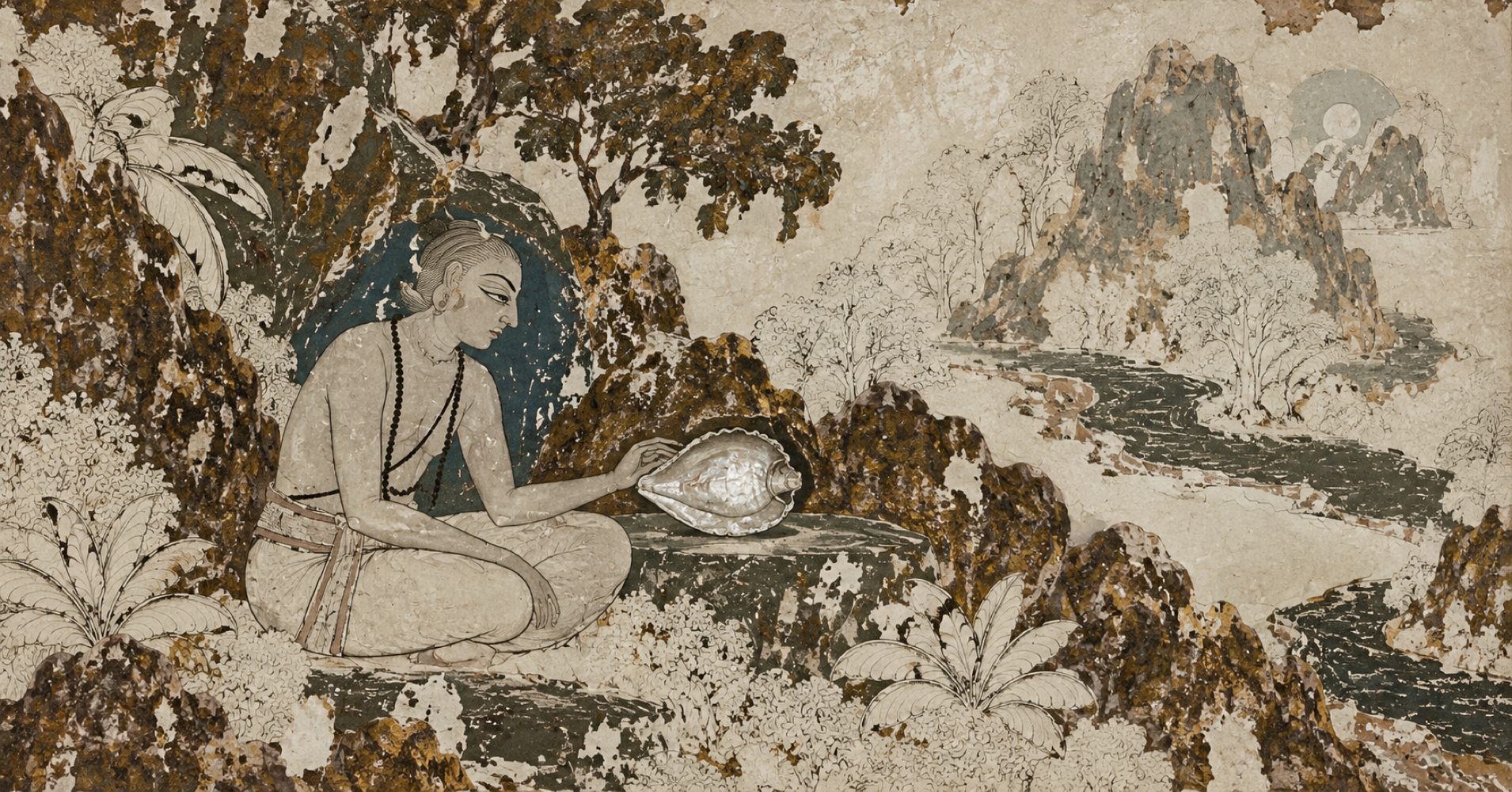
Illustrations: AI-generated.

Please log in to write a message. Go to login
No messages yet.