
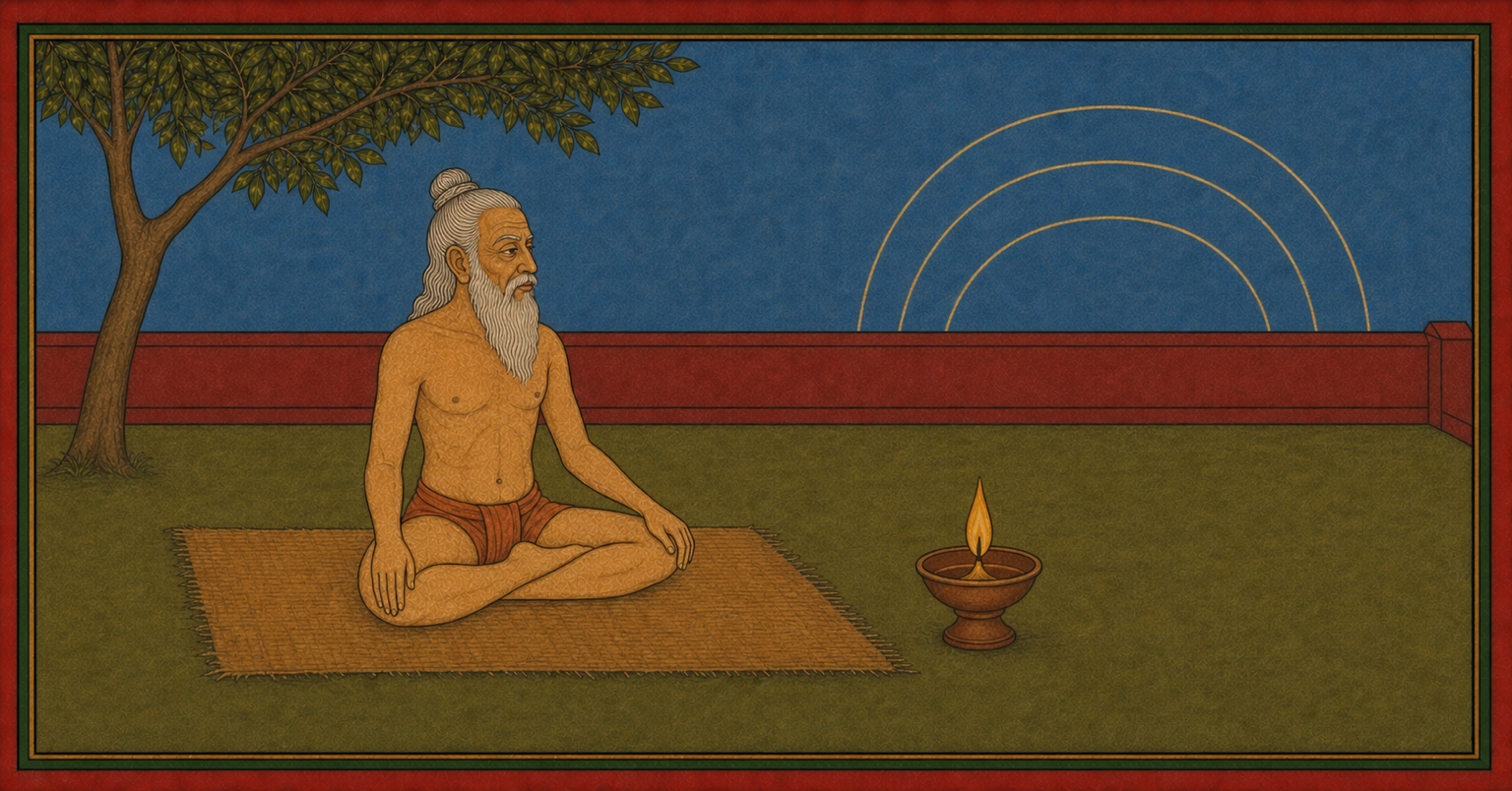
Illustration for the Haṭha Pradīpikā section “HP 1.64-1.65: Practice and Rājayoga”.

Haṭha Pradīpikā 1.64-1.65: Success through Practice and Rājayoga

Regardless of age or weakness, persistent practice leads to success; all methods of Haṭha are directed toward Rājayoga.

Dr. Ronald Steiner Dr. Ronald Steiner
Haṭha Pradīpikā 1.64
युवा वृद्धो ऽतिवृद्धो वा व्याधितो दुर्बलो ऽपि वा |
yuvā vṛddho 'ti-vṛddho vā; vyādhito durbalo 'pi vā | Analysis ▾ Analysis ▴
yuvā
nominative singular masculine
adjective
young
vṛddhaḥ
nominative singular masculine
adjective
old
ati
karmadhāraya-compound
previx
very
vṛddhaḥ
nominative singular masculine
adjective
old
vā
particle
or
vyādhitaḥ
nominative singular masculine
adjective
sick
durbalaḥ
nominative singular masculine
adjective
weak
api
particle
even, also
vā
particle
or
अभ्यासात्सिद्धिमाप्नोति सर्वयोगेष्वतन्द्रितः ||64||
abhyāsāt siddhim āpnoti; sarva-yogeṣv atandritaḥ ||64|| Analysis ▾ Analysis ▴
abhyāsāt
ablative singular
substantive masculine
through practice
siddhim
accusative singular
substantive feminine
success, perfection
āpnoti
3rd person singular aktive present
verbal root
attains
sarva
karmadhāraya-compound
adjective
all
yogeṣu
lokative plural
substantive masculine
in yogas
atandritaḥ
nominative singular masculine
previx
adjective
tireless, vigilant
Metre: Anuṣṭubh
Whether young (yuvā | nom sg m), old (vṛddhaḥ | nom sg m), very old (ati-vṛddhaḥ | nom sg m), ill (vyādhitaḥ | nom sg m), or even (’pi vā) weak (durbalaḥ | nom sg m), one who is tireless (atandritaḥ | nom sg m) attains (āpnoti | 3p sg act pres), through practice (abhyāsāt | abl sg), success (siddhim | acc sg) in all yogas (sarva-yogeṣu | loc pl).
Dr. Ronald Steiner - 2026 - historically literal
Age, illness, or weakness does not rule out success. What matters is attentive, regular practice.
Dr. Ronald Steiner - 2026 - modern transfer
Whether young, old or too old, sick or lean, one who discards laziness, gets success if he practises Yoga.
Pancham Sinh - 1915
Any person if he actively practises Yoga becomes a Siddha: be he young, old or even very old, sickly or weak.
Srinivasa Iyangar - 1893
Ob jung, oder erwachsen, ob sehr alt oder krank, oder schwach, durch Uebung erlangt derjenige die Vollendung, welcher in allen Yogaübungen unermüdlich ist.
Hermann Walter - 1893
Haṭha Pradīpikā 1.65
पीठानि कुम्भकाश्चित्रा दिव्यानि करणानि च |
pīṭhāni kumbhakāś citrā; divyāni karaṇāni ca | Analysis ▾ Analysis ▴
pīṭhāni
nominative plural
substantive neuter
postures, āsanas
kumbhakāḥ
nominative plural
substantive masculine
kumbhakas, breath retentions
citrāḥ
nominative plural masculine
adjective
manifold
divyāni
nominative plural neuter
adjective
divine, excellent
karaṇāni
nominative plural
substantive neuter
techniques
ca
particle
and
सर्वो ऽपि च हठाभ्यासो राजयोगफलावधि ||65||
sarvo 'pi ca haṭhābhyāso; rāja-yoga-phalāvadhi ||65|| Analysis ▾ Analysis ▴
sarvaḥ
nominative singular masculine
adjective
wholly, all
api
particle
also
ca
particle
and
haṭha
tatpuruṣa-compound genitive
substantive masculine
Haṭha
abhyāsaḥ
nominative singular
substantive masculine
practice
rāja
tatpuruṣa-compound genitive
substantive masculine
royal
yoga
tatpuruṣa-compound genitive
substantive masculine
yoga
phala
tatpuruṣa-compound genitive
substantive neuter
fruit, result
avadhiḥ
nominative singular
substantive masculine
limit, goal
Metre: Anuṣṭubh
The seats (pīṭhāni | nom pl), the manifold breath retentions (kumbhakāḥ citrāḥ | nom pl), the divine techniques (divyāni karaṇāni | nom pl), and also (’pi ca) the whole practice of Haṭha (sarvaḥ haṭha-abhyāsaḥ | nom sg) have the fruit of Rājayoga as their culmination (rāja-yoga-phala-avadhiḥ | nom sg).
Dr. Ronald Steiner - 2026 - historically literal
All Āsanas, breath retentions, and techniques of Haṭha ultimately serve one goal: the fruit of Rājayoga.
Dr. Ronald Steiner - 2026 - modern transfer

In explaining the additional stanzas transmitted in NS1882 immediately before the concluding verse, Brahmānanda says that practice means the actual performance of the limbs of yoga. Mere reading, talking about yoga, or wearing ocher-colored clothing cannot replace this performance. Āsanas, Kumbhakas, and Mudrās are then practised until Rājayoga, their goal, is reached.

Brahmānanda's Jyotsnā - 19th c.
om. MBHDL2026 ] add. kriyāyuktasya siddhiḥ syād ... yogasiddhiḥ prajāyate NS1882 ante HP 1.65
Critical Apparatus
Âsanas (postures), various Kumbhakas, and other divine means, all should be practised in the practice of Haṭha Yoga, till the fruit—Râja Yoga—is obtained.
Pancham Sinh - 1915
The various Asanas, the Kumbhakas, and the various Mudras of, Hatha-yoga, should be practised only so far as one does not attain Raja-Yoga.
Srinivasa Iyangar - 1893
Die Asana, die verschiedenen Kumbhaka, die erhabenen Uebungen (wie Mudra, Com.), kurz Alles, was sich auf Uebungen des Hathayoga bezieht, soll bis zur Erreichung des Rajayoga ausgeführt werden.
Hermann Walter - 1893

Continue with AYI Free

Illustrations: AI-generated.

Editor

Dr. Ronald Steiner

From Ulm

The "Yoga Doc" - Dr. Ronald Steiner is the founder of the AYI method. This method links traditional Ashtanga Yoga with innovative Yogatherapy and living Philosophy. This forms a practice that is personal for each and... more ›

Messages and ratings
0 messages

Please log in to write a message. Go to login

No messages yet.