
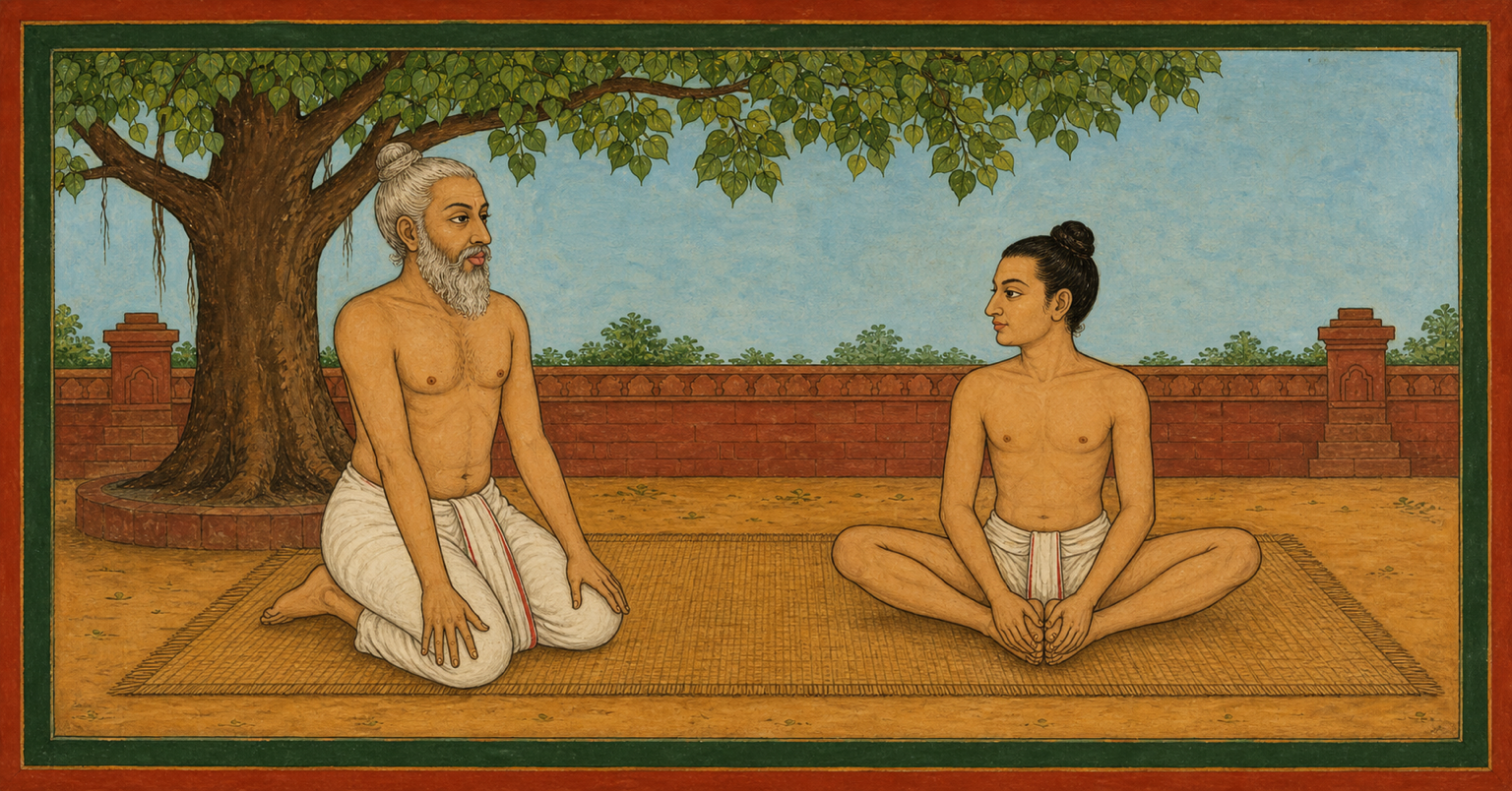
Illustration for the Haṭha Pradīpikā section “HP 1.50–54: Siṃhāsana and Bhadrāsana”.

Haṭha Pradīpikā 1.50–54: Siṃhāsana and Bhadrāsana

The other two principal seats are described through the position of the feet, the binding of the body, and their yogic effects.

Dr. Ronald Steiner Dr. Ronald Steiner
Haṭha Pradīpikā
गुल्फौ च वृषणस्याधः सीवन्याः पार्श्वयोः क्षिपेत् |
gulphau ca vṛṣaṇasyādhaḥ; sīvanyāḥ pārśvayoḥ kṣipet | Analysis ▾ Analysis ▴
gulphau
accusative dual
substantive masculine
both ankles
ca
particle
and
vṛṣaṇasya
genitive singular
substantive neuter
of the scrotum
adhaḥ
adverb
below
sīvanyāḥ
genitive singular
substantive feminine
perineal seam
pārśvayoḥ
lokative dual
substantive neuter
on both sides
kṣipet
3rd person singular aktive optative
verbal root
he should place
दक्षिणे सव्यगुल्फं तु दक्षगुल्फं तु सव्यके ||50||
dakṣiṇe savya-gulphaṃ tu; dakṣa-gulphaṃ tu savyake ||50|| Analysis ▾ Analysis ▴
dakṣiṇe
lokative singular neuter
adjective
on the right side
savya
karmadhāraya-compound
adjective
left
gulpham
accusative singular
substantive masculine
ankle
tu
particle
but
dakṣa
karmadhāraya-compound
adjective
right
gulpham
accusative singular
substantive masculine
ankle
tu
particle
but
savyake
lokative singular neuter
adjective
on the left side
हस्तौ च जान्वोः संस्थाप्य स्वाङ्गुलीः संप्रसार्य च |
hastau ca jānvoḥ, saṃsthāpya; svāṅgulīḥ saṃprasārya ca | Analysis ▾ Analysis ▴
hastau
accusative dual
substantive masculine
both hands
ca
particle
and
jānvoḥ
lokative dual
substantive neuter
on the knees
saṃsthāpya
absolutus
previx
verbal root
having placed
sva
karmadhāraya-compound
adjective
own
aṅgulīḥ
accusative plural
substantive feminine
fingers
saṃprasārya
absolutus
previx
previx
verbal root
having extended
ca
particle
and
व्यात्तवक्त्रो निरीक्षेत नासाग्रं सुसमाहितः ||51||
vyātta-vaktro nirīkṣeta; nāsāgraṃ su-samāhitaḥ ||51|| Analysis ▾ Analysis ▴
vyātta
karmadhāraya-compound past participle passive
previx
previx
verbal root
opened
vaktraḥ
nominative singular masculine bahuvrīhi-compund
substantive neuter
having a mouth
nirīkṣeta
3rd person singular medial optative
previx
verbal root
he should look at
nāsā
tatpuruṣa-compound genitive
substantive feminine
nose
agram
accusative singular
substantive neuter
tip
su
karmadhāraya-compound
previx
fully, completely
samāhitaḥ
nominative singular masculine past participle passive
previx
previx
verbal root
collected
सिंहासनं भवेदेतत्पूजितं योगिभिः सदा |
siṃhāsanaṃ bhaved etat; pūjitaṃ yogibhiḥ sadā | Analysis ▾ Analysis ▴
siṃha
tatpuruṣa-compound genitive
substantive masculine
lion
āsanam
nominative singular
substantive neuter
posture
bhavet
3rd person singular aktive optative
verbal root
becomes, is
etat
nominative singular neuter
pronoun dem
this
pūjitam
nominative singular neuter past participle passive
verbal root
revered
yogibhiḥ
instrumental case plural
substantive masculine
by yogins
sadā
adverb
always
बन्धत्रितयसंधानं कुरुते चासनोत्तमम् ||52||
bandha-tritaya-saṃdhānaṃ; kurute cāsanottamam ||52|| Analysis ▾ Analysis ▴
bandha
tatpuruṣa-compound genitive
substantive masculine
bandha, lock
tritaya
tatpuruṣa-compound genitive
substantive neuter
triad
saṃdhānam
accusative singular
substantive neuter
connection, joining
kurute
3rd person singular medial present
verbal root
produces, makes
ca
particle
and
āsana
tatpuruṣa-compound genitive
substantive neuter
āsana
uttamam
nominative singular neuter
adjective
highest, best
Metre: Anuṣṭubh
One should place (kṣipet | 3p sg act opt) both ankles (gulphau | acc du) on the two sides (pārśvayoḥ | loc du) of the perineal seam (sīvanyāḥ | gen sg), below (adhaḥ) the scrotum (vṛṣaṇasya | gen sg): the left ankle (savya-gulpham | acc sg) on the right side (dakṣiṇe | loc sg n), but (tu) the right ankle (dakṣa-gulpham | acc sg) on the left side (savyake | loc sg n). Having placed (saṃsthāpya | abs) both hands (hastau | acc du) on the knees (jānvoḥ | loc du) and (ca) extended (saṃprasārya | abs) one's own fingers (sva-aṅgulīḥ | acc pl), one should gaze (nirīkṣeta | 3p sg med opt) at the tip of the nose (nāsā-agram | acc sg) with the mouth open (vyātta-vaktraḥ | nom sg m bv), fully composed (su-samāhitaḥ | nom sg m ppp). This (etat | nom sg n) is (bhavet | 3p sg act opt) Siṃhāsana (siṃha-āsanam | nom sg), always (sadā) revered (pūjitam | nom sg n ppp) by yogis (yogibhiḥ | ins pl). It brings about (kurute | 3p sg med pres) the conjunction of the three locks (bandha-tritaya-saṃdhānam | acc sg) and (ca) is the best posture (āsana-uttamam | nom sg n).
Dr. Ronald Steiner - 2026 - historically literal
Siṃhāsana: Place the crossed ankles at the sides of the perineum. Rest the hands on the knees with the fingers spread wide, open the mouth, and keep the gaze collected at the tip of the nose. The posture brings the three Bandhas together and is regarded as especially valuable.
Dr. Ronald Steiner - 2026 - modern transfer
Press the heels on both sides of the seam of Perineum, in such a way that the left heel touches the right side and the right heel touches the left side of it.

Place the hands on the thighs, with stretched fingers, and keeping the mouth open and the mind collected, gaze on the tip of the nose.

This is Siṃhâsana, held sacred by the best of Yogîs. This excellent Âsana effects the completion of the three Bandhas (The Mûlabandha, Kanṭha or Jâlandhar Bandha and Uḍḍiyâna Bandha).
Pancham Sinh - 1915
Place the ankles upon that part of the body between the anus and the scrotum, the right ankle upon the left side of it, and the left ankle upon the right.

Place the palms upon the knees extending the fingers and direct the eyes to the tip of the nose, with opened mouth and a concentrated mind

This is Sinhasana held in so great esteem by the highest Yogis: this most excellent asana facilitates the three bandhas.
Srinivasa Iyangar - 1893
Man lege die Fussknöchel unter das scrotum an die beiden Seiten des fraenum praeputii, und zwar den linken Knöchel an die rechte Seite, den rechten an die linke.

Die Hände lege man auf die Knie und strecke die Finger aus; mit geöffnetem Munde (und heraushängender Zunge, Com.) vertiefe man sich in den Anblick der Nasenspitze.

Dies ist das Simhasana, gerühmt von den hervorragendsten Yogin; und dieses vorzüglichste Asana verhilft zur Ausführung der drei Bandha (s. III. 55 ff.)..
Hermann Walter - 1893
Haṭha Pradīpikā
गुल्फौ च वृषणस्याधः सीवन्याः पार्श्वयोः क्षिपेत् |
gulphau ca vṛṣaṇasyādhaḥ; sīvanyāḥ pārśvayoḥ kṣipet | Analysis ▾ Analysis ▴
gulphau
accusative dual
substantive masculine
both ankles
ca
particle
and
vṛṣaṇasya
genitive singular
substantive neuter
of the scrotum
adhaḥ
adverb
below
sīvanyāḥ
genitive singular
substantive feminine
perineal seam
pārśvayoḥ
lokative dual
substantive neuter
at the sides
kṣipet
3rd person singular aktive optative
verbal root
he should place
पार्श्वपादौ च पाणिभ्यां दृढं बद्ध्वा सुनिश्चलम् ||53||
pārśva-pādau ca pāṇibhyāṃ; dṛḍhaṃ baddhvā su-niścalam ||53|| Analysis ▾ Analysis ▴
pārśva
tatpuruṣa-compound genitive
substantive neuter
side
pādau
accusative dual
substantive masculine
both feet
ca
particle
and
pāṇibhyām
instrumental case dual
substantive masculine
with both hands
dṛḍham
adverb
firmly
baddhvā
absolutus
verbal root
having held, bound
su
karmadhāraya-compound
previx
fully, completely
niścalam
accusative singular neuter
adjective
motionless
भद्रासनं भवेदेतत्सर्वव्याधिविषापहम् |
bhadrāsanaṃ bhaved etat; sarva-vyādhi-viṣāpaham | Analysis ▾ Analysis ▴
bhadra
karmadhāraya-compound
adjective
auspicious, favourable
āsanam
nominative singular
substantive neuter
posture
bhavet
3rd person singular aktive optative
verbal root
becomes, arises
etat
nominative singular neuter
pronoun dem
this
sarva
karmadhāraya-compound
adjective
all
vyādhi
dvandva-compound
substantive masculine
diseases
viṣa
dvandva-compound
substantive neuter
poison
apaham
nominative singular neuter
adjective
removing
गोरक्षासनमित्याहुरिदं वै सिद्धयोगिनः ||54||
gorakṣāsanam ity āhur; idaṃ vai siddha-yoginaḥ ||54|| Analysis ▾ Analysis ▴
gorakṣa
tatpuruṣa-compound genitive
substantive masculine
Gorakṣa
āsanam
accusative singular
substantive neuter
posture
iti
particle
thus
āhuḥ
3rd person plural aktive perfekte
verbal root
they call
idam
accusative singular neuter
pronoun dem
this
vai
particle
indeed
siddha
karmadhāraya-compound
adjective
accomplished
yoginaḥ
nominative plural
substantive masculine
yogins
Metre: Anuṣṭubh
One should place (kṣipet | 3p sg act opt) both ankles (gulphau | acc du) at the sides (pārśvayoḥ | loc du) of the perineal seam (sīvanyāḥ | gen sg), below (adhaḥ) the scrotum (vṛṣaṇasya | gen sg). Having firmly (dṛḍham) held (baddhvā | abs) the outer sides of the feet (pārśva-pādau | acc du) with both hands (pāṇibhyām | ins du), one remains completely motionless (su-niścalam | acc sg n). This (etat | nom sg n) becomes Bhadrāsana (bhadra-āsanam | nom sg); it removes all diseases and poisons (sarva-vyādhi-viṣa-apaham | nom sg n). The Siddha yogis (siddha-yoginaḥ | nom pl) indeed (vai) call (āhuḥ | 3p pl act perf) this (idam | acc sg n) Gorakṣāsana (gorakṣa-āsanam | acc sg).
Dr. Ronald Steiner - 2026 - historically literal
Bhadrāsana begins in a similar way: place the ankles beside the perineum, below the scrotum. Hold the feet firmly at the sides with the hands and keep the body very still.

Bhadrāsana is regarded as a remedy for diseases and poisons. In the Siddha tradition, it is also called Gorakṣāsana.
Dr. Ronald Steiner - 2026 - modern transfer
om. MBHDL2026 ] add. savyagulphaṃ tathā savye dakṣagulphaṃ tu dakṣiṇe NS1882 post sīvanyāḥ pārśvayoḥ kṣipet
Critical Apparatus
Place the heels on either side of the seam of the Perineum, keeping the left heel on the left side and the right one on the right side, hold the feet firmly joined to one another with both the hands. This Bhadrâsana is the destroyer of all the diseases.
Pancham Sinh - 1915
Place the ankles upon the sides of the Sivni (the part between the anus and the scrotum), the right upon the right and the left upon the left side.

Then bind the thighs with your hands wound round them. This is Bhadrasana and destroys all ills.
Srinivasa Iyangar - 1893
Man lege die Fussknöchel unter das scrotum an die beiden Seiten des fraenum praeputii, den linken Fussknöchel an die linke Seite, den rechten an die rechte,

und die Füsse, die an den Seiten ruhen, fasse man fest und unbeweglich mit den Händen; dies ist das Bhadrasana, das alle Krankheiten vernichtet.

Vollendete Yogin nennen dies auch Gorakshasana. Wenn der ausgezeichnete Yogin es dahin gebracht hat, dass er ohne Ermüdung in diesen Stellungen verweilen kann, so übe er die Athmungsübungen, wie Mudrâ etc., welche die Adern reinigen (über Mudra s. III. 10 ff.).
Hermann Walter - 1893

Continue with AYI Free

Illustrations: AI-generated.

Editor

Dr. Ronald Steiner

From Ulm

The "Yoga Doc" - Dr. Ronald Steiner is the founder of the AYI method. This method links traditional Ashtanga Yoga with innovative Yogatherapy and living Philosophy. This forms a practice that is personal for each and... more ›

Messages and ratings
0 messages

Please log in to write a message. Go to login

No messages yet.