
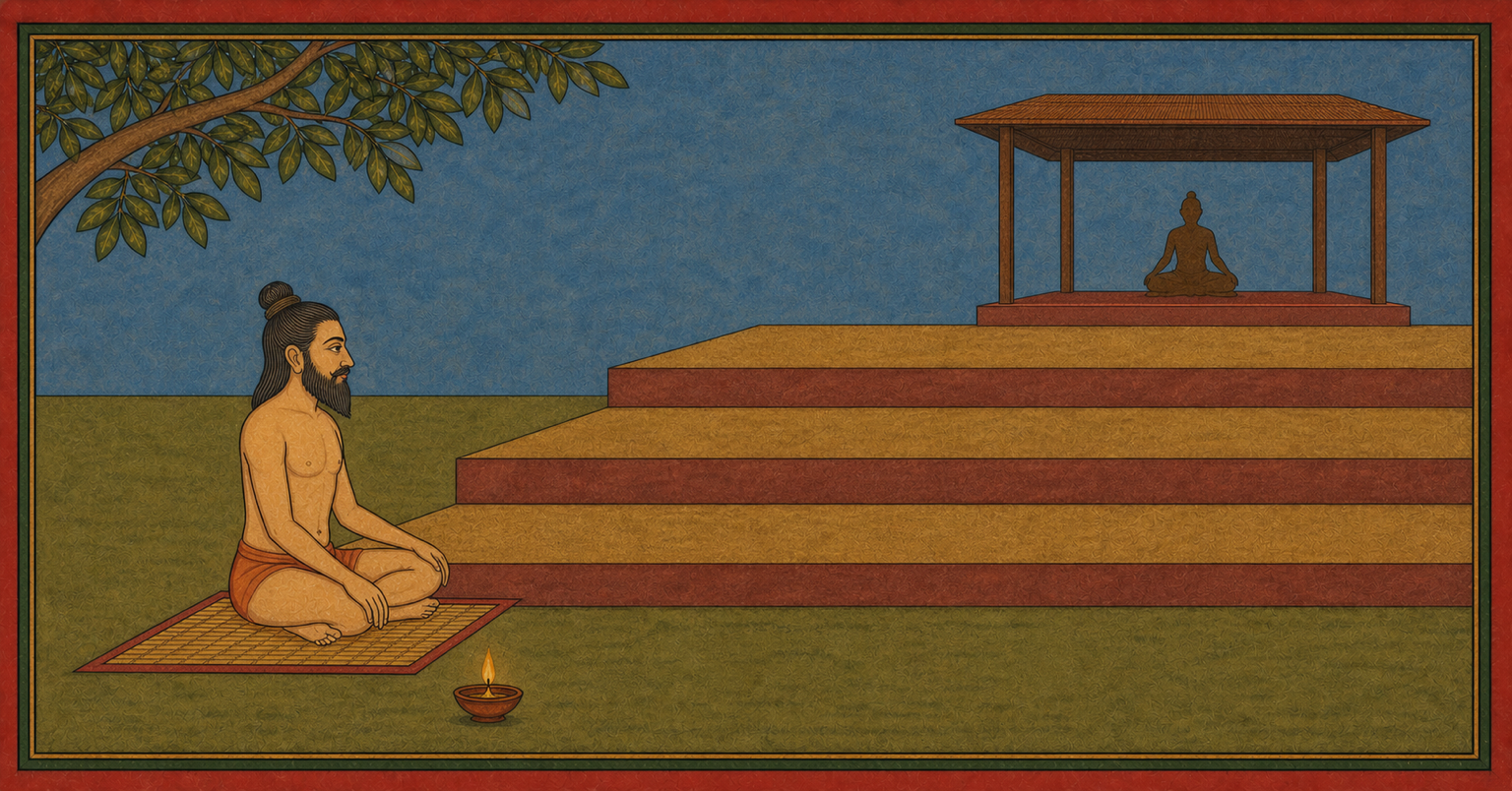
Illustration for the Haṭha Pradīpikā section “HP 1.1-1.3: Opening”.

Haṭha Pradīpikā 1.1-1.3: Opening and Purpose of the Teaching

Ādinātha, the Guru, and Svātmārāma frame Haṭha as a ladder to Rājayoga and a lamp for seekers in the darkness of many teachings.

Dr. Ronald Steiner Dr. Ronald Steiner
Haṭha Pradīpikā 1.1
श्रीआदिनाथाय नमो ऽस्तु तस्मै येनोपदिष्टा हठयोगविद्या |
śrī-ādināthāya namo 'stu tasmai; yenopadiṣṭā haṭha-yoga-vidyā | Analysis ▾ Analysis ▴
śrī
karmadhāraya-compound
adjective
venerable, glorious
ādināthāya
dative singular
substantive masculine
to Ādinātha
namaḥ
nominative singular
substantive neuter
homage, salutation
astu
3rd person singular aktive imperative
verbal root
may it be
tasmai
dative singular
pronoun dem
to him
yena
instrumental case singular
pronoun rel
by whom
upadiṣṭā
nominative singular feminine past participle passive
previx
verbal root
taught, instructed
haṭha
tatpuruṣa-compound genitive
substantive masculine
Haṭha
yoga
tatpuruṣa-compound genitive
substantive masculine
yoga
vidyā
nominative singular
substantive feminine
knowledge, science
विराजते प्रोन्नतराजसौधमारोढुमिच्छोरधिरोहिणीव ||1||
virājate pronnata-rāja-saudham; āroḍhum icchor adhirohiṇīva ||1|| Analysis ▾ Analysis ▴
virājate
3rd person singular medial present
previx
verbal root
she shines, gleams
pronnata
karmadhāraya-compound
adjective
towering high
rāja
karmadhāraya-compound
substantive masculine
royal
saudham
accusative singular
substantive neuter
palace, terrace
āroḍhum
infinitive
previx
verbal root
to climb
icchoḥ
genitive singular masculine present participle active
verbal root
of the one who wishes
adhirohiṇī
nominative singular
substantive feminine
ladder, aid to ascent
iva
particle
like
Metre: Upajāti
Homage (namaḥ | nom sg) be (astu | 3p sg act imp) to this (tasmai | dat sg) glorious Ādinātha (śrī-ādināthāya | dat sg), by whom (yena | ins sg) the science of Haṭhayoga (haṭha-yoga-vidyā | nom sg) was taught (upadiṣṭā | nom sg f ppp); it shines (virājate | 3p sg med pres) like (iva) a stairway (adhirohiṇī | nom sg) for one who wishes (icchoḥ | gen sg m pca) to ascend (āroḍhum | inf) to the lofty royal terrace (pronnata-rāja-saudham | acc sg).
Dr. Ronald Steiner - 2026 - historically literal
Homage to Ādinātha, who taught the knowledge of Haṭha Yoga. It is like a staircase for someone who wishes to ascend to the lofty royal terrace.
Dr. Ronald Steiner - 2026 - modern transfer

Brahmānanda interprets Haṭha as the union of sun and moon, which he identifies with Prāṇa and Apāna. This union takes place in Prāṇāyāma. He understands Rājayoga as non-objective yoga, in which all movements of the mind become still; Haṭha is the ladder to this higher goal.

Brahmānanda's Jyotsnā - 19th c.
virājate pronnatarājasaudham MBHDL2026 ] vibhrājate pronnatarājayogam NS1882
Critical Apparatus
Salutation to Âdinâtha (Śiva) who expounded the knowledge of Haṭha Yoga, which like a staircase leads the aspirant to the high pinnacled Râja Yoga.
Pancham Sinh - 1915
I salute the First Lord, Siva, who taught to Parvati the Hathavidya, that is, a step to the attainment of the most excellent Raja Yoga.
Srinivasa Iyangar - 1893
Verehrung dem erhabenen Siva (adinatha), durch den die Lehre vom Hathayoga verkündigt wurde. Sie leuchtet dem, welcher den hohen Rajayoga zu erklimmen wünscht, gleich einer Leiter.
Hermann Walter - 1893
Haṭha Pradīpikā 1.2
प्रणम्य श्रीगुरुं नाथं स्वात्मारामेण योगिना |
praṇamya śrī-guruṃ nāthaṃ; svātmārāmeṇa yoginā | Analysis ▾ Analysis ▴
praṇamya
absolutus
previx
verbal root
having bowed
śrī
karmadhāraya-compound
adjective
venerable, glorious
gurum
accusative singular
substantive masculine
the teacher
nātham
accusative singular
substantive masculine
the lord
svātmārāmeṇa
instrumental case singular
substantive masculine
by Svātmārāma
yoginā
instrumental case singular
substantive masculine
by the yogin
केवलं राजयोगाय हठविद्योपदिश्यते ||2||
kevalaṃ rāja-yogāya; haṭha-vidyopadiśyate ||2|| Analysis ▾ Analysis ▴
kevalam
adverb
solely, exclusively
rāja
karmadhāraya-compound
substantive masculine
royal
yogāya
dative singular
substantive masculine
for Rājayoga
haṭha
tatpuruṣa-compound genitive
substantive masculine
Haṭha
vidyā
nominative singular
substantive feminine
science, teaching
upadiśyate
3rd person singular passive present
previx
verbal root
is taught
Metre: Anuṣṭubh
Having bowed (praṇamya | abs) to the glorious guru (śrī-guruṃ | acc sg), the Lord (nāthaṃ | acc sg), the Haṭha system (haṭha-vidyā | nom sg) is taught (upadiśyate | 3p sg pas pres) by the yogi (yoginā | ins sg) Svātmārāma (svātmārāmeṇa | ins sg) solely (kevalam) for Rājayoga (rāja-yogāya | dat sg).
Dr. Ronald Steiner - 2026 - historically literal
Svātmārāma bows to his guru and makes the purpose clear: Haṭha is not taught here as an end in itself, but as a path to Rājayoga.
Dr. Ronald Steiner - 2026 - modern transfer

Brahmānanda interprets the word “alone” (kevalam) in relation to the goal: the true purpose of the Haṭha teaching is Rājayoga, not the acquisition of extraordinary powers. Siddhis may arise incidentally, but they are not the primary aim. Through Rājayoga, one is ultimately to reach Kaivalya, final liberation.

Brahmānanda's Jyotsnā - 19th c.
Yogin Swâtmârâma, after saluting first his Gurû Srinâtha explains Haṭha Yoga for the attainment of Raja Yoga.
Pancham Sinh - 1915
Swatmarama Yogi, having saluted his own Guru, gives out the Hathavidya solely for the attainment of Raja Yoga.
Srinivasa Iyangar - 1893
Nach Verneigung vor dem erhabenen Lehrer, dem Meister, erklärt der Yogin Svâtmârâma bloss zum Zweck der Erreichung des Rajayoga die Lehre vom Hathayoga.
Hermann Walter - 1893
Haṭha Pradīpikā 1.3
भ्रान्त्या बहुमतध्वान्ते राजमार्गमजानताम् |
bhrāntyā bahu-mata-dhvānte; rāja-mārgam ajānatām | Analysis ▾ Analysis ▴
bhrāntyā
instrumental case singular
substantive feminine
through confusion, error
bahu
karmadhāraya-compound
adjective
many
mata
tatpuruṣa-compound genitive
substantive neuter
teachings, opinions
dhvānte
lokative singular
substantive neuter
in the darkness
rāja
karmadhāraya-compound
substantive masculine
royal
mārgam
accusative singular
substantive masculine
path
ajānatām
genitive plural masculine present participle active
previx
verbal root
of those who do not know
हठप्रदीपिकां धत्ते स्वात्मारामः कृपाकरः ||3||
haṭha-pradīpikāṃ dhatte; svātmārāmaḥ kṛpā-karaḥ ||3|| Analysis ▾ Analysis ▴
haṭha
tatpuruṣa-compound genitive
substantive masculine
Haṭha
pradīpikām
accusative singular
substantive feminine
lamp, light
dhatte
3rd person singular medial present
verbal root
he holds, bears
svātmārāmaḥ
nominative singular
substantive masculine
Svātmārāma
kṛpā
tatpuruṣa-compound genitive
substantive feminine
compassion
karaḥ
nominative singular masculine
adjective
making, full of
Metre: Anuṣṭubh
For those who, through confusion (bhrāntyā | ins sg), do not know (ajānatām | gen pl pca) the royal path (rāja-mārgam | acc sg) in the darkness of many doctrines (bahu-mata-dhvānte | loc sg), Svātmārāma (svātmārāmaḥ | nom sg), full of compassion (kṛpā-karaḥ | nom sg m), holds up (dhatte | 3p sg med pres) the Lamp on Haṭha (haṭha-pradīpikām | acc sg).
Dr. Ronald Steiner - 2026 - historically literal
For all who have lost their way in the darkness of many doctrines and cannot see the royal path, Svātmārāma holds up this lamp of Haṭha Yoga.
Dr. Ronald Steiner - 2026 - modern transfer

Brahmānanda reads the name Svātmārāma programmatically as “one who delights in his own self.” He thereby places the author at the highest of seven stages of knowledge:

  • Śubhecchā: the desire for liberation founded on discernment and detachment.
  • Vicāraṇā: listening to and critically reflecting on the teaching.
  • Tanumānasā: the mind becomes “thin” and flows with concentration toward a single real object.
  • Sattvāpatti: direct realization of “I am Brahman.”
  • Asaṃsakti: non-attachment even to Siddhis that may arise.
  • Parārthābhāvinī: what is other than Brahman is no longer regarded as an independent reality.
  • Turyagā: uninterrupted absorption from which the yogi emerges neither independently nor through the intervention of others.

Brahmānanda thus understands the “lamp” as the compassionate instruction of one who is already liberated, offered for the sake of those who remain ignorant.

Brahmānanda's Jyotsnā - 19th c.
rājamārgam MBHDL2026 ] rājayogam NS1882
Critical Apparatus
Owing to the darkness arising from the multiplicity of opinions people are unable to know the Râja Yoga. Compassionate Swâtmârâma composes the Haṭha Yoga Pradipikâ like a torch to dispel it.
Pancham Sinh - 1915
To those who wander in the darkness of the conflicting Sects unable to obtain Raja Yoga; the most merciful Swatmarama Yogi offers the light of Hathavidya.
Srinivasa Iyangar - 1893
Denjenigen, welche in der Finsterniss der Meinungsverschiedenheiten, welche dem Irrthum entspringen, den Rajayoga nicht kennen, verleiht der mitleidige Svâtmârâma die Leuchte des Hathayoga.
Hermann Walter - 1893

Continue with AYI Free

Illustrations: AI-generated.

Editor

Dr. Ronald Steiner

From Ulm

The "Yoga Doc" - Dr. Ronald Steiner is the founder of the AYI method. This method links traditional Ashtanga Yoga with innovative Yogatherapy and living Philosophy. This forms a practice that is personal for each and... more ›

Messages and ratings
0 messages

Please log in to write a message. Go to login

No messages yet.