
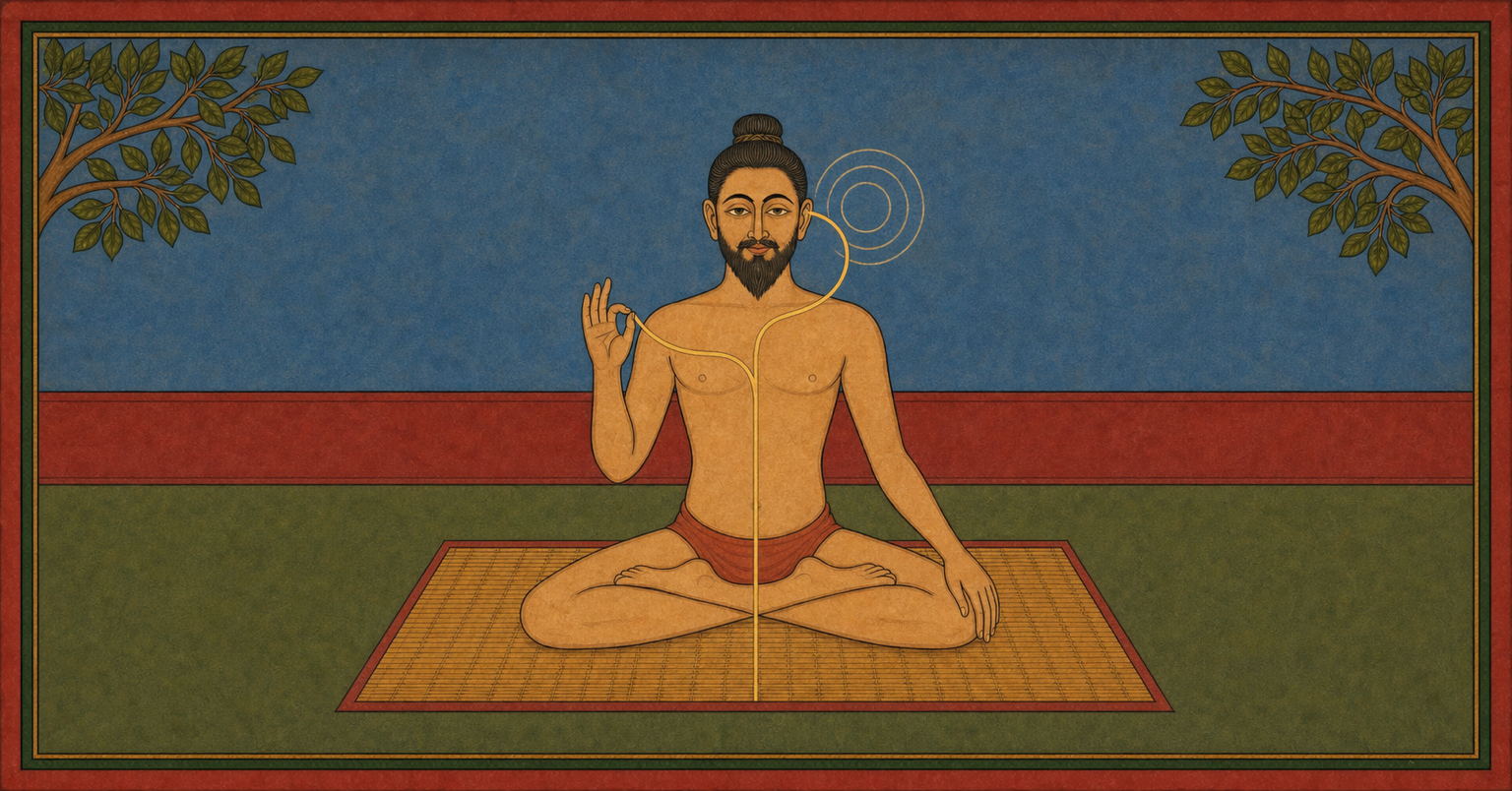

Haṭha Pradīpikā 1.56
आसनं कुम्भकं चित्रं मुद्राख्यं करणं तथा |
अथ नादानुसन्धानमभ्यासानुक्रमो हठे ||56||
Metre: Anuṣṭubh
The sequence of practice (abhyāsa-anukramaḥ | nom sg) in Haṭha (haṭhe | loc sg) is posture (āsanam | nom sg), manifold breath retention (citraṃ kumbhakam | nom sg), likewise (tathā) the technique called mudrā (mudrā-ākhyaṃ karaṇam | nom sg), and then (atha) concentration on the inner sound (nāda-anusandhānam | nom sg).
The sequence of practice in Haṭha is Āsana, Kumbhaka, Mudrā or Karaṇa, and finally attending to the inner sound.
Brahmānanda understands Haṭha here as a sequence of four parts: Āsana, the various Kumbhakas, the procedures called Mudrā, and finally Nādānusandhāna, absorption in the inner sound. He sees the remaining higher limbs of yoga, from withdrawal of the senses through Samādhi, as included in this final stage of absorption in sound.
The Nâdis should be cleansed of their impurities by performing the mudrâs, etc., (which are the practices relating to the air) Âsanas, Kumbhakas and various curious mûdrâs.
Then he should purify the Nadis, by performing Pranayama and practise Mudras and Kumbhakas of various sorts.
Asana, die verschiedenen Kumbhaka, die Mudra genannte Uebung und das Versenken in den Nada; dies ist die Reihenfolge der Uebungen im Hatha.
Haṭha Pradīpikā 1.57
ब्रह्मचारी मिताहारी योगी योगपरायणः |
अब्दादूर्ध्वं भवेत्सिद्धो नात्र कार्या विचारणा ||57||
Metre: Anuṣṭubh
The celibate (brahmacārī | nom sg), moderate-eating (mita-āhārī | nom sg m) yogi (yogī | nom sg), devoted to yoga (yoga-parāyaṇaḥ | nom sg m), becomes accomplished (siddhaḥ | nom sg m ppp) after one year (abdāt | abl sg) and beyond (ūrdhvam). Here (atra) no further consideration (vicāraṇā | nom sg) is to be made (kāryā | nom sg f pfp).
With moderation in food, Brahmacarya, and dedication to yoga, success can mature within a year. The text leaves no room for doubt.
Here Brahmacārin denotes one who lives in continence. Brahmānanda can understand tyāgin both as generous and as detached from sense objects. He defines the Siddhi promised after one year more narrowly as the consummation of Haṭha, not necessarily as final liberation.
yogī yogaparāyaṇaḥ MBHDL2026 ] tyāgī yogaparāyaṇaḥ NS1882
By regular and close attention to Nâda (anâhata nâda) in Haṭha Yoga, a Brahmachari, sparing in diet, unattached to objects of enjoyment, and devoted to Yoga, gains success, no doubt, within a year.
Then in the course of Yoga, the concentration upon the Nada (sounds from the Anahata Chakra or the cardiac plexus) comes next. The Brahmachari (devoted to Brahma), who leads a chaste life and, observing a moderate diet, practises this Yoga, renouncing the fruits of his actions, becomes a Siddha after a year; there need be no doubt about this.
Keusch, mässig im Essen, der Welt entsagend, nur dem Yoga nachstrebend wird man nach einem Jahr vollkommen; daran darf nicht gezweifelt werden.
Continue with AYI Free
Illustrations: AI-generated.

Please log in to write a message. Go to login
No messages yet.