
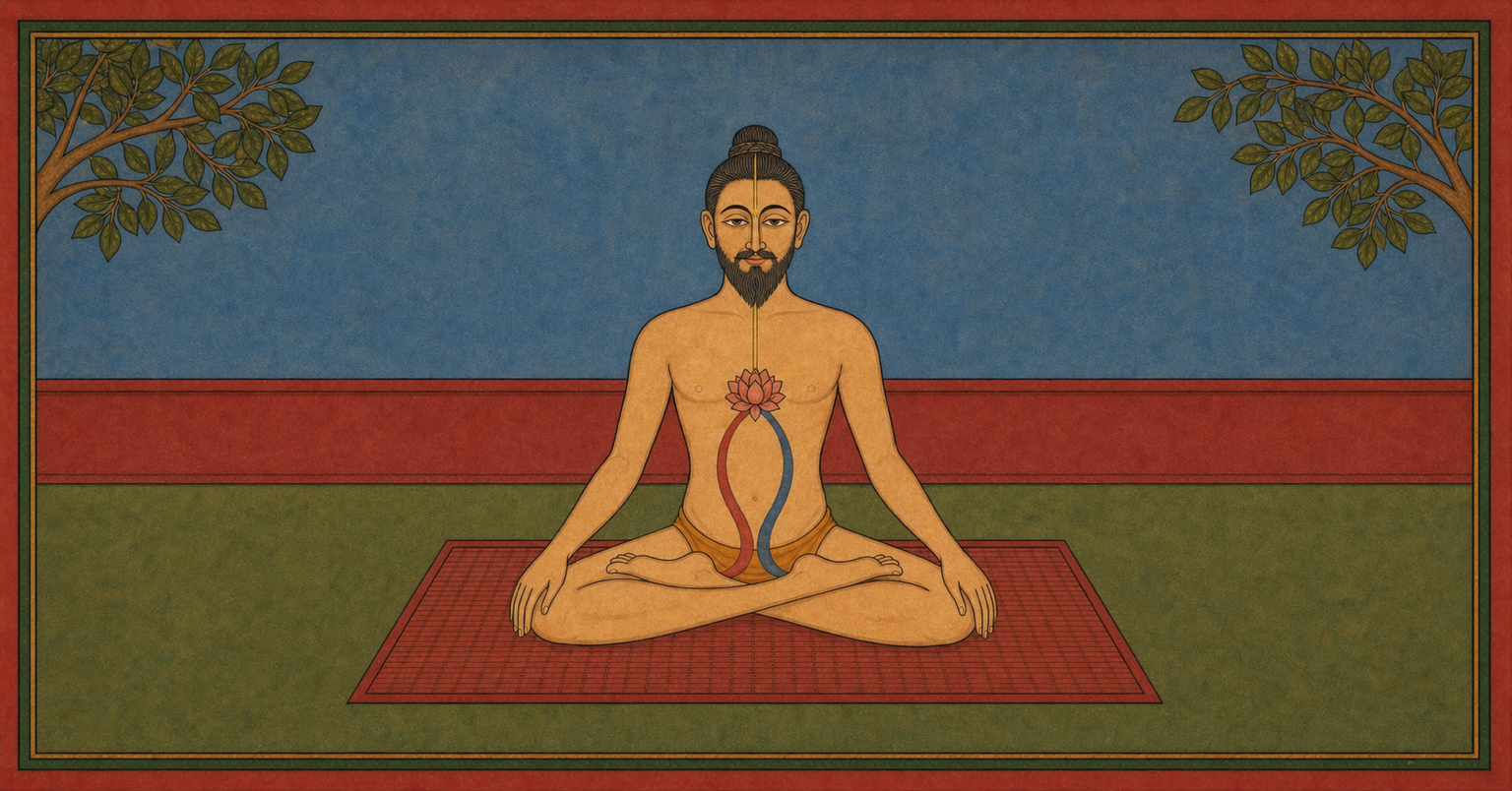
Illustration for the Haṭha Pradīpikā section “HP 1.44-1.49: Padmāsana”.

Haṭha Pradīpikā 1.44-1.49: Padmāsana and Inner Collectedness

Padmāsana is explained in several forms and connected with breath concentration, the dynamics of Prāṇa and Apāna, the action of Śakti, and liberation.

Dr. Ronald Steiner Dr. Ronald Steiner
Haṭha Pradīpikā 1.44
वामोरूपरि दक्षिणं च चरणं संस्थाप्य वामं तथा याम्योरूपरि पश्चिमेन विधिना धृत्वा कराभ्यां दृढम् |
vāmorūpari dakṣiṇaṃ ca caraṇaṃ, saṃsthāpya vāmaṃ tathā; yāmyorūpari paścimena vidhinā, dhṛtvā karābhyāṃ dṛḍham | Analysis ▾ Analysis ▴
vāma
karmadhāraya-compound
adjective
left
ūru
tatpuruṣa-compound lokative
substantive masculine
thigh
upari
adverb
on, above
dakṣiṇam
accusative singular masculine
adjective
right
ca
particle
and
caraṇam
accusative singular
substantive masculine
foot
saṃsthāpya
absolutus
previx
verbal root
having placed
vāmam
accusative singular masculine
adjective
left
tathā
adverb
likewise
yāmya
karmadhāraya-compound
adjective
right
ūru
tatpuruṣa-compound lokative
substantive masculine
thigh
upari
adverb
on, above
paścimena
instrumental case singular
adjective
backward, from behind
vidhinā
instrumental case singular
substantive masculine
according to the method
dhṛtvā
absolutus
verbal root
having grasped
karābhyām
instrumental case dual
substantive masculine
with both hands
dṛḍham
adverb
firmly
अङ्गुष्ठौ हृदये निधाय चिबुकं नासाग्रमालोकयेदेतद्व्याधिविघातकारि यमिनां पद्मासनं प्रोच्यते ||44||
aṅguṣṭhau hṛdaye nidhāya cibukaṃ, nāsāgram ālokayed; etad vyādhi-vighāta-kāri yamināṃ, padmāsanaṃ procyate ||44|| Analysis ▾ Analysis ▴
aṅguṣṭhau
accusative dual
substantive masculine
both big toes
hṛdaye
lokative singular
substantive neuter
on the chest, at the heart
nidhāya
absolutus
previx
verbal root
having placed
cibukam
accusative singular
substantive neuter
chin
nāsā
tatpuruṣa-compound genitive
substantive feminine
nose
agram
accusative singular
substantive neuter
tip
ālokayet
3rd person singular aktive optative
previx
verbal root
he should look at
etat
nominative singular neuter
pronoun dem
this
vyādhi
tatpuruṣa-compound genitive
substantive masculine
disease
vighāta
tatpuruṣa-compound genitive
substantive masculine
warding off, removal
kāri
nominative singular neuter
adjective
producing
yaminām
genitive plural
substantive masculine
of the self-controlled
padma
tatpuruṣa-compound genitive
substantive neuter
lotus
āsanam
nominative singular
substantive neuter
posture
procyate
3rd person singular passive present
previx
verbal root
is called
Metre: Śārdūlavikrīḍita
Having placed (saṃsthāpya | abs) the right foot (dakṣiṇam caraṇam | acc sg) upon the left thigh (vāma-ūru-upari), and (ca) likewise (tathā) the left one (vāmam | acc sg m) upon the right thigh (yāmya-ūru-upari), one should firmly (dṛḍham) hold (dhṛtvā | abs) both big toes (aṅguṣṭhau | acc du) with both hands (karābhyām | ins du) by the method from behind (paścimena vidhinā | ins sg), place (nidhāya | abs) the chin (cibukam | acc sg) on the chest (hṛdaye | loc sg), and gaze (ālokayet | 3p sg act opt) at the tip of the nose (nāsā-agram | acc sg). This (etat | nom sg n), which wards off disease (vyādhi-vighāta-kāri | nom sg n) for the self-restrained (yaminām | gen pl), is called (procyate | 3p sg pas pres) Padmāsana (padma-āsanam | nom sg).
Dr. Ronald Steiner - 2026 - historically literal
Padmāsana: Place the right foot on the left thigh and the left foot on the right. Reach behind the back to hold the big toes, rest the chin on the chest, and direct the gaze toward the tip of the nose. This posture wards off disease.
Dr. Ronald Steiner - 2026 - modern transfer

In this form of Padmāsana, the big toes are held behind the back: the right hand grasps the right foot on the left thigh, and the left hand correspondingly grasps the left foot on the right thigh. Here too, Brahmānanda leaves about four fingerbreadths between the chin and chest instead of pressing them firmly together.

Brahmānanda's Jyotsnā - 19th c.
yāmyorūpari MBHDL2026 ] dakṣorūpari NS1882

vyādhivighātakāri MBHDL2026 ] vyādhivināśakāri NS1882
Critical Apparatus
Place the right foot on the left thigh and the left foot on the right thigh, and grasp the toes with the hands crossed over the back. Press the chin against the chest and gaze on the tip of the nose. This is called the Padmâsana, the destroyer of the diseases of the Yamîs.
Pancham Sinh - 1915
Place the right heel at the root of the left thigh and the left heel at the root of the right, cross the hands behind the back and take hold of the toes, the right toe with the right hand and the left toe with the left. Place the chin firmly on the breast and look fixedly at the tip of the nose. This is called Padmasana and destroys all diseases.
Srinivasa Iyangar - 1893
Man lege den rechten Fuss auf den linken Schenkel und ebenso den linken Fuss auf den rechten Schenkel nach der letzten Regel, mit beiden Händen ergreife man fest die Zehen, drücke das Kinn auf die Herzgegend und sehe die Nasenspitze an; dies nennt man das Padmasana der Yogin (yaminâm = yoginâm nach Com.), welches die Krankheiten vernichtet.
Hermann Walter - 1893
Haṭha Pradīpikā
उत्तानौ चरणौ कृत्वा ऊरुसंस्थौ प्रयत्नतः |
uttānau caraṇau kṛtvā; ūru-saṃsthau prayatnataḥ | Analysis ▾ Analysis ▴
uttānau
accusative dual masculine
adjective
turned upward
caraṇau
accusative dual
substantive masculine
both feet
kṛtvā
absolutus
verbal root
having made, brought
ūru
tatpuruṣa-compound lokative
substantive masculine
thighs
saṃsthau
accusative dual masculine
adjective
situated, placed
prayatnataḥ
adverb
carefully, with effort
ऊरुमध्ये तथोत्तानौ पाणी कृत्वा ततो दृशौ ||45||
ūru-madhye tathottānau; pāṇī kṛtvā tato dṛśau ||45|| Analysis ▾ Analysis ▴
ūru
tatpuruṣa-compound genitive
substantive masculine
thigh
madhye
lokative singular
substantive neuter
in the middle
tathā
adverb
likewise
uttānau
accusative dual masculine
adjective
turned upward
pāṇī
accusative dual
substantive masculine
both hands
kṛtvā
absolutus
verbal root
having made, placed
tataḥ
adverb
then
dṛśau
accusative dual
substantive neuter
both eyes
नासाग्रे विन्यसेद्राजदन्तमूलं च जिह्वया |
nāsāgre vinyased rāja;-danta-mūlaṃ ca jihvayā | Analysis ▾ Analysis ▴
nāsā
tatpuruṣa-compound genitive
substantive feminine
nose
agre
lokative singular
substantive neuter
at the tip
vinyaset
3rd person singular aktive optative
previx
previx
verbal root
he should place
rāja
tatpuruṣa-compound genitive
substantive masculine
foremost, upper
danta
tatpuruṣa-compound genitive
substantive masculine
tooth
mūlam
accusative singular
substantive neuter
root
ca
particle
and
jihvayā
instrumental case singular
substantive feminine
with the tongue
उत्तभ्य चिबुकं वक्षस्यास्थाप्य पवनं शनैः ||46||
uttabhya cibukaṃ vakṣasy; āsthāpya pavanaṃ śanaiḥ ||46|| Analysis ▾ Analysis ▴
uttabhya
absolutus
previx
verbal root
having raised, supported
cibukam
accusative singular
substantive neuter
chin
vakṣasi
lokative singular
substantive neuter
on the chest
āsthāpya
absolutus
previx
verbal root
having set, placed
pavanam
accusative singular
substantive masculine
the breath, wind
śanaiḥ
adverb
slowly
Metre: Anuṣṭubh
Having carefully (prayatnataḥ) placed the two feet (caraṇau | acc du), turned upward (uttānau | acc du m), upon the thighs (ūru-saṃsthau | acc du m), and having done this (kṛtvā | abs), one should likewise (tathā) place (kṛtvā | abs) both hands (pāṇī | acc du), turned upward (uttānau | acc du m), in the middle of the thighs (ūru-madhye | loc sg); then (tataḥ) one should direct (vinyaset | 3p sg act opt) both eyes (dṛśau | acc du) ... toward the tip of the nose (nāsā-agre | loc sg), raise (uttabhya | abs) the root of the front teeth (rāja-danta-mūlam | acc sg) with the tongue (jihvayā | ins sg), place the chin (cibukam | acc sg) on the chest (vakṣasi | loc sg), and gently (śanaiḥ) gather (āsthāpya | abs) the breath (pavanam | acc sg).
Dr. Ronald Steiner - 2026 - historically literal
Another instruction for Padmāsana: place the soles of the feet upward on the thighs and the hands, likewise facing upward, in the middle of the thighs; then direct the gaze.

Rest the gaze at the tip of the nose, work the tongue at the front of the palate or roots of the teeth, place the chin on the chest, and slowly gather the breath.
Dr. Ronald Steiner - 2026 - modern transfer

According to Brahmānanda, the tongue rests against the roots of the two lateral front teeth; this tongue lock must be learned directly from the guru. He also recognizes Mūlabandha in the slow raising of the breath, likewise as a technique to be transmitted orally. Exponents of a secret Haṭha tradition, however, regarded the tongue lock alone as the decisive action in this passage.

Brahmānanda's Jyotsnā - 19th c.
rājadantamūlaṃ ca MBHDL2026 ] rājadantamūle tu NS1882
Critical Apparatus
Place the feet on the thighs, with the soles upwards, and place the hands on the thighs, with the palms upwards.

Gaze on the tip of the nose, keeping the tongue pressed against the root of the teeth of the upper jaw, and the chin against the chest, and raise the air up slowly, i.e., pull the apâna-vâyû gently upwards.
Pancham Sinh - 1915
Place the feet firmly on the opposite thighs and place the palms one upon another in the middle; direct your eyes to the tip of the nose and place the tip of the tongue at the root of the front teeth; place the chin on the wrist and slowly raise upwards the Prana (by contracting the anus upwards.)
Srinivasa Iyangar - 1893
Man strecke die Füsse aus, so dass die Schenkel mit Gewalt zusammengedrückt werden, lege die Hände ausgestreckt auf die Mitte der Schenkel (und zwar so dass die flache rechte Hand auf die flache linke zu liegen kommt, Com.); dann richte man die Augen auf die Nasenspitze, lege die Zunge an die Wurzel der beiden oberen (vordersten) Schneidezähne (râjadanta), drücke das Kinn auf die Brust und lasse den Athem langsam heraus.
Hermann Walter - 1893
Haṭha Pradīpikā 1.47
इदं पद्मासनं प्रोक्तं सर्वव्याधिविनाशनम् |
idaṃ padmāsanaṃ proktaṃ; sarva-vyādhi-vināśanam | Analysis ▾ Analysis ▴
idam
nominative singular neuter
pronoun dem
this
padma
tatpuruṣa-compound genitive
substantive neuter
lotus
āsanam
nominative singular
substantive neuter
posture
proktam
nominative singular neuter past participle passive
previx
verbal root
called, taught
sarva
karmadhāraya-compound
adjective
all
vyādhi
tatpuruṣa-compound genitive
substantive masculine
disease
vināśanam
nominative singular neuter
adjective
destroying, removing
दुर्लभं येन केनापि धीमता लभ्यते भुवि ||47||
durlabhaṃ yena kenāpi; dhīmatā labhyate bhuvi ||47|| Analysis ▾ Analysis ▴
durlabham
nominative singular neuter
adjective
difficult to obtain
yena
instrumental case singular masculine
pronoun rel
by anyone at all
kena
instrumental case singular masculine
pronoun inter
by any
api
particle
even
dhīmatā
instrumental case singular masculine
adjective
by a discerning person
labhyate
3rd person singular passive present
verbal root
is attained
bhuvi
lokative singular
substantive feminine
on earth
Metre: Anuṣṭubh
This (idam | nom sg n) is called (proktam | nom sg n ppp) Padmāsana (padma-āsanam | nom sg) and destroys all diseases (sarva-vyādhi-vināśanam | nom sg n). It is difficult to attain (durlabham | nom sg n): it is not attained by just anyone (kena | ins sg m), whoever (yena | ins sg m) that may be, even (api), but is attained (labhyate | 3p sg pas pres) on earth (bhuvi | loc sg) by a discerning person (dhīmatā | ins sg).
Dr. Ronald Steiner - 2026 - historically literal
This Padmāsana is said to destroy disease, but it is not easily attained. It succeeds for the discerning and persistent practitioner.
Dr. Ronald Steiner - 2026 - modern transfer
This is called the Padmâsana, the destroyer of all diseases. It is difficult of attainment by everybody, but can be learnt by intelligent people in this world.
Pancham Sinh - 1915
This is Padmasana that destroys all diseases. This cannot be attained by ordinary mortals. But only some intelligent persons attain it.
Srinivasa Iyangar - 1893
Dies ist das Padmasana, das alle Krankheiten vernichtet. Es ist nicht für jeden leicht ausführbar, wird aber von den Weisen auf Erden schon erlangt.
Hermann Walter - 1893
Haṭha Pradīpikā 1.48
कृत्वा संपुटितौ करौ दृढतरं बद्ध्वा तु पद्मासनं गाढं वक्षसि संनिधाय चिबुकं ध्यानं च तच्चेतसि |
kṛtvā saṃpuṭitau karau dṛḍhataraṃ, baddhvā tu padmāsanaṃ; gāḍhaṃ vakṣasi saṃnidhāya cibukaṃ, dhyānaṃ ca tac cetasi | Analysis ▾ Analysis ▴
kṛtvā
absolutus
verbal root
having made
saṃpuṭitau
accusative dual masculine past participle passive
previx
verbal root
cupped together
karau
accusative dual
substantive masculine
both hands
dṛḍhataram
adverb
very firmly
baddhvā
absolutus
verbal root
having bound, adopted
tu
particle
now, but
padma
tatpuruṣa-compound genitive
substantive neuter
lotus
āsanam
accusative singular
substantive neuter
posture
gāḍham
adverb
firmly, tightly
vakṣasi
lokative singular
substantive neuter
on the chest
saṃnidhāya
absolutus
previx
previx
verbal root
having placed, applied
cibukam
accusative singular
substantive neuter
chin
dhyānam
accusative singular
substantive neuter
meditation
ca
particle
and
tat
accusative singular neuter
pronoun dem
this
cetasi
lokative singular
substantive neuter
in the mind
वारं वारमपानमूर्ध्वमनिलं प्रोच्चालयन्पूरितं मुञ्चन्प्राणमुपैति बोधमतुलं शक्तिप्रभावान्नरः ||48||
vāraṃ vāram apānam ūrdhvam anilaṃ, proccālayan pūritaṃ; muñcan prāṇam upaiti bodham atulaṃ, śakti-prabhāvān naraḥ ||48|| Analysis ▾ Analysis ▴
vāram
adverb
time
vāram
adverb
time after time
apānam
accusative singular
substantive masculine
apāna
ūrdhvam
adverb
upward
anilam
accusative singular
substantive masculine
breath, wind
proccālayan
nominative singular masculine present participle active
previx
previx
verbal root
driving, moving
pūritam
accusative singular masculine past participle passive
verbal root
filled, inhaled
muñcan
nominative singular masculine present participle active
verbal root
releasing, letting go
prāṇam
accusative singular
substantive masculine
prāṇa
upaiti
3rd person singular aktive present
previx
verbal root
he reaches
bodham
accusative singular
substantive masculine
knowledge, awakening
atulam
accusative singular masculine
adjective
unequalled
śakti
tatpuruṣa-compound genitive
substantive feminine
śakti, power
prabhāvāt
ablative singular
substantive masculine
through the power
naraḥ
nominative singular
substantive masculine
the person
Metre: Śārdūlavikrīḍita
Having formed (kṛtvā | abs) both hands (karau | acc du) into a cup (saṃpuṭitau | acc du m ppp), the person (naraḥ | nom sg), having adopted (baddhvā | abs) Padmāsana (padma-āsanam | acc sg) very firmly (dṛḍhataram), firmly (gāḍham) placed (saṃnidhāya | abs) the chin (cibukam | acc sg) on the chest (vakṣasi | loc sg), and held this meditation (tat dhyānam | acc sg) in the mind (cetasi | loc sg), again (vāram) and again (vāram) drives (proccālayan | nom sg m pca) Apāna (apānam | acc sg) and the inhaled breath (pūritam anilam | acc sg) upward (ūrdhvam). Releasing (muñcan | nom sg m pca) Prāṇa (prāṇam | acc sg), he attains (upaiti | 3p sg act pres) unequalled knowledge (atulam bodham | acc sg) through the power of Śakti (śakti-prabhāvāt | abl sg).
Dr. Ronald Steiner - 2026 - historically literal
In Padmāsana, the hands, chin, breath, and mind are gathered. By repeatedly raising Apāna and releasing Prāṇa, an incomparable awakening arises through the power of Śakti.
Dr. Ronald Steiner - 2026 - modern transfer

Brahmānanda develops a clear chain of effects. In Padmāsana, Jālandharabandha is applied and the chosen deity or Brahman is meditated upon. Apāna rises through Mūlabandha, while the inhaled Prāṇa is directed downward, and the two unite. This awakens Kuṇḍalinī; Prāṇa rises through Suṣumṇā to the crown, the mind becomes still, and direct realization of the self arises from this concentration.

Brahmānanda's Jyotsnā - 19th c.
dhyānaṃ ca tac cetasi MBHDL2026 ] dhyāyaṃś ca tac cetasi NS1882
Critical Apparatus
Having kept both the hands together in the lap, performing the Padmâsana firmly, keeping the chin Fixed to the chest and contemplating on Him in the mind, by drawing the apâna-vâyû up (performing Mûla Bandha) and pushing down the air after inhaling it, joining thus the prâṇa and apâna in the navel, one gets the highest intelligence by awakening the śakti (kundalinî) thus.
Pancham Sinh - 1915
Assuming the Padmasana posture and having placed the palms one upon another, fix the chin firmly upon the breast and, contemplating upon Brahma, frequently contract the anus and raise the Apana upwards; by a similar contraction of the throat force the Prana downwards. By this he obtains unequalled knowledge through the favour of Kundalini (which is roused by this process).
Srinivasa Iyangar - 1893
Mit den Händen bilde man eine kugelförmige Schale, führe das Padmasana besonders eifrig aus, drücke das Kinn fest auf die Brust und vertiefe sich ganz in die Betrachtung des Brahma (tat.). Wiederholt den Apâna (durch die Sushumna, Com.) aufwärts und den durch Pûraka erhaltenen Prâņa abwärts führend (d. h. Prâna und Apâna vereinigend) erlangt der Mensch durch die Macht der Sakti (Kundalî) unvergleichliche Weisheit.
Hermann Walter - 1893
Haṭha Pradīpikā 1.49
पद्मासनस्थितो योगी नाडीद्वारेषु पूरयन् |
padmāsana-sthito yogī; nāḍī-dvāreṣu pūrayan | Analysis ▾ Analysis ▴
padma
tatpuruṣa-compound genitive
substantive neuter
lotus
āsana
tatpuruṣa-compound lokative
substantive neuter
posture
sthitaḥ
nominative singular masculine past participle passive
verbal root
situated, seated
yogī
nominative singular
substantive masculine
the yogin
nāḍī
tatpuruṣa-compound genitive
substantive feminine
nāḍī
dvāreṣu
lokative plural
substantive neuter
in the openings, gates
pūrayan
nominative singular masculine present participle active
verbal root
filling
मारुतं म्रियते यस्तु स मुक्तो नात्र संशयः ||49||
mārutaṃ mriyate yas tu; sa mukto nātra saṃśayaḥ ||49|| Analysis ▾ Analysis ▴
mārutam
accusative singular
substantive masculine
breath, wind
mriyate
3rd person singular medial present
verbal root
dies
yaḥ
nominative singular masculine
pronoun rel
whoever
tu
particle
now, but
saḥ
nominative singular masculine
pronoun dem
he
muktaḥ
nominative singular masculine past participle passive
verbal root
liberated
na
particle
not
atra
adverb
here
saṃśayaḥ
nominative singular
substantive masculine
doubt
Metre: Anuṣṭubh
The yogi (yogī | nom sg) seated in Padmāsana (padma-āsana-sthitaḥ | nom sg m ppp) who (yaḥ | nom sg m) dies (mriyate | 3p sg med pres) while filling (pūrayan | nom sg m pca) [himself] with breath (mārutam | acc sg) through the openings of the channels (nāḍī-dvāreṣu | loc pl), he (saḥ | nom sg m) [is] indeed (tu) liberated (muktaḥ | nom sg m ppp); here (atra) [there is] no (na) doubt (saṃśayaḥ | nom sg).
Dr. Ronald Steiner - 2026 - historically literal
The verse connects a yogi’s death with liberation. Today, it can invite you to consider what sustains you in the face of your own mortality.
Dr. Ronald Steiner - 2026 - modern transfer

Brahmānanda defines the retention of the inhaled wind spatially: Prāṇa is led through Suṣumṇā to the head and stabilized there. In his reading, the statement about liberation presupposes the opening and use of the middle channel.

Brahmānanda's Jyotsnā - 19th c.
nāḍīdvāreṣu pūrayan MBHDL2026 ] nāḍīdvāreṇa pūritam NS1882

mriyate MBHDL2026 ] mārayed MBHDL2024; dhārayed NS1882
Critical Apparatus
The Yogî who, sitting with Padmâsana, can control breathing, there is no doubt, is free from bondage.
Pancham Sinh - 1915
The Yogi sitting in the Padmasana posture by restraining the breath drawn in through the Nadis, becomes liberated; there is no doubt about this.
Srinivasa Iyangar - 1893
Der Yogin, welcher im Padmasana verweilend den eingeathmeten Prâņa vermittelst der Sushumna (nâdîdvâreņa nach Com. S.) festhält, wird erlöst; daran ist kein Zweifel.
Hermann Walter - 1893

Continue with AYI Free

Illustrations: AI-generated.

Editor

Dr. Ronald Steiner

From Ulm

The "Yoga Doc" - Dr. Ronald Steiner is the founder of the AYI method. This method links traditional Ashtanga Yoga with innovative Yogatherapy and living Philosophy. This forms a practice that is personal for each and... more ›

Messages and ratings
0 messages

Please log in to write a message. Go to login

No messages yet.