
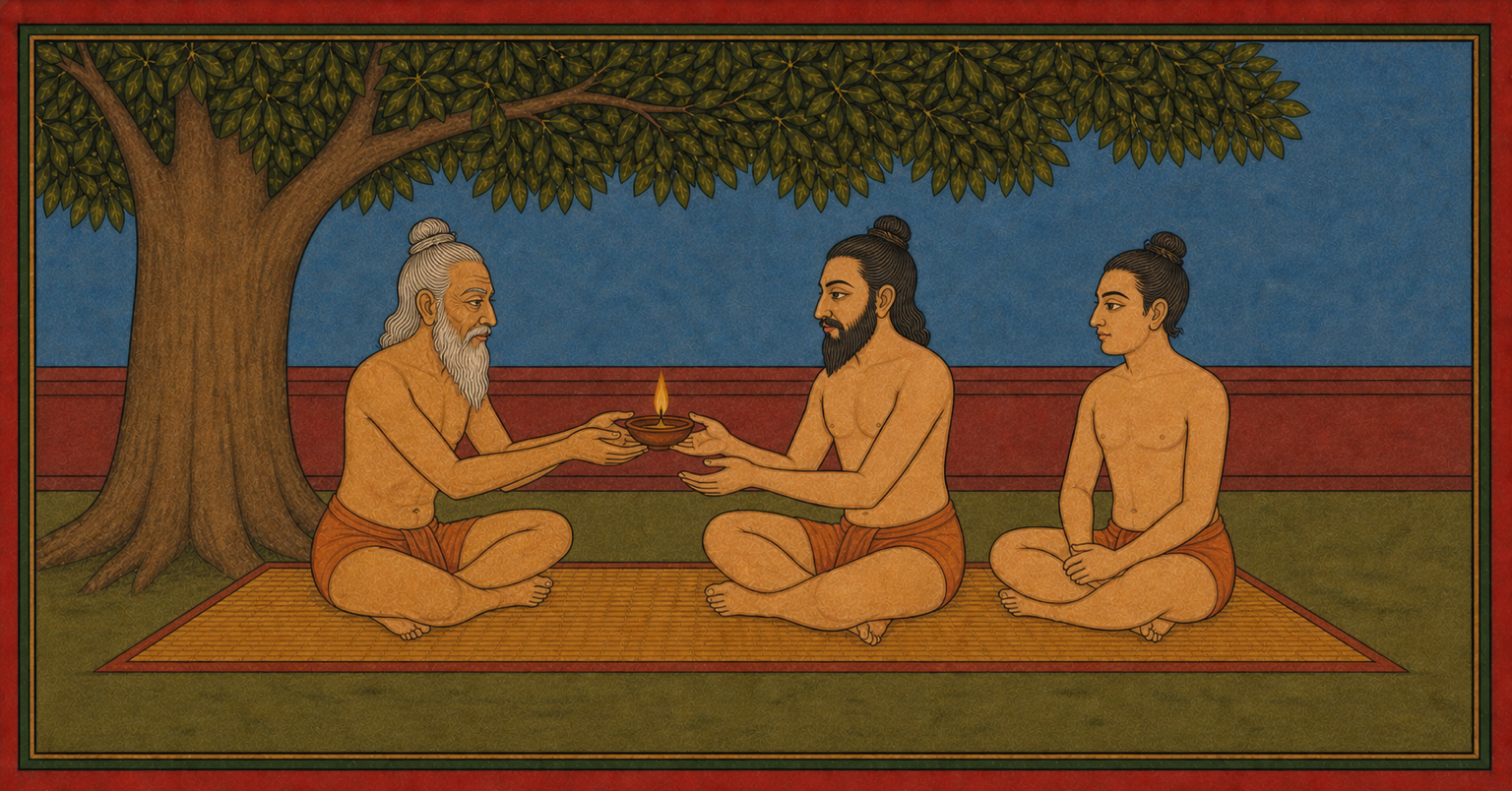
Illustration for the Haṭha Pradīpikā section “HP 1.4-1.10: Lineage of Siddhas”.

Haṭha Pradīpikā 1.4-1.10: Lineage of Siddhas and Protective Power

The teaching is legitimized through the Siddhas; Haṭha appears as a powerful refuge and foundation of the paths of Yoga.

Dr. Ronald Steiner Dr. Ronald Steiner
Haṭha Pradīpikā 1.4
हठविद्यां हि मत्स्येन्द्रगोरक्षाद्या विजानते |
haṭha-vidyāṃ hi matsyendra;-gorakṣādyā vijānate | Analysis ▾ Analysis ▴
haṭha
tatpuruṣa-compound genitive
substantive masculine
Haṭha
vidyām
accusative singular
substantive feminine
knowledge, teaching
hi
particle
for
matsyendra
dvandva-compound
substantive masculine
Matsyendra
gorakṣa
dvandva-compound
substantive masculine
Gorakṣa
ādyāḥ
nominative plural
substantive masculine
and the others
vijānate
3rd person plural medial present
previx
verbal root
they know, understand
स्वात्मारामो ऽथवा योगी जानीते तत्प्रसादतः ||4||
svātmārāmo 'thavā yogī; jānīte tat-prasādataḥ ||4|| Analysis ▾ Analysis ▴
svātmārāmaḥ
nominative singular
substantive masculine
Svātmārāma
athavā
particle
or also
yogī
nominative singular
substantive masculine
the yogin
jānīte
3rd person singular medial present
verbal root
he knows
tat
tatpuruṣa-compound ablative
pronoun
their
prasādataḥ
ablative singular
substantive masculine
through favour, grace
Metre: Anuṣṭubh
For (hi) Matsyendra, Gorakṣa, and the others (matsyendra-gorakṣa-ādyāḥ | nom pl) know (vijānate | 3p pl med pres) the science of Haṭha (haṭha-vidyām | acc sg); Svātmārāma (svātmārāmaḥ | nom sg), the yogi (yogī | nom sg), likewise (athavā) knows it (jānīte | 3p sg med pres) through their favour (tat-prasādataḥ | abl sg).
Dr. Ronald Steiner - 2026 - historically literal
This teaching comes through the lineage of the Siddhas. Matsyendra, Gorakṣa, and others knew it, and Svātmārāma receives it through their grace.
Dr. Ronald Steiner - 2026 - modern transfer

Brahmānanda relates the “blessing of those” especially to Gorakṣa. Svātmārāma describes the teaching as a tradition received through the grace of the Siddhas. Brahmānanda names both knowers and worshippers of God as practitioners of Haṭhayoga.

Brahmānanda's Jyotsnā - 19th c.
Matsyendra, Gorakṣa, etc., knew Haṭha Vidyâ, and by their favour Yogî Swâtmârâma also learnt it from them.
Pancham Sinh - 1915
Goraksha and Matsyêndra knew well the Hathavidya. The Yogi Swatmarama learnt it from them by their favour.
Srinivasa Iyangar - 1893
Matsyendra, Goraksha und Andere kannten die Lehre vom Hathayoga, und nur durch deren Gunst gelangte der Yogin Svâtmârâma zur Kenntniss derselben.
Hermann Walter - 1893
Haṭha Pradīpikā 1.5
श्रीआदिनाथमत्स्येन्द्रशाबरानन्दभैरवाः |
śrī-ādinātha-matsyendra;-śābarānanda-bhairavāḥ | Analysis ▾ Analysis ▴
śrī
karmadhāraya-compound
adjective
venerable, glorious
ādinātha
dvandva-compound
substantive masculine
Ādinātha
matsyendra
dvandva-compound
substantive masculine
Matsyendra
śābara
dvandva-compound
substantive neuter
Śābara
ānanda
dvandva-compound
substantive masculine
Ānanda
bhairavāḥ
nominative plural
substantive masculine
Bhairava
चौरङ्गीमीनगोरक्षविरूपाक्षबिलेशयाः ||5||
cauraṅgī-mīna-gorakṣa;-virūpākṣa-bileśayāḥ ||5|| Analysis ▾ Analysis ▴
cauraṅgī
dvandva-compound
substantive feminine
Cauraṅgī
mīna
dvandva-compound
substantive masculine
Mīna
gorakṣa
dvandva-compound
substantive masculine
Gorakṣa
virūpākṣa
dvandva-compound
substantive masculine
Virūpākṣa
bileśayāḥ
nominative plural
substantive masculine
Bileśaya
Metre: Anuṣṭubh
Named are the glorious Ādinātha, Matsyendra, Śābara, Ānanda, and Bhairava (śrī-ādinātha-matsyendra-śābara-ānanda-bhairavāḥ | nom pl), as well as Cauraṅgī, Mīna, Gorakṣa, Virūpākṣa, and Bileśaya (cauraṅgī-mīna-gorakṣa-virūpākṣa-bileśayāḥ | nom pl).
Dr. Ronald Steiner - 2026 - historically literal
The lineage begins with the great Siddhas: Ādinātha, Matsyendra, Śābara, Ānanda, Bhairava, Cauraṅgī, Mīna, Gorakṣa, Virūpākṣa, and Bileśaya.
Dr. Ronald Steiner - 2026 - modern transfer

In connection with the list of Siddhas, Brahmānanda recounts two traditional legends:

  • Matsyendra was originally a fish who listened motionlessly and with full concentration while Śiva secretly instructed Pārvatī in yoga. Śiva noticed this, compassionately sprinkled him with water, and transformed him into a Siddha with a divine body.
  • Cauraṅgī, who lacked hands and feet, received new limbs through Matsyendra's gracious gaze and afterward became his disciple.

The stories present the list of names as a Siddha lineage transmitted through instruction and grace.

Brahmānanda's Jyotsnā - 19th c.
Sri Âdinâtha (Śiva), Matsyendra, Nâtha, Sâbar, Anand, Bhairava, Chaurangi, Mîna nâtha, Gorakṣanâtha, Virupâkṣa, Bileśaya.
Pancham Sinh - 1915
Siva, Matsyendra, Sabara, Ananda Bhairava, Chourangi, Meena, Goraksha, Virupaksha, Bilesa, Manthana, Bhairava, Siddhi, Buddha, Kanthadi, Korantaka, Surananda, Siddhapada, Charpati, Kaneri, Pujyapada, Nityanatha, Niranjana, Kapalika, Bindunatha, Kaka Chandeeswara, Allama Prabhudeva, Ghoda Choli, Tintini, Bhanuki, Naradeva, Khanda Kapalika and many other great Siddhas, having conquered time, move about the world.
Srinivasa Iyangar - 1893
Der erhabene Şiva, Matsyendra, Şabara, Anandabhairava, Caurangin, Mîna, Goraksha, Virûpaksha, Bileşaya,
Hermann Walter - 1893
Haṭha Pradīpikā 1.6
मन्थानभैरवो योगी सिद्धबुद्धश्च कन्थडिः |
manthāna-bhairavo yogī; siddha-buddhaś ca kanthaḍiḥ | Analysis ▾ Analysis ▴
manthāna
dvandva-compound
substantive neuter
Manthāna
bhairavaḥ
nominative singular
substantive masculine
Bhairava
yogī
nominative singular
substantive masculine
the yogin
siddha
dvandva-compound
substantive masculine
Siddha
buddhaḥ
nominative singular
substantive masculine
Buddha
ca
particle
and
kanthaḍiḥ
nominative singular
substantive neuter
Kanthaḍi
गोरण्टकः सुरानन्दः सिद्धपादश्च चर्पटिः ||6||
goraṇṭakaḥ surānandaḥ; siddhapādaś ca carpaṭiḥ ||6|| Analysis ▾ Analysis ▴
goraṇṭakaḥ
nominative singular
substantive masculine
Goraṇṭaka
surānandaḥ
nominative singular
substantive masculine
Surānanda
siddhapādaḥ
nominative singular
substantive masculine
Siddhapāda
ca
particle
and
carpaṭiḥ
nominative singular
substantive neuter
Carpaṭi
Metre: Anuṣṭubh
They include Manthānabhairava (manthāna-bhairavaḥ | nom sg), the yogi (yogī | nom sg), Siddhabuddha (siddha-buddhaḥ | nom sg), Kanthaḍi (kanthaḍiḥ | nom sg), Goraṇṭaka (goraṇṭakaḥ | nom sg), Surānanda (surānandaḥ | nom sg), Siddhapāda (siddhapādaḥ | nom sg), and (ca) Carpaṭi (carpaṭiḥ | nom sg).
Dr. Ronald Steiner - 2026 - historically literal
The text goes on to name Manthānabhairava, Siddhabuddha, Kanthaḍi, Goraṇṭaka, Surānanda, Siddhapāda, and Carpaṭi as bearers of the tradition.
Dr. Ronald Steiner - 2026 - modern transfer
manthānabhairavo MBHDL2026 ] manthāno bhairavo NS1882
Critical Apparatus
Manthâna, Bhairava, Siddhi Buddha, Kanthadi, Karantaka, Surânanda, Siddhipâda, Charapati.
Pancham Sinh - 1915
Manthana, der schreckliche Yogin, Siddhi und der weise Kanthadi, Koranțaka, Surananda, Siddhapada, Carpați,
Hermann Walter - 1893
Haṭha Pradīpikā 1.7
कणेरी पूज्यपादश्च नित्यनाथो निरञ्जनः |
kaṇerī pūjyapādaś ca; nityanātho nirañjanaḥ | Analysis ▾ Analysis ▴
kaṇerī
nominative singular
substantive feminine
Kaṇerī
pūjyapādaḥ
nominative singular
substantive masculine
Pūjyapāda
ca
particle
and
nityanāthaḥ
nominative singular
substantive masculine
Nityanātha
nirañjanaḥ
nominative singular
substantive masculine
Nirañjana
कपाली बिन्दुनाथश्च काकचण्डीश्वरो गयः ||7||
kapālī bindu-nāthaś ca; kākacaṇḍīśvaro gayaḥ ||7|| Analysis ▾ Analysis ▴
kapālī
nominative singular
substantive masculine
Kapālī
bindu
tatpuruṣa-compound genitive
substantive masculine
Bindu
nāthaḥ
nominative singular
substantive masculine
Nātha
ca
particle
and
kākacaṇḍīśvaraḥ
nominative singular
substantive masculine
Kākacaṇḍīśvara
gayaḥ
nominative singular
substantive masculine
Gaya
Metre: Anuṣṭubh
Next come Kaṇerī (kaṇerī | nom sg), Pūjyapāda (pūjyapādaḥ | nom sg), and (ca) Nityanātha (nityanāthaḥ | nom sg), Nirañjana (nirañjanaḥ | nom sg), Kapālī (kapālī | nom sg), Bindunātha (bindu-nāthaḥ | nom sg), and (ca) Kākacaṇḍīśvara (kākacaṇḍīśvaraḥ | nom sg), Gaya (gayaḥ | nom sg).
Dr. Ronald Steiner - 2026 - historically literal
The line of Siddhas continues with Kaṇerī, Pūjyapāda, Nityanātha, Nirañjana, Kapālī, Bindunātha, Kākacaṇḍīśvara, and Gaya.
Dr. Ronald Steiner - 2026 - modern transfer
kaṇerī MBHDL2026 ] kānerī NS1882

kākacaṇḍīśvaro gayaḥ MBHDL2026 ] kākacaṇḍīśvarāhvayaḥ MBHDL2024
Critical Apparatus
Kânerî, Pûjyapâda, Nityanâtha, Nirañjana, Kapâli, Vindunâtha, Kâka Chandîśwara.
Pancham Sinh - 1915
Kânerin, Pûjyapada, Nityanatha, Niranjana, Kapâlin, Bindunatha, Kakacaņdîşvara,
Hermann Walter - 1893
Haṭha Pradīpikā 1.8
अल्लमप्रभुदेवश्च घोडाचोली च टिण्टिणिः |
allama-prabhudevaś ca; ghoḍācolī ca ṭiṇṭiṇiḥ | Analysis ▾ Analysis ▴
allama
karmadhāraya-compound
substantive masculine
Allama
prabhudevaḥ
nominative singular
substantive masculine
Prabhudeva
ca
particle
and
ghoḍācolī
nominative singular
substantive feminine
Ghoḍācolī
ca
particle
and
ṭiṇṭiṇiḥ
nominative singular
substantive masculine
Ṭiṇṭiṇi
भालुकिर्नागबोधश्च खण्डकापालिकस्तथा ||8||
bhālukir nāga-bodhaś ca; khaṇḍa-kāpālikas tathā ||8|| Analysis ▾ Analysis ▴
bhālukiḥ
nominative singular
substantive masculine
Bhāluki
nāga
tatpuruṣa-compound genitive
substantive masculine
Nāga
bodhaḥ
nominative singular
substantive masculine
Bodha
ca
particle
and
khaṇḍa
karmadhāraya-compound
substantive masculine
Khaṇḍa
kāpālikaḥ
nominative singular
substantive masculine
Kāpālika
tathā
adverb
likewise
Metre: Anuṣṭubh
They further include Allamaprabhudeva (allama-prabhudevaḥ | nom sg), Ghoḍācolī (ghoḍācolī | nom sg), Ṭiṇṭiṇi (ṭiṇṭiṇiḥ | nom sg), Bhāluki (bhālukiḥ | nom sg), Nāgabodha (nāga-bodhaḥ | nom sg), and (ca) likewise (tathā) Khaṇḍakāpālika (khaṇḍa-kāpālikaḥ | nom sg).
Dr. Ronald Steiner - 2026 - historically literal
Allamaprabhudeva, Ghoḍācolī, Ṭiṇṭiṇi, Bhāluki, Nāgabodha, and Khaṇḍakāpālika also belong to this tradition.
Dr. Ronald Steiner - 2026 - modern transfer
allamaprabhudevaś MBHDL2026 ] allāmaḥ prabhudevaś NS1882
Critical Apparatus
Allâma, Prabhudeva, Ghodâ, Cholî, Tintiṇi, Bhânukî Nârdeva, Khanda Kâpâlika, etc.
Pancham Sinh - 1915
Allama, Prabhudeva, Ghodacolin, Tintini, Bhanukin, Nâradeva, Khanda, Kapalika;
Hermann Walter - 1893
Haṭha Pradīpikā 1.9
इत्यादयो महासिद्धा हठयोगप्रभावतः |
ity ādayo mahā-siddhā; haṭha-yoga-prabhāvataḥ | Analysis ▾ Analysis ▴
iti
particle
thus
ādayaḥ
nominative plural
substantive masculine
and the others
mahā
karmadhāraya-compound
adjective
great
siddhāḥ
nominative plural
substantive masculine
siddhas, adepts
haṭha
tatpuruṣa-compound genitive
substantive masculine
Haṭha
yoga
tatpuruṣa-compound genitive
substantive masculine
yoga
prabhāvataḥ
ablative singular
substantive masculine
through the power
खण्डयित्वा कालदण्डं ब्रह्माण्डेषु चरन्ति ते ||9||
khaṇḍayitvā, kāla-daṇḍaṃ; brahmāṇḍeṣu caranti te ||9|| Analysis ▾ Analysis ▴
khaṇḍayitvā
absolutus
verbal root
having broken
kāla
tatpuruṣa-compound genitive
substantive masculine
time, death
daṇḍam
accusative singular
substantive neuter
staff, rod of power
brahmāṇḍeṣu
lokative plural
substantive neuter
in the cosmic eggs, worlds
caranti
3rd person plural aktive present
verbal root
they wander, move
te
nominative plural masculine
pronoun
they
Metre: Anuṣṭubh
These and others (ādayaḥ | nom pl), thus (iti) named, are great adepts (mahā-siddhāḥ | nom pl) who, through the power of Haṭhayoga (haṭha-yoga-prabhāvataḥ | abl sg), have broken (khaṇḍayitvā | abs) the rod of death (kāla-daṇḍam | acc sg); they (te | nom pl m) roam (caranti | 3p pl act pres) the worlds (brahmāṇḍeṣu | loc pl).
Dr. Ronald Steiner - 2026 - historically literal
Through the power of Haṭha Yoga, these Siddhas broke through the power of death and now move freely through the worlds.
Dr. Ronald Steiner - 2026 - modern transfer
brahmāṇḍeṣu caranti MBHDL2026 ] brahmāṇḍe vicaranti NS1882
Critical Apparatus
These Mahâsiddhas (great masters), breaking the sceptre of death, are roaming in the universe.
Pancham Sinh - 1915
Diese und Andere sind durch Hathayoga hochvollkommen geworden; die Macht des Todes überwindend schweifen sie durch das Weltall.
Hermann Walter - 1893
Haṭha Pradīpikā 1.10
संसारतापतप्तानां समाश्रयमठो हठः |
saṃsāra-tāpa-taptānāṃ; samāśraya-maṭho haṭhaḥ | Analysis ▾ Analysis ▴
saṃsāra
tatpuruṣa-compound genitive
substantive neuter
saṃsāra, cycle of existence
tāpa
tatpuruṣa-compound instrumental case
substantive neuter
heat, torment
taptānām
genitive plural masculine past participle passive
verbal root
of those scorched, afflicted
sama
karmadhāraya-compound
adjective
complete, shared
āśraya
tatpuruṣa-compound genitive
substantive masculine
refuge
maṭhaḥ
nominative singular
substantive masculine
hut, hermitage
haṭhaḥ
nominative singular
substantive masculine
Haṭha
अशेषयोगजगतामाधारकमठो हठः ||10||
aśeṣa-yoga-jagatām; ādhāra-kamaṭho haṭhaḥ ||10|| Analysis ▾ Analysis ▴
aśeṣa
karmadhāraya-compound
adjective
entire, all
yoga
tatpuruṣa-compound genitive
substantive masculine
yoga
jagatām
genitive plural
substantive neuter
worlds
ādhāra
tatpuruṣa-compound genitive
substantive neuter
support, foundation
kamaṭhaḥ
nominative singular
substantive masculine
tortoise
haṭhaḥ
nominative singular
substantive masculine
Haṭha
Metre: Anuṣṭubh
Haṭha (haṭhaḥ | nom sg) is a hut of complete refuge (sama-aśraya-maṭhaḥ | nom sg) for those scorched by the torment of saṃsāra (saṃsāra-tāpa-taptānām | gen pl ppp); Haṭha (haṭhaḥ | nom sg) is the supporting tortoise (ādhāra-kamaṭhaḥ | nom sg) for the worlds of all yogas (aśeṣa-yoga-jagatām | gen pl).
Dr. Ronald Steiner - 2026 - historically literal
Haṭha is a refuge for people scorched by the sufferings of life. At the same time, it is the supporting foundation of every path of yoga.
Dr. Ronald Steiner - 2026 - modern transfer

Brahmānanda divides the “torments” into three classical groups. Ādhyātmika includes bodily suffering such as illness and mental suffering such as desire. Ādhibhautika arises from other living beings, such as predators or snakes. Ādhidaivika is attributed to higher powers, such as planetary influences. Haṭha is presented as a refuge from all three.

Brahmānanda's Jyotsnā - 19th c.
saṃsāratāpataptānāṃ MBHDL2026 ] aśeṣatāpataptānāṃ NS1882
Critical Apparatus
Like a house protecting one from the heat of the sun, Haṭha Yoga protects its practiser from the burning heat of the three Tâpas; and, similarly, it is the supporting tortoise, as it were, for those who are constantly devoted to the practice of Yoga.
Pancham Sinh - 1915
The Hathayoga is a monastery for those scorched by the three Tápas (pains). To all those engaged in the practice of Yoga, Hathayoga is like the tortoise that supports the world.
Srinivasa Iyangar - 1893
Hathayoga ist die allgemeine Zufluchtzelle derer, die von der Gesammtzahl der Schmerzen gepeinigt werden; wie die Schildkröte (dem Weltall), so dient der Hathayoga denjenigen als Grundlage, die sich in den gesammten Yoga vertieft haben.
Hermann Walter - 1893

Continue with AYI Free

Illustrations: AI-generated.

Editor

Dr. Ronald Steiner

From Ulm

The "Yoga Doc" - Dr. Ronald Steiner is the founder of the AYI method. This method links traditional Ashtanga Yoga with innovative Yogatherapy and living Philosophy. This forms a practice that is personal for each and... more ›

Messages and ratings
0 messages

Please log in to write a message. Go to login

No messages yet.