

ā आ – up to; as far as; hither; near
adverb · Interjection · particle · previx · substantive feminine · substantive masculine · Word type unspecified
Dictionary sources
AYI dictionary particle · previx
Cappeller 1891 adverb · Interjection · substantive feminine · Word type unspecified
Original text · English · adverb
ā́1 ·adv. hither, near, towards (esp. as a pref. to verbs of motion); besides, further; quite, entirely, even (often only emphasizing the prec. word). °-- a little, slightly, scarcely (in adj. & subst.); reaching to (in adj.); till, as far as, before, from (in adv.). As prep. towards, up to, till, as far as (acc. or abl.); except, but, save (acc.); all the way or time from (abl.); in, at, on (loc.).
Original text · English · Interjection
ā2 ·excl., esp. of sudden remembrance.
Original text · English · Word type unspecified
ā ·(ī) hard, rough, harsh, cruel, severe; n. & °tāÅ f. abstr.

Original text · English · substantive feminine
ā ·f. love-letter.
Monier-Williams 1872 previx · substantive masculine · Word type unspecified
Original text · English · previx
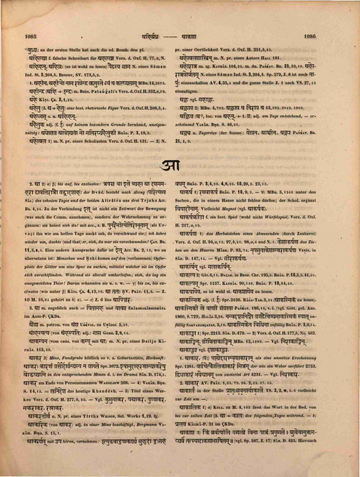
ā 3 . ā a prefix to verbs and nouns, (ex- pressing) near, near to, towards, from all sides, all around; and sometimes redundant. As a prefix to verbs of motion it expresses the notion of moving or going towards; e. g. ā-krāmati, he goes towards. When prefixed to roots like gam, yā, and i, to go, and dā, to give, it reverses the action; e. g. ā-gacchati, he comes; ā-datte, he takes. As unconnected with verbs and prefixed to nouns it forms with them either compound adverbs or adjectives, implying the limit conclusive (until, unto, as far as), or the limit inceptive (from, from thence or that time); e. g. ā-maraṇam, till death; ā-kumāram, from childhood [cf. a puero]; ā-gopālā dvijātayaḥ, the twice-born including the cowherds. (Prefixed to adjectives &c. it implies) diminution; e. g. ā-pāṇḍu, a little pale; ā-pakva, half-cooked. (As a separable adverb ā implies) near, near to, towards; thereto, further, also, and; especially, even. In many places in the Vedas ā gives force to the word which precedes it (e. g. mahimā vām In- drāgnī paniṣṭha ā, ‘your greatness, O Indra and Agni, is praiseworthy indeed’); and in a similar man- ner we find it in the Veda placed after prepositions, the sense of which is strengthened by it. (As a separable preposition with acc. or abl.) near to, up to, to, as far as; e. g. śatam ā jātīs, as far as a hundred births; ā samudrāt, as far as the ocean: (with abl.) away from, from; out of, of, from among; e. g. ā mūlāt, from the beginning; bahubhya ā, from among many: (with loc.) in, at; e. g. dama ā, in a house.
Original text · English · substantive masculine
ā 4 . ā, ās, m., N. of Śiva; (ā), f., N. of Lakṣmī.
Original text · English · Word type unspecified
ā 1 . ā, the second letter of the alphabet, corresponding to a long, as in far.
Original text · English · Word type unspecified
ā 2 . ā, (as a particle or interjection of as- sent) yes, verily; (of compassion or pain) Ah! Alas! in the latter sense it is more correctly written ās; (of reminiscence) Ah! Oh! (a conjunction dis- junctive) but; (a conjunction copulative) and. This particle remains unaltered in orthography even before vowels.
Original text · English · Word type unspecified
—Kṛṣṇa-bhedī or ā, f. a medicinal plant, = kaṭu-rohiṇī.
Petersburger 1855 adverb · particle · substantive feminine · substantive masculine · Word type unspecified
Original text · German · adverb
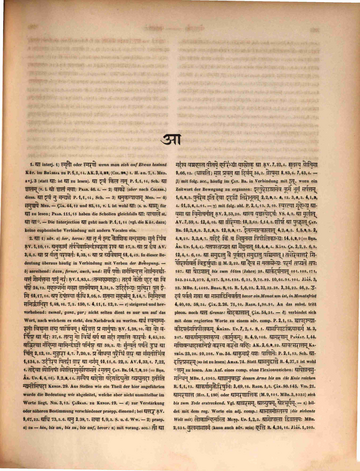
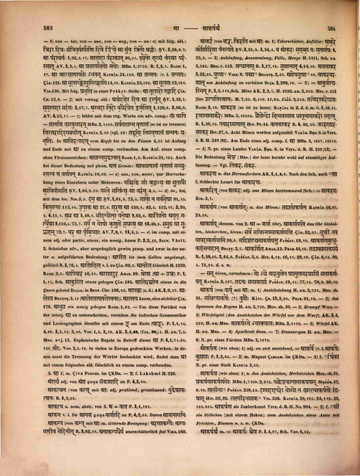
2. ā 1〉 adv. a〉 her, herzu: ā tū nà indra kauśika mandasā̱naḥ su̱taṃ pìba ṚV. 1,10,11. a̱nu̱kā̱maṃ tàrpayethā̱mindrā̀varuṇa rā̱ya ā ṚV. 1,17,3. ā pra dràva AV. 3,4,5. ā pra yā̀tu parā̱vatàḥ AV. 6,35,1. ā pra cyàvethām AV. 18,4,49. In dieser Bedeutung überaus häufig in Verbindung mit Verben der Bewegung. — b〉 anreihend: dazu, ferner, auch, und: sarvàṃ pa̱ṇeḥ samàvindanta̱ bhojàna̱maśvā̀vanta̱ṃ gomànta̱mā pa̱śuṃ naràḥ ṚV. 1,83,4. (tanmahyamāhuḥ) tada̱yaṃ ketò hṛ̱da ā vi cáṣṭe ṚV. 1,24,12. ma̱hāngarbho̱ mahyā jā̱tamèṣām ṚV. 3,31,3. udidā̀bhya̱ḥ śuci̱rā pū̱ta èmi ṚV. 10,17,10. apa̱ dveṣā̱ṃsyā kṛ̀dhi ṚV. 3,16,5. śa̱tamā sa̱hasràm ṚV. 2,14,7. mi̱mi̱kṣvā samiḻā̀bhi̱rā ṚV. 1,48,16. ṚV. 1,7,2. ṚV. 1,150,1. ṚV. 4,11,1. ṚV. 4,12,2. — c〉 steigernd und hervorhebend: zumal, ganz, gar; nicht selten dient es nur um auf das Wort, nach welchem es steht, den Nachdruck zu werfen. adhà sva̱nānma̱rutā̱ṃ viśva̱mā sadma̱ pārthìvam . arèjanta̱ pra mānùṣāḥ ṚV. 1,38,10. ko vo̱ varṣìṣṭha̱ ā nàraḥ ṚV. 1,37,6. tatsu no̱ viśvè a̱rya ā sadā̀ gṛṇanti kā̱ravàḥ ṚV. 6,45,33. baḻi̱tthā màhi̱mā vā̱mindrā̀gnī̱ panìṣṭha̱ ā ṚV. 6,59,2. yaḥ sùnva̱te pacàte du̱dhra ā cìt ṚV. 2,12,15. muhu̱rā ṚV. 4,7. ṚV. 7,20,2. pra bòdhayā̱ puràṃdhiṃ jā̱ra ā sàsa̱tīmìva ṚV. 1,134,3. udī̀raya pi̱tarā̀ jā̱ra ā bhagàm ṚV. 10,11,6. ṚV. 10,22,3. AV. 6,33,1. AV. 7,22,1. taddevā jyotiṣāṃ jyotirāyurhyopāsate 'mṛtam ŚAT. BR. 14,7,2,20 (= BṚH. ĀR. UP. 4,4,16). ŚAT. BR. 9,2,3,44. tasyaiṣa ādeśo yadetadvidyuto vyadyutadā itīti nyamīmiṣadā KENOP. 29. Aus Stellen wie ein Theil der hier angeführten wurde die Bedeutung wie abgeleitet, welche aber nicht unmittelbar im Worte liegt. NIR. 3,13. ŚAṂK._zu_KENOP. 19. — d〉 zur Verstärkung oder näheren Bestimmung verschiedener praepp. dienend; bei antar ṚV. 9,67,23. adhi ṚV. 73,5. ṚV. 9,6. anu ṚV. 2,38,7. sacā ṚV. 1,9,3. S. u. d. Ww. — 2〉 praep. a〉 zu — hin, bis an, bis zu, bis auf, bevor: α〉 mit vorang. acc.: tām̐ ā madā̀ya vajrahasta pī̱taye̱ harìbhyāṃ yā̱hyoka̱ ā ṚV. 7,32,4. ṛ̱tasya̱ yoni̱mā ṚV. 9,66,12. (dhāvati) sa̱pta pra̱vata̱ ā divàm ṚV. 9,54,2. joṣa̱mā ṚV. 8,83,6. ṚV. 7,43,4. — β〉 mit folg. acc., häufig im ŚAT. BR. in Verbindung mit it, wozu ein Zeitwort der Bewegung zu ergänzen: etpuroḍāśameva kūrmaṃ bhūtaṃ sarpantam ŚAT. BR. 1,6,2,3. punarema iti devā edagniṃ tirobhūtam ŚAT. BR. 2,2,3,3. ŚAT. BR. 2,2,4,12. ŚAT. BR. 2,3,4,2. ŚAT. BR. 4,1,3,4. ŚAT. BR. 11,5,1,4. ŚAT. BR. 11,5,1,11. — γ〉 mit folg. abl. P. 2,1,13. P. 2,3,10. sva̱styā gṛ̱hebhya̱ āva̱sā ā vi̱mocanā̀t ṚV. 3,53,20. āsyā ya̱jñasyo̱dṛcàḥ VS. 4,9. ā mūlā̀t AV. 7,59,1. AV. 12,4,16. ā jàri̱mṇaḥ AV. 18,3,62. AV. 1,14,3. śīrṣṇa ā pucchāt ŚAT. BR. 10,2,1,9. ŚAT. BR. 3,1,3,9. ŚAT. BR. 12,8,3,17. aitasmātkālāt ŚAT. BR. 4,2,4,5. ŚAT. BR. 1,5,2,9. ŚAT. BR. 2,4,2,21. ŚAT. BR. 3,2,1,7. yadidaṃ kiṃ ca mithunamā pipīlikābhyaḥ ŚAT. BR. 14,4,2,9 (= BṚH. ĀR. UP. 1,4,4). yattapastapyata ā maithunāt ŚAT. BR. 10,4,4,4. KĀTY. ŚR. 2,2,2. KĀTY. ŚR. 2,6,9. KĀTY. ŚR. 12,4,1. KĀTY. ŚR. 12,6,18. ā samudrāttu vai pūrvādā samudrāttu paścimāt . tayorevāntaraṃ giryorāryāvartaṃ vidurbudhāḥ .. M. 2,22. ā haiva sa nakhāgrebhyaḥ paramaṃ tapyate tapaḥ M. 2,167. ā ṣoḍaśāt bis zum 16ten (Jahre) M. 2,38. ārkadarśanāt M. 2,101. M. 2,108. M. 2,171. M. 2,243. M. 2,244. M. 3,279. M. 4,137. M. 5,88. M. 2,158. M. 6,31. M. 9,70. M. 2,89. M. 10,64. M. 2,91. M. 2,104. YĀJÑ. 3,23. MBH. 1,4405. BHAG. 8,16. R. 1,6,25. R. 2,32,32. R. 2,32,38. R. 3,34,23. R. 3,46,2. udayaṃ parvataṃ gatvā ā māsādvinivartata bevor ein Monat um ist, in Monatsfrist R. 4,40,69. R. 4,58,34. ŚĀK. 2. ŚĀK. 26. ŚĀK. 71,10. RAGH. 1,90. RAGH. 1,91. An das subst. tritt pleon. noch anta Grenze: odakāntāt ŚĀK. 54,21. — δ〉 verbindet sich mit dem regierten Worte zu einem adv. comp. P. 2,1,13. aśvāpadānyākīṭapataṃgapipīlakam CHĀND. UP. 7,2,1. CHĀND. UP. 7,8,1. āsapiṇḍakriyākarma M. 3,247. ākarṇamūlamākṛṣya (kārmukam) R. 4,9,106. āmaraṇam PAÑCAT. I, 44. maṇibandhādākaniṣṭhaṃ karasya karabho bahiḥ AK. 2,6,2,32. āvatsarāntam KATHĀS. 23,20. KATHĀS. 10,208. VID. 54. ākumāraṃ yaśaḥ pāṇineḥ P. 2,1,13, Sch. ādṛṣṭiprasaram (so ist zu lesen) AMAR. 74. Statt āsamudrānte R. 4,37,3 ist wohl ˚ntam zu lesen. Am Anf. eines comp. ohne Flexionszeichen: āyojanasugandhin MBH. 1,6965. ājānubāhu dessen Arme bis an die Knie reichen R. 1,1,12. ākarṇamuktairiṣubhiḥ R. 3,69,16. RAGH. 1,5. ŚĀK. 80. ŚĀK. 145. VID. 21. āmaraṇānta (HIT. I, 180) oder āmaraṇāntika (M. 9,101. MBH. 3,8333) sich bis zum Tode erstreckend. Vgl. ājarasam, āvyuṣam, otsūryam. — ε〉 bildet mit dem reg. Worte ein adj. comp.: āsaptamāṃstasya (die siebente Welt mit) lokānhinasti MUṆḌ. UP. 1,2,3. āgopālā dvijātayaḥ MBH. 2,531. kulamāsaptamaṃ (kann auch adv. sein) hanti R. 4,34,16. YĀJÑ. 1,205. — b〉 von — her, von — aus, von — weg, von — an: α〉 mit folg. abl.: trirā di̱vaḥ sàvita̱rvāryā̀ṇi di̱ve dì ve̱ ā sùva̱ trirno̱ ahnàḥ ṚV. 3,56,6. ṚV. 3,56,7. ā pàrā̱vatàḥ ṚV. 1,92,3. ṚV. 1,92,17. āntā̱dā pàrā̱kāt ṚV. 1,30,21. śye̱no ha̱vyaṃ nàya̱tvā paràsmāt AV. 3,3,4. ā prajāpatito manoḥ MBH. 1,3756. R. 1,5,1. RAGH. 1,17. ā bālyāttāpaso 'bhavam KATHĀS. 24,186. ā janmanaḥ (v. l. janmataḥ) ŚĀK. 121. ā mūlācchrotumicchāmi ŚĀK. 14,19. KATHĀS. 25,195. ā mūlataḥ KATHĀS. 12,191. VID. 130. Mit folg. prabhṛti in einer Prākṛt-Stelle: ā mūlādo pahudi ŚĀK. CH. 13,6. — β〉 mit vorang. abl.: avā̀daho di̱va ā dasyùm ṚV. 1,33,7. sa̱mā̱nādā sadàsaḥ ṚV. 2,17,7. a̱smadā ni̱do va̱dhairàjeta durma̱tim ṚV. 1,129,6. ṚV. 8,66,6. AV. 4,15,11. — γ〉 bildet mit dem reg. Worte ein adv. comp.: māṃ cāpi — jānanti hyākumāram MBH. 3,1403. sarvamājanma vṛttāntaṃ (so ist zu trennen) vistarādidamabravīt KATHĀS. 2,29 (vgl. KATHĀS. 2,28: tadbrūhi nijavṛttāntaṃ janmanaḥ prabhṛti). In āśiraḥpādam vom Kopfe bis zu den Füssen KATHĀS. 4,53 ist Anfang und Ende mit ā zu einem comp. verbunden. Am Anf. eines comp. ohne Flexionszeichen: ājanmaśuddhānām RAGH. 1,5. KATHĀS. 21,122. Auch bei dieser Bedeutung mit pleon. anta Grenze: āmajjanāntaṃ vṛttāntaṃ sakhyustasya ca varṇayan KATHĀS. 10,69. — c〉 aus, von, unter, zur Hervorhebung eines Einzelnen unter Mehreren: yaści̱ddhi tvā̀ ba̱hubhya̱ ā su̱tāvā̀m̐ ā̱vivā̀sati ṚV. 1,84,9. ṚV. 1,84,20. yaste̱ sakhìbhya̱ ā varàm ṚV. 1,4,4. — d〉 in, bei, mit dem loc. NIR. 5,5. dama̱ ā ṚV. 1,61,9. ṚV. 1,73,4. gāvo̱ na yavàse̱ṣvā ṚV. 1,91,13. kiyā̱tyā ṚV. 1,113,10. u̱pā̱ka ā ṚV. 1,27,6. śa̱ra̱ṇa ā ṚV. 150,1. ṚV. 82,2. ṚV. 112,17. ṚV. 2,30,1. ṚV. 4,11,1. a̱bhra ā ṚV. 5,48,1. sīda̱nyonā̱ vane̱ṣvā ṚV. 9,62,8. ajī̀jano amṛta̱ martye̱ṣvā ṚV. 9,110,4. ṚV. 9,73,7. marya̱ṃ na yoṣā̀ kṛṇute sa̱dhastha̱ ā ṚV. 10,40,2. sa̱mu̱dra ā gū̱ḻham ṚV. 10,72,7. vara̱ ā pṛ̀thi̱vyāḥ AV. 7,8,1. AV. 16,4,2. — e〉 im comp. mit einem adj. oder partic. etwas, ein wenig, kaum P. 2,2,18, SAUN. Vārtt. 3. Scheinbar adv., aber ursprünglich gewiss praep. und zwar in der unter a. aufgeführten Bedeutung: āpīta bis zum Gelben angelangt, gelblich R. 2,76,4. ālohita v. l. zu ŚĀK. 69,2. ānīla bläulich H. 1239. RAGH. 3,8. āpiñcara RAGH. 16,51. āpāṇḍura AMAR. 89. oṣṇa (ā + uṣṇa) P. 1,1,14, Sch. ākuṭila etwas gebogen ŚĀK. 184. ātiraścīna etwas in die Quere gehend DAŚAK._in_BENF. Chr. 198,23. āpakva (s. d.) AK. 2,9,47. ālola BHARTṚ. 3,48 (ālolāyatalocanāḥ). ālakṣya kaum, eben sichtbar ŚĀK. 176. ābhugna ein wenig gebogen RAGH. 1,83. — Um diese Partikel von der interj. ā zu unterscheiden, versehen die indischen Grammatiker und Lexicographen dieselbe mit einem ṅ am Ende (āṅ). P. 1,1,14. P. 1,4,89. P. 2,1,13. P. 2,3,10. VOP. 1,8. VOP. 2,19. AK. 3,4,32,1. (COL. 3,4,28,1). H. an. 7,2. MED. avy. 13. Euphonische Regeln in Betreff dieses ā P. 6,1,74. P. 6,1,95. P. 6,1,126 (ām̐). VOP. 2,5. VOP. 2,19. In vielen in Europa gedruckten Werken, in denen sonst die Trennung der Wörter beobachtet wird, findet man ā mit einem folgenden abl. fälschlich zu einem comp. verbunden.⫽print_change
Original text · German · particle
1. ā interj. 1〉 smṛtau oder smaraṇe wenn man sich auf Etwas besinnt Kār. im BHĀṢYA_zu_P. 1,1,14. AK. 3,4,32,1. (COL. 3,4,28,1). H. an. 7,1. MED. avy. 3 (statt āḥ ist ā zu lesen). ā evaṃ kila tat P. 1,1,14, Sch. ā jñātam (v. l. āṃ jñātaṃ mayā) PRAB. 46. PRAB. 4.⫽print_change — 2〉 vākye (aber nach COLEBR.) diess. ā evaṃ nu manyase P. 1,1,14, Sch. — 3〉 anukampāyām MED. — 4〉 samuccaye MED. — ŚĀK. 44,12 und ŚĀK. 85,15, v. l. ist wohl āḥ (s. u. ās) für ā zu lesen; PRAB. 111,15 haben die Scholien gleichfalls āḥ vācāle st. ā vā˚. — Die Interjection ā geht nach P. 1,1,14 (vgl. die Kār. dazu) keine euphonische Verbindung mit andern Vocalen ein.
Original text · German · substantive feminine · substantive masculine
3. ā 1〉 m., Śiva PURUṢ._im_ŚKDR. — 2〉 f. Lakṣmī H. 226.
Original text · German · substantive feminine
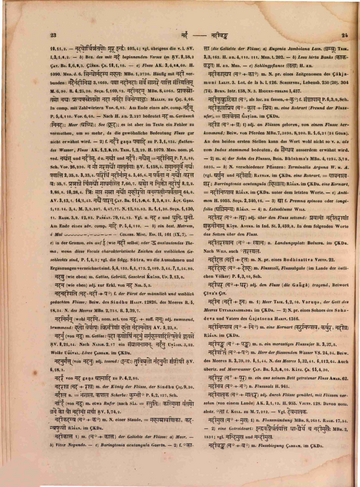
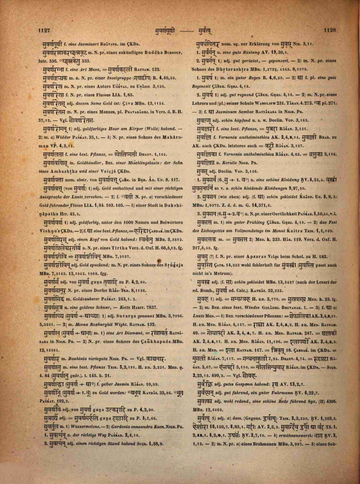
nadīja (na˚ + ja) 1〉 adj. an Flüssen geboren, von einem Flusse herkommend; Beiw. von Pferden MBH. 7,3898. MBH. 8,200. R. 1,6,21 (R. 1,6,24 GORR.). An den beiden ersten Stellen kann das Wort wohl nicht so v. a. als vom Indus stammend bedeuten, da saindhava ausserdem erwähnt wird. — 2〉 m. a〉 der Sohn des Flusses, Bein. Bhiṣmaʼs MBH. 4,1294. MBH. 5,78. MBH. 5,5035. — b〉 N. verschiedener Pflanzen: Terminalia Arjuna W. u. A. (vgl. arjuna und nadīsarja) RATNAM._im_ŚKDR. eine Rohrart, = yāvanālaśara; Barringtonia acutangula (hijjala) RĀJAN._im_ŚKDR. eine Kornart, = nadīniṣpāva RĀJAN._im_ŚKDR. unter dem letzten Worte. — c〉 Antimon H. 1055. SUŚR. 2,340,16. — 3〉 ā f. Premna spinosa oder longifolia (agnimantha) RĀJAN. — 4〉 n. Lotusblume WILS.
Original text · German · substantive feminine
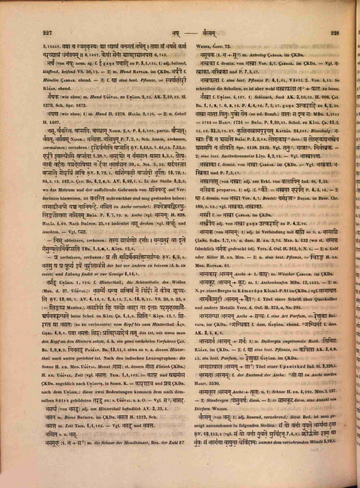
bhastrika proparox. 1〉 adj. (f. ˚kī́ = bhastrayā harati) P. 4,4,16. — 2〉 ā f. demin. von bhastrā VOP. 4,7. Beutel: carmaratna˚ DAŚAK._in_BENF. Chr. 189,2. BENF. Chr. 189,12.; vgl. bhastrakā, bhastrākā.
Original text · German · substantive feminine
1. suvarṣa 1〉 m. ein guter Regen R. 4,6,20. — 2〉 ā f. pl. eine gute Regenzeit ŚĀṄKH. GṚHY. 4,18.
Original text · German · substantive masculine
3. ā m. angeblich auch = pitāmaha und vākya EKĀKṢARĀBHIDHĀNA_im_AGNI-P. ŚKDR.
Original text · German · Word type unspecified
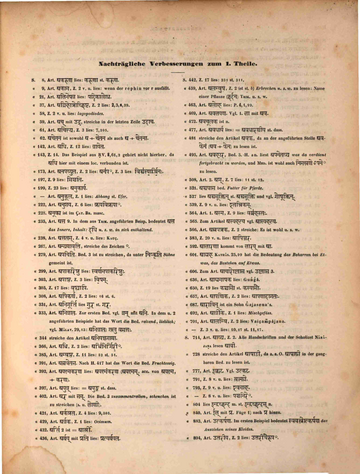
ā [vgl. [1:583]] Z. 20 v. u. lies: āpiñjara. (revision)
Original text · German · Word type unspecified
2. ā 2〉a〉β〉 bis auf, bis exclusive: trayaśca vā ete tryahā ā daśamamaharā dvāvatirātrau yaddvādaśāhaḥ der Dvād. besteht nach Abzug (parityajya SĀY.) des zehnten Tages und der beiden Atirātra aus drei Tryaha AIT. BR. 4,24. Zu der Verbindung et ist nicht ein Zeiltwort der Bewegung (was auch die Comm. annehmen), sondern der Wahrnehmung zu ergänzen: sie heisst sieh da! mit acc., z. B. punaraimītyettirobhūtām (als Urvaśi ihn wie am hellen Tage nackt sah, da verschwand sie): ich kehre wieder um, dachte (und that) er, sieh, da war sie verschwunden! ŚAT. BR. 11,5,1,4. Eine andere Aussprache dafür ist ait AIT. BR. 2,13, wo zu übersetzen ist: Menschen und Ṛṣi kamen auf den (verlassenen) Opferplatz der Götter um eine Spur su suchen, mittelst welcher sie im Opfer sich zurechtfänden, Während sie überall umherliefen, sieh, da lag ein ausgeweidetes Thier! Daran erkannten sie u. s. w. — γ〉 bis zu, bis exclusive (wie unter β) KĀTY. ŚR. 4,13,16. ā tataḥ ṚV. PRĀT. 11,9. — Z. 10 M. 10,64 gehört zu b〉α〉. — e〉 Z. 6 lies āpiñjara.
Böhtlingk 1879 adverb · particle · substantive feminine · substantive masculine · Word type unspecified
Original text · German · adverb · particle
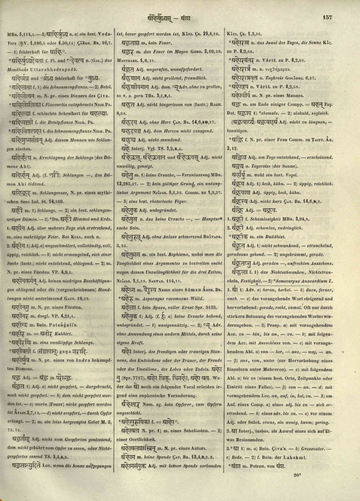
1. ā́ — 1〉 Adv. — a〉 heran, herbei. — b〉 dazu, ferner, auch. — c〉 das vorangehende Wort steigernd und hervorhebend; gerade, recht, zumal. Oft nur durch stärkere Betonung des vorangehenden Wortes wiederzugeben. — 2〉 Praep. — a〉 mit vorangehendem Acc. zu — hin, bis an, — zu. — b〉 mit folgendem Acc. mit Ausschluss von. — c〉 mit vorangehendem Abl. — α〉 von — her, — aus, — weg, — an. — β〉 aus, von, unter (zur Hervorhebung eines Einzelnen unter Mehreren). — d〉 mit folgendem Abl. — α〉 bis zu (einem best. Orte, Zeitpunkte oder Eintritt eines Falles). — β〉 von — an. — e〉 mit vorangehendem Loc. an, auf, in, bei, zu. — 3〉 am Anf. eines Comp. — a〉 eines Adj. bis zu — sich erstreckend. — b〉 eines Adv. bis zu. — c〉 vor einem Adj. oder Subst. etwas, ein wenig, kaum; gering.
Original text · German · particle
2. ā Interj., insbes. als Ausruf eines sich auf Etwas Besinnenden.
Original text · German · substantive feminine · substantive masculine
3. *ā — 1〉 m. — a〉 Bein. Śivaʼs. — b〉 Grossvater. — c〉 Rede. — 2〉 f. Bein. der Lakṣmī.
Original text · German · Word type unspecified
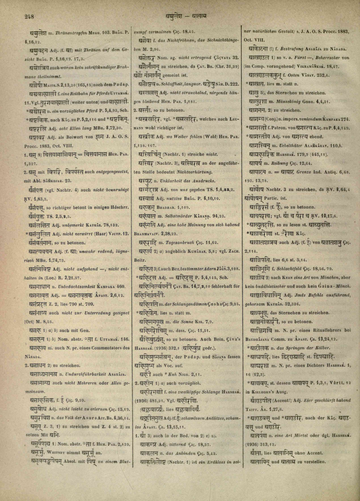
1. ā́ 3〉 auch in der Bed. von 2〉c〉α〉. [Nachtrag, Band 5]
Original text · German · Word type unspecified
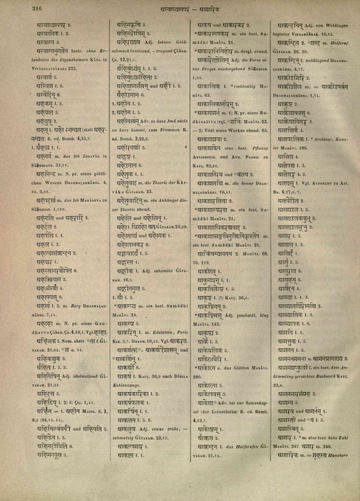
1. ā́ I. 5. [Nachtrag, Band 7]
Apte 1890 Word type unspecified
Original text · English · Word type unspecified
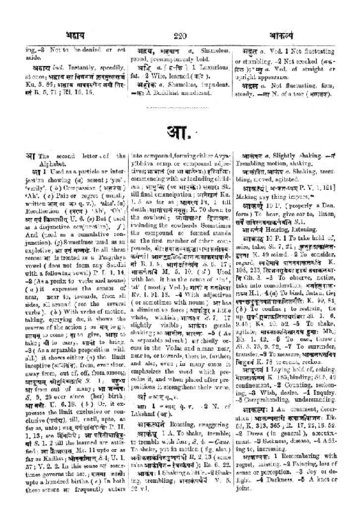
ā The second letter of the Alphabet.
Original text · English · Word type unspecified
ā 1 Used as a particle or interjection showing (a) assent; ‘yes’, ‘verily’. (b) Compassion (anukaṃpā) ‘Ah’. (c) Pain or regret (usually written ās or āḥ q. v.), ‘alas’. (a) Recollection (smaraṇa) ‘Ah’, ‘Oh’; ā evaṃ kilāsīt U. 6. (e) But (used as a disjunctive conjunction). (f) And (used as a cumulative conjunction). (g) Sometimes used as an expletive; ā evaṃ manyase. In all these senses ā is treated as a Pragṛhya vowel (does not form any Saṃdhi with a following vowel) P. I. 1. 14. 2 (As a prefix to verbs and nouns) (a) it expresses the senses of near, near to, towards, from all sides, all around (see the several verbs). (b) With verbs of motion, taking, carrying &c. it shows the reverse of the action; as gam to go, āgam to come; dā to give, ādā to take; nī to carry, ānī to bring. 3 (As a separable preposition with abl.) it shows either (a) the limit inceptive (abhividhi), from, ever since, away from, out of, off, from among; āmūlāt śrotumicchāmi Ś. 1; bahubhya ā from out of many; ā janmanaḥ Ś. 5. 25 ever since (her) birth; ā manoḥ U. 6. 18. (b) Or, it expresses the limit exclusive or conclusive (maryādā), till, until, upto, as far as, unto; āṅ maryādābhividhyoḥ P. II. 1. 13; see abhividhi; ā paritoṣādviduṣāṃ Ś. 1. 2 till the learned are satisfied; ā kailāsāt Me. 11 upto or as far as Kailāsa; odakāṃtāt Ś. 4; U. 1. 37; V. 2. 2. In this sense ā sometimes governs the acc.; śatamā jātīḥ upto a hundred births. (c) In both these senses ā frequently enters ([Page 0220-1b]) into compound, forming either Avyayībhāva comp. or compound adjectives; ābālaṃ (or ā bālebhyaḥ) haribhaktiḥ commencing with or including children; āmukti (or āmukteḥ) saṃsāraḥ Sk. till final emancipation; āmekhalaṃ Ku. 1. 5 as far as.; āmaraṇaṃ Pt. 1 till death; āgopālaṃ nanṛtuḥ K. 70 down to the cowherd; āgopālā dvijātayaḥ including the cowherds. Sometimes the compound so formed stands as the first member of other compounds, so' hamājanmaśuddhānāmāphalodayakarmaṇāṃ . āsamudrakṣitīśānāmānākarathavartmanāṃ R. 1. 5; āgaṃḍavilaṃbi Ś. 6. 17; ākarṇalaṃbi M. 5. 10. (d) Used with loc. it has the sense of ‘in’, ‘at’ (mostly Ved.); gāvo na yavaseṣvā Rv. 1. 91. 13. 4 With adjectives (or sometimes with nouns) ā has a diminutive force; āpāṃḍura a little white, whitish; ālakṣya Ś. 7. 17 slightly visible; ākaṃpaḥ gentle shaking; so ānīla, ārakta. 5 (As a separable adverb) ā chiefly occurs in the Vedas and means near, near to, or towards, there to, further; and also, even; in many cases it emphasizes the word which precedes it, and when placed after prepositions it strengthens their sense.
Cappeller 1887 adverb · Interjection
Original text · German · adverb
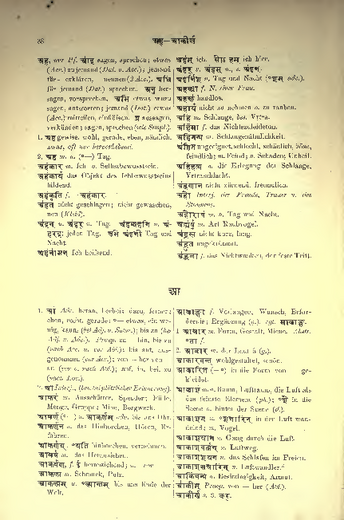
1. ā́ Adv. heran, herbei; dazu, ferner; eben, recht, gerade; ˚— etwas, ein wenig, kaum (bei Adj. u. Subst.); bis zu (bei Adj. u. Adv.). Praep. zu—hin, bis zu (nach Acc. u. vor Abl.); bis auf, ausgenommen (vor Acc.); von — her von— an (vor o. nach Abl.); auf, in, bei, zu (nach Loc.).
Original text · German · Interjection
2. ā Interj., (bes. beiplötzlicher Erinnerung).
Burnouf 1866 Word type unspecified
Original text · French · Word type unspecified
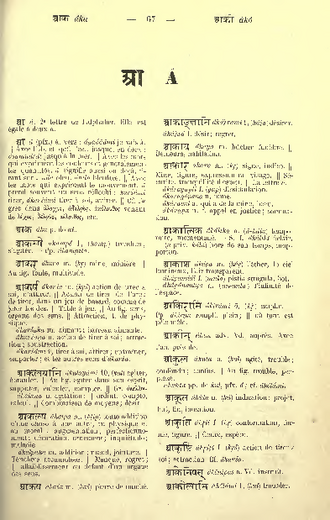
ā ā, 2ᵉ lettre de l'alphabet. Elle est égale à deux a.
Original text · French · Word type unspecified
ā ā (pfx.) à, vers: āgacchāmi je vais à. Avec l'ab. et qqf. l'ac., jusque, en decà: āsamudrāt jusqu'à la mer. Avec les mots qui expriment les couleurs et généralement les quantités, ā signifie aussi en deçà, tirant sur: nīla bleu, ānīla bleuâtre. Avec les mots qui expriment le mouvement, ā prend souvent un sens réfléchi: karṣāmi tirer, ākarṣāmi tirer à soi, attirer. Cf. l'α grec dans ἄλοχος, ἀδελφὸς, ἀϰόλουθος venant de λέχος, δελφύς, ϰέλευθος, etc.
Derived words
-
āśaya आशय substantive masculine deposit; repository; latent disposition; abode; dwelling place; seat
More direct derivatives (17)
-
samādhi समाधि substantive masculine samādhi; meditative concentration; perfect concentration; unitive experience
Further derivatives (5)
Occurrences in source texts (399)
DYS 36 occurrences
DYS 34–38: Padmāsana 3 occurrences
Direct occurrences
Occurrences through derived words
-
DYS 38 Segment 6
DYS 54–59: The Yogi’s Hut 2 occurrences
Direct occurrences
-
DYS 58 Segment 13
Occurrences through derived words
-
DYS 57 Segment 13
15 more source pages
DYS 125–130: Liberation in Life 2 occurrences
Occurrences through derived words
DYS 154–167: Vajrolī for the Male Yogi 3 occurrences
Direct occurrences
DYS 168–179*1: Vajrolī for the Yoginī 6 occurrences
Direct occurrences
GoS 16 occurrences
GoS 34–41: Sun, Sound and Cooling 4 occurrences
Direct occurrences
GoS 50–63: Three Locks 4 occurrences
Direct occurrences
Occurrences through derived words
-
GoS 63 Segment 13
HP 100 occurrences
HP 1.4-1.10: Lineage of Siddhas 2 occurrences
Occurrences through derived words
HP 1.44-1.49: Padmāsana 4 occurrences
Direct occurrences
-
HP 1.44 Segment 25
-
HP 1.45–46 Segment 29
Occurrences through derived words
HP 1.50–54: Siṃhāsana and Bhadrāsana 3 occurrences
Direct occurrences
-
HP 1.50–52 Segment 27
-
HP 1.50–52 Segment 33
Occurrences through derived words
-
HP 1.53–54 Segment 23
40 more source pages
HP 2.34-2.36: Naulī and Kapālabhātī 1 occurrence
Occurrences through derived words
-
HP 2.35 Segment 7
HP 2.48-2.50: Sūryabhedana 3 occurrences
Direct occurrences
HP 2.69-2.71: Three Kumbhakas 3 occurrences
Direct occurrences
Occurrences through derived words
-
HP 2.69 Segment 19
HP 3.10-3.18: Mahāmudrā 4 occurrences
Direct occurrences
Occurrences through derived words
-
HP 3.11 Segment 13
HP 3.33-3.48*1: Khecarī and Soma 2 occurrences
Direct occurrences
-
HP 3.38 Segment 13
Occurrences through derived words
-
HP 3.47 Segment 20
HP 3.49-3.57: Mūlabandha 6 occurrences
Direct occurrences
HP 3.66-3.72: Jālandhara and the Bandhas 2 occurrences
Direct occurrences
HP 3.79-3.86*1: Vajrolī 3 occurrences
Direct occurrences
HP 3.87-3.93*7: Sahajolī and Amarolī 4 occurrences
Direct occurrences
Occurrences through derived words
HP 3.103-3.107*2: Conclusion of the Mudrā Teaching 1 occurrence
Direct occurrences
-
HP 3.107*2 Segment 7
HP 4.0*1-4.0*14: Samādhi and Laya 6 occurrences
Direct occurrences
-
HP 4.0*11 Segment 3
Occurrences through derived words
HP 4.1-4.4: Laya and Breath 3 occurrences
Direct occurrences
Occurrences through derived words
-
HP 4.1*1 Segment 16
HP 4.9-4.11*4: Gaze and Lunar Nectar 1 occurrence
Occurrences through derived words
-
HP 4.11*2 Segment 2
HP 4.11*15-4.11*28: Space and Laya 3 occurrences
Direct occurrences
-
HP 4.11*18 Segment 4
-
HP 4.11*19 Segment 12
-
HP 4.11*23 Segment 19
HP 4.11*29-4.11*31: Transition to Nāda 1 occurrence
Occurrences through derived words
-
HP 4.11*29 Segment 10
HP 4.20-4.27: Four Stages of Nāda 5 occurrences
Occurrences through derived words
HP 4.27*1-4.35: Rājayoga and Haṭha 3 occurrences
Direct occurrences
-
HP 4.29 Segment 14
Occurrences through derived words
-
HP 4.32–33 Segment 3
-
HP 4.35 Segment 9
HP 4.35*1-4.36: Signs of Samādhi 5 occurrences
Occurrences through derived words
HP 4.37-4.46: Listening to Nāda 2 occurrences
Direct occurrences
HP 4.47-4.55*4: Nāda Binds the Mind 4 occurrences
Direct occurrences
Occurrences through derived words
-
HP 4.53 Segment 2
HTK 23 occurrences
HTK 10.5*1–6*1: Sūryabhedana / Sūryabheda 2 occurrences
Direct occurrences
HTK 10.6*2–9*1: Ujjāyī / Ujjāyikā and Sūryabheda 2 occurrences
Direct occurrences
HTK 10.11*2–14*1: Bhastrikā: Breath like a bellows 3 occurrences
Direct occurrences
HTK 10.14*2–17*1: Śītalī and Antaraṅgaka-kumbha 6 occurrences
Direct occurrences
HTK 10.17*2–18: Bhrāmarī: The sound of bees 2 occurrences
Direct occurrences
-
HTK 10.18 Segment 2
Occurrences through derived words
-
HTK 10.18 Segment 20
5 more source pages
HTK 10.26–29*1: Cakra, Śaṅkha, Vāmāvartta, Vartmagati and Gadā 1 occurrence
Direct occurrences
-
HTK 10.26 Segment 10
HTK 10.30–33*1: Nāḍī-viśudhy-ākhyaka-kumbha and Nāḍīśuddhi 2 occurrences
Direct occurrences
IVU 2 occurrences
MAN 10 occurrences
Aṣṭāṅga Yoga Mantra 2 occurrences
Direct occurrences
-
MAN AY 2.1 Segment 1
Occurrences through derived words
-
MAN AY 2.1 Segment 4
Nāgarājāya Namaḥ 2 occurrences
Direct occurrences
-
MAN NN 2.1 Segment 1
Occurrences through derived words
-
MAN NN 2.1 Segment 4
Patañjali Mantra 3 occurrences
Direct occurrences
-
MAN PY 1.2 Segment 8
-
MAN PY 2.1 Segment 1
Occurrences through derived words
-
MAN PY 2.1 Segment 4
MandUp 3 occurrences
PJH 9 occurrences
PJH 15-16: Attaining Power, the Joy of Awareness (cidānanda), and Liberation While Living (jīvanmukti) 1 occurrence
Occurrences through derived words
-
PJH 16 Segment 2
PJH 17-19: Simple Means (sukhopāyas) and Samādhi 3 occurrences
Occurrences through derived words
PJH 20: Everything Is Śiva 2 occurrences
Occurrences through derived words
PJH 21: Epilogue and Closing Blessing 1 occurrence
Occurrences through derived words
-
PJH 21.1 Segment 10
PYS 46 occurrences
PYS 1.5–11: The Five Vṛtti 2 occurrences
Occurrences through derived words
30 more source pages
PYS 2.15–17: Everything Is Suffering 1 occurrence
Occurrences through derived words
-
PYS 2.16 Segment 3
PYS 2.27–29: Aṣṭāṅga as a Path to Liberation 2 occurrences
Direct occurrences
-
PYS 2.28 Segment 8
Occurrences through derived words
-
PYS 2.29 Segment 8
PYS 2.46–48: Āsana as a Seated Posture 1 occurrence
Occurrences through derived words
-
PYS 2.47 Segment 4
PYS 2.49–51: Prāṇāyāma as Breath Suspension 1 occurrence
Occurrences through derived words
-
PYS 2.51 Segment 4
PYS 2.52–53: Karmic Veil and Dhāraṇā 1 occurrence
Occurrences through derived words
-
PYS 2.52 Segment 4
PYS 3.9–12: Three Transformations of Citta 1 occurrence
Occurrences through derived words
-
PYS 3.11 Segment 6
PYS 3.15–16: Sequence of Transformation 1 occurrence
Occurrences through derived words
-
PYS 3.16 Segment 5
PYS 3.23–25: Powers and Distant Knowledge 1 occurrence
Occurrences through derived words
-
PYS 3.25 Segment 2
PYS 3.35–37: Knowledge of Puruṣa and Siddhis 3 occurrences
Occurrences through derived words
PYS 3.41–42: Divine Hearing and Travel through Space 4 occurrences
Occurrences through derived words
PYS 4.9–11: Continuity of Saṃskāras 2 occurrences
Occurrences through derived words
PYS 4.12–14: Real Objects in Transformation 1 occurrence
Occurrences through derived words
-
PYS 4.12 Segment 2
PYS 4.22-24: Citta as Mirror 2 occurrences
Occurrences through derived words
SiSa 92 occurrences
SiSa 1.45-1.50: Rückkehr zum Bewusstsein 1 occurrence
Occurrences through derived words
-
SiSa 1.45 Segment 1
SiSa 1.51-1.64: Selbst als Licht 4 occurrences
Occurrences through derived words
SiSa 1.71-1.81: Avidyā und Elemente 1 occurrence
Occurrences through derived words
-
SiSa 1.77 Segment 4
SiSa 1.82-1.90: Guṇas und Gegenstände 3 occurrences
Occurrences through derived words
39 more source pages
SiSa 2.13-2.20: Suṣumṇā und Citrā 3 occurrences
Direct occurrences
-
SiSa 2.17 Segment 13
Occurrences through derived words
SiSa 2.21-2.24: Ādhāra und Kuṇḍalī 1 occurrence
Occurrences through derived words
-
SiSa 2.23 Segment 4
SiSa 2.25-2.31: Nāḍī-Netz 2 occurrences
Direct occurrences
SiSa 2.49-2.54: Befreiungswissen 2 occurrences
Direct occurrences
SiSa 3.21-3.31: Nāḍī-Reinigung 4 occurrences
Direct occurrences
-
SiSa 3.23 Segment 3
Occurrences through derived words
SiSa 3.49-3.50: Karma-Reinigung 2 occurrences
Direct occurrences
SiSa 3.61-3.67: Paricaya und Niṣpatti 3 occurrences
Direct occurrences
-
SiSa 3.62 Segment 14
Occurrences through derived words
SiSa 3.68-3.80: Vāyusādhana 2 occurrences
Direct occurrences
-
SiSa 3.76 Segment 3
Occurrences through derived words
-
SiSa 3.79 Segment 12
SiSa 3.88-3.91: Padmāsana 2 occurrences
Direct occurrences
-
SiSa 3.88 Segment 35
Occurrences through derived words
-
SiSa 3.88 Segment 53
SiSa 4.1-4.8: Yonimudrā-Kreislauf 3 occurrences
Direct occurrences
Occurrences through derived words
-
SiSa 4.5 Segment 7
SiSa 4.81-4.90: Bindu-Bewahrung 6 occurrences
Direct occurrences
SiSa 4.101-4.104: Bindu-Siddhi 3 occurrences
Direct occurrences
-
SiSa 4.101 Segment 7
-
SiSa 4.101 Segment 15
-
SiSa 4.102 Segment 6
SiSa 4.105-4.111: Śakticālana 3 occurrences
Direct occurrences
-
SiSa 4.105 Segment 10
-
SiSa 4.105 Segment 12
-
SiSa 4.106 Segment 7
SiSa 5.10-5.14: Subtile Hindernisse 1 occurrence
Occurrences through derived words
-
SiSa 5.12 Segment 11
SiSa 5.77-5.81: Kanda und Hauptnāḍīs 2 occurrences
Direct occurrences
SiSa 5.132-5.143: Innere Vārāṇasī 5 occurrences
Direct occurrences
-
SiSa 5.132 Segment 4
-
SiSa 5.134 Segment 13
-
SiSa 5.138 Segment 15
Occurrences through derived words
-
SiSa 5.136 Segment 3
-
SiSa 5.139 Segment 2
SiSa 5.156-5.181: Sahasrāra 6 occurrences
Direct occurrences
-
SiSa 5.157 Segment 15
-
SiSa 5.159 Segment 14
-
SiSa 5.171 Segment 7
-
SiSa 5.172 Segment 8
-
SiSa 5.173 Segment 6
-
SiSa 5.177 Segment 14
SiSa 5.182-5.190: Sahasrāra-Mond 1 occurrence
Occurrences through derived words
-
SiSa 5.187 Segment 1
SiSa 5.191-5.207: Kailāsa und Mahāśūnya 3 occurrences
Direct occurrences
-
SiSa 5.201 Segment 10
Occurrences through derived words
-
SiSa 5.194 Segment 14
-
SiSa 5.195 Segment 10
SiSa 5.208-5.222: Rājayoga 5 occurrences
Direct occurrences
-
SiSa 5.208 Segment 4
-
SiSa 5.209 Segment 15
-
SiSa 5.215 Segment 9
-
SiSa 5.222 Segment 14
Occurrences through derived words
-
SiSa 5.216 Segment 3
SiSa 5.234-5.252: Tripurā-Mantra 4 occurrences
Direct occurrences
-
SiSa 5.243 Segment 10
-
SiSa 5.244 Segment 10
-
SiSa 5.245 Segment 10
-
SiSa 5.247 Segment 2
SS 7 occurrences
SVU 13 occurrences
5 more source pages
SVU 6.1–6.6: Lord of Cosmic Unfolding 3 occurrences
Direct occurrences
SVU 6.18–6.23: Refuge and Transmission 1 occurrence
Occurrences through derived words
-
SVU 6.20 Segment 3
VBT 42 occurrences
VBT 14–17: Highest Reality 2 occurrences
Occurrences through derived words
10 more source pages
VBT 65–74: Joy and Enjoyment 11 occurrences
Occurrences through derived words
VBT 75–85: Thresholds and Sky 5 occurrences
Direct occurrences
Occurrences through derived words
VBT 86–92: Light and Darkness 4 occurrences
Direct occurrences
-
VBT 92 Segment 7
Occurrences through derived words
VBT 121–129: Devotion and Release 2 occurrences
Direct occurrences
-
VBT 128 Segment 13
Occurrences through derived words
-
VBT 128 Segment 12
VBT 146–155: Inner Rituals 7 occurrences
Direct occurrences
Occurrences through derived words
Continue with AYI Free
Image source: AYI archive.