

vṛt वृत् – turn; occur; remain; abide; live; behave
adjective · verbal root · substantive feminine · Word type unspecified · verb
Dictionary sources
AYI dictionary verbal root
turn; occur; remain; abide; live; behave
Cappeller 1891 Word type unspecified · verb
Original text · English · verb
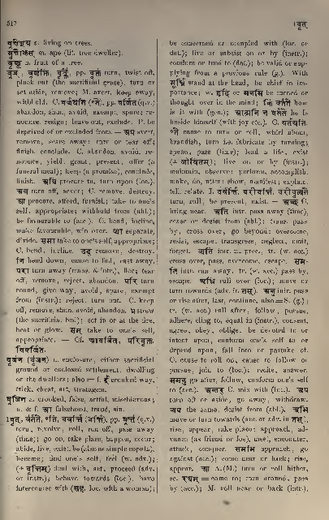
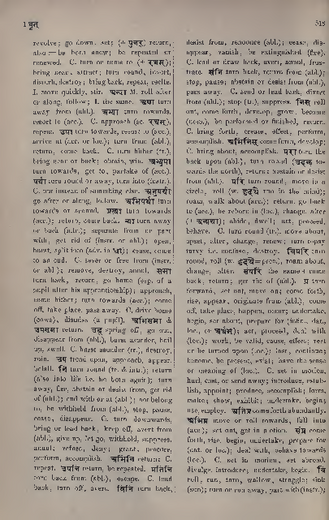
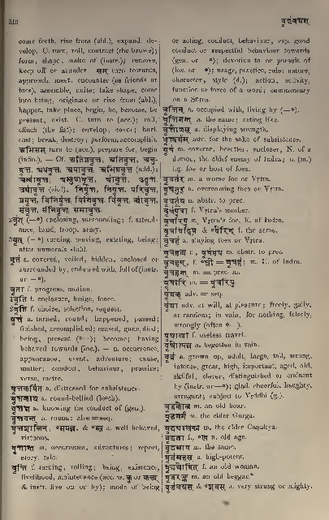
vṛt vártate várta°ti vavartti1 ·v (vartti), pp. vṛttá (q.v.) turn, revolve, roll, run off, pass away (time); go on, take place, happen, occur; abide, live, exist, be (also as simple copula), become; find one's self, feel (w. adv.); (±vṛttim) deal with, act, proceed (adv. or instr.); behave towards (loc.), have intercourse with (saha, loc. with a woman); be concerned or occupied with (loc. or dat.); live or subsist on or by (instr.); conduce or tend to (dat.); be valid or supplying from a previous rule (g.). With mūrghni stand at the head, be chief in importance; w. hṛdi or manasi be turned or thought over in the mind; kiṃ vartate how is it with (gen.); ātmani na vartate he is beside himself (with joy etc.). C. vartáyati, vártate, várta°ti, vavartti1 (vartti), pp. vṛttá (q.v.) turn, revolve, roll, run off, pass away (time); go on, take place, happen, occur; abide, live, exist, be (also as simple copula), become; find one's self, feel (w. adv.); (±vṛttim) deal with, act, proceed (adv. or instr.); behave towards (loc.), have intercourse with (saha, loc. with a woman); be concerned or occupied with (loc. or dat.); live or subsist on or by (instr.); conduce or tend to (dat.); be valid or supplying from a previous rule (g.). With mūrghni stand at the head, be chief in importance; w. hṛdi or manasi be turned or thought over in the mind; kiṃ vartate how is it with (gen.); ātmani na vartate he is beside himself (with joy etc.). C. vartáya°te cause to turn or roll, whirl about, brandish, turn i.e. fabricate by turning; spend, pass (time); lead a life, exist (±jīvitam); live on or by (instr.); maintain, observe; perform, accomplish, make, do, utter; show, manifest; explain. tell, relate. I. várvartti, varīvartti, varīvṛtyate turn, roll, be present, exist. -- accha C. bring near. ati intr. pass away (time), cease or desist from (abl.); trans, pass by, cross over, go beyond; overcome, resist, escape, transgress, neglect, omit, forget. vyati intr. = prec., tr. (w. acc.) cross over, pass, overcome, escape. samati intr. run away, tr. (w. acc.) pass by, escape. adhi roll over (loc.); move or turn towards (adv. in tas). anu intr. pass or rise after, last, continue, also = S. (g.); tr. (w. acc.) roll after, follow, pursue, adhere, cling to, equal in (instr.) consent, agree, obey, oblige, be devoted to or intent upon, conform one's self to or depend upon, fall, into or partake of. C. cause to roll on, cause to follow or pursue, join to (loc.); recite, answer. samanu go after, follow, conform one's self to (acc.). antar C. mix with (loc.). apa turn off or aside, go away, withdraw. vyapa the same, desist from (abl.). abhi move or turn towards (acc. or adv. in tas), rise, appear, take place; approach, advance (as friend or foe), meet, encounter, attack, conquer. samabhi approach, go against (acc.); come near or back; rise, appear. ā A. (M.) turn or roll hither, sc. ratham = come to; turn around, pass by (acc.); M. roll near or back (intr.), revolve; go down, set; (±punar) return, also = be born anew; be repeated or renewed. C. turn or come to (±ratham); bring near, attract; turn round, invert, disturb, destroy; bring back, repeat, recite. I. move quickly, stir. anvā M. roll after or along, follow; I. the same. apā turn away from (abl.). abhyā turn towards, resort to (acc.). C. approach (sc. ratham), repeat. upā turn towards, resort to (acc.), arrive at (acc. or loc.); turn from (abl.), return, come back. C. turn hither (tr.), bring near or back; obtain, win. abhyupā turn towards, get to, partake of (acc.). paryā turn round or away, turn into (instr.). C. put instead of something else. anuparyā go after or along, follow. abhiparyā turn towards or around. pratyā turn towards (acc.); return, come back. vyā turn away or back (intr.); separate from or part with, get rid of (instr. or abl.); open, burst, split into (adv. in dhā); cease, come to an end. C. sever or free from (instr. or abl.); remove, destroy, annul. samā turn back, return, go home (esp. of a pupil after his apprenticeship); approach, come hither; turn towards (acc.); come off, take place, pass away. C. drive home (cows), dismiss (a pupil). abhisamā & upasamā return. ud spring off, go out, disappear from (abl.), burst asunder, boil up, swell. C. burst asunder (tr.), destroy, ruin. upa tread upon, approach, appear, befall. ni turn round (tr. & intr.); return (also into life i.e. be born again); turn away, flee, abstain or desist from, get rid of (abl.); end with or at (abl.); not belong to, be withheld from (abl.), stop, pause, cease, disappear. C. turn downwards, bring or lead back, keep off, avert from (abl.), give up, let go, withhold, suppress, annul; refuse, deny; grant, procure, perform, accomplish. abhini return; C. repeat. upani return, be repeated. pratini turn back from (abl.), escape. C. lead back, turn off, avert. vini turn back, desist from, renounce (abl.); cease, disappear, vanish, be extinguished (fire). C. lead or draw back, avert, annul, frustrate. saṃni turn back, return from (abl.); stop, pause; abstain or desist from (abl.), pass away. C. send or lead back, divert from (abl.); stop (tr.), suppress. nis roll out, come forth, develop, grow, become (nom.), be performed or finished, return. C. bring forth, create, effect, perform, accomplish. abhinis come forth, develop; C. bring about, accomplish. parā turn the back upon (abl.), turn round (udak towards the north), return; abstain or desist from (abl.). pari turn round, move in a circle, roll (w. hṛdaye run in the mind); roam, walk about (acc.); return, go back to (acc.), be reborn in (loc.), change, alter (±anyathā); abide, dwell; act, proceed, behave. C. turn round (tr.), move about, upset, alter, change, renew; turn topsy turvy i.e. confuse, destroy. vipari turn round, roll (w. hṛdaye = prec.), roam about, change, alter. saṃpari the same + come back, return; get rid of (abl.). pra turn forward, set out, move on; come forth, rise, appear, originate from (abl.), come off, take place, happen, occur; undertake, begin, set about, prepare for (infin., dat., loc., or artham); act, proceed, deal with (loc.); work, be valid, cause, effect; rest or be turned upon (loc.); last, continue; become, be present, exist; have the sense or meaning of (loc.). C. set in motion, hurl, cast, or send away; introduce, establish, appoint; produce, accomplish; form, make; show, exhibit; undertake, begin; use, employ. atipra come forth abundantly. abhipra move or roll towards, fall into (acc); set out, get in motion. saṃpra come forth, rise, begin, undertake, prepare for (dat. or loc.); deal with, behave towards (loc.). C. set in motion, set abroad, divulge, introduce; undertake, begin. vi roll, run, turn, wallow, struggle; sink (sun); turn or run away, part with (instr.); come forth, rise from (abl.), expand, develop. C. turn, roll, contract (the brows); form, shape, make of (instr.); remove, keep off or asunder. sam turn towards, approach, meet, encounter (as friends or foes), assemble, unite; take shape, come into being, originate or rise from (abl.), happen, take place, begin, be, become, be present, exist. C. turn to (acc.); roll, clinch (the fist); envelop, cover; hurl, cast; break, destroy; perform, accomplish. abhisam turn to (acc.), prepare for, begin (infin.). -- Cf. atipravṛtta, ativṛtta, anuvṛtta, apavṛtta, apāvṛtta, abhipravṛtta (add.); abhyā́vṛtta, abhyupāvṛtta, ā́vṛtta, udvṛtta, upā́vṛtta (sic!), nirvṛtta, nivṛtta, parivṛtta, pravṛtta, vinirvṛtta, vinivṛtta, vívṛtta, vyā́vṛtta, saṃvṛtta, saṃnivṛtta, samāvṛtta.
Original text · English · Word type unspecified
vṛ́t2 ·(--°) enclosing, surrounding; f. attendance, band, troop, army.
Original text · English · Word type unspecified
vṛt3 ·(--°) turning, moving, existing, being; after numerals-fold.
Monier-Williams 1872 Word type unspecified · verb
Original text · English · Word type unspecified
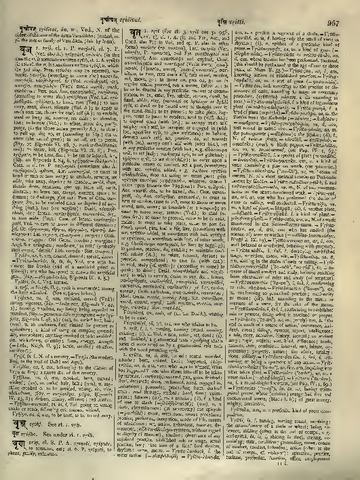
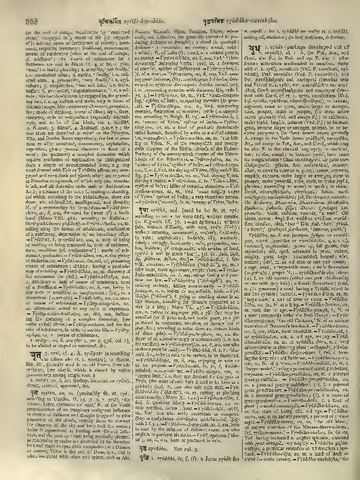
vṛt 1 . vṛt (for rt. 3. vṛt see p. 958, col. 1), cl. 1. A. (in 2nd Fut., Aor., and Cond. also P.; in Ved. and ep. P. also in other forms) vartate (ep. vartati), Perf. vavṛte (Ved. vāvṛte, P. vavarta), 2nd Fut. vartiṣyate and vartsyati, Aor. avartiṣṭa and avṛtat, Cond. avartiṣyata and avartsyat (Vedic forms [anu]- vartti, [ā] varta, avart, [sam-ā] vavartti), var- titum, to turn, turn one's self, turn round, revolve, roll, move, go; to move on, pass on, go on in regular course, proceed, run a course, follow on; to be or be situated in any particular manner or circum- stances, to be, exist, live, subsist, remain, dwell, be fixed, abide, stay, (manasi or hṛdaye or hṛdi vṛt, to dwell or be turned over or thought over in the mind, &c.); to be present; to take place, hap- pen, come to pass; to conduce, tend to (with dat.); to depend upon (with loc.); to occupy one's self, employ one's self, be occupied or engaged in (with loc., upakāre vṛt, to give assistance); to behave, demean one's self, act, practice, do, act towards (with loc.), occupy one's self with (with inst.), act in any particular manner (with inst., e. g. dharmeṇa vṛt, to act justly; amāyayā vṛt, to act guilelessly; vyājena vṛt, to act deceitfully); to enter upon a particular course of conduct, act a part, (sometimes with acc. vṛttim added, e. g. vartase vṛttim akṣudrām, thou art acting no mean part; yāṃ vṛttiṃ vartāmi pāṇḍaveṣu, whatever course I enter upon towards the Pāṇḍavas): Pass. vṛtyate, Aor. avarti, &c., to be turned, &c.: Caus. varta- yati, -te, Aor. avīvṛtat, avavartat, to cause to turn or revolve, cause to roll, cause to move or move round, turn, move; to brandish (as a weapon); to cause to move away, remove (Ved.); to shed (as tears &c.); to cause to proceed, cause to be or exist, make; to cause to take place, cause to pass (as time), spend, pass, lead a life, live, (sometimes with acc. vṛttim added, or sometimes with inst. vṛttyā or vṛttena, or sometimes with inst. of other words, e. g. bhaikṣeṇa vartayati, he lives by begging); to perform, practice, do, exhibit; to maintain one's self, subsist (A.); to relate, recount, declare; to perceive, comprehend; to care for (with dat.); to read, study [cf. vṛtta]; (according to some) to speak; to shine: Desid. vivartiṣate and vivṛt- sati, to wish to remain, desire to stay, &c.: Intens. varīvṛtyate, varīvṛtīti, varvṛtīti, varivṛtīti, varvartti, varivartti, varīvartti; [cf. Lat. vert-o, versus; Goth. vairthan, ana-vairths, vaurs-tva; Mod. Germ. werde, ward; Angl. Sax. weordhan, ward, weard, wyrd; Lith. wartau, werciu, war- toju, wirs-tu; Slav. vrat-i-ti.]
Original text · English · Word type unspecified
2. vṛt, t, t, t, turning, turning round, moving, existing; (t), f., Ved. a turn, action, act, deed; (t), ind. ‘finished,’ a grammatical term signifying that a series of roots acted on by a grammatical rule ends with the word preceding vṛt.
Original text · English · verb
vṛt 3 . vṛt, cl. 4. A. vṛtyate (according to others also cl. 1. vartate), to choose, like, &c., generally used in an old Intens. form vā- vṛtyate, (see vāvṛt, which is classed by native grammarians among simple roots.)
Petersburger 1855 adjective · substantive feminine
Original text · German · adjective · substantive feminine
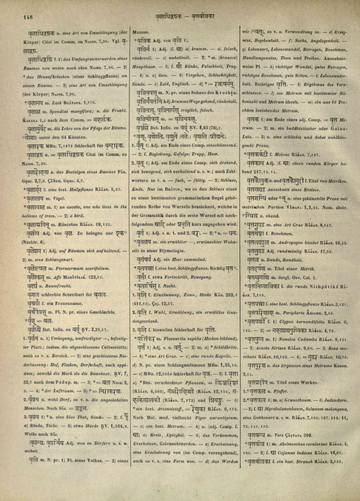
1. √vṛt (von 1. var) 1〉 adj. einschliessend in arṇo˚ und nadī˚. — 2〉 f. Begleitung, Gefolge; Heer: kayā̱ śacìṣṭhayā vṛ̱tā (na ā bhuvat) ṚV. 4,31,1. u̱bhe vṛtaù saṃya̱tī saṃ jàyāti ṚV. 5,37,5. yayòru̱bhe rodàsī̱ nādhàsī̱ vṛtaù ṚV. 10,65,5. vṛ̱teva̱ yantàṃ ba̱hubhìrvasa̱vyaìḥ ṚV. 6,1,3. va̱yaṃ jàyema̱ vṛtàm ṚV. 1,102,4. ṚV. 4,17,9. ayùddha̱ idyu̱dhā vṛta̱ṃ śūra̱ ājàti̱ satvàbhiḥ ṚV. 8,45,3. ajā̱ vṛtà indra̱ śūràpatnīḥ ṚV. 1,174,2.
Original text · German · adjective
2. vṛt (von vart) 1〉 adj. am Ende eines adj. comp. in eka˚, tri˚, pañca˚, purū˚, viṣū˚, su˚. — 2〉 Schluss, Ende; bezeichnet im DHĀTUP. (z. B. nach DHĀTUP. 19,79. DHĀTUP. 23,41. DHĀTUP. 28,108. DHĀTUP. 28,143. DHĀTUP. 31,32) den Schluss einer zu einer bestimmten grammatischen Regel gehörenden Reihe von Wurzeln, die in der Grammatik durch die erste Wurzel mit nachfolgendem ādi oder prabhṛti kurz angegeben wird. P. 7,2,59, Schol.
Böhtlingk 1879 adjective · substantive feminine
Original text · German · adjective · substantive feminine
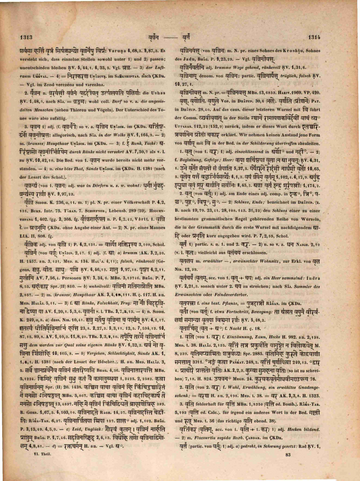
1. vṛ́t — 1〉 Adj. am Ende eines Comp. einschliessend. — 2〉 f. Begleitung, Gefolge; Trupp, Heer.
Original text · German · adjective
2. vṛt — 1〉 Adj. am Ende eines Comp. sich drehend, sich bewegend, sich verhaltend u. s. w.; nach Zahlwörtern so v. a. -fach, -fältig. — 2〉 Schluss, Ende. Nur im DHĀTUP., wo es den Schluss einer zu einer bestimmten grammatischen Regel gehörenden Reihe von Wurzeln bezeichnet, welche in der Grammatik durch die erste Wurzel mit nachfolgenden ādi oder prabhṛti kurz angegeben wird.
Whitney Roots 1885 verbal root
Original text · English · verbal root
vṛt — turn
Apte 1890 verbal root
Original text · English · verbal root
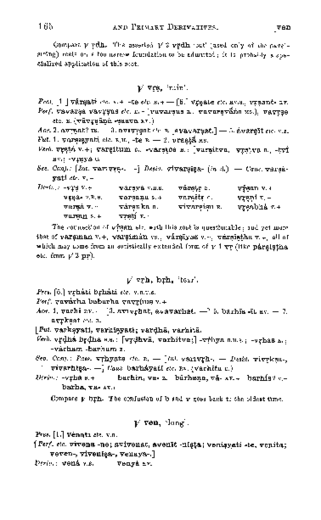
vṛt I. 4 A. (vṛtyate) 1 To choose, like; cf. vāvṛt. 2 To distribute, divide. II. 10 U. (vartayati-te) To shine. III. 1 A. (vartate, but Paras. also in the Aorist, Second Future and Conditional; also in the Desiderative; vavṛte, avṛtat-avartiṣṭa, vartiṣyate-vartsyati, vartituṃ, vṛtta) 1 To be, exist, abide, remain, subsist, stay; idaṃ me manasi vartate Ś. 1; atra viṣaye'smākaṃ mahatkutūhalaṃ vartate Pt. 1; marālakulanāyakaḥ kathaya re kathaṃ vartatāṃ Bv. 1. 3; often used merely as a copula; atītya harito harīṃśca vaṃrtate vājinaḥ Ś. 1. 2 To be in any particular condition or circumstances; paścipe vayasi vartamānasya K.; so duḥkhe, harṣe, viṣāde &c. vartate. 3 To happen, take place, occur, come to pass; sītādevyāḥ kiṃ vṛttamityasti kācitpravṛttiḥ U. 2; sāyaṃ saṃprati vartate pathika re sthānāṃtaraṃ gamyatāṃ Subhāṣ. ‘now it is evening’ &c.; Ś. Til. 6; Bg. 5. 26. 4 To move on, proceed in regular course; sarvathā vartate yajñaḥ Ms. 2. 15; nirvyājamijyā vavṛte Bk. 2. 37; R. 12. 56. 5 To be maintained or supported by, live on, subsist by (fig. also); phalamūlavāribhirvartamānā K. 172; Ms. 3. 77. 6 To turn, roll on, revolve; yāvadiyaṃ lokayātrā vartate Ve. 3. 7 To occupy or engage oneself, be occupied or engaged in, set about (with loc); bhagavān kāśyapaḥ śāśvate brahmaṇi vartate Ś. 1; itaro dahane svakarmaṇāṃ vavṛte jñānamayena vāhninā R. 8. 20; Ms. 8. 346; Bg. 3. 22. 8 To act, behave, conduct or demean oneself towards, do, perform, practise (usually with loc. or by itself); āryo'smin vinayena vartatāṃ U. 6; kavirnisargasauhṛdena bharateṣu vartamānaḥ Māl. 1; audāsīnyena vartituṃ R. 10. 25; mitravanmayyavartiṣṭa Dk.; Ms. 7. 104, Ms. 8. 173, Ms. 11. 30. 9 To act a part, enter upon a course of conduct; sādhvīṃ vuttiṃ vartate ‘he acts an honest part’. 10 To act up to, abide by, ([Page 1006-b]) follow, tadaśakyāraṃbhāduparamya māturmate vartasva Dk. 11 To have the sense of, signify, be used in the sense of; puṣyasamīpasthe caṃdramasi puṣyaśabdo vartate Mbh. on P. IV. 2. 3 (often used in lexicons in this sense). 12 To tend or conduce to (with. dat.); putreṇa kiṃ phalaṃ yo vai pitṛduḥkhāya vartate. 13 To rest or depend upon. — Caus. (vartayati-te) 1 To cause to be or exist. 2 To cause to move or turn round, cause to revolve; jyotīṃṣi vartayati ca pravibhaktaraśmiḥ Ś. 7. 6. 3 To brandish, flourish, whirl round; Bk. 15. 37. 4 To do, practise, exhibit; Māl. 9. 33. 5 To perform, discharge, attend or look to; sodhikāramabhikaḥ kulocitaṃ ka ścana svayamavartayatsamāḥ R. 19. 4; Mv. 3. 23. 6 To spend, pass (as time). 7 To live on, subsist; rāmopi saha vaidehyā vane vanyena vartayan R. 12. 80; sometimes Atm. also; madasiktamukhairmṛgādhipaḥ karibhirvartayate svayaṃ hataiḥ Ki. 2. 18. 8 To relate, describe. 9 To perceive, comprehend. 10 To study. 11 To shine. 12 To speak. 13 To shed (as tears). — Desid. (vivṛtsati, vivartiṣate).
Cappeller 1887 Word type unspecified
Original text · German · Word type unspecified
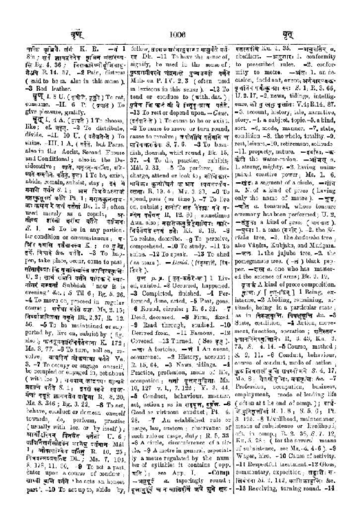
1. vṛt s. vart.
Original text · German · Word type unspecified
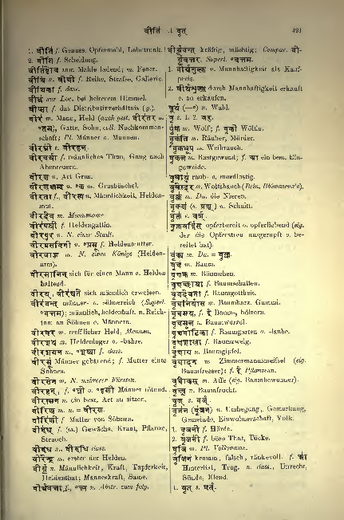
2. vṛ́t einschließend (—˚); f. Schar, Heer.
Original text · German · Word type unspecified
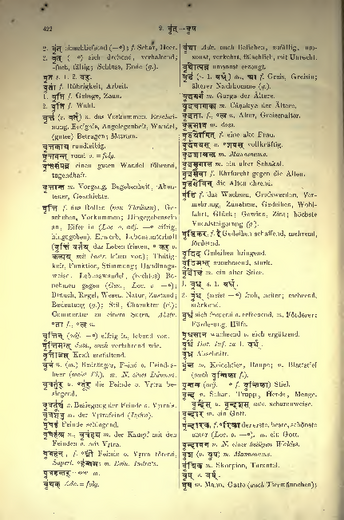
3. vṛt (—˚) sich drehend, verhaltend; -fach, fältig; Schluss, Ende (g.).
Burnouf 1866 verbal root
Original text · French · verbal root
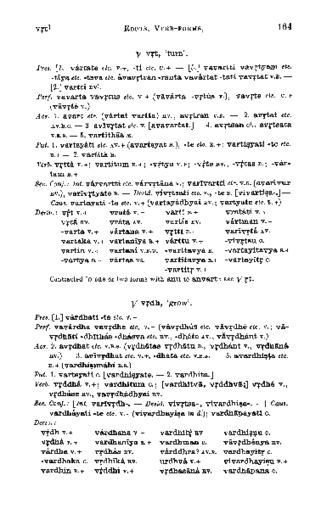
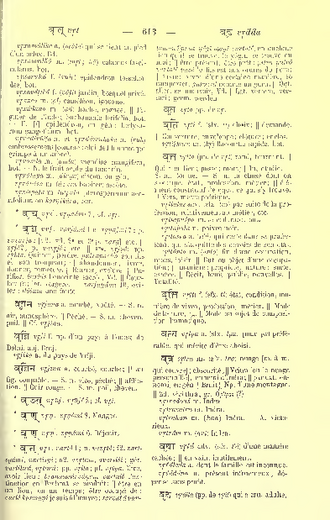
*vṛt vṛt. varte 1; p. vavṛte; f2. vartsyāmi, vartiṣye; a2. avṛtam, avartiṣi; gér. vartitvā, vṛttvā; pp. vṛtta; pf. vṛtya. Etre, avoir lieu: brahmanirvāṇaṃ vartate l'extinction en Brahmā se produit; être en un lieu, en un temps; être occupé de; varte karmaṇi jesuis à l'œuvre; sarvathāvar- [Page613-2] -tamānopi sa yogī mayi vartate, en quelque lieu qu'il se trouve, le yogin se trouve en moi; être présent, être prêt: pitus putro vartate vaśe le fils est aux ordres du père; vivre; vivre d'une certaine manière, se comporter, guruvat comme un guru. Qqf. aller, se mouvoir, Vd. Lat. vertere, versari; germ. werden.
Derived words
Occurrences in source texts (96)
DYS 5 occurrences
HP 14 occurrences
HP 3.103-3.107*2: Conclusion of the Mudrā Teaching 1 occurrence
Occurrences through derived words
-
HP 3.105 Segment 12
4 more source pages
HTK 1 occurrence
PJH 1 occurrence
PYS 13 occurrences
PYS 1.2–4: Cessation of the Vṛtti 2 occurrences
Occurrences through derived words
PYS 1.5–11: The Five Vṛtti 2 occurrences
Occurrences through derived words
PYS 2.10–11: Eliminating the Kleśas 1 occurrence
Occurrences through derived words
-
PYS 2.11 Segment 4
PYS 2.15–17: Everything Is Suffering 1 occurrence
Occurrences through derived words
-
PYS 2.15 Segment 6
SiSa 43 occurrences
SiSa 1.32-1.34: Selbst als Ursprung 1 occurrence
Occurrences through derived words
-
SiSa 1.33 Segment 6
SiSa 1.91-1.92: Wahres Wissen 2 occurrences
Direct occurrences
SiSa 2.1-2.5: Körperkosmos 3 occurrences
Direct occurrences
22 more source pages
SiSa 2.21-2.24: Ādhāra und Kuṇḍalī 2 occurrences
Direct occurrences
SiSa 2.35-2.40: Jīva und Karma 2 occurrences
Direct occurrences
SiSa 2.49-2.54: Befreiungswissen 2 occurrences
Direct occurrences
SiSa 3.1-3.10: Herzlotus und Prāṇa 2 occurrences
Direct occurrences
-
SiSa 3.3 Segment 8
Occurrences through derived words
-
SiSa 3.3 Segment 2
SiSa 5.156-5.181: Sahasrāra 2 occurrences
Direct occurrences
-
SiSa 5.157 Segment 7
-
SiSa 5.163 Segment 13
SiSa 5.191-5.207: Kailāsa und Mahāśūnya 4 occurrences
Direct occurrences
-
SiSa 5.205 Segment 4
Occurrences through derived words
-
SiSa 5.195 Segment 2
-
SiSa 5.199 Segment 6
-
SiSa 5.200 Segment 2
SiSa 5.208-5.222: Rājayoga 5 occurrences
Direct occurrences
-
SiSa 5.220 Segment 12
-
SiSa 5.220 Segment 22
-
SiSa 5.221 Segment 3
-
SiSa 5.222 Segment 19
Occurrences through derived words
-
SiSa 5.211 Segment 10
SS 2 occurrences
SVU 7 occurrences
Continue with AYI Free
Image source: AYI archive.