

prati प्रति – towards; with regard to
adverb · particle · previx · substantive masculine · Word type unspecified
Dictionary sources
AYI dictionary particle · previx
Cappeller 1891 adverb
Original text · English · adverb
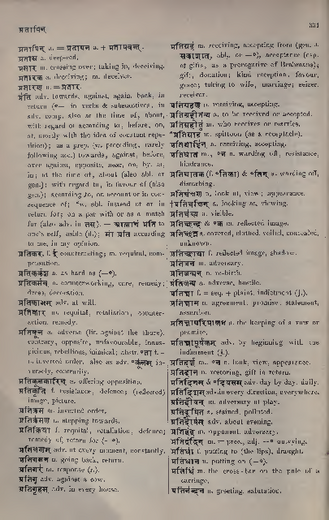
práti ·adv. towards, against, again, back, in return (°-- in verbs & substantives, in adv. comp. also at the time of, about, with regard or according to, before, on, at, mostly with the idea of constant repetition); as a prep. (w. preceding, rarely following acc.) towards, against, before, over against, opposite, near, on, by, at in; at the time of, about (also abl. or gen.); with regard to, in favour of (also gen.); according to, on account or in consequence of; *w. abl. instead of or in return for; on a par with or as a match for (also adv. in tas). -- ātmānaṃ prati to one's self, aside (d.); māṃ prati according to me, in my opinion.
Monier-Williams 1872 substantive masculine · Word type unspecified
Original text · English · substantive masculine
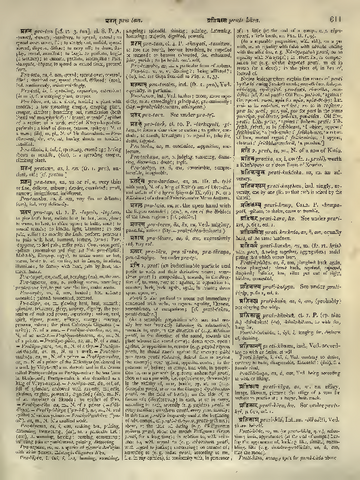
prati 2 . prati, is, m., N. of a son of Kuśa.
Original text · English · Word type unspecified
prati 1 . prati (an indeclinable particle and prefix to verbs and their derivative nouns; some- times pratī in composition), towards, in the direc- tion of, to, unto, near to; against, in opposition to, counter; back, back again, again, in return; down upon, upon, on.
Original text · English · Word type unspecified
Prati is also prefixed to nouns not immediately connected with verbs, to express equality, likeness, resemblance, or comparison; [cf. prati-cakra, prati-candra.] (As a separable preposition with acc. and usu- ally but not invariably following its substantive), towards, to, unto, in the direction of (e. g. śabdam prati, in the direction of the sound, towards the place whence the sound came); down upon, upon; against, in opposition to, counter (e. g. yāyād ripum prati, he should march against the enemy; pāhi nas tvam prati rīṣataḥ, defend thou us against the enemy); over against, opposite, contra; in the presence of, before; in comparison with, in propor- tion to, on a par with (e. g. tvaṃ sahasrāṇi prati, thou art on a par with, i. e. equivalent to, thousands); in the vicinity of, near, beside, by, at, on (e. g. Gaṅgām prati, at or on the Ganges; āyodhanam prati, on the field of battle); on the side of, in favour of; (distributively) in each, at or in every, according to each, severally (e. g. yajñam prati, at every sacrifice; varṣam prati, every year, annually; in this sense prati is frequently used at the beginning of adv. comps., cf. prati-kṣaṇam, prati-gṛham); about, at the time of, during (e. g. Phālgunam māsam prati, about the month Phālguna; ciram prati, for a long time); in relation to, with refer- ence to, with regard to (e. g. dharmam prati, with regard to justice); concerning; on account of; according to (e. g. mām prati, according to me, i. e. in my opinion), in conformity with, in pursuance of; a little (at the end of a comp., e. g. sūpa- prati, a little broth, see Pāṇ. II. 1, 9). (As a separable preposition, with abl.), on a par with, on an equality with (also with adverbs ending with the affix tas, e. g. Nārāyaṇataḥ prati, on an equality with Nārāyaṇa); in return for, as compen- sation for (e. g. ukṣā kapotāt prati, an ox in return for a dove); in the place of, in lieu of, instead of. Native lexicographers explain the senses of prati by the following Sanskrit words: pra-dhāna, kṣepa, niś-caya, vy-āvṛtti, pra-śasti, vi-rodha, sam- ādhi: [cf. Zend paiti: Old Pers. pati-sh, ‘against:’ Gr. προ-τί, πα-τί, πρός for πρότ, πρόσ-θε-(ν): Lat. red- as in red-dere, red-ire; re- as in re-ferre; prœ for prai; por, pol, pos for port in the forms por-rigo, pol-liceor, pol-lus, pos-sides: Old Slav. proti: Lith. prësz, ‘against:’ Bohem. proti: Hib. frith, frioth, as in frithbeart, ‘I object, oppose;’ frithbuille, ‘a back-stroke;’ frithshearc, ‘a return of love, mutual regard;’ frithcuirim, ‘I oppose, obstruct;’ frithbharamhuil, ‘a paradox.’]
Petersburger 1855 adverb · substantive masculine · Word type unspecified
Original text · German · adverb
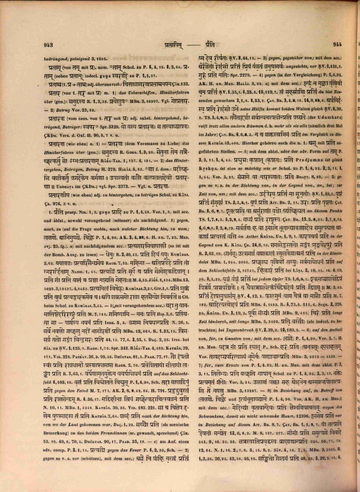
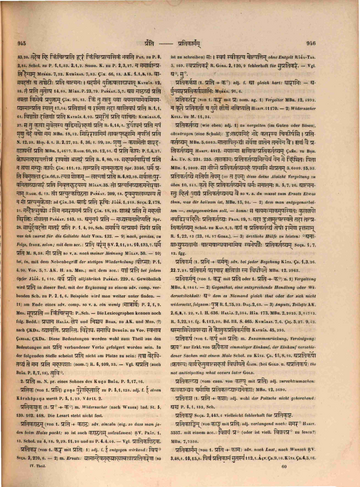
1. práti praep. NIR. 1,3. gaṇa prādi zu P. 1,4,58. VOP. 1,8. mit acc. und ablat., sowohl vorangehend (seltener) als nachfolgend. 1〉 gegen, nach, zu (auf die Frage wohin, nach welcher Richtung hin, zu wem; lakṣaṇe, ābhimukhye, cihne P. 1,4,90. AK. 3,4,32,6. H. an. 7,23. MED. avy. 25. fg.). a〉 mit nachfolgendem acc.: pratyagāramivāyāntī (so ist mit der Bomb. Ausg. zu lesen) — dhenuḥ R. 2,40,42. prati divaṃ yayuḥ KUMĀRAS. 2,62. yayāvajaḥ pratyarisainyameva RAGH. 7,52. mahimā — atiprapede prati tāṃ smarārditām NAIṢ. 1,41. pratyagniṃ prati sūryaṃ ca prati somodakadvijān . prati gāṃ prati vātaṃ ca prajñā naśyati mehataḥ .. M. 4,52. YĀJÑ. 1,134. MBH. 13,5029. MBH. 3,12437. MBH. 4,1462. pratyanilaṃ viceruḥ KUMĀRAS. 3,31. GĪT. 1,1. prati śukraṃ prati budhaṃ pratyaṅgārakameva ca . api śakrasamo rājā hatasainyo nivartate .. Cit. beim Schol. zu KUMĀRAS. 3,43. — b〉 mit vorangehendem acc.: yadā tu yānamātiṣṭhedarirāṣṭraṃ prati M. 7,181. gamiṣyāmi — nabhaḥ prati HIḌ. 3,6. prasthitā sā — pārthasya bhavanaṃ prati INDR. 5,5. jagāma niṣadhānprati N. 26,1. sarve bhavanto gacchantu nadīṃ bhāgīrathīṃ prati MBH. 15,861. R. 1,33,15. visasarja tato gaṅgāṃ vindusaraḥ prati R. 44,13. R. 77,6. R. 2,55,1. DAŚ. 2,35. ITIH._bei_SĀY._zu_ṚV. 1,125,1. RAGH. 1,75. Spr. 343. RĀJA-TAR. 4,469. KATHĀS. 39,171. VID. 324. PAÑCAT. 36,3. PAÑCAT. 95,25. DHŪRTAS. 81,5. PRAB. 77,17. tau daṃpatī svāṃ prati rājadhānīṃ prasthāpayāmāsa RAGH. 2,70. praveśitāyāṃ sītāyāṃ laṅkāṃ prati R. 3,63,1. varṣeṇāmṛtayuktena vavarṣāyodhanaṃ prati auf das Schlachtfeld R. 6,105,18. vṛkṣaṃ prati vidyotate vidyut P. 1,4,90, Sch. tadā yāyādripuṃ prati gegen den Feind M. 7,171. AK. 2,8,2,42. AK. 2,8,2,64. H. 791. pradudruvustaṃ prati rākṣasendram R. 6,36,17. madvihīnāṃ dviyaṃ gacchetkadācitsvajanaṃ prati N. 10,11. MBH. 1,5248. KATHĀS. 30,35. VID. 185. VID. 221. sā ca cikṣepa dantena puṣpamādāya taṃ prati KATHĀS. 7,64. śabdaṃ prati nach der Richtung hin, von wo der Laut gekommen war, DAŚ. 1,22. sakhyau prati (als scenische Bemerkung) zu den beiden Freundinnen (sc. gewandt, sprechend) ŚĀK. 53,19. ŚĀK. 49,8. ŚĀK. 70,4. DHŪRTAS. 90,17. PRAB. 33,18. — c〉 am Anf. eines adv. comp. P. 2,1,14. pratyagni gegen das Feuer P. 6,2,33, Sch. — 2〉 gegen so v. a. vor (schützen), mit dem acc.: agne̱ ni pā̀hi na̱stvaṃ pratì ṣma deva̱ rīṣàtaḥ ṚV. 8,44,11. — 3〉 gegen, gegenüber von; mit dem acc.: arèjetā̱ṃ rodàsī̱ pratì pri̱yaṃ yàja̱taṃ ja̱nuṣā̱mavàḥ angesichts, vor ṚV. 1,151,1. guruṃ prati natiḥ Spr. 2279. — 4〉 gegen (in der Vergleichung) P. 1,4,92. AK. H. an. MED. HALĀY. 5,95. a〉 mit dem acc.: indra̱ṃ na ma̱hnā pṛ̀thi̱vī ca̱na pratì ṚV. 1,55,1. ṚV. 6,25,5. ṚV. 10,119,7. tvaṃ sa̱hasrā̀ṇi̱ pratì du bist Tausenden gewachsen ṚV. 2,1,8. ṚV. 8,53,2. ŚAT. BR. 3,4,3,18. ŚAT. BR. 14,8,15,8. a̱rdhamidàsya̱ prati̱ rodàsī ubhe seine Hälfte kommt beiden Welten gleich ṚV. 6,30,1. TS. 5,4,8,3. tayaitadūrjā sarvānvanaspatīnprati pacyate (der Udumbara) reift trotz allen andern Bäumen d. h. mehr als sie alle (nämlich drei Mal im Jahre) ŚAT. BR. 6,6,3,3. na ca śaktastvamimaṃ prati im Vergleich zu diesem KATHĀS. 45,400. Hierher gehören auch die u. 1. as mit prati angeführten Stellen. — b〉 mit dem ablat. oder der adv. Form auf tas P. 2,3,11. P. 5,4,44. pradyumnaḥ kṛṣṇāt (kṛṣṇataḥ) prati Pradyumna ist gleich Kṛṣṇa, ist eben so mächtig wie er Schol. zu P. 1,4,92. P. 2,3,11. P. 5,4,44. VOP. 5,21. saṃgrāme yā nārāyaṇataḥ prati BHAṬṬ. 8,89. — 5〉 gegen so v. a. in der Richtung von, in der Gegend von, an, bei; zur Zeit von, um; mit dem acc.: udī̀raya̱ pratì mā sū̱nṛtā̀ḥ ṚV. 1,48,2. pṛ̱ṣṭhaṃ pratì sa̱ṃgṛhyà TS. 2,1,5,1. yūpaṃ prati AIT. BR. 2,11. uraḥ prati pṛṣṭayaḥ ŚAT. BR. 8,6,2,7. e̱tatprati̱ vā asùrāṇāṃ ya̱jño vyàcchidyata an diesem Punkte TS. 1,7,1,5. TS. 5,5,2,4. madhyaṃ prati rāṣṭrasya ŚAT. BR. 13,5,4,24. ŚAT. BR. 3,7,1,13. ŚAT. BR. 4,6,8,5. ŚAT. BR. 8,2,4,19. sarvāṇi ha vā imāni bhūtānyākāśādeva samutpadyanta ākāśaṃ pratyastaṃ yanti im Aether CHĀND. UP. 1,9,1. kārapacavaṃ prati in der Gegend von K. KĀTY. ŚR. 24,6,10. samāsedustato gaṅgāṃ śṛṅgaverapuraṃ prati R. 2,83,19. (garbham) utsasarja yathākālaṃ sthūlakeśāśramaṃ prati in der Einsiedelei MBH. 1,944. MBH. 1,3005. pracchādya pṛthivīṃ tasthuḥ sarvamāyodhanaṃ prati auf dem Schlachtfelde MBH. 3,15745. hiṃkāraṃ prati bei LĀṬY. 2,10,15. LĀṬY. 2,10,16. LĀṬY. 4,10,26. LĀṬY. 8,1,22. ya̱jñaṃ yàjña̱ṃ pratì bei jedem Opfer TS. 1,6,5,1. ekamapyāśayedvipraṃ pitrarthe pāñcayajñike . na caivātrāśayetkaṃcidvaiśvadevaṃ prati dvijam .. M. 3,83. pratì do̱ṣāmu̱ṣāsàm ṚV. 4,12,2. phālgunaṃ vātha caitraṃ vā māsau prati M. 7,182. ādityasyodayaṃ prati MBH. 4,1482. R. 6,73,8. R. 6,111,6. SUŚR. 2,376,20. CHĀND. UP. 3,19,3. pūrvāṃ saṃdhyāṃ prati MBH. 9,411. ciraṃ prati lange Zeit hindurch, seit lange MBH. 5,3469. prati̱ vastòḥ (als indecl. zu betrachten) bei Tagesanbruch ṚV. 2,39,3. ṚV. 10,189,3. — 6〉 auf den Antheil von, für, zu Gunsten von; mit dem acc. (bhāge) P. 1,4,90. VOP. 5,7. H. an. MED. yadatra māṃ prati syāt P., Sch. haraṃ prati (abhavat) halāhalam VOP. tāvadapyaparityājyaṃ bhūmernaḥ pāṇḍavānprati MBH. 5,2312 = MBH. 5,4258. — 7〉 für, zum Ersatz von P. 1,4,92. H. an. MED. mit dem ablat. P. 2,3,11. tilebhyaḥ prati yacchati māṣān Schol. zu P. 1,4,92. P. 2,3,11. bhakteḥ pratyamṛtaṃ śaṃbhoḥ VOP. 5,21. ukṣāṇaṃ paktvā saha odanena asmātkapotātprati te nayantu MBH. 3,13287. — 8〉 in Beziehung auf, in Betreff von (lakṣaṇe, cihne und itthaṃbhūtākhyāne P. 1,4,90. VOP. AK. H. an. MED.); mit dem acc.: medinyāṃ kṛtavāndevaḥ prati kṣobhamivācalam wegen des Schwankens, damit sie nicht schwanke HARIV. 12396. imameva prati nur in Beziehung auf diesen AIT. BR. 8,7. ŚAT. BR. 1,1,2,7. yāṃ tatprati devatāṃ manyeta ŚAT. BR. 12,6,1,2. M. 8,157. M. 8,277. sīmāṃ prati samutpanne vivāde M. 245. M. 9,16. M. 9,31. M. 9,55. kṣatrasyātipravṛddhasya brāhmaṇānprati M. 320. M. 10,77. M. 10,78. M. 12,84. N. 1,16. N. 2,1. N. 2,6. N. 5,15. N. 8,2. SĀV. 4,18. SĀV. 7,5. MBH. 3,2803. R. 1,3,35. R. 1,20,22. R. 1,43,10. R. 1,46,15. śaṅkito gautamaṃ prati R. 48,23. R. 2,29,2. R. 1,15. R. 6,83,20. tadeva hi kiṃcitprati dūraṃ kiṃcitpratyantikaṃ bhavati PAT._zu_P. 8,2,84. Schol. zu P. 1,1,33. P. 2,1,2. SIDDH. K._zu_P. 2,3,27. na mamārthānprati dainyam MṚCCH. 7,22. KUMĀRAS. 7,83. ŚĀK. 66,18. AK. 1,1,5,15. vāsavadattāṃ ca tacceṭīḥ prati cātmanaḥ . adarśanaṃ yuktibalādvyadhāt KATHĀS. 12,59. taṃ prati tutoṣa KATHĀS. 14,88. MĀRK. P. 23,79. PAÑCAT. 5,7. atha māṭhavyaṃ prati bhavatā kimevaṃ prayuktam ŚĀK. 95,13. kiṃ nu khalu yathā vayamasyāmevamiyamapyasmānprati syāt ŚĀK. 17,14. pratijñātaṃ ca rāmeṇa tadā bālivadhaṃ prati R. 1,1,61. vijñapto dakṣiṇāṃ prati KATHĀS. 4,93. prasūtiṃ prati yācitaḥ KUMĀRAS. 6,27. sa tu kṛtvā suvelasya buddhimārohaṇaṃ prati R. 6,14,1. duryodhanaṃ prati nṛpaṃ śṛṇu cedaṃ vaco mama MBH. 18,12. girirājamimaṃ tāvatpṛcchāmi nṛpatiṃ prati N. 12,28. HIḌ. 4,1. R. 2,27,23. R. 6,36,1. R. 6,99,38. śṛṇu — kathāmetāṃ śāradaṇḍāyanīṃ prati MBH. 1,4677. RAGH. 10,29. RAGH. 12,51. yaṃ prati kopaḥ P. 1,4,37. krodhamāhārayattīvra rāvaṇo bhrātaraṃ prati R. 6,80,19. sahadharmacāriṇaṃ prati na tvayā manyuḥ kāryaḥ ŚĀK. 111,12. tānprati mānamujjhata Spr. 3346. dharmaṃ prati vimukhatā ŚĀK. 66,2. tyaja śokam — lakṣmaṇaṃ prati R. 6,82,35. sarvāntaḥpuravanitāvyāpāraṃ prati nivṛttahṛdayasya MĀLAV. 35. tāṃ pratyabhivyaktamanorathānām RAGH. 6,12. tvāṃ pratyutkaṇṭhitā PAÑCAT. 209,18. evamupālabdhasya te na māṃ pratyanukrośaḥ ad ŚĀK. 54. śrāddhaṃ prati ruciḥ YĀJÑ. 1,218. SUŚR. 2,178,21. mandautsukyo 'smi nagaragamanaṃ prati ŚĀK. 18,22. śāstraṃ prati me mahatī viraktiḥ saṃjātā PAÑCAT. 143,15. anunayaṃ prati — madhyasthatāmeṣyati Spr. 28. sādhurdevadatto mātaraṃ prati P. 1,4,90, Sch. samarthaye yatprathamaṃ priyāṃ prati was ich zuerst für die Geliebte hielt VIKR. 132. — 9〉 nach, gemäss, zu Folge, franz. selon; mit dem acc.: prati̱ varàm ṚV. 2,11,21. ṚV. 10,133,7. dharmaṃ prati M. 8,58. māṃ prati so v. a. nach meiner Meinung MĀLAV. 50. — 10〉 bei, in, mit dem Nebenbegriff der stetigen Wiederholung (vīpsā) P. 1,4,90. VOP. 5,7. AK. H. an. MED.; mit dem acc.: yajñaṃ prati bei jedem Opfer YĀJÑ. 1,110. varṣaṃ prati alljährlich PAÑCAT. 229,6. Gewöhnlich wird prati in dieser Bed. mit der Ergänzung zu einem adv. comp. verbunden Sch. zu P. 2,1,6. Beispiele wird man weiter unter finden. — 11〉 am Ende eines adv. comp. so v. a. ein wenig (mātrārthe) P. 2,1,9. MED. sūpaprati = kiṃcitsūpaḥ P., Sch. — Die Lexicographen kennen noch folg. Bedd.: pradhāna HALĀY. kṣepa und niścaya BHAR._zu_AK. und MED. (?) nach ŚKDR. vyāvṛtti, praśasti, virodha, samādhi DURGĀD._zu_VOP. svabhāva ŚABDAR. ŚKDR. Diese Bedeutungen werden wohl zum Theil aus den Bedeutungen mit prati verbundener Verba gefolgert worden sein. In der folgenden Stelle scheint prati nicht am Platze zu sein: tacca vedayitavyaṃ te mama prati mahāyaśāḥ (nom. !) R. 6,109,33. — Vgl. aprati (auch BHĀG. P. 8,7,18), tuvi˚.
Original text · German · substantive masculine
2. prati m. N. pr. eines Sohnes des Kuśa BHĀG. P. 9,17,16.
Original text · German · Word type unspecified
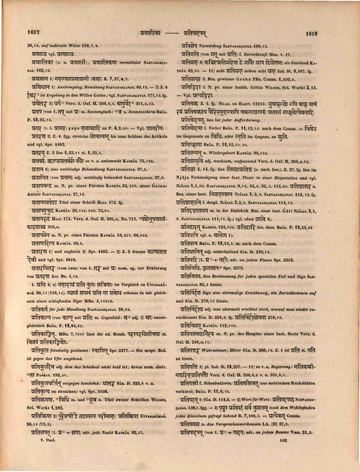
1. prati 4〉a〉 mahārājaṃ prati kutaḥ kṣatriyāḥ im Vergleich zu UTTARARĀMAC. 90,15 (116,14). vyāghraṃ śayānaṃ prati mā prabodha erkenne in mir gleichsam einen schlafenden Tiger MBH. 3,10653.
Original text · German · Word type unspecified
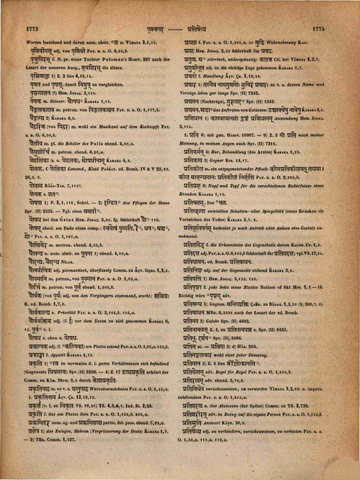
1. prati 8〉 mit gen. HARIV. 10967. — 9〉 Z. 3 māṃ prati nach meiner Meinung, in meinen Augen auch Spr. (II) 7211.
Böhtlingk 1879 adverb · particle · substantive masculine
Original text · German · adverb · particle
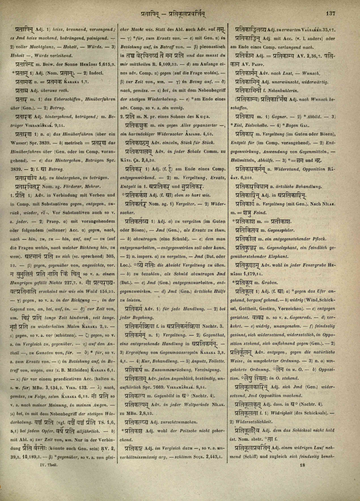
1. práti — 1〉 Adv. in Verbindung mit Verben und in Comp. mit Substantiven gegen, entgegen, zurück, wieder, rĕ-. Vor Substantiven auch so v. a. jeder. — 2〉 Praep. — a〉 mit vorangehendem oder folgendem (seltener) Acc. — α〉 gegen, nach, nach — hin, zu, — hin, auf, auf — zu (auf die Fragen wohin, nach welcher Richtung hin, zu wem). ātmānaṃ prati. zu sich (sc. sprechend) Chr. 305,32. — β〉 gegen, gegenüber von, angesichts, vor. na bubhukṣitaṃ prati bhāti kiṃ cit so v. a. einem Hungrigen gefällt Nichts Chr. 227,8. māṃ pratyaraṇyavatpratibhāti erscheint mir wie Wald Chr. 154,25. — γ〉 gegen, so v. a. in der Richtung —, in der Gegend von, an, bei, auf, in. — δ〉 zur Zeit von, um ciraṃ prati lange Zeit hindurch, seit lange. bhṛśaṃ prati zu wiederholten Malen CARAKA. 2,2. — ε〉 gegen, so v. a. vor (schützen). — ζ〉 gegen, so v. a. im Vergleich zu, gegenüber. — η〉 auf den Antheil —, zu Gunsten von, für. — ϑ〉 *für, so v. a. zum Ersatz von. — ι〉 in Beziehung auf, in Betreff von, wegen, aus (z. B. Mitleiden) CARAKA. 6,1. — ϰ〉 für von einem praedicativen Acc. (halten u. s. w. für) MBH. 3,134,3. VIKR. 132. — λ〉 nach, gemäss, zu Folge, selon CARAKA. 6,18. māṃ prati so v. a. nach meiner Meinung, in meinen Augen. — μ〉 bei, in mit dem Nebenbegriff der stetigen Wiederholung. yajñaṃ prati (vgl. yajñáṃ yajñaṃ práti TS. 1,6,5,1) bei jedem Opfer, varṣaṃ prati alljährlich. — b〉 mit Abl. — α〉 zur Zeit von, um. Nur in der Verbindung práti vástoḥ (könnte auch Gen. sein) ṚV. 2,39,3. 10,189,3. — β〉 *gegenüber, so v. a. von gleicher [Page4-137-b] Macht wie. Statt des Abl. auch Adv. auf tas. — γ〉 *für, zum Ersatz von. — c〉 mit Gen. — α〉 in Beziehung auf, in Betreff von. — β〉 pleonastisch in tacca vedayitavyaṃ te mama prati und das musst du mir mittheilen R. 6,109,33. — d〉 am Anfange einen Adv. Comp. — α〉 gegen (auf die Frage wohin). — β〉 zur Zeit von, um. — γ〉 in Bezug auf. — δ〉 nach, gemäss. — ε〉 bei, in mit dem Nebenbegriff der stetigen Wiederholung. — e〉 *am Ende eines adv. Comp. s. v. a. ein wenig.
Original text · German · substantive masculine
2. prati m. N. pr. eines Sohnes des Kuśa.
Apte 1890 particle
Original text · English · particle
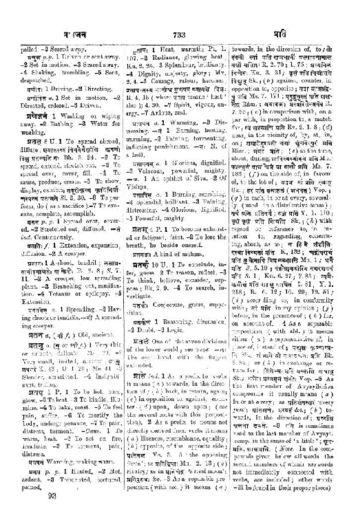
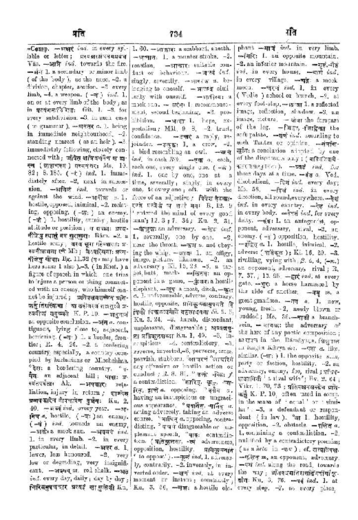
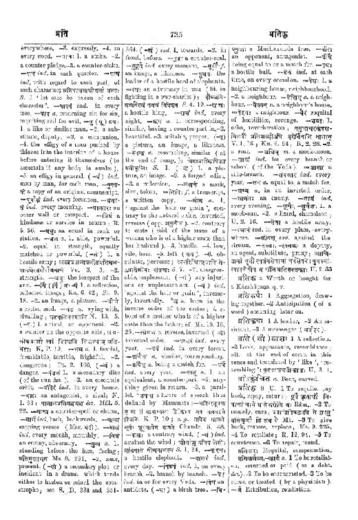
prati ind. 1 As a prefix to verbs it means (a) towards, in the direction of; (b) back, in return, again; (c) in opposition to, against, counter; (d) upon, down upon; (see the several roots with this preposition). 2 As a prefix to nouns not directly derived from verbs it means (a) likeness, resemblance, equality; (b) opposite, of the opposite side; pratibala Ve. 3. 5 ‘the opposing force’; so pratidvipāḥ Mu. 2. 13; (c) rivalry; as in praticaṃdraḥ ‘a rival moon’; pratipuruṣaḥ &c. 3 As a separable preposition (with acc.) it means (a) ([Page 0733-c]) towards, in the direction of, to; tau daṃpatī svāṃ prati rājadhānīṃ prasthāpayāmāsa vaśī vasiṣṭhaḥ R. 2. 70; R. 1. 75; pratyanilaṃ viceruḥ Ku. 3. 31; vṛkṣaṃ prati vidyotate vidyut Sk.; (b) against, counter, in opposition to, opposite; tadā yāyādripuṃ prati Ms. 7. 171; pradudruvustaṃ prati rākṣaseṃdraṃ Rām.; yayāvajaḥ pratyarisainyameva R. 7. 55; (c) in comparison with, on a par with, in proportion to, a match for; tvaṃ sahasrāṇi prati Rv. 2. 1. 8; (d) near, in the vicinity of, by, at, in, on; samāsedustato gaṃgāṃ śṛṃgaverapuraṃ prati Rām.; gaṃgāṃ prati; (e) at the time, about, during; ādityasyodayaṃ prati Mb.; phālgunaṃ vātha caitraṃ vā māsau prati Ms. 7. 182; (f) on the side of, in favour of, to the lot of; yadatra māṃ prati syāt Sk.; haraṃ prati halāhalaṃ (abhavat) Vop.; (g) in each, in or at every, severally (used in a distributive sense); varṣaṃ prati, prativarṣaṃ; yajñaṃ prati Y. 1. 110; vṛkṣaṃ vṛkṣaṃ prati siṃcati Sk.; (h) with regard or reference to, in relation to, regarding, concerning, about, as to; na hi me saṃśītirasyā divyatāṃ prati K. 132; caṃdroparāgaṃ prati tu kenāpi vipralabdhāsi Mu. 1; dharmaṃ prati Ś. 5. 18; maṃdautsukyosmi nagaragamanaṃ prati Ś. 1; Ku. 6. 27; Ku. 7. 83; tvayaikamīśaṃ prati sādhu bhāṣitaṃ Ku. 5. 81; Y. 1. 218; R. 6. 12; R. 10. 29; R. 12. 51; (i) according to, in conformity with; māṃ prati in my opinion; (j) before, in the presence of; (k) for, on account of. 4 As a separable preposition (with abl.) it means either (a) a representative of, in place of, instead of; pradyumnaḥ kṛṣṇātprati Sk., saṃ grāme yo dārāyaṇataḥ prati Bk. 8. 89; or (b) in exchange or return for; tilebhyaḥ prati yacchati māṣān Sk.; bhakteḥ pratyamṛtaṃ śaṃbhoḥ Vop. 5 As the first member of Avyayībhāva compounds it usually means (a) in or at every; as pratisaṃvatsaraṃ ‘every year’; pratikṣaṇaṃ, pratyahaṃ &c.; (b) towards, in the direction of; pratyagni śalabhā ḍayaṃte. 6 prati is sometimes used as the last member of Avyayī. comp. in the sense of ‘a little’; sūpaprati, śākaprati. (Note. In the compounds given below all words the second members of which are words not immediately connected with verbs, are included; other words will be found in their proper places) ([Page 0734-a]) Comp. — akṣaraṃ ind. in every syllable or letter; pratyakṣaraśleṣamayaprabaṃdha Vās. — āgni ind. towards the fire. — aṃgaṃ 1 a secondary or minor limb (of the body), as the nose. 2 a division, chapter, section. 3 every limb. 4 a weapon. — (gaṃ) ind. 1 on or at every limb of the body; as in pratyaṃgamāliṃgitaḥ Gīt. 1. 2 for every subdivision. 3 in each case (in grammar). — anaṃtara a. 1 being in immediate neighbourhood. 2 standing nearest (as an heir). 3 immediately following, closely connected with; jīvet kṣatriyadharmeṇa sa hyasya (brāhmaṇasya) pratyanaṃ taraḥ Ms. 10. 82; Ms. 8. 185. — (raṃ) ind. 1 immediately after. 2 next in succession. — anilaṃ ind. towards or against the wind. — anīka a. 1 hostile, opposed, inimical. 2 resisting, opposing. — (kaḥ) an enemy. — (kaṃ) 1 hostility, enmity, hostile attitude or position; na śaktāḥ pratyanīkeṣu sthātuṃ mama surāsurāḥ Rām. 2 a hostile army; yasya śūrā maheṣvāsāḥ pratyanīkagatā raṇe Mb.; ye'vasthitāḥ pratyanīkeṣu yodhāḥ Bg. 11. 32 (pra˚ may have here sense 1 also). 3 (in Rhet.) a figure of speech in which one tries to injure a person or thing connected with an enemy, who himself cannot be injured; pratipakṣamaśaktena pratikartu tiraskriyā . yā tadīyasya tatstutyai pratyanīkaṃ taducyate K. P. 10. — anumānaṃ an opposite conclusion. — aṃta a. contiguous, lying close to, adjacent, bordering. — (taḥ) 1 a border, frontier; R. 4. 26. 2 a bordering country; especially, a country occupied by barbarians or Mlecchas. ˚deśaḥ a bordering country. ˚parvataḥ an adjacent hill; pādāḥ pratyaṃtaparvatāḥ Ak. — apakāraḥ retaliation, injury in return; śāmyet pratyapakāreṇa nopakāreṇa durjanaḥ Ku. 2. 40. — abdaṃ ind. every year. — amitra a. hostile. — (traḥ) an enemy. — (traṃ) ind. towards an enemy. — arkaḥ a mock sun. — avayavaṃ ind. 1 in every limb. 2 in every particular, in detail. — avara a. 1 lower, less honoured. 2 very low or degrading, very insignificant. — aśman m. red chalk. — ahaṃ ind. every day, daily; day by day; giriśamupacacāra pratyahaṃ sā sukeśī ([Page 0734-b]) Ku. 1. 60. — ākāraḥ a scabbard, sheath. — āghātaḥ 1 a counter-stroke. 2 reaction. — ācāraḥ suitable conduct or behaviour. — ātmaṃ ind. singly, severally. — ātmaka a. belonging to oneself. — ātmyaṃ similarity with oneself. — ādityaḥ a mock sun. — āraṃbhaḥ 1 recommencement, second beginning. 2 prohibition. — āśā 1 hope, expectation; Māl. 9. 8. 2 trust, confidence. — uttaraṃ a reply, rejoinder. — ulūkaḥ 1 a crow. 2 a bird resembling an owl. — ṛcaṃ ind. in each Ṛk. — eka a. each, each one, every single one. — (kaṃ) ind. 1 one by one, one at a time, severally; singly, in every one, to every one; oft. with the force of an adjective; viveśa daṃḍakāraṇyaṃ pratyekaṃ ca satāṃ manaḥ R. 12. 9 ‘entered the mind of every good man’; R. 12. 3, R. 7. 34; Ku. 2. 31. — kaṃcukaḥ an adversary. — kaṃṭhaṃ ind. 1 severally, one by one. 2 near the throat. — kaśa a. not obeying the whip. — kāyaḥ 1 an effigy, image, picture, likeness. 2 an adversary; Ki. 13. 28. 3 a target, butt, mark. — kitavaḥ an opponent in a game. — kuṃjaraḥ a hostile elephant. — kūpaḥ a moat, ditch. — kūla a. 1 unfavourable, adverse, contrary, hostile, opposite, pratikūlatāmupagate hi vidhau viphalatvameti bahusādhanatā Śi. 9. 6; Ku. 3. 24. 2 harsh, discordant, unpleasant, disagreeable; apyannapuṣṭā pratikūlaśabdā Ku. 1. 45. 3 inauspicious. 4 contradictory. 5 reverse, inverted. 6 perverse, cross, peevish, stubborn. ˚ācaraṇaṃ ˚ācaritaṃ any offensive or hostile action or conduct; R. 8. 81. ˚uktaṃ -ktiḥ f. a contradiction. ˚kārin, -kṛta, — cārin, -vṛṃtti a. opposing. ˚darśana a. having an inauspicious or ungracious appearance. ˚pravartin, -vartin a. acting adversely, taking an adverse course. ˚bhāṣin a. opposing, contradicting. ˚vacanaṃ disagreeable or unpleasant speech. ˚vādaḥ contradiction. (pratikūlatā, -tvaṃ adverseness, opposition, hostility. pratikūlayati ‘to oppose’). — kūlaṃ ind. 1 adversely, contrarily. 2 inversely, in inverted order. — kṣaṇaṃ ind. at every moment or instant; constantly; Ku. 3. 56. — gajaḥ a hostile ([Page 0734-c]) elephant — gātraṃ ind. in very limb. — giriḥ 1 an opposite mountain. 2 an inferior mountain. — gṛhaṃ, -gehaṃ ind. in every house. — grāmaṃ ind. in every village. — caṃdraḥ a mock moon. — caraṇaṃ ind. 1 in every (Vedic) school or branch. 2 at every foot-step. — chāyā 1 a reflected image, reflection, shadow. 2 an image, picture. — jaṃghā the forepart of the leg. — jihvā, -jihvikā the soft palate. — taṃtraṃ ind. according to each Tantra or opinion. — taṃtrasiddhāṃtaḥ a conclusion adopted by one of the disputants only; ( vādiprativādyekataramātrābhyupagataḥ). — iyahaṃ ind. for three days at a time. — daṃḍa a. Ved. disobedient. — dinaṃ ind. every day; Me. 58. — diśaṃ ind. in every direction, all round, everywhere. — deśaṃ ind. in every country. — dehaṃ ind. in every body. — daivataṃ ind. for every deity. — dvaṃdvaḥ 1 an antagonist, opponent, adversary, rival. 2 an enemy. — (dvaṃ) opposition, hostility. — dvaṃdbin a. 1 hostile, inimical. 2 adverse (pratikūla); Ki. 16. 29. 3 rivalling, vying with; Ś. 4. 4. ( — m.) an opponent, adversary, rival; R. 7. 37.; R. 15. 25. — dvāraṃ ind. at every gate. — dhuraḥ a horse harnessed by the side of another. — naptṛ m. a great-grandson. — nava a. 1 new, young, fresh. 2 newly blown or budded; Me. 36. — nāḍī a branchvein. — nāyakaḥ the adversary of the hero of any poetic composition; as rāvaṇa in the Rāmāyaṇa, śiśupāla in Māgha Kāvya &c. — pakṣa a. like, similar. — (kṣaḥ) 1 the opposite side, party or faction, hostility. 2 an adversary, enemy, foe, rival; pratipakṣakāminī ‘a rival wife’; Bv. 2. 64; Vikr. 1. 70, Vikr. 1. 73; pratipakṣamaśaktena pratikartuṃ K. P. 10; often used in comp. in the sense of ‘equal’ or ‘similar’. 3 a defendant or respondent (in law). ˚tā 1 hostility, opposition. 2 obstacle. — pakṣita a. 1 containing a contradiction. 2 nullified by a contradictory premiss; (as a hetu in nyāya); cf. satpratipakṣa. — pakṣin m. an opponent, adversary. — pathaṃ ind. along the road, towards the way; pratipathagatirāsīdvegadīrghīkṛtāṃgaḥ Ku. 3. 76. — padaṃ ind. 1 at every stop. 2 at every place, ([Page 0735-a]) everywhere. 3 expressly. 4 in every word. — pāṇaḥ 1 a stake. 2 a counter-pledge. 3 a counter-stake. — pādaṃ ind. in each quarter. — pātraṃ ind. with regard to each part, of each character; pratipātramādhīyatāṃ yatnaḥ Ś. 1 ‘let care be taken of each character’. — pādapaṃ ind. in every tree. — pāpa a. returning sin for sin, requiting evil for evil. — pu(pū)ruṣaḥ 1 a like or similar man. 2 a substitute, deputy. 3 a companion. 4 the effigy of a man pushed by thieves into the interior of a house before entering it themselves (to ascertain if any body is awake). 5 an effigy in general. — (baṃ) ind. man by man, for each man. — pustakaṃ a copy of an original manuscript. — pūrvāhṇaṃ ind. every forenoon. — prabhātaṃ ind. every morning. — prākāraḥ an outer wall or rampart. — priyaṃ a kindness or service in return; R. 5. 56. — baṃdhuḥ an equal in rank or station. — bala a. 1 able, powerful. 2 equal in strength, equally matched or powerful. — (laṃ) 1 a hostile army; astrajvālābalīḍhapratibalajaladheraṃtaraurvāyamāṇe Ve. 3. 5. 2 strength. — bāhuḥ the forepart of the arm. — biṃ(biṃ)baḥ -baṃ 1 a reflection, reflected image; Ku. 6. 42; Śi. 9. 18. 2 an image, a picture. — bījaṃ a rotten seed. — bhaṭa a. vying with, rivalling; ghaṭapratibhaṭastani N. 13. 5. — (ṭaḥ) 1 a rival, an opponent. 2 a warrior on the opposite side; saptālokyājau tvāṃ vidadhati vikalpān pratibhaṭāḥ K. P. 10. — bhaya a. 1 fearful, formidable, terrible, frightful. 2 dangerous; Pt. 2. 166. — (yaṃ) a danger. — maṃḍalaṃ 1 a secondary disc (of the sun &c.). 2 an eccentric orbit. — maṃdiraṃ ind. in every house. — mallaḥ an antagonist, a rival; N. 1. 63; pātālapratimallagalla &c. Māl. 5. 22. — māyā a counter-spell or charm. — mārgaṃ ind. back, backwards. — mālā capping verses (Mar. bhaṃḍī). — māsaṃ ind. every month, monthly. — mitraṃ an enemy, adversary. — mukha a. 1 standing before the face, facing; pratimukhāgata Ms. 8. 291. 2 near, present. — (khaṃ) a secondary plot or incident in a drama which tends either to hasten or retard the catastrophe; see S. D. 334 and S. D. 351-64 ([Page 0735-b]) — (khaṃ) ind. 1 towards. 2 in front, before. — mudrā a counter-seal. — muhūrtaṃ ind. every moment. — mūrtiḥ f. an image, a likeness. — yūthapaḥ the leader of a hostile herd of elephants. — rathaḥ an adversary in war (lit. in fighting in a war-chariot); dauṣyaṃtimapratirathaṃ tanayaṃ niveśya Ś. 4. 19. — rājaḥ a hostile king. — rātraṃ ind. every night. — rūpa a. 1 corresponding, similar, having a counter-part in. 2 beautiful. 3 suitable, proper. — (paṃ) a picture, an image, a likeness. — rupaka a. resembling, similar (at the end of comp.); ceṣṭāpratirūpikā manovṛttiḥ Ś. 1. — (kaṃ) 1 a picture, an image. 2 a forged edict. 3 a reflection. — lakṣaṇaṃ a mark, sign, token. — lipiḥ f. a transcript, a written copy. — loma a. 1 ‘against the hair or grain’, contrary to the natural order, inverted, reverse (opp. anuloma). 2 contrary to easte (said of the issue of a woman who is of a higher caste than her husband). 3 hostile. 4 low, vile, base. 5 left (vāma). 6 obstinate, perverse; aparicitasvāpi te'pratilomaḥ saṃvṛttaḥ Ś. 7. 7 disagreeable, unpleasant. — (maṃ) any injurious or unpleasant act. — (maṃ) ind. ‘against the hair or grain’, inversely, invertedly. ˚ja a. born in the inverse order of the eastes; i. e. born of a mother who is of a higher caste than the father; cf. Ms. 10. 16, Ms. 10. 25. — lomaka a. reverse, inverted. — (kaṃ) inverted order. — vatsaraṃ ind. every year. — vanaṃ ind. in every forest. — varṇika a. similar, corresponding. — vardhin a. being a match for. — varṣaṃ ind. every year. — vastu n. 1 an equivalent, a counter-part. 2 anything given in return. 3 a parallel. ˚upamā a figure of speech thus defined by Mammaṭa: — prativastūpamā tu sā .. sāmānyasya dvirekasya yatra vākyadvaye sthitiḥ K. P. 10; e. g. tāpena bhrājate sūryaḥ śūraścāpena rājate Chandr. 5. 48. — bātaḥ a contrary wind. — (taṃ) ind. against the wind; cīnāṃśukamiva ketoḥ prativātaṃ nīyamānasya Ś. 1. 34. — vāraṇaḥ a hostile elephant. — vāsaraṃ ind. every day. — viṭapaṃ ind. 1 on every branch. 2 branch by branch. — vedaṃ ind. in or for every Veda. — viṣaṃ an antidote. — (ṣā) a birch tree. ([Page 0735-c]) — viṣṇukaḥ a Mucukunda tree. — vīraḥ an opponent, antagonist. — vīryaṃ being equal to or a match for. — vṛṣaḥ a hostile bull. — velaṃ ind. at each time, on every occasion. — veśaḥ 1 a neighbouring house, neighbourhood. 2 a neighbour. — veśin a. a neighbour. — veśman n. a neighbour's house. — veśyaḥ a neighbour. — vairaṃ requital of hostilities, revenge. — śabdaḥ 1 echo, reverberation; vasudhādharakaṃdarābhisarpī pratiśabdo'pi harerbhinatti nāgān V. 1. 16; Ku. 6. 64; R. 2. 28. 2 a roar. — śaśin m. a mock-moon. — śākhaṃ ind. for every branch or school (of the Veda). — śākhā a side-branch. — saṃvatsaraṃ ind. every year. — sama a. equal to, a match for. — savya a. in an inverted order. — sāmaṃtaḥ an enemy. — sāyaṃ ind. every evening. — sūryaḥ, -sūryakaḥ 1 a mock-sun. 2 a lizard, chameleon; U. 2. 16. — senā a hostile army. — sthānaṃ ind. in every place, everywhere. — srotas ind. against the stream. — hastaḥ, -hastakaḥ a deputy, an agent, substitute, proxy; āśritānāṃ bhṛtau svāmisevāyāṃ dharmasevane . putrasyotpādane caiva na saṃti prati hastakāḥ H. 2. 33
Cappeller 1887 Word type unspecified
Original text · German · Word type unspecified
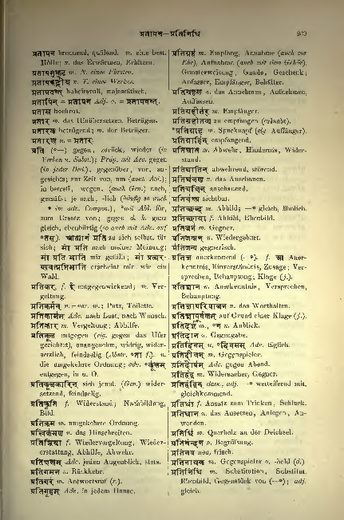
prati (˚—) gegen, zurück, wieder (in Verben u. Subst.); Präp. mit Acc. gegen (in jeder Bed.) gegenüber, vor, angesichts; zur Ziet von, um (auch Abl.); in betreff, wegen, (auch Gen). nach, gemäßig; je nach, -lich (häufig so auch —˚ im adv. Compos)., *mit Abl. für, zum Ersatz von; gegen d. h. ganz gleich, ebenbürtig (so auch mit Adv. auf ˚tas). ātmānaṃ prati zu sich selbst, für sich; māṃ prati nach meiner Meinung; māṃ prati bhāti mir gefällt; māṃ pratyara ṇyavatpratibhāti erscheint mir wie ein Wald.
Burnouf 1866 Word type unspecified
Original text · French · Word type unspecified
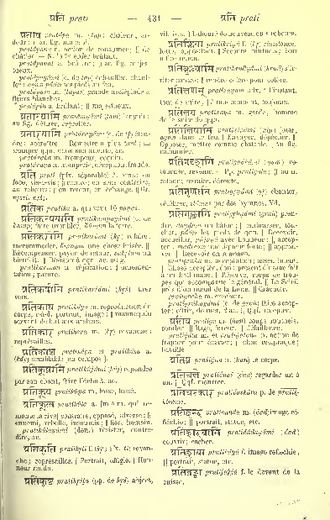
prati prati (pfx. séparable) à, vers; en face, vis-à-vis; contre; en sens contraire, au rebours; en retour, en échange. Gr. προτί, πρός.
Derived words
More direct derivatives (4)
Occurrences in source texts (48)
DYS 3 occurrences
GoS 1 occurrence
GoS 95–100: Dream and Discerning Knowledge 1 occurrence
Occurrences through derived words
-
GoS 95 Segment 6
HP 3 occurrences
HP 4.27*1-4.35: Rājayoga and Haṭha 1 occurrence
Occurrences through derived words
-
HP 4.27*1 Segment 11
MandUp 1 occurrence
MandUp 3-7: Four modes of awareness 1 occurrence
Occurrences through derived words
-
MandUp 7 Segment 26
PJH 2 occurrences
PYS 24 occurrences
PYS 1.5–11: The Five Vṛtti 3 occurrences
Occurrences through derived words
PYS 1.31–32: Distraction and Its Remedy 1 occurrence
Occurrences through derived words
-
PYS 1.32 Segment 2
PYS 2.10–11: Eliminating the Kleśas 1 occurrence
Occurrences through derived words
-
PYS 2.10 Segment 2
PYS 2.20–22: Puruṣa and the Seen 2 occurrences
Direct occurrences
-
PYS 2.22 Segment 3
Occurrences through derived words
-
PYS 2.20 Segment 6
8 more source pages
PYS 2.30–34: Vows and Counterreflection 2 occurrences
Occurrences through derived words
PYS 2.35–39: Perfected Yamas 4 occurrences
Occurrences through derived words
PYS 3.9–12: Three Transformations of Citta 1 occurrence
Occurrences through derived words
-
PYS 3.12 Segment 6
PYS 3.17–20: Extraordinary Knowledge 2 occurrences
Occurrences through derived words
PYS 3.35–37: Knowledge of Puruṣa and Siddhis 1 occurrence
Occurrences through derived words
-
PYS 3.35 Segment 5
PYS 4.27–28: The Return of Old Saṃskāras 1 occurrence
Occurrences through derived words
-
PYS 4.27 Segment 3