

bala बल – Kraft; Stärke
Adjektiv · Substantiv Maskulin · Substantiv Neutrum · Worttyp nicht bestimmt
Wörterbuchquellen
AYI Wörterbuch Substantiv Neutrum
Kraft; Stärke
Cappeller 1891 Substantiv Maskulin · Substantiv Neutrum
Originaltext · Englisch · Substantiv Neutrum
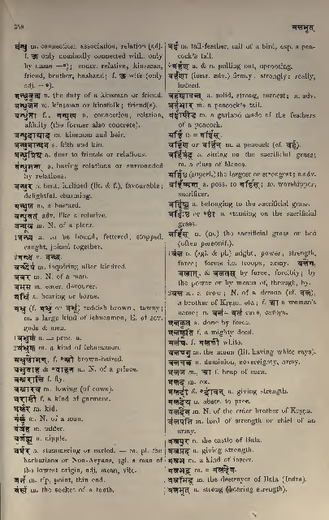
bála1 ·n. (sgl. & pl.) might, power, strength, force; forces i.e. troops, army. balena, balāt & balatas by force, forcibly; by the power or by means of, through, by.
Originaltext · Englisch · Substantiv Maskulin
bala2 ·m. a crow; N. of a demon (cf. valá), a brother of Krsna, etc.; f. ā a woman's name; n. balá = valá cave, cavern.
Monier-Williams 1872 Substantiv Neutrum
Originaltext · Englisch · Substantiv Neutrum
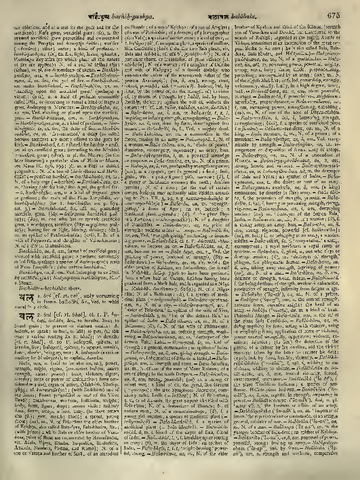
Bala, am, n. (said to be also as, m.), power, strength, might, vigour, (aurasam balam, native strength, innate power); force, violence, rigour, severity; force or power of articulation; force con- sidered as a sixth organ of action, (Mahā-bh. Śānti-p. 9895; cf. karmendriya); (with Buddhists) one of ten forces; Power personified as one of the Viśve Devāḥ; massiveness, stoutness, bulkiness, weight; body, form, figure, shape; semen virile; military force, forces, troops, a host, army, (in these senses also pl.); gum, myrrh; blood; a sprout, young shoot; (as), m., N. of Bala-rāma the elder brother of Kṛṣṇa, also called Bala-deva, Bala-bhadra, &c.; (with Jainas) a white Bala or elder brother of Vāsu- deva, (nine of these are enumerated by Hemacandra, viz. Acala, Vijaya, Bhadra, Su-prabha, Su-darśana, Ānanda, Nandana, Padma, and Rāma); N. of a son of Varuṇa and brother of Surā; of an attendant on Skanda; of a son of Kṛṣṇa; of a son of Aṅgiras; of a son of Pari-kṣit; of a demon; of a lexicographer (also Vala); a species of carrion crow; a kind of tree, = 1. balāya; (ā), f. an aquatic plant, a species of mallow, Sida Cordifolia; (bale, f. du. the two Balā plants, viz. Balā and Ati-balā, cf. ati-b˚, jyeṣṭha-b˚); N. of a particular charm or incantation of great efficacy [cf. ati-balā]; N. of a woman; of a daughter of Dakṣa and wife of Kaśyapa; of a female divinity who executes the orders of the seventeenth Arhat of the present Ava-śarpiṇī; (as, ā, am), strong, stout, robust, powerful; sick (= amin?); balena, ind. by force, by the power of, on the strength of; in virtue of, by means of, through, by; balāt, ind. by force, forcibly, violently; against the will of, without the consent of; [cf. Lat. valor, validus, valeo, de-bilis.]
Petersburger 1855 Adjektiv · Substantiv Maskulin · Substantiv Neutrum · Worttyp nicht bestimmt
Originaltext · Deutsch · Adjektiv · Substantiv Maskulin
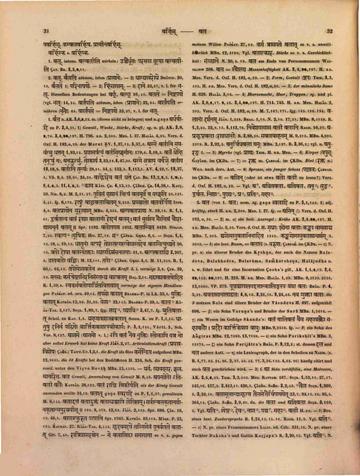
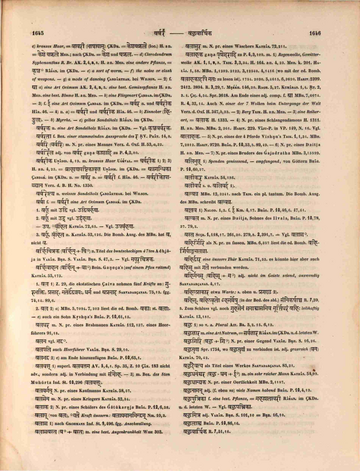
2. bala (von 1. bala) nom. ag. gaṇa jvalādi zu P. 3,1,140. 1〉 adj. kräftig, stark H. an. 2,500. MED. l. 37. fg. = amin (!) Verz. d. Oxf. H. 182,a,30. — 2〉 m. a〉 ein best. Aasvogel; Krähe AK. 3,4,26,197. H. an. MED. HALĀY. 5,23. Verz. d. Oxf. H. gṛdhrāḥ śyenā balāḥ kaṅkā vāyasāśca MBH. 7,203. śvagomāyubalābhinādita MBH. 7,1342. kaṅkagomāyubalāśanārtham MBH. 7,1. MBH. 7,3603. — b〉 ein best. Baum, = balāya (s. varuṇa) ŚABDAC._im_ŚKDR. — c〉 N. pr. — α〉 ein älterer Bruder des Kṛṣṇa, der auch die Namen Baladeva, Balabhadra, Balarāma, Saṃkarṣaṇa, Halāyudha u. s. w. führt und für eine Incarnation Śeṣaʼs gilt, AK. 1,1,1,19. AK. 3,4,23,143. AK. 3,4,26,197. H. 224. M. H. an. MED. HALĀY. 1,29. MBH. 9,2120. MBH. 9,2136. MBH. 13,6860. VP. 579. pūṣṇaścāpātayaddantānkāliṅgasya yathā balaḥ BHĀG. P. 4,5,21. avatājjanāntādbalaḥ BHĀG. P. 6,8,16. BHĀG. P. 8,21,16. BHĀG. P. 9,24,45. nava śuklā balāḥ die 9 weissen Bala sind ältere Brüder der Vāsudeva H. 697. aufgezählt H. 698. — β〉 ein Sohn Varuṇaʼs und Bruder der Surā MBH. 1,2616. — γ〉 ein Wesen im Gefolge Skandaʼs: balaṃ cātibalaṃ caiva mahāvaktrau mahābalau . pradadau kārttikeyāya vāyuḥ MBH. 9,2546. fg. — δ〉 ein Sohn des Aṅgiras MBH. 12,7593. MBH. 13,7108. — ε〉 ein Sohn Pariyātraʼs MBH. 3,13178. — ζ〉 ein Sohn Pariyātraʼs BHĀG. P. 9,12,2; st. dessen dala und nala andere Autt. — η〉 ein Lexicograph, der in den Scholien zu NAIṢ. (z. B. NAIṢ. 1,77. NAIṢ. 1,85. NAIṢ. 1,94. NAIṢ. 1,96. NAIṢ. 2,37. NAIṢ. 2,40. NAIṢ. 2,48. NAIṢ. 2,77. NAIṢ. 3,36. NAIṢ. 3,123. NAIṢ. 4,52. NAIṢ. 4,96) häufig citirt und auch vala geschrieben wird. — 3〉 f. ā Sida cordifolia, eine Malvacee, AK. 2,4,3,25. TRIK. 3,3,402. MED. RATNAM. 167. SUŚR. 1,53,11. SUŚR. 1,57,17. SUŚR. 1,145,16. SUŚR. 1,157,2. SUŚR. 2,413,11. SUŚR. 2,420,5. ŚĀRṄG. SAṂH. 2,2,43. ˚taila SUŚR. 1,369,5. SUŚR. 2,24,18. balāmūlānyāhṛtya tailametairvipācayet SUŚR. 23,7. SUŚR. 94,15. SUŚR. 94,16. SUŚR. 95,5. SUŚR. 364,12. ŚĀRṄG. SAṂH. 2,9,20. du. die balā und atibalā SUŚR. 2,110,2. Vgl. ati˚, jyeṣṭha˚, deva˚, nāga˚, pañca˚, mahā˚. balī H. an. — b〉 Bez. eines best. Zauberspruchs R. 1,24,12. R. 1,24,14. R. 1,24,16. RAGH. 11,9. Vgl. ati˚. — c〉 N. pr. eines Frauenzimmers LALIT. ed. Calc. 331,16. N. pr. einer Tochter Dakṣaʼs und Gattin Kaśyapaʼs R. 3,20,12. Vgl. ati˚. N. pr. einer Göttin, welche die Befehle des 17ten Arhantʼs der gegenwärtigen Avasarpiṇī ausführt, H. 45.
Originaltext · Deutsch · Substantiv Maskulin · Substantiv Neutrum
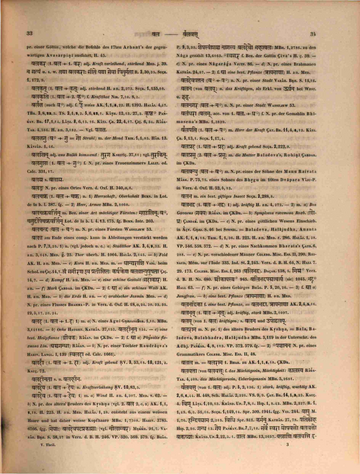
1. bála n. AK. 3,6,3,22. m. (dieses nicht zu belegen) und n. gaṇa ardharcādi zu P. 2,4,31. 1〉 Gewalt, Wucht, Stärke, Kraft; sg. u. pl. AK. 2,8,2,70. AK. 3,4,26,197. H. 796. H. an. 2,500. MED. l. 37. HALĀY. 4,38. Verz. d. Oxf. H. 182,a,29. der Marut ṚV. 1,37,12. ṚV. 5,57,6. a̱sme balā̀ni ma̱ghavàtsu dhattam ṚV. 1,93,12. pra̱jāmapàtya̱ṃ balàmi̱cchamā̀naḥ ṚV. 179,6. ṚV. 3,18,3. balàṃ dhehi ta̱nūṣù naḥ, a̱na̱ḻutsù, to̱kāyà ṚV. 3,53,18. ṚV. 6,47,30. a̱sme kṣa̱trāya̱ barcàse̱ balā̀ya ṚV. 10,18,9. balā̀ni ta̱nvàḥ ṚV. 28,11. ṚV. 54,2. ṚV. 133,5. ṚV. 9,113,1. AV. 4,10,7. AV. 19,37,1. VS. 9,9. VS. 19,91. VS. 24,38. bāhvoreva balaṃ dhatte ŚAT. BR. 13,2,2,5. ŚAT. BR. 13,1,9,4. ŚAT. BR. 9,4,4,3. ŚAT. BR. 11,4,4,3. ˚kāma KĀTY. ŚR. 4,15,23. ŚĀṄKH. ŚR. 14,58,1. KAUŚ. 59. NIR. 8,2. M. 2,31. M. 2,37. pūjitaṃ hyaśanaṃ nityaṃ balamūrjaṃ ca yacchati M. 55. M. 121. M. 4,41. fg. M. 8,172. rāṣṭraṃ bāhubalāśritam M. 9,255. prakhyāto balavīryeṇa INDR. 4,8. balaprāṇena śūrāṇām MBH. 4,355. alpabalaprāṇa N. 19,15. R. 1,1,61. durbalasya balaṃ rājā bālānāṃ rodanaṃ balam . balaṃ mūrkhasya maunitvaṃ caurāṇāmanṛtaṃ balam .. Spr. 1192. balopapanna Spr. 1952. balānvita Spr. 4429. SŪRYAS. 7,20. svalpa˚ (mūṣika) HIT. 27,18. sa˚ ŚĀṄKH. GṚHY. 6,5. — SUŚR. 1,4,13. SUŚR. 1,18,4. SUŚR. 1,19,13. dhātūnāṃ yatparaṃ tejastatkhalvojastadeva balamityucyate SUŚR. 50,15. trayo doṣā balasyoktāḥ vyāpadvisraṃsanakṣayāḥ SUŚR. 51,9. alpabalāgni SUŚR. 2,207,5. jātabalo vahniḥ M. 12,101. tapo˚ ŚĀṄKH. GṚHY. 4,5. M. 11,240. R. 1,60,1. R. 1,64,13. tapoyogabalena durch die Kraft d. i. vermöge R. 1,3,6. ŚUK. 39,19. manasaḥ karmaceṣṭābhirabhisaṃstabhya vāgbalam DAŚ. 2,11. madvākyabalacodita R. 1,39,8. svakarmabalopārjitavittatvāt vermöge der eigenen Handlungen PAÑCAT. ed. orn. 49,12. tapaso balāt BRAHMA-P. in LA. 55,6. yuktibalāt KATHĀS. 12,59. KATHĀS. 31,93. yoga˚ KATHĀS. 32,143. BRAHMA-P. 59,2. kāla˚ RĀJA-TAR. 5,137. SUŚR. 1,89,7. fgg. kṣāra˚, vyādhi˚ SUŚR. 2,47,7. fg. śrutibalāt Schol. zu KAP. 1,8. grahaṇakaśāstrabalāt SIDDH. K._zu_P. 1,1,10. dhātuṣu dabhirna paṭhito vārttikabalātsvīkāryaḥ P. 3,1,124, Vārtt. 3, Sch. VOP. 8,127. āgame (āgamo v. l.) 'pi balaṃ naiva bhuktiḥ stokāpi yatra no aber selbst Erwerb hat keine Kraft YĀJÑ. 2,27. Articulationskraft (prayatnaviśeṣaḥ ŚAṂK.) TAITT. UP. 1,2,1. die Kraft als 6tes karmendriya aufgefasst MBH. 12,9895. die 10 Kräfte bei den Buddhisten H. 234, Sch. die Kraft personif. unter den Viśve Devāḥ MBH. 13,4355. — dharma, vyavahāra, chala, ācarita, bala Gewalt, Anwendung von Gewalt M. 8,49. ayamajeyo 'tibalī balaiḥ KATHĀS. 38,132. balaṃ rājñi cikīrṣati als der König Gewalt anwenden wollte KATHĀS. 34,19. balāt gaṇa svarādi zu P. 1,1,37. gewaltsam M. 8,144. balāddattaṃ balādbhuktaṃ balādyaccāpi lekhitam . sarvānbalakṛtānarthānakṛtānmanurabravīt .. M. 168. M. 8,378. M. 12,68. YĀJÑ. 2,182. Spr. 688. ŚĀK. 16,19. ŚĀK. 16,40. ŚĀK. 16,1. bālātkuruta pāpāni Spr. 1945. KATHĀS. 49,118. MĀRK. P. 23,105. CAURAP. 27. RĀJA-TAR. 4,142. hṛdayamadaye tasminnevaṃ pūnarvalate balāt GĪT. 7,40. rātrijāgaraṇena — me balānnidrā samāyātā so v. a. gegen meinen Willen PAÑCAT. 27,10. karma trāsayate balāt so v. a. unwillkührlich MBH. 12,5180. Vgl. balātkāra. Stärke so v. a. Geschicklichkeit: saṃkhyāne N. 20,5. N. 20,19. bala am Ende von Personennamen WASSILJEW 268. bala = sthaulya Massenhaftigkeit AK. 3,4,26,197. H. an. MED. Verz. d. Oxf. H. 182,a,29. — 2〉 Form, Gestalt (rūpa) TRIK. 3,3,402. H. an. MED. Verz. d. Oxf. H. 182,a,30. — 3〉 der männliche Same H. 629. HALĀY. 3,16. — 4〉 Heeresmacht, Heer, Truppen; sg. und pl. AK. 2,8,1,17. AK. 2,8,2,46. AK. 3,4,26,197. H. 714. H. 745. H. an. MED. HALĀY. 2,302. Verz. d. Oxf. H. 182,a,29. M. 7,167. fgg. M. 7,171. M. 7,185. fgg. M. 7,188. fgg. M. 7,194. balānāṃ darśanam YĀJÑ. 1,328. BHAG. 1,10. N. 2,10. N. 17,21. MBH. 8,4158. R. 1,3,24. R. 1,52,9. R. 1,3,13. R. 6,112,76. niveśayāmāsa balī balāni RAGH. 16,37. aprahṛṣṭabalā (rājadhānī) R. 2,88,20. sabalavāhanam M. 9,313. MBH. 4,993. MBH. 4,2219. R. 2,92,5. caturvidhabalā camūḥ MBH. 2,197. R. 2,36,2; vgl. u. caturaṅga 1. — 5〉 Myrrhe (vgl. prāṇa) TRIK. H. an. MED. — 6〉 Körper (vapus) JAṬĀDH._im_ŚKDR. — 7〉 = rakta m. ŚABDAC._im_ŚKDR. Blut (rakta n.) WILS. nach ders. Aut. — 8〉 Sprosse, ein junger Schoss (pallava) ŚABDAR._im_ŚKDR. — 9〉 = balin (oder ist etwa balo balī zu lesen?) Verz. d. Oxf. H. 182,a,29. — Vgl. a˚, ajitabalā, atibala, tanū˚, tuṅga˚, durbala, niśā˚, puṇya˚, pra˚, prati˚, mahā˚.
Originaltext · Deutsch · Worttyp nicht bestimmt
1. bala 1〉 Z. 29, die ekstatischen Śaiva nehmen fünf Kräfte an: gurubhakti, prasāda, materdvaṃdvajayaḥ, dharma und apramāda SARVADARŚANAS. 75,15. fgg. SARVADARŚANAS. 74,14. fgg. SARVADARŚANAS. 89,6.
Originaltext · Deutsch · Worttyp nicht bestimmt
2. bala 2〉a〉 MBH. 5,7094. MBH. 7,203 liest die ed. Bomb. bakāḥ st. balāḥ. — c〉 auch ein Sohn Kṛṣṇaʼs BHĀG. P. 10,61,15.
Böhtlingk 1879 Adjektiv · Substantiv Maskulin · Substantiv Neutrum
Originaltext · Deutsch · Adjektiv · Substantiv Maskulin · Substantiv Neutrum
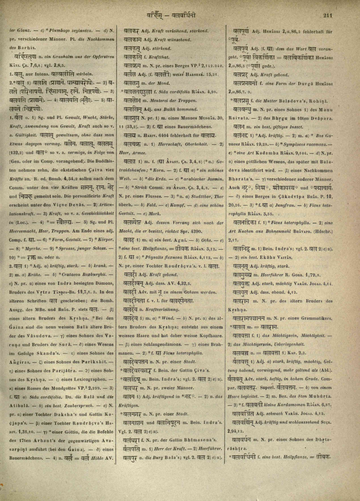
2. bala — 1〉 *Adj. — a〉 kräftig, stark. — b〉 krank. — 2〉 m. — a〉 Krähe. — b〉 *Crateva roxburghii. — c〉 N. pr. — α〉 eines von Indra besiegten Dämons, Bruders des Vṛtra TĀṆḌYA-BR. 19,7,1. 3. In den älteren Schriften bala geschrieben; die Bomb. Ausgg. des MBH. und BHĀG. P. stets bala. — β〉 eines ältern Bruders des Kṛṣṇa. *Bei den Jaina sind die neun weissen Bala ältere Brüder des Vāsudeva. — γ〉 eines Sohnes des Varuṇa und Bruders der Surā. — δ〉 eines Wesens im Gefolge Skandaʼs. — ε〉 eines Sohnes des Aṅgiras. — ζ〉 eines Sohnes des Parikṣit. — η〉 eines Sohnes des Pāriyātra — ϑ〉 eines Sohnes des Kṛṣṇa. — ι〉 eines Lexicographen. — ϰ〉 eines Rosses des Mondgottes VP.² 2,299. — 3〉 1. ā — a〉 Sida cordifolia. Du. die Balā und die Atibalā. — b〉 ein best. Zauberspruch. — c〉 N. pr. — α〉 einer Tochter Dakṣaʼs und Gattin Kaśyapaʼs. — β〉 einer Tochter Raudrāśvaʼs HARIV. 1,21,10. — γ〉 *einer Göttin, die die Befehle des 17ten Arhantʼs der gegenwärtigen Avasarpiṇī ausführt (bei den Jaina). — δ〉 eines Bauermädchens. — 4〉 n. balá = balá Höhle AV.
Originaltext · Deutsch · Substantiv Neutrum
1. bála n. — 1〉 Sg. und Pl. Gewalt, Wucht, Stärke, Kraft, Anwendung von Gewalt, Kraft auch so v. a. Gültigkeit. balāt gewaltsam, ohne dass man Etwas dagegen vermag. balena, balāt, balatas (Chr. 132,2) und bala˚ so v. a. vermöge, in Folge von (Gen. oder im Comp. vorangehend). Die Buddhisten nehmen zehn, die ekstatischen Śaiva vier Kräfte an. R. ed. Bomb. 4,54,2 sollen nach dem Comm. unter den vier Kräften sāman, dāna, bheda und nigraha gemeint sein. Die personificirte Kraft erscheint unter den Viśve Devās. — 2〉 Articulationskraft. — 3〉 Kraft, so v. a. Geschicklichkeit in (Loc.) — 4〉 *= sthaulya. — 5〉 Sg. und Pl. Heeresmacht, Heer, Truppen. Am Ende eines adj. Comp. f. ā. — 6〉 *Form, Gestalt. — 7〉 *Körper. — 8〉 *Myrrhe. — 9〉 *Sprosse, junger Schoss. — 10〉 *= rakta m. oder n.
Apte 1890 Substantiv Maskulin · Substantiv Neutrum
Originaltext · Englisch · Substantiv Maskulin · Substantiv Neutrum
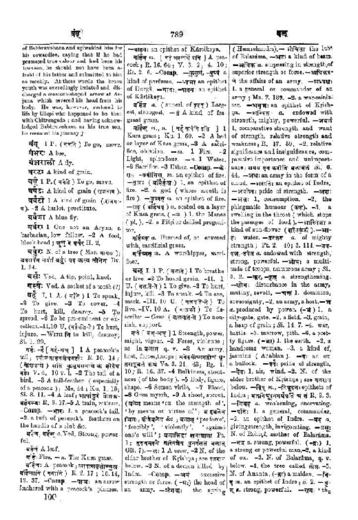
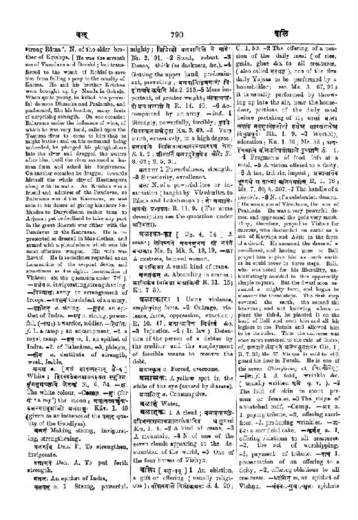
balaṃ [bal-ac] 1 Strength, power, might, vigour. 2 Force, violence; as in balāt q. v. 3 An army, host, forces, troops; bhavedabhīṣmamadroṇaṃ dhṛtarāṣṭrabalaṃ kathaṃ Ve. 3. 24, Ve. 3. 43; Bg. 1. 10; R. 16. 37. 4 Bulkiness, stoutness (of the body). 5 Body, figure, shape. 6 Semen virile, 7 Blood, 8 Gum myrrh. 9 A shoot, sprout. (balena means ‘on the strength of’, ‘by means or virtue of’; bahubalena jitaḥ, vīryabalena &c.; balāt ‘perforce’, ‘forcibly’, ‘violently’, ‘against one's will’; balānnidrā samāyātā Pt. 1; hṛdayamadaye tasminnevaṃ punarvalate balāt Gīt. 7). — laḥ 1 A crow. 2 N. of the elder brother of Kṛṣṇa; see valarāma below. 3 N. of a demon killed by Indra. Comp. — agraṃ excessive strength or force. — (graḥ) the head of an army. — aṃgakaḥ the spring ([Page 0789-c]) (Hemacandra). — aṃcitā the lute of Balarāma. — aṭaḥ a kind of beam. — adhika a. surpassing in strength, of superior strength or force. — adhikaraṇaṃ the affairs of an army. — adhyakṣaḥ 1 a general or commander of an army; Ms. 7. 189. 2 a war-minister. — anujaḥ an epithet of Kṛṣṇa. — anvita a. endowed with strength, mighty, powerful. — abalaṃ 1 comparative strength and want of strength, relative strength and weakness; R. 17. 59. 2 relative significance and insignificance, comparative importance and unimportance; samaya eva karoti balābalaṃ Śi. 6. 44. — abhraḥ an army in the form of a cloud. — arātiḥ an epithet of Indra. — avalepaḥ pride of strength. — aśaḥ — asaḥ 1 consumption. 2 the phlegmatic humour (kapha). 3 a swelling in the throat (which stops the passages of food). — ātmikā a kind of sun-flower (hastiśuṃḍī). — āhaḥ water. — utkraṭa a. of mighty strength; Pt. 2. 40; Pt. 3. 114. — upapanna, -upeta a. endowed with strength, strong, powerful. — oghaḥ a multitude of troops, numerous army; Śi. 5. 2. — kara, -kṛt a. strengthening. — kṣobhaḥ disturbance in the army, mutiny, revolt. — cakraṃ 1 dominion, sovereignty. 2 an army, a host. — ja a. produced by power. — (jaṃ) 1 a city-gate, gate. 2 a field. 3 grain, a heap of grain; Śi. 14. 7. 4 war, battle. 5 marrow, pith. 6 a pretty figure. — (jā) 1 the earth. 2 a handsome woman. 3 a kind of, jasmine (Arabian). — daḥ an ox a bullock. — darpaḥ pride of strength. — devaḥ 1 air, wind. 2 N. of the elder brother of Kṛṣṇa; see balarāma below. — dviṣ m., — niṣūdanaḥ epithets of Indra; balaniṣūdanamarthapatiṃ ca taṃ R. 9. 3. — nigraha a. weakening, enervating. — patiḥ 1 a general, commander. 2 an epithet of Indra. — prada a. giving strength, invigorating. — prasūḥ N. of Rohiṇī, mother of Balarāma. — bhadra a. strong, powerful. — (draḥ) 1 a strong or powerful man. 2 a kind of ox. 3 N. of Balarāma, q. v. below. 4 the tree called lodhra. 5 N. of Ananta. — (drā) a maiden. — bhid m. an epithet of Indra; Ś. 2. — bhṛt a. strong, powerful. — rāmaḥ ‘the ([Page 0790-a]) strong Rāma’, N. of the elder brother of Kṛṣṇa. [He was the seventh son of Vasudeva and Devakī; but transferred to the womb of Rohiṇi to save him from falling a prey to the cruelty of Kaṃsa. He and his brother Kṛṣṇa were brought up by Nanda in Gokula. When quite young, he killed the powerful demons Dhenuka and Pralamba, and performed, like his brother, many feats of surprising strength. On one occasion Balarāma under the influence of wine, of which he was very fond, called upon the Yamunā river to come to him that he might bathe; and on his command being unheeded, he plunged his plough-share into the river and dragged the waters after him, until the river assumed a human form and asked his forgiveness. On another occasion he dragged towards himself the whole city of Hastināpura along with its walls. As Kṛṣṇa was a friend and admirer of the Pāṇḍavas, so Balarāma was of the Kauravas, as was seen in his desire of giving his sister Subhadrā to Duryodhana rather than to Arjuna; yet he declined to take any part in the great Bhāratī war either with the Pāṇḍavas or the Kauravas. He is represented as dressed in blue clothes, and armed with a ploughshare which was his most effective weapon. His wife was Revatī. He is sometimes regarded as an incarnation of the serpent Śeṣa and sometimes as the eighth incarnation of Viṣṇu; see the quotation under hala]. — vardhana a. invigorating, strengthening. — vinyāsaḥ array or arrangement of troops. — vyasanaṃ the defeat of an army. — śālin a. strong. — sūdanaḥ an epithet of Indra. — stha a. strong, powerful. — (sthaḥ) a warrior, soldier. — sthitiḥ f. 1 a camp; an encampment. 2 a royal camp. — han m. 1 an epithet of Indra. 2 of Balarāma. 3 phlegm. — hīna a. destitute of strength, weak, feeble.
Cappeller 1887 Substantiv Neutrum · Worttyp nicht bestimmt
Originaltext · Deutsch · Substantiv Neutrum
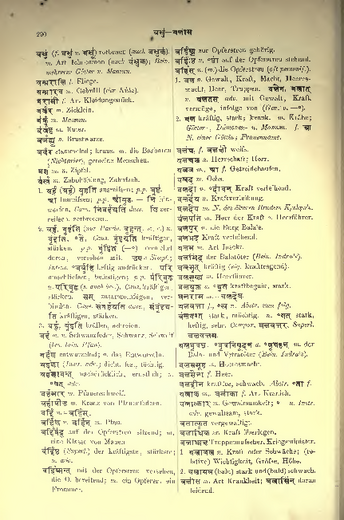
1. bála n. Gewalt, Kraft, Macht, Heeresmacht, Heer, Truppen. balena, balāt u. balatas adv. mit Gewalt, Kraft, vermöge, infolge von (Gen. o. —˚).
Originaltext · Deutsch · Worttyp nicht bestimmt
2. bala kräftig, stark; krank. m. Krähe; Götter-, Dämonen- u. Mannsn. f. ā N. einer Göttin; Frauenname.
Burnouf 1866 Adjektiv
Originaltext · Französisch · Adjektiv
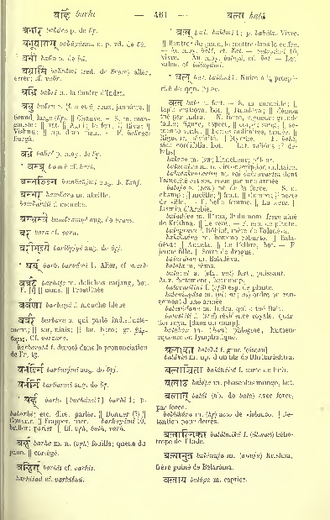
bala bala a. fort. — S. m. corneille; tapia cratœva, bot. Baladeva; démon tué par Indra. — N. force, vigueur; grande taille; figure, aspect; corps; sang; semence virile. Forces militaires, armée. Rigueur, sévérité. Myrrhe. — F. balā, sida cordifolia, bot. — Lat. validus [? debilis]. balakṣa m. (kṣai) blancheur; pâleur. balacakra m. n. circonscription militaire. balacakravartin m. roi cakravartin dont l'autorité est soutenue par une armée. balaja a. (jan) né de la force. — S. n. champ; moelle; fruit. Guerre; porte de ville. — F. belle femme. La terre. Jasmin d'Arabie. baladeva m. Rāma, 3ᵉ du nom, frère aîné de Kṛṣṇa. Le vent. — F. esp. de plante. balaprasū f. Rohiṇī, mère de Baladeva. balabhadra m. homme robuste. Baladeva; Ananta. Le lôdhra, bot. — F. jeune fille. Sorte de drogue. balarāma m. Baladeva. balala m. mms. balavat a. (sfx. vat) fort, puissant. — Adv. fortement, beaucoup. balavardhinī f. (vṛdh) esp. de plante. balavinyāsa m. (vi; ni; as) ordre ou rangement d'une armée. balasūdana m. Indra, qui a tué Bala. balasthiti f. (sthā) résidence royale, quartier royal [dans un camp]. balahan m. (han) phlegme, humeur aqueuse ou lymphatique.
Quelltextfundstellen (29)
DYS 2 Fundstellen
GoS 2 Fundstellen
HP 3 Fundstellen
HTK 4 Fundstellen
HTK 10.26–29*1: Cakra, Śaṅkha, Vāmāvartta, Vartmagati und Gadā 1 Fundstelle
Direkt belegt
-
HTK 10.29 Segment 21
PJH 1 Fundstelle
PJH 15-16: Erlangung der Kraft, Freude des Bewusstseins (cidānanda) und Befreiung zu Lebzeiten (jīvanmukti) 1 Fundstelle
Direkt belegt
-
PJH 15 Segment 1
PYS 3 Fundstellen
SiSa 13 Fundstellen
Weitere 5 Quelltextseiten
SiSa 5.48-5.71: Innere Meditation 2 Fundstellen
Direkt belegt
SiSa 5.234-5.252: Tripurā-Mantra 2 Fundstellen
Direkt belegt
-
SiSa 5.244 Segment 24
-
SiSa 5.249 Segment 15
SVU 1 Fundstelle
Mit AYI Free weitermachen
Bildquelle: AYI Archiv.