

sam सम् – together
adverb · particle · previx · verbal root · Word type unspecified
Dictionary sources
AYI dictionary particle · previx
Cappeller 1891 adverb
Original text · English · adverb
sám ·adv. along with, together (mostly °--).
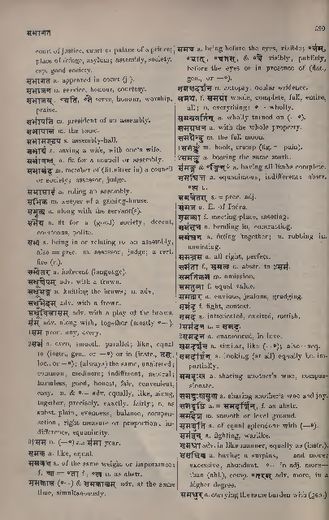
Monier-Williams 1872 Word type unspecified
Original text · English · Word type unspecified
sam 1 . sam (= rt. stam), cl. 1. P. sa- mati, sasāma, samitum, to be confused or agitated or disturbed; (according to some) to be undisturbed, not to be agitated [cf. rt. 1. śam]; cl. 10. P. samayati, -yitum, to be agitated or dis- turbed.
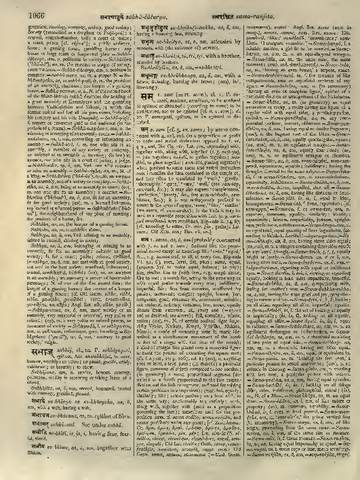
Original text · English · Word type unspecified
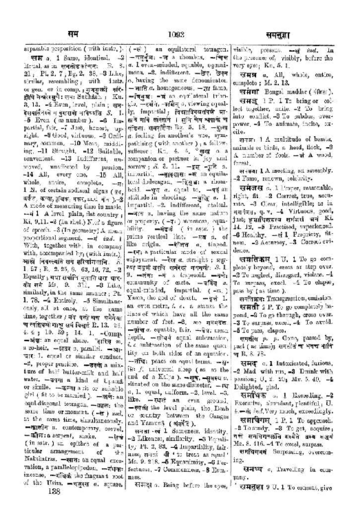
sam 2 . sam [cf. 5. sa, sama; by some con- nected with 4. sa], ind. (as a preposition or prefix to verbs and verbal derivatives opposed to 1. vi, q. v., and like Gr. σύν, Lat. con, expressing) with, together with, along with, together (e. g. saṃ-yuj, to join together; sañ-ci, to gather together; san- dhā, to place together; san-dhi, placing together); when prefixed to some roots and verbal derivatives sam intensifies the idea contained in the simple rt., and may often be translated by ‘much,’ ‘greatly,’ ‘thoroughly,’ ‘quite,’ ‘very,’ ‘well,’ (see san-tap, san-tuṣ, &c.); it may also express ‘completeness,’ ‘perfection,’ ‘beauty,’ &c., (see sam-uccheda, san- tamas, &c.); it is not unfrequently prefixed to nouns in the sense of sama, ‘same,’ ‘like,’ ‘similar,’ (see sama, cf. sam-artha); in the Veda it may be used as a separable preposition with inst. (e. g. asṛ- jad madhunā sam madhūni, Ṛg-veda X. 54, 6); [cf. according to some, Gr. σύν, ξύν; perhaps Lat. cum; Old Russ. sen; Slav. sū, su.]
Petersburger 1855 Word type unspecified
Original text · German · Word type unspecified
1. √sam , sámati DHĀTUP. 19,82 (avaiklavye, avaikalye, vaiklavye). — Vgl. stam.
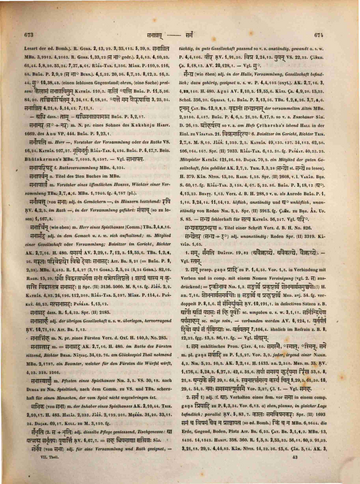
Original text · German · Word type unspecified
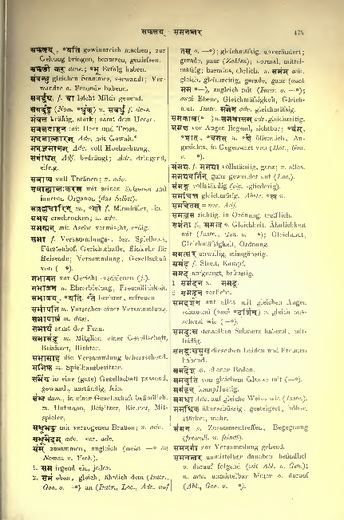
2. sam praep. gaṇa prādi zu P. 1,4,58. VOP. 1,8. in Verbindung mit Verben und in comp. mit einem Nomen Vereinigung (vgl. 2. sa) ausdrückend; = ekībhāva NIR. 1,3. saṅgārthe prakṛṣṭārthe śobhanārthasamuccayoḥ (!) H. an. 7,16. śobhanārthasamarthayoḥ .. saṅgārthe ca prahṛṣṭārthe MED. avy. 54. fg. verdoppelt P. 8,1,6. saṃ sàmi̱dyùvase ṚV. 10,191,1. in defectiven Sätzen z. B. āpò a̱gniṃ ya̱śasa̱ḥ saṃ hi pū̱rvīḥ sc. umgaben u. s. w. ṚV. 3,1,11. samìndri̱yeṇa̱ payàsā̱ham sc. möge sein, — verbunden werden AV. 6,124,1. va̱rtayàtaṃ di̱vo va̱dhaṃ saṃ pṛ̀thi̱vyāḥ sc. vartayatam AV. 7,104,4. ähnlich im Refrain z. B. AV. 8,12,22. fgg. AV. 8,13,2. AV. 8,86,11. fg. — Vgl. saṃtaram.
Böhtlingk 1879 adverb · verbal root
Original text · German · adverb
2. sám Adv. in Verbindung mit Verben und in Comp. mit einem Nomen Vereinigung ausdrückend. [Page7-052-c] In defectiven Sätzen ist bisweilen ein Verbum fin. zu ergänzen.
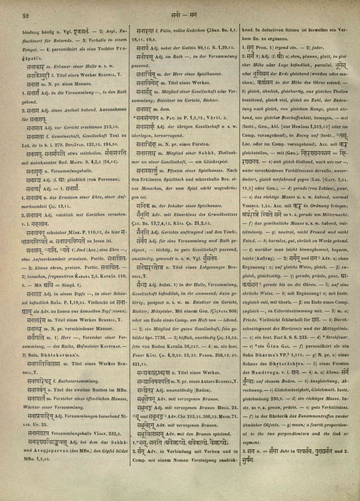
Original text · German · verbal root
1. *√sam samati avaiklavye avaikalye vaiklavye.
Apte 1890 particle · verbal root
Original text · English · particle
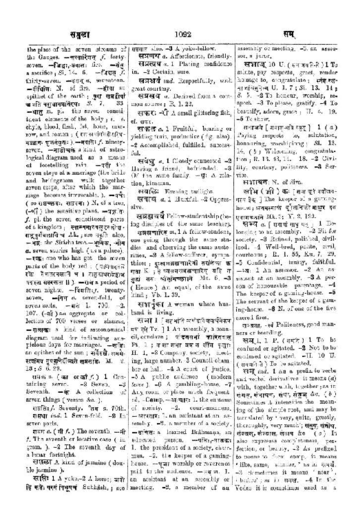
sam ind. 1 As a prefix to verbs and verbal derivatives it means (a) with, together with, together; as in saṃgam, saṃbhāṣaṇa, saṃdhā, saṃyuj &c. (b) Sometimes it intensifies the meaning of the simple root, and may be translated by ‘very, quite, greatly, thoroughly, very much’; saṃtuṣ, saṃtoṣa, saṃnyas, saṃnyāsa, saṃtāpa &c. (c) It also expresses completeness, perfection, or beauty. 2 As prefixed to nouns to form comp. it means ‘like, same, similar,’ as in samartha. 3 Sometimes it means ‘near’, ‘before’; as in samakṣa. 4 In the Vedas it is sometimes used as a ([Page 1093-a]) separable preposition (with instr.).
Original text · English · verbal root
sam I. 1 P. (samati) 1 To be confused or agitated. 2 Not to be confused or agitated. II. 10 U. (samayati-te) To be agitated.
Cappeller 1887 Word type unspecified
Original text · German · Word type unspecified
sám zusammen, zugleich (meist —˚ im Nomen u. Verb.).
Burnouf 1866 previx · verbal root
Original text · French · previx
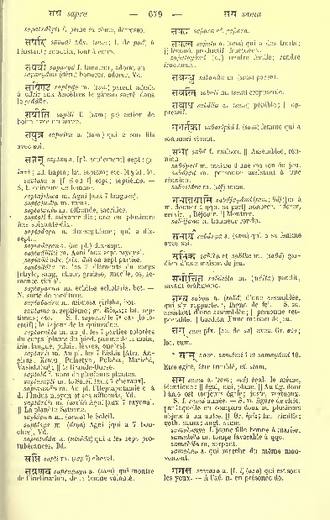
sam sam pfx. [ac. de sa] avec. Gr. σὐν; lat. cum.
Original text · French · verbal root
*sam sam. samāmi 1. et samayāmi 10. Etre agité, être troublé, cf. stam.
Derived words
More direct derivatives (27)
-
samādhi समाधि substantive masculine samādhi; meditative concentration; perfect concentration; unitive experience
Further derivatives (4)
Occurrences in source texts (434)
DYS 36 occurrences
DYS 54–59: The Yogi’s Hut 4 occurrences
Direct occurrences
15 more source pages
DYS 60–66: Prāṇāyāma 2 occurrences
Direct occurrences
-
DYS 63 Segment 10
Occurrences through derived words
-
DYS 64 Segment 3
DYS 124: Samādhi 2 occurrences
Direct occurrences
-
DYS 124 Segment 13
Occurrences through derived words
-
DYS 124 Segment 14
DYS 125–130: Liberation in Life 4 occurrences
Direct occurrences
Occurrences through derived words
GoS 23 occurrences
GoS 34–41: Sun, Sound and Cooling 2 occurrences
Direct occurrences
GoS 50–63: Three Locks 7 occurrences
Direct occurrences
Occurrences through derived words
5 more source pages
GoS 74–80: Through the Three Knots 3 occurrences
Direct occurrences
GoS 81–88: Moon, Fluid and Union 3 occurrences
Direct occurrences
HP 90 occurrences
HP 1.15-1.16*2: Factors of Practice 1 occurrence
Occurrences through derived words
-
HP 1.16*2 Segment 2
HP 1.17-1.32: Āsana 6 occurrences
Direct occurrences
HP 1.44-1.49: Padmāsana 3 occurrences
Direct occurrences
HP 1.50–54: Siṃhāsana and Bhadrāsana 3 occurrences
Direct occurrences
-
HP 1.50–52 Segment 21
-
HP 1.50–52 Segment 24
-
HP 1.50–52 Segment 33
32 more source pages
HP 2.60-2.68: Bhastrikā 3 occurrences
Direct occurrences
HP 3.10-3.18: Mahāmudrā 4 occurrences
Direct occurrences
Occurrences through derived words
-
HP 3.15 Segment 13
HP 3.19-3.25: Mahābandha 6 occurrences
Direct occurrences
HP 3.26-3.31: Mahāvedha 4 occurrences
Direct occurrences
Occurrences through derived words
-
HP 3.27 Segment 4
HP 3.33-3.48*1: Khecarī and Soma 2 occurrences
Direct occurrences
HP 3.49-3.57: Mūlabandha 6 occurrences
Direct occurrences
HP 3.94-3.102*1: Śakti Cālana 3 occurrences
Direct occurrences
HP 3.103-3.107*2: Conclusion of the Mudrā Teaching 2 occurrences
Direct occurrences
-
HP 3.105 Segment 6
-
HP 3.107*2 Segment 7
HP 4.0*1-4.0*14: Samādhi and Laya 3 occurrences
Occurrences through derived words
HP 4.11*5-4.11*14: Khecarī in Space 4 occurrences
Direct occurrences
-
HP 4.11*5 Segment 6
-
HP 4.11*9 Segment 9
-
HP 4.11*11 Segment 13
-
HP 4.11*12 Segment 9
HP 4.11*29-4.11*31: Transition to Nāda 2 occurrences
Direct occurrences
-
HP 4.11*31 Segment 6
Occurrences through derived words
-
HP 4.11*29 Segment 10
HP 4.27*1-4.35: Rājayoga and Haṭha 6 occurrences
Direct occurrences
Occurrences through derived words
-
HP 4.32–33 Segment 3
HP 4.35*1-4.36: Signs of Samādhi 4 occurrences
Occurrences through derived words
HP 4.37-4.46: Listening to Nāda 2 occurrences
Direct occurrences
HP 4.47-4.55*4: Nāda Binds the Mind 3 occurrences
Direct occurrences
HTK 16 occurrences
HTK 10.6*2–9*1: Ujjāyī / Ujjāyikā and Sūryabheda 2 occurrences
Direct occurrences
HTK 10.11*2–14*1: Bhastrikā: Breath like a bellows 5 occurrences
Direct occurrences
HTK 10.30–33*1: Nāḍī-viśudhy-ākhyaka-kumbha and Nāḍīśuddhi 1 occurrence
Direct occurrences
-
HTK 10.33 Segment 19
HTK 10.34*2–38*1: Asvaṅgaśṛṅkhalā and Kumbhāntaraśṛṅkhalā 2 occurrences
Direct occurrences
IVU 7 occurrences
MAN 3 occurrences
PJH 10 occurrences
PJH 3-4: Perceiver and Perceived; Microcosm and Macrocosm 2 occurrences
Direct occurrences
-
PJH 4 Segment 6
Occurrences through derived words
-
PJH 4 Segment 2
PJH 9: In the Cycle of Rebirth 2 occurrences
Occurrences through derived words
PJH 12-14: Understanding the Five Acts 1 occurrence
Occurrences through derived words
-
PJH 12 Segment 6
PJH 17-19: Simple Means (sukhopāyas) and Samādhi 3 occurrences
Occurrences through derived words
PYS 64 occurrences
PYS 1.17–18: Two Kinds of Samādhi 2 occurrences
Direct occurrences
-
PYS 1.17 Segment 7
Occurrences through derived words
-
PYS 1.18 Segment 5
PYS 1.19–22: Two Approaches 2 occurrences
Occurrences through derived words
31 more source pages
PYS 1.50–51: Samādhi without Seed 3 occurrences
Occurrences through derived words
PYS 2.15–17: Everything Is Suffering 2 occurrences
Occurrences through derived words
PYS 2.23–26: From Avidyā to Kaivalya 2 occurrences
Occurrences through derived words
PYS 2.27–29: Aṣṭāṅga as a Path to Liberation 1 occurrence
Occurrences through derived words
-
PYS 2.29 Segment 8
PYS 2.30–34: Vows and Counterreflection 2 occurrences
Occurrences through derived words
PYS 2.35–39: Perfected Yamas 2 occurrences
Occurrences through derived words
PYS 2.40–45: Perfected Niyamas 3 occurrences
Occurrences through derived words
PYS 2.46–48: Āsana as a Seated Posture 1 occurrence
Occurrences through derived words
-
PYS 2.47 Segment 4
PYS 2.49–51: Prāṇāyāma as Breath Suspension 1 occurrence
Occurrences through derived words
-
PYS 2.50 Segment 7
PYS 3.1–4: Saṃyama 2 occurrences
Occurrences through derived words
PYS 3.9–12: Three Transformations of Citta 3 occurrences
Occurrences through derived words
PYS 3.15–16: Sequence of Transformation 1 occurrence
Occurrences through derived words
-
PYS 3.16 Segment 3
PYS 3.17–20: Extraordinary Knowledge 3 occurrences
Occurrences through derived words
PYS 3.21–22: Invisibility and Time of Death 3 occurrences
Occurrences through derived words
PYS 3.26–28: Knowledge of the Cosmos 1 occurrence
Occurrences through derived words
-
PYS 3.26 Segment 4
PYS 3.29–34: Bodily Locations and Knowledge 1 occurrence
Occurrences through derived words
-
PYS 3.34 Segment 3
PYS 3.35–37: Knowledge of Puruṣa and Siddhis 2 occurrences
Occurrences through derived words
PYS 3.41–42: Divine Hearing and Travel through Space 5 occurrences
Occurrences through derived words
PYS 3.44–46: Mastery over the Elements 3 occurrences
Occurrences through derived words
PYS 3.47–48: Mastery over the Senses 1 occurrence
Occurrences through derived words
-
PYS 3.47 Segment 6
PYS 4.9–11: Continuity of Saṃskāras 2 occurrences
Occurrences through derived words
PYS 4.18–21: Puruṣa Knows Citta 2 occurrences
Occurrences through derived words
PYS 4.27–28: The Return of Old Saṃskāras 1 occurrence
Occurrences through derived words
-
PYS 4.27 Segment 5
SiSa 126 occurrences
SiSa 1.10-1.16: Lehrmeinungen 2 occurrences
Direct occurrences
-
SiSa 1.13 Segment 10
Occurrences through derived words
-
SiSa 1.15 Segment 6
SiSa 1.35-1.44: Täuschungs-Gleichnisse 2 occurrences
Occurrences through derived words
SiSa 1.51-1.64: Selbst als Licht 1 occurrence
Occurrences through derived words
-
SiSa 1.64 Segment 13
SiSa 1.71-1.81: Avidyā und Elemente 1 occurrence
Occurrences through derived words
-
SiSa 1.72 Segment 3
SiSa 2.6-2.12: Mond und Sonne 2 occurrences
Direct occurrences
53 more source pages
SiSa 2.25-2.31: Nāḍī-Netz 5 occurrences
Direct occurrences
SiSa 2.32-2.34: Inneres Feuer 2 occurrences
Direct occurrences
SiSa 2.35-2.40: Jīva und Karma 2 occurrences
Direct occurrences
SiSa 3.1-3.10: Herzlotus und Prāṇa 4 occurrences
Direct occurrences
Occurrences through derived words
SiSa 3.11-3.16: Guru und Śraddhā 2 occurrences
Direct occurrences
SiSa 3.17-3.20: Praxisbeginn 3 occurrences
Direct occurrences
SiSa 3.21-3.31: Nāḍī-Reinigung 2 occurrences
Direct occurrences
-
SiSa 3.31 Segment 9
Occurrences through derived words
-
SiSa 3.27 Segment 16
SiSa 3.39-3.40: Kumbhaka-Kraft 2 occurrences
Direct occurrences
SiSa 3.61-3.67: Paricaya und Niṣpatti 5 occurrences
Direct occurrences
Occurrences through derived words
SiSa 3.68-3.80: Vāyusādhana 5 occurrences
Direct occurrences
Occurrences through derived words
SiSa 3.84-3.87: Siddhāsana 2 occurrences
Direct occurrences
SiSa 4.9-4.20: Yonimudrā-Geheimnis 4 occurrences
Direct occurrences
Occurrences through derived words
-
SiSa 4.18 Segment 1
SiSa 4.26-4.30: Mahāmudrā-Praxis 3 occurrences
Direct occurrences
SiSa 4.37-4.42: Mahābandha 4 occurrences
Direct occurrences
Occurrences through derived words
-
SiSa 4.38 Segment 11
SiSa 4.91-4.94: Vajrolī-Siddhi 3 occurrences
Direct occurrences
Occurrences through derived words
-
SiSa 4.91 Segment 9
SiSa 4.95-4.100: Sahajolī und Amarolī 1 occurrence
Occurrences through derived words
-
SiSa 4.98 Segment 1
SiSa 5.10-5.14: Subtile Hindernisse 1 occurrence
Occurrences through derived words
-
SiSa 5.12 Segment 11
SiSa 5.24-5.28: Adhimātratama 2 occurrences
Direct occurrences
SiSa 5.48-5.71: Innere Meditation 7 occurrences
Direct occurrences
-
SiSa 5.49 Segment 1
-
SiSa 5.49 Segment 14
-
SiSa 5.50 Segment 10
-
SiSa 5.51 Segment 2
-
SiSa 5.51 Segment 6
-
SiSa 5.52 Segment 1
Occurrences through derived words
-
SiSa 5.63 Segment 5
SiSa 5.77-5.81: Kanda und Hauptnāḍīs 2 occurrences
Direct occurrences
SiSa 5.82-5.89: Mūlādhāra 3 occurrences
Direct occurrences
SiSa 5.132-5.143: Innere Vārāṇasī 2 occurrences
Direct occurrences
-
SiSa 5.138 Segment 15
-
SiSa 5.141 Segment 12
SiSa 5.144-5.155: Ājñā und Khecarī 2 occurrences
Occurrences through derived words
-
SiSa 5.149 Segment 13
-
SiSa 5.152 Segment 3
SiSa 5.156-5.181: Sahasrāra 4 occurrences
Direct occurrences
-
SiSa 5.157 Segment 15
-
SiSa 5.165 Segment 4
-
SiSa 5.172 Segment 8
-
SiSa 5.173 Segment 6
SiSa 5.191-5.207: Kailāsa und Mahāśūnya 4 occurrences
Direct occurrences
-
SiSa 5.195 Segment 11
-
SiSa 5.201 Segment 3
-
SiSa 5.206 Segment 15
Occurrences through derived words
-
SiSa 5.195 Segment 10
SiSa 5.208-5.222: Rājayoga 5 occurrences
Direct occurrences
-
SiSa 5.209 Segment 11
-
SiSa 5.209 Segment 15
-
SiSa 5.219 Segment 3
-
SiSa 5.220 Segment 10
-
SiSa 5.222 Segment 16
SiSa 5.234-5.252: Tripurā-Mantra 3 occurrences
Direct occurrences
-
SiSa 5.234 Segment 8
-
SiSa 5.239 Segment 7
-
SiSa 5.241 Segment 2
SiSa 5.253-5.260: Haushalter-Abschluss 3 occurrences
Direct occurrences
-
SiSa 5.258 Segment 3
-
SiSa 5.258 Segment 4
-
SiSa 5.259 Segment 12
SS 12 occurrences
SS 1.17–1.18: Self-Knowledge and Bliss 1 occurrence
Occurrences through derived words
-
SS 1.18 Segment 3
SS 2.6–2.7: Guru and the Circle of Sound 1 occurrence
Occurrences through derived words
-
SS 2.7 Segment 3
5 more source pages
SS 3.30–3.32: The World as One's Own Śakti 1 occurrence
Occurrences through derived words
-
SS 3.32 Segment 5
SS 3.40–3.42: Desire and Liberation 2 occurrences
Direct occurrences
-
SS 3.40 Segment 4
Occurrences through derived words
-
SS 3.41 Segment 7
SS 3.43–3.45: Prāṇa and Returning Within 1 occurrence
Occurrences through derived words
-
SS 3.44 Segment 4
SVU 27 occurrences
SVU 1.1-1.3: The Search for the Cause 2 occurrences
Direct occurrences
-
SVU 1.1 Segment 11
Occurrences through derived words
-
SVU 1.2 Segment 12
11 more source pages
SVU 3.1-3.4: The One Rudra 5 occurrences
Direct occurrences
SVU 4.6-4.10: Two Birds and Māyā 2 occurrences
Direct occurrences
SVU 4.11-4.16: The Hidden Creator 2 occurrences
Direct occurrences
SVU 5.7–5.11: The Wandering Self 3 occurrences
Direct occurrences
SVU 5.12–5.14: Knowledge and Freedom 1 occurrence
Occurrences through derived words
-
SVU 5.12 Segment 18
VBT 20 occurrences
VBT 36–42: Sound and Bindu 2 occurrences
Direct occurrences
-
VBT 37 Segment 4
Occurrences through derived words
-
VBT 41 Segment 7
VBT 57–64: Intervals and Equality 2 occurrences
Direct occurrences
-
VBT 61 Segment 6
Occurrences through derived words
-
VBT 64 Segment 3
VBT 65–74: Joy and Enjoyment 3 occurrences
Direct occurrences
5 more source pages
VBT 110–120: Everyday as Gate 3 occurrences
Direct occurrences
-
VBT 111 Segment 12
Occurrences through derived words
VBT 121–129: Devotion and Release 2 occurrences
Direct occurrences
-
VBT 128 Segment 13
Occurrences through derived words
-
VBT 127 Segment 18
Continue with AYI Free
Image source: AYI archive.