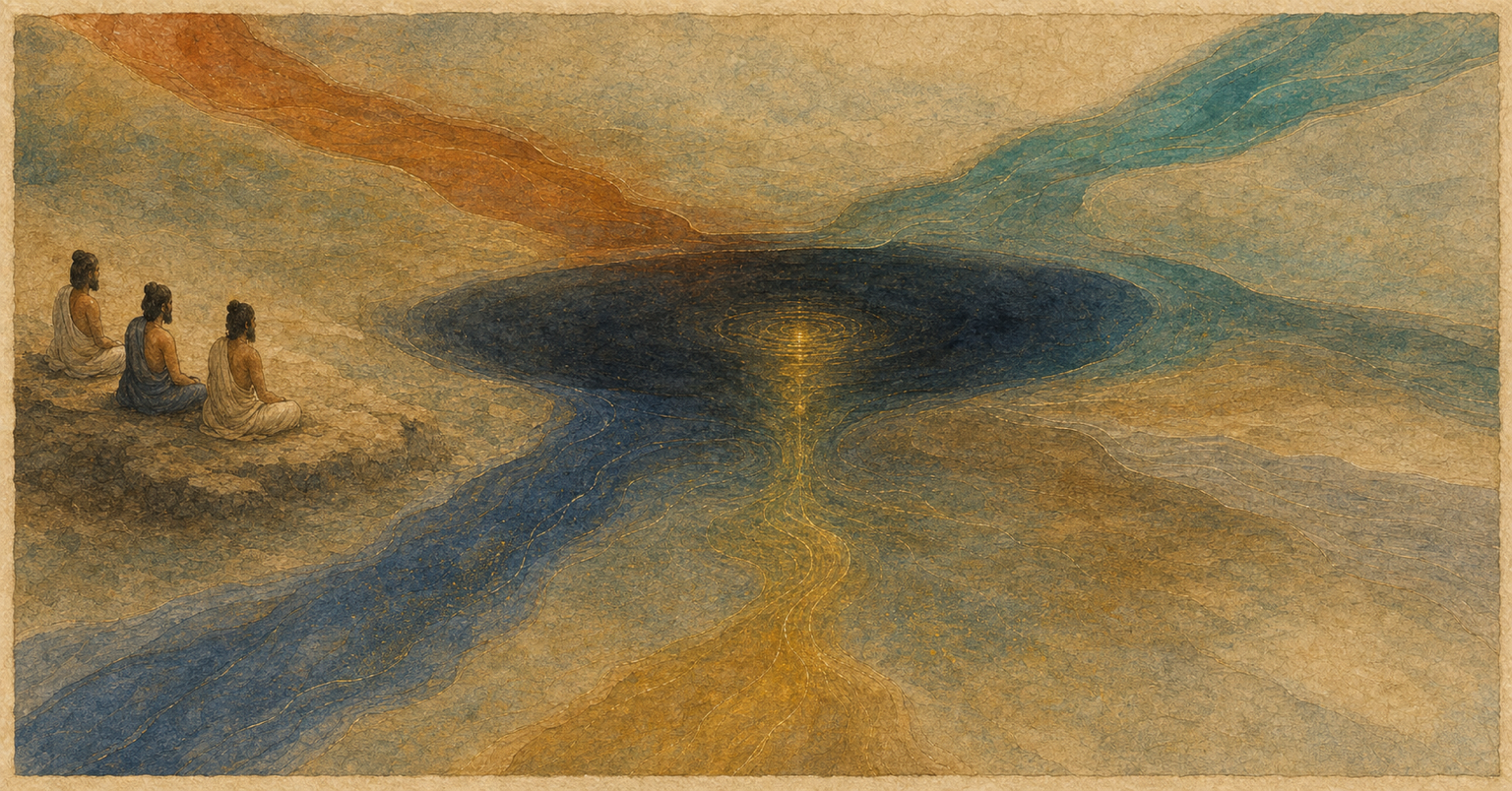
SVU 1.1-1.3: Suche nach der Ursache

SVU 1.1-1.3: Fragen nach Weltgrund und Selbst

Die Weisen prüfen mögliche Weltursachen und erkennen in Meditation die eine göttliche Selbstkraft, die Zeit, Natur und alle Ursachen beherrscht.

Dr. Ronald Steiner Dr. Ronald Steiner Nils Jacob Liersch Nils Jacob Liersch
Śvetāśvatara Upaniṣad 1.1
किं कारणं ब्रह्म कुतः स्म जाता जीवामः केन क्व च संप्रतिष्ठाः |
kiṃ kāraṇaṃ, brahma kutaḥ sma jātā; jīvāmaḥ kena, kva ca saṃpratiṣṭhāḥ | Analyse ▾ Analyse ▴
kim
Nominativ Singular Neutrum
Pronomen inter
was, welches
kāraṇam
Nominativ Singular
Substantiv Neutrum
die Ursache, der Grund
brahma
Nominativ Singular
Substantiv Neutrum
Brahman, der Urgrund
kutas
Adverb
woher, warum
sma
Partikel
denn, wohl
jātāḥ
Nominativ Plural Maskulin Partizip Perfekt Passiv
Verbalwurzel
geboren
jīvāmaḥ
1. Person Plural Aktiv Präsens
Verbalwurzel
wir leben
kena
Instrumentalis Singular Neutrum
Pronomen inter
wodurch
kva
Adverb
wo, worin
ca
Partikel
und
saṃpratiṣṭhāḥ
Nominativ Plural Maskulin Partizip Perfekt Passiv
Präfix
Präfix
Verbalwurzel
gegründet, feststehend
अधिष्ठिताः केन सुखेतरेषु वर्तामहे ब्रह्मविदो व्यवस्थाम् ||1||
adhiṣṭhitāḥ, kena sukhetareṣu; vartāmahe, brahma-vido vyavasthām ||1|| Analyse ▾ Analyse ▴
adhiṣṭhitāḥ
Nominativ Plural Maskulin Partizip Perfekt Passiv
Präfix
Verbalwurzel
gelenkt, beherrscht
kena
Instrumentalis Singular Maskulin
Pronomen inter
durch wen
sukhetareṣu
Lokativ Plural
Substantiv Neutrum
in Freude und ihrem Gegenteil, in Freude und Leid
vartāmahe
1. Person Plural Medial Präsens
Verbalwurzel
wir bewegen uns, befinden uns
brahma
Upapada-Kompositum
Substantiv Neutrum
Brahman
vidaḥ
Vokativ Plural Maskulin
Adjektiv
ihr Kenner, ihr Wissenden
vyavasthām
Akkusativ Singular
Substantiv Feminin
Ordnung, Gesetz, Lage
Metrum: Triṣṭubh mit Vajrā-Ausklang
Was (kim | nom sg n) ist die Ursache (kāraṇam | nom sg), ist es Brahman (brahma | nom sg)? Woher (kutas) sind wir denn (sma) geboren (jātāḥ | nom pl m ppp), leben wir (jīvāmaḥ | 1p pl act pres) wodurch (kena | ins sg n)? Worin (kva) und (ca) sind wir fest gegründet (saṃpratiṣṭhāḥ | nom pl m ppp)? Gelenkt (adhiṣṭhitāḥ | nom pl m ppp) von wem (kena | ins sg m), befinden wir uns in Freude und Leid (sukhetareṣu | loc pl) und bewegen uns darin (vartāmahe | 1p pl med pres)? Erklärt, ihr Brahman-Kenner (brahmavido | voc pl m), die Ordnung (vyavasthām | acc sg).
Dr. Ronald Steiner - 2026 - historisch wörtlich
Was ist die Ursache unseres Daseins? Ist es Brahman? Woher kommen wir, wodurch leben wir, und worin sind wir gegründet? Wer lenkt uns und bestimmt, dass wir Freude und Leid erfahren? Ihr Kenner des Brahman, erklärt uns diese Ordnung.
Dr. Ronald Steiner - 2026 - moderner Transfer

Das Śaṅkara zugeschriebene Bhāṣya bündelt eine umfassende Ursachenfrage: Gefragt wird nach Brahmans Rolle, nach Entstehung des verkörperten Lebens, Erhalt, Auflösung und der Ordnung von Glück und Leid. Der Jīva selbst gilt als ungeboren; geboren wird seine Verbindung mit Leib und Organen.

Śvetāśvatara-Upaniṣad Śaṅkara-Bhāṣya

Śaṅkarānanda hält das ungebundene Brahman nur zusammen mit Māyā für als Weltstoff erklärbar. Die Einzelfragen verfolgen den unbekannten Ursprung, den Lebensgrund, den Träger in der Auflösung und die Instanz, die den gesetzmäßigen Saṃsāra und seine gegensätzlichen Erfahrungen lenkt.

Śaṅkarānandas Śvetāśvataropaniṣaddīpikā

Nārāyaṇa entfaltet die Frage nach Herkunft und Lenkung in vier Richtungen: Woher kommen die Wesen, wodurch leben sie, worin ruhen sie, und wer ordnet Freude und Leid? Gerade das Erleiden dieser Gegensätze zeigt für ihn, dass der einzelne Jīva nicht völlig autonom ist.

Nārāyaṇas Śvetāśvataropaniṣaddīpikā

Vijñānabhagavat macht aus dem Mantra einen breiten Hypothesenkatalog. Er fragt nach Stoff- oder Wirkursache, wirklicher oder scheinbarer Wiederentstehung nach der Auflösung, nach Adṛṣṭa oder Īśvara als Lebensgrund, nach unterschiedlichen Formen der Einheit im Mokṣa und nach der lenkenden Instanz.

Vijñānabhagavats Śvetāśvataropaniṣadvivaraṇa
jīvāmaḥ LV1958 ] jīvāma ASS1927, LV1958-app, TO1995
Kritischer Apparat
Was ist Urgrund, was Brahman?<1> Woher sind wir? Wodurch bestehn, und worin sind gegründet wir? Von wem regiert, bewegen wir, ihr Weisen, Uns in der Lust und Unlust Wechselständen?
<1: „Brahman“ ist hier allgemeiner Name für „Prinzip“, wie Kaush. 4,1. Brih. 2,1,1. Chānd. 5,11,1. Brih. 4,1,2 fg.>
Paul Deussen - 1921
What is the cause? Brahma?<1> Whence are we born? Whereby do we live? And on what are we established? Overruled by whom, in pains and pleasures, Do we live our various conditions, O ye theologians (brahma-vid)?
<1: The words kiṁ kāraṇaṁ brahma might mean also ‘What is the cause? Is it Brahma?’ or ‘What is the cause? What is Brahma?’ or ‘Is the cause Brahma?’ or ‘Is Brahma the cause?’ or even ‘What sort of a cause is Brahma?’>
Robert Hume - 1921
Is Brahm the Cause (of the Universe)? From whom have we been created? By whom do we live? On whom do we depend? Under whose superintendence do we exist in happiness and misery? O Knowers of Brahm! let us (consider and) come to a decision.
Siddhesvar Varma Shastri - 1916
Was ist Urgrund, was Brahman?<1> Woher sind wir? Wodurch bestehn, und worin sind gegründet wir? Von wem regiert, bewegen wir, ihr Weisen, Uns in der Lust und Unlust Wechselständen?
<1: „Brahman“ ist hier allgemeiner Name für „Princip“, wie Kaush. 4,1. Brih. 2,1,1. Chānd. 5,11,1. Brih. 4,1,2 fg.>
Paul Deussen - 1897
Is Brahman the cause?<1> Whence are we born? Whereby do we live, and whither do we go? O ye who know Brahman, (tell us) at whose command we abide, whether in pain or in pleasure?
<1: This translation seems the one which Saṅkara himself prefers, for on p. 277, when recapitulating, he says, kim brahma kāraṇam āhosvit kālādi. In comparing former translations, whether by Weber, Roer, Gough, and others, it will be seen that my own differs considerably from every one of them, and differs equally from Saṅkara’s interpretation. It would occupy too much space to criticise former translations, nor would it seem fair, considering how long ago they were made, and how imperfect were the materials which were then accessible. All I wish my readers to understand is that, if I differ from my predecessors, I do so after having carefully examined their renderings. Unfortunately, Roer’s edition of both the text and the commentary is often far from correct. Thus in the very first verse of the Svetāsvatara-upanishad, I think we ought to read sampratishthāh, instead of sampratishthitāh. In the commentary the reading is right. Vyavasyām is a misprint for vyavasthām. In the second verse we must separate kālah and svabhāvah. Yadrikhhā, no very usual word, meaning chance, was formerly taken for a name of the moon! Instead of na tvātmabhāvāt, both sense and metre require that we should read anātmabhāvāt, though the commentators take a different view. They say, because there is a self, and then go on to say that even that would not suffice. Such matters, however, belong to a critical commentary on the Upanishads rather than to a translation, and I can refer to them in cases of absolute necessity only, and where the readings of the two MSS., A. and B, seem to offer some help.>
F. Max Müller - 1884
What cause is Bramha?<1> Whence are (we) produced? By whom do we live, and where do we (ultimately) abide?<2> By whom governed<3> do we walk after a rule in happiness and unhappiness, O ye knowers of Bramha?
<1: “Kim” is either the pronoun, and in this case it means “of what nature,” or it is merely the sign of a question, when it implies:—Is Brahma a cause, or not a cause, and if so, is it a substantial, or an instrumental cause, or both!—Ś.>
<2: Ultimately, that is at the time of the destruction of the world.>
<3: That is to say, who is the cause of the creation, preservation, and destruction of the world!>
Edward Röer - 1853
Śvetāśvatara Upaniṣad 1.2
कालः स्वभावो नियतिर्यदृच्छा भूतानि योनिः पुरुष इति चिन्त्यम् |
kālaḥ sva-bhāvo, niyatir yadṛcchā; bhūtāni yoniḥ, puruṣa iti cintyam | Analyse ▾ Analyse ▴
kālaḥ
Nominativ Singular
Substantiv Maskulin
die Zeit
sva
Karmadhāraya-Kompositum
Adjektiv
eigen, die eigene
bhāvaḥ
Nominativ Singular
Substantiv Maskulin
Natur, Wesen, Dasein
niyatiḥ
Nominativ Singular
Substantiv Feminin
Notwendigkeit, festgelegte Ordnung
yadṛcchā
Nominativ Singular
Substantiv Feminin
Zufall
bhūtāni
Nominativ Plural
Substantiv Neutrum
die Elemente, entstandenen Wesen
yoniḥ
Nominativ Singular
Substantiv Feminin
Ursprung, Quelle
puruṣaḥ
Nominativ Singular
Substantiv Maskulin
der Puruṣa, Mensch, Geist
iti
Partikel
so, als
cintyam
Nominativ Singular Neutrum Partizip Futur Passiv
Verbalwurzel
zu erwägen, denkbar
संयोग एषां न तु आत्मभावादात्मा ह्यनीशः सुखदुःखहेतोः ||2||
saṃyoga eṣāṃ, na tu* ātma-bhāvād; ātmā hy anīśaḥ, sukha-duḥkha-hetoḥ ||2|| Analyse ▾ Analyse ▴
saṃyogaḥ
Nominativ Singular
Substantiv Maskulin
die Verbindung, Vereinigung
eṣām
Genitiv Plural Neutrum
Pronomen dem
dieser
na
Partikel
nicht
tu
Partikel
aber, jedoch
ātma
Tatpuruṣa-Kompositum Genitiv
Substantiv Maskulin
des Selbstes, Selbst-
bhāvāt
Ablativ Singular
Substantiv Maskulin
aufgrund des Daseins, Wesens
ātmā
Nominativ Singular
Substantiv Maskulin
das Selbst
hi
Partikel
denn, nämlich
anīśaḥ
Nominativ Singular Maskulin
Adjektiv
machtlos, nicht Herr
sukha
Dvandva-Kompositum
Substantiv Neutrum
Freude, Glück
duḥkha
Tatpuruṣa-Kompositum Genitiv
Substantiv Neutrum
Leid, Schmerz
hetoḥ
Genitiv Singular
Substantiv Maskulin
der Ursache, des Grundes
Metrum: Pāda 1: Triṣṭubh mit Vajrā-Ausklang; Pāda 2: Triṣṭubh — 12 Silben; abweichende Kadenz; Pāda 3: Triṣṭubh mit Vajrā-Ausklang; Pāda 4: Triṣṭubh mit Vajrā-Ausklang
Die Zeit (kālaḥ | nom sg), die eigene Natur (svabhāvaḥ | nom sg), die Notwendigkeit (niyatiḥ | nom sg), der Zufall (yadṛcchā | nom sg), die Elemente (bhūtāni | nom pl), der Ursprung (yoniḥ | nom sg) oder der Puruṣa (puruṣa | nom sg) – so (iti) ist zu erwägen (cintyam | nom sg n pfp). Die Verbindung (saṃyogaḥ | nom sg) dieser (eṣām | gen pl n) ist es nicht (na), aber (tu) wegen des Daseins des Selbstes (ātmabhāvād | abl sg); denn das Selbst (ātmā | nom sg) ist nämlich (hi) nicht Herr (anīśaḥ | nom sg m) über die Ursache von Freude und Leid (sukhaduḥkhahetoḥ | gen sg).
Dr. Ronald Steiner - 2026 - historisch wörtlich
Soll man die Zeit, die eigene Natur, die Notwendigkeit, den Zufall, die Elemente, den Ursprung oder den Puruṣa als Ursache ansehen? Auch ihr bloßes Zusammenwirken reicht nicht aus, weil ein Selbst da ist. Doch ebenso wenig kann das Selbst die letzte Ursache sein, denn gegenüber Freude und Leid ist es nicht souverän.
Dr. Ronald Steiner - 2026 - moderner Transfer

Das Śaṅkara zugeschriebene Bhāṣya definiert Zeit, Eigenart und die weiteren Ursachenkandidaten, verwirft aber sowohl jeden einzelnen als auch ihre Verbindung. Zusammengesetztes dient einem anderen Zweck und ist nicht souverän. Auch der Jīva ist durch Verdienst, Schuld, Glück und Leid abhängig und daher keine Weltursache.

Śvetāśvatara-Upaniṣad Śaṅkara-Bhāṣya

Śaṅkarānanda behandelt die Reihe als konkurrierende Ursachenhypothesen. Ihre Verbindung ist teils unmöglich und bleibt jedenfalls unbewusst; auch der Jīva ist als Genießer von Freude und Leid unsouverän. Die Erklärung verlangt deshalb einen unabhängigen, bewussten Grund.

Śaṅkarānandas Śvetāśvataropaniṣaddīpikā

Nārāyaṇa erläutert die Begriffe von Zeit bis Puruṣa einzeln. Die materiellen Größen und ihre Verbindung genügen nicht, weil sie ohne Bewusstsein sind und vom erlebenden Selbst abhängen. Dieses Selbst scheidet seinerseits aus, da es Freude und Leid nicht beherrscht.

Nārāyaṇas Śvetāśvataropaniṣaddīpikā

Vijñānabhagavat ordnet die Positionen historischen Denkschulen zu: Zeitdenkern, Lokāyatas, Mīmāṃsakas, Atheisten, Ewigkeitslehrern, Prakṛti- und Śākta-Lehren sowie dem Yoga. Sie alle bleiben als Gegenstände für das Selbst abhängig; der karma- und leidabhängige Jīva ist ebenfalls nicht souverän.

Vijñānabhagavats Śvetāśvataropaniṣadvivaraṇa
puruṣa iti LV1958 ] puruṣeti conj. LV1958

cintyam LV1958 ] cintyā ASS1927; cintyāḥ LV1958-app

ātmā hy anīśaḥ LV1958 ] ātmāpy anīśaḥ ASS1927

tu* ātmabhāvād conj. ed. ] tv ātmabhāvād LV1958
Kritischer Apparat
Sind Zeit, Natur, Notwendigkeit, der Zufall, Grundstoffe, Geist, ist die Verbindung dieser Als Urgrund denkbar? Doch nicht! — Denn ein Selbst ist! Doch auch das Selbst schafft frei nicht Lust und Unlust!<1>
<1: Alle aufgezählten Prinzipien können nicht für sich allein, sondern nur als Bestimmungen an einem Selbste (ātman) gedacht werden, welches daher unter allen Umständen der Urgrund ist. Aber das empirische Selbst kann dieser Urgrund nicht sein, da es nicht Herr ist, Lust und Schmerz zu schaffen, sondern ihnen unterworfen ist.>
Paul Deussen - 1921
Time (kāla), or inherent nature (sva-bhāva), or necessity (niyati), or chance (yadṛcchā), Or the elements (bhūta), or a [female] womb (yoni), or a [male] person (puruṣa) are to be considered [as the cause]; Not a combination of these, because of the existence of the soul (ātman). The soul certainly is impotent over the cause of pleasure and pain.
Robert Hume - 1921
It should be considered whether Time, Nature, Law, Chance, the Elements, or the Soul can be the cause (of the Universe). (None of these can be the cause) nor can their combination be the cause; owing to the existence of the soul; the soul also is incapable (of being the cause), on account of its being subject to happiness and pain.
Siddhesvar Varma Shastri - 1916
Sind Zeit, Natur, Notwendigkeit, der Zufall, Grundstoffe, Geist, ist die Verbindung dieser Als Urgrund denkbar? Doch nicht! — Denn ein Selbst ist! Doch auch das Selbst schafft frei nicht Lust und Unlust!<1>
<1: Alle aufgezählten Principien können nicht für sich allein, sondern nur als Bestimmungen an einem Selbste (ātman) gedacht werden, welches daher unter allen Umständen der Urgrund ist. Aber das empirische Selbst kann dieser Urgrund nicht sein, da es nicht Herr ist, Lust und Schmerz zu schaffen, sondern ihnen unterworfen ist.>
Paul Deussen - 1897
Should time, or nature,<1> or necessity, or chance, or the elements be considered as the cause, or he who is called the person (puruṣa, vijñānātmā)? It cannot be their union either, because that is not self-dependent,<2> and the self also is powerless, because there is (independent of him) a cause of good and evil.<3>
<1: Svabhāva, their own nature or independent character.>
<2: Union presupposes a uniter.>
<3: Ātmā is explained by Saṅkara as the gīvaḥ, the living self, and as that living self is in his present state determined by karman, work belonging to a former existence, it cannot be thought of as an independent cause.>
F. Max Müller - 1884
Is time Bramha (as cause) or the own nature of things, or the necessary consequences of work, or accident, or the elements, or nature (Yoni)<1> or the soul? This must be considered.—It is not the union of them,<2> because the soul remains; the soul (the individual soul) also is not powerful (to be the author of the creation) since there is (independent of it) a cause of happiness and unhappiness (viz. work).<3>
<1: Śankara, who is well aware of the above explanation, yet in preference to it, adopts another, which tallies better with Vedāntic doctrines, viz. he connects Yoni (which means either origin,—or cause) with all the members of the above series, so that the sense would be:—Is time the cause, or the own nature of the things, or the necessary consequences from work, or accident, or the elements, or the soul? If his view were correct, Yoni would probably not have been placed between two of the members of the series, and the explanation followed in our translation agrees also better with the doctrine of the Sānkhya which, within the limits set forth in the introduction, prevails throughout this Upanishad.>
<2: Here is, according to Śankara, an omission in the argument which he thus supplies:—If the mentioned things are the cause, they are so either individually or collectively, but not individually, because this would be at variance with our perception.>
<3: Hereby, then, all the above suppositions are denied. Bramha is neither cause, nor non-cause, nor both, that is to say, not by his own nature. How then can he be a cause? The answer is given in the next verse.—Ś.>
Edward Röer - 1853
Śvetāśvatara Upaniṣad 1.3
ते ध्यानयोगानुगता अपश्यन्देवात्मशक्तिं स्वगुणैर्निगूढाम् |
te dhyāna-yogā,nugatā apaśyan; devātma-śaktiṃ, sva-guṇair nigūḍhām | Analyse ▾ Analyse ▴
te
Nominativ Plural Maskulin
Pronomen dem
sie, jene
dhyāna
Tatpuruṣa-Kompositum Genitiv
Substantiv Neutrum
Meditation, Versenkung
yoga
Upapada-Kompositum
Substantiv Maskulin
Yoga
anugatāḥ
Nominativ Plural Maskulin Partizip Perfekt Passiv
Präfix
Verbalwurzel
hingegeben, gefolgt
apaśyan
3. Person Plural Aktiv Präteritum
Verbalwurzel
sie sahen, erkannten
deva
Tatpuruṣa-Kompositum Genitiv
Substantiv Maskulin
Gottes, göttlich
ātma
Karmadhāraya-Kompositum
Substantiv Maskulin
eigen, Selbst-
śaktim
Akkusativ Singular
Substantiv Feminin
die Kraft, Macht
sva
Karmadhāraya-Kompositum
Adjektiv
eigen, die eigenen
guṇaiḥ
Instrumentalis Plural
Substantiv Maskulin
durch die Eigenschaften, Guṇas
nigūḍhām
Akkusativ Singular Feminin Partizip Perfekt Passiv
Präfix
Verbalwurzel
verborgen, verhüllt
यः कारणानि निखिलानि तानि कालात्मयुक्तान्यधितिष्ठत्येकः ||3||
yaḥ kāraṇāni, nikhilāni tāni; kālātma-yuktāny, adhitiṣṭhaty ekaḥ ||3|| Analyse ▾ Analyse ▴
yaḥ
Nominativ Singular Maskulin
Pronomen rel
der, welcher
kāraṇāni
Akkusativ Plural
Substantiv Neutrum
die Ursachen, Gründe
nikhilāni
Akkusativ Plural Neutrum
Adjektiv
sämtliche, vollständige
tāni
Akkusativ Plural Neutrum
Pronomen dem
jene, diese
kāla
Dvandva-Kompositum
Substantiv Maskulin
Zeit
ātma
Upapada-Kompositum
Substantiv Maskulin
Selbst, Seele
yuktāni
Akkusativ Plural Neutrum Partizip Perfekt Passiv
Verbalwurzel
verbunden, verknüpft
adhitiṣṭhati
3. Person Singular Aktiv Präsens
Präfix
Verbalwurzel
er beherrscht, beaufsichtigt
ekaḥ
Nominativ Singular Maskulin
Zahlwort
der Eine, einzige
Metrum: Triṣṭubh mit Vajrā-Ausklang
Sie (te | nom pl m), der Meditationsübung hingegeben (dhyānayogānugatā | nom pl m ppp), sahen (apaśyan | 3p pl act pret) die göttliche Selbstkraft (devātmaśaktiṃ | acc sg), durch ihre eigenen Eigenschaften (svaguṇaiḥ | ins pl) verborgen (nigūḍhām | acc sg f ppp). Derjenige (yaḥ | nom sg m), der die Ursachen (kāraṇāni | acc pl), alle (nikhilāni | acc pl n) jene (tāni | acc pl n), die mit Zeit und Selbst verbunden sind (kālātmayuktāny | acc pl n ppp), beherrscht (adhitiṣṭhati | 3p sg act pres), ist der Eine (ekaḥ | nom sg m).
Dr. Ronald Steiner - 2026 - historisch wörtlich
In tiefer Meditation erkannten die Weisen die göttliche Kraft des Selbst, verborgen in ihren eigenen Eigenschaften. Diese eine göttliche Macht herrscht über sämtliche Ursachen, die mit der Zeit und dem Selbst verbunden sind.
Dr. Ronald Steiner - 2026 - moderner Transfer

Das Śaṅkara zugeschriebene Bhāṣya versteht die göttliche Selbstkraft als unselbständige Māyā des einen Paramātman. Nicht Brahman an sich, sondern diese Kraft vermittelt Stoff- und Wirkursächlichkeit. Alternativ verbindet der Kommentar sie mit den Guṇas und den Schöpfungs-, Erhaltungs- und Auflösungsfunktionen Brahmās, Viṣṇus und Śivas.

Śvetāśvatara-Upaniṣad Śaṅkara-Bhāṣya

Śaṅkarānanda lässt Meditation über die Grenzen bloßer Debatte hinausführen. Avidyā oder Māyā ist die göttliche Selbstkraft, durch Sattva, Rajas und Tamas verborgen. Der eine Grund erscheint nur kraft dieser Macht vielgestaltig und kontrolliert sämtliche Ursachen.

Śaṅkarānandas Śvetāśvataropaniṣaddīpikā

Nārāyaṇa setzt die Selbstkraft mit der Macht des Paramātman gleich. Avidyā und die drei Guṇas verbergen sie vor dem Jīva, ohne sie selbständig zu machen. Der eine Herr bleibt der Lenker aller zuvor erwogenen Ursachen.

Nārāyaṇas Śvetāśvataropaniṣaddīpikā

Vijñānabhagavat bestimmt Māyā als vom unveränderlichen Bewusstsein abhängige Veränderungsursache der Welt. Guṇas sowie Schöpfungs-, Erhaltungs- und Auflösungsfunktionen verhüllen sie. Der eine Paramātman trägt Māyā und alle Ursachen als Sein, Bewusstsein und Freude.

Vijñānabhagavats Śvetāśvataropaniṣadvivaraṇa
adhitiṣṭhaty ekaḥ LV1958, ASS1927 ] adhitiṣṭhat ekaḥ TO1995
Kritischer Apparat
Nachdenken und Hingebung (yoga) übend, sah’n sie Gottes Selbstkraft, verhüllt in eignen Guna’s<2>; Er ist’s, der allen den genannten Gründen, Nebst Zeit und Seele, vorsteht als der Eine.
<2: Die individuelle Seele besteht nicht aus dem Purusha und der von ihm unabhängigen Prakriti (Çakti) nebst deren Guna’s (Sattvam, Rajas, Tamas), sondern es ist Gottes eigene Kraft (ātma-çakti), welche, in ihre eigenen Qualitäten (sva-guṇaiḥ) verhüllt, als Seele erscheint. — Schärfer kann der Gegensatz gegen die Sāṅkhyalehre wohl nicht ausgesprochen werden.>
Paul Deussen - 1921
Those who have followed after meditation (dhyāna) and abstraction (yoga) Saw the self-power (ātma-śakti) of God (deva) hidden in his own qualities (guṇa). He is the One who rules over all these causes, From ‘time’ to ‘the soul.’
Robert Hume - 1921
Resorting to yoga in the form of mental concentration, they beheld, extremely hidden by its own attributes (or effects), the power of the self-luminous soul, who, alone, governs all those causes including time and the individual soul.
Siddhesvar Varma Shastri - 1916
Nachdenken und Hingebung (yoga) übend, sah’n sie Gottes Selbstkraft, verhüllt in eignen Guna’s<2>; Er ist’s, der allen den genannten Gründen, Nebst Zeit und Seele, vorsteht als der Eine.
<2: Die individuelle Seele besteht nicht aus dem Purusha und der von ihm unabhängigen Prakriti (Çakti) nebst deren Guna’s (Sattvam, Rajas, Tamas), sondern es ist Gottes eigene Kraft (ātma-çakti), welche, in ihre eigenen Qualitäten (sva-guṇaiḥ) verhüllt, als Seele erscheint. — Schärfer kann der Gegensatz gegen die Sāṅkhyalehre wohl nicht ausgesprochen werden.>
Paul Deussen - 1897
The sages, devoted to meditation and concentration, have seen the power belonging to God himself,<1> hidden in its own qualities (guṇa). He, being one, superintends all those causes, time, self, and the rest.<2>
<1: Devātmaśakti is a very important term, differently explained by the commentators, but meaning a power belonging to the Deva, the Īśvara, the Lord, not independent of him, as the Sāṅkhyas represent Prakriti or nature. Herein lies the important distinction between Vedānta and Sāṅkhya.>
<2: Kālātmyābhyāṁ yuktāni, kālapuruṣasaṁyuktāni svabhāvādīni. Ātman is here taken as synonymous with puruṣa in verse 2.>
F. Max Müller - 1884
They who followed abstract meditation (Dhyāna) and concentration (Yoga) beheld (as the cause of the creation) the power (Śakti) of the divine soul,<1> concealed by its own qualities, of the divine soul, which alone superintends all those causes, of which time was the first, and soul (the individual soul) the last.<2>
<1: For devātmaśaktiṁ svaguṇairnigūḍhāṁ Śankara offers several explanations.—1. Devātmaśakti (deva-ātmaśakti) is either the own power of god, that is to say, a power which is dependent upon god. Here is the power (Śakti) the Māyā, delusion, or nature as the root of all things (Prakriti, natura naturans), and its qualities are goodness (Sattva), activity (rajas), and darkness (tamas);—or 2. Devātmaśakti (devātmani avasthitāṁ śaktim) is the power, which is constituted in the likeness with god. Here are the “own qualities” (svaguṇāḥ) to be referred to god (Deva), as his omnipotence, omniscience, &c.; or 3. the power is of the same nature with god (deva), and his likeness with Bramha, Vishnu, and Śiva, is the cause of the creation, preservation, and destruction of the world. The “own qualities” (svaguṇāḥ) denote, according to this view, the three supreme deities, viz. goodness represents Bramha, activity Vishnu, and darkness Śiva, by which, however, the supreme god is concealed, not adequately expressed; or 4. devātmaśakti (deva, ātma, śakti) means the supreme ruler, the individual soul, and nature, which represent the power of god, and the “own qualities” (svaguṇāḥ), are the different allegations of a nature, &c., by which Bramha is concealed; or 5. devātmaśakti (devātma śakti) is the power, the omnipotence of god, his overruling of the creation, preservation, and destruction of the world, which is concealed by his special qualities.>
<2: Viz. the causes, named in verse 2.>
Edward Röer - 1853

Mit AYI Free weitermachen

Illustrationen: KI-generiert.

Editor:innen

Dr. Ronald Steiner

Aus Ulm

Dr. Ronald Steiner, der „Yoga Doc“, begründete die AYI Methode: traditioneller Ashtanga, moderne Yogatherapie und lebendige Philosophie – als persönliche Praxis von sportlich-akrobatisch bis meditativ-therapeutisch. Er... mehr ›

Nils Jacob Liersch

Meine Begeisterung für Yoga, indische Philosophie und Sanskrit führte mich zum Studium der Indologie und Religionswissenschaft an der Universität Heidelberg. Seit 2004 befinde ich mich auf meinem persönlichen Yogaweg... mehr ›

Nachrichten und Bewertungen
4 Nachrichten Ø

Bitte melde Dich an, um eine Nachricht zu schreiben. Hier gehts zum Login

Hallo zusammen, gibt es eine bestimmte Literatur / Quelle, welche ihr für das Studieren der Upanishaden empfehlen würdet, auch in Vorbereitung auf den kommenden Schwerpunkt im September (Ausbildung)? :-) Liebe Grüsse, Romy
Paul Deussen - 60 Upanishads
- Doch an sich hast Du hier die komplette Übersetzung und Kommentar.
und im eLearning wird alles auch nochmal aufgearbeitet.
dankeschön... es tut so gut immer wieder und immer wieder einen kleinen Schritt weiter zum Selbst zum Sein zum Atman ... namasté