

svayam स्वयम् – von selbst
Adverb · Unflektierbares Wort · Partikel · Worttyp nicht bestimmt
Wörterbuchquellen
AYI Wörterbuch Adverb
von selbst
Cappeller 1891 Unflektierbares Wort
Originaltext · Englisch · Unflektierbares Wort
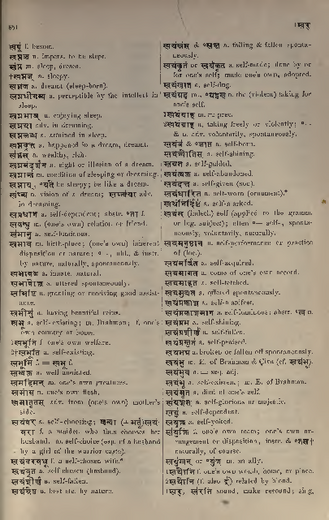
svayám ·(indecl.) self (applied to the gramm. or log. subject); often °-- self-, spontaneously, voluntarily, naturally.
Monier-Williams 1872 Partikel · Worttyp nicht bestimmt
Originaltext · Englisch · Partikel
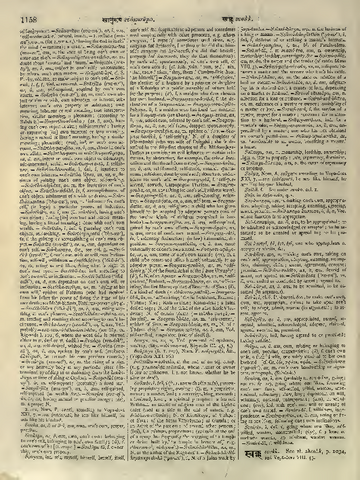
Svayam, ind. self, myself, himself, herself, itself, one's self, &c. (applicable to all persons and sometimes used emphatically with other pronouns, e. g. ahaṃ svayam, ‘I myself;’ sometimes used alone, e. g. svayaṃ tat kṛtavān, I or thou or he did that him- self; svayaṃ tat kṛtavatī, she did that herself; svayaṃ tat kurvanti, they do that themselves); by one's self, spontaneously, of one's own self, of one's own accord; [cf. Hib. feiñ, ‘own, self;’ sin, ‘that, there;’ siom, ‘they, them:’ Cambro-Brit. hun, ‘he himself.’]
Originaltext · Englisch · Worttyp nicht bestimmt
svayam svayam, svayaṃ-vara, svayam-bhū, &c. See p. 1158.
Petersburger 1855 Partikel
Originaltext · Deutsch · Partikel
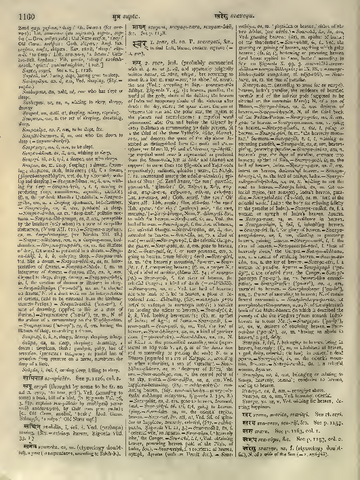
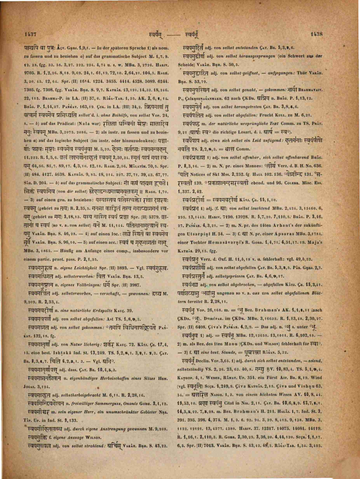
svayám indecl. (eig. ein erstarrter nom. von sva die eigene Person: vgl. ayam, iyam, idam) gaṇa svarādi zu P. 1,1,37. selbst AK. 3,5,16. ṚV. 1,122,9. ṚV. 1,158,5. ṚV. 2,35,14. sva̱yamatka̱ṃ vasā̀naḥ ṚV. 4,18,5. ṚV. 4,18,10. ṚV. 5,44,8. sva̱yaṃ vàrdhasva ta̱nvàm ṚV. 7,8,5. ṚV. 7,56,11. ṚV. 10,7,6. ṚV. 10,27,12. AV. 12,4,27. AV. 14,1,57. ŚAT. BR. 1,6,3,8. ŚAT. BR. 13,2,7,11. ŚAT. BR. 14,7,1,10. KAṬHOP. 2,5. TAITT. UP. 2,7. svayaṃ patnyapi vā putraḥ ĀŚV. GṚHY. 1,9,1. — In der späteren Sprache 1〉 als nom. zu fassen und zu beziehen a〉 auf das grammatische Subject M. 1,7. fgg. M. 1,9. M. 1,12. fgg. M. 1,28. M. 1,33. fgg. M. 1,58. M. 3,27. fgg. M. 3,222. M. 3,224. fgg. M. 4,74 u. s. w. MBH. 3,2726. HARIV. 9705. R. 1,2,26. R. 1,8,18. R. 1,9,69. R. 1,24,1. R. 1,61,19. R. 1,72,10. R. 2,64,21. R. 2,104,5. RAGH. 3,20. RAGH. 3,45. RAGH. 12,64. Spr. (II) 1614. fg. Spr. (II) 1224. Spr. (II) 3455. fg. Spr. (II) 4414. Spr. (II) 4528. fg. Spr. (II) 5089. Spr. (II) 6244. fg. Spr. (II) 7305. fg. Spr. (II) 7308. fgg. VARĀH. BṚH. S. 9,7. KATHĀS. 13,191. KATHĀS. 14,33. KATHĀS. 18,246. KATHĀS. 22,115. BRAHMA-P. in LA. (II) 57,6. RĀJA-TAR. 1,35. AK. 2,6,1,14. BHĀG. P. 1,14,27. PAÑCAT. 163,19. ŚUK. in LA. (III) 34,2. kriyamāṇaṃ tu yatkarma svayameva prasidhyati selbst d. i. ohne Beihilfe, von selbst VOP. 24,8. — b〉 auf das Prädicat: (Nala war) rakṣitā dhanvināṃ śreṣṭhaḥ sākṣādiva manuḥ svayam MBH. 3,2075. MBH. 3,2086. — 2〉 als instr. zu fassen und zu beziehen a〉 auf das logische Subject (im instr. oder hinzuzudenken): yajñārthāḥ paśavaḥ sṛṣṭāḥ svayameva svayaṃbhuvā M. 5,39. homaḥ kartavyaḥ svayamanvaham M. 11,222. R. 1,5,6. jalaṃ lakṣmaṇenāhṛtaṃ svayam R. 2,50,34. smṛtaṃ pāpaṃ mayā svayam R. 64,56. R. 81,7. R. 89,17. R. 4,3,10. R. 12,18. RAGH. 2,56. MĀLATĪM. 70,5. Spr. (II) 484. Spr. (II) 4127. Spr. (II) 4638. KATHĀS. 9,85. KATHĀS. 18,214. KATHĀS. 18,327. KATHĀS. 37,71. KATHĀS. 39,43. KATHĀS. 67,77. SĀH. D. 204. — b〉 auf das grammatische Subject: māṃ kathaṃ paśyanna dūyase . siktaṃ svayamiva (von dir selbst) snehādvandhyamāśramavṛkṣakam .. RAGH. 1,70. — 3〉 auf einen gen. zu beziehen: yasyāstava patistyakto rājā daśarathaḥ svayam (gehört zu tava) R. 2,35,5. manasā kāṅkṣitaṃ tasya mamāpyāgamanaṃ svayam (gehört zu mama) R. 3,18,13. yasya nāsti svayaṃ prajñā Spr. (II) 5379. jātānāṃ ca svayaṃ (so v. a. von selbst) vane M. 11,144. patitānāmutthāne svayam VARĀH. BṚH. S. 46,28. — 4〉 auf einen loc.: lagne sthite vā svayameva sūrye VARĀH. BṚH. S. 96,10. — 5〉 auf einen acc.: svayaṃ ca gṛhamāgatāṃ mām MBH. 3,1865. — Häufig am Anfange eines comp., insbesondere vor einem partic. praet. pass. P. 2,1,25.
Böhtlingk 1879 Partikel
Originaltext · Deutsch · Partikel
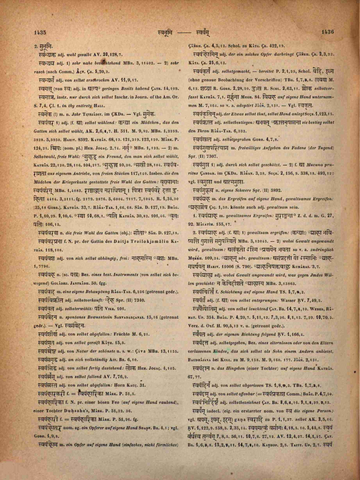
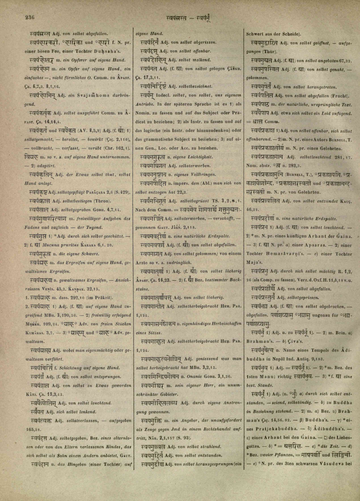
svayám Indecl. selbst, von selbst, aus eigenem Antriebe. In der späteren Sprache ist es — 1〉 als Nomin. zu fassen und auf das Subject oder Prädicat zu beziehen; — 2〉 als Instr. zu fassen und auf das logische (ein Instr. oder hinzuzudenken) oder das grammatischen Subject zu beziehen; — 3〉 auf einen Gen., Loc. oder Acc. zu beziehen.
Apte 1890 Partikel
Originaltext · Englisch · Partikel
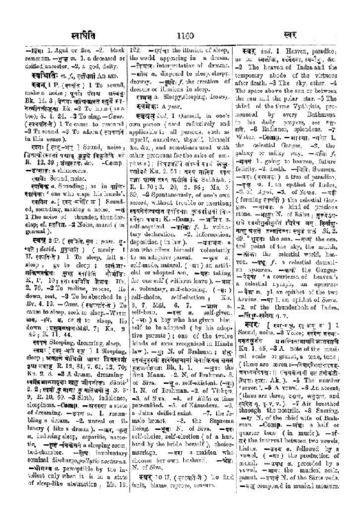
svayam ind. 1 Oneself, in one's own person (used reflexively and applicable to all persons, such as myself, ourselves, thyself, himself &c. &c., and sometimes used with other pronouns for the sake of emphasis); viṣavṛkṣopi saṃvardhya svayaṃ chettumasāṃprataṃ Ku. 2. 55; yasya nāsti svayaṃ prajñā śāstraṃ tasya karoti kiṃ Subhāṣ.; R. 1. 70; R. 3. 20, R. 2. 56; Ms. 5. 39. 2 Spontaneously, of one's own accord, without trouble or exertion; svayamevotpadyaṃta evaṃvidhāḥ kulapāṃśavo niḥsnehāḥ paśavaḥ K. Comp. — arjita a. self-acquired. — uktiḥ f. 1 voluntary declaration. 2 information, deposition (in law). — upāgataḥ a son who offers himself voluntarily to an adoptive parent. — kṛta a. self-made, natural. — (taḥ) an artificial or adopted son. — grahaḥ taking for one-self (without leave). — grāha a. voluntary, self-choosing. — (haḥ) self-choice, self-election; Ku. 3. 7, Māl. 6. 7. — jāta a. self-born. — datta a. self-given. — (ttaḥ) a boy who has given himself to be adopted (by his adoptive parents); one of the twelve kinds of sons recognised in Hindu law. — bhuḥ N. of Brahman; śaṃbhusvayaṃbhuharayo hariṇekṣaṇānāṃ yenākriyaṃta satataṃ gṛhakarmadāsāḥ Bh. 1. 1. — bhuvaḥ the first Manu. 2 N. of Brahman. 3 of Śiva. — bhū a. self-existent. — (bhūḥ) 1 N. of Brahman. 2 of Viṣṇu. 3 of Śiva. 4 of Kāla or time personified. 5 of Kāmadeva. 6 a Jaina deified saint. 7 the female breast. 8 the Supreme Being. — bhūtaḥ N. of Śiva. — varaḥ self-choice, self-election (of a husband by the bride herself), choicemarriage. — varā a maiden who chooses her own husband. — śreṣṭhaḥ N. of Śiva.
Cappeller 1887 Worttyp nicht bestimmt
Originaltext · Deutsch · Worttyp nicht bestimmt
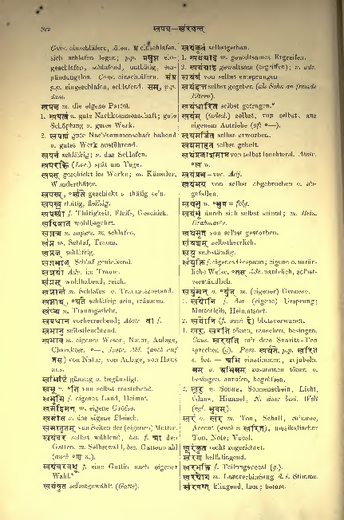
svayám (indecl.) selbst, von selbst, aus eigenem Antriebe (oft ˚—).
Burnouf 1866 Partikel
Originaltext · Französisch · Partikel
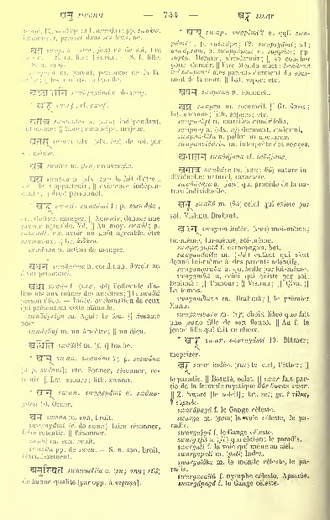
svayam svayam indéc. (sva) moi-même; toi-même, lui-même, soi-même. svayaṅguptā f. carpopogon, bot. svayandatta m. (dā) enfant qui s'est donné lui-même à des parents adoptifs. svayamprabha a. qui brille par lui-même. svayambhū a. celui qui existe par soi, Brahmā; l'amour; Viṣṇu; Śiva. Le temps. svayambhuva m. Brahmā; le premier Manu. svayamvara m. (vṛ) choix libre que fait une jeune fille de son fiancé. Au f. la jeune fille qui fait ce choix.
Abgeleitete Wörter
Quelltextfundstellen (33)
DYS 4 Fundstellen
GoS 2 Fundstellen
HP 4 Fundstellen
IVU 1 Fundstelle
SiSa 19 Fundstellen
Weitere 10 Quelltextseiten
SiSa 5.48-5.71: Innere Meditation 2 Fundstellen
Direkt belegt
SiSa 5.82-5.89: Mūlādhāra 2 Fundstellen
Über Ableitungen belegt
Mit AYI Free weitermachen
Bildquelle: AYI Archiv.