
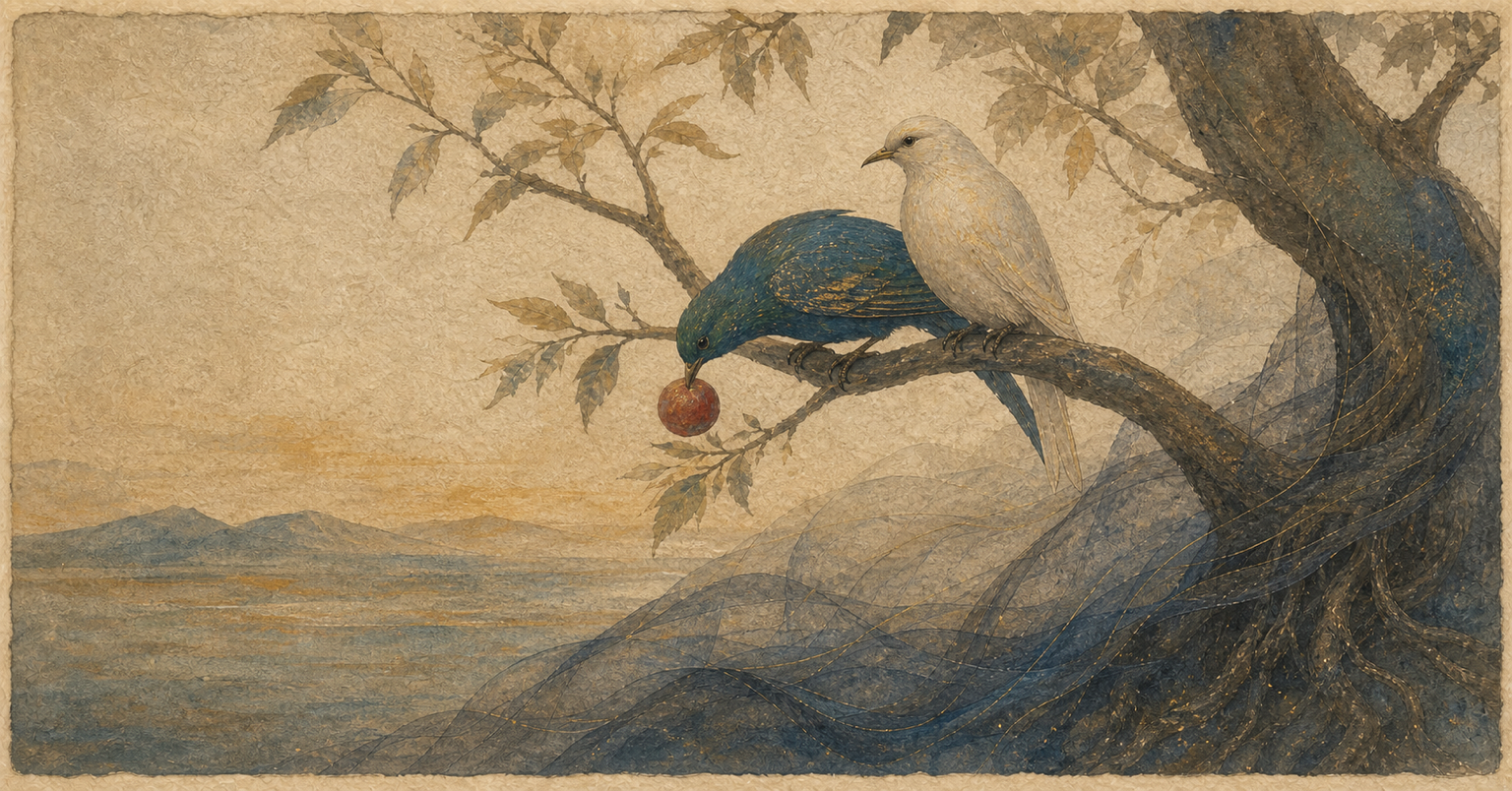
The Bhāṣya attributed to Śaṅkara portrays the bound person as overwhelmed by identification with the body: birth, kinship, loss and powerlessness create grief. After long purification, the person knows the other, innermost Lord as their own Self and becomes free from the entire ocean of sorrow.
Śaṅkarānanda sees the Jīva sunk through beginningless habits in anxiety and delusion. As soon as it directly knows the self-luminous Self of joy, distinct from Avidyā and its effects, as Lord and its own greatness, all grief falls away together with ignorance.
Nārāyaṇa explains the sinking as identification with the shared body. The Jīva regards itself as powerless and clings to sensory objects. When it knows the Lord made gracious through worship and his greatness, it becomes free from grief.
Vijñānabhagavat interprets powerlessness as the superimposition of the five sheaths. Through hearing, reflection and contemplation with a teacher, the prepared Jīva recognises that the unlimited greatness of the supposedly other Īśvara is its own innermost Self; this direct knowledge destroys Saṃsāra and its cause.
<1: This stanza = Muṇḍ. 3. 1. 2.>
ṛco akṣare, parame vyoman; yasmin devā, adhi viśve niṣedhuḥ | Analysis ▾ Analysis ▴
yas tan na veda, kim ṛcā kariṣyati; ya it tad vidus, ta ime samāsate ||8|| Analysis ▾ Analysis ▴
The Bhāṣya attributed to Śaṅkara grounds the Vedas and gods in the imperishable highest space. Whoever does not know Paramātman gains nothing from the mere Ṛc; whoever truly knows him rests fulfilled and has reached the goal.
Śaṅkarānanda distinguishes word-Brahman from its ground of meaning. The Vedas, their meanings, deities or organs rest in highest Brahman. One who knows only words misses their purpose; the true knowers become absorbed in all-pervading joy.
Nārāyaṇa stresses that mere recitation and teaching of the Ṛc without knowledge of its imperishable ground remains useless. Those who know this ground are truly collected and united with it.
Vijñānabhagavat assigns the Vedas both a preparatory and a consummating function. Rites and worship purify the inner organ; hearing, reflection and contemplation then disclose Akṣara as one's own Self. Without this knowledge of unity, even the whole of Vedic practice remains without its ultimate purpose.
<1: This stanza = RV. 1. 164. 39.>
<1: It is difficult to see how this verse comes in here. In the Taitt. Ār. II, 11, 6, it is quoted in connection with the syllable Om, the Akshara, in which all the Vedas are comprehended. It is similarly used in the Nṛsiṃha-pūrva-tāpanī, IV, 2; V, 2. In our passage, however, akshara is referred by Śaṅkara to the paramātman, and I have translated it accordingly. Ṛcaḥ is explained as a genitive singular, but it may also be taken as a nom. plur., and in that case both the verses of the Veda and the gods are said to reside in the Akshara, whether we take it for the Paramātman or for the Om. In the latter case, parame vyoman is explained by utkṛṣṭe and rakṣake.>
chandāṃsi yajñāḥ, kratavo vratāni; bhūtaṃ bhavyaṃ, yac ca vedā vadanti | Analysis ▾ Analysis ▴
asmān māyī, sṛjate viśvam etat; tasmiṃś cānyo, māyayā saṃniruddhaḥ ||9|| Analysis ▾ Analysis ▴
The Bhāṣya attributed to Śaṅkara lets Vedas, rites and the world of time arise from immutable Brahman through its own Māyā. In the cosmos thus projected, the Jīva appears bound through that same Māyā and wanders in Saṃsāra.
Śaṅkarānanda classifies Chandas, sacrifices, vows, and past, present and future as products of the Māyin. Īśvara creates the fivefold world; the Jīva who appears distinct from him is held in it by Avidyā.
Nārāyaṇa understands the Vedic and temporal order broadly: Chandas, types of sacrifice, vows and everything denoted by the Vedas belong to it. The Māyin creates this whole, while the Jīva is completely bound within it by Māyā.
Vijñānabhagavat understands Vedas, rites and all three times as effects of Brahman's Māyā. The immutable ground does not itself become world-matter but appears as creator through its power. In the same total and individual world, enclosed by Māyā, it receives the designation Jīva.
<1: Der andre, anya, kann nur die Vers 6–7 erwähnte individuelle Seele sein.>
<1: That is, the individual soul.>
<1: Der andre, anya, kann nur die Vers 6–7 erwähnte individuelle Seele sein.>
<1: It is impossible to find terms corresponding to māyā and māyin. Māyā means making, or art, but as all making or creating, so far as the Supreme Self is concerned, is phenomenal only or mere illusion, māyā conveys at the same time the sense of illusion. In the same manner māyin is the maker, the artist, but also the magician or juggler. What seems intended by our verse is that from the akshara, which corresponds to brahman, all proceeds, whatever exists or seems to exist, but that the actual creator or the author of all emanations is Īśa, the Lord, who, as creator, is acting through māyā or devātmaśakti. Possibly, however, anya, the other, may be meant for the individual purusha.>
<1: Or, according to Śankara’s explanation: The sacred metres, the sacrifices, offerings, expiations, what has been, and what is to be, all, according to the evidence of the Vedas, springs from that immortal letter.>
The Bhāṣya attributed to Śaṅkara expressly defines Māyā as Prakṛti and Maheśvara as its conscious bearer. The world is not incorporated into him as a real transformation, but is spread out through the superimposition of his apparent parts, like a snake upon a rope.
Śaṅkarānanda calls Māyā the material cause of the world and Maheśvara the controller even of the great deities. The whole conscious and unconscious universe is pervaded by the effects of this Māyin, which are designated as his limbs.
Nārāyaṇa understands beings and parts of the world as limbs of Maheśvara only figuratively. Through these limb-like Jīvas, the entire world is filled by the Lord without his essential nature being composite.
Vijñānabhagavat describes Māyā as the cause of the world and a dependent superimposition. Maheśvara gives it being and luminosity without transforming himself into it; like silver upon mother-of-pearl, the whole visible universe appears upon non-dual consciousness and can be cancelled by right knowledge.
<1: Die Natur ist doch nicht völlig wesenlose Māyā, sofern sie von den (individuellen) Seelen durchzogen wird, welche hier wie öfter (Bṛh. 2,1,20. Muṇḍ. 2,1,1 etc.) bildlich als Teile des Brahman vorgestellt werden und an seiner Realität teilhaben.>
<1: Die Natur ist doch nicht völlig wesenlose Māyā, sofern sie von den (individuellen) Seelen durchzogen wird, welche hier wie öfter (Bṛh. 2,1,20. Muṇḍ. 2,1,1 etc.) bildlich als Teile des Brahman vorgestellt werden und an seiner Realität teilhaben.>
<1: Attempt to reconcile the doctrine of the Vedānta with the Sānkhya.>
<2: Or, by the elements (the five great elements) which are his parts.>
Continue with AYI Free
Illustrations: AI-generated.
Please log in to write a message. Go to login
No messages yet.