
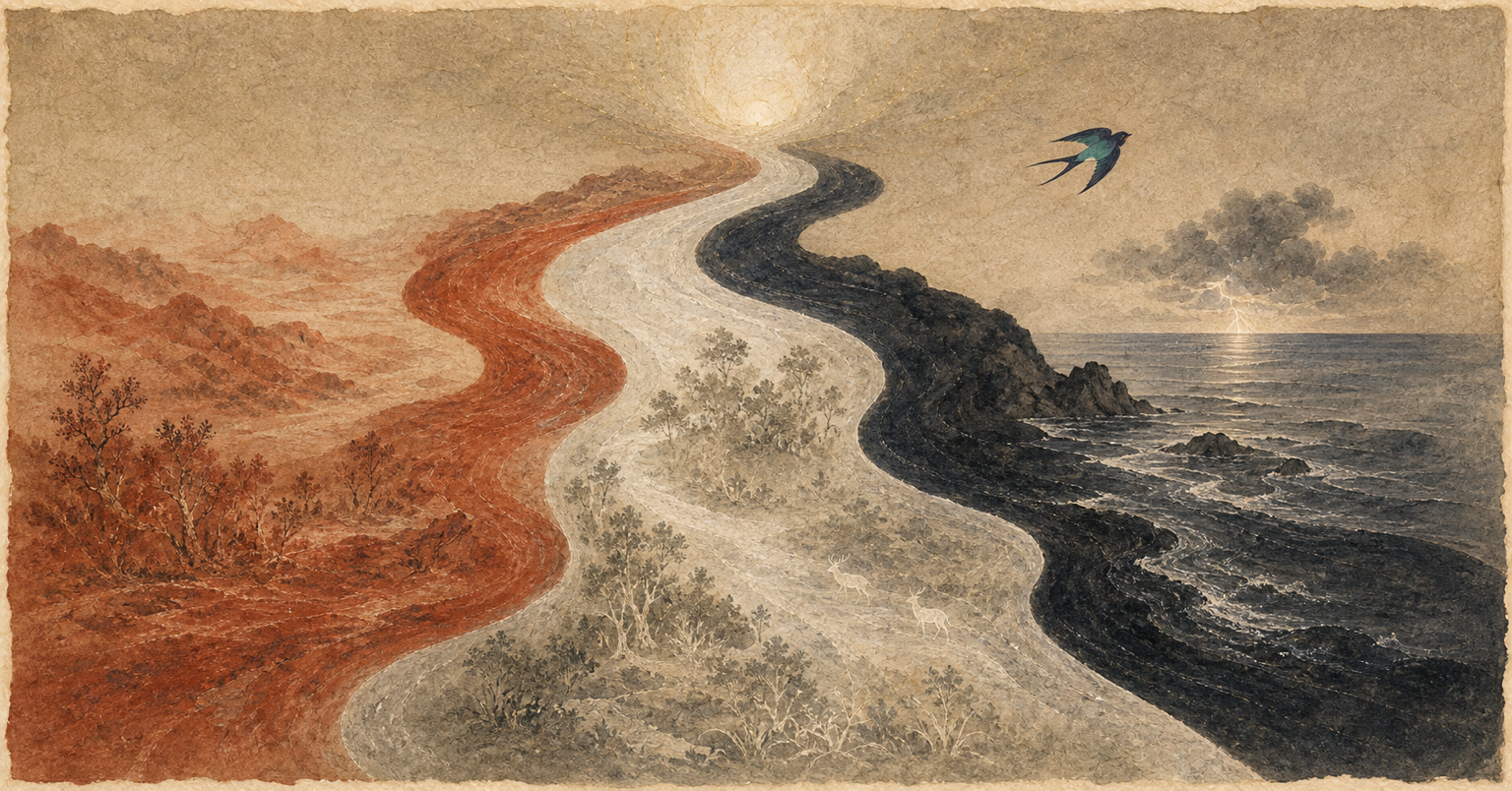
SVU 4.1-4.5: The One in Every Form

SVU 4.1-4.5: Unity, Forms of the World and Primordial Nature

The colourless One assumes countless forms, pervades fire, sun, nature and living beings, and stands behind the three-coloured primordial nature and those who enjoy it.

Śvetāśvatara Upaniṣad 4.1
य एको ऽवर्णो बहुधा शक्तियोगाद्वर्णाननेकान्निहितार्थो दधाति |
ya eko 'varṇo, bahudhā śakti-yogād; varṇān anekān, nihitārtho dadhāti | Analysis ▾ Analysis ▴
yaḥ
nominative singular masculine
pronoun rel
who
ekaḥ
nominative singular masculine
numeral
the one
avarṇaḥ
nominative singular masculine
adjective
colourless
bahudhā
adverb
manifoldly
śakti
tatpuruṣa-compound instrumental case
substantive feminine
through power
yogāt
ablative singular
substantive masculine
through union
varṇān
accusative plural
substantive masculine
colours, forms
anekān
accusative plural masculine
adjective
many
nihita
karmadhāraya-compound past participle passive
previx
verbal root
hidden
arthaḥ
nominative singular masculine bahuvrīhi-compund
substantive masculine
having a purpose
dadhāti
3rd person singular aktive present
verbal root
he brings forth
वि चैति चान्ते विश्वमादौ स देवः स नो बुद्ध्या शुभया संयुनक्तु ||1||
vi caiti cānte, viśvam ādau sa devaḥ; sa no buddhyā, śubhayā saṃyunaktu ||1|| Analysis ▾ Analysis ▴
vi
particle
apart
ca
particle
and
eti
3rd person singular aktive present
verbal root
it goes
ca
particle
and
ante
lokative singular
substantive masculine
at the end
viśvam
nominative singular neuter
adjective
the whole
ādau
lokative singular
substantive masculine
at the beginning
saḥ
nominative singular masculine
pronoun dem
he
devaḥ
nominative singular
substantive masculine
God
saḥ
nominative singular masculine
pronoun dem
he
naḥ
accusative plural
pronoun pers 1p
us
buddhyā
instrumental case singular
substantive feminine
with understanding
śubhayā
instrumental case singular feminine
adjective
with auspicious
saṃyunaktu
3rd person singular aktive imperative
previx
verbal root
may he join, endow
Metre: Pāda 1: Triṣṭubh with Śālinī ending — 12 syllables; Pāda 2: Triṣṭubh with Śālinī ending — 12 syllables; Pāda 3: Triṣṭubh with Śālinī ending — 12 syllables; Pāda 4: Triṣṭubh with Śālinī ending
He who (yaḥ | nom sg m), the One (ekaḥ | nom sg m), [himself] colourless (avarṇaḥ | nom sg m), brings forth (dadhāti | 3p sg act pres), in manifold ways (bahudhā) through union with [his] power (śakti-yogāt | abl sg), forms (varṇān | acc pl), namely numerous ones (anekān | acc pl m), with a hidden purpose (nihitārthaḥ | nom sg m bv). Into diversity (vi) it also (ca) goes (eti | 3p sg act pres), and (ca) at the end (ante | loc sg) the whole (viśvam | nom sg n) [returns into him]; at the beginning (ādau | loc sg) [stands] he (saḥ | nom sg m), God (devaḥ | nom sg). May he (saḥ | nom sg m) endow (saṃyunaktu | 3p sg act imp) us (naḥ | acc pl) with auspicious understanding (buddhyā śubhayā | ins sg).
Dr. Ronald Steiner - 2026 - historically literal
The One is himself without colour and, through union with his manifold power, causes countless forms to arise for a hidden purpose. In him the whole unfolds and, at the end, returns once more; he is God, the source of everything. May he fill us with auspicious understanding.
Dr. Ronald Steiner - 2026 - modern transfer

The Bhāṣya attributed to Śaṅkara understands the One as the formless Paramātman, who through different powers brings forth the many forms and takes them back into himself at dissolution. The requested auspicious Buddhi is to unite one with this pure consciousness.

Śaṅkara's Bhāṣya on the Śvetāśvatara Upaniṣad

Śaṅkarānanda develops several readings of the one sound: self-luminous consciousness, Oṃ, the basic sound A, the principle of speech unfolded through Kuṇḍalinī, or a colour perceived in Yoga. In each reading, multiplicity arises from unity and returns to it.

Śaṅkarānanda's Śvetāśvataropaniṣaddīpikā

Nārāyaṇa reads the One as Oṃ, from which sounds, words and meaningful sentences emerge. At the end the world sheds its effect-form, while the radiant Paramātman remains untouched by decay and is to join the worshipper to self-knowing insight.

Nārāyaṇa's Śvetāśvataropaniṣaddīpikā

Vijñānabhagavat defines the One as consciousness without name or form. Through Māyā it first differentiates names and forms and withdraws them again at the end. Good Buddhi comprises discrimination, dispassion, collectedness and the certainty “I am Brahman”.

Vijñānabhagavat's Śvetāśvataropaniṣadvivaraṇa
avarṇo LV1958, ASS1927 ] varṇīḥ LV1958-app
Critical Apparatus
Er, der, selbst farblos, vielfach versehn mit Kräften, Die vielen Farben verleiht zu bestimmten Zwecken, Bis endlich das All zergeht in ihm, dem Anfang, Der Gott begäbe uns mit edler Einsicht (3,4).
Paul Deussen - 1921
The One who, himself without color, by the manifold application of his power (śakti-yoga) Distributes many colors in his hidden purpose, And into whom, its end and its beginning, the whole world dissolves—He is God (deva)! May He endow us with clear intellect!
Robert Hume - 1921
He is the Luminous Being, who, being One and without form and name, creates, by connection with Maya, and keeping the words and forms (in His thought), numerous forms and names of many kinds, in the beginning (of creation), and at the end destroys the Universe. May He fit us with good wisdom.
Siddhesvar Varma Shastri - 1916
Er, der, selbst farblos, vielfach versehn mit Kräften, Die vielen Farben verleiht zu bestimmten Zwecken, Bis endlich das All zergeht in ihm, dem Anfang, Der Gott begäbe uns mit edler Einsicht (3,4).
Paul Deussen - 1897
He, the sun, without any colour, who with set purpose<1> by means of his power (śakti) produces endless colours<2>, in whom all this comes together in the beginning, and comes asunder in the end—may he, the god, endow us with good thoughts<3>.
<1: Nihitārtha, explained by Śaṅkara as gṛhītaprayojanaḥ svārthanirapekṣaḥ. This may mean with set purpose, but if we read agṛhītaprayojanaḥ it would mean the contrary, namely, without any definite object, irrespective of his own objects. This is possible, and perhaps more in accordance with the idea of creation as propounded by those to whom the devātmaśakti is māyā. Nihita would then mean hidden.>
<2: Colour is intended for qualities, differences, &c.>
<3: This verse has been translated very freely. As it stands, vi caiti cānte viśvam ādau sa devaḥ, it does not construe, in spite of all attempts to the contrary, made by Śaṅkara. What is intended is yasminn idaṃ saṃ ca vi caiti sarvam (IV, 11); but how so simple a line should have been changed into what we read now, is difficult to say.>
F. Max Müller - 1884
He, who one alone, (and) without distinction, by his union with many powers (śakti) creates infinite distinctions, according to their necessity, and into whom the world at last (at the time of universal destruction) is dissolved, is God. May he grant us auspicious intellect.<1>
<1: Vid. 3 ch. 1.>
Edward Röer - 1853
Śvetāśvatara Upaniṣad 4.2
तदेवाग्निस्तदादित्यस्तद्वायुस्तदु चन्द्रमाः |
tad evāgnis tad ādityas; tad vāyus tad u candramāḥ | Analysis ▾ Analysis ▴
tat
nominative singular neuter
pronoun dem
that
eva
particle
indeed
agniḥ
nominative singular
substantive masculine
Agni, fire
tat
nominative singular neuter
pronoun dem
that
ādityaḥ
nominative singular
substantive masculine
Āditya, sun
tat
nominative singular neuter
pronoun dem
that
vāyuḥ
nominative singular
substantive masculine
Vāyu, wind
tat
nominative singular neuter
pronoun dem
that
u
particle
also
candramāḥ
nominative singular
substantive masculine
moon
तदेव शुक्रं तद्ब्रह्म तदापस्तत्प्रजापतिः ||2||
tad eva śukraṃ tad brahma; tad āpas tat prajāpatiḥ ||2|| Analysis ▾ Analysis ▴
tat
nominative singular neuter
pronoun dem
that
eva
particle
indeed
śukram
nominative singular neuter
adjective
the luminous, pure
tat
nominative singular neuter
pronoun dem
that
brahma
nominative singular
substantive neuter
Brahman, the Absolute
tat
nominative singular neuter
pronoun dem
that
āpaḥ
nominative plural
substantive feminine
the waters
tat
nominative singular neuter
pronoun dem
that
prajāpatiḥ
nominative singular
substantive masculine
Prajāpati, Lord of Creatures
Metre: Anuṣṭubh
That (tat | nom sg n), indeed (eva), is Agni (agniḥ | nom sg); that (tat | nom sg n) [is] Āditya (ādityaḥ | nom sg); that (tat | nom sg n) [is] Vāyu (vāyuḥ | nom sg); that (tat | nom sg n) [is] also (u) the moon (candramāḥ | nom sg). That (tat | nom sg n), indeed (eva), is the Pure (śukram | nom sg n); that (tat | nom sg n) [is] Brahman (brahma | nom sg); that (tat | nom sg n) [is] the waters (āpaḥ | nom pl); that (tat | nom sg n) [is] Prajāpati (prajāpatiḥ | nom sg).
Dr. Ronald Steiner - 2026 - historically literal
He is fire, sun, wind and moon. He is pure light, Brahman, the waters and Prajāpati.
Dr. Ronald Steiner - 2026 - modern transfer

The Bhāṣya attributed to Śaṅkara reads the series as a statement of the identity of all powers with the principle of the Self. Śukra denotes the pure or luminous, Brahman denotes Hiraṇyagarbha, and Prajāpati denotes the cosmic Virāj-form.

Śaṅkara's Bhāṣya on the Śvetāśvatara Upaniṣad

Śaṅkarānanda turns fire, sun, wind, moon, light, water and Prajāpati into different forms for meditation on Brahman. The verse thus teaches not multiple causes but the presence of the same ground of the world in every cosmic function.

Śaṅkarānanda's Śvetāśvataropaniṣaddīpikā

Nārāyaṇa's Dīpikā adopts two striking word meanings: it understands Śukra as generative power or seed and Brahman as the Veda. These too are identified without qualification with the same divine ground.

Nārāyaṇa's Śvetāśvataropaniṣaddīpikā

Vijñānabhagavat arranges the named deities as cosmic totalities: fire stands for speech, the sun for sight, wind for the vital breath, and the moon for the mind. The series also represents all other collective organs and faculties.

Vijñānabhagavat's Śvetāśvataropaniṣadvivaraṇa
Das ja ist Agni, Āditya, Das ist Vāyu und Candramas, Das ist das Reine, das Brahman, Die Wasser und Prajāpati.<1>
<1: Der Anfangsvers des Tadeva-Liedes, Vāj. Saṃh. 32,1 (Gesch. d. Phil. I, 291).>
Paul Deussen - 1921
That surely is Agni (fire). That is Āditya (the sun). That is Vāyu (the wind), and That is the moon. That surely is the pure. That is Brahma. That is the waters. That is Prajāpati (Lord of Creation).
Robert Hume - 1921
He alone is fire, He is the sun, He is air, He is also the moon, He alone is the bright group of planets, He is Hiranyagarbha, He is the waters, He is Virat.
Siddhesvar Varma Shastri - 1916
Das ja ist Agni, Āditya, Das ist Vāyu und Candramas, Das ist das Reine, das Brahman, Die Wasser und Prajāpati.<1>
<1: Der Anfangsvers des Tadeva-Liedes, Vāj. Saṃh. 32,1 (Gesch. d. Phil. I, 291).>
Paul Deussen - 1897
That (Self) indeed is Agni (fire), it is Āditya (sun), it is Vāyu (wind), it is Candramas (moon); the same also is the starry firmament<1>, it is Brahman (Hiraṇyagarbha), it is water, it is Prajāpati (Virāj).
<1: This is the explanation of Śaṅkara, and probably that of the Yoga schools in India at his time. But to take śukram for dīptiman nakṣatrādi, brahma for Hiraṇyagarbha, and Prajāpati for Virāj seems suggested by this verse only.>
F. Max Müller - 1884
He, (the nature of Bramha) is even fire, he the sun (Āditya), he the wind, he the moon, he even the brilliant (stars), he Bramha, he is the waters, he is Prajāpati.<1>
<1: Śankara explains “Bramha” by “Hiraṇyagarbha,” that is to say, the universal soul, as pervading all subtle bodies, and Prajāpati by Virāt, or the universal soul, as pervading all gross bodies.>
Edward Röer - 1853
Śvetāśvatara Upaniṣad 4.3
त्वं स्त्री त्वं पुमानसि त्वं कुमार उत वा कुमारी |
tvaṃ strī tvaṃ pumān asi; tvaṃ kumāra, uta vā kumārī | Analysis ▾ Analysis ▴
tvam
nominative singular
pronoun pers 2p
you
strī
nominative singular
substantive feminine
woman
tvam
nominative singular
pronoun pers 2p
you
pumān
nominative singular
substantive masculine
man
asi
2nd person singular aktive present
verbal root
you are
tvam
nominative singular
pronoun pers 2p
you
kumāraḥ
nominative singular
substantive masculine
boy, young man
uta
particle
and
vā
particle
also
kumārī
nominative singular
substantive feminine
girl, young woman
तुवं जीर्णो दण्डेन वञ्चसि तुवं जातो भवसि विश्वतोमुखः ||3||
tu*vaṃ jīrṇo, daṇḍena vañcasi; tu*vaṃ jāto, bhavasi viśvato-mukhaḥ ||3|| Analysis ▾ Analysis ▴
tvam
nominative singular
pronoun pers 2p
you
jīrṇaḥ
nominative singular masculine past participle passive
verbal root
aged
daṇḍena
instrumental case singular
substantive masculine
with a staff
vañcasi
2nd person singular aktive present
verbal root
you walk bent over
tvam
nominative singular
pronoun pers 2p
you
jātaḥ
nominative singular masculine past participle passive
verbal root
born
bhavasi
2nd person singular aktive present
verbal root
you become
viśvatas
bahuvrīhi-compund
adverb
on every side
mukhaḥ
nominative singular masculine bahuvrīhi-compund
substantive neuter
facing every direction
Metre: Pāda 1: Anuṣṭubh — 7 rather than 8 syllables; Pāda 2: Triṣṭubh with Vajrā ending — 10 syllables; Pāda 3: Jagatī — 10 syllables; Pāda 4: Jagatī with Vaṃśa ending
You (tvam | nom sg) [are] the woman (strī | nom sg); you (tvam | nom sg) are (asi | 2p sg act pres) the man (pumān | nom sg). You (tvam | nom sg) [are] the boy (kumāraḥ | nom sg) and (uta) also (vā) the girl (kumārī | nom sg). You (tvam | nom sg) [are] aged (jīrṇaḥ | nom sg m ppp) and, with a staff (daṇḍena | ins sg), walk bent over (vañcasi | 2p sg act pres); you (tvam | nom sg), born (jātaḥ | nom sg m ppp), become (bhavasi | 2p sg act pres) all-faced (viśvato-mukhaḥ | nom sg m bv).
Dr. Ronald Steiner - 2026 - historically literal
You are woman and man, boy and girl. You are the old man who walks bent over his staff, and in every birth you appear with faces turned in all directions.
Dr. Ronald Steiner - 2026 - modern transfer

Śaṅkarānanda understands woman, man, child, old person and the form looking in all directions as concepts for the same Self of joy. Difference lies in the respective verbal conceptions and stages of life, not in a change of Ātman.

Śaṅkarānanda's Śvetāśvataropaniṣaddīpikā

Nārāyaṇa explains differences of sex and age as determinations imagined in the Self. Whether female, male, young or old, the entire realm of forms brought forth is not a reality independent of the one Self.

Nārāyaṇa's Śvetāśvataropaniṣaddīpikā

Vijñānabhagavat compares the many individual forms with space in vessels and reflections of the moon in water. Through Māyā the Lord creates bodies and organs, enters them and only apparently receives their sex, age and names.

Vijñānabhagavat's Śvetāśvataropaniṣadvivaraṇa
tu*vaṃ jīrṇo conj. ed. ] tvaṃ jīrṇo LV1958
Critical Apparatus
Du bist das Weib, du bist der Mann, Das Mädchen und der Knabe, Du wächst, geboren, allerwärts, Du wankst als Greis am Stabe.<1>
<1: = Atharvav. 10,8,27 (Gesch. d. Phil. I, 322).>
Paul Deussen - 1921
Thou art woman. Thou art man. Thou art the youth and the maiden too. Thou as an old man totterest with a staff. Being born, thou becomest facing in every direction.<1>
<1: This stanza = AV. 10. 8. 27.>
Robert Hume - 1921
Thou art woman, thou art man, thou art the young man, thou art even the young woman, thou art the old man who goest with a staff, (in short) thou art born in all forms.
Siddhesvar Varma Shastri - 1916
Du bist das Weib, du bist der Mann, Das Mädchen und der Knabe, Du wächst, geboren, allerwärts, Du wankst als Greis am Stabe.<1>
<1: = Atharvav. 10,8,27 (Gesch. d. Phil. I, 322).>
Paul Deussen - 1897
Thou art woman, thou art man; thou art youth, thou art maiden; thou, as an old man, totterest<1> along on thy staff; thou art born with thy face turned everywhere.
<1: Vañkayasi, an exceptional form, instead of vañkasi (A. B.).>
F. Max Müller - 1884
Thou art woman, thou art man, thou art the youth, and even the maid, thou art the old man trembling on his staff, thou art born, thy face is the universe.
Edward Röer - 1853
Śvetāśvatara Upaniṣad 4.4
नीलः पतङ्गो हरितो लोहिताक्षस्तडिद्गर्भ ऋतवः समुद्राः |
nīlaḥ pataṅgo, harito lohitākṣas; taḍid-garbha, ṛtavaḥ samudrāḥ | Analysis ▾ Analysis ▴
nīlaḥ
nominative singular masculine
adjective
dark blue
pataṅgaḥ
nominative singular
substantive masculine
flying creature, bird
haritaḥ
nominative singular masculine
adjective
green
lohita
karmadhāraya-compound
adjective
red
akṣaḥ
nominative singular masculine bahuvrīhi-compund
substantive neuter
red-eyed
taḍit
bahuvrīhi-compund
substantive feminine
lightning
garbhaḥ
nominative singular masculine bahuvrīhi-compund
substantive masculine
bearing lightning within
ṛtavaḥ
nominative plural
substantive masculine
seasons
samudrāḥ
nominative plural
substantive masculine
seas
अनादिमांस्त्वं विभुत्वेन वर्तसे यतो जातानि भुवनानि विश्वा ||4||
anādimāṃs, tvaṃ vibhutvena vartase; yato jātāni, bhuvanāni viśvā ||4|| Analysis ▾ Analysis ▴
anādimān
nominative singular masculine
adjective
beginningless
tvam
nominative singular
pronoun pers 2p
you
vibhutvena
instrumental case singular
substantive neuter
through all-pervasiveness
vartase
2nd person singular medial present
verbal root
you abide
yataḥ
ablative singular masculine
pronoun rel
from whom
jātāni
nominative plural neuter past participle passive
verbal root
born
bhuvanāni
nominative plural
substantive neuter
worlds
viśvā
nominative plural neuter
adjective
all
Metre: Pāda 1: Triṣṭubh with Śālinī ending — 12 syllables; Pāda 2: Triṣṭubh with Vajrā ending — 10 syllables; Pāda 3: Jagatī; Pāda 4: Triṣṭubh with Vajrā ending
You (tvam | nom sg) [are] the dark-blue (nīlaḥ | nom sg m) bird (pataṅgaḥ | nom sg), green (haritaḥ | nom sg m) [and] red-eyed (lohitākṣaḥ | nom sg m bv), bearing lightning within (taḍid-garbhaḥ | nom sg m bv); [you are] the seasons (ṛtavaḥ | nom pl), the seas (samudrāḥ | nom pl). [You are] beginningless (anādimān | nom sg m); through all-pervasiveness (vibhutvena | ins sg) you abide (vartase | 2p sg med pres). From you (yataḥ | abl sg m) [are] the worlds (bhuvanāni | nom pl), all (viśvā | nom pl n), born (jātāni | nom pl n ppp).
Dr. Ronald Steiner - 2026 - historically literal
You are the dark-blue bird and the green bird with red eyes, the cloud pregnant with lightning, the seasons and the seas. You are beginningless and omnipresent; from you all the worlds have arisen.
Dr. Ronald Steiner - 2026 - modern transfer

The Bhāṣya attributed to Śaṅkara supplies “you yourself” throughout and recognises the all-form of the Lord: bee, differently coloured birds, thundercloud, seasons and seas. The source of all worlds is beginningless in time and omnipresent in space.

Śaṅkara's Bhāṣya on the Śvetāśvatara Upaniṣad

Śaṅkarānanda explains the images from nature individually and interprets the lightning-like cloud as an image of a world visible one moment and gone the next. Time and water can appear as the two wings; the worlds brought forth are effects of the one ground.

Śaṅkarānanda's Śvetāśvataropaniṣaddīpikā

Nārāyaṇa assigns the terse colour images to concrete appearances: the blue moth, red-eyed fire and the lightning-bearing cloud. Seasons, seas and all things whatsoever are, according to his Dīpikā, forms of the same One.

Nārāyaṇa's Śvetāśvataropaniṣaddīpikā

Vijñānabhagavat connects the series of images with a threefold limitlessness. Beginninglessness denotes freedom from temporal limitation, omnipresence freedom from spatial limitation, and the origin of all worlds shows the Lord as the unlimited material ground of their forms.

Vijñānabhagavat's Śvetāśvataropaniṣadvivaraṇa
anādimāṃs tvaṃ LV1958, ASS1927 ] anādimattvam LV1958-app
Critical Apparatus
Schwarz bist als Vogel du, grün mit roten Augen,<1> Blitzschwanger als Wolke, Jahreszeiten, Meere, Das Anfanglose bist du, das Allverbreitete, Aus dem geworden sind die Wesen alle.
<1: Unter den, in Indien überaus zahlreichen, Vögeln treten besonders hervor die Krähen, die man allmorgendlich scharenweise und krächzend von einem der Riesenbäume zum andern fliegen sieht, und die kleinen, grünen Papageichen, die oft dutzendweise auf einem Baume zusammensitzen, und an deren liebliches, süßes Gezwitscher man sich nicht erinnern kann, ohne Heimweh nach Indien zu empfinden.>
Paul Deussen - 1921
Thou art the dark-blue bird and the green [parrot] with red eyes. Thou hast the lightning as thy child. Thou art the seasons and the seas. Having no beginning, thou dost abide with immanence, Wherefrom all beings are born.
Robert Hume - 1921
Thou art the black bird (or bee); (Thou art) the green (bird), the red-eyed (bird), the cloud, the seasons and the oceans. On account of Thy transcending all Time and Space, Thou art without beginning, from whom all the worlds are born.
Siddhesvar Varma Shastri - 1916
Schwarz bist als Vogel du, grün mit roten Augen,<1> Blitzschwanger als Wolke, Jahreszeiten, Meere, Das Anfanglose bist du, das Allverbreitete, Aus dem geworden sind die Wesen alle.
<1: Unter den, in Indien überaus zahlreichen, Vögeln treten besonders hervor die Krähen, die man allmorgendlich scharenweise und krächzend von einem der Riesenbäume zum andern fliegen sieht, und die kleinen, grünen Papageichen, die oft dutzendweise auf einem Baume zusammensitzen, und an deren liebliches, süßes Gezwitscher man sich nicht erinnern kann, ohne Heimweh nach Indien zu empfinden.>
Paul Deussen - 1897
Thou art the dark-blue bee, thou art the green parrot with red eyes, thou art the thunder-cloud, the seasons, the seas. Thou art without beginning<1>, because thou art infinite, thou from whom all worlds are born.
<1: We see throughout the constant change from the masculine to the neuter gender, in addressing either the lord or his true essence.>
F. Max Müller - 1884
Thou art the black bee, the green bird with red-coloured eye, (the parrot,) the cloud, in whose womb the lightning sleeps, the seasons, the seas; without beginning thou embracest all; for by thee are all the worlds created.
Edward Röer - 1853
Śvetāśvatara Upaniṣad 4.5
अजामेकां लोहितशुक्लकृष्णां बह्वीः प्रजाः सृजमानां सरूपाः |
ajām ekāṃ, lohita-śukla-kṛṣṇāṃ; bahvīḥ prajāḥ, sṛjamānāṃ sa-rūpāḥ | Analysis ▾ Analysis ▴
ajām
accusative singular
substantive feminine
the Unborn female
ekām
accusative singular feminine
numeral
one
lohita
dvandva-compound
adjective
red
śukla
dvandva-compound
adjective
white
kṛṣṇām
accusative singular feminine
adjective
black
bahvīḥ
accusative plural feminine
adjective
many
prajāḥ
accusative plural
substantive feminine
offspring
sṛjamānām
accusative singular feminine present participle medial
verbal root
bringing forth
sa
bahuvrīhi-compund
previx
alike
rūpāḥ
accusative plural feminine bahuvrīhi-compund
substantive neuter
of like form
अजो ह्येको जुषमाणो ऽनुशेते जहात्येनां भुक्तभोगामजो ऽन्यः ||5||
ajo hy eko, juṣamāṇo 'nuśete; jahāty enāṃ, bhukta-bhogām ajo 'nyaḥ ||5|| Analysis ▾ Analysis ▴
ajaḥ
nominative singular
substantive masculine
the Unborn male
hi
particle
for, indeed
ekaḥ
nominative singular masculine
numeral
the one
juṣamāṇaḥ
nominative singular masculine present participle medial
verbal root
delighting
anuśete
3rd person singular medial present
previx
verbal root
he lies beside
jahāti
3rd person singular aktive present
verbal root
he leaves
enām
accusative singular feminine
pronoun dem
her
bhukta
karmadhāraya-compound past participle passive
verbal root
enjoyed
bhogām
accusative singular feminine bahuvrīhi-compund
substantive masculine
whose enjoyment has been consumed
ajaḥ
nominative singular
substantive masculine
the Unborn male
anyaḥ
nominative singular masculine
pronoun quant
the other
Metre: Pāda 1: Triṣṭubh with Vajrā ending; Pāda 2: Triṣṭubh with Śālinī ending; Pāda 3: Triṣṭubh with Śālinī ending; Pāda 4: Triṣṭubh with Śālinī ending
The Unborn female (ajām | acc sg), the one (ekām | acc sg f), red, white and black (lohita-śukla-kṛṣṇām | acc sg f), bringing forth (sṛjamānām | acc sg f pcm) many (bahvīḥ | acc pl f) offspring (prajāḥ | acc pl), [all] of like form (sa-rūpāḥ | acc pl f bv): the Unborn male (ajaḥ | nom sg), indeed (hi), the one (ekaḥ | nom sg m), delighting (juṣamāṇaḥ | nom sg m pcm), lies beside [her] (anuśete | 3p sg med pres). The other (anyaḥ | nom sg m) Unborn male (ajaḥ | nom sg) leaves (jahāti | 3p sg act pres) her (enām | acc sg f), whose enjoyment has been consumed (bhukta-bhogām | acc sg f bv).
Dr. Ronald Steiner - 2026 - historically literal
The one Unborn female, red, white and black, brings forth many creatures like herself. One Unborn male enjoys her company; the other leaves her when his enjoyment of her is over.
Dr. Ronald Steiner - 2026 - modern transfer

The Bhāṣya attributed to Śaṅkara interprets the three-coloured Unborn female as Prakṛti consisting of fire, water and food. A Jīva bound from beginningless time by desire and Karma enjoys her products; another dispels the darkness of ignorance through a teacher's instruction and leaves her behind.

Śaṅkara's Bhāṣya on the Śvetāśvatara Upaniṣad

Śaṅkarānanda identifies the one Unborn female with Avidyā and its many projections. The bound Jīva continues as if asleep because it does not know the Self; the awakened one leaves concealment and projection behind through knowledge of Brahman. Bondage and liberation ultimately remain imagined states.

Śaṅkarānanda's Śvetāśvataropaniṣaddīpikā

Nārāyaṇa reads the red, white and black Unborn female as Māyā of the three Guṇas. The Saṃsārin clings to her in enjoyment and takes this for well-being. The other Unborn male is the detached Paramātman, who neither enjoys nor needs to discard anything.

Nārāyaṇa's Śvetāśvataropaniṣaddīpikā

Vijñānabhagavat connects red, white and black both with fire, water and earth and with Rajas, Sattva and Tamas. The ignorant Jīva attributes their changes to itself; the knower burns root-Māyā through the direct knowledge “I am Brahman”.

Vijñānabhagavat's Śvetāśvataropaniṣadvivaraṇa
bhuktabhogām LV1958, ASS1927 ] bhuktabhogyām LV1958-app
Critical Apparatus
Die eine Ziege, rot und weiß und schwärzlich, Wirft viele Junge, die ihr gleichgestaltet; Der eine Bock in Liebesbrunst bespringt sie, Der andre Bock verläßt sie, die genossen.<1>
<1: Lies lohita-śukla-kṛṣṇām und sarūpāḥ (wie auch der Telugudruck hat). Daß, wie Śaṅkara, und höchst wahrscheinlich auch schon Bādarāyana, annehmen (Brahmasūtra 1,4,8–10), die Stelle ursprünglich auf das Seiende und seine Produkte, Glut, Wasser, Nahrung, Chānd. 6,2, zu beziehen ist, dafür sprechen sowohl die Ausdrücke lohita, śukla, kṛṣṇa (siehe Chānd. 6,4,1) als auch ihre Reihenfolge, die nach dem Sāṅkhyasystem eine andre sein müßte. Auf der andern Seite ist die Beziehung von Bock und Ziege auf Purusha und Prakṛti (mit ihren drei Guna’s, Rajas, Sattvam, Tamas) der Sāṅkhya’s zu treffend, um abgewiesen zu werden. — Wir haben hier eine der Stellen, in denen wir aus dem Monismus der Upanishadlehre die dualistische Sāṅkhyatheorie hervorwachsen sehen (vgl. oben S. 290).>
Paul Deussen - 1921
With the one unborn female, red, white, and black,<1> Who produces many creatures like herself, There lies the one unborn male<2> taking his delight. Another unborn male<3> leaves her with whom he has had his delight.
<1: That is, Nature, Prakṛti, with three constituent Qualities (guṇa), namely Pureness (sattva), Passion (rajas), and Darkness (tamas).>
<2: The cosmic Person, father of all being.>
<3: The individual soul, or experiencer.>
Robert Hume - 1921
One male goat (or uncreated being) follows, while serving, one female goat (or unborn entity) which has red, white and black colours, which produces many various creatures of similar forms. Another he goat (or uncreated Being) abandons her by whom pleasure has been enjoyed.
Siddhesvar Varma Shastri - 1916
Die eine Ziege, rot und weiß und schwärzlich, Wirft viele Junge, die ihr gleichgestaltet; Der eine Bock in Liebesbrunst bespringt sie, Der andre Bock verläßt sie, die genossen.<1>
<1: Lies lohita-śukla-kṛṣṇām und sarūpāḥ (wie auch der Telugudruck hat). Daß, wie Śaṅkara, und höchst wahrscheinlich auch schon Bādarāyana, annehmen (Brahmasūtra 1,4,8–10), die Stelle ursprünglich auf das Seiende und seine Produkte, Glut, Wasser, Nahrung, Chānd. 6,2, zu beziehen ist, dafür sprechen sowohl die Ausdrücke lohita, śukla, kṛṣṇa (siehe Chānd. 6,4,1) als auch ihre Reihenfolge, die nach dem Sāṅkhyasystem eine andre sein müßte. Auf der andern Seite ist die Beziehung von Bock und Ziege auf Purusha und Prakṛti (mit ihren drei Guna’s, Rajas, Sattvam, Tamas) der Sāṅkhya’s zu treffend, um abgewiesen zu werden. — Wir haben hier eine der Stellen, in denen wir aus dem Monismus der Upanishadlehre die dualistische Sāṅkhyatheorie hervorwachsen sehen (vgl. oben S. 290).>
Paul Deussen - 1897
There is one unborn being (female), red, white, and black, uniform, but producing manifold offspring. There is one unborn being (male) who loves her and lies by her; there is another who leaves her, while she is eating what has to be eaten.<1>
<1: This is again one of the famous verses of our Upanishad, because it formed for a long time a bone of contention between Vedānta and Sāṅkhya philosophers. The Sāṅkhyas admit two principles, the Purusha, the absolute subject, and the Prakṛti, generally translated by nature. The Vedānta philosophers admit nothing but the one absolute subject, and look upon nature as due to a power inherent in that subject. The later Sāṅkhyas therefore, who are as anxious as the Vedāntins to find authoritative passages in the Veda, confirming their opinions, appeal to this and other passages, to show that their view of Prakṛti, as an independent power, is supported by the Veda. The whole question is fully discussed in the Vedānta-sūtras I, 4, 8. Here we read rohita-kṛṣṇa-śuklām, which seems preferable to lohita-kṛṣṇa-varṇām, at least from a Vedānta point of view, for the three colours, red, black, and white, are explained as signifying either the three guṇas, rajas, sattva, and tamas, or better (Chānd. Up. VI, 3, 1), the three elements, tejas (fire), ap (water), and anna (earth). A. reads rohitaśuklakṛṣṇām; B. lohitaśuklakṛṣṇā (sic). We also find in A. and B. bhuktabhogām for bhuktabhogyām, but the latter seems technically the more correct reading. It would be quite wrong to imagine that aja and ajā are meant here for he-goat and she-goat. These words, in the sense of unborn, are recognised as early as the hymns of the Rig-veda, and they occurred in our Upanishad I, 9, where the two ajas are mentioned in the same sense as here. But there is, no doubt, a play on the words, and the poet wished to convey the second meaning of he-goat and she-goat, only not as the primary, but as the secondary intention.>
F. Max Müller - 1884
The one, unborn (the individual soul) for his enjoyment approaches the one, unborn (nature), which is red, white and black,<1> of one form, and producing a manifold offspring; the other, who is unborn,<2> abandons her (nature) whose enjoyment he has enjoyed.
<1: According to Śankara, this means nature which has the qualities of light, water, and food, that is to say, all qualities. It has, however, yet another meaning, if Aja is taken in the sense of a goat, which it also denotes.>
<2: Another who by the instruction of his teacher overcomes ignorance, and gets thereby separated from nature and its enjoyment, becomes of the same being with the supreme spirit. “Aja,” “unborn.” There are two substances unborn, according to the doctrine of the Sānkhya, nature and the soul. By the union of both the world is produced; by the separation from nature through knowledge, a soul attains its last object—liberation.>
Edward Röer - 1853

Continue with AYI Free

Illustrations: AI-generated.

Messages and ratings
0 messages

Please log in to write a message. Go to login

No messages yet.