

an अन् – negative prefix an- before a vowel; not; without
previx · verbal root · substantive masculine · Word type unspecified · verb
Dictionary sources
AYI dictionary previx · verbal root
Cappeller 1891 verb
Original text · English · verb
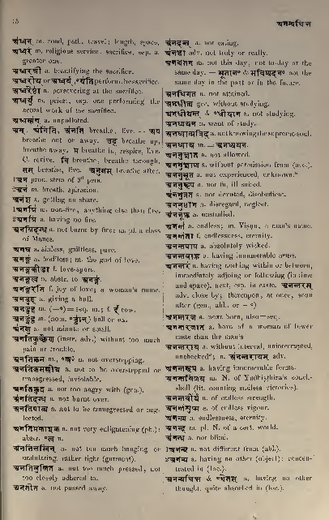
an ániti ánati ·v breathe, live. -- apa breathe out or away. ud breathe up, breathe away. pra breathe in, respire, live. C. revive. vi breathe, breathe through. sam breathe, live. anusam breathe after.
Monier-Williams 1872 Word type unspecified · verb
Original text · English · Word type unspecified
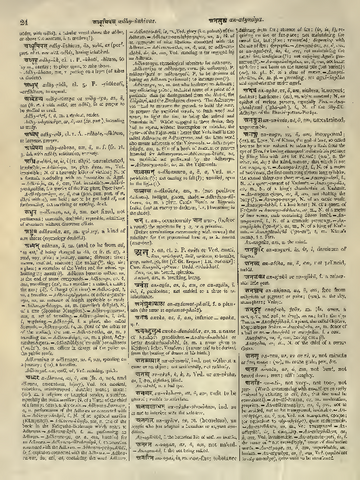
an 1 . an-, occasionally ana ana-, (before a vowel) the substitute for 3. a, or a privative. (Before terminations commencing with vowels) the substitute for the pronominal base a, as in anena (ana-ina).
Original text · English · verb
an 2 . an, cl. 2. P. aniti or Ved. anati, āna, aniṣyati, ānīt, anitum, to breathe, gasp, move, go, live [cf. Gr. ἄνεμος Lat. animus]: Caus. ānayati, -yitum: Desid. aniniṣati.
Petersburger 1855 Word type unspecified
Original text · German · Word type unspecified
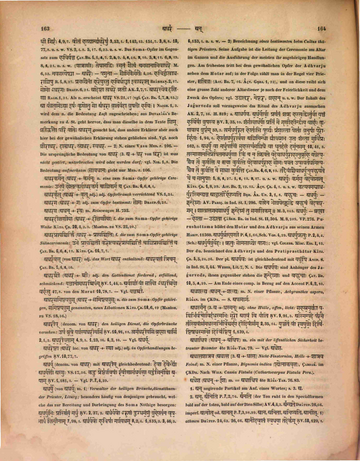
1. an negirende Partikel am Anf. eines Wortes; s. 3. a.
Original text · German · Word type unspecified
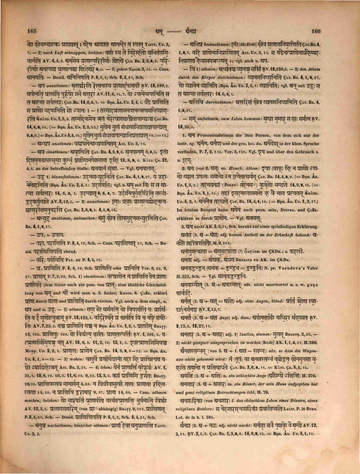
2. an , ániti P. 7,2,76. ánati (der Ton ruht in den Specialformen bald auf der 1sten, bald auf der 2ten Silbe) AV. 4,4,3. ányate DHĀTUP. 26,66. imperf. ānīt od. ānat P. 7,3,98. P. 7,3,99. āna, anitā, aniṣyati, ānīt. 1〉 athmen DHĀTUP. 24,62. DHĀTUP. 26,66. ānī̀davā̱taṃ sva̱dhayā̱ tadekàm ṚV. 10,129,1. ko hyevānyātkaḥ prāṇyāt . yadeṣa ākāśa ānando na syāt TAITT. UP. 2,7. — 2〉 nach Luft schnappen, lechzen: yathā̀ sma te vi̱rohàto a̱bhitàptami̱vānàti AV. 4,4,3. a̱nanneva prā̱ṇanpa̱ridīrṇaḥ śiśye ŚAT. BR. 2,5,3,3. pa̱ridīrṇā a̱natyaśca prā̱ṇatyaśca śiśyiryare ŚAT. BR. 2,5,2,2. — 3〉 gehen NAIGH. 2,14. — Caus. ānayati. — Desid. aniniṣati P. 6,1,3, Sch. P. 8,4,21, Sch. — apa ausathmen: a̱ntaścàrati roca̱nāsya prā̱ṇādàpāna̱tī ṚV. 10,189,2. apā̀nati̱ prāṇàti̱ purùṣo̱ garbhè anta̱rā AV. 11,6,14. AV. 11,6,7. yo 'pānenāpāniti sa ta ātmā sarvāntaraḥ ŚAT. BR. 14,6,5,1. = BṚH. ĀR. UP. 3,4,1. yadvai prāṇiti sa prāṇo yadapāniti so 'pānaḥ . — . tasmādaprāṇannanapānanvācamabhivyāharati CHĀND. UP. 1,3,3. tasmādekameva vrataṃ caretprāṇyāccaivāpānyācca ŚAT. BR. 14,4,3,34. (= BṚH. ĀR. UP. 1,5,23.) mukhena mukhaṃ saṃdhāyābhiprāṇyāpānyāt ŚAT. BR. 14,9,4,9. (= BṚH. ĀR. UP. 6,4,10.) mukhena mukhaṃ saṃdhāyāpānyābhiprāṇyāt ŚAT. BR. 14,9,4,10. (= BṚH. ĀR. UP. 6,4,11.) — abhyapa anathmen: yadyapānenābhyapānitam AIT. UP. 3,11. — ava einathmen: avā̱niti ŚAT. BR. 4,3,2,6. a̱navānan ŚAT. BR. 4,6,1,5. etāṃ di̱śama̱navānantsṛtvā̱ kumbha̱ṃ prakṣīyā̱napekṣamāṇa ehi ŚAT. BR. 13,8,3,4. KĀTY. ŚR. 21,4,6. an der betreffenden Stelle: atavānaṃ sṛtvā. — Vgl. anavānam. — ud 1〉 hinaufathmen: uda̱nannabhyuda̱niti ŚAT. BR. 4,1,2,27. ya udānenodaniti (BṚH. ĀR. UP. 3,4,1: udāniti; vgl. u. an mit vi) sa ta ātmā sarvāntaraḥ ŚAT. BR. 14,6,5,1. u̱danyāt ŚAT. BR. 4,6,1,7. udā̀niṣurma̱hīriti̱ tasmā̀duda̱kamùcyate AV. 3,13,4. — 2〉 ausathmen: imā̱ḥ prajā̱ḥ prāṇa̱tyaścodana̱tyaścānta̱rīkṣama̱nucaranti ŚAT. BR. 3,8,3,2. ŚAT. BR. 4,1,2,16. — abhyud anathmen, anhauchen: amuṃ hyeva lokamuda̱nannabhyudaniti ŚAT. BR. 4,1,2,27. — upa, s. upāna. — parā, parāṇiti P. 8,4,19, Sch. — Caus. parāṇiṇat P. 8,4,21, Sch. — Desid. parāṇiṇiṣati ebend. — pari, paryaniti PAT._zu_P. 8,4,19. — pra, prāṇiti P. 8,4,19, Sch. prāṇiti oder prāniti VOP. 8,22. VOP. 9,27. prāṇat P. 7,3,99, Sch. 1〉 einathmen: yatprāṇena na prāṇiti yena prāṇaḥ praṇīyate (dem Sinne nach ein pass. von prān; eine ähnliche Gleichstellung von an und nī wird man u. 3. finden) KENOP. 8. ŚAṂK. erklärt prāṇa durch ghrāṇa und prāṇiti durch riechen. Vgl. noch u. dem simpl., u. apa und u. ud. — 2〉 athmen: mayā̱ so annàmatti̱ yo vi̱paśyàti̱ yaḥ prāṇìti̱ ya ī̀ṃ śṛ̱ṇotyu̱ktam ṚV. 10,125,4. yadvi̱rocàte̱ pra cānàti vi ca̱ caṣṭe̱ śacī̀bhiḥ AV. 7,25,2. yacca prāṇiti yacca na BṚH. ĀR. UP. 1,5,1. prāṇīt BHAṬṬ. 15,102. prāṇiṣuḥ BHAṬṬ. 15,108. yo viśvàsya̱ jagàtaḥ prāṇa̱taspatìḥ ṚV. 1,101,5. yatprā̱ṇannìmi̱ṣacca̱ yat AV. 10,8,2. AV. 11,2,10. AV. 12,1,3. ejatprāṇannimiṣacca MUṆḌ. UP. 2,2,1. prāṇa̱ntaḥ prāṇena ŚAT. BR. 14,9,2,8—ŚAT. BR. 14,9,2,12. = BṚH. AR. UP. 6,1,8—AR. UP. 6,1,12. — 3〉 wehen: vāyurvai praṇīryajñānāṃ yadā hi prāṇityatha yajño 'thāgnihotram AIT. BR. 2,34. — 4〉 leben: yenà prā̱ṇantì vī̱rudhàḥ AV. 1,31,1. AV. 10,8,19. AV. 10,10,5. AV. 11,6,10. AV. 11,9,23. AV. 13,3,3. kathaṃ prāṇimi durgataḥ BHAṬṬ. 18,10. prāṇivastava mānārtham BHAṬṬ. 4,38. na jijīvāsukhī tātaḥ prāṇatā rahitastvayā BHAṬṬ. 14,58. na prāṇiṣi durācāra BHAṬṬ. 9,57. prāṇa BHAṬṬ. 14,60. — Caus. athmen machen, beleben: yo mā̱rayatì prā̱ṇayàti yasmā̀tprā̱ṇanti̱ bhuvànāni̱ viśvā̀ AV. 13,3,3. prāṇayantamarim (von prā˚ abhängig) BHAṬṬ. 9,101. prāṇiṇat P. 8,4,21, Sch. — Desid. prāṇiṇiṣati P. 6,1,3, Sch. P. 8,4,21, Sch. — anupra nachathmen, hinterher athmen: prāṇaṃ devā anuprāṇanti TAITT. UP. 2,3. — abhipra beeinathmen: imāṃ (die Erde) hyeva prā̱ṇannabhiprā̱ṇiti ŚAT. BR. 4,1,2,7. yadi prāṇenābhiprāṇitam AIT. UP. 3,11. sa yaddhainatprāṇenāgrahaiṣyadabhiprāṇya haivānnamatrapsyat 4; vgl. auch u. apa. — vi 1〉 athmen: avyànacca vya̱nacca̱ sasnì ṚV. 10,120,2. — 2〉 den Athem durch den Körper durchathmen: vya̱nannabhivya̱niti ŚAT. BR. 4,1,2,27. yo vyānena vyaniti (BṚH. ĀR. UP. 3,4,1: vyāniti; vgl. an mit ud) sa ta ātmā sarvāntaraḥ ŚAT. BR. 14,6,5,1. — abhivi durchathmen: antarikṣaṃ hyeva vyanannabhivyaniti ŚAT. BR. 4,1,2,27. — sam aufathmen, zum Leben kommen: a̱dyā ma̱māra̱ sa hyaḥ samā̀na ṚV. 10,55,5.
Original text · German · Word type unspecified
an [vgl. [1:165]] mit apa {11,6,14. 7} = {11,4,14. 8}. (revision)
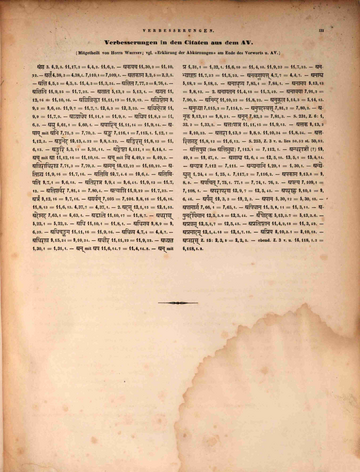
Original text · German · Word type unspecified
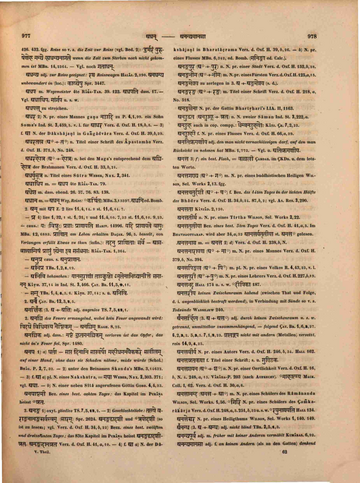
2. an mit apa *Z. 2 lies 11,4,14. 8 st. 11,6,14. 7. — pra 4〉 lies 1,32,1 st. 1,31,1 und 11,4,10. 7,23 st. 11,6,10. 9,23. — caus.: yaḥ (viṣṇuḥ) prajāḥ prāṇayati HARIV. 14996. yadi prāṇayate vāyuḥ MBH. 12,6883. prāṇita am Leben erhalten DAŚAK. 96,5. beseelt, von Verlangen erfüllt Etwas zu thun (infin.): tadanu prāṇitāḥ sarve — āsanrājyāmiṣaṃ prāptuṃ śyenā iva sasaṃbhramāḥ RĀJA-TAR. 1,364. — anupra caus. s. anuprāṇana. — abhipra TBR. 1,2,1,19. — abhivi behauchen: yānasurāṇāṃ tāñchuṣṇo 'mṛtenābhivyānītte samānan KĀṬH. 37,14_in_Ind. St. 3,466. ŚAT. BR. 11,5,9,11. — sam TBR. 1,4,4,3. TBR. 1,4,4,6. KĀṬH. 37,14; s. u. abhivi.
Original text · German · Word type unspecified
2. an mit abhyapa AIT. BR. 2,21. — abhipra einathmen AIT. BR. 2,21.

Böhtlingk 1879 verbal root · Word type unspecified
Original text · German · verbal root
2. √an , ánati und ániti — 1〉 athmen Chr. 19,17. — 2〉 nach Luft schnappen, lechzen. — 3〉 *gehen. — Mit apa ausathmen, aushauchen. — Mit abhyapa anathmen. — Mit ava einathmen. — Mit vyava dazwischen athmen MAITR. S. 4,7,7. TĀṆḌYA-BR. 7,1,9. — Mit udā (udāniti fehlerhaft für udaniti). — Mit ud — 1〉 hinaufathmen. — 2〉 ausathmen. — Mit abhyud anathmen, anhauchen. — Mit *parā und *pari. — Mit pra — 1〉 einathmen. — 2〉 athmen Chr. 32,2. — 3〉 leben. — 4〉 wehen. — Caus. athmen machen, beleben. — prāṇita — 1〉 am Leben erhalten. — 2〉 beseelt, von Verlangen erfüllt Etwas zu thun (Inf.). — Mit anupra nachathmen, hinterher athmen. — Mit abhipra einathmen; beeinathmen. — Mit vi — 1〉 athmen. — 2〉 den Athem durch den Körper durchathmen. — Mit abhivi behauchen, durchathmen. — Mit sam athmen, leben. — Mit anusam darnach athmen AIT. BR. 4,30.
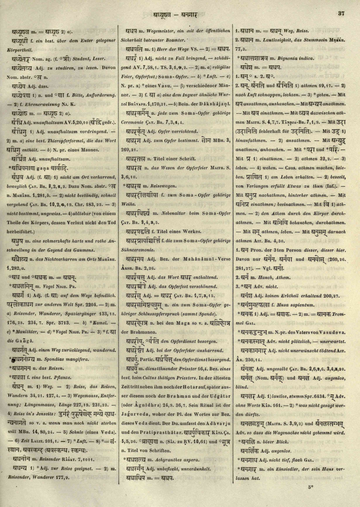
Original text · German · Word type unspecified
2. a˚ vor Consonanten, an˚ vor Vocalen = ἀ, ἀν priv. abrāhmaṇa kein Brahman, anadhyāya kein Lesen, asveda schweisslos, anaṅga körperlos, aśuci unrein, atarha unwürdig, akṛtvā nicht gethan habend, anarcitum (selten) nicht ehren, aspṛhayanti (BHĀG. P. ŚIŚ. 15,33) sie begehren nicht.
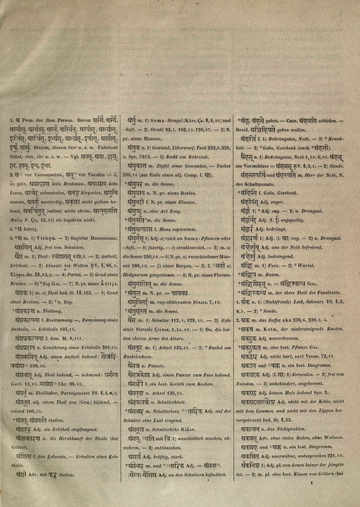
Original text · German · Word type unspecified
1. an˚ s. 2. a˚.
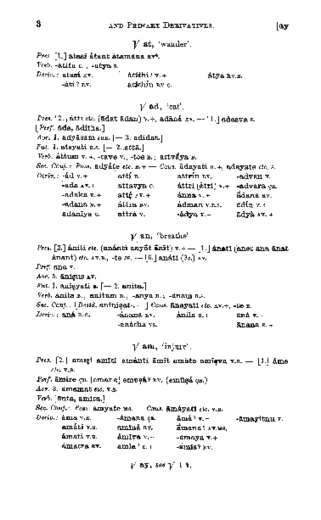
Whitney Roots 1885 verbal root
Original text · English · verbal root
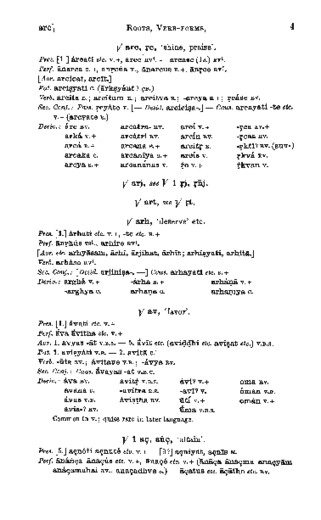
an — breathe
Apte 1890 verbal root · substantive masculine
Original text · English · verbal root
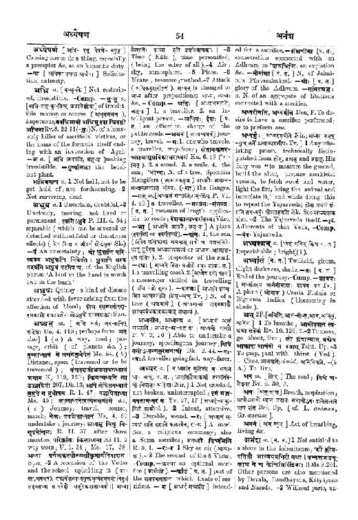
an 2 P. [aniti, āna-nī-t, āna, anituṃ, anita] 1 To breathe; ānīdavātaṃ svadhayā tadekaṃ Rv. 10. 129. 2. 2 To move, go about, live; ko hyevānyāt yadyeṣa ākāśa ānaṃdo na syāt T. Up. 3 To gasp, pant with thirst (Ved.) — Caus. ānayati; desid. aniniṣati. - (4 A.) To live.
Original text · English · substantive masculine
an m. [kvip] The soul; viśve canedanā Rv. 4. 30. 3.
Cappeller 1887 verb
Original text · German · verb
an ániti, ánati atmen. apa aushauchen, verwehen. pra = simpl.
Burnouf 1866 verbal root · Word type unspecified
Original text · French · verbal root
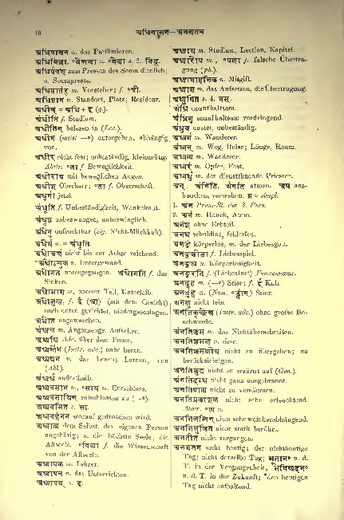
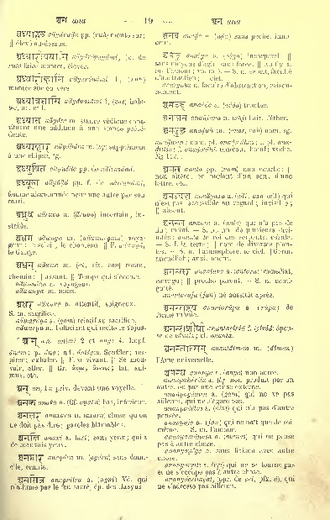
*an an. anīmi 2 et anye 4. Impf. ānam; p. āna; a1. āniṣam. Souffler; respirer; exhaler. Etre vivant. Se mouvoir, aller. Gr. ἄημι, ἄνεμος; lat. animus, etc.
Original text · French · Word type unspecified
an an, l'a priv. devant une voyelle.
Derived words
More direct derivatives (9)
Occurrences in source texts (162)
DYS 7 occurrences
DYS 150–153*3: Vajrolī: Secret Teaching 1 occurrence
Occurrences through derived words
-
DYS 151 Segment 12
1 more source page
GoS 19 occurrences
GoS 20–28: Setting Sarasvatī in Motion 3 occurrences
Occurrences through derived words
GoS 29–33: Four Forms of Breath Retention 1 occurrence
Occurrences through derived words
-
GoS 29 Segment 1
GoS 50–63: Three Locks 4 occurrences
Occurrences through derived words
5 more source pages
GoS 67–73: Examining Obstacles 2 occurrences
Occurrences through derived words
GoS 74–80: Through the Three Knots 2 occurrences
Occurrences through derived words
GoS 81–88: Moon, Fluid and Union 2 occurrences
Occurrences through derived words
GoS 95–100: Dream and Discerning Knowledge 1 occurrence
Occurrences through derived words
-
GoS 99 Segment 5
HP 43 occurrences
HP 2.1-2.6: Introduction to Prāṇāyāma 2 occurrences
Occurrences through derived words
HP 2.7-2.10: Nāḍīśodhana 3 occurrences
Occurrences through derived words
20 more source pages
HP 2.37-2.43: Path to Manonmanī 3 occurrences
Occurrences through derived words
HP 2.44-2.47: Eight Kumbhakas 2 occurrences
Occurrences through derived words
HP 2.72-2.78: Kevala Kumbhaka 3 occurrences
Occurrences through derived words
HP 3.49-3.57: Mūlabandha 3 occurrences
Occurrences through derived words
HP 3.58-3.65: Uḍḍiyāna Bandha 2 occurrences
Occurrences through derived words
HP 3.66-3.72: Jālandhara and the Bandhas 1 occurrence
Occurrences through derived words
-
HP 3.70*1 Segment 12
HP 3.87-3.93*7: Sahajolī and Amarolī 1 occurrence
Occurrences through derived words
-
HP 3.92 Segment 11
HP 3.94-3.102*1: Śakti Cālana 2 occurrences
Occurrences through derived words
HP 3.103-3.107*2: Conclusion of the Mudrā Teaching 1 occurrence
Occurrences through derived words
-
HP 3.106 Segment 10
HP 4.0*1-4.0*14: Samādhi and Laya 4 occurrences
Occurrences through derived words
HP 4.11*15-4.11*28: Space and Laya 1 occurrence
Occurrences through derived words
-
HP 4.11*16 Segment 12
HP 4.47-4.55*4: Nāda Binds the Mind 2 occurrences
Direct occurrences
HP 4.56-4.66: The Middle Path 2 occurrences
Occurrences through derived words
HTK 1 occurrence
HTK 10.39–39*1: Jīvacālaka / Jīvacāla 1 occurrence
Occurrences through derived words
-
HTK 10.39 Segment 6
IVU 1 occurrence
PJH 1 occurrence
PJH 21: Epilogue and Closing Blessing 1 occurrence
Occurrences through derived words
-
PJH 21.1 Segment 2
PYS 22 occurrences
PYS 2.15–17: Everything Is Suffering 1 occurrence
Occurrences through derived words
-
PYS 2.16 Segment 3
PYS 2.27–29: Aṣṭāṅga as a Path to Liberation 1 occurrence
Occurrences through derived words
-
PYS 2.29 Segment 4
PYS 2.30–34: Vows and Counterreflection 2 occurrences
Occurrences through derived words
12 more source pages
PYS 2.46–48: Āsana as a Seated Posture 2 occurrences
Direct occurrences
-
PYS 2.48 Segment 3
Occurrences through derived words
-
PYS 2.47 Segment 3
PYS 2.49–51: Prāṇāyāma as Breath Suspension 1 occurrence
Occurrences through derived words
-
PYS 2.49 Segment 7
PYS 3.15–16: Sequence of Transformation 1 occurrence
Occurrences through derived words
-
PYS 3.16 Segment 5
PYS 3.39–40: Udāna and Samāna 2 occurrences
Occurrences through derived words
PYS 3.44–46: Mastery over the Elements 1 occurrence
Occurrences through derived words
-
PYS 3.45 Segment 8
PYS 3.49–51: Omniscience or Kaivalya 1 occurrence
Occurrences through derived words
-
PYS 3.51 Segment 7
PYS 4.9–11: Continuity of Saṃskāras 2 occurrences
Occurrences through derived words
PYS 4.12–14: Real Objects in Transformation 1 occurrence
Occurrences through derived words
-
PYS 4.12 Segment 2
SiSa 43 occurrences
SiSa 3.1-3.10: Herzlotus und Prāṇa 10 occurrences
Occurrences through derived words
SiSa 3.41-3.48: Atemkraft und Hindernisse 1 occurrence
Occurrences through derived words
-
SiSa 3.47 Segment 12
SiSa 3.49-3.50: Karma-Reinigung 2 occurrences
Occurrences through derived words
17 more source pages
SiSa 3.51-3.54: Prāṇāyāma-Siddhis 1 occurrence
Occurrences through derived words
-
SiSa 3.52 Segment 1
SiSa 3.61-3.67: Paricaya und Niṣpatti 1 occurrence
Occurrences through derived words
-
SiSa 3.66 Segment 9
SiSa 3.68-3.80: Vāyusādhana 4 occurrences
Occurrences through derived words
SiSa 3.88-3.91: Padmāsana 2 occurrences
Occurrences through derived words
SiSa 4.1-4.8: Yonimudrā-Kreislauf 1 occurrence
Occurrences through derived words
-
SiSa 4.6 Segment 12
SiSa 4.9-4.20: Yonimudrā-Geheimnis 1 occurrence
Occurrences through derived words
-
SiSa 4.20 Segment 14
SiSa 4.37-4.42: Mahābandha 3 occurrences
Occurrences through derived words
SiSa 4.51-4.59: Khecarīmudrā 2 occurrences
Occurrences through derived words
SiSa 5.48-5.71: Innere Meditation 1 occurrence
Occurrences through derived words
-
SiSa 5.59 Segment 12
SiSa 5.74-5.76: Nāḍī-Zirkulation 1 occurrence
Occurrences through derived words
-
SiSa 5.76 Segment 13
SiSa 5.144-5.155: Ājñā und Khecarī 2 occurrences
Occurrences through derived words
-
SiSa 5.152 Segment 1
-
SiSa 5.152 Segment 11
SiSa 5.156-5.181: Sahasrāra 3 occurrences
Occurrences through derived words
-
SiSa 5.163 Segment 15
-
SiSa 5.166 Segment 6
-
SiSa 5.176 Segment 13
SiSa 5.182-5.190: Sahasrāra-Mond 1 occurrence
Occurrences through derived words
-
SiSa 5.187 Segment 1
SS 5 occurrences
SVU 13 occurrences
SVU 2.8-2.9: Raft and Reins of Breath 2 occurrences
Occurrences through derived words
3 more source pages
SVU 5.1–5.6: The Lord of Cosmic Origins 1 occurrence
Occurrences through derived words
-
SVU 5.1 Segment 6
SVU 5.7–5.11: The Wandering Self 2 occurrences
Occurrences through derived words
Continue with AYI Free
Image source: AYI archive.