
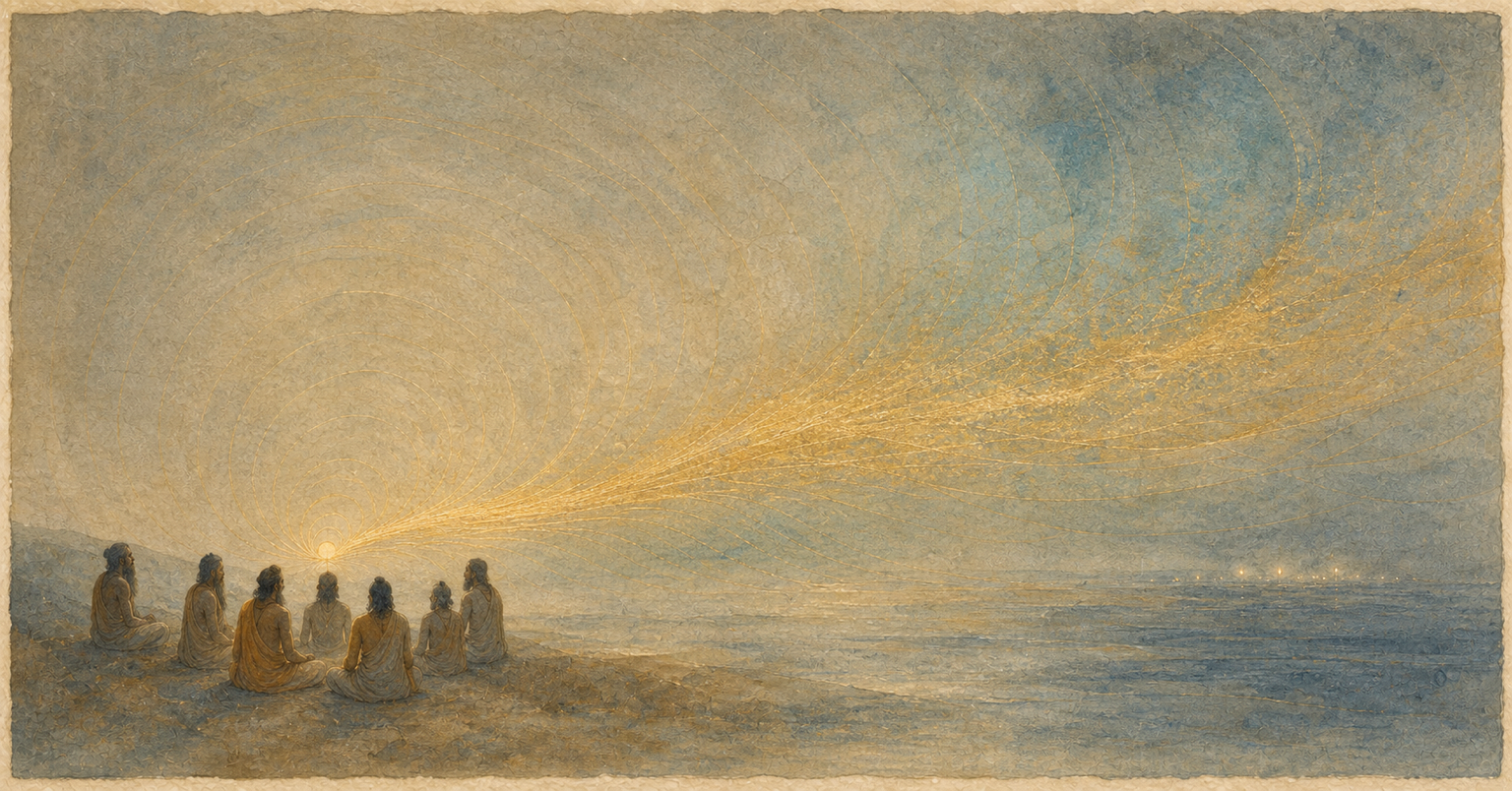


yuje vāṃ brahma, pūrvyaṃ namobhir; vi śloka etu, pathyeva sūreḥ | Analyse ▾ Analyse ▴
|
yuje
|
ich schirre an, verbinde | |
|
vām
|
euer beider | |
|
brahma
|
das heilige Wort, Brahman | |
|
pūrvyam
|
das uralte, ursprüngliche | |
|
namobhiḥ
|
mit Verneigungen, Verehrungen | |
|
vi
|
hervor, weithin | |
|
ślokaḥ
|
der Ruf, Lobgesang | |
|
etu
|
er möge gehen, gelangen | |
|
pathyā
|
auf der Bahn, dem Pfad | |
|
iva
|
wie, gleich | |
|
sūreḥ
|
des Weisen, der Sonne |
śṛṇvanti viśve, amṛtasya putrā; ā ye dhāmāni, diviyāni tasthuḥ ||5|| Analyse ▾ Analyse ▴
Das Śaṅkara zugeschriebene Bhāṣya versteht den Vers als Gebet, das uranfängliche Brahman mit Verehrung und Sammlung zu erfassen. Die Preisung soll sich wie der gute Weg oder der Ruhm eines Weisen ausbreiten. Hören sollen sie die „Söhne des Unsterblichen“, die himmlischen Nachkommen Hiraṇyagarbhas.
Śaṅkarānanda bezieht das Paar „euch beide“ auf individuelles und höchstes Selbst. Ihr Yoga ist Identität, weil beide in Wahrheit das eine, anfanglose Brahman ohne räumliche, zeitliche oder sachliche Begrenzung sind. Verehrung führt auch Nichtgelehrte auf den guten Weg, den die Weisen durch pflichtgemäßes Handeln beschreiten.
Nārāyaṇa deutet rituell Brahman als Lebenskräfte und das „Uranfängliche“ als Speise, die im Essen gleichsam geopfert und mit den Prāṇas verbunden wird. Yogisch richtet der Beter Geist und Einsicht durch Hingabe auf Brahman; die fünf Savitṛ-Mantren sollen durch Sonnenhilfe den Weg öffnen und sogar die Sonnenscheibe durchdringen.
Vijñānabhagavat formuliert einen Entschluss zur Sammlung: Rede und Geist werden im inneren Selbst festgelegt, damit das anfanglose Brahman unmittelbar erkannt wird. Die daraus hervorgehende Preisung soll dem Weg der Weisen folgen und von Hiraṇyagarbha und den übrigen „Söhnen des Unsterblichen“ in ihren himmlischen Stätten gehört werden.
śṛṇvanti LV1958 ] śṛṇvantu ASS1927, LV1958-app
diviyāni LV1958 ] divyāni ASS1927
<1: This stanza also = RV. 10. 13. 1; VS. 11. 5. Lines a, b, c with slight variants = AV. 18. 3. 39 b, c, d.>
<1: For this verse, see Taitt. Samh. IV, 1, 1, 2, 1; Vāg. Samh. XI, 5; Atharva-veda XVIII, 3, 39; Rig-veda X, 13, 1. The Vāgasaneyins read vi sloka etu for vi slokā yanti; sūreh for sūrāh; srinvantu for srinvanti; and the Rig-veda agrees with them. The dual vām is accounted for by the verse belonging to a hymn celebrating the two sakatas, carts, bearing the offerings (havirdhāne); most likely, however, the dual referred originally to the dual deities of heaven and earth. I prefer the text of the Rig-veda and the Vāgasaneyins to that of the Taittirīyas, and have translated the verse accordingly. In the Atharva-veda XVIII, 39, if we may trust the edition, the verse begins with svāsasthe bhavatam indave nah, which is really the end of the next verse (Rv. X, 13, 2), while the second line is, vi sloka eti pathyeva sūrih srinvantu visve amritāsa etat. I see no sense in pathyeva sūrāh. Saṅkara explains pathyeva by pathi sanmārge, athavā pathyā kīrtih, while his later commentary, giving srinvantu and putrāh sūrātmano hiranyagarbhasya, leads one to suppose that he read sūreh srinvantu. Sāyana (Taitt. Samh. IV, 1, 1, 2) explains pathyā sūrā iva by gīrvānamārga antarikshe sūryarasmayo yathā prasaranti tadvat. The same, when commenting on the Rig-veda (X, 13, 1), says: pathyā-iva sūreh, yathā stotuh svabhūtā pathyā parināmasukhāvahāhutir visvān devān prati vividham gakkhati tadvat. Mahīdhara (Vāg. Samh. XI, 5) refers sūreh (panditasya) to slokah, and explains pathyeva by patho ’napetā pathyā yagñamārgapravrittāhutih.>
<2: Yuge cannot stand for yuñge, as all commentators and translators suppose, but is a datival infinitive. Neither can yuñgate in the following verse stand for yuṅkte (see Boehtlingk, s. v.), or be explained as a subjunctive form. A. reads adhirudhyate, B. abhirudhyate, with a marginal note abhinudyate. It is difficult to say whether in lighting the fire the wind should be directed towards it, or kept from it.>
<1: The text in Weber’s edition of the Yajur V. is, with the following exceptions, the same as in the Upanishad: Instead of “Slokā yanti” Weber reads, “Slokā etu;” instead of “Sūrā,” “Sūreḥ;” and instead of “Śrinwanti,” “Śrinwantu.” To show in an example the difference of the explanation, I translate here this verse according to Mahīdhara’s commentary. “O you sacrificer and his wife, for your sake I perform (at present) with food (namobhir) the ancient (work called) Bramha (a kind of fire offering). (By Bramha the caste of the Brāhmanas may also be understood.) May the fame of the wise (of the sacrificer), reach the two worlds, as the oblation does. May all the sons of the immortal (Prajāpati) who inhabit divine dwellings, hear (the praise of the sacrificer).”>
Mit AYI Free weitermachen
Illustrationen: KI-generiert.


Bitte melde Dich an, um eine Nachricht zu schreiben. Hier gehts zum Login
Noch keine Nachrichten.