

mahat महत् – groß
Adjektiv · Adverb · Partikel · Substantiv Maskulin · Substantiv Neutrum · Worttyp nicht bestimmt
Wörterbuchquellen
AYI Wörterbuch Adjektiv
groß
Monier-Williams 1872 Adjektiv · Worttyp nicht bestimmt
Originaltext · Englisch · Adjektiv
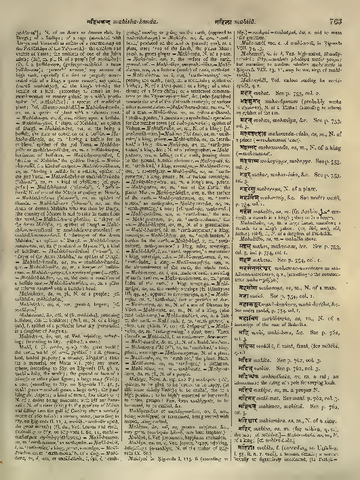
Mahat, ān, atī, at (originally pres. part. of rt. 1. mah, but making in nom. sing. du. pl. mahān, ma- hāntau, mahāntas, acc. sing. du. pl. mahāntam, mahāntau, mahatas, inst. mahatā, &c., see Gram. 142; in Ved. the acc. sing. mahām occurs, see mahā; in ep. the crude or neut. form mahat is sometimes used for the correct form mahāntam; at the beginning of Karma-dhāraya and Bahu-vrīhi com- pounds mahā, q. v., is generally substituted for ma- hat, but in Tat-puruṣas and a few exceptional cases mahat is retained), great, mighty, strong, big, large, huge, full-grown, ample, extensive, long, (mahān adhvā, a long road; mahad āyus, long life; ma- hatī kathā, a long story); far advanced, late, (ma- haty aparāhṇe, late in the afternoon); numerous, abundant, much, many, (janasya mahato madhye, in the presence of many people); abounding in (sometimes with inst. c.); rich in; high (in price); gross, thick, dense, (bhūtāni mahānti, the gross elements; mahat tamas, thick darkness); loud, (mahān ghoṣaḥ, a loud noise); important, signifi- cant, (mahatī vārtā, important news; mahat kār- yam, an important affair); high, lofty, eminent, noble, (mahat sthānam, a lofty position; mahat kulam, a distinguished family); excellent, distin- guished; (ān), m. (in the Sāṅkhya phil.) ‘the great principle,’ the intellect (= buddhi, i. e. the second of the twenty-five Tattvas produced from Pradhāna or Mūla-prakṛti and itself producing the third prin- ciple or Ahaṅkāra, being thus both a Vikṛti and a Prakṛti; buddhi, intellect, is called mahat to dis- tinguish it from the Tattva manas, mind, with which and with Ahaṅkāra it is connected and to both of which it is superior); the superior of a monastery; a camel; epithet of Rudra or of a Rudra; (scil. gaṇa), epithet of a class of Manes; N. of a Dānava; N. of a king; (atī), f. the egg- plant (= bṛhatī); the seven-stringed or (according to some) hundred-stringed Vīṇā or lute of Nārada; (at), n. greatness, power, dominion; infinity; the greater part, (mahati rātryāḥ, Ved. when the greater part of the night is past); (scil. tattva), the great intellectual principle or intellect (the second Tattva of the Sāṅkhya phil. described above); sacred knowledge; (at), ind. greatly, exceedingly, much, very; [cf. Gr. μέγ-α-ς, μείζων, μέγ-ιστο-ς, μεγα-λύν-ω, μέγ-εθ-ος, μάλα, μᾶλλον, μῆκος, μακρός, μάκαρες: Lat. mag-nu-s, major, maximu-s, ma- gis, magis-ter, magistra-tus: Goth. mik-il-s, ‘great;’ mikil-jan = μεγαλύνειν; mais, ‘greater;’ maist, ‘greatest:’ Old Germ. mihhil, mêr.]

Originaltext · Englisch · Worttyp nicht bestimmt
mahat mahat. See p. 753, col. 2.
Böhtlingk 1879 Adverb
Originaltext · Deutsch · Adverb
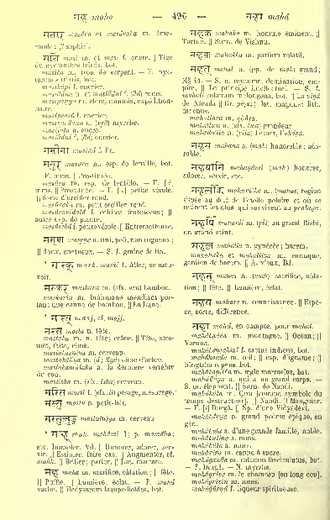
mahat Adv. mit bhu gross, — voll werden (vom Monde).
Apte 1890 Adjektiv · Partikel · Substantiv Maskulin · Substantiv Neutrum
Originaltext · Englisch · Adjektiv · Partikel · Substantiv Maskulin · Substantiv Neutrum
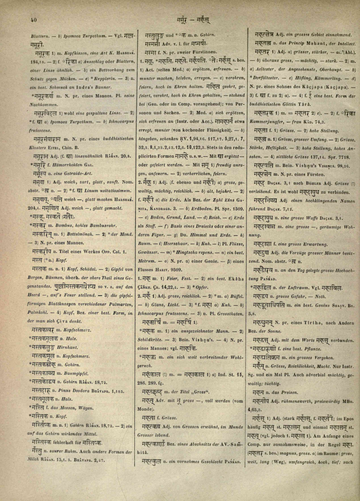
mahat a. [mah-ati] (compar. mahīyas; superl. mahiṣṭha; nom. mahān, mahāṃtau, mahāṃtaḥ; acc. pl. mahataḥ) 1 Great, big, large, huge, vast; mahān siṃhaḥ, vyāghraḥ &c. 2 Ample, copious, abundant, many, numerous; mahājanaḥ, mahān dravyarāśiḥ. 3 Long, extended, extensive; mahāṃtau bāhū yasya sa mahābāhuḥ; so mahatī kathā, mahānadhvā. 4 Strong, powerful, mighty; as mahān vīraḥ. 5 Violent, intense, excessive; mahatī śirovedanā, mahatī pipāsā. 6 Gross, thick, dense; mahānaṃdhakāraḥ. 7 Important, weighty, momentous; mahatkāryamupasthitaṃ, mahatī vārtā. 8 High, lofty, eminent, distinguished, noble; mahatkulaṃ, mahāñjanaḥ. 9 Loud; mahān ghoṣaḥ -dhvaniḥ. 10 Early or late; mahati pratyūṣe ‘early in the morning’; mahatyaparāhṇe ‘late in the afternoon.’ 11 High; mahārgha. — m. 1 A camel. 2 An epithet of Śiva. 3 (In Sān. phil.) The great principle, the intellect (distinguished from manas), the second of the twenty-five elements or tattvas. recognized by the Sāṃkhyas; Ms. 12. 14; Sāṅ. K. 3, Sāṅ. K. 8, Sāṅ. K. 22 &c. 4 The superior of a monastery. — n. 1 Greatness, infiniteness, numerousness. 2 Kingdom, dominion. 3 Sacred knowledge. — ind. Greatly, excessively, very much, exceedingly. (Note. mahat as the first member of a Tatpuruṣa compound and a few other cases, remains unchanged, while in Karmadhāraya and Bahuvrīhi comp. it is changed to mahā q. v.). Comp. — āvāsaḥ a spacious or large building. — āśā a high hope. — āścarya a. very wonderful. — āśrayaḥ dependence on or seeking protection with the great. — katha a. talked of or mentioned by the great, in great men's mouths. — kṣetra a. occupying a wide territory. — guṇa a. having the qualities of the great. — tattvaṃ the second of the 25 principles of the Sāṃkhyas. — bilaṃ the atmosphere. — sevā service of the great. — sthānaṃ ([Page 0850-b]) a high place, lofty station.
Burnouf 1866 Adjektiv
Originaltext · Französisch · Adjektiv
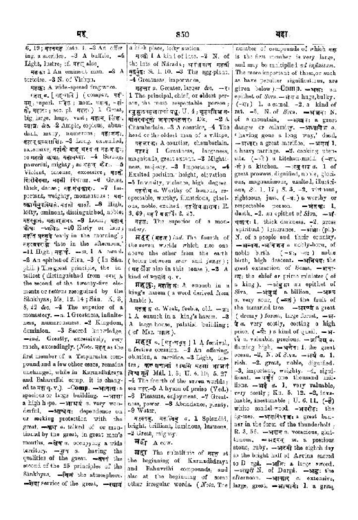
mahat mahat a. (pp. de mah) grand; M§ 44. — S. n. royaume, domination, empire. Le principe intellectuel. — S. f. mahati solanum melongena, bot. La vīṇā de Nārada Gr. μέγας; lat. magnus; lith. macnus. mahattara m. śūdra. mahattva n. (sfx. tva) grandeur. mahadvila n. (vila) l'éther, l'ākāśa.
Abgeleitete Wörter
Quelltextfundstellen (104)
DYS 14 Fundstellen
Weitere 5 Quelltextseiten
GoS 1 Fundstelle
HP 36 Fundstellen
HP 3.6-3.9: Zehn Mudrās 3 Fundstellen
Direkt belegt
HP 3.10-3.18: Mahāmudrā 7 Fundstellen
Direkt belegt
HP 3.19-3.25: Mahābandha 9 Fundstellen
Direkt belegt
HP 3.26-3.31: Mahāvedha 3 Fundstellen
Direkt belegt
Weitere 10 Quelltextseiten
HP 4.11*29-4.11*31: Nāda-Übergang 2 Fundstellen
Direkt belegt
-
HP 4.11*29 Segment 15
-
HP 4.11*30 Segment 10
HTK 1 Fundstelle
MAN 1 Fundstelle
PJH 2 Fundstellen
PYS 2 Fundstellen
SiSa 26 Fundstellen
SiSa 4.21-4.25: Zehn Mudrās 3 Fundstellen
Direkt belegt
SiSa 4.26-4.30: Mahāmudrā-Praxis 2 Fundstellen
Direkt belegt
SiSa 4.43-4.50: Mahāvedha 5 Fundstellen
Direkt belegt
Weitere 10 Quelltextseiten
SiSa 4.101-4.104: Bindu-Siddhi 2 Fundstellen
Direkt belegt
-
SiSa 4.102 Segment 12
-
SiSa 4.104 Segment 3
SiSa 5.182-5.190: Sahasrāra-Mond 2 Fundstellen
Direkt belegt
-
SiSa 5.184 Segment 6
-
SiSa 5.187 Segment 13
SiSa 5.234-5.252: Tripurā-Mantra 2 Fundstellen
Direkt belegt
-
SiSa 5.249 Segment 14
-
SiSa 5.251 Segment 3
SS 1 Fundstelle
SVU 8 Fundstellen
SVU 3.19-3.21: Jenseits der Sinne 2 Fundstellen
Direkt belegt
SVU 4.17-4.22: Erkenntnis und Schutz 2 Fundstellen
Direkt belegt
VBT 12 Fundstellen
VBT 57–64: Zwischenräume und Gleichheit 2 Fundstellen
Direkt belegt
VBT 65–74: Freude und Genuss 3 Fundstellen
Direkt belegt
Mit AYI Free weitermachen
Bildquelle: AYI Archiv.