

ma म – superlative suffix -ma
pronoun · substantive masculine · substantive neuter · suffix · Word type unspecified
Dictionary sources
AYI dictionary suffix
superlative suffix -ma
Cappeller 1891 pronoun
Original text · English · pronoun
ma ·pron. stem of 1^st pers.
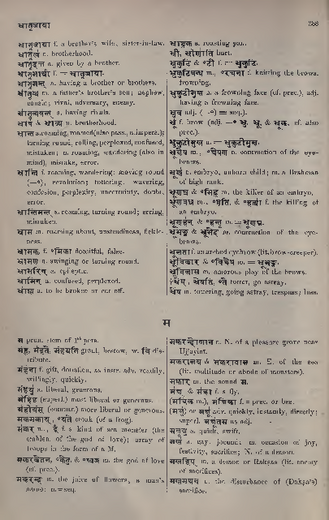
Monier-Williams 1872 substantive masculine · Word type unspecified
Original text · English · substantive masculine
ma 2 . ma, as, m. (in prosody) a molossus or foot consisting of three long syllables.
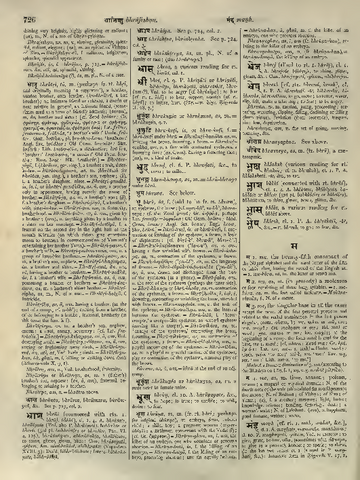
Original text · English · substantive masculine
ma 4 . ma, as, m. time, season; poison, venom; a magical or mystical formula; N. of the fourth note of the scale (abbreviated for madhyama); the moon; N. of Brahmā; of Viṣṇu; of Śiva; of Yama; (ā), f. a mother; measure; light, lustre; knowledge, science; binding, fettering; death; a woman's waist; N. of Lakṣmī; (am), n. happiness, good fortune, welfare; water.
Original text · English · Word type unspecified
ma 1 . ma, the twenty-fifth consonant of the Nāgarī alphabet and the nasal letter of the fifth or labial class, having the sound of the English m. — 1. ma-kāra, as, m. the letter or sound ma.
Original text · English · Word type unspecified
ma 3 . ma, the singular base in all the cases except the nom. of the first personal pronoun and related to the verbal termination in the first person singular, (nom. aham, 1; acc. mām or mā, me; inst. mayā; dat. mahyam or me; abl. mat or mad; gen. mama or me; loc. mayi); at the beginning of a comp. the form mad is used for the base, see 1. mad; [cf. aham: Zend ma: Gr. ἐμέ, ἐμ-ό-ς: Lat. me, me-u-s, mihi = Umbr. me-he: Goth. mi-s, ‘to me;’ mi-k, acc. ‘me:’ Slav. me, acc. ‘me:’ Lith. ma-n, ‘to me.’]
Petersburger 1855 substantive masculine · substantive neuter · Word type unspecified
Original text · German · substantive masculine · substantive neuter
2. ma 1〉 m. TRIK. 3,5,4. a〉 Zeit. — b〉 Gift MED. m. 1. — c〉 eine magische Formel VIŚVA_bei_WILSON. — d〉 abgekürzte Bez. für die 4te Note der Tonleiter (vollständig madhyama) ŚABDĀRTHAK._bei_WILSON. Verz. d. Oxf. H. 200,b,8. — e〉 der Mond TRIK. 1,1,85. EKĀKṢARAK._im_ŚKDR. — f〉 Brahman EKĀKṢARAK. — g〉 Viṣṇu MED. — h〉 Śiva TRIK. 1,1,47. H. an. 1,10. MED. EKĀKṢARAK. — i〉 Yama MED. — 2〉 f. mā a〉 Mutter. — b〉 Maass EKĀKṢARAK._im_ŚKDR. — c〉 Licht EKĀKṢARAK._bei_WILS. — d〉 Kenntniss, Wissenschaft ebend. mā vidyā ca hare proktā tasyā īśo yato bhavān . tasmānmādhavanāmāsi HARIV. 14952. — e〉 das Binden, Fesseln EKĀKṢARAK._bei_WILS. — f〉 Tod. — g〉 Leibesmitte eines Frauenzimmers ŚABDĀRTHAK._bei_WILSON. — h〉 Lakṣmī AK. 1,1,1,23. TRIK. 1,1,41. H. 226. H. an. MED. HALĀY. 1,31. — 3〉 n. a〉 Glück, Wohlfahrt EKĀKṢARAK._bei_WILS. — b〉 Wasser ŚABDĀRTHAK._bei_WILSON.
Original text · German · Word type unspecified
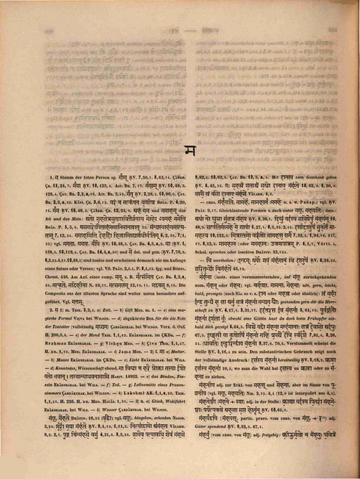
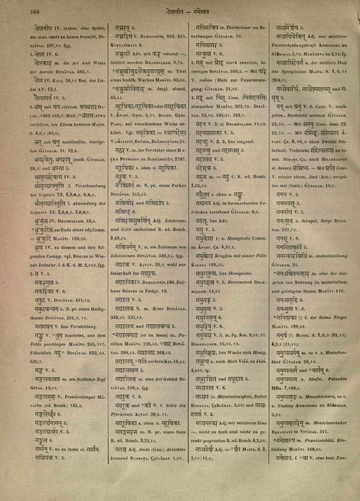
1. ma Stamm der 1sten Person sg. mā́m ṚV. 7,50,1. ṚV. 8,63,14. ŚĀṄKH. ŚR. 15,24,7. máyā ṚV. 10,125,4. AIT. BR. 7,17. máhyam ṚV. 10,48,3. ṚV. 10,128,4. ŚAT. BR. 2,2,4,16. AIT. BR. 3,49. mát ṚV. 2,28,5. ṚV. 10,86,6. ŚAT. BR. 2,3,4,26. KĀTY. ŚR. 3,6,12. varaṃ ca matkaṃcana vṛṇīṣva BHĀG. P. 4,20,16. máma ṚV. 10,48,3. ŚĀṄKH. ŚR. 12,24,8. ahaṃ mama und mamāham das Ich und das Mein: ato gṛhakṣetrasutāptavittairjanasya moho 'yamahaṃ mameti BHĀG. P. 5,5,8. asamāropitāhaṃmamābhimānatvāt BHĀG. P. 30. saṃnyasyāhaṃmamātmatām BHĀG. P. 7,12,24. mamāhamiti dehādau hitvāmithyārthadhīrmatim BHĀG. P. 6,2,38. BHĀG. P. 7,1,23: vgl. mamatā, mamatva. máyi ṚV. 10,48,3. ŚAT. BR. 4,5,4,3. mā (ṚV. 1,158,5. ṚV. 10,119,4. ŚAT. BR. 14,4,1,30) und me dat. und gen. (ṚV. 7,76,2. ṚV. 8,3,22. ṚV. 8,4,21. ṚV. 10,48,5) sind tonlos und erscheinen demnach nie am Anfange eines Satzes oder Verses; vgl. VS. PRĀT. 2,3. VS. PRĀT. 2,4. P. 8,1,22. fgg. und BÖHTL. Chrest. 446. Am Anf. eines comp. mat, z. B. mátsaṃmita ŚAT. BR. 6,2,1,25. matkṛte, madvihīnā N. 10,11. matsamakṣam N. 12,10. N. 12,11. madvacas N. 8,18. Die Composita aus der ältesten Sprache sind weiter unten besonders aufgeführt. Vgl. mattas.
Böhtlingk 1879 substantive masculine · substantive neuter · Word type unspecified
Original text · German · substantive masculine · substantive neuter
2. ma — 1〉 m. — a〉 Zeit. — b〉 Gift. — c〉 eine magische Formel. — d〉 die 4te Note der Tonleiter (abgekürzt für madhyama). — e〉 der Mond. — f〉 Bein. — α〉 Brahmanʼs. — β〉 Viṣṇuʼs. — γ〉 Śivaʼs. — δ〉 Yamaʼs. — 2〉 f. mā — a〉 Mutter. — b〉 *Maass. — c〉 Autorität NYĀYAM. 1,3,3. 10. 13. 17. Nom. abstr. mātva n. NYĀYAM. 1,1,20. 3,1. 3. 17. — d〉 Licht. — e〉 Kenntniss, Wissenschaft. — f〉 das Binden, Fesseln. — g〉 Tod. — h〉 Leibesmitte eines Frauenzimmers. — i〉 Bein. der Lakṣmī. parameśa VP. 1,9,45. wird im Comm. in para-mā + īśa zerlegt. — 3〉 n. — a〉 Glück, Wohlfahrt. — b〉 Wasser.
Original text · German · Word type unspecified
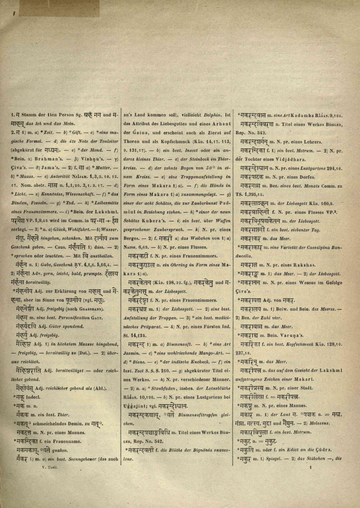
1. ma Stamm der 1ten Person Sg. mrahaṃ mama und mamāham das Ich und das Mein.
Original text · German · Word type unspecified
2. ma 2〉 vgl. 4. mā́. [Nachtrag, Band 5]
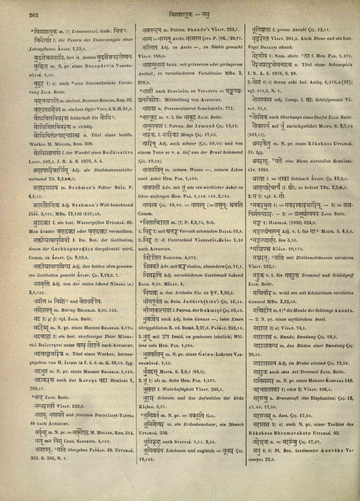
Original text · German · Word type unspecified
2. ma V. 5. [Nachtrag, Band 7]
Apte 1890 substantive masculine · substantive neuter
Original text · English · substantive masculine · substantive neuter
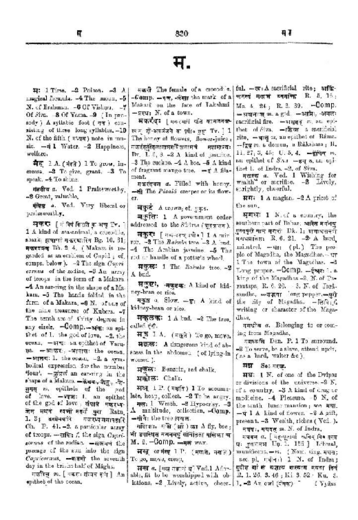
maḥ 1 Time. 2 Poison. 3 A magical formula. 4 The moon. 5 N. of Brahman. 6 Of Viṣṇu. 7 Of Śiva. 8 Of Yama. 9 (In prosody) A syllabic foot (gaṇa) consisting of three long syllables. 10 N. of the fifth (madhyama) note in music. — maṃ 1 Water. 2 Happiness, welfare.
Cappeller 1887 pronoun
Original text · German · pronoun
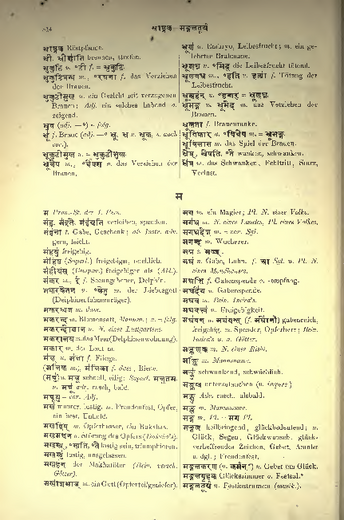
ma Pron. -St. der 1. Pers.
Burnouf 1866 substantive masculine · Word type unspecified
Original text · French · substantive masculine
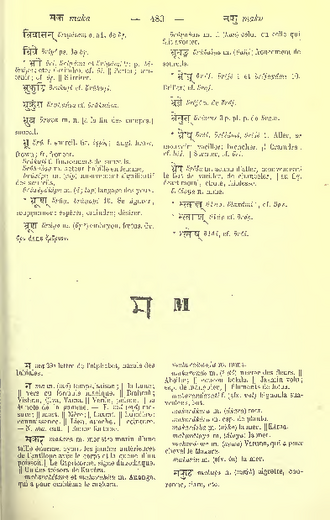
ma ma m. (mā) temps, saison; la Lune; vers ou formule magique. Brahmā; Viṣṇu, Śiva, Yama. Venin, poison. la 4ᵉ note de la gamme. — F. mā (mā) mesure; mort. Mère; Lakṣmī. Lumière; connaissance. Lien, attache; ceinture. — N. ma, eau. Bonne fortune.
Original text · French · Word type unspecified
ma ma 39ᵉ lettre de l'alphabet, nasale des labiales.
Derived words
Further derivatives (1)
Occurrences in source texts (63)
DYS 2 occurrences
GoS 1 occurrence
HP 12 occurrences
HP 4.9-4.11*4: Gaze and Lunar Nectar 1 occurrence
Occurrences through derived words
-
HP 4.11*3 Segment 31
HP 4.11*15-4.11*28: Space and Laya 1 occurrence
Occurrences through derived words
-
HP 4.11*19 Segment 15
HP 4.27*1-4.35: Rājayoga and Haṭha 1 occurrence
Occurrences through derived words
-
HP 4.34 Segment 10
PJH 1 occurrence
PJH: Maṅgala and Invocation Verses 1 occurrence
Occurrences through derived words
-
PJH 0.1 Segment 13
PYS 3 occurrences
SiSa 25 occurrences
SiSa 1.35-1.44: Täuschungs-Gleichnisse 1 occurrence
Occurrences through derived words
-
SiSa 1.38 Segment 16
SiSa 1.45-1.50: Rückkehr zum Bewusstsein 1 occurrence
Occurrences through derived words
-
SiSa 1.48 Segment 18
SiSa 1.71-1.81: Avidyā und Elemente 1 occurrence
Occurrences through derived words
-
SiSa 1.81 Segment 22
SiSa 1.82-1.90: Guṇas und Gegenstände 1 occurrence
Occurrences through derived words
-
SiSa 1.87 Segment 6
SiSa 3.1-3.10: Herzlotus und Prāṇa 1 occurrence
Occurrences through derived words
-
SiSa 3.9 Segment 14
13 more source pages
SiSa 4.1-4.8: Yonimudrā-Kreislauf 2 occurrences
Occurrences through derived words
SiSa 4.21-4.25: Zehn Mudrās 2 occurrences
Occurrences through derived words
SiSa 5.1-5.2: Hindernisse der Befreiung 1 occurrence
Occurrences through derived words
-
SiSa 5.2 Segment 17
SiSa 5.48-5.71: Innere Meditation 2 occurrences
Occurrences through derived words
SiSa 5.144-5.155: Ājñā und Khecarī 1 occurrence
Occurrences through derived words
-
SiSa 5.152 Segment 15
SiSa 5.156-5.181: Sahasrāra 2 occurrences
Occurrences through derived words
-
SiSa 5.172 Segment 15
-
SiSa 5.178 Segment 15
SiSa 5.191-5.207: Kailāsa und Mahāśūnya 2 occurrences
Occurrences through derived words
-
SiSa 5.195 Segment 7
-
SiSa 5.198 Segment 14
SiSa 5.234-5.252: Tripurā-Mantra 2 occurrences
Occurrences through derived words
-
SiSa 5.251 Segment 6
-
SiSa 5.252 Segment 6
SVU 7 occurrences
SVU 6.7–6.13: Lord of All Lords 3 occurrences
Occurrences through derived words
VBT 12 occurrences
VBT 36–42: Sound and Bindu 2 occurrences
Occurrences through derived words
VBT 49–56: Heart and Dissolution 2 occurrences
Occurrences through derived words
Continue with AYI Free
Image source: AYI archive.