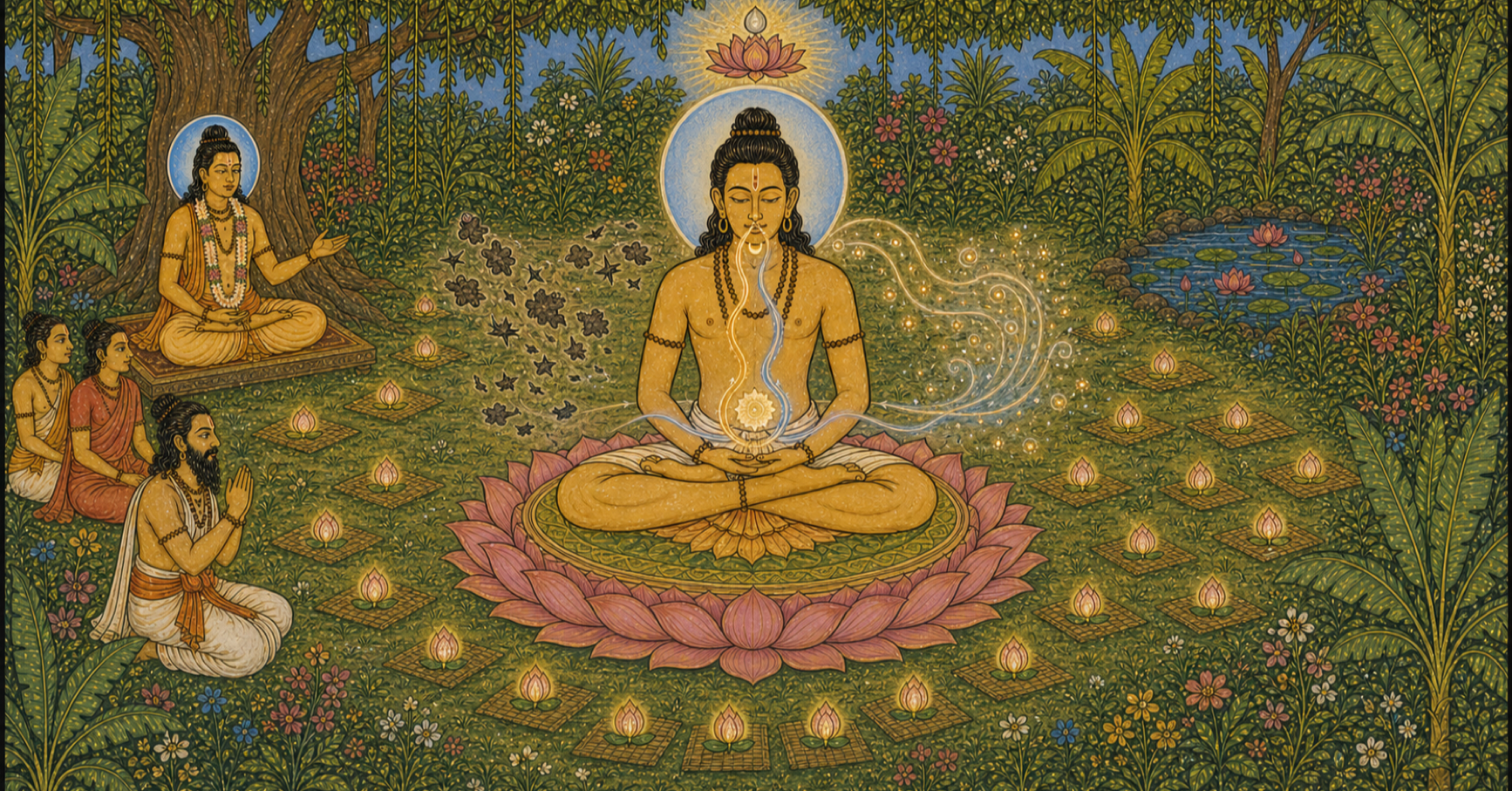
DYS 34–38: Padmāsana

Dattātreyayogaśāstra 34–38: Lotus Pose, Breath, and the Start of Practice

Among the many seats, Padmāsana is especially effective; posture, gaze, tongue position, and slow inhalation and exhalation prepare the practice that follows.

Dr. Ronald Steiner Dr. Ronald Steiner Nils Jacob Liersch Nils Jacob Liersch
Dattātreyayogaśāstra 34
चतुराशीतिलक्षेषु आसनेषूत्तमं शृणु |
catur-āśīti-lakṣeṣu; āsaneṣūttamaṃ śṛṇu | Analysis ▾ Analysis ▴
catur
dvandva-compound
numeral
four
aśīti
dvandva-compound
numeral
eighty
lakṣeṣu
lokative plural
substantive neuter
among the hundred-thousands
āsaneṣu
lokative plural
substantive neuter
among the āsanas
uttamam
accusative singular neuter
adjective
highest, best
śṛṇu
2nd person singular aktive imperative
verbal root
hear
आदिनाथेन संप्रोक्तं पद्मासनमिहोच्यते ||34||
ādi-nāthena saṃproktaṃ; padmāsanam ihocyate ||34|| Analysis ▾ Analysis ▴
ādi
karmadhāraya-compound
substantive masculine
primordial; first
nāthena
instrumental case singular
substantive masculine
lord
saṃproktam
nominative singular neuter past participle passive
previx
previx
verbal root
taught
padma
tatpuruṣa-compound genitive
substantive neuter
lotus
āsanam
nominative singular
substantive neuter
posture
iha
adverb
here
ucyate
3rd person singular passive present
verbal root
is called
Metre: Anuṣṭubh
Among the 8,400,000 (catur-āśīti-lakṣeṣu | loc pl) postures (āsaneṣu | loc pl), hear (śṛṇu | 2p sg act imp) the best (uttamam | acc sg n). The lotus posture (padma-āsanam | nom sg) taught (saṃproktam | nom sg n ppp) by Ādinātha (ādi-nāthena | ins sg) is described (ucyate | 3p sg pas pres) here (iha).
Dr. Ronald Steiner - 2026 - historically literal
Of the many possible postures, the best is now described: the lotus posture taught by Ādinātha.
Dr. Ronald Steiner - 2026 - modern transfer
caturāśītilakṣeṣu JM2024 ] caturaśītilakṣeṣu DYŚ

saṃproktaṃ padmāsanam JM2024 ] samproktaṃ yad āsanam DYŚ
Critical Apparatus
Dattātreyayogaśāstra 35
उत्तानौ चरणौ कृत्वा ऊरुसंस्थौ प्रयत्नतः |
uttānau caraṇau kṛtvā; ūru-saṃsthau prayatnataḥ | Analysis ▾ Analysis ▴
uttānau
accusative dual masculine
adjective
upturned
caraṇau
accusative dual
substantive masculine
the two feet
kṛtvā
absolutus
verbal root
having placed
ūru
tatpuruṣa-compound lokative
substantive masculine
thigh
saṃsthau
accusative dual masculine
adjective
situated, placed
prayatnataḥ
adverb
carefully
ऊरुमध्ये तथोत्तानौ पाणी कृत्वा ततो दृशौ ||35||
ūru-madhye tathottānau; pāṇī kṛtvā tato dṛśau ||35|| Analysis ▾ Analysis ▴
ūru
tatpuruṣa-compound genitive
substantive masculine
thigh
madhye
lokative singular
substantive neuter
in the middle
tathā
adverb
likewise
uttānau
accusative dual masculine
adjective
turned upward
pāṇī
accusative dual
substantive masculine
the two hands
kṛtvā
absolutus
verbal root
having placed
tataḥ
adverb
then
dṛśau
accusative dual
substantive feminine
the two eyes
Metre: Anuṣṭubh
Having placed (kṛtvā | abs) the upturned (uttānau | acc du m) feet (caraṇau | acc du) carefully (prayatnataḥ) on the thighs (ūru-saṃsthau | acc du m), and likewise (tathā) placed the two upturned (uttānau | acc du m) hands (pāṇī | acc du) between the thighs (ūru-madhye | loc sg), [one then directs] (tataḥ) the two eyes (dṛśau | acc du).
Dr. Ronald Steiner - 2026 - historically literal
Place the feet carefully on the thighs and rest the hands, palms facing upward, in the lap.
Dr. Ronald Steiner - 2026 - modern transfer
pāṇī kṛtvā JM2024 ] pāṇīkṛtvā DYŚ
Critical Apparatus
Dattātreyayogaśāstra 36
नासाग्रे विन्यसेद्राजदन्तमूलं च जिह्वया |
nāsāgre vinyased rāja;-danta-mūlaṃ ca jihvayā | Analysis ▾ Analysis ▴
nāsā
tatpuruṣa-compound genitive
substantive feminine
nose
agre
lokative singular
substantive neuter
at the tip
vinyaset
3rd person singular aktive optative
previx
previx
verbal root
one should fix
rāja
tatpuruṣa-compound genitive
substantive masculine
royal
danta
tatpuruṣa-compound genitive
substantive masculine
tooth
mūlam
accusative singular
substantive neuter
root
ca
particle
and
jihvayā
instrumental case singular
substantive feminine
with the tongue
उत्तभ्य चिबुकं वक्षस्यास्थाप्य पवनं शनैः ||36||
uttabhya cibukaṃ vakṣasy; āsthāpya pavanaṃ śanaiḥ ||36|| Analysis ▾ Analysis ▴
uttabhya
absolutus
previx
verbal root
having raised
cibukam
accusative singular
substantive neuter
the chin
vakṣasi
lokative singular
substantive neuter
on the chest
āsthāpya
absolutus
previx
verbal root
having placed
pavanam
accusative singular
substantive masculine
the breath
śanaiḥ
adverb
slowly
Metre: Anuṣṭubh
One should fix [the eyes] on the tip of the nose (nāsāgre vinyaset) and raise the base of the uvula with the tongue (rāja-danta-mūlaṃ ca jihvayā uttabhya). Having placed the chin on the chest (cibukaṃ vakṣasy āsthāpya), one should [draw in] the breath slowly (pavanaṃ śanaiḥ).
Dr. Ronald Steiner - 2026 - historically literal
Rest the gaze on the tip of the nose. The tongue raises the base of the uvula, the chin rests on the chest, and the breath is drawn in slowly.
Dr. Ronald Steiner - 2026 - modern transfer
rājadantamūlaṃ JM2024 ] rājadd(sic)antamūlaṃ DYŚ

vakṣasy āsthāpya JM2024 ] vakṣaḥ saṃsthāpya DYŚ
Critical Apparatus
Dattātreyayogaśāstra 37
यथाशक्त्या समाकृष्य पूरयेदुदरं शनैः |
yathā-śaktyā samākṛṣya; pūrayed udaraṃ śanaiḥ | Analysis ▾ Analysis ▴
yathā
avyayībhāva-compund
adverb
according to
śaktyā
instrumental case singular
substantive feminine
strength, capacity
samākṛṣya
absolutus
previx
previx
verbal root
having drawn in
pūrayet
3rd person singular aktive optative
verbal root
one should fill
udaram
accusative singular
substantive neuter
the abdomen
śanaiḥ
adverb
slowly
यथाशक्त्यैव पश्चात्तु रेचयेत्पवनं शनैः ||37||
yathā-śaktyaiva paścāt tu; recayet pavanaṃ śanaiḥ ||37|| Analysis ▾ Analysis ▴
yathā
avyayībhāva-compund
adverb
according to
śaktyā
instrumental case singular
substantive feminine
strength, capacity
eva
particle
indeed
paścāt
adverb
afterwards
tu
particle
then
recayet
3rd person singular aktive optative causative
verbal root
one should exhale
pavanam
accusative singular
substantive masculine
the breath
śanaiḥ
adverb
slowly
Metre: Anuṣṭubh
Having drawn [the breath] in according to one’s capacity (yathāśaktyā samākṛṣya | abs), one should slowly (śanaiḥ) fill (pūrayet | 3p sg act opt) the abdomen (udaram | acc sg). Afterwards (paścāt), one should exhale (recayet | 3p sg act opt) the breath (pavanam | acc sg), equally according to one’s capacity (yathāśaktyaiva), slowly (śanaiḥ).
Dr. Ronald Steiner - 2026 - historically literal
Draw the breath in as far as is comfortably possible, slowly fill the abdomen, and then breathe out again with ease.
Dr. Ronald Steiner - 2026 - modern transfer
yathāśaktyā JM2024 ] yathāśakti DYŚ

yathāśaktyaiva JM2024 ] yathāśakty eva DYŚ
Critical Apparatus
Dattātreyayogaśāstra 38
इदं पद्मासनं प्रोक्तं सर्वव्याधिविनाशनम् |
idaṃ padmāsanaṃ proktaṃ; sarva-vyādhi-vināśanam | Analysis ▾ Analysis ▴
idam
nominative singular neuter
pronoun dem
this
padma
tatpuruṣa-compound genitive
substantive neuter
lotus
āsanam
nominative singular
substantive neuter
posture
proktam
nominative singular neuter past participle passive
previx
verbal root
is taught
sarva
karmadhāraya-compound
adjective
all
vyādhi
tatpuruṣa-compound genitive
substantive masculine
disease
vināśanam
nominative singular neuter
adjective
destroying, removing
दुर्लभं येन केनापि धीमता लभ्यते भुवि ||38||
durlabhaṃ yena kenāpi; dhīmatā labhyate bhuvi ||38|| Analysis ▾ Analysis ▴
durlabham
nominative singular neuter
adjective
difficult to attain
yena
instrumental case singular masculine
pronoun
by whom
kena
instrumental case singular masculine
pronoun inter
by any
api
particle
also
dhīmatā
instrumental case singular masculine
adjective
by an intelligent person
labhyate
3rd person singular passive present
verbal root
is attained
bhuvi
lokative singular
substantive feminine
in the world
Metre: Anuṣṭubh
This is called Padmāsana (idaṃ padmāsanaṃ proktam), and it destroys all diseases (sarva-vyādhi-vināśanam). It is difficult for just anyone to attain (durlabhaṃ yena kenāpi); in this world it is attained by an intelligent person (dhīmatā labhyate bhuvi).
Dr. Ronald Steiner - 2026 - historically literal
This posture is called Padmāsana and is said to destroy every disease. It is difficult to master and, according to the text, is attained by a discerning person.
Dr. Ronald Steiner - 2026 - modern transfer

Continue with AYI Free

Illustrations: AI-generated.

Editor

Dr. Ronald Steiner

From Ulm

The "Yoga Doc" - Dr. Ronald Steiner is the founder of the AYI method. This method links traditional Ashtanga Yoga with innovative Yogatherapy and living Philosophy. This forms a practice that is personal for each and... more ›

Nils Jacob Liersch

Meine Begeisterung für Yoga, indische Philosophie und Sanskrit führte mich zum Studium der Indologie und Religionswissenschaft an der Universität Heidelberg. Seit 2004 befinde ich mich auf meinem persönlichen Yogaweg... more ›

Messages and ratings
5 messages Ø

Please log in to write a message. Go to login

K
Geringe Nahrungsaufnahme im Sinn von bedarfsgerecht oder im Sinn von Fasten / zu wenig? Zweiteres kann auch eine Form von Gewalt gegen sich selbst darstellen.
Hallo Katrin,
wie die Yogis damals das wirklich verstanden wissen wir nicht mit absoluter Sicherheit. Wir könnten es aber auch im übertragenen Sinne sehen. "Wenig Nahrungsaufnahme" wäre dann auch wenig Konsum (physischer und mentaler). Wir würden dann bewusst auswählen was wir mit unserer Zeit tun und nicht wahllos alles einfach aufnehmen. Daraus kann eine Zufriedenheit entstehen mit dem was wir haben.
Viel Freude dabei wünscht Dir
Ronald
Wow, geringe Nahrungsaufnahme. Schon damals ein Thema, heute mehr denn je!
Ah! Es ist umgekehrt, geringe Nahrungsaufnahme als Yama, Gewaltlosigkeit als Niyama, sehr spannend!
Es wird hier ja als ~i~Yama~~ genannt, also eine Leitlinie im Umgang mit der Außenwelt. Spannend. :)