

mukha मुख – mouth; face; opening
adjective · substantive masculine · substantive neuter · Word type unspecified
Dictionary sources
AYI dictionary substantive neuter
mouth; face; opening
Cappeller 1891 substantive neuter
Original text · English · substantive neuter
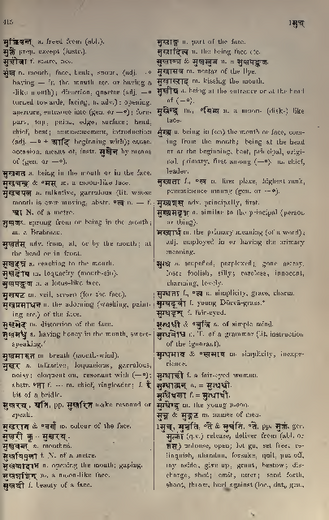
múkha ·n. mouth, face, beak, snout, (adj. --° having -- in the mouth etc. or having a like mouth); direction, quarter (adj. --° turned towards, facing, n. adv.); opening, aperture, entrance into (gen. or --°); forepart, top, point, edge, surface; head, chief, best; commencement, introduction (adj. --° ±ādi beginning with); cause, occasion, means of, instr. mukhena by means of (gen. or --°).
Monier-Williams 1872 substantive neuter
Original text · English · substantive neuter
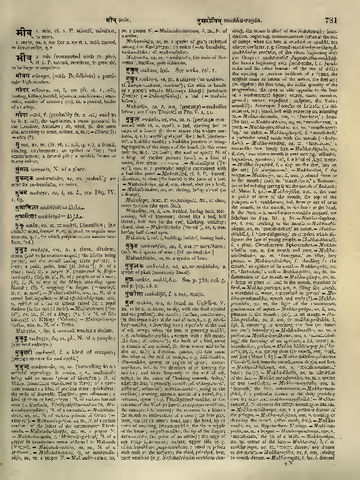
mukha mukha, am, n. (said in Uṇādi-s. V. 20. to be fr. rt. khan, to dig, with the final rejected and mu prefixed), the mouth; the face, countenance, (in this sense often at the end of comps., e. g. bhrū- kuṭī-mukha, a frowning face; especially at the end of adj. comps. when the fem. is generally mukhī, e. g. sakalendu-mukhī, a woman with a full moon- like face; cf. aśru-m˚); the beak of a bird, snout or muzzle of any animal, (in these senses said to be also as, m.); a direction, quarter, (in this sense also often at the end of comps., e. g. āśā-mukha, diṅ-mukha, quarter or region of space; antar- mukham, ind. in the direction of or towards the interior; and more frequently at the end of adj. comps. in the sense of ‘looking towards, facing,’ when the fem. is generally -mukhī, cf. ubhayato-m˚, adho-m˚, udaṅ-m˚; makha-mukha, going to the sacrifice); opening, aperture, mouth of a vessel, &c.; entrance, egress (e. g. Vindhyāṭavī-mukhe, at the entrance of the Vindhya forest; svargasya mukham, the entrance into heaven); the entrance to a house; the mouth or embouchure of a river; the fore part, front, van (of an army), head, top; the head, tip or point of anything, (stana-mukha, the tip or nipple of the breast; aṅgulī-mukha, the tip of the finger; śara-mukha, the point of an arrow); the edge of any sharp instrument; surface, upper side (e. g. viṣa-kumbham payo-mukham, a vessel of poison with milk on the surface); the chief, principal, best, most excellent (e. g. Nakṣatrāṇām mukhaṃ can- draḥ, the moon is chief of the Nakṣatras); intro- duction, beginning, commencement, (often at the end of comps. when the fem. is -mukhā or -mukhī, but oftener the latter, e. g. Gaṅgā-mukhīnāṃ or Gaṅgā- mukhānāṃ saritām, of the rivers beginning with the Ganges; mahā-rathā Jayadratha-mukhāḥ, the heroes beginning with Jayad-ratha, i. e. Jayad- ratha and the other heroes; cf. the use of ādi); the opening or previous incidents of a drama, the original cause or source of the action, the first act; (in algebra) the first term, the intial quantity of the progression; the apex or side opposite to the base of a mathematical figure; source, cause, occasion, ground; means, expedient; scripture, the Veda; sound (?); Artocarpus Locucha or Lakuca, (in this sense as, m.); (ena), ind. with reference to, according to.
Petersburger 1855 substantive masculine · Word type unspecified
Original text · German · substantive masculine
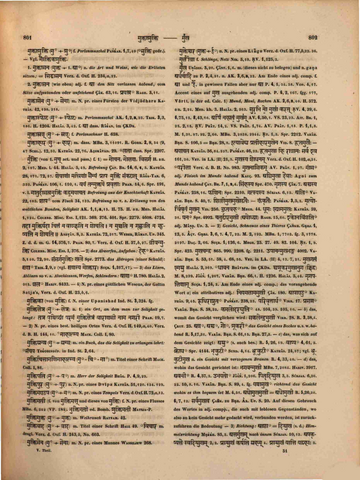
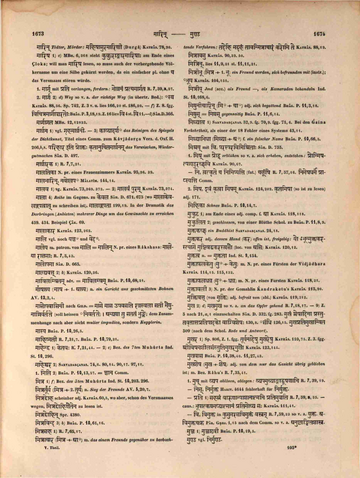
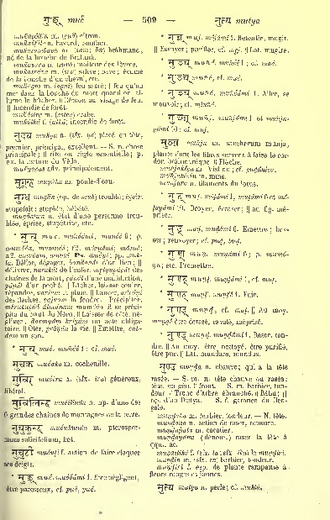
múkha UṆĀDIS. 5,20. ŚĀNT. 1,6. m. (dieses nicht zu belegen) und n. gaṇa ardharcādi zu P. 2,4,31. n. AK. 3,6,3,22. Am Ende eines adj. comp. f. ā und ī́, in gewissen Fällen aber nur ā P. 4,1,54. P. 4,1,58. VOP. 4,17. Accent eines auf mukha ausgehenden adj. comp. P. 6,2,167. fgg. P. 6,2,177, Vārtt. in der ed. Calc. 1〉 Mund, Maul, Rachen AK. 2,6,2,40. H. 572. H. an. 2,24. MED. kh. 3. HALĀY. 2,363. su̱ra̱bhi no̱ mukhā̀ karat ṚV. 4,39,6. ṚV. 6,75,15. ṚV. 8,43,10. apì nahyata̱ṃ mukhàm AV. 6,50,1. VS. 23,23. AIT. BR. 1,25. AIT. BR. 2,15. ṚV. PRĀT. 14,2. VS. PRĀT. 1,74. AV. PRĀT. 1,18. P. 1,1,8. M. 1,31. M. 1,87. M. 1,92. M. 2,60. MBH. 3,2838. MBH. 3,2944. ṚT. 1,3. Spr. 2212. VARĀH. BṚH. S. 106,5 = BṚH. 28,8. ityāvedya pratīhāramukhena VID. 8. dūtamukhaiḥ — ayācata KATHĀS. 56,84. KATHĀS. 56,257. PAÑCAT. 46,22. dūtamukhā hi rājānaḥ sarva eva PAÑCAT. 161,20. VET. in LA. (II) 21,5. mukhasya śodhanam Verz. d. Oxf. H. 102,a,31. ˚parīkṣā Verz. d. B. H. No. 983. mukhanāsikam AV. PRĀT. 1,27. māṃsa˚ adj. Fleisch im Munde habend KAUŚ. 93. agnimukhā devāḥ Agni zum Munde habend ŚAT. BR. 7,1,2,4. siṃhasya Spr. 470. mṛgasya ŚĀK. 7. aśvasya PAÑCAT. 258,16. phaṇinaḥ Spr. 2210. matsyasya SŪRYAS. 6,15. ali˚ VARĀH. BṚH. S. 40,7. śilīmukhamukhodgataiḥ — jhaṃkṛtaiḥ PAÑCAR. 3,5,2. mṛtyorvivṛtaṃ mukham VID. 256. hutavaha˚ MEGH. 44. dhūmaḥ śyāmamukhaḥ KATHĀS. 59,31. ghana˚ Spr. 4992. caturdvāramukhī (ayodhyā) RAGH. 15,60. ekonaviṃśati˚ adj. MĀṆḌ. UP. 3. — 2〉 Gesicht, Schnauze eines Thieres ŚĀṄKH. GṚHY. 1,12,5. ĀŚV. GṚHY. 3,6,7. ĀŚV. GṚHY. 4,7,22. M. 2,192. MBH. 1,7703. fg. MBH. 3,1778. fg. MBH. 3,2197. DAŚ. 2,66. SUŚR. 1,126,6. MEGH. 25. MEGH. 27. MEGH. 49. MEGH. 82. MEGH. 104. ṚT. 1,9. Spr. 423. mukhacandra Spr. 865. Spr. 990. Spr. 2208. fg. Spr. 2211. upānanmukhabhaṅga Spr. 4002. VARĀH. BṚH. S. 53,51. VARĀH. BṚH. S. 58,4. VARĀH. BṚH. S. 68,55. VET. in LA. (II) 4,13. VET. in LA. (II) 7,21. mukhagataṃ śmaśru HALĀY. 2,369. ˚dhāvana BHĀVAPR._im_ŚKDR. śvaśūkaramukhānuga (chidra) M. 8,239. YĀJÑ. 1,207. VARĀH. BṚH. 66,1. H. 1236. HALĀY. 5,46. mṛgapakṣiṇām SUŚR. 1,24,2. Am Ende eines adj. comp.; das vorangehende Wort a〉 ein attributives adj.: niyamakṣāmamukhī ŚĀK. 180. āpāṇḍu˚ KATHĀS. 9,45. rudhirāpluta˚ PAÑCAT. 238,23. parivṛttārdha˚ VIKR. 17. prasanna˚ VARĀH. BṚH. S. 58,32. kamalodaradyuti˚ VARĀH. BṚH. S. 48. VARĀH. BṚH. S. 104,39. VARĀH. BṚH. S. 105,10. — b〉 das, womit das Gesicht verglichen wird: sakalendumukhī VIKR. 28. R. 3,58,4. ŚRUT. 25. aja˚, aśva˚, go˚, śūkarī˚ das Gesicht eines Bockes u. s. w. habend R. 5,17,31. VARĀH. BṚH. S. 61,15. BṚH. 27,2. — c〉 das, was sich auf dem Gesichte zeigt: aśru˚ (s. auch bes.) R. 5,26,19. vāṣpa˚ R. 4,61,2. krodha˚ Spr. 4144. bhṛkuṭī˚ SUND. 4,14. bhrūkuṭī˚ KATHĀS. 24. KATHĀS. 87; vgl. bhrūkuṭīmukha n. ein Gesicht mit verzogenen Brauen R. 4,33,40. — d〉 das, wohin das Gesicht gerichtet ist: bhagavanmukhī MBH. 7,2084. HARIV. 3917. avanī˚ R. 4,57,2. ubhayato˚ YĀJÑ. 1,206. pitṛdiṅmukha YĀJÑ. 3,3. SŪRYAS. 6,20. SŪRYAS. 6,22. SŪRYAS. 10,8. SŪRYAS. 10,10. VARĀH. BṚH. S. 89,4. fg. yathāsukha˚ richtend das Gesicht wohin es ihm bequem ist M. 4,51. adhomukhamukhī = adhomukhī R. 5,26,20. R. 6,7,12. sarvamukhatva ŚAṂK._zu_BṚH. ĀR. UP. S. 20. Auf diesen Gebrauch des Wortes in adj. compp., die auch mit leblosen Gegenständen, wo also an kein Gesicht mehr gedacht wird, verbunden werden, ist zurückzuführen die Bedeutung — 3〉 Richtung: āśā˚ = diṅmukha (s. d.) Himmelsrichtung MṚCCH. 85,2. antarmukham nach innen SŪRYAS. 10,12. apakṛṣyante svadiṅmukham SŪRYAS. 2,2. prāṅmukhaṃ karṣati graham SŪRYAS. 4. prāṅmukhaṃ yānti yadgrahāḥ SŪRYAS. 5. — 4〉 Schnauze (eines Gefässes) KĀTY. ŚR. 9,13,14. — 5〉 Oeffnung, Eingang, Ausgang; = niḥsaraṇa AK. 2,2,18. H. 982. H. an. MED. HALĀY. 2,134. koṭara˚ ŚĀK. 14. darī˚ (zugleich Mund) KUMĀRAS. 1,8. guhā˚ MBH. 3,16118. KATHĀS. 55,203. bila˚ KATHĀS. 56,225. saṃdhi˚ MṚCCH. 48,11. tato vraṇamukhaiścaiva susrāva rudhiraṃ bahu HARIV. 11959. vindhyāṭavīmukhe am Eingange des Waldes MUDRĀR. 11,15. tattu (devakulaṃ) caityaṃ vinā mukham HĀR. 198. svargasya Eingang zum Himmel MBH. 5,4341. narakapura˚ Spr. 392. nadī˚ Mündung eines Flusses RAGH. 3,28. Am Ende eines adj. comp.: dīrghamukhā śālā P. 6,2,167, Sch. sahasra˚ (bila) tausend Aus- oder Eingänge habend PAÑCAT. 107,2. śata˚ (bila) Spr. 89. KATHĀS. 61,69. HIT. 14,18, v. l. vivekabhraṣṭānāṃ bhavati vinipātaḥ śatamukhaḥ aus hundert Oeffnungen erfolgend so v. a. plötzlich, jäh Spr. 2982. — 6〉 Vordertheil, Spitze: pṛthu˚ adj. breites Vordertheil habend KĀTY. ŚR. 7,4,8. senā˚ TBR. 3,8,23,1. ājiṃ yatāmabhisṛṣṭānāṃ vāyurmukhaṃ prathamaḥ pratyapadyata Vāyu kam zuerst an die Spitze der Laufenden d. h. gewann den Vorsprung (SĀY. an das Zeil) AIT. BR. 2,25. dhvajinīmukhe MBH. 3,15723. R. 2,98,25. R. 6,29,29. mukhamāsīttu sainyasya hanūmān MBH. 3,16284. some 'graṃ mukhamabhiparyāharadanuṣṭubham AIT. BR. 3,13. hala˚ R. 5,19,4. HALĀY. 5,46. śa̱lyānā̀m VS. 16,13. VS. 16,53. vajrasya TS. 7,4,7,1. śarairdīptamukhaiḥ MBH. 3,11960. R. 6,79,69. R. 6,79,73. fg. RAGH. 3,59. RAGH. 12,96. RAGH. 12,98. HALĀY. 2,314. mṛgapakṣiṇāṃ mukhairmukhāni yantrāṇāṃ sadṛśāni SUŚR. 1,24,2. SUŚR. 1,25,1. fgg. stanadvaya˚ Brustwarze HARIV. 2902. ānīlamukhaṃ stanadvayam RAGH. 3,8. aṅgulī˚ Fingerspitze H. 144. ŚIŚ. 9,64. Schneide: kuṭhārasya Spr. 5258. Oberfläche: viṣakumbhaṃ payomukham Spr. 1729. vādyabhāṇḍa˚ die obere Seite (der Trommel) AK. 3,4,25,188. mṛdaṅgo mukhalepena karoti madhuradhvanim Spr. 748. — 7〉 das Haupt, der Beste, Vorzüglichste, = śreṣṭha H. an. = pradhāna ŚABDAR._im_ŚKDR. agnirmukhaṃ prathamo devatānām AIT. BR. 1,4. mukhamasi mukhaṃ bhūyāsam AIT. BR. 2,22. AIT. BR. 7,16. ŚAT. BR. 12,5,2,10. mukhamahaṃ śreṣṭhaḥ samānānāṃ bhūyāsam KAUŚ. 90. rāja˚ TBR. 3,8,23,1. agnihotramukhā vedā gāyatrī chandasāṃ mukham . rājā mukhaṃ manuṣyāṇāṃ nadīnāṃ sāgaro mukham .. nakṣatrāṇāṃ mukhaṃ candra ādityastejasāṃ mukham . parvatānāṃ mukhaṃ merurgaruḍaḥ patatāṃ mukham .. MBH. 2,1395. M. 2,81. sa hi rājyasya sarvasya mukhameko bhaviṣyati R. 2,53,12. kṣatraṃ brahmamukham (adj.) R. 1,6,16. jñāyate sarvavidyānāṃ mukhaṃ vyākaraṇam KATHĀS. 6,144. KATHĀS. 4,22. Am Ende eines adj. comp.: prajāpatimukhābhirdevatābhiḥ ŚAT. BR. 13,1,8,2. — 8〉 Anfang, Beginn; = prārambha H. an. MED. yajñānām VS. 29,6. yajña˚ AIT. BR. 1,8. ŚAT. BR. 1,1,2,3. savana˚ LĀṬY. 1,9,4. svādhyāyasya ṚV. PRĀT. 15,4. saṃvatsarasya TS. 7,4,8,2. ŚĀṄKH. BR. 4,4. ŚĀṄKH. BR. 5,1. ṛtu˚ Spr. 5414. PAÑCAV. BR. 21,15,2. surabhimāsa˚ ad ŚĀK. 135. kṣaṇadā˚ R. 2,50,7. H. 144. niśā˚ MBH. 1,703. KATHĀS. 72,26. Spr. 3807. GHAṬ. 2. PAÑCAT. 29,16. PAÑCAT. 85,6. ahnaḥ PAÑCAR. 3,11,2. aharmukhe Verz. d. Oxf. H. 237,a, No. 568. dina˚ RAGH. 9,25. divasa˚ RAGH. 5,76. kaumudī˚ RAGH. 3,1. tejaḥparihānamukhāt VARĀH. BṚH. S. 47,21. brahmaṇaiva mukhena mit dem Brahman voran CHĀND. UP. 3,10,1. CHĀND. UP. 3,10,3. Am Ende eines adj. comp. — zum Anfang habend, damit beginnend ṚV. PRĀT. 18,7. mahāsatomukhā ṚV. PRĀT. 18,14. gaṇane bhavanmukhe Spr. 3882. SĀH. D. 23,12. pariṇāmamukhamidamṛtoḥ (vielleicht ist sukham st. mukham zu lesen) — yauvanam MĀLAV. 79. (mahārathāḥ) jayadrathamukhāḥ Jayadratha und Andere, Jayadr. u. s. w. MBH. 1,532. MBH. 3,1997. MBH. 4,85. gaṅgāmukhībhiḥ (˚mukhābhiḥ die neuere Ausg.) saridbhiḥ HARIV. 2967. R. 4,48,1. RAGH. 8,21. KATHĀS. 44,130. KATHĀS. 72,396. grāmāḥ — jayasthalamukhāḥ (jayasthala N. pr. eines Grāma) RĀJA-TAR. 5,121. iṣṭipaśusomamukhairmakhaiḥ PRAB. 107,3. AK. 1,1,1,47. AK. 1,1,2,28. AK. 1,1,3,38. TRIK. 1,2,36. TRIK. 3,1,24. H. 183. H. 1200. Zum Ueberfluss noch ādi hinzugefügt: bhūpālamantrisenāpatimukhādayaḥ KATHĀS. 66,43. In der Math. the first term, the initial quantity of the progression COLEBR. Alg. 52. — 9〉 Anfang so v. a. Anlass, Veranlassung: vināśa˚ MBH. 3,16008. anayasyāsya tu mukhaṃ bhīṣmaḥ śāntanavo mama MBH. 5,6008. dhairyaṃ ca viśate yodhānvijayasya mukhaṃ ca tat MBH. 12,3766. tāvubhau vṛṣṇināśasya mukhamāstām MBH. 16,156. In der Dramatik der erste Anlass der Handlung DAŚAR. 1,23. PRATĀPAR. 21,a,1. Hierher vielleicht die Bed. saṃdhyantara und nāṭakādeḥ śabdaḥ (woraus ŚABDAR. nach ŚKDR. zwei Bedeutungen: nāṭaka und śabda macht) MED. — 10〉 Mittel, = upāya H. an. MED. upanyāsamukhena vermittelst ŚAṂK._bei_WIND. Sancara 94. — 11〉 the side opposite to the base; the summit COLEBR. Alg. 72. — 12〉 = veda ŚABDAR._im_ŚKDR. — 13〉 m. Artocarpus Locucha (s. lakuca) Roxb. ŚABDAC._im_ŚKDR. — Vgl. a˚, akṣara˚, aja˚, adho˚ (in der ersten Bed. auch PAÑCAT. 84,8), abhi˚, ayo˚, avāṅmukha (auch VARĀH. BṚH. S. 53,51. VARĀH. BṚH. S. 53,110), aśru˚, aśva˚, āṭī˚, udaṅmukha, unmukha, ulkā˚, ūrdhva˚ (auch VARĀH. BṚH. S. 95,11), ṛtu˚, eka˚, kaṅka˚, kathā˚, kāla˚, kālikā˚, kravya˚, go˚, gaura˚, caturmukha, jñāti˚, jyotirmukha, jvālā˚, dakṣiṇā˚ (auch MBH. 17,43). dadhi˚, daśa˚, diṅmukha, divasa˚, durmukha, nandī˚, nava˚, nāndī˚, niśā˚, padmamukhī, parāṅmukha, puṇḍarīkamukhī, puruṣamukha, pūrṇa˚, pūrvapaścānmukha, pra˚, prati˚, pratyaṅmukha, prāṅmukha (auch SŪRYAS. 4,9. SŪRYAS. 6,9), phaṇi˚, bahirmukha, bahu˚, bhadra˚, bhāga˚, martya˚, malina˚, mahā˚, mātṛ˚, mleccha˚, yajña˚, ratha˚, vaḍavā˚, vali˚, valī˚, vi˚, viśvato˚, śaṅkha˚, śata˚, śilī˚, ṣaṇmukha, saṃ˚, sarvato˚, su˚, sūcī˚, senā˚, stana˚, svasti˚, mukhya, maukha.
Original text · German · Word type unspecified
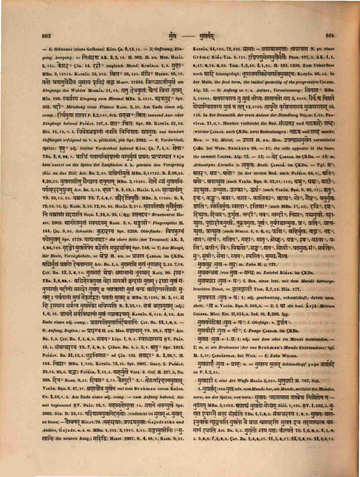
mukha 2〉d〉 makhamukha so v. a. an das Opfer gehend R. 7,18,17. — 9〉 Z. 5 nach 21,a,1 einzuschalten SĀH. D. 332. fg. SĀH. D. 283. mukhaṃ śleṣādinā prastutavṛttāntapratipādako vāgviśeṣaḥ SĀH. D. 130,8. ˚saṃdhi SĀH. D. 126,15. mukhapratimukhānvita SĀH. D. 509 (nach dem Schol. Rede und Antwort).
Original text · German · Word type unspecified
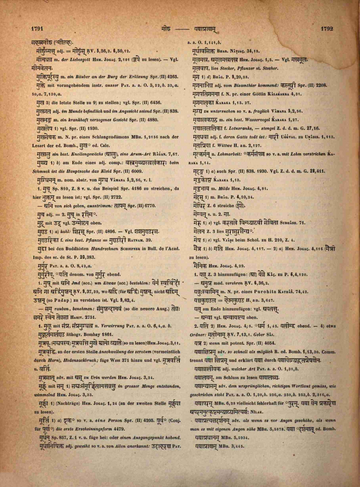
mukha 5〉 die letzte Stelle zu 9〉 zu stellen; vgl. Spr. (II) 6456.
Böhtlingk 1879 substantive masculine · substantive neuter · Word type unspecified
Original text · German · substantive masculine · substantive neuter
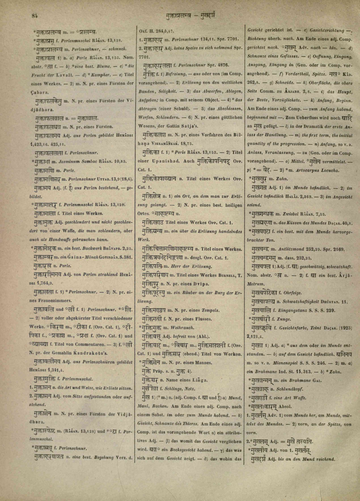
múkha — 1〉 (*m.) n. (adj. Comp. f. ā und ī) — a〉 Mund, Maul, Rachen. Am Ende eines adj. Comp. nach einem Subst. im oder zum Munde habend. — b〉 Gesicht, Schnauze des Thieres. Am Ende eines adj. Comp. ist das vorangehende Wort — α〉 ein attributives Adj. — β〉 das womit das Gesicht verglichen wird. aja˚ ein Bocksgesicht habend. — γ〉 das was sich auf dem Gesicht zeigt. — δ〉 das wohin das [Page5-084-c] Gesicht gerichtet ist. — c〉 Gesichtsrichtung —, Richtung überh. nach. Am Ende eines adj. Comp. gerichtet nach. ˚mukham Adv. nach — hin. — d〉 Schnauze eines Gefässes. — e〉 Oeffnung, Eingang, Ausgang, Eingang in (Gen. oder im Comp. vorangehend). — f〉 Vordertheil, Spitze. nākha˚ KĀD. 292,8. — g〉 Schneide. — h〉 Oberfläche, die obere Seite Comm. zu ĀRYABH. 2,3. — i〉 das Haupt, der Beste, Vorzüglichste. — k〉 Anfang, Beginn. Am Ende eines adj. Comp. — zum Anfang habend, beginnend mit —. Zum Ueberfluss wird noch ādi an mukha gefügt. — l〉 in der Dramatik der erste Anlass der Handlung. — m〉 the first term, the initial quantity of the progression. — n〉 Anfang, so v. a. Anlass, Veranlassung, — zu (Gen. oder im Comp. vorangehend). — o〉 Mittel. ˚mukhena vermittelst. — p〉 *= veda. — 2〉 *m. Artocarpus lacucha.
Original text · German · Word type unspecified
mukha V. der blosse Schein von Etwas. bhrātṛ˚ Adj. R. 4,9,11. = bhrātṛrūpin R. 4,12,8. Am Ende eines adj. Comp. ähnlich, zu vergleichen mit JĀTAKAM. 6,9. — 1〉a〉 niṣedhamukhena in negativer Weise ANIRUDDHA zu SĀṂKHYAS. 3,22. [Nachtrag, Band 7]
Apte 1890 substantive neuter
Original text · English · substantive neuter
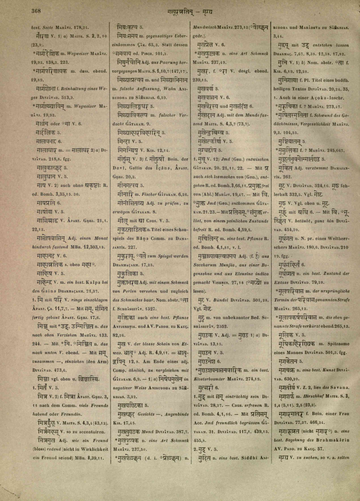
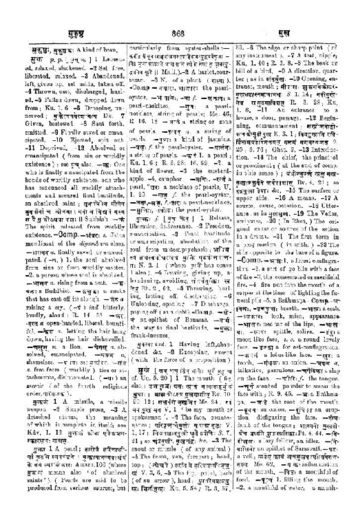
mukhaṃ [khan ac ḍit dhātoḥ pūrvaṃ muṭ ca cf. Uṇ. 5. 20] 1 The mouth (fig. also;) prajamṛjā yataḥ khātaṃ tasmādāhurmukhaṃ budhāḥ; brāhmaṇo'sya mukhamāsīt Rv. 10. 90. 12; sabhrabhaṃgaṃ mukhamiva Me. 24; tvaṃ mama mukhaṃ bhava V. 1 ‘be my mouth or spokesman’. 2 The face, countenance; parivṛttārdhamukhī mayādya dṛṣṭā V. 1. 17; niyamakṣāmapukhī dhṛtaikavoṇiḥ Ś. 7. 21; so caṃdramukhī, mukhacaṃdraḥ &c. 3 The snout or muzzle (of any animal). 4 The front, van, forepart; head, top; (locane) harati me harivāhanadiṅmukhaṃ V. 3. 6. 5 The tip, point, barb (of an arrow), head; purārimaprāptamukhaḥ śilīmukhaḥ Ku. 5. 54; R. 3. 57. ([Page 0868-c]) R. 3. 59. 6 The edge or sharp point (of any instrument). 7 A teat, nipple; Ku. 1. 40; R. 3. 8. 8 The beak or bill of a bird. 9 A direction, quarter; as in aṃtarmukha. 10 Opening, entrance, mouth; nīvārāḥ śukagarbhakoṭaramukhabhraṣṭāstarūṇāmadhaḥ Ś. 1. 14; nadīmukheneva samudramāviśat R. 3. 28; Ku. 1. 8. 11 An entrance to a house, a door, passage. 12 Beginning, commencement; sakhījanodvīkṣaṇakaumudīmukha R. 3. 1; dinamukhāni ravirhimānagrahairvimalayan malayaṃ nagamatyajat R. 9. 25; R. 5. 76; Ghaṭ. 2. 13 Introduction. 14 The chief, the principal or prominent; (at the end of comp. in this sense); badhonmuktyai khalu makhamukhānkurvate karmapāśān Bv. 1. 21; so idramukhā devāḥ &c. 15 The surface or upper side. 16 A means. 17 A source, cause, occasion. 18 Utterance; as in mukhasukha. 19 The Vedas, scripture. 20 (In Rhet.) The original cause or source of the action in a drama. 21 The first term in a progression (in arith.) 22 The side opposite to the base of a figure. Comp. — agniḥ 1 a forest conflagration. 2 a sort of goblin with a face of fire. 3 the consecrated or sacrificial fire. 4 fire put into the mouth of a corpse at the time of lighting the funeral pile 5 a Brāhmaṇa — anilaḥ, -ucchvāsaḥ breath. — astraḥ a crab. — ākāraḥ look, mien, appearance. — āsavaḥ nectar of the lips. — āsnavaḥ, -srāvaḥ spittle, saliva. — iṃduḥ a moon-like face, i. e. a round lovely face. — ulkā a forest-conflagration. — kamalaṃ a lotus-like face. — khuraḥ a tooth. — gaṃdhakaḥ an onion. — capala a. talkative, garrulous. — capeṭikā a slap on the face. — cīriḥ f. the tongue. — cūrṇaṃ scented powder to smear the face with; R. 9. 45. — jaḥ a Brāhmaṇa. — jāhaṃ the root of the mouth. — dūṣaṇaḥ an onion. — dūṣikā an eruption disfiguring the face. — doṣaḥ fault of the tongue; ātmano mukhadoṣaṇe badhyaṃte śukasārikāḥ Pt. 4. 44. — nirīkṣakaḥ a lazy fellow, an idler. — nivāsinī an epithet of Sarasvatī. — paṭaḥ a veil; kurvan kāmaṃ kṣaṇamukhapaṭaprītimairāvatasya Me. 62. — pakaḥ inflammation of the mouth. — piṃḍaḥ a mouthful of food. — pūraṇa 1 filling the mouth. 2 a mouthful of water, a ([Page 0869-a]) mouthful in general. — prasādaḥ a pleased countenance, graciousness of aspect — priyaḥ an orange. — (yaṃ) cloves. — prekṣa a. observing or watching the face. — baṃdhaḥ a preface, an introduction. — baṃdanaṃ 1 a preface. 2 a lid, cover. — bhūṣaṇaṃ a preparation of betel; see tāṃbūla. — bhedaḥ distortion of the face. — maṃḍanakaḥ a kind of tree (tilaka). — maṃḍalaṃ the (round) face. — madhu a. honey-mouthed, sweet-lipped. — mārjanaṃ washing the face. — yaṃtraṇaṃ the bit of a bridle. — rāgaḥ the colour or complexion of the face; daṭṭa ṣṭharvismitāstasya mukharāgaṃ samaṃ janāḥ R. 12. 8, R. 17. 31; tava khalu mukharāgo yatra bhedaṃ prayātaḥ Śi. 11. 31. — rogaḥ a disease of the mouth or face — lāṃgalaḥ a dog. — lepaḥ 1 anointing the face or upper side (of a drum); mṛdaṃgo mukhale pena karoti mukharadhvaniṃ Bh. 2. 118. 2 a disease of the phlegmatic humour — vallabhaḥ the pomegranate tree. — vādyaṃ 1 an instrument of music sounded with the mouth, any wind-instrument. 2 a sound made with the mouth. — vāsaḥ, -vāsanaḥ a perfume used to scent the breath. — viluṃṭhikā a she-goat — vyādānaṃ gaping, yawning. — śapha a. abusive, foul-mouthed, scurrilous — śuddhiḥ f. washing or purifying the mouth. — śeṣaḥ an epithet of Rāhu. — śodhana a. 1 cleansing the mouth. 2 pungent, sharp. — (naḥ) the sharp flavour, pungency. — (naṃ) 1 cleansing the month. 2 cinnamon. — śocin m. the citron tree. — śrīḥ f. ‘beauty of countenauce’, a lovely face. — saṃbhavaḥ a Brāhmaṇa. — sukhaṃ facility of pronunciation, phonetic ease. — suraṃ the moisture of the lips. — srāvaḥ saliva. — hāsaḥ cheerfulness or liveliness of countenance; Śi. 11. 47.

Cappeller 1887 substantive neuter
Original text · German · substantive neuter
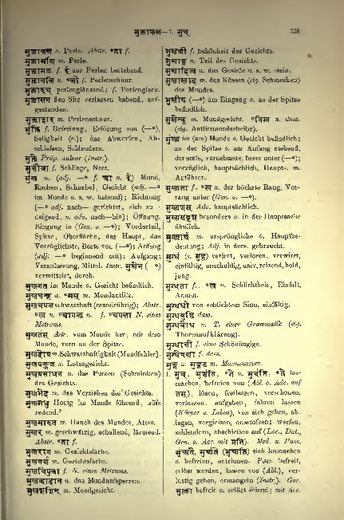
mukha n. (adj. —˚ f. ā u. ī) Mund. Rachen, Schnabel, Gesicht (adj. —˚ im Munde u. s. w. habend); Richtung (—˚ adj. nach — gerichtet, sich zu— neigend, n. adv. nach—hin); Öffnung,Eingang in (Gen. o. —˚); Vorderteil, Spitze, Oberfläche, das Haupt, das Vorzüglichste, Beste von (—˚); Anfang (adj. —˚ beginnend mit); Aufgang; Veranlassung, Mittel. Instr. mukhena (—˚) vermittelst, durch.
Burnouf 1866 adjective
Original text · French · adjective
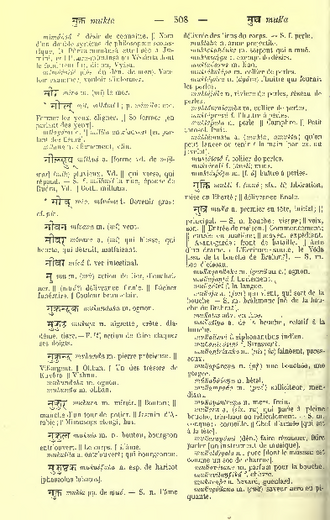
mukha mukha a. premier en tête, initial; principal. — S. n. bouche; visage; voix, son. Entrée de maison. Commencement; entrée en matière; moyen, expédient. Avant-garde; front de bataille. Acte d'un drame. L'Ecriture-sainte, le Veda [issu de la bouche de Brahmā]. — S. m. bec d'oiseau. mukhagandhaka m. (gandh au c.) ognon. mukhaghaṇṭā f. hurlement. mukhacīrī f. la langue. mukhaja a. (jan) qui vient, qui sort de la bouche. — S. m. brâhmane [né de la bouche de Brahmā]. mukhatas adv. en face. mukhatiya a. de la bouche, relatif à la bouche. mukhadhautā f. siphonanthus indica. mukhanivāsinī f. Sarasvatī. mukhanirīkṣaka m. (nis; īkṣ) fainéant, paresseux. mukhapūraṇa n. (pṝ) une bouchée, une gorgée. mūkhabhūṣaṇa n. bétel. mukhampaca m. (pac) solliciteur; mendiant. mukhayantraṇa n. mors, frein. mukhara a. (sfx. ra) qui parle à pleine bouche, très-haut ou ridiculement. — S. m. conque; corneille. Chef d'armée [qui est à la tète]. mukharayāmi (dén.) faire résonner, faire parler [un instrument de musique]. mukhalāṅgala m. porc [dont le museau est comme un soc de charrue]. mukhavāsana m. parfum pour la bouche. mukhaviluṇṭhikā f. chèvre. mukhaśapha a. bavard, gueulard. mukhaśodhana m. (śudh) saveur acre ou piquante. [Page509-1] mukhaśodhin m. (śudh) citron. mukhaṣṭhīla a. bavard, bouffon. mukhasambhava m. (sam; bhū) brâhmane, né de la bouche de Brahmā. mukhasura n. (surā) moiteur des lèvres. mukhasrāva m. (sru) salive; bave; écume de la bouche d'un cheval, etc. mukhāgni m. (agni) feu sacré; feu qu'on met dans la bouche du mort quand on allume le bûcher. Démon au visage de feu. Incendie de forêt. mukhāstra m. (astra) crabe. mukholkā f. (ulkā) incendie de forêt.
Occurrences in source texts (47)
AsS1 1 occurrence
Tryanga Mukhaika Paada Pashchimottanasana 1 occurrence
Direct occurrences
GoS 4 occurrences
HP 15 occurrences
7 more source pages
HTK 3 occurrences
IVU 1 occurrence
MandUp 3 occurrences
PJH 1 occurrence
SiSa 11 occurrences
2 more source pages
SiSa 5.156-5.181: Sahasrāra 4 occurrences
Direct occurrences
-
SiSa 5.162 Segment 4
-
SiSa 5.165 Segment 11
-
SiSa 5.168 Segment 3
-
SiSa 5.181 Segment 2
SVU 5 occurrences
Continue with AYI Free
Image source: AYI archive.