

cit चित् – indefinite particle: some; any; ever
adjective · particle · verbal root · substantive feminine · substantive neuter · suffix · Word type unspecified · verb
Dictionary sources
AYI dictionary particle · verbal root · substantive feminine · substantive neuter · suffix
particle
indefinite particle: some; any; ever
verbal root
perceive; be conscious
substantive feminine
consciousness
substantive neuter
consciousness
suffix
indefinite suffix -cit: some; any
Cappeller 1891 substantive feminine · verb
Original text · English · verb
cit cétati céta°te ·v pp. cittá1 (q.v.) perceive, observe, attend to (gen. or acc.), aim at, intend (dat.), strive after, desire (acc.), take care of (acc.); conceive, understand, know; intr. appear, be conspicuous or known. C. cetáyati, °te & citáyati make attentive, remind, instruct, teach; notice, put to mind, attend to; M. (A.) be conscious or sensible, think, reflect, conceive, understand, remember; appear, be conspicuous, shine. D. cikitsati (°te) intend, aim at, care for; treat medically, heal. I. cékite appear, shine. -- ā attend to, call to mind, understand, know, find out, invent; intr. appear, shine, excel. pra become visible, appear, also = C. perceive, understand, announce, proclaim. vi observe, discern conceive, know (also C.); M. be perceptible, appear. D. wish to discern, deliberate, doubt, hesitate. sam perceive (together), survey, notice; be unanimous, agree. -- Cf. cikitváṃs, cékitāna, vícitta.
Original text · English · substantive feminine
cít2 ·f. thought, mind, intelligence.
Monier-Williams 1872 particle · substantive feminine · Word type unspecified
Original text · English · particle
cit 7 . cit, ind. a particle, = cid below.
Original text · English · substantive feminine
5. cit, t, f. thought, intelligence, intellect, under- standing, mind; the soul, heart.
Original text · English · Word type unspecified
1. cit, t, t, t, (at the end of compounds) piling up (e. g. agni-cit, q. v.); forming a layer or stratum, piled up.
Original text · English · Word type unspecified
2. cit, t, t, t, observing, knowing (in ṛta-cit).
Original text · English · Word type unspecified
3. cit, t, t, t, punishing (in ṛṇa-cit).
Original text · English · Word type unspecified
cit 1 . 2. 3. cit. See under rt. 1. 2. 3. ci.
Original text · English · Word type unspecified
cit 4 . cit (= kit, which is by some regarded as a separate root; cf. keta, &c.; cf. also rt. cint), cl. 1. 3. P. cetati, ciketti, ciceta or ciketa, cikite or cekite or cicite (Ved. 3rd pl. ci- kitre or cikitrire; Part. cikitāna or cekitāna), ceti- ṣyati, acetīt; Leṭ, ciketati or ciketat; cettum or cetitum, to perceive, fix the mind upon, attend to, be attentive, observe, notice, take notice of (with gen. or acc., e. g. yajñasya or yajñaṃ cetati, he takes notice of the sacrifice); to aim at, intend, design (with dat., e. g. yudhaye ciketati, he intends fighting), to desire, long for (with acc.); to be anxious about, to care for; to resolve; to understand, com- prehend, know, make known; to recover conscious- ness, become conscious; P. and A. to become per- ceptible, to appear; to be regarded as: to be known; Pass. Aor. aceti: Caus. P. A. citayati Ved., and ceta- yati, -te, -yitum, ketayati, -yitum (see keta, p. 252), to cause to attend, to make attentive, remind of; to cause to comprehend or understand, instruct, teach; to observe, perceive, be intent upon; to form an idea in the mind, be conscious of, understand, compre- hend, think, reflect upon; to form a conception, have a right notion; to appear, be conspicuous, shine: Desid. P. A cicitiṣati, cicetiṣati, cikit- sati, -te; Inf. cikitsitum, to intend, have in view, aim at, desire, long for; to care for, be anxious about; to treat medically, heal, cure, attend as a physician (in these senses the form cikitsati is usual); to wish to appear; to remove, destroy; to keep down, press down; to doubt: Caus. of the Desid. cikitsayati, to cure, to heal; Intens. cecityate, cecetti; [cf. Lith. kettu.]
Original text · English · Word type unspecified
cit 6 . cit, an interjection.
Petersburger 1855 adjective · particle · substantive feminine · Word type unspecified · verb
Original text · German · adjective
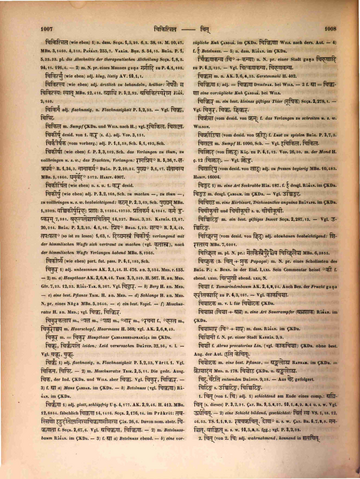
1. √cit (von 1. ci) adj. 1〉 schichtend am Ende eines comp.: agnicit (s. dieses) P. 3,2,91. ŚAT. BR. 9,5,1,57. ŚAT. BR. 19,1,4,9. ŚAT. BR. 19,1,5,4 u. s. w. Vgl. ūrdhvacit. — 2〉 eine Schicht bildend, geschichtet: cità stha VS. 1,18. VS. 12,46. VS. 12,53. TS. 1,1,7,2. rathacakracit, droṇa˚ u. s. w. ŚAT. BR. 6,7,2,8. manaścit, vākcit u. s. w. ŚAT. BR. 10,5,3,3. fgg.; vgl. P. 3,2,92.
Original text · German · adjective
2. cit (von 2. ci) adj. wahrnehmend kennend in ṛtacit.
Original text · German · adjective
3. √cit (von 3. ci) adj. bestrafend in ṛṇacit.
Original text · German · particle
6. cit interj. s. citkāra und vgl. 2. citti.
Original text · German · substantive feminine
5. √cit (= 4. cit) f. das Denken, Intelligenz AK. 1,1,4,10. H. 309. VS. 4,19. KAP. 1,105. KAP. 1,147. KAP. 1,165. BHĀG. P. 1,7,23. BHĀG. P. 7,3,34. BHĀG. P. 7,9,48. BHĀG. P. 8,3,16. BHĀG. P. 8,12,5. BHĀG. P. 8,18,12. cinmātra reine Intelligenz, ganz Geist KAIV. UP._in_Ind. St. 2,12. BHARTṚ. 2,1. BHĀG. P. 3,7,2. BHĀG. P. 4,7,26. BHĀG. P. 6,16,21. BHĀG. P. 7,12,31. cidātmaka BHĀG. P. 3,31,14. BHĀG. P. 8,3,2. — PRAB. 14,4. PRAB. 69,11. VEDĀNTAS. (Allah.) No. 2. — Vgl. acit.
Original text · German · Word type unspecified
7. √cit Partikel s. cid.
Original text · German · Word type unspecified
4. cit , cityante SARVADARŚANAS. 15,3 fehlerhaft für cityante. — vi desid. 2〉 sarvatra vicikitsate Spr. 5106. vicikitsan nicht recht glauben wollend KATHĀS. 54,175. — savi vgl. pravicetana. — sam caus. gewahr werden: asaṃcetayamāna Spr. 2814.
Original text · German · Word type unspecified
5. √cit , cinmātra SARVADARŚANAS. 46,5. cidghana SARVADARŚANAS. 96,1.
Original text · German · verb
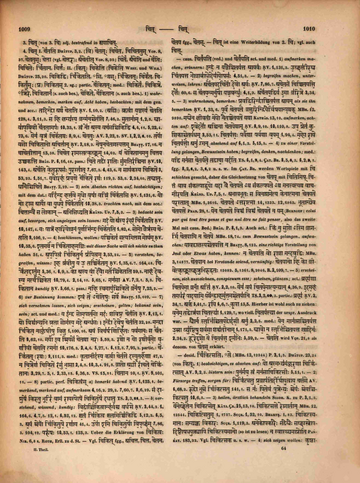
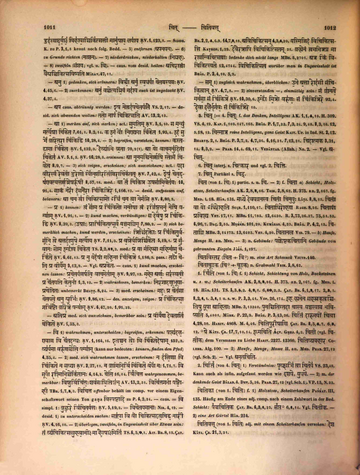
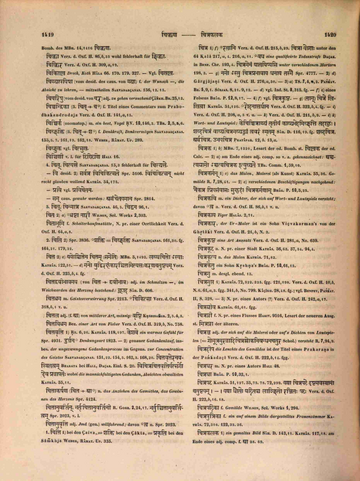
4. cit I. cétati DHĀTUP. 3,2. (vi) cetat; ciceta, cicitatus VOP. 8,37. cetatus; cettā (vgl. cettar); ácetīt VOP. 8,35; cité, áceti und céti; cicite; cítāna, cittá; II. (kit) ciketti (ciketi WEST. und WILS.) DHĀTUP. 25,20. cikiddhi; cíketati, ˚si, ˚thas; cíketat; cikéta, cikitús; (pra) cikitas 2. sg.; partic. cékitat; med.: cikité, cikitre, ˚trire, cikitāná (s. auch bes.), cekite, cékitāna (s. auch bes.) 1〉 wahrnehmen, bemerken, merken auf, Acht haben, beobachten; mit dem gen. und acc.: tadindro̱ arthàṃ cetati ṚV. 1,10,2. (agniḥ) kratvā̀ ya̱jñasyà cetati ṚV. 128,4. ṚV. 3,11,3. sa hi kṣamyàsya̱ janmàna̱ścetàti ṚV. 7,46,2. su̱tānā̀m ṚV. 1,2,5. dyāvā̀pṛthi̱vī cètatā̱mapàḥ ṚV. 10,35,1. tvaṃ nò a̱sya vacàsaścikiddhi ṚV. 4,4,11. ṚV. 5,22,4. ṚV. 5,73,6. yenà vṛ̱traṃ cikètathaḥ ṚV. 8,9,4. cetatuḥ AV. 3,22,2. SV. I, 2,2,1,10. tapò vaso cikitā̱no a̱cittā̀n ṚV. 3,18,2. neṣūnacetannasyantam BHAṬṬ. 17,16. na cācetīttān BHAṬṬ. 15,38. ciceta rāmastatkṛcchram BHAṬṬ. 14,62. yaṃ cekitānamanu cittaya uccakanti BHĀG. P. 6,16,48. pass.: ci̱te tadvā̀ṃ rā̱tiḥ sùma̱tiràśvinā ṚV. 10,143,4. acèti ke̱turu̱ṣasàḥ pu̱rastā̀t ṚV. 7,67,2. ṚV. 4,43,6. na sāyàkasya cikite ṚV. 3,53,23. ṚV. 1,51,7. yu̱vorahà prava̱ṇe cèkite̱ rathàḥ ṚV. 119,3. ṚV. 53,3. ṚV. 2,34,10. tadyātudhānaiścicite BHAṬṬ. 2,29. — 2〉 sein Absehen richten auf, beabsichtigen; mit dem dat.: yadìndra̱ hantàve̱ mṛdho̱ vṛṣā̀ vajri̱ṃ cikètasi ṚV. 1,131,6. yo no̱ dāsa̱ āryò vā yu̱dhaye̱ cikètati ṚV. 10,38,3. trachten nach, mit dem acc.: cittānvai sa lokān — abhisidhyati CHĀND. UP. 7,5,3. — 3〉 bedacht sein auf, besorgen, sich angelegen sein lassen: mada̱ṃ yo àsya̱ raṃhya̱ṃ cikètati ṚV. 10,147,4. yaḥ pātràṃ hāriyoja̱naṃ pū̱rṇamìndra̱ cikètati ṚV. 1,82,4. somo̱ jaitràsya cetati ṚV. 9,106,2. — 4〉 beschliessen, wollen: yacci̱ketà sa̱tyamittanna moghàm ṚV. 10,55,6. e̱tamartha̱ṃ na cìketā̱hama̱gniḥ mit dieser Sache will ich nichts zu thun haben ṚV. 10,51,4. a̱pa̱pi̱tvaṃ cìkitu̱rna pràpi̱tvam ṚV. 3,53,24. — 5〉 verstehen, begreifen, wissen: i̱ha bràvītu̱ ya u̱ taccikètat ṚV. 1,35,6. ṚV. 1,35,7. ṚV. 1,164,48. cikèta̱ddātùm ṚV. 5,36,1. ṚV. 6,9,3. ko a̱sya vā̱ṃ devau̱ martàściketati ṚV. 6,59,5. nāhaṃ de̱vasya̱ martyàściketa ṚV. 10,79,4. ṚV. 2,14,10. ṚV. 5,65,1. manàsā AV. 7,2,1. AV. 7,5,5. cikitāna kundig ṚV. 5,66,1. pass.: na̱hi svamāyùściki̱te janèṣu ṚV. 7,23,2. — 6〉 zur Besinnung kommen: evaṃ te 'cetiṣuḥ sarve BHAṬṬ. 15,109. — 7〉 sich vernehmen lassen, sich zeigen; erscheinen, gelten; bekannt sein, sein; act. und med.: ya ìndra soma̱pātàmo̱ madàḥ śaviṣṭha̱ cetàti ṚV. 8,12,1. yo viśvā̀nya̱bhi vra̱tā somàsya̱ made̱ andhàsaḥ . indrò de̱veṣu̱ cetàti ṚV. 8,32,28. ma̱ndrā cìketa̱ nāhùṣīṣu vi̱kṣu ṚV. 1,100,16. a̱yaṃ vicàrṣaṇirhi̱taḥ pavàmāna̱ḥ sa cètati ṚV. 9,62,10. maryā̀ iva śri̱yasè cetathā naraḥ ṚV. 5,59,3. ra̱tho na yo ra̱thīvṛ̀to̱ ghṛṇī̀vāṃ cetati̱ tmanā̀ ṚV. 10,176,3. ṚV. 2,4,6. ṚV. 5,27,1. ṚV. 6,12,3. ṚV. 7,95,2. partic.: cekìtat (rathaḥ) ṚV. 9,111,3. med.: kṛ̱tānīdàsya̱ kartvā̱ cetànte dasyu̱tarhàṇā ṚV. 9,47,2. na ci̱treṇà ciki̱te raṃsù bhā̱sā ṚV. 2,4,5. ṚV. 10,3,4. ṚV. 10,91,5. jā̱to a̱gnī ròcate̱ cekìtānaḥ ṚV. 3,29,7. ṚV. 3,5,1. ṚV. 2,33,15. ṚV. 6,36,5. VS. 15,51. citāna VS. 10,1. ṚV. 9,101,11. — 8〉 partic. perf. cikitvaṃs a〉 bemerkt habend ṚV. 1,125,1. bemerkend, merkend auf, aufmerksam ṚV. 4,16,2. ṚV. 4,29,2. ṚV. 7,60,7. ṚV. 8,6,29. saṃ dā̱śuṣè kiratu̱ bhūrì vā̱maṃ rā̱yaspoṣàṃ ciki̱tuṣè dadhātu TS. 3,3,11,5. — b〉 verstehend, wissend, kundig: vi̱dvāṃścìki̱tvānhàryaśva vardhase ṚV. 3,44,2. ṚV. 1,164,6. ṚV. 4,7,5. ṚV. 4,12,1. ṚV. 6,52,12. ṛ̱taṃ cìkitva ṛ̱tamiccìkiddhi ṚV. 5,12,2. ṚV. 6,5,3. a̱yaṃ śreyā̀ṃ cìki̱tuṣe̱ raṇā̀ya ṚV. 6,41,4. upò emi ciki̱tuṣò vi̱pṛcchàm ṚV. 7,86,3. ṚV. 7,104,12. parùṣaḥ ṚV. 10,53,1. ṚV. 10,125,3. Ueber die Erklärang von cikitvaḥ NIR. 6,8 s. ROTH, Erll. zu d. St. — Vgl. cikit fgg., acitta, citta, cetana, cetaya fgg., cetas. -- cit ist eine Weiterbildung von 2. ci; vgl. auch cint. — caus. citáyati (ved.) und cetáyati act. und med. 1〉 aufmerken machen, erinnern: indra̱ṃ na ya̱jñaiści̱tayànta ā̱yavàḥ ṚV. 1,131,2. u̱cchantī̀ra̱dya cìtayanta bho̱jānrā̀dho̱deyā̀yo̱ṣasàḥ ṚV. 4,51,3. — 2〉 begreifen machen, unterweisen, lehren: acètayada̱citò de̱vo a̱ryaḥ ṚV. 7,86,7. a̱ce̱tasàṃ ciccitayanti̱ dakṣaìḥ ṚV. 7,60,6. sa cètaya̱nmanùṣo yajña̱bandhùḥ ṚV. 4,1,9. acètaya̱ddhiyà i̱mā jàri̱tre ṚV. 3,34,5. — 3〉 wahrnehmen, bemerken: pra̱vadbhi̱rindrā̀cci̱tayànta āyan als sie ihn bemerkten ṚV. 1,33,6. pūrvaṃ cetayate janturindriyairviṣayānpṛthak MBH. 12,9890. madyena kṣīvatāṃ neyo naitaccetayate yathā KATHĀS. 13,10. aufmerken, achten auf: e̱vedatò aśvinā cetayethām ṚV. 8,9,10. ṚV. 10,110,8. upa̱ pretà kuśikāśce̱tayàdhvam ṚV. 3,53,11. ci̱tayànta̱ḥ parvàṇā parvaṇā va̱yam ṚV. 1,94,4. ma̱ho rā̱ye ci̱tayànto̱ anù gman absehend auf ṚV. 6,1,2. ṚV. 5,15,5. — 4〉 zu einer Vorstellung gelangen, Bewusstsein haben; begreifen, denken, nachdenken; med.: yaddhi manàsā ce̱tayàte̱ tadvācā̱ vadàti TS. 6,1,7,4. ŚAT. BR. 8,5,4,3. fgg. ŚAT. BR. 6,2,3,1. ŚAT. BR. 8,2,1,2. fgg. ŚAT. BR. 8,3,1,2 u. s. w. Im ŚAT. BR. werden Wortspiele mit ci schichten gesucht, daher die Gleichsetzung von cetay mit citimiṣ, cittaṃ vāva saṃkalpādbhūyo yadā vai cetayate 'tha saṃkalpayate 'tha manasyatyatha vācamīrayati CHĀND. UP. 7,5,1. abhāvabhūtaḥ sa vināśametya kenātmanā cetayate parastāt MBH. 1,3616. cetayate 'ntarātmā MBH. 14,1333. MBH. 12,6863. bhūtānyeva cetayante PRAB. 28,1. yena cetayate viśvaṃ viśvaṃ cetayate na yam (BURNOUF: celui par qui tout être pense et que nul être ne fait penser, also das zweite Mal mit caus. Bed.) BHĀG. P. 8,1,9. Auch act.: kiṃ nu supto 'smi jāgarmi cetayāmi na cetaye MBH. 18,74. zum Bewusstsein gelangen, aufwachen: yāvadrākṣasyaścetayanti na BHAṬṬ. 8,123. eine richtige Vorstellung von Jmd oder Etwas haben, kennen: na cetayati vo rājā mandabuddhiḥ MBH. 3,14877. cetayāna bei Verstande seiend, vernünftig: cetayāno hi ko jīvetkṛcchrācchatrubhiruddhṛtaḥ MBH. 3,15089. MBH. 5,1361. MBH. 8,2046. R. 2,109,7. — 5〉 erscheinen, sich auszeichnen, conspicuum esse; scheinen, glänzen; act.: brahmàṇā citayemā̱ janā̱m̐ atì ṚV. 2,2,10. yenà va̱yaṃ ci̱taye̱mātya̱nyān ṚV. 4,36,9. i̱dama̱haṃ tamadhàraṃ pādayāmi̱ yathèndrā̱hamùtta̱maśce̱tayā̀ni TS. 3,2,10,2. partic.: brahmà ṚV. 2,34,7. arka ṚV. 5,41,7. rayi ṚV. 6,6,7. kṛ̱pā ṚV. 6,15,5. Hierher ist wohl auch zu ziehen: va̱nema̱ taddhotràyā ci̱tantyā̀ ṚV. 1,129,7., wo viell. ci̱tayàntyā der urspr. Ausdruck war. — dyaurna stṛbhìścitaya̱drodàsī̱ anù ṚV. 2,2,5. med.: yena̱ mānā̀saści̱tayànta u̱srā vyùṣṭiṣu̱ śavàsā̱ śaśvàtīnām ṚV. 1,171,5. dyāvo̱ na stṛbhìścitayanta khā̱dinàḥ ṚV. 2,34,2. dū̱re̱dṛśo̱ ye ci̱tayànta̱ emàbhiḥ ṚV. 5,59,2. — cetati wird VOP. 21,8 als denom. von cetas erklärt. — desid. cíkitsati, ˚te (MBH. 12,12544) P. 3,1,5. DHĀTUP. 23,24 (von kit). 1〉 beabsichtigen, es absehen auf: yo a̱smabhyàmaṃhūra̱ṇā cikìtsāt AV. 9,2,3. lüstern sein: punàrmagha̱ tvaṃ manàsācikitsīḥ AV. 5,11,1. — 2〉 Fürsorge treffen, sorgen für: cikìtsatu pra̱jāpàtirdīrghāyu̱tvāya̱ cakṣàse AV. 6,68,2. ru̱dro bhū̱mne cìkitsatu AV. 6,141,1. sa nàḥ pi̱tevà pu̱trebhya̱ḥ śreyàḥ śreyaścikitsatu AV. 10,6,5. — 3〉 heilen, ärztlich behandeln SIDDH. K._zu_P. 3,1,5. yenecchettena cikitset KĀTY. ŚR. 25,13,10. cikitsante rogārtān MBH. 12,12544. cikitsitum MBH. 1,1757. SUŚR. 1,52,10. BHARTṚ. 1,83. cikitsyamānaḥ samyakca vikāraḥ SUŚR. 1,119,3. anekopakāraiḥ sadvaidyaiḥ sacchāstropadiṣṭauṣadhayuktyāpi cikitsyamāno (so ist zu lesen) na svāsthyamāpnoti PAÑCAT. 183,22. Vgl. cikitsaka u. s. w. — 4〉 sich zeigen wollen: kṛ̱ṣṇādudàsthāda̱ryā̱3̱̀ vihā̀yā̱ścikìtsantī mānùṣāya̱ kṣayā̀ya ṚV. 1,123,1. — SIDDH. K._zu_P. 3,1,5 kennt noch folg. Bedd. — 5〉 entfernen (apanayana). — 6〉 zu Grunde richten (nāśana). — 7〉 niederdrücken, niederhalten (nigraha). — 8〉 zweifeln (saṃśaya; vgl. u. vi). — caus. vom desid. heilen: acirāttvāṃ vaidyaścikitsayiṣyati MĀLAV. 47,11. — anu 1〉 gedenken, sich erinnern: viśvā̱m̐ anù sva̱dhayā̀ cetathaspa̱thaḥ ṚV. 4,45,6. — 2〉 zuerkennen: anù vaścetyagri̱yaṃ madā̀ya euch ist zugedacht ṚV. 4,37,4. — apa caus. abtrünnig werden: e̱ṣa nettvadàpace̱tayā̀tai VS. 2,17. — desid. sich abwenden wollen: tato̱ nāpà cikitsati AV. 13,2,15. — ā 1〉 merken auf, sich merken; act.: su̱ma̱tim ṚV. 5,1,10. sa ma̱nyuṃ martye̱ṣvā cìketa ṚV. 7,61,1. ṚV. 8,2,14. ka i̱maṃ vò ni̱ṇyamā cìketa ṚV. 1,95,4. i̱daṃ su mè jarita̱rā cìkiddhi ṚV. 10,28,4. — 2〉 begreifen, verstehen, kennen: kastadvā̱mā cìketa ṚV. 1,152,3. daivyā̀ni vra̱tā ṚV. 1,70,2. (1) ā yo vāca̱manùditāṃ ci̱ketà AV. 5,1,2. ṚV. 10,28,5. ersinnen: ā nū̱nama̱śvino̱rṛṣi̱ stomàṃ ciketa ṚV. 8,9,7. — 3〉 sich zeigen, erscheinen; sich auszeichnen; act.: ya̱dā vī̱rasyà re̱vatò duro̱ṇe syòna̱śīratìthirā̱cikètat ṚV. 7,42,4. aiṣù ceta̱dvṛṣàṇvatyantarṛ̱jreṣvarùṣī ṚV. 8,57,18. med.: ā tè cikitra u̱ṣasā̀mi̱vetàyaḥ ṚV. 10,91,4. sā̱kaṃ narò da̱ṃsanai̱rā cìkitrire ṚV. 1,166,13. — desid. aufpassen auf, belauern: ā ca̱na tvā̀ cikitsā̱mo 'dhì ca̱na tvā̱ nemàsi ṚV. 8,80,3. — pra 1〉 kennen: tvaṃ sòma̱ pra cìkito manī̱ṣā tvaṃ rajìṣṭha̱manù neṣi̱ panthā̀m ṚV. 1,91,1. — 2〉 kund machen, verkündigen: sa de̱veṣu̱ pra cìkiddhi ṚV. 8,39,3. (uṣāḥ) prācìkita̱tsūryàṃ ya̱jñama̱gnim ṚV. 7,80,2. — 3〉 sich bemerklich machen, kund werden, erscheinen: triścìda̱ktoḥ pra cìkitu̱rvasū̀ni̱ tve a̱ntardā̱śuṣe̱ martyā̀ya ṚV. 7,11,3. pra va̱vrerva̱vriścìketa ṚV. 5,19,1. pra sùvā̱naḥ soma̱ indrā̀ya ciketa TS. 2,2,12,3. med.: pra yā màhi̱mnā ma̱hinā̀su̱ cekìte ṚV. 6,61,13. pra nu yadèṣāṃ mahi̱nā cìki̱tre ṚV. 1,186,9. pass.: tadvā̀ṃ ceti̱ pra vī̱ryàm ṚV. 3,12,9. — Vgl. apraketa. — caus. 1〉 kund machen, erscheinen lassen: pra̱ce̱tayànnarṣati̱ vāca̱metā̀m ṚV. 9,97,13. ma̱ho arṇa̱ḥ saràsvata̱ pra cètayati ke̱tunā̀ ṚV. 1,3,12. — 2〉 wahrnehmen, bemerken: niragādaṇūbhūyāpracetitaḥ unbemerkt BHAṬṬ. 8,24. — 3〉 med. erscheinen: mada̱ḥ pra cetàsā cetayate̱ anu dyubhìḥ ṚV. 9,86,42. — des. anzeigen, zeigen: pra cìkitsā̱ gavìṣṭau jari̱tre panthā̀m ṚV. 6,47,20. ṚV. 1,91,23. — atipra med. sich auszeichnen, bemerkbar sein: pra vī̱ryèṇa de̱vatātì cekite ṚV. 1,55,3. — vi 1〉 wahrnehmen, unterscheiden; begreifen, erkennen: paśyàdakṣa̱ṇvānna vi cètada̱ndhaḥ ṚV. 1,164,16. e̱tacca̱na tvo̱ vi cìketadeṣām ṚV. 1,152,2. vyàrya̱mā varùṇaśceti̱ panthā̀m (kann nur bedeuten: kennen, finden den Pfad) ṚV. 4,55,4. — 2〉 med. sich wahrnehmen lassen, erscheinen: na dàkṣi̱ṇā vi cìkite̱ na sa̱vyā ṚV. 2,27,11. na jā̱mibhi̱rvi cìkite̱ vayò naḥ ṚV. 1,71,7. vi sūryò ra̱śmibhi̱ścekìtānaḥ ṚV. 4,14,2. ceti ṚV. 4,16,14. vícitta wahrgenommen, bemerkbar: viṣṇu̱rvicìtta̱ḥ śavàsādhi̱tiṣṭhàn AV. 13,2,31. vicìttagarbhā paṣṭhau̱hī TBR. 1,7,3,3. vicitta offenbar behält im comp. vor einem Eigenschaftswort seinen Ton gaṇa vispaṣṭādi zu P. 6,2,24. — caus. = vi simpl. 1: ju̱hu̱re vìci̱tayàntaḥ ṚV. 5,19,2. = vicetayamānāḥ NIR. 4,19. — desid. 1〉 zu unterscheiden suchen: sarū̀pā̱ vi vā̀ṃ cikitsadṛta̱ciddha̱ nārī̀ ṚV. 4,16,10. — 2〉 überlegen, zweifeln, in Ungewissheit über Etwas sein: taṃ vyàcikitsajju̱havā̱nī3 mā hau̱ṣā3mitì TS. 6,5,9,1. AIT. BR. 8,15. ŚAT. BR. 2,2,4,6. ŚAT. BR. 2,2,4,9. ŚAT. BR. 14,7,2,18. avicikitsan ŚAT. BR. 4,3,4,20. yasminnidaṃ vicikitsanti KAṬHOP. 1,29. devairatrāpi vicikitsitam KAṬHOP. 1,21. jahyenaṃ tvamamitraghna mā rājanvicitsathāḥ bedenke dich nicht lange MBH. 5,2701. atra kiṃ vicikitsyate MBH. 12,4744. vicikitsita worüber man in Ungewissheit ist BHĀG. P. 2,4,10. BHĀG. P. 2,5,9. — sam 1〉 zugleich wahrnehmen, überblicken: u̱bhe a̱ntā rodàsī saṃciki̱tvān ṚV. 4,7,8. — 2〉 einverstanden —, einmüthig sein: saṃ jā̀nate̱ manàsā̱ saṃ cìkitre ṚV. 10,30,6. indrò mi̱tro varùṇa̱ḥ saṃ cìkitrire ṚV. 10,92,4. de̱vā dakṣai̱rbhṛgàva̱ḥ saṃ cìkitrire ṚV. 10,92,10.
Böhtlingk 1879 adjective · verbal root · substantive feminine
Original text · German · adjective
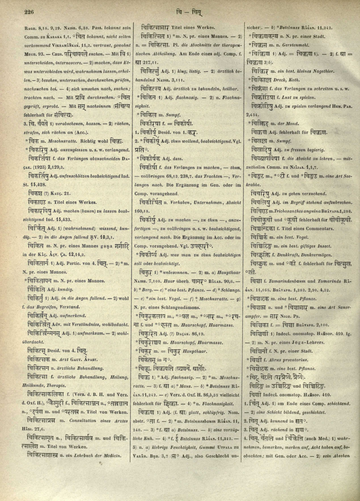
1. cít Adj. — 1〉 am Ende eines Comp. schichtend. — 2〉 eine Schicht bildend, geschichtet.
Original text · German · adjective
2. cit Adj. kennend in ṛta˚.
Original text · German · adjective
3. cit Adj. rächend in ṛṇa˚.
Original text · German · verbal root
4. √cit , cétati und cíketti (auch Med.) — 1〉 wahrnehmen, bemerken, merken auf, Acht haben auf, beobachten; mit Gen. oder Acc. — 2〉 sein Absehen [Page2-227-a] richten auf, beabsichtigen; mit Dat. — 3〉 trachten nach (Acc.). citta so v. a. begehrt. — 4〉 bedacht sein auf, besorgen, sich angelegen sein lassen. — 5〉 beschliessen, wollen, mit Etwas zu thun haben wollen. — 6〉 verstehen, begreifen, wissen. — 7〉 *zur Besinnung kommen. — 8〉 sich vernehmen lassen, sich zeigen, erscheinen, gelten, bekannt sein, sein. — 9〉 Partic. perf. cikitváṃs — a〉 bemerkt habend, bemerkend, merkend auf, aufmerksam. — b〉 verstehend, wissend, kundig. — Caus. cetáyati, ˚te und citáyati — 1〉 aufmerken machen, erinnern. — 2〉 begreifen machen, unterweisen, lehren. — 3〉 Jmd zum Bewusstsein bringen, denken lassen. — 4〉 wahrnehmen, bemerken. — 5〉 aufmerken, achten auf. — 6〉 Med. (ausnahmsweise Act.) zu einer Vorstellung gelangen, Bewusstsein haben, begreifen, denken, nachdenken, eine richtige Vorstellung haben von (Acc.). cetayāna bei Verstande seiend, vernünftig. — 7〉 *zum Bewusstsein gelangen, so v. a. erwachen. — 8〉 Med. wissen, so v. a. sich erinnern Chr. 241,10. Bewusstsein haben von (Acc.) ŚAṂK. zu BĀDAR. 2,3,18. — 9〉 erscheinen, sich zeigen als, sich auszeichnen, conspicuum esse, glänzen. — Desid. cíkitsati (ausnahmsweise Med.) — 1〉 beabsichtigen, es absehen auf. — 2〉 lüstern sein. — 3〉 Fürsorge treffen, sorgen für. — 4〉 ärztlich behandeln, heilen Chr. 171,5. — 5〉 sich zeigen wollen. — Caus. vom Desid. cikitsayati heilen. — Intens. cékite (d. i. cékitte) und Partic. cékitat, cékitāna sich zeigen, erscheinen, erglänzen. — Mit anu — 1〉 gedenken, sich erinnern. — 2〉 zuerkennen, zudenken. — Mit apa Caus. abtrünnig werden von (Abl.). — Desid. sich abwenden wollen von (Abl.). — Mit ā — 1〉 merken auf, sich merken. — 2〉 begreifen, verstehen, kennen. — 3〉 ersinnen. — 4〉 sich zeigen, erscheinen, sich auszeichnen. — Desid. aufpassen auf, belauern. — Mit pra — 1〉 sich bemerklich machen, kund werden, erscheinen. — 2〉 begreifen, verstehen. — 3〉 kund machen, verkündigen. — Caus. — 1〉 kund machen, verkündigen, erscheinen machen ṚV. 7,80,2. — 2〉 wahrnehmen, bemerken. — 3〉 Med. erscheinen. — Desid. anzeigen, zeigen. — Mit atipra bemerkbar sein, sich auszeichnen. — Mit vi — 1〉 wahrnehmen, unterscheiden. vícitta wahrgenommen, bemerkbar. — 2〉 begreifen, erkennen. — 3〉 Med. sich wahrnehmen lassen, erscheinen. — Caus. unterscheiden, erkennen. — Desid. — 1〉 zu unterscheiden suchen. — 2〉 überlegen, zweifeln, in Ungewissheit sein über, nicht glauben wollen, sich lange bedenken. vicikitsita [Page2-227-b] worüber man in Ungewissheit ist. — Intens. Partic. ví — cékitāna erscheinend, sichtbar werdend ṚV. 4,14,2. — Mit pravi in ˚cetana. — Mit sam — 1〉 zugleich wahrnehmen, überblicken, gewahr werden. — 2〉 einverstanden —, einmüthig sein.

Original text · German · substantive feminine
5. cít f. Intellect, Geist.
Whitney Roots 1885 verbal root
Original text · English · verbal root
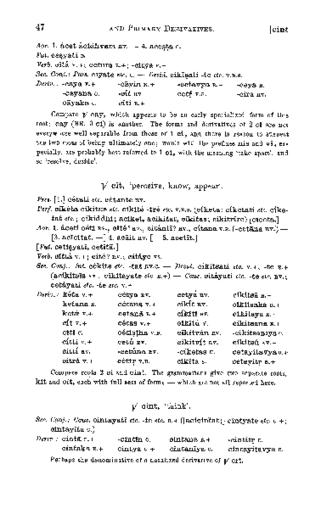
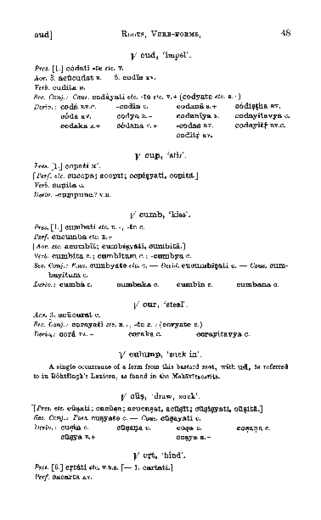
cit — perceive, know, appear
Apte 1890 verbal root · substantive feminine
Original text · English · verbal root
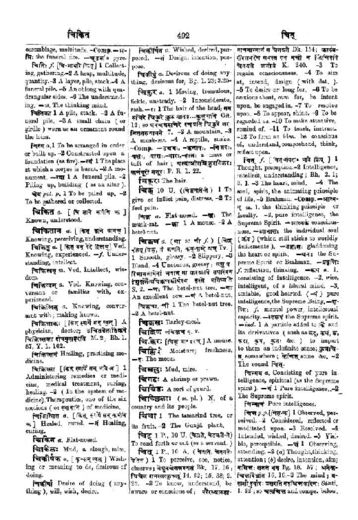
cit 1 P., 10 A. (cetati, cetayate, cetita) 1 To perceive, see, notice, observe; neṣūnacetannasyaṃtaṃ Bk. 17. 16; ciceta rāmastatkṛcchraṃ Bk. 14. 62; Bk. 15. 38; Bk. 2. 29. 2 To know, understand, be aware or conscious of; ([Page 0492-c]) parairadhyāruhyamāṇamātmānaṃ na cetayate Dk. 154; kādaṃbarīrasabhareṇa samasta eva matto na kiṃcidapi cetayate janoyaṃ K. 240. 3 To regain consciousness. 4 To aim at, intend, design (with dat.). 5 To desire or long for. 6 To be anxious about, care for, be intent upon, be engaged in. 7 To resolve upon. 8 To appear, shine. 9 To be regarded as. 10 To make attentive, remind of. 11 To teach, instruct. 12 To form an idea, be conscious of, understand, comprehend, think, reflect upon.
Original text · English · substantive feminine
cit f. [cit-saṃpadā˚ bhāve kvip] 1 Thought, preception. 2 Intelligence, intellect, understanding; Bh. 2. 1; Bh. 3. 1. 3 The heart, mind. 4 The soul, spirit, the animating principle of life. 5 Brahman. Comp. — ātman m. 1 the thinking principle or faculty. 2 pure intelligence, the Supreme Spirit. — ātmakaṃ consciousness. — ābhāsaḥ the individual soul (jīva) (which still sticks to worldly defilements). — ullāsaḥ gladdening the heart or spirit. — ghanaḥ the Supreme Spirit or Brahman. — pravṛttiḥ f. reflection, thinking. — rūpa a. 1 consisting of intelligence. 2 wise, intelligent, of a liberal mind. 3 amiable, good-hearted. — (paṃ) pure intelligence, the Supreme Being. — śaktiḥ f. mental power, intellectual capacity. — svarūpaṃ the Supreme spirit. — ind. 1 A particle added to kiṃ and its derivatives (such as kad, kathaṃ, kva, kadā, kutra, kutaḥ &c.) to impart to them an indefinite sense; kutracit somewhere; kecit some &c. 2 The sound cit.
Cappeller 1887 substantive feminine · verb
Original text · German · substantive feminine
2. cit f. Intellecht, Geist.
Original text · German · verb
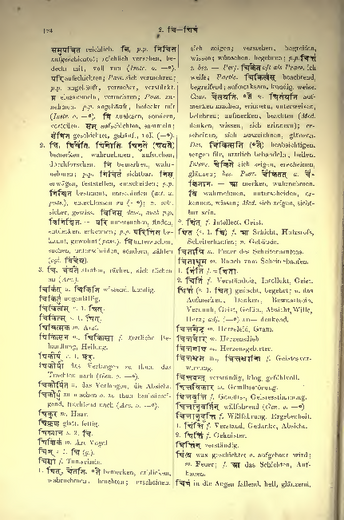
1. cit cétati, ˚te bemerken, erblicken waghrnehmen, beachten; erscheinen, [Page124-2] sich zeigen; verstehen, begreifen, wissen; wünschen, begehren; p.p. cittá s. bes. — Perf. ciketa oft als Praes. ich Weiß; Partic. cikitvás beachtend, begreifend; aufmerksam, kundig, weise. Caus. cetáyati, ˚te u. citáyati aufmerken machen, erinnern, unterweisen, belehren; aufmerken, beachten (Med. denken, wissen, sich erinnern); erscheinen, sich auszeichenen, glänzen. Des. cíkitsati (˚te) beabsichtigen, sorgen für ärztlich behandeln, heilen. Inten.s cékite sich zeigen, erscheinen, glänzen; bes. Part. cékitat u. cekitāna.—ā merken, wahrnehmen. vi wahrnemen, unterscheiden, erkennen, wissen; Med. sich zeigen, sichtbar sein.
Burnouf 1866 verbal root · Word type unspecified
Original text · French · verbal root
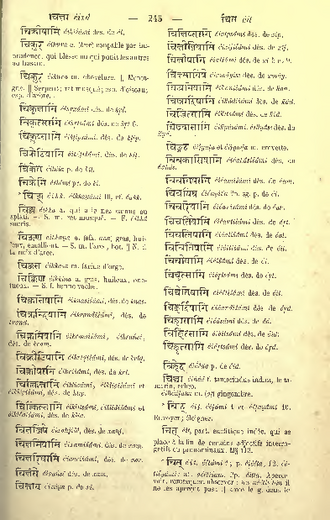
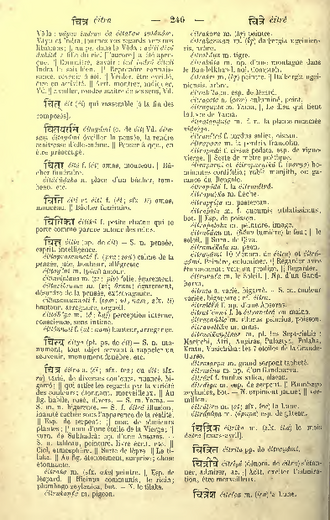
*cit cit. cetāmi 1; p. ciceta; f2. cetiṣyāmi; a1. acetiṣam. Pp. citta. Apercevoir, remarquer, observer: na acetīt tān il ne les aperçut pas; avec le g. dans le [Page246-1] Veda: vāyav indraś ca cetathas sutānām, Vāyu et Indra, tournez vos regards vers nos libations; au ps. dans le Veda: aceti divo duhitā la fille du ciel [l'aurore] a été aperçue. Connaître, savoir: tad indro cetali Indra le sait bien. Reprendre connaissance, revenir à soi. Veiller, être éveillé, être en activité. Actt. montrer, indiquer, Vd. Eveiller, rendre maître de ses sens, Vd.
Original text · French · Word type unspecified
cit cit, part. enclitique indéc. qui se place à la fin de certains adjectifs interrogatifs ou pronominaux, M§ 113.
Original text · French · Word type unspecified
cit cit (ci) qui rassemble [à la fin des composés].
Derived words
Further derivatives (1)
Occurrences in source texts (166)
DYS 15 occurrences
GoS 9 occurrences
HP 24 occurrences
HP 1.17-1.32: Āsana 2 occurrences
Direct occurrences
-
HP 1.18 Segment 13
Occurrences through derived words
-
HP 1.32 Segment 14
12 more source pages
HP 4.0*1-4.0*14: Samādhi and Laya 1 occurrence
Occurrences through derived words
-
HP 4.0*11 Segment 1
HP 4.12-4.19: Path of Nāda 3 occurrences
Direct occurrences
-
HP 4.15 Segment 14
Occurrences through derived words
HP 4.20-4.27: Four Stages of Nāda 2 occurrences
Occurrences through derived words
HP 4.37-4.46: Listening to Nāda 2 occurrences
Occurrences through derived words
HP 4.47-4.55*4: Nāda Binds the Mind 1 occurrence
Occurrences through derived words
-
HP 4.48 Segment 3
HTK 3 occurrences
HTK 10.0*1–5: Sītkā, Śītalī and Sūryabheda 1 occurrence
Occurrences through derived words
-
HTK 10.4 Segment 7
HTK 10.6*2–9*1: Ujjāyī / Ujjāyikā and Sūryabheda 1 occurrence
Direct occurrences
-
HTK 10.9 Segment 10
HTK 10.17*2–18: Bhrāmarī: The sound of bees 1 occurrence
Occurrences through derived words
-
HTK 10.18 Segment 17
MAN 2 occurrences
PJH 19 occurrences
PJH 1-2: A Description of Universal or Divine Awareness 1 occurrence
Occurrences through derived words
-
PJH 1 Segment 1
PJH 3-4: Perceiver and Perceived; Microcosm and Macrocosm 2 occurrences
Occurrences through derived words
PJH 5-6: The Contraction of the Divine 4 occurrences
Occurrences through derived words
PJH 12-14: Understanding the Five Acts 4 occurrences
Occurrences through derived words
3 more source pages
PJH 15-16: Attaining Power, the Joy of Awareness (cidānanda), and Liberation While Living (jīvanmukti) 3 occurrences
Direct occurrences
PJH 17-19: Simple Means (sukhopāyas) and Samādhi 2 occurrences
Direct occurrences
PJH 21: Epilogue and Closing Blessing 1 occurrence
Occurrences through derived words
-
PJH 21.1 Segment 17
PYS 23 occurrences
10 more source pages
PYS 3.9–12: Three Transformations of Citta 3 occurrences
Occurrences through derived words
PYS 3.17–20: Extraordinary Knowledge 1 occurrence
Occurrences through derived words
-
PYS 3.19 Segment 3
PYS 3.29–34: Bodily Locations and Knowledge 1 occurrence
Occurrences through derived words
-
PYS 3.34 Segment 2
PYS 4.4–5: Created Cittas 2 occurrences
Occurrences through derived words
PYS 4.15–17: Object and Citta 3 occurrences
Occurrences through derived words
PYS 4.18–21: Puruṣa Knows Citta 2 occurrences
Occurrences through derived words
PYS 4.22-24: Citta as Mirror 2 occurrences
Occurrences through derived words
PYS 4.25–26: Citta Flows toward Kaivalya 1 occurrence
Occurrences through derived words
-
PYS 4.26 Segment 6
SiSa 36 occurrences
SiSa 1.4-1.9: Begrenzte Wege 8 occurrences
Direct occurrences
SiSa 1.45-1.50: Rückkehr zum Bewusstsein 2 occurrences
Occurrences through derived words
SiSa 1.71-1.81: Avidyā und Elemente 1 occurrence
Occurrences through derived words
-
SiSa 1.80 Segment 1
11 more source pages
SiSa 1.82-1.90: Guṇas und Gegenstände 3 occurrences
Direct occurrences
-
SiSa 1.86 Segment 11
Occurrences through derived words
SiSa 1.91-1.92: Wahres Wissen 2 occurrences
Direct occurrences
-
SiSa 1.91 Segment 12
Occurrences through derived words
-
SiSa 1.92 Segment 14
SiSa 2.41-2.43: Māyā-Projektion 3 occurrences
Occurrences through derived words
SiSa 4.26-4.30: Mahāmudrā-Praxis 2 occurrences
Occurrences through derived words
SiSa 5.38-5.47: Nāda-Laya 2 occurrences
Direct occurrences
-
SiSa 5.46 Segment 12
Occurrences through derived words
-
SiSa 5.45 Segment 4
SiSa 5.48-5.71: Innere Meditation 3 occurrences
Direct occurrences
Occurrences through derived words
-
SiSa 5.61 Segment 14
SiSa 5.94-5.101: Mūlādhāra-Siddhis 1 occurrence
Occurrences through derived words
-
SiSa 5.96 Segment 4
SiSa 5.182-5.190: Sahasrāra-Mond 1 occurrence
Occurrences through derived words
-
SiSa 5.187 Segment 4
SiSa 5.191-5.207: Kailāsa und Mahāśūnya 3 occurrences
Occurrences through derived words
-
SiSa 5.195 Segment 1
-
SiSa 5.199 Segment 5
-
SiSa 5.200 Segment 1
SS 7 occurrences
1 more source page
SS 3.38–3.39: Turya in Body and World 1 occurrence
Occurrences through derived words
-
SS 3.39 Segment 1
SVU 6 occurrences
SVU 6.1–6.6: Lord of Cosmic Unfolding 1 occurrence
Occurrences through derived words
-
SVU 6.5 Segment 21
VBT 22 occurrences
VBT 57–64: Intervals and Equality 2 occurrences
Direct occurrences
VBT 86–92: Light and Darkness 4 occurrences
Direct occurrences
-
VBT 86 Segment 1
Occurrences through derived words
VBT 93–100: Pain and Desire 5 occurrences
Direct occurrences
Occurrences through derived words
4 more source pages
VBT 110–120: Everyday as Gate 5 occurrences
Direct occurrences
-
VBT 117 Segment 13
Occurrences through derived words
Continue with AYI Free
Image source: AYI archive.