

guṇa गुण – Guṇa; Eigenschaft; Qualität
Substantiv Maskulin · Substantiv Neutrum · Worttyp nicht bestimmt
Wörterbuchquellen
AYI Wörterbuch Substantiv Maskulin · Substantiv Neutrum
Cappeller 1891 Substantiv Maskulin
Originaltext · Englisch · Substantiv Maskulin
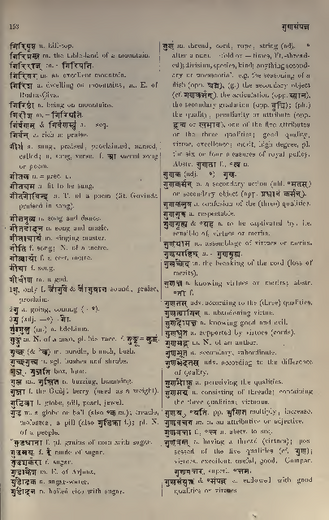
guṇá ·m. thread, cord, rope, string (adj. --° after a num. = fold or -- times, lit. threaded); division, species, kind; anything secondary or unessential, e.g. the seasoning of a dish (opp. anna), (g.) the secondary object (cf. gaṇakarman), the articulation (opp. sthāna), the secondary gradation (opp. vṛddhi); (ph.) the quality, peculiarity or attribute (opp. dravya or svabhāva), one of the five attributes or the three qualities; good quality, virtue, excellence; merit, high degree, pl. the six or four measures of royal policy. Abstr. guṇatā f., °tva n.
Monier-Williams 1872 Substantiv Maskulin
Originaltext · Englisch · Substantiv Maskulin
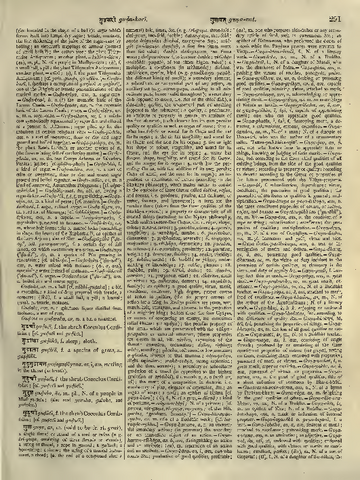
guṇa guṇa, as, m. (said to be fr. rt. grah), a single thread or strand of a cord or twine (e. g. tri-guṇa, consisting of three threads or strands), a string or thread, a rope in general; a garland; a bow-string; a sinew; the string of a musical instru- ment, a chord; (at the end of a compound after a numeral) fold, times, &c. (e. g. tri-guṇa, three-fold; dvi-guṇa, two-fold, double; catur-guṇa, four-fold; sapta triguṇāni dināni, twenty-one days; mūl- yāt pañcaguṇo daṇḍaḥ, a fine five times more than the value; duṣṭo daśaguṇam, ten times worse; dviguṇatvam i, to become double; viśiṣṭo daśabhir guṇaiḥ, of ten times higher value); a multiplier, a co-efficient (in arithmetic); division, subdivision, species, kind (e. g. gandhasya guṇāḥ, the different kinds of smell); a secondary element, a subordinate or unessential part of any action, an auxiliary act (e. g. sarva-guṇa, reaching to all sub- ordinate parts, hence ‘valid throughout’); a secondary dish (opposed to anna, i. e. rice or the chief dish), a side-dish; quality, the unessential part of anything (opposed to the substance); a quality, a peculiarity, an attribute or property in general, an attribute of the five elements, (each element has its own peculiar quality or qualities as well as organ of sense; thus 1. ether has śabda or sound for its Guṇa and the ear for its organ; 2. the air has tangibility and sound for its Guṇas and the skin for its organ; 3. fire or light has shape or colour, tangibility, and sound for its Guṇas, and the eye for its organ; 4. water has flavour, shape, tangibility, and sound for its Guṇas, and the tongue for its organ; 5. earth has the pre- ceding Guṇas, with the addition of its own peculiar Guṇa of smell, and the nose for its organ); an in- gredient or constituent of nature (according to the Sāṅkhya philosophy, which makes nature to consist in the equipoise of three Guṇas called sattva, rajas, and tamas, i. e. goodness, passion, and darkness, or virtue, foulness, and ignorance); a term for the number three (taken from the three qualities of the Sāṅkhya system); a property or characteristic of all created things (according to the Nyāya philosophy, which makes twenty-four Guṇas, viz. 1. rūpa, shape, colour; 2. rasa, savour; 3. gandha, odour; 4. sparśa, tangibility; 5. saṅkhyā, number; 6. parimāṇa, dimension; 7. pṛthaktva, severalty; 8. saṃyoga, conjunction; 9. vibhāga, disjunction; 10. paratva, remoteness; 11. aparatva, proximity; 12. gurutva, weight; 13. dravatva, fluidity; 14. sneha, viscidity; 15. śabda, sound; 16. buddhi or jñāna, under- standing or knowledge; 17. sukha, pleasure; 18. duḥkha, pain; 19. icchā, desire; 20. dveṣa, aversion; 21. prayatna, effort; 22. dharma, merit or virtue; 23. adharma, demerit; 24. saṃskāra, faculty); an epithet; a good quality, virtue, merit, excellence, eminence, high degree, proper course of action in politics, (the six proper courses of action for a king in foreign politics are peace, war, march, halt, stratagem, and recourse to the protection of a mightier king; besides these the four Upāyas, or means of conquering an enemy, are sometimes called Guṇas; see upāya); the peculiar property of the letters which are pronounced with the vāhya- prayatna or external utterance, (these properties are eleven in all, viz. vivāra, expansion of the throat; saṃvāra, contraction; śvāsa, sighing; nāda, sounding; ghoṣa, soft sound or low murmur; a-ghoṣa, absence of that murmur; alpa-prāṇa, slight aspiration; mahā-prāṇa, strong aspiration; and the three accents); a secondary or subordinate gradation of a vowel (in opposition to the highest gradation or vṛddhi), the vowels a, e, o (with ar, al); the merit of a composition in rhetoric, i. e. consistency of plan, elegance of expression, &c.; an organ of sense; a cook; an epithet of Bhīma [cf. guṇa-kāra]; (ā), f., N. of a grass, = dūrvā; a kind of perfume, = māṃsa-rohiṇī; N. of a princess; [cf. gauṇa, nir-guṇa, vi-guṇa, sa-guṇa; cf. also Hib. gaoine, ‘goodness, honesty.’]
Petersburger 1855 Substantiv Maskulin · Worttyp nicht bestimmt
Originaltext · Deutsch · Substantiv Maskulin
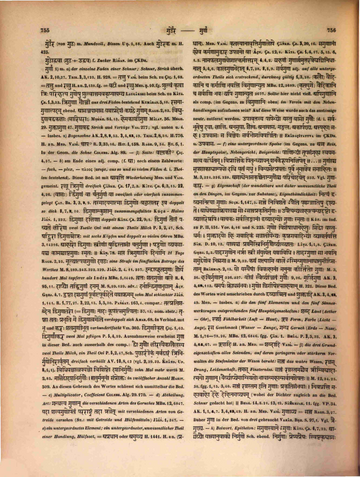
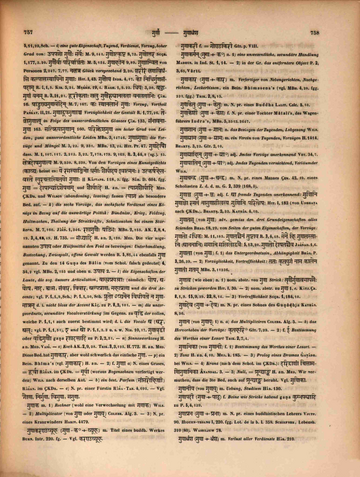
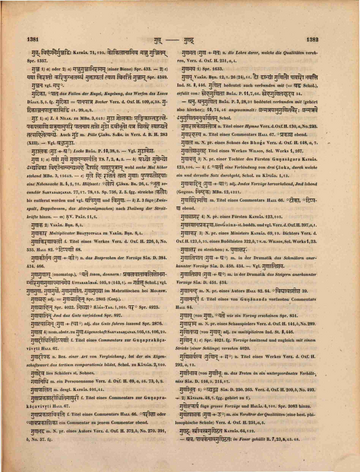
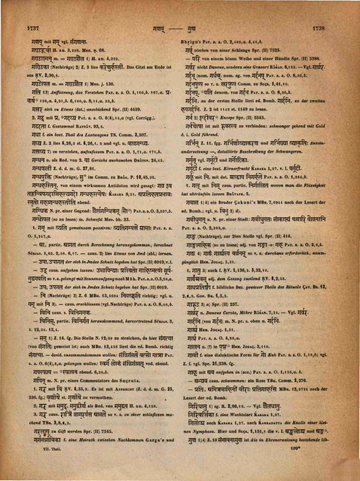
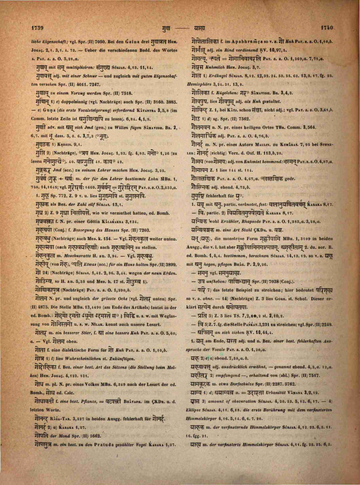
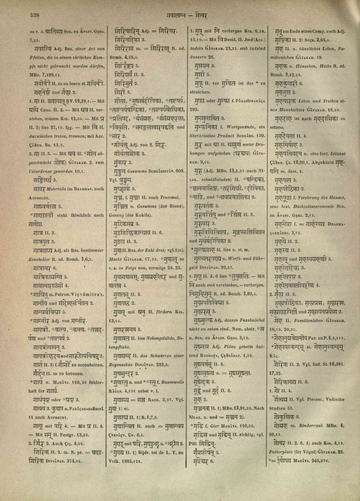
guṇá 1〉 m. a〉 der einzelne Faden einer Schnur; Schnur, Strick überh. AK. 2,10,27. TRIK. 3,3,125. H. 928. = tantu VAIJ. beim Sch. zu ŚIŚ. 1,62. = tantu und rajju H. an. 2,138. fg. = vaṭī und rajju MED. ṇ. 10. fg. śulvaṃ kṛtvā triḥ parihṛtya guṇeṣu śulvāntamavakṛṣyāyamya LAUGĀKṢI beim Sch. zu KĀTY. ŚR. 1,3,23. triguṇā mauñjī aus drei Fäden bestehend KUMĀRAS. 5,10. rasanāguṇāspadam ebend. āsañjayāmāsa yathāpradeśaṃ kaṇṭhe guṇam RAGH. 2,83. vidyudguṇabaddhakakṣāḥ (vāridharāḥ) MṚCCH. 84,13. hemakāñcīguṇa MĀLAV. 56. MEGH. 29. muktāguṇa MEGH. 47. guṇabaddha Strick und Vorzüge VID. 277; vgl. unten u. i. — Insbes. α〉 Bogensehne AK. 2,8,2,53. AK. 3,4,13,49. TRIK. 2,8,51. H. 776. H. an. MED. VAIJ. cāpa˚ R. 3,33,16. HIT. I, 158. RAGH. 9,54. ṚT. 6,1. In der Geom. die Sehne COLEBR. Alg. 89. — β〉 Saite: vallakī˚ ŚIŚ. 4,57. — b〉 am Ende eines adj. comp. (f. ā) nach einem Zahlworte: — fach, — plex, — πλοος (urspr. aus so und so vielen Fäden d. i. Theilen bestehend). Diese Bed. ist mit āvṛtti Wiederholung MED. und VAIG. gemeint. rajjū triguṇe dreifach ŚĀṄKH. ŚR. 17,2,3. KĀTY. ŚR. 6,3,15. KĀTY. ŚR. 22,4,26. (vāsaḥ) dvíguṇaṃ vā cáturguṇaṃ vā zweifach oder vierfach zusammengelegt ŚAT. BR. 3,3,2,9. tasmādayamātmā dviguṇo bahulatara iva doppelt so dick ŚAT. BR. 8,7,2,10. dviguṇānkuśān zusammengefaltete Kuśa — Halme YĀJÑ. 1,232. dviguṇā dakṣiṇā doppelt KĀTY. ŚR. 22,9,2. dviguṇaṃ tailaṃ pacyate kṣīreṇa zwei Theile Oel mit einem Theile Milch P. 5,2,47, Sch. ṣaṭśirā dviguṇaśrotraḥ mit sechs Köpfen und doppelt so vielen Ohren MBH. 3,14316. āhāro dviguṇaḥ strīṇāṃ buddhistāsāṃ caturguṇā . ṣaḍgu̱ṇo vyavasāyaśca kāmaścāṣṭaguṇaḥ smṛtaḥ .. CĀṆ. 78. sapta triguṇāni dināni 21 Tage RAGH. 2,25. mūlyātpañcaguṇo daṇḍaḥ eine Strafe im fünffachen Betrage des Werthes M. 8,289. M. 8,243. M. 8,322. M. 8,329. YĀJÑ. 2,4. YĀJÑ. 2,11. YĀJÑ. 2,257. indrācchataguṇaḥ śaurye hundert Mal tapferer als Indra MBH. 1,1449. tvattaḥ śataguṇo bale R. 6,95,11. dāpyau taddviguṇaṃ damam M. 8,59. M. 8,139. adv.: darbhāndviguṇabhugnān ĀŚV. GṚHY. 4,7. duṣṭā daśaguṇaṃ pūrvātpūrvādete yathākramam zehn Mal schlechter YĀJÑ. 1,141. R. 1,77,27. R. 3,22,15. R. 5,5,30. PAÑCAT. 163,4. compar.: tatpratiśabdena dviguṇataro (= dviguṇa) nādaḥ kūpātsamutthitaḥ PAÑCAT. 57,15. nom. abstr.: tṛṣṇā tataḥ prabhṛti me dviguṇatvameti verdoppelt sich AMAR. 68. In Verbind. mit bhū und kar: śataguṇībhūta verhundertfacht VID. 303. dviguṇīkṛta ŚIŚ. 1,63. dviguṇā́kar zwei Mal pflügen P. 5,4,59. Ausnahmsweise erscheint guṇa in dieser Bed. auch ausserhalb des comp.: dvau guṇau kṣīrasyaikastailasya zwei Theile Milch, ein Theil Oel P. 5,2,47, Sch. puṇḍarī̀ka̱ṃ navàdvāraṃ tri̱bhirgu̱ṇebhi̱rāvṛ̀tam dreifach verhüllt AV. 10,8,43 (vgl. AV. 2,29. AV. 10,32. CHĀND. UP. 8,1,1). vidhiyajñājjapayajño viśiṣṭo daśabhirguṇaiḥ zehn Mal mehr werth M. 2,85. māsairdvādaśabhirguṇaiḥ . ṛturmanūnāṃ saṃproktaḥ in zwölffacher Anzahl HARIV. 509. An diesen Gebrauch des Wortes schliesst sich unmittelbar die Bed. — c〉 Multiplicator, Coefficient COLEBR. Alg. 29. COLEBR. Alg. 170. — d〉 Abtheilung, Art: gandhasya guṇān die verschiedenen Arten des Geruches MBH. 12,6847. yadā śasyaguṇopetaṃ pararāṣṭraṃ tadā vrajet mit verschiedenen Arten von Getreide versehen (ST.: mit Getreide und Hülfsmitteln) YĀJÑ. 1,347. — e〉 ein untergeordnetes Element; ein untergeordneter, unwesentlicher Theil einer Handlung, Hülfsact, = apradhāna oder amukhya H. 1441. H. an. (pradhāna). MED. VAIJ. kṛtasyānāvṛttirguṇaṃlope ŚĀṄKH. ŚR. 3,20,16. saguṇānāṃ hyeva karmaṇāmuddhāra upajano vā ĀŚV. ŚR. 12,4. KĀTY. ŚR. 1,4,17. KĀTY. ŚR. 1,5,13. KĀTY. ŚR. 1,6,1. KĀTY. ŚR. 1,4,5. nāmaphalaguṇayogātkarmāntaram KĀTY. ŚR. 4,4,2. grahaṇaṃ guṇārthamuttaravedyagninidhānāt KĀTY. ŚR. 5,4,6. kālaguṇabhedāt KĀTY. ŚR. 6,7,28. KĀTY. ŚR. 8,1,9. sarvaguṇa adj. auf alle untergeordneten Theile sich erstreckend, durchweg gültig KĀTY. ŚR. 1,3,28. (kalau) vaidikāni ca karmāṇi bhavanti viguṇānyuta MBH. 12,2689. (kṛtayuge) vaidikāni ca sarvāṇi bhavantyapi guṇānyuta MBH. 12,2677. Sollte hier nicht viell. apiguṇāni als comp. (im Gegens. zu viguṇāni oben) im Verein mit den Nebenhandlungen aufzufassen sein? Auf diese Weise würde auch das anstössige neutr. entfernt werden. upāvṛttasya pāpebhyo yastu vāso guṇaiḥ (d. i. sarvabhūteṣu dayā, kṣānti, anasūyā, śauca, anāyāsa, maṅgala, akārpaṇya, aspṛhā) saha . upavāsaḥ sa vijñeyaḥ sarvabhogavivarjitaḥ .. EKĀDAŚĪTATTVA_im_ŚKDR. u. upavāsa. — f〉 eine untergeordnete Speise (im Gegens. zu anna Reis, der Hauptspeise), Nebengericht, Beigericht: pāṇibhyāṃ tūpasaṃgṛhya svayamannasya vardhitam . viprāntike pitṝndhyāyan śanakairupanikṣipet .. … .. guṇāṃśca sūpaśākādyānpayo dadhi ghṛtaṃ madhu . vinyasetprayataḥ pūrvaṃ bhūmāveva samāhitaḥ .. M. 3,224. M. 3,226. M. 3,228. annādyenāsakṛccaitānguṇaiśca paricodayet M. 233. Vgl. guṇakāra. — g〉 Eigenschaft (der wandelbare und daher unwesentliche Theil an den Dingen, im Gegens. zur Substanz), Eigenthümlichkeit: nityaṃ dravyamanityā guṇāḥ SUŚR. 1,147,5. sattve niviśate 'paiti pṛthagjātiṣu dṛśyate . ādheyaścākriyājaśca so 'sattvaprakṛtirguṇaḥ .. upaityanyajjahātyanyaddṛṣṭo dravyāntareṣvapi . vācakaḥ sarvaliṅgānāṃ dravyādanyo guṇaḥ smṛtaḥ .. Kār. im Ind. zu P. II, 451. VOP. 4,16 und S. 225. guṇo viśeṣādhānahetuḥ siddho vastudharmaḥ . śuklādayo hi gavādikaṃ sajātīyebhyaḥ kṛṣṇagavādibhyo vyāvartayanti SĀH. D. 10,13. yājyaśca prathamaistribhirguṇairvyākhyātaḥ LĀṬY. 1,1,8. ŚĀṄKH. GṚHY. 1,2. yādṛgguṇena bhartrā strī saṃyujyeta yathāvidhi . tādṛgguṇā sā bhavati samudreṇeva nimnagā .. M. 9,22. kathaṃ śakṣyāmi bāle 'sminguṇānādhātumīpsitān BRĀHMAṆ. 2,15. yo yasyaiṣāṃ vivāhānāṃ manunā kīrtito guṇaḥ M. 3,36. havirguṇān M. 236. M. 237. vījaṃ svairvyāñjataṃ guṇaiḥ M. 9,36. mūrtiguṇa AK. 3,4,18,113. amarṣaḥ krodhasaṃbhavaḥ . guṇo jigīṣotsāhavān H. 321. Diese Bed. des Wortes wird umschrieben durch dravyāśrita und śuklādi AK. 3,4,13,49. MED. — Insbes. α〉 die den fünf Elementen und den fünf Sinneswerkzeugen entsprechenden fünf Haupteigenschaften: śabda Laut (Aether — Ohr), sparśa Fühlbarkeit (Luft — Haut), rūpa Form, Farbe (Licht — Auge), rasa Geschmack (Wasser — Zunge), gandha Geruch (Erde — Nase). M. 1,76—M. 1,78. M. 1,20. MBH. 12,6846. fgg. ŚĀK. 1. BHĀG. P. 3,5,35. AK. 3,4,14,67. = rūpādi H. an. MED. = śabdādi VAIJ. — β〉 die drei Grundeigenschaften alles Seienden, auf deren geringerm oder stärkerm Vorwalten die Stufenleiter der Wesen beruht: sattva das wahre Wesen, rajas Drang, Leidenschaft, tamas Finsterniss. sattvaṃ rajastamaścaiva trīnvidyādātmano guṇān . yairvyāpyemānsthito bhāvānmahānsarvānaśeṣataḥ .. M. 12,24. fgg. M. 12,25. M. 12,30. fgg. M. 1,15. fgg. M. 3,40. sattvaṃ rajastama iti guṇāḥ prakṛtisaṃbhavāḥ . nibadhnanti mahābāho dehe dehinamavyayam (wobei der Dichter zugleich an die Bed. Schnur gedacht hat) .. BHAG. 14,5. BHAG. 14,21. BHAG. 13,19. SĀṂKHYAK. 11. fgg. VP. 34. AK. 1,1,4,7. AK. 3,4,13,49. H. an. MED. VAIJ. guṇāgrya = sattva RAGH. 3,27. Daher guṇa in der Bed. von drei gebraucht VARĀH. BṚH. S. 97,1. Vgl. traiguṇya. — h〉 Beiwort, Epitheton: saguṇasthāne 'guṇaḥ KĀTY. ŚR. 6,7,23. āgneyyau yājyānuvākye nirguṇe Sch. ebend. nirguṇaḥ preṣyapraiṣaḥ sviṣṭakṛdyāgaḥ KĀTY. ŚR. 5,11,23, Sch. — i〉 eine gute Eigenschaft, Tugend, Verdienst, Vorzug, hoher Grad von: upapanno guṇaiḥ sarvaiḥ M. 9,141. guṇotkṛṣṭa M. 8,73. guṇottara SUŚR. 1,177,3. SUŚR. 1,177,20. guṇairvā parivarjitaḥ M. 5,154. guṇahīna M. 9,89. guṇānvita von Personen M. 2,247. M. 7,77. nakṣatra Glück versprechend M. 2,30. śarīraṃ kṣaṇavidhvaṃsi kalpāntasthāyino guṇāḥ HIT. I, 43. guṇaugha INDR. 4,17. ko nidhirguṇasaṃpadām R. 1,1,5. KIR. 5,24. MṚCCH. 19,4. RAGH. 1,9. RAGH. 1,22. dhiyaḥ RAGH. 3,30. bahuguṇaṃ vanam R. 3,21,21. dūrīkṛtāḥ khalu guṇairudyānalatā vanalatābhiḥ ŚĀK. 16. ṣāḍguṇyaguṇavedin M. 7,167. kaḥ sthānalābhe guṇaḥ Vorzug, Vortheil PAÑCAT. II, 21. guṇādrūpaguṇācca Vorzüglichkeit der Gestalt R. 1,77,26. tejoguṇāt in Folge des ausserordentlichen Glanzes ŚĀK. 133. saṃbhāvanāguṇa ŚĀK. 163. satkriyāguṇān ŚĀK. 160. parikleśaguṇa ein hoher Grad von Leiden, ganz ausserordentliche Leiden MBH. 3,14746. guṇāguṇāḥ die Vorzüge und Mängel M. 3,22. M. 9,331. MBH. 13,24. HIT. Pr. 47. guṇadoṣau dass. M. 1,107. M. 1,117. M. 2,212. M. 3,22. M. 7,178. M. 7,179. M. 9,169. R. 3,44,8 (sg.) R. 3,44,15. kṣetradoṣaguṇasya M. 9,330. M. 8,338. Von den Vorzügen eines Kunstgedichts (kāvya) heisst es: ye rasasyāṅgino dharmāḥ śauryādaya ivātmanaḥ . utkarṣahetavaste syuracalasthitayo guṇāḥ .. KĀYVAPR. 118,5. fgg. SĀH. D. 604. fgg. guṇa = doṣānyadviśeṣaṇam und śauryādi H. an. = tyāgaśauryādi MED. ŚKDR. und WILSON (abandoning, leaving) fassen tyāga als besondere Bed. auf. — k〉 die sechs Vorzüge, das sechsfache Verdienst eines Königs in Bezug auf die auswärtige Politik: Bündniss, Krieg, Feldzug, Haltmachen, Theilung der Streitkräfte, Schutzsuchen bei einem Stärkern. M. 7,160. YĀJÑ. 1,346. rājaguṇaiḥ ṣaḍbhiḥ MBH. 2,155. AK. 2,8,1,19. AK. 3,4,13,49. H. 735. = saṃdhyādi H. an. 2,138. MED. Die vier sogenannten upāya oder Hülfsmittel den Feind zu bezwingen: Unterhandlung, Bestechung, Zwiespalt, offene Gewalt werden R. 5,81,44 ebenfalls guṇa genannt. Zu den 14 Guṇa des Bālin (vom Schol. falsch gedeutet) R. 4,54,2 vgl. MBH. 2,155 und oben u. upāya MBH. 2,2. — l〉 die Eigenschaften der Laute, die sog. äussere Articulation, bāhyaprayatnāḥ (nämlich: ghoṣa, aghoṣa, nāda, śvāsa, saṃvāra, vivāra, alpaprāṇa, mahāprāṇa und die drei Accente; vgl. P. 1,1,9, Sch.) P. 1,1,50, Sch. pluto 'pyanena vidhīyate na guṇamātram d. i. nicht bloss der Accent KĀŚ._zu_P. 8,2,101. — m〉 die untergeordnete, secundäre Vocalverstärkung (im Gegens. zu vṛddhi der vollen, welche P. 1,1,1 auch zuerst bestimmt wird) d. i. die Vocale a (ar, al; vgl. P. 1,1,51), e und o P. 1,1,2. P. 1,1,3 u. s. w. NIR. 10,17. guṇavṛddhī oder vṛddhiguṇau gaṇa rājadantādi zu P. 2,2,31. — n〉 Sinneswerkzeug H. an. MED. VAIJ. — o〉 Koch AK. 2,9,28. TRIK. 3,3,125. H. 772. H. an. MED. Diese Bed. hat guṇakāra, aber wohl schwerlich das einfache guṇa. — p〉 ein Bein. Bhīmaʼs (vgl. guṇakāra) H. an. — 2〉 f. guṇā a〉 N. eines Grases, = dūrvā RĀJAN._im_ŚKDR. = mūrvā (woraus Bogensehnen verfertigt werden) WILS. nach derselben Aut. — b〉 ein best. Parfum (māṃsarohiṇī) RĀJAN._im_ŚKDR. — c〉 N. pr. einer Fürstin RĀJA-TAR. 4,695. — Vgl. gauṇa, nirguṇa, viguṇa, saguṇa.
Originaltext · Deutsch · Worttyp nicht bestimmt
guṇa 1〉a〉 yathā̀ gu̱ṇe gu̱ṇama̱nvasyàti TS. 7,2,4,2. — b〉 ṣaḍbhyo guṇebhyo 'bhyadhikā vihīnānmanyāmahe draupadi pāṇḍuputrān wohl sechs Mal höher stehend MBH. 3,15649. — e〉 mūle hi rakṣite tāta guṇāḥ puṣpaphalodayāḥ eine Nebensache R. 5,1,71. Hilfsact: ˚lope ŚĀṄKH. BR. 26,4. ˚bhūta secundär SARVADARŚANAS. 77,17. SARVADARŚANAS. 78,15. Sp. 756, Z. 5. fgg. streiche (kalau) bis entfernt werden und vgl. apiguṇa und viguṇa. — k〉 Z. 3 füge (Zwiespalt, Doppelwesen, das Abtrünnigmachen) nach Theilung der Streitkräfte hinzu. — m〉 ṚV. PRĀT. 11,6.
Originaltext · Deutsch · Worttyp nicht bestimmt
guṇa 1〉i〉 Z. 10 saṃbhāvanāguṇa ist die in Ehrenerweisung bestehende löbliche Eigenschaft; vgl. Spr. (II) 7050. Bei den Jaina drei guṇavrata HEM. YOGAŚ. 2,1. YOGAŚ. 3,1. YOGAŚ. 3,4. YOGAŚ. 3,73. — Ueber die verschiedenen Bedd. des Wortes s. PAT. a. a. O. 5,28,a.
Böhtlingk 1879 Substantiv Maskulin · Worttyp nicht bestimmt
Originaltext · Deutsch · Substantiv Maskulin
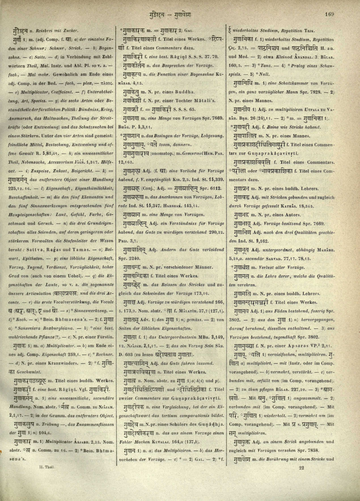
guṇá — 1〉 m. (adj. Comp. f. ā) — a〉 der einzelne Faden einer Schnur; Schnur, Strick. — b〉 Bogensehne. — c〉 Saite. — d〉 in Verbindung mit Zahlwörtern Theil, Mal. Instr. und Abl. Pl. so v. a. -fach, — Mal mehr. Gewöhnlich am Ende eines adj. Comp. in der Bed. -fach, -plex, πλοος. — e〉 Multiplicator, Coefficient. — f〉 Unterabtheilung, Art, Species. — g〉 die sechs Arten oder Bestandtheile der fürstlichen Politik; Bündniss, Krieg, Ausmarsch, das Haltmachen, Theilung der Streitkräfte (oder Entzweiung) und das Schutzsuchen bei einem Stärkern. Unter den vier Arten sind gemeint: feindliche Mittel, Bestechung, Entzweiung und offene Gewalt R. 5,81,41. — h〉 ein unwesentlicher Theil, Nebensachen, Accessorium YĀJÑ. 1,347. Hilfsact. — i〉 Zuspeise, Zukost, Beigericht. — k〉 = guṇakarman das entferntere Object einer Handlung Chr. 225,12. Chr. 225,16. — l〉 Eigenschaft, Eigenthümlichkeit, Beschaffenheit. — m〉 die den fünf Elementen und den fünf Sinneswerkzeugen entsprechenden fünf Haupteigenschaften: Laut, Gefühl, Farbe, Geschmack und Geruch. — n〉 die drei Grundeigenschaften alles Seienden, auf deren geringerem oder stärkerem Vorwalten die Stufenleiter der Wesen beruht; Sattva, Rajas und Tamas. — o〉 Beiwort, Epitheton. — p〉 ein löbliche Eigenschaft, Vorzug, Tugend, Verdienst, Vorzüglichkeit, hoher Grad von (auch von einem Uebel). — q〉 die Eigenschaften der Laute, so v. a. die sogenannte äussere Articulation (bāhyaprayatna) und die drei Accente. — r〉 die erste Vocalverstärkung, die Vocale a (ar, al), e und o. — s〉 *Sinneswerkzeng. — t〉 *Koch. — u〉 *Bein. Bhīmasenaʼs. — 2〉 f. guṇā — a〉 *Sansevieria roxburghiana. — b〉 *eine best. wohlriechende Pflanze (?). — c〉 N. pr. einer Fürstin.
Originaltext · Deutsch · Worttyp nicht bestimmt
guṇa II. Bez. der Zahl drei; vgl. 1〉n〉. Macht JĀTAKAM. 17,23. ˚guṇāt so v. a. in Folge von, vermöge JĀTAKAM. 24. 25. [Nachtrag, Band 7]
Apte 1890 Substantiv Maskulin
Originaltext · Englisch · Substantiv Maskulin
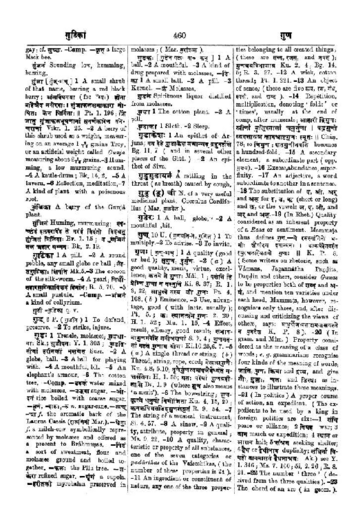
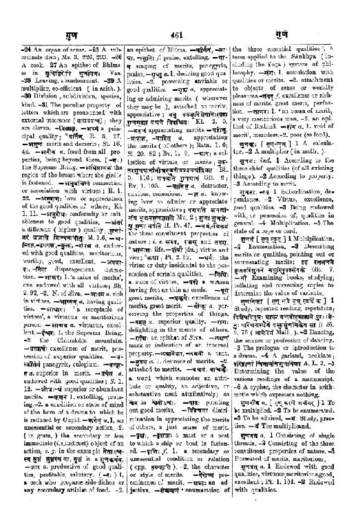
guṇaḥ [guṇ-ac] 1 A quality (good or bad); suguṇa, durguṇa. 2 (a) A good quality, merit, virtue, excellence; katame te guṇāḥ Māl. 1; vasaṃti hi premṇi guṇā na vastuni Ki. 8. 37; R. 1. 9, R. 1. 22; sādhutve tasya ko guṇaḥ Pt. 4. 108. (b) Eminence. 3 Use, advantage, good (with instr. usually); Pt. 5.; kaḥ sthānalābhe guṇaḥ Pt. 2. 20; H. 1. 52; Mu. 1. 15. 4 Effect, result, efficacy, good result; saṃbhāvanāguṇamavehi tamīśvarāṇāṃ Ś. 7. 4; guṇamahatāṃ mahate guṇāya yogaḥ Ki. 10. 25, Ki. 6. 7. 5 (a) A single thread or string. (b) Thread, string, rope, cord; mekhalāguṇaiḥ Ku. 4. 8; Ku. 5. 10; tṛṇairguṇatvaptāpannairbadhyaṃte mattadaṃtinaḥ H. 1. 35; yataḥ pareṣāṃ guṇagrahītāsi Bv. 1. 9 (where guṇa also means ‘a merit’). 6 The bow-string; guṇakṛtye dhanuṣo niyojitā Ku. 4. 15, Ku. 4. 29; kanakapiṃgataḍidguṇasaṃyutaṃ R. 9. 54. 7 The string of a musical instrument; Śi. 4. 57. 8 A sinew. 9 A quality, attribute, property in general; Ms. 9. 22. 10 A quality, characteristic or property of all substances, one of the seven categories or padārthas of the Vaiśeṣikas, (the number of these properties is 24). 11 An ingredient or constituent of nature, any one of the three ([Page 0460-c]) properties belonging to all created things; (these are sattva, rajas, and tamas); guṇatrayavibhāgāya Ku. 2. 4; Bg. 14. 5; R. 3. 27. 12 A wick, cotton thread; Pt. 1. 221. 13 An object of sense; (these are five rūpa, rasa, gaṃdha, sparśa, and śabda). 14 Repetition, multiplication, denoting ‘folds’ or ‘times’, usually at the end of comp. after numerals; āhāro dviguṇaḥ strīṇāṃ buddhistāsāṃ caturguṇā . ṣaḍguṇo vyavasāyaśca kāmaścāṣṭaguṇaḥ smṛtaḥ .. Chāṇ. 78; so triguṇa; śataguṇībhavati becomes a hundred-fold. 15 A secondary element, a subordinate part (opp. mukhya). 16 Excess, abundance, superfluity. 17 An adjective, a word subordinate to another in a sentence. 18 The substitution of e, o, ar and al for i, u, ṛ (short or long) and ḷ, or the vowels a, e, o, and ar and al. 19 (In Rhet.) Quality considered as an inherent property of a Rasa or sentiment. Mammaṭa thus defines guṇa. — ye rasasyāṃgino dharmāḥ śauryādaya ivātmanaḥ . utkarṣahetavaste syuracalasthitayo guṇāḥ .. K. P. 8. (Some writers on rhetoric, such as Vāmana, Jagannātha Paṇḍita, Daṇḍin and others, consider Guṇas to be properties both of śabda and artha, and mention ten varieties under each head. Mammaṭa, however, recognises only three, and, after discussing and criticizing the views of others, says: mādhuryaujaḥprasādākhyāstrayaste na punardaśa K. P. 8). 20 (In gram. and Mīm.) Property considered as the meaning of a class of words; e. g. grammarians recognise four kinds of the meaning of words; jāti, guṇa, kriyā and dravya, and give gauḥ, śuklaḥ, calaḥ and ḍitthaḥ as instances to illustrate these meanings. 21 (In politics) A proper course of action, an expedient. (The expedients to be used by a king in foreign politics are six: 1 saṃdhi peace or alliance; 2 vigraha war; 3 yāna march or expedition; 4 sthāna or āsana halt; 5 saṃśraya seeking shelter; 6 dvaidha or dvaidhībhāva duplicity; saṃdhirnā vigraho yānamāsanaṃ dvaidhamāśrayaḥ Ak.) see Y. 1. 346; Ms. 7. 160; Śi. 2. 26; R. 8. 21. 22 The number ‘three’ (derived from the three qualities). 23 The chord of an arc (in geom.). ([Page 0461-a]) 24 An organ of sense. 25 A subordinate dish; Ms. 3. 226, Ms. 3. 233. 26 A cook. 27 An epithet of Bhīma; as in yudhiṣṭhiropi guṇapriyaḥ Vas. 28 Leaving, abandonment. 29 A multiplier, co-efficient (in arith.). 30 Division, subdivision, species, kind. 31 The peculiar property of letters which are pronounced with external utterance (bāhyaprayatna); they are eleven. Comp. — agryaṃ a principal quality; ˚vartin R. 3. 27. — aguṇaḥ merit and demerit; Śi. 16. 44. — atīta a. freed from all properties, being beyond them. — (taḥ) the Supreme Being. — adhiṣṭhānakaṃ the region of the breast where the girdle is fastened. — anubaṃdhitvaṃ connection or association with virtues; R. 1. 22. — anurāgaḥ love or appreciation of the good qualities of others; Ki. 1. 11. — anurodhaḥ conformity or suitableness to good qualities. — aṃtaraṃ a different (higher) quality; guṇāṃtaraṃ vrajati śilpamādhātuḥ M. 1. 6. — anvita, -upapanna, -yukta, -saṃpanna a. endowed with good qualities, meritorious, worthy, good, excellent. — apavādaḥ, -niṃdā disparagement, detraction. — ākaraḥ 1 ‘a mine of merits’, one endowed with all virtues; Bh. 2. 92. 2 N. of Śiva. — āḍhya a. rich in virtues. — ātman a. having qualities. — ādhāraḥ ‘a receptacle of virtues’, a virtuous or meritorious person. — āśraya a. virtuous, excellent. — īśvaraḥ 1 the Supreme Being. 2 the Citrakūṭa mountain. — utkarṣaḥ excellence of merit, possession of superior qualities. — utkīrtanaṃ panegyric, eulogium. — utkṛṣṭa a. superior in merit. — upeta a. endowed with good qualities; Ś. 1. 12. — oghaḥ -ghaṃ superior or abundant merits. — kathanaṃ 1 extolling, praising. 2 a condition or state of mind of the hero of a drama to which he is reduced by Cupid. — karman n. 1 an unessential or secondary action. 2 (in gram.) the secondary or less immediate (i. e. indirect) object of an action; e. g. in the example netā' śvasya srughnaṃ srughnasya vā, srughnaṃ is a guṇakarman. — kāra a. productive of good qualities, profitable, salutary. — (raḥ) 1 a cook who prepares side-dishes or any secondary articles of food. 2 ([Page 0461-b]) an epithet of Bhīma. — kīrtanaṃ, — ślāghā, -stutiḥ f. praise, extolling. — gānaṃ singing of merits, panegyric, praise. — gṛdhnu a. 1 desiring good qualities. 2 possessing enviable or good qualities. — gṛhya a. appreciating or admiring merits (wherever they may be), attached to merits; appreciative; nanu vaktṛviśeṣaniḥspṛhā guṇagṛhyā vacane vipaścitaḥ Ki. 2. 5. — grahaṇaṃ appreciating merits. — grahītṛ, — grāhaka, -grāhin a. appreciating the merits (of others); Ratn. 1. 6; Śi. 20. 82; Bv. 1. 9. — grāmaḥ a collection of virtues or merits; gurutaraguṇagrāmāṃbhojasphuṭojjvalacaṃdrikā Bh. 3. 116; gaṇayati guṇagrāmaṃ Gīt. 2; Bv. 1. 103. — ghātin a. detractor, envious, censorious. — jña a. knowing how to admire or appreciate merits, appreciative; bhagavati kamalālaye bhṛśamaguṇajñāsi Mu. 2; guṇā guṇajñeṣu guṇā bhavaṃti H. Pr. 47. — trayaṃ, -tritayaṃ the three constituent properties of nature; i. e. sattva, rajas and tamas. ˚ābhāsaḥ life. — doṣau (du.) virtue and vice; ˚kathā; Pt. 2. 62. — dharmaḥ the virtue or duty incidental to the possession of certain qualities. — nidhiḥ a store of virtues. — padī a woman having feet as thin as cords. — pūgaṃ great merits. — prakarṣaḥ excellence of merits, great merit. — bhoktṛ a. perceiving the properties of things. — mahat n. superior quality. — rāgaḥ delighting in the merits of others. — rāśiḥ an epithet of Śiva. — lakṣaṇaṃ mark or indication of an internal property. — layanikā, -layanī a tent. — lubdha a. 1 desirous of merits. 2 attached to merits. — vacanaṃ, vācakaḥ a word which connotes an attribute or quality, an adjective, or substantive used attributively; as śveta in śveto'śvaḥ. — vādaḥ pointing out good merits. — vivecanā discrimination in appreciating the merits of others, a just sense of merit. — vṛkṣaḥ, -vṛkṣakaḥ a mast or a post to which a ship or boat is fastened. — vṛttiḥ f. 1 a secondary or unessential condition or relation (opp. mukhyavṛtti). 2 the character or style of merits. — vaiśeṣyaṃ preeminence of merit. — śabdaḥ an adjective. — saṃkhyānaṃ ‘enumeration of ([Page 0461-c]) the three essential qualities’, a term applied to the Sāṃkhya (including the Yoga) system of philosophy. — saṃgaḥ 1 association with qualities or merits. 2 attachment to objects of sense or worldly pleasures. — saṃpad f. excellence or richness of merits, great merit, perfection. — sāgaraḥ 1 ‘an ocean of merit, a very meritorious man. 2 an epithet of Brahmā. — hīna a. 1 void of merit’, meritless. 2 poor (as food).
Cappeller 1887 Substantiv Maskulin
Originaltext · Deutsch · Substantiv Maskulin
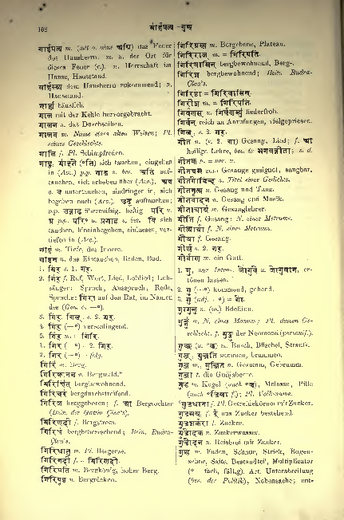
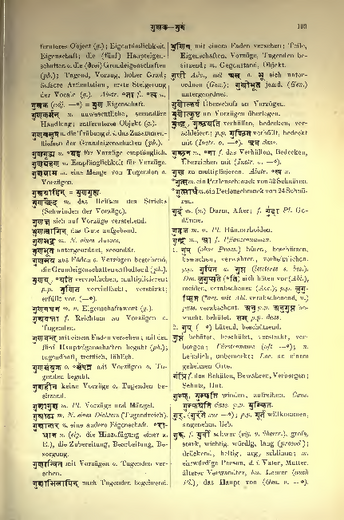
guṇá m. Faden, Schnur, Strick, Bogensehne, Saite, Bestandteil, Multiplicator (˚— fach, fältig), Art, Unterabteilung (bes. der Politik), Nebensache; ent= [Page109-1] fernteres Object (g.); Eigentümlichkeit, Eigenschaft; die (fünf) Haupteigenschaften o. die (drei) Grundeigenschaften (ph.) Tugend, Vorzug, hoher Grad; äußere Articulation, erste Steigerung, der Vocale (g.). Abstr. ˚tā f. ˚tva n.
Burnouf 1866 Substantiv Maskulin
Originaltext · Französisch · Substantiv Maskulin
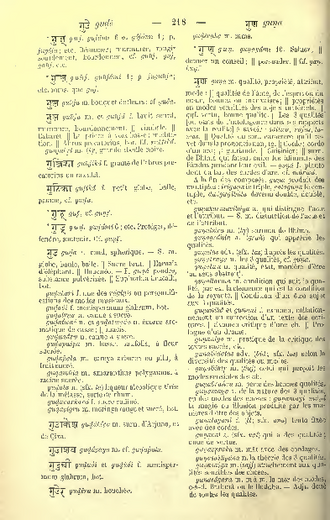
guṇa guṇa m. qualité, propriété, attribut, mode: qualités de l'âme, de l'esprit ou du cœur, bonnes ou mauvaises; propriétés ou modes sensibles des objets matériels. qqf. vertu, bonne qualité. Les 3 qualités [ou états de l'intelligence dans ses rapports avec la réalité] à savoir: sattva, rajas, tamas. Qualité du son, caractère qu'il revêt dans la prononciation, tg. Corde; corde d'un arc; guirlande. Cuisinier; surn. de Bhīma qui faisait cuire les aliments des Pāṇḍus pendant leur exil. — guṇā f. plante dont on fait des cordes d'arc, cf. mūrvā. À la fin des composés, guṇa produit des multiples: triguṇa le triple, śataguṇa le centuple, dviguṇībhūla devenu double, doublé, etc. guṇakarmavibhāga a. qui distingue l'acte et l'attribut. — S. m. distinction de l'acte et de l'attribut. guṇakāra m. (kṛ) surnom de Bhīma. guṇagrāhin a. (grah) qui apprécie les qualités. guṇatas adv. (sfx. tas) d'après les qualités. guṇatraya n. les 3 qualités, cf. guṇa. guṇatva n. qualité, état, manière d'être [au sens abstrait]. guṇadharma m. condition qui suit la qualité, par ex. la clémence qui est la condition de la royauté. Condition d'un être sujet aux 3 qualités. guṇanikā et guṇanī f. examen, collationnement ou correction d'un texte des écritures. Examen critique d'une ch. Prologue d'un drame. guṇanīya m. pratique de la critique des textes sacrés, etc. guṇabhedatas adv. (bhid; sfx. tas) selon la diversité des qualités ou modes. guṇabhoktṛ m. (bhuj) celui qui perçoit les modes sensibles des ch. guṇabhraṃśa m. perte des bonnes qualités. guṇamaya a. de la nature des 3 qualités. ou des modes des choses: guṇamayī māyā la magie ou illusion produite par les manières d'être des objets. guṇalayanī f. (lī; sfx. ana) tente fixée avec des cordes. guṇavat a. (sfx. vat) qui a des qualités; doué de vertus. guṇavṛkṣaka m. mât avec des cordages. guṇasaṅkhyāna n. la théorie des 3 qualités. guṇasaṅga m. (sajj) attachement aux qualités sensibles des choses. guṇasāgara m. m à m. la mer des modes, c-à-d. Brahmā ou le Buddha. — Adjt. doué de toutes les qualités. [Page219-1] guṇākara m. (ākara) la mine des qualités, c-à-d. le Buddha. — Adjt. doué de toutes les qualités. guṇātīta a. (ati; i) qui a franchi les 3 qualités, qui s'en est affranchi. guṇānvita a. (anu; i) enveloppé par les qualités, caché sous les modes des choses.
Abgeleitete Wörter
Quelltextfundstellen (57)
DYS 6 Fundstellen
GoS 3 Fundstellen
HP 7 Fundstellen
1 weitere Quelltextseite
HTK 5 Fundstellen
HTK 10.42–43: Meru: Drei Stufen des Atemanhaltens 2 Fundstellen
Direkt belegt
HTK 10.47*2: Kumbhaka: Namen, Formen und Wirkungen 1 Fundstelle
Direkt belegt
-
HTK 10.47*2 Segment 10
PYS 7 Fundstellen
1 weitere Quelltextseite
SiSa 13 Fundstellen
SiSa 1.82-1.90: Guṇas und Gegenstände 2 Fundstellen
Direkt belegt
Weitere 6 Quelltextseiten
SVU 15 Fundstellen
SVU 5.7-5.11: Die wandernde Seele 4 Fundstellen
Direkt belegt
SVU 5.12-5.14: Erkenntnis und Freiheit 3 Fundstellen
Direkt belegt
VBT 1 Fundstelle
Mit AYI Free weitermachen
Bildquelle: AYI Archiv.