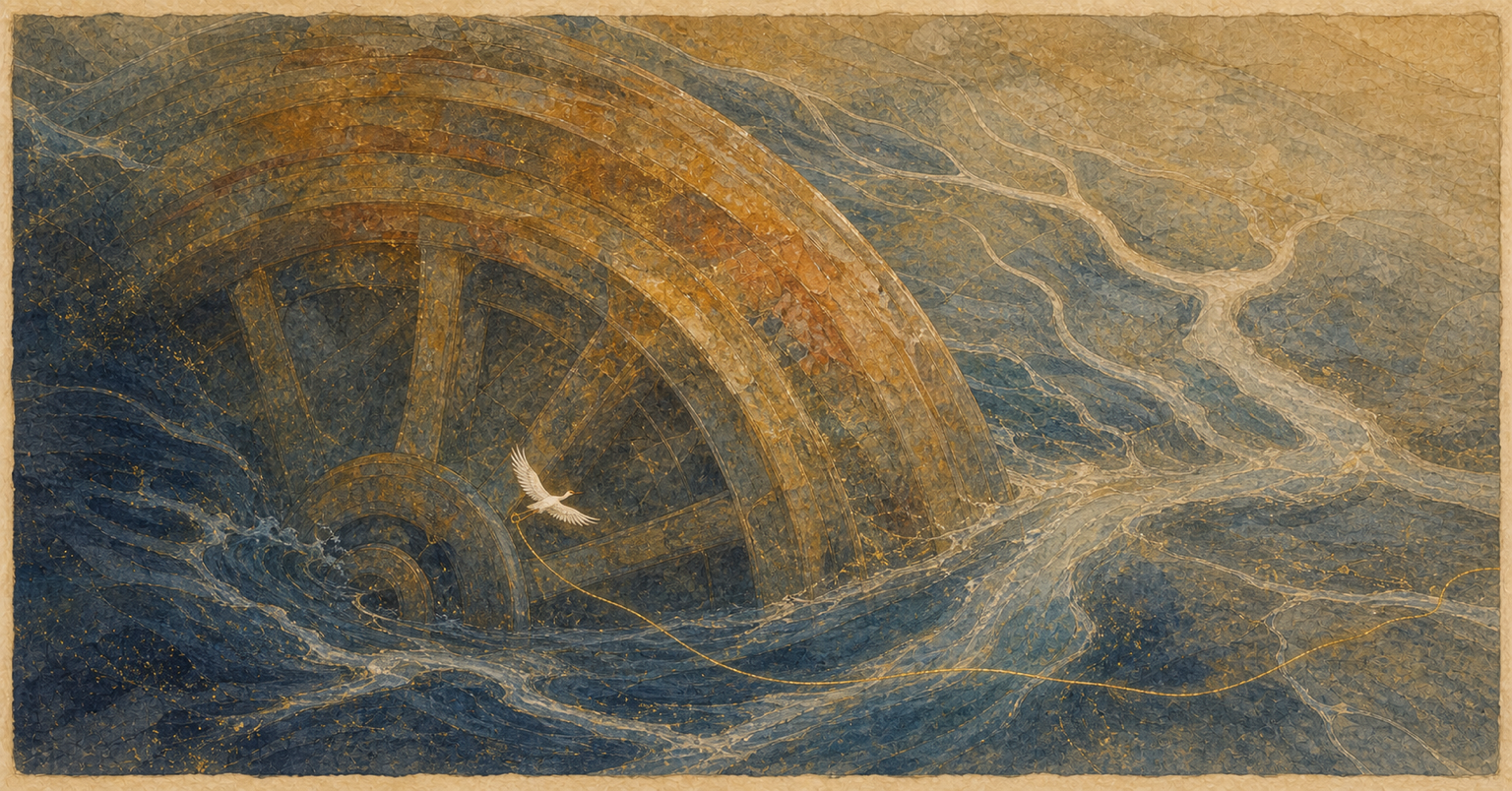
SVU 1.4-1.6: Rad, Strom und Seele

SVU 1.4-1.6: Bilder des Weltkreislaufs

Weltrad und Lebensstrom entfalten die Vielheit des Daseins; die darin kreisende Einzelseele gelangt durch den göttlichen Lenker zur Unsterblichkeit.

Dr. Ronald Steiner Dr. Ronald Steiner Nils Jacob Liersch Nils Jacob Liersch
Śvetāśvatara Upaniṣad 1.4
तमेकनेमिं त्रिवृतं षोडशान्तं शतार्धारं विंशतिप्रत्यराभिः |
tam eka-nemiṃ, tri-vṛtaṃ ṣoḍaśāntaṃ; śatārdhāraṃ, viṃśati-pratyarābhiḥ | Analyse ▾ Analyse ▴
tam
Akkusativ Singular Maskulin
Pronomen dem
ihn, diesen
eka
Dvigu-Kompositum
Zahlwort
eins, ein-
nemim
Akkusativ Singular Maskulin
Substantiv Feminin
mit einem Radkranz, einer Felge
tri
Dvigu-Kompositum
Zahlwort
drei, drei-
vṛtam
Akkusativ Singular Maskulin Partizip Perfekt Passiv
Verbalwurzel
umgeben, dreifach umringt
ṣoḍaśa
Dvigu-Kompositum
Zahlwort
sechzehn
antam
Akkusativ Singular Maskulin
Substantiv Maskulin
mit Enden, Begrenzungen
śata
Dvigu-Kompositum
Zahlwort
hundert
ardha
Karmadhāraya-Kompositum
Adjektiv
halb, zur Hälfte
aram
Akkusativ Singular Maskulin
Substantiv Maskulin
mit Speichen
viṃśati
Dvigu-Kompositum
Zahlwort
zwanzig
pratyarābhiḥ
Instrumentalis Plural
Präfix
Substantiv Maskulin
mit Gegenspeichen
अष्टकैः षड्भिर्विश्वरूपैकपाशं त्रिमार्गभेदं द्विनिमित्तैकमोहम् ||4||
aṣṭakaiḥ ṣaḍbhir, viśva-rūpaika-pāśaṃ; tri-mārga-bhedaṃ, dvi-nimittaika-moham ||4|| Analyse ▾ Analyse ▴
aṣṭakaiḥ
Instrumentalis Plural
Substantiv Neutrum
mit Achtheiten, Achtergruppen
ṣaḍbhiḥ
Instrumentalis Plural
Zahlwort
mit sechs
viśva
Bahuvrīhi-Kompositum
Adjektiv
all-, alle Formen umfassend
rūpa
Tatpuruṣa-Kompositum Genitiv
Substantiv Neutrum
Form, Gestalt
eka
Dvigu-Kompositum
Zahlwort
ein, einzig
pāśam
Akkusativ Singular Maskulin
Substantiv Maskulin
mit einer Fessel, Schnur
tri
Dvigu-Kompositum
Zahlwort
drei
mārga
Tatpuruṣa-Kompositum Genitiv
Substantiv Maskulin
Weg, Pfad
bhedam
Akkusativ Singular Maskulin
Substantiv Maskulin
mit Teilung, Verschiedenheit
dvi
Dvigu-Kompositum
Zahlwort
zwei
nimitta
Tatpuruṣa-Kompositum Instrumentalis
Substantiv Neutrum
durch Ursachen, Bedingungen
eka
Dvigu-Kompositum
Zahlwort
ein, einzig
moham
Akkusativ Singular Maskulin
Substantiv Maskulin
mit Verblendung, Irrtum
Metrum: Pāda 1: Triṣṭubh mit Śālinī-Ausklang — 12 Silben; Pāda 2: Triṣṭubh mit Śālinī-Ausklang; Pāda 3: Triṣṭubh mit Śālinī-Ausklang — 12 Silben; Pāda 4: Triṣṭubh mit Śālinī-Ausklang — 12 Silben
Ihn (tam | acc sg m) [erkannten sie als Weltrad] mit einer Felge (ekanemim | acc sg m), dreifach umringt (trivṛtam | acc sg m ppp), mit sechzehn Enden (ṣoḍaśāntam | acc sg m), mit fünfzig Speichen (śatārdhāram | acc sg m) und mit zwanzig Gegenspeichen (viṃśatipratyarābhiḥ | ins pl); mit Achtergruppen (aṣṭakaiḥ | ins pl), an Zahl sechs (ṣaḍbhiḥ | ins pl), mit einer Fessel von allumfassender Gestalt (viśvarūpaikapāśam | acc sg m), mit einer Dreiteilung des Weges (trimārgabhedam | acc sg m) und mit einer einzigen, aus zwei Ursachen erwachsenden Verblendung (dvinimittaikamoham | acc sg m).
Dr. Ronald Steiner - 2026 - historisch wörtlich
Sie schauten die Wirklichkeit als ein einziges Weltrad: Es hat eine Felge und einen dreifachen Reifen, sechzehn Enden, fünfzig Speichen und zwanzig Gegenspeichen. Es trägt sechs Gruppen zu je acht, eine einzige allgestaltige Fessel, drei verschiedene Wege und eine Verblendung, die aus zwei Ursachen entsteht.
Dr. Ronald Steiner - 2026 - moderner Transfer

Das Śaṅkara zugeschriebene Bhāṣya liest das eine Rad als detaillierte Gesamtschau der Erscheinungswelt. Es ordnet Guṇas, Kalās oder Welten, fünfzig psychische Fehlformen oder Kräfte, Sinne und Gegenstände sowie sechs Achtergruppen ein. Begehren bildet die Fessel; Verdienst und Schuld beziehungsweise Lust und Leid nähren die Verblendung.

Śvetāśvatara-Upaniṣad Śaṅkara-Bhāṣya

Śaṅkarānanda deutet das Saṃsāra-Rad systematisch mit Sāṃkhya- und Yoga-Kategorien: Avidyā als Felge, Guṇas, sechzehn Elemente, fünfzig Formen von Irrtum bis Vollkommenheit, Sinnesfunktionen, sechs Achtergruppen und drei Wege. Lust und Leid verstärken die eine grundlegende Nichterkenntnis.

Śaṅkarānandas Śvetāśvataropaniṣaddīpikā

Nārāyaṇa verlegt das Rad stark in den yogischen Körper. Kuṇḍalinī bildet die Felge; Guṇas, Nāḍīs, Elemente, sechzehn Orte oder Kalās und fünfzig Cakra-Blätter gliedern es. Drei Wege sowie Lust und Leid erklären die Bewegung des gebundenen Menschen.

Nārāyaṇas Śvetāśvataropaniṣaddīpikā

Vijñānabhagavat bietet zur Radmetapher mehrere parallele Kataloge: Māyā, Guṇas, sechzehn Praśna-Kalās oder Veränderungen, fünfzig Buchstaben und psychophysische Faktoren, zwanzig Gegenstreben, sechs Achtergruppen und drei Wege. Lust und Leid oder Verdienst und Schuld erscheinen als doppelte Verblendungsursache.

Vijñānabhagavats Śvetāśvataropaniṣadvivaraṇa
Den einen Radkranz<3>, dreifach<4>, sechzehnendig<5>, Mit fünfzig Speichen<6>, zwanzig Gegenspeichen<7>, Sechs Achtheiten<8>, die eine Schnur des Weltalls<9>, Dreipfadig<10>, zweibedingten<11>, einen Wahnes<12>,
<3: Das Bild von dem einen Radkranze (oder auch der einen Radnabe) mit den vielen Speichen (Kaush. 3,8. Brih. 2,5,15. Chānd. 7,15,1. Mund. 2,2,6. Praçna 2,6. 6,6) wird hier, mit Anlehnung an Sāṅkhyavorstellungen, näher ausgeführt.>
<4: Aus den drei Guna’s (Sattvam, Rajas, Tamas) bestehend.>
<5: Auslaufend in Manas, fünf Erkenntnissinne, fünf Tatsinne, fünf Elemente.>
<6: Die fünfzig Affekte (bhāva) der Sāṅkhyaphilosophie (Sāṅkhya-K. 46).>
<7: Die zehn Sinne und ihre Objekte.>
<8: 1) Fünf Elemente, Manas, Ahaṅkāra, Buddhi, 2) acht Bestandteile des Leibes, 3) acht Vollkommenheiten, 4) acht Grundaffekte (Sāṅkhya-K. 44–45), 5) acht Götter, 6) acht Tugenden.>
<9: Vgl. das sūtram Brih. 3,7.>
<10: Pitriyāna, Devayāna, Erlösung.>
<11: Durch gute und böse Werke.>
<12: Der Wahn des Ichbewußtseins.>
Paul Deussen - 1921
We understand him [as a wheel] with one felly, with a triple<2> tire, With sixteen end-parts,<3> fifty spokes,<4> twenty counter-spokes,<5> With six sets of eights,<1> whose one rope<2> is manifold, Which has three different paths,<3> whose one illusion (moha)<4> has two conditioning causes.<5>
<2: That is, consisting of the Three Qualities according to the Sāṅkhya philosophy (see Introduction, p. 8): sattvam, rajas, and tamas—pureness, passion, and darkness.>
<3: That is, the five elements (bhūta), the five organs of perception (buddhīndriya), the five organs of action (karmendriya), and the mind (manas).>
<4: The fifty conditions (bhāva) of the Sāṅkhya philosophy (cf. Sāṅkhya Kārikā 46).>
<5: The ten senses (indriya) and their ten corresponding objects.>
<1: That is, (1) eight producing causes of Prakṛti, namely the five elements, mind (manas), intellect (buddhi), and self-consciousness (ahaṁkāra); (2) eight constituents of the body (dhātu); (3) eight forms of superhuman power; (4) eight conditions (bhāva); (5) eight gods; (6) eight virtues.>
<2: That is, desire.>
<3: Namely religiousness (dharma), irreligiousness (a-dharma), and knowledge (jñāna).>
<4: That is, the illusion of self-consciousness.>
<5: Namely the consequences of good and of evil deeds.>
Robert Hume - 1921
(They beheld) that (wheel of the world) having one circumference, covered with three (attributes, etc.), possessing sixteen ends, having fifty spokes with twenty nails, having six groups of eight each, with one bond of many forms, with three kinds of paths, and having delusion which is the one cause of two.
Siddhesvar Varma Shastri - 1916
Den einen Radkranz<3>, dreifach<4>, sechzehnendig<5>, Mit fünfzig Speichen<6>, zwanzig Gegenspeichen<7>, Sechs Achtheiten<8>, die eine Schnur des Weltalls<9>, Dreipfadig<10>, zweibedingten<11>, einen Wahnes<12>,
<3: Das Bild von dem einen Radkranze (oder auch der einen Radnabe) mit den vielen Speichen (Kaush. 3,8. Brih. 2,5,15. Chānd. 7,15,1. Mund. 2,2,6. Praçna 2,6. 6,6) wird hier, mit Anlehnung an Sāṅkhyavorstellungen, näher ausgeführt.>
<4: Aus den drei Guna’s (Sattvam, Rajas, Tamas) bestehend.>
<5: Auslaufend in Manas, fünf Erkenntnissinne, fünf Tatsinne, fünf Elemente.>
<6: Die fünfzig Affekte (bhāva) der Sāṅkhyaphilosophie (Sāṅkhya-K. 46).>
<7: Die zehn Sinne und ihre Objekte.>
<8: 1) Fünf Elemente, Manas, Ahaṅkāra, Buddhi, 2) acht Bestandteile des Leibes, 3) acht Vollkommenheiten, 4) acht Grundaffekte (Sāṅkhya-K. 44–45), 5) acht Götter, 6) acht Tugenden.>
<9: Vgl. das sūtram Brih. 3,7.>
<10: Pitriyāna, Devayāna, Erlösung.>
<11: Durch gute und böse Werke.>
<12: Der Wahn des Ichbewußtseins.>
Paul Deussen - 1897
We meditate on him who (like a wheel) has one felly with three tires, sixteen ends, fifty spokes, with twenty counter-spokes, and six sets of eight; whose one rope is manifold, who proceeds on three different roads, and whose illusion arises from two causes.<3>
<3: It is difficult to say whether this verse was written as a summing up of certain technicalities recognised in systems of philosophy existing at the time, or whether it is a mere play of fancy. I prefer the former view, and subjoin the explanation given by Saṅkara, though it is quite possible that on certain points he may be mistaken. The Īsvara or deva is represented as a wheel with one felly, which would seem to be the phenomenal world. It is called trivrit, threefold, or rather having three tires, three bands or hoops to bind the felly, these tires being intended for the three gunas of the prakriti, the Sattva, Ragas, and Tamas. In the Brahmopanishad (Bibl. Ind. p. 233 p. 251) the trivrit sūtram is mentioned. Next follows shodasāntam, ending in the sixteen. These sixteen are differently explained. They may be meant for the five elements and the eleven indriyas or organs (the five receptive and the five active senses, together with manas, the common sensory); or for the sixteen kalās, mentioned in the Prasñopanishad, VI, 1, p. 283. Then follows a new interpretation. The one felly may be meant for the chaos, the undeveloped state of things, and the sixteen would then be the two products in a general form, the Virāg and the Sūtrātman, while the remaining fourteen would be the individual products, the bhuvanas or worlds beginning with Bhūh. Next follows satārdhāram, having fifty spokes. These fifty spokes are supposed to produce the motion of the mundane wheel, and are explained by Saṅkara as follows: 1. The five Viparyayas, misconceptions, different kinds of ignorance or doubt, viz. Tamas, Moha, Mahāmoha, Tāmisra, Andhatāmisra, or, according to Patañgali, ignorance, self-love, love, hatred, and fear (Yoga-sūtras I, 8; II, 2; Sāṅkhya-sūtras III, 37). 2. The twenty-eight Asaktis, disabilities, causes of misconception. (See Sāṅkhya-sūtras III, 38.) 3. The nine inversions of the Tushtis, satisfactions. (Sāṅkhya-sūtras III, 39.) 4. The eight inversions of the Siddhis, perfections. (Sāṅkhya-sūtras III, 40.) These are afterwards explained singly. There are 8 kinds of Tamas, 8 kinds of Moha, 10 kinds of Mahāmoha, 18 kinds of Tāmisra, and 18 kinds of Andhatāmisra, making 62 in all. More information on the Asaktis, the Tushtis, and Siddhis may be found in the Sāṅkhya-sūtras III, 37–45; Sāṅkhya-kārikā 47 seq.; Yoga-sūtras II, 2 seq. Then follow the 20 pratyaras, the counter-spokes, or wedges to strengthen the spokes, viz. the 10 senses and their 10 objects. The six ashtakas or ogdoads are explained as the ogdoads of Prakriti, of substances (dhātu), of powers (aisvarya), of states (bhāva), of gods (deva), of virtues (ātmaguna). The one, though manifold cord, is love or desire, Kāma, whether of food, children, heaven or anything else. The three paths are explained as righteousness, unrighteousness, and knowledge, and the one deception arising from two causes is ignorance of self, produced by good or bad works.>
F. Max Müller - 1884
Him<1> we consider as (a wheel) which has one circumference,<2> which is covered by three<3> (layers, of which the circumference is composed), which has sixteen end parts<4> (probably the several pieces of wood, of which the circumference consists), which has fifty spokes<5> and twenty counter-spokes,<6> which has six times eight nails (appendants),<7> which has one rope of various form,<8> whose road is three-fold divided,<9> and which has one revolution for two traces.<10>
<1: “Him,” who superintends all those causes, the universal soul.>
<2: The circumference (nemi) of the wheel represents nature in its cause, either as unmanifested ether, or as Māyā (delusion), or first nature (Prakriti), or as power (Śakti), or as ignorance, &c., that is to say, the cause upon which the whole creation depends.>
<3: The three layers are the three qualities of nature, goodness, activity and darkness.>
<4: These denote the sixteen productions of the Sānkhya, by which the creation is completed, because no other productions ensue from them (vid. Ballantyne’s Lecture on the Sānkhya Philosophy, p. 2), viz. the eleven organs (the 5 organs of intellect, the 5 organs of action, and mind, the internal organ) and the five gross elements (earth, water, light, air and ether), l. c. pp. 13–15. Śankara, or the author of the commentary under his name, evidently knows the Tattwa Samāsa, as he quotes passages from it almost literally. According to another explanation the sixteen parts are the Virāt and Sūtrātma, as representing the totality of the creation of the supreme spirit and the 14 worlds representing it in its parts.>
<5: These are the five classes of ignorance, viz. obscurity (tamas), illusion (moha), extreme illusion (mahāmoha), gloom (tāmisra), and utter darkness (andha-tāmisra),—28 disabilities, viz. the depravity of the 11 organs as deafness, insensibility, leprosy, blindness, loss of smell, dumbness, crippledness, lameness, constipation, impotence, insanity, and the seventeen defects of intellect (vid. B.’s L. on the S. P. pp. 35–40),—nine kinds of acquiescence (this is indifference to the investigation of truth.—l. c. p. 39),—and eight perfections (viz. tāra, sutāra, tārayantī, pramoda, pramodita, pramodamāna, ramyaka and satpramodita, the first of which, for instance, is the knowledge in regard to the principles, the conditions of intellect, and the elemental creation, which arises from hearing alone.—l. c. p. 42). Śankara states the 8 kinds of perfection differently, viz. three kinds, arising from perfection in the impressions of knowledge, with reference to nature, &c., which remain from a former birth, or from perfection in understanding a truth by hearing, or lastly from perfection in understanding a truth by study; three kinds, arising from our indifference to the three-fold pain (viz. pain, arising from our own nature, or from other living creatures, or from other external causes), and two kinds, arising from the acquisition of a friend and true liberality towards the teacher.>
<6: The 20 counterspokes (pieces of wooden bolts, firmly to secure the spokes), are, according to Śankara, the 10 senses and the 10 objects of them.>
<7: The first are the eight producers of the Sānkhya (nature, intellect, self-consciousness, and the five subtile elements of ether, air, light, water and earth); the second, the eight constituent parts of the body (the internal skin of sensation, the external skin, flesh, blood, fat, bones, marrow, and semen); the third, the eight kinds of superhuman power (viz. assumption of the smallest possible shape, of the greatest possible shape, of the heaviest form, of the lightest form, the power of obtaining every thing, irresistible will, ruling of all and independency of all); the fourth, the eight states of intellect of the Sānkhya (viz. virtue, knowledge, dispassion, super-human power, vice, ignorance, want of dispassion, and want of superhuman power); the fifth, the eight deities (Bramha, Prajāpati, Devas, Gandharvas, Yakshas, Rakshasas, Pitris and Pisāchas); and the sixth, the eight virtues of the soul (compassion with all beings, forbearance, freedom from calumny, purity of mind, freedom from fatigue, prosperity, and freedom from poverty).>
<8: The rope is desire in all its varieties.>
<9: The three roads are those of virtue, of vice, and of knowledge.>
<10: One revolution, delusion, which is the cause of two, viz. of holiness and sin.>
Edward Röer - 1853
Śvetāśvatara Upaniṣad 1.5
पञ्चस्रोतोऽम्बुं पञ्चयोन्युग्रवक्त्रां पञ्चप्राणोर्मिं पञ्चबुद्ध्यादिमूलाम् |
pañca-sroto-'mbuṃ, pañca-yony ugra-vaktrāṃ; pañca-prāṇormiṃ, pañca-buddhy-ādi-mūlām | Analyse ▾ Analyse ▴
pañca
Dvigu-Kompositum
Zahlwort
fünf
srotas
Bahuvrīhi-Kompositum
Substantiv Neutrum
mit fünf Strömen, aus fünf Flüssen
ambum
Akkusativ Singular Feminin
Substantiv Neutrum
dessen Wasser aus fünf Flüssen stammt
pañca
Dvigu-Kompositum
Zahlwort
fünf
yoni
Bahuvrīhi-Kompositum
Substantiv Feminin
Quellen, Ursprünge
ugra
Karmadhāraya-Kompositum
Adjektiv
heftig, gewaltig
vaktrām
Akkusativ Singular Feminin
Substantiv Neutrum
mit Mündungen, Mäulern
pañca
Dvigu-Kompositum
Zahlwort
fünf
prāṇa
Bahuvrīhi-Kompositum
Substantiv Maskulin
Lebenshauch, Atem
ūrmim
Akkusativ Singular
Substantiv Maskulin
Welle, Woge
pañca
Dvigu-Kompositum
Zahlwort
fünf
buddhi
Bahuvrīhi-Kompositum
Substantiv Feminin
Erkenntnis, Intellekt
ādi
Tatpuruṣa-Kompositum Genitiv
Substantiv Maskulin
Anfang, Ursprung
mūlām
Akkusativ Singular Feminin
Substantiv Neutrum
als Wurzel, Grund
पञ्चावर्तां पञ्चदुःखौघवेगां पञ्चाशद्भेदां पञ्चपर्वामधीमः ||5||
pañcāvartāṃ, pañca-duḥkhaugha-vegāṃ; pañcāśad bhedāṃ, pañca-parvām adhīmaḥ ||5|| Analyse ▾ Analyse ▴
pañca
Dvigu-Kompositum
Zahlwort
fünf
āvartām
Akkusativ Singular Feminin
Substantiv Maskulin
mit Strudeln, Windungen
pañca
Dvigu-Kompositum
Zahlwort
fünf
duḥkha
Tatpuruṣa-Kompositum Genitiv
Substantiv Neutrum
Leid, Schmerz
ogha
Tatpuruṣa-Kompositum Genitiv
Substantiv Maskulin
Flut, Strom
vegām
Akkusativ Singular Feminin
Substantiv Maskulin
mit Strömung, Andrang
pañcāśat
Dvigu-Kompositum
Zahlwort
fünfzig
bhedām
Akkusativ Singular Feminin
Substantiv Maskulin
mit Teilungen, Verzweigungen
pañca
Dvigu-Kompositum
Zahlwort
fünf
parvām
Akkusativ Singular Feminin
Substantiv Neutrum
mit Gliedern, Abschnitten
adhīmaḥ
1. Person Plural Medial Präsens
Präfix
Verbalwurzel
wir betrachten, meditieren über
Metrum: Pāda 1: Triṣṭubh mit Śālinī-Ausklang — 12 Silben; Pāda 2: Triṣṭubh mit Śālinī-Ausklang — 12 Silben; Pāda 3: Triṣṭubh mit Śālinī-Ausklang; Pāda 4: Triṣṭubh mit Śālinī-Ausklang — 12 Silben
[Einen Fluss] mit Wasser aus fünf Strömen (pañcasroto'mbuṃ | acc sg f), mit fünf Quellen und heftigen Mündungen (pañcayonyugravaktrāṃ | acc sg f), mit fünf Lebenshauchen als Wogen (pañcaprāṇormiṃ | acc sg), mit den fünf Erkenntniskräften als Wurzel (pañcabuddhyādimūlām | acc sg f), mit fünf Wirbeln (pañcāvartāṃ | acc sg f), mit dem Andrang der Flut des fünffachen Leidens (pañcaduḥkhaughavegāṃ | acc sg f), mit fünfzig Verzweigungen (pañcāśadbhedāṃ | acc sg f) und mit fünf Gliedern (pañcaparvām | acc sg f) betrachten wir (adhīmaḥ | 1p pl med pres).
Dr. Ronald Steiner - 2026 - historisch wörtlich
Wir betrachten sie auch als einen mächtigen Strom: Fünf Wasserläufe speisen ihn; er entspringt fünf Quellen und hat fünf gewaltige Mündungen. Seine Wogen sind die fünf Lebenskräfte, und die fünf Erkenntnisvermögen bilden seine Wurzel. Er hat fünf Wirbel, wird vom Andrang der Flut des fünffachen Leidens fortgerissen, verzweigt sich fünfzigfach und besitzt fünf Abschnitte.
Dr. Ronald Steiner - 2026 - moderner Transfer

Das Śaṅkara zugeschriebene Bhāṣya bestimmt die fünf Ströme als Erkenntnissinne und die Quellen als Elemente. Prāṇas oder Handlungsorgane bilden Wellen, der Geist ist Wurzel der Erkenntnisse, Sinnesgegenstände sind Strudel. Geburt bis Tod erscheinen als Leiden; die fünf Stromabschnitte sind die klassischen Kleśas.

Śvetāśvatara-Upaniṣad Śaṅkara-Bhāṣya

Śaṅkarānanda liest den Saṃsāra-Strom als leiblich-sensorischen Prozess. Wahrnehmungsöffnungen, Elemente, Lebenshauche, Erkenntnisse und Wünsche treiben ihn. Auch Lust bleibt leidverbunden, weil sie beginnt und endet; fünf dunkle Verblendungsstufen oder Elemente strukturieren seine Tiefe.

Śaṅkarānandas Śvetāśvataropaniṣaddīpikā

Nārāyaṇa lässt den Strom in der aus Prakṛti hervorgehenden Avidyā wurzeln. Sinne, Prāṇas, Bewusstseinsfaktoren, Sinnesgegenstände und Leiden bilden seine Bewegungen. Die Fünfzig erscheinen als Cakra-Blätter oder Buchstaben, die fünf Abschnitte als Kośas oder Kleśas.

Nārāyaṇas Śvetāśvataropaniṣaddīpikā

Vijñānabhagavat entfaltet den Saṃsāra-Fluss durch fünf Sinnesströme und subtile Gegenstände, fünf Prāṇa-Wellen, Erkenntnisse und Wünsche sowie Elemente als Strudel. Fünf Gebrechen oder Kleśas, fünfzig Buchstaben und fünf kosmische Stufen ergänzen die Metapher.

Vijñānabhagavats Śvetāśvataropaniṣadvivaraṇa
ugravaktrāṃ LV1958 ] ugravakrāṃ ASS1927
Kritischer Apparat
Den Fünfstrom<13>, der fünfquellig<14> schwillt, sich windet, Mit fünf Hauchwellen<15>, mit der fünf Sinne Urwurzel<16>, Mit Strudeln fünf<1>, fünf Schmerz-Sturmwogen<2>, fünfzig Flußarmen<3> und fünf Schnellen<4>, — den verstehn wir.
<13: Die fünf Erkenntnissinne.>
<14: Die fünf Elemente.>
<15: Die fünf Tatsinne (oder vielleicht die fünf Prāṇa’s).>
<16: Das Manas.>
<1: Die fünf Objekte der Sinne (Ton, Farbe usw.).>
<2: Aufenthalt im Mutterleib, Geburt, Alter, Krankheit, Tod.>
<3: Wohl wieder die fünfzig Affekte.>
<4: Die fünf Anfechtungen (kleçāḥ) des Yoga: Nichtwissen, Egoismus, Liebe, Haß, Leidenschaft.>
Paul Deussen - 1921
We understand him as a river of five streams<6> from five sources,<7> impetuous and crooked, Whose waves are the five vital breaths, whose original source is fivefold perception (buddhi), With five whirlpools,<8> an impetuous flood of fivefold misery, Divided into five distresses,<9> with five branches.
<6: The five senses.>
<7: The five elements.>
<8: The five objects of sense.>
<9: According to Śaṅkara’s reading. The traditional text has ‘divided fiftyfold.’>
Robert Hume - 1921
We understand that river, the water of which has five currents, which is crooked and severe on account of five causes, the waves of which are the five breaths, whose source is the five senses of perception, which has five whirlpools, whose movement is the collection of five miseries, which includes fifty kinds, and which has five stages.
Siddhesvar Varma Shastri - 1916
Den Fünfstrom<13>, der fünfquellig<14> schwillt, sich windet, Mit fünf Hauchwellen<15>, mit der fünf Sinne Urwurzel<16>, Mit Strudeln fünf<17>, fünf Schmerz-Sturmwogen<18>, fünfzig Flußarmen<19> und fünf Schnellen<20>, — den verstehn wir.
<13: Die fünf Erkenntnissinne.>
<14: Die fünf Elemente.>
<15: Die fünf Tatsinne (oder vielleicht die fünf Prāṇa’s).>
<16: Das Manas.>
<17: Die fünf Objekte der Sinne (Ton, Farbe usw.).>
<18: Aufenthalt im Mutterleib, Geburt, Alter, Krankheit, Tod.>
<19: Wohl wieder die fünfzig Affekte.>
<20: Die fünf Anfechtungen (kleçāḥ) des Yoga: Nichtwissen, Egoismus, Liebe, Haß, Leidenschaft.>
Paul Deussen - 1897
We meditate on the river whose water consists of the five streams, which is wild and winding with its five springs, whose waves are the five vital breaths, whose fountain head is the mind, the course of the five kinds of perceptions. It has five whirlpools, its rapids are the five pains; it has fifty kinds of suffering, and five branches.<1>
<1: Here again, where the Īśvara is likened to a stream, the minute coincidences are explained by Śaṅkara in accordance with certain systems of philosophy. The five streams are the five receptive organs, the five springs are the five elements, the five waves are the five active organs. The head is the manas, the mind, or common sensory, from which the perceptions of the five senses spring. The five whirlpools are the objects of the five senses, the five rapids are the five pains of being in the womb, being born, growing old, growing ill, and dying. The next adjective pañcāśadbhedāṁ is not fully explained by Śaṅkara. He only mentions the five divisions of the kleśa (see Yoga-sūtras I, 2), but does not show how their number is raised to fifty. Dr. Roer proposes to read pañcakleśabhedāṁ, but that would not agree with the metre. The five parvans or branches are not explained, and may refer to the five kinds of suffering (kleśa). The whole river, like the wheel in the preceding verse, is meant for the Brahman as kārya-kāraṇātmaka, in the form of cause and effect, as the phenomenal, not the absolutely real world.>
F. Max Müller - 1884
Him we consider as a river, whose water is derived from five currents (the five senses of intellect), which is fearful and crooked, by its five sources (the five elements), whose waves are the five (vital) airs, whose origin is the producer of the five senses of intellect (the mind), which has five whirlpools (the objects of the senses),<1> which is impelled by the velocity of the five kinds of pain,<2> which is divided by the five kinds of misery,<3> and which has five turnings.
<1: The five objects of the senses,—sound, touch, colour, taste, and smell,—are called whirlpools, because in them the individual souls are drowned.>
<2: The five kinds of pain, viz. the pain arising from the state of an embryo, from birth, age, illness and death.>
<3: In the text is given “Panchasadbhedam,” divided into fifty kinds, but Śankara gives in his explanation the reading, “Panchakleśabhedam,” which I have adopted in the translation, as it agrees better with the whole passage, where a division into five members is followed throughout the verse.>
Edward Röer - 1853
Śvetāśvatara Upaniṣad 1.6
सर्वाजीवे सर्वसंस्थे बृहन्ते तस्मिन्हंसो भ्राम्यते ब्रह्मचक्रे |
sarvājīve, sarva-saṃsthe bṛhante; tasmin haṃso, bhrāmyate brahma-cakre | Analyse ▾ Analyse ▴
sarva
Bahuvrīhi-Kompositum
Pronomen quant
alles, all-
ājīve
Lokativ Singular
Substantiv Maskulin
im Belebenden, Leben Tragenden
sarva
Bahuvrīhi-Kompositum
Pronomen quant
alles, all-
saṃsthe
Lokativ Singular Neutrum
Adjektiv
in dem alles ruht, befindlich
bṛhante
Lokativ Singular Neutrum
Adjektiv
im großen, mächtigen
tasmin
Lokativ Singular Neutrum
Pronomen dem
in diesem
haṃsaḥ
Nominativ Singular
Substantiv Maskulin
der Schwan, die Einzelseele
bhrāmyate
3. Person Singular Passiv Präsens Causativ
Verbalwurzel
er wird zum Kreisen gebracht
brahma
Tatpuruṣa-Kompositum Genitiv
Substantiv Neutrum
Brahman-
cakre
Lokativ Singular
Substantiv Neutrum
im Rad
पृथगात्मानं प्रेरितारं च मत्वा जुष्टस्ततस्तेनामृतत्वमेति ||6||
pṛthag ātmānaṃ, preritāraṃ ca matvā; juṣṭas tatas, tenāmṛtatvam eti ||6|| Analyse ▾ Analyse ▴
pṛthak
Adverb
getrennt, gesondert
ātmānam
Akkusativ Singular
Substantiv Maskulin
das Selbst
preritāram
Akkusativ Singular
Substantiv Maskulin
den Antreiber, Beweger
ca
Partikel
und
matvā
Absolutus
Verbalwurzel
nachdem er gemeint, erkannt hat
juṣṭaḥ
Nominativ Singular Maskulin Partizip Perfekt Passiv
Verbalwurzel
begünstigt, angenommen
tatas
Adverb
dann, darauf
tena
Instrumentalis Singular Maskulin
Pronomen dem
durch ihn, von diesem
amṛtatvam
Akkusativ Singular
Substantiv Neutrum
Unsterblichkeit
eti
3. Person Singular Aktiv Präsens
Verbalwurzel
er erreicht, gelangt zu
Metrum: Pāda 1: Triṣṭubh mit Śālinī-Ausklang; Pāda 2: Triṣṭubh mit Śālinī-Ausklang; Pāda 3: Triṣṭubh mit Śālinī-Ausklang — 12 Silben; Pāda 4: Triṣṭubh
In dem alles Belebenden (sarvājīve | loc sg), in dem alles ruht (sarvasaṃsthe | loc sg n), in dem Großen (bṛhante | loc sg n), in diesem (tasmin | loc sg n), wird der Schwan, die Einzelseele (haṃsaḥ | nom sg), zum Kreisen gebracht (bhrāmyate | 3p sg pas pres caus) im Rad des Brahman (brahmacakre | loc sg), indem er als getrennt (pṛthak) das Selbst (ātmānam | acc sg) und den Antreiber (preritāram | acc sg) ebenfalls (ca) meint (matvā | abs). Der Begünstigte (juṣṭaḥ | nom sg m ppp) erreicht daraufhin (tatas) durch diesen (tena | ins sg m) die Unsterblichkeit (amṛtatvam | acc sg) und gelangt zu ihr (eti | 3p sg act pres).
Dr. Ronald Steiner - 2026 - historisch wörtlich
In diesem großen Rad des Brahman, das alles belebt und in dem alles seinen Ort hat, kreist die Einzelseele wie ein Schwan. Solange sie sich und ihren Lenker für voneinander getrennt hält, bleibt sie im Kreislauf. Wird sie von ihm angenommen, gelangt sie durch ihn zur Unsterblichkeit.
Dr. Ronald Steiner - 2026 - moderner Transfer

Das Śaṅkara zugeschriebene Bhāṣya sieht den Jīva im aus Ursache und Wirkung bestehenden Brahmanrad kreisen, weil er Nicht-Selbst für Selbst hält und Jīva und Lenker trennt. Verehrung des Herrn mündet in ahaṃ brahmāsmi: Unterschiedsschau bindet, Erkenntnis der Nichtverschiedenheit befreit.

Śvetāśvatara-Upaniṣad Śaṅkara-Bhāṣya

Śaṅkarānanda erklärt das Kreisen des Jīva durch Karma, Nichtwissen, Begehren und Vāsanās. Erkenntnis erfasst inneres Selbst und Īśvara und führt durch dessen Gunst zur nichtdualen, leidfreien Unsterblichkeit. Das Rad ist Brahman, insofern es unter Avidyā als Saṃsāra erscheint.

Śaṅkarānandas Śvetāśvataropaniṣaddīpikā

Nārāyaṇa deutet den Körper als Brahmarad. Karma und Vāsanās bewegen den Jīva durch den Kreislauf, während der göttliche Lenker von ihm unterschieden erscheint. Erkenntnis und die Gunst dieses Lenkers führen aus der Gebundenheit zur Unsterblichkeit.

Nārāyaṇas Śvetāśvataropaniṣaddīpikā

Vijñānabhagavat verbindet den Haṃsa-Jīva mit Wachsein, Traum, Tiefschlaf, Tod und wechselnden Körpern. Karma hält diese Bewegung in Gang. Unterscheidungswissen trennt Zeugenbewusstsein und Leib; die Erkenntnis der Einheit von tat und tvam zerstört Avidyā, alternativ wird Befreiung als Gunst Īśvaras beschrieben.

Vijñānabhagavats Śvetāśvataropaniṣadvivaraṇa
tasmin LV1958 ] asmin ASS1927
Kritischer Apparat
In diesem großen Brahmanrad<5>, das alles Beseelt, umschließt, — ein Schwan<6> schweift, doch nur weil er Gesondert wähnt sich und des Rades Treiber; — Von ihm begnadigt, wird er dann unsterblich.
<5: Dem Saṃsāra. Maitr. 2,6 wird an ein Töpferrad gedacht.>
<6: Die individuelle Seele.>
Paul Deussen - 1921
In this which vitalizes all things, which appears in all things, the Great— In this Brahma-wheel the soul (haṁsa) flutters about, Thinking that itself (ātmānam) and the Actuator are different. When favored by Him, it attains immortality.
Robert Hume - 1921
In this mighty wheel of Brahm, which is (the receptacle of) the life of all and of the stability (or death) of all, the individual soul is revolved. Having known Him as a separate and controlling Self, and having then been beloved by Him, the individual soul attains Immortality.
Siddhesvar Varma Shastri - 1916
In diesem großen Brahmanrad<21>, das alles Beseelt, umschließt, — ein Schwan<22> schweift, doch nur weil er Gesondert wähnt sich und des Rades Treiber; — Von ihm begnadigt, wird er dann unsterblich.
<21: Dem Saṃsāra. Maitr. 2,6 wird an ein Töpferrad gedacht.>
<22: Die individuelle Seele.>
Paul Deussen - 1897
In that vast Brahma-wheel, in which all things live and rest, the bird flutters about, so long as he thinks that the self (in him) is different from the mover (the god, the lord). When he has been blessed by him, then he gains immortality.<2>
<2: If he has been blessed by the Īsvara, i.e. when he has been accepted by the Lord, when he has discovered his own true self in the Lord. It must be remembered, however, that both the Īsvara, the Lord, and the purusha, the individual soul, are phenomenal only, and that the Brahma-wheel is meant for the prapañka, the manifest, but unreal world.>
F. Max Müller - 1884
In this wheel of Bramha, which is the support, as well as the end of all beings,<1> which is infinite, roams about the pilgrim soul,<2> when it fancies itself and the (supreme) ruler different; it obtains immortality, when it is upheld,<3> by him (the supreme ruler).
<1: In which all beings have their origin and their end.>
<2: Hansa, explained by Śankara by hanti gacchanti adhvānam iti hansa; it is called hansa, because it travels along the road.>
<3: This takes place, explains Śankara, if a person thinks himself as one with him.>
Edward Röer - 1853

Mit AYI Free weitermachen

Illustrationen: KI-generiert.

Editor:innen

Dr. Ronald Steiner

Aus Ulm

Dr. Ronald Steiner, der „Yoga Doc“, begründete die AYI Methode: traditioneller Ashtanga, moderne Yogatherapie und lebendige Philosophie – als persönliche Praxis von sportlich-akrobatisch bis meditativ-therapeutisch. Er... mehr ›

Nils Jacob Liersch

Meine Begeisterung für Yoga, indische Philosophie und Sanskrit führte mich zum Studium der Indologie und Religionswissenschaft an der Universität Heidelberg. Seit 2004 befinde ich mich auf meinem persönlichen Yogaweg... mehr ›

Nachrichten und Bewertungen
0 Nachrichten

Bitte melde Dich an, um eine Nachricht zu schreiben. Hier gehts zum Login

Noch keine Nachrichten.