

yoga योग – Yoga; Verbindung; Anwendung
Substantiv Maskulin · Substantiv Neutrum · Worttyp nicht bestimmt
Wörterbuchquellen
AYI Wörterbuch Substantiv Maskulin
Yoga; Verbindung; Anwendung
Herkunft
Cappeller 1891 Substantiv Maskulin
Originaltext · Englisch · Substantiv Maskulin
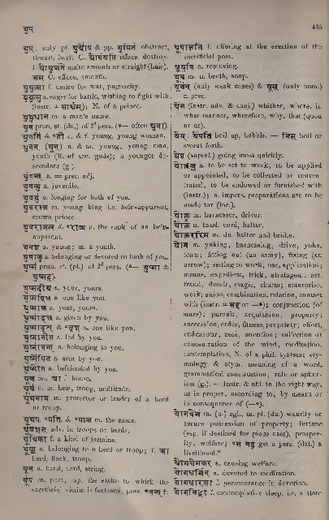
yóga ·m. yoking, harnessing, drive, yoke, team; fitting out (an. army), fixing (an arrow); setting to work, use, application; means, expedient, trick, stratagem, art, fraud, deceit, magic, charm; enterprise, work; union, combination, relation, contact with (instr. ±saha or --°); conjunction (of stars); pursuit, acquisition, property; succession, order, fitness, propriety; effort, endeavour, zeal, attention; collection or concentration of the mind, meditation. contemplation, N. of a phil. system; etymology & etym. meaning of a word, grammatical construction, rule or aphorism (g.). -- Instr. & abl. in the right way, as is proper, according to, by means or in consequence of (--°).
Monier-Williams 1872 Substantiv Maskulin · Worttyp nicht bestimmt
Originaltext · Englisch · Substantiv Maskulin
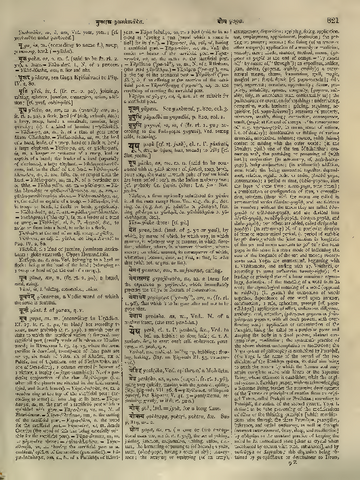
yoga yoga, as, m. (in one or two excep- tional cases am, n.; fr. rt. 1. yuj), the act of yoking, joining, junction, conjunction, uniting, union, con- tact; the harnessing or putting to (of horses); a yoke, team, (ṣaḍ-yoga, having a team of six); convey- ance; the arraying or equipping (of an army), arrangement, disposition; applying, fixing, application, use, employment, appointment, institution; the put- ting on armour; armour; the fixing (of an arrow or other weapon); application of a remedy or medicine, remedy, cure; mode, manner, method, means, (yo- gena or yogāt at the end of comps. = ‘by means of,’ ‘by reason of,’ ‘through’); an expedient, artifice, plan, device, (yogena, artfully, craftily); a super- natural means, charm, incantation, spell, magic, magical art; fraud, deceit [cf. yoga-nanda]; side, part, argument; occasion, opportunity; fitness, pro- priety, suitability, aptness, congruity, (yogena, suit- ably, fitly, in accordance with, conformably to); the performance or execution (of anything); undertaking, occupation, work, business; gaining, acquiring, ac- quisition [cf. yoga-kṣema]; accession of property, substance, wealth, thing; connection, consequence, result, (yogāt at the end of comps. = ‘in consequence of,’ e. g. karma-yogāt, in consequence of actions, i. e. of destiny); combination or mixing of various materials, association, mixture; contact, (with Jainas) contact or mixing with the outer world; (in the Sāṅkhya phil.) one of the ten Mūlikārthas; con- nection with, the partaking or possessing of (with inst.); conjunction (in astronomy, cf. nakṣatra- yoga), lucky conjuncture; (in arithmetic) addition, sum, total; the being connected together, depend- ance, relation, regular order or series, (kathā-yoga, conversation); a period of time, (kāla-yogena, after the lapse of some time; nava-yoga, nine times); a combination or configuration of stars, a constella- tion, asterism, (these with the moon are called in astronomical works cāndra-yogāḥ, and are thirteen in number; without the moon they are called kha- yogāḥ or nābhasa-yogāḥ, and are divided into ākṛti-yogāḥ, saṅkhyā-yogāḥ, āśraya-yogāḥ, and dala-yogāḥ; two others are added, called dvigraha- yogāḥ); (in astronomy) N. of a particular division of time or astronomical period, (a period of variable length during which the joint motion in longitude of the sun and moon amounts to 30° 204; the term yoga in this sense is a mere mode of indicating the sum of the longitude of the sun and moon; twenty- seven such Yogas are enumerated, beginning with 1. Viṣkambha, and ending with 27. Vaidhṛti, or according to some authorities twenty-eight); the leading or principal star of a lunar mansion; etymo- logy, derivation of the meaning of a word from its root; the etymological meaning of a word (opposed to rūḍhi); (in gram.) the connection of words together, dependence of one word upon another, construction; a rule, aphorism, precept [cf. yoga- vibhāga]; application of effort, endeavour, diligence, assiduity, zeal, attention, (pūrṇena yogena or jala- pūrṇena yogena, with all one's powers, with over- flowing zeal); application or concentration of the thoughts, fixing the mind on a particular point and keeping the body in a fixed posture, abstract con- templation, meditation; the systematic practice of the above abstract contemplation or meditation; the Yoga system of philosophy as established by Patañjali, (the Yoga is the name of the second of the two divisions of the Sāṅkhya system, its chief aim being to teach the means by which the human soul may attain complete union with Īśvara or the Supreme Being, whose existence it establishes, while the origi- nal system or Sāṅkhya proper, without acknowledging a Supreme Being, teaches the successive development of the Tattvas or principles of creation from an origi- nal Tattva, called Prakṛti or Pradhāna; according to Patañjali, the author of the second system, Yoga is defined to be ‘the preventing of the modifications of citta or the thinking principle [which modifica- tions arise through the three Pramāṇas, perception, inference, and verbal testimony, as well as through incorrect ascertainment, fancy, sleep, and recollection] by abhyāsa or the constant practice of keeping the mind in its unmodified state [clear as crystal when uncoloured by contact with other substances], and by vairāgya or dispassion;’ this dispassion being ob- tained by praṇidhāna or devotedness to Īśvara, the Supreme, who is defined as a particular Puruṣa or spirit unaffected by afflictions, works, &c., and having the appellation Praṇava or Om, which mono- syllable is to be muttered and its meaning reflected on in order to attain knowledge of the Supreme and the prevention of the obstacles to Yoga: the eight means or stages of Yoga or mental concentration are, 1. yama, forbearance; 2. niyama, religious ob- servances; 3. āsana, postures; 4. prāṇāyāma, regu- lation of the breath; 5. pratyāhāra, restraint of the senses; 6. dhāraṇā, steadying of the mind; 7. dhyā- na, contemplation; 8. samādhi, profound medita- tion, which, according to the Bhagavad-gītā VI. 13, is to be practised by fixing the eyes on the tip of the nose: true liberation is the cessation of all idea of self and the separation of matter and spirit or kaivalya, isolation: the self-mortification and asce- ticism of the Yoga connects it closely with Buddhism); the union of the individual soul with the universal soul, devotion, pious seeking after God; any single act or rite conducive to Yoga or abstract contem- plation; (personified as) the son of Dharma and Kriyā; a follower of the Yoga system of philosophy; a traitor, violator of confidence, spy; N. of a com- mentator on the Paramārtha-sāra; (ā), f., N. of Pīvarī (daughter of the Pitṛs called Barhiṣads); of a Śakti.
Originaltext · Englisch · Worttyp nicht bestimmt
Yoga, yogya, &c. See p. 821, col. 2, and p. 823, col. 2.
Petersburger 1855 Substantiv Maskulin · Substantiv Neutrum · Worttyp nicht bestimmt
Originaltext · Deutsch · Substantiv Maskulin · Substantiv Neutrum
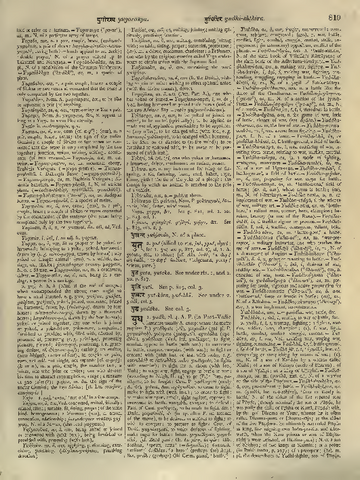
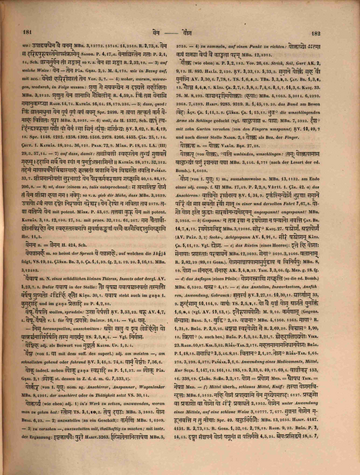
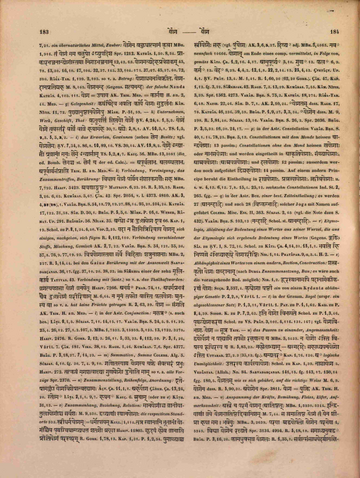
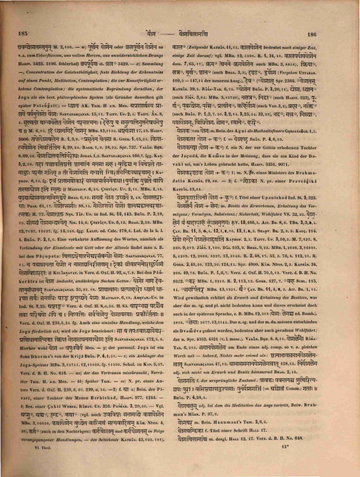
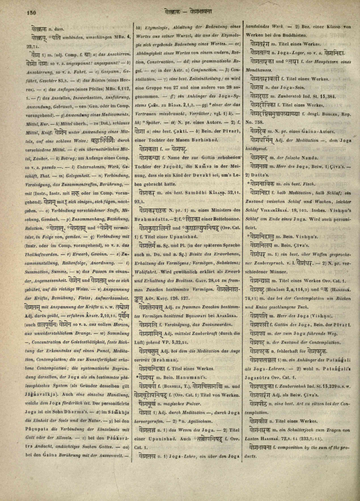
yóga (von 1. yuj) 1〉 m., ausnahmsweise n. MBH. 13,1132. am Ende eines adj. comp. f. ā MBH. 17,49. P. 2,2,8, Vārtt. 1. ŚĀK. 42. a〉 das Anschirren: vā̱jino̱ rāsàbhasya ṚV. 1,34,9. ekàsmi̱nyogè bhuraṇā samā̱ne parì vāṃ sa̱pta sra̱vato̱ rathò gāt in einer und derselben Fahrt ṚV. 7,67,8. yogo yoga iti kruddhāḥ sārathīnabhyacodayan angespannt! angespannt! MBH. 5,5958. — b〉 Gespann: na tatra rathā na rathayogā na panthāno bhavanti ŚAT. BR. 14,7,1,11. rathayogavid MBH. 3,12086. sīra˚ KAUŚ. 27. ṣaḍyogá, aṣṭāyogá (AV. PRĀT. 3,2) Sechs-, Achtgespann AV. 6,91,1. sīraṃ ṣaḍyogam KĀTY. ŚR. 5,11,12. Vgl. dvyoga. — c〉 das Rüsten (eines Heeres): ete hi yogāḥ senāyāḥ praśastāḥ parabādhane MBH. 12,3693. senā˚ MBH. 12,3691. MBH. 2,2466. balānām R. 2,82,29 (R. 2,89,11 GORR.). yogamājñāpayāmāsuryuddhāya ca viniryayuḥ MBH. 8,10. yoga = saṃnahana, saṃnāha AK. 3,4,3,23. TRIK. 3,3,66. fg. MED. g. 18. fg. — d〉 das Auflegen (eines Pfeils): yogamastrāṇi gacchanti (so die ed. Bomb.) MBH. 6,5202. astra˚ MBH. 4,47. — e〉 das Anstellen, Inswerksetzen, Ausführen, Anwendung, Gebrauch: ṛ̱tasyà ṚV. 3,27,11. ṚV. 10,30,11. grāvṇā̀m ṚV. 10,35,9. chandàsām ṚV. 10,114,9. vācàḥ TS. 2,5,7,1. yo vai ya̱jñaṃ yoga̱ āgàte yu̱naktì TS. 1,6,8,4 (vgl. AV. 19,13,1). etairupāyayogaiḥ M. 9,10. karmaṇām (Gegens. saṃnyāsa) BHAG. 5,1. buddhi˚ BHAG. 2,49. vañcanā˚ MBH. 4,1560. MBH. 4,1563. māyā˚ R. 1,31,8. BHĀG. P. 2,9,26. bhraṣṭaśca svarayogo me R. 2,69,20. viśvāsa˚ R. 5,90,10. kriyā˚ (s. auch bes.) BHĀG. P. 1,5,34. BHĀG. P. 3,21,7. snehadākṣiṇyayoḥ VIKR. 23. RAGH. 10,87. KIR. 5,52. RĀJA-TAR. 2,171. mahattamānāmabhidhānayogaḥ BHĀG. P. 1,18,18. samādhi˚ BHĀG. P. 3,5,46. BHĀG. P. 3,8,21. vitāna˚ BHĀG. P. 2,1,37. bhoga˚ RĀJA-TAR. 1,65. RĀJA-TAR. 1,278. RĀJA-TAR. 3,298. RĀJA-TAR. 4,371. PAÑCAR. 3,1,6. Anwendung eines Medicaments, Mittel, Kur SUŚR. 1,147,12. SUŚR. 1,161,14. SUŚR. 1,185,19. SUŚR. 2,33,6. SUŚR. 2,49,17. SUŚR. 2,69,4. vājīkara SUŚR. 153,16. SUŚR. 338,19. ŚĀRṄG. SAṂH. 3,2,17. yoga = yoga MED. = auṣadha TRIK. = bheṣaja MED. — f〉 Mittel überh., schlaues Mittel, Kniff: tasyā yogamavindantaḥ MBH. 1,5152. nahi yogaṃ prapaśyāmi yena mucyeyamāpadaḥ MBH. 1,6127. pracchanno vā prakāśo vā yogo yo 'riṃ prabādhate MBH. 2,1953. yogena unter Anwendung eines Mittels, auf eine schlaue Weise MBH. 3,10777. MBH. 7,677. sujanā yogena mṛdūbhavanti na tu nīcāḥ Spr. 49. bahubhiryogaiḥ MBH. 13,2655. HARIV. 4147. HARIV. 4151. R. 2,73,15. R. GORR. 1,52,16. R. GORR. 2,78,18. RAGH. 9,23. BHĀG. P. 3,14,45. dṛṣṭvā saṃjñapanaṃ yogaṃ paśūnāṃ sa patirmakhe BHĀG. P. 4,5,24. śreyaḥprasiddhaye BHĀG. P. 18,3. BHĀG. P. 7,7,21. ein übernatürliches Mittel, Zauber: yogena bahudhātmānaṃ kṛtvā MBH. 1,916. taṃ yogaṃ mama cakṣuṣo 'pyupadiśa Spr. 1212. KATHĀS. 1,50. KATHĀS. 8,34. prākārabhañjanānyogāṃstathā nigaḍabhañjanān KATHĀS. 12,42. KATHĀS. 12,63. yogamanyadehapraveśakam KATHĀS. 45,78. KATHĀS. 13,20. KATHĀS. 16,10. KATHĀS. 17,104. KATHĀS. 32,37. KATHĀS. 32,143. KATHĀS. 33,104. KATHĀS. 33,174. KATHĀS. 37,27. KATHĀS. 45,57. KATHĀS. 45,60. KATHĀS. 72,380. RĀJA-TAR. 1,199. RĀJA-TAR. 2,105. so v. a. Betrug: yogādhamanavikrīta, yogadānapratigraha M. 8,165. yogananda (Gegens. satyananda) der falsche Nanda KATHĀS. 4,103. KATHĀS. 4,111. yoga = upāya AK. TRIK. MED. = kārmaṇa H. an. 2,44. MED. — g〉 Gelegenheit: kathaṃcideva bhavati kārye yogaḥ sudurlabhaḥ KĀM. NĪTIS. 11,72. puṇyānuṣṭhānayogeṣu MĀRK. P. 51,59. — h〉 Unternehmen, Werk, Geschäft, That: kra̱tū̱yantì kṣi̱tayo̱ yogè ṚV. 4,24,4. ṚV. 1,5,3. yogè yoge ta̱vastàra̱ṃ vājè vāje havāmahe ṚV. 1,30,7. a̱gneḥ ṚV. 2,8,1. AV. 10,5,1. TS. 1,5,7,3. TS. 5,5,3,2. — i〉 das Erwerben, Gewinnen (neben kṣema Besitz; vgl. yogakṣema) ṚV. 7,54,3. ṚV. 7,86,8. ṚV. 10,89,10. VS. 30,14. AV. 19,8,2. yoge̱ 'nyāsā̀ṃ pra̱jānā̱ṃ mana̱ḥ kṣeme̱ 'nyāsā̀m TS. 5,2,1,7. KAUŚ. 56. MBH. 13,3081 (die ed. Bomb. kṣemaśca st. kṣemaṃ ca der ed. Calc.). = apūrvalābha, alabdhalābha, apūrvārthasaṃprāpti TRIK. H. an. MED. — k〉 Verbindung, Vereinigung, das Zusammentreffen, Berührung: vidhāya yogaṃ pārthena saṃśaptakagaṇaiḥ saha MBH. 7,793. HARIV. 5429. śravaṇāṅguṣṭha˚ MAITRYUP. 6,22. MAITRYUP. 6,36. R. 5,35,25. RAGH. 3,26. RAGH. 6,65. KUMĀRAS. 5,67. ŚĀK. 42. Spr. 2054, v. l. Spr. 4373. Spr. 4810. AK. 3,4,32 (28), 1. VARĀH. BṚH. S. 54,18. VARĀH. BṚH. S. 79,19. VARĀH. BṚH. S. 79,27. VARĀH. BṚH. S. 88,14. VARĀH. BṚH. S. 95,21. VARĀH. BṚH. S. 104,24. KATHĀS. 17,122. KATHĀS. 31,58. SĀH. D. 50,1. BHĀG. P. 5,5,6. MĀRK. P. 16,6. WEBER, RĀMAT. UP. 291. BHĀṢĀP. 56. NĪLAK. 35. bandho 'tra duḥkhayoga eva NĪLAK. 66. KAP. 1,19. Schol. zu P. 8,1,24. P. 8,4,40. VOP. 2,25. yadā na saumitririyāya yogam sich einigen, nachgeben, sich fügen R. 6,112,110. Verbindung verschiedener Stoffe, Mischung, Gemisch AK. 2,7,22. VARĀH. BṚH. S. 54,121. VARĀH. BṚH. S. 55,30. VARĀH. BṚH. S. 57,8. VARĀH. BṚH. S. 76,9. VARĀH. BṚH. S. 77,19. VARĀH. BṚH. S. 77,25. viṣayogāstathā sarve viditāḥ śatrunāśanāḥ MBH. 2,257. R. 5,14,44. bei den Jaina Berührung mit der Aussenwelt SARVADARŚANAS. 36,17. fgg. SARVADARŚANAS. 37,10. SARVADARŚANAS. 37,20. fgg. SARVADARŚANAS. 38,22. im SĀṂKHYA einer der zehn mūlikārtha TATTVAS. 43. Verbindung mit (instr.) so v. a. das Theilhaftwerden: jagatyayaśasā yogaṃ janayet HARIV. 7266. anartha˚ PRAB. 74,11. adharmaprabhavaṃ caiva duḥkhayogaṃ śarīriṇām M. 6,64. na nūnaṃ tapaso vāsti phalayogaḥ śrutasya vā so v. a. hat keine Früchte getragen R. 2,63,39. yoga = saṃgati AK. TRIK. H. an. MED. — l〉 in der Astr. Conjunction: nakṣatra˚ (s. auch bes.) LĀṬY. 8,1,5. SŪRYAS. 7,11. SŪRYAS. 14,15. SŪRYAS. 14,17. VARĀH. BṚH. S. 24,5. VARĀH. BṚH. S. 24,9. VARĀH. BṚH. S. 24,11. VARĀH. BṚH. S. 24,29. VARĀH. BṚH. S. 25,4. VARĀH. BṚH. S. 26,12. VARĀH. BṚH. S. 27,1. VARĀH. BṚH. S. 27,2. VARĀH. BṚH. S. 107,3. MBH. 1,7333. MBH. 3,15959. MBH. 5,125. MBH. 13,1732. MBH. 13,3278. HARIV. 2476. R. GORR. 2,12,3. R. GORR. 2,26,11. R. GORR. 5,35,23. R. GORR. 6,112,59. P. 3,1,26, Vārtt. 7. ŚĀK. 181. VIKR. 38,12. RAGH. 1,46. KUMĀRAS. 7,6. Spr. 4377. BHĀG. P. 3,18,27. BHĀG. P. 7,14,23. — m〉 Summation, Summe COLEBR. Alg. 5. SŪRYAS. 4,10. fg. SŪRYAS. 4,20. SŪRYAS. 7,4. fg. SŪRYAS. 9,10. gaṇitasyātha yogasya cakre saṃvatsaraṃ prabhuḥ HARIV. 272. tatkathaṃ mṛgaśāvākṣyā guṇayogo dunoti mām so v. a. alle Vorzüge Spr. 2370. — n〉 Zusammenstellung, Reihenfolge, Anordnung: eteṣāmahnāṃ yogaviśeṣānvakṣyāmaḥ ĀŚV. ŚR. 11,1,1. aharyoga ŚĀṄKH. ŚR. 13,24,20. stoma˚ LĀṬY. 2,1,1. LĀṬY. 2,9,7. havana˚ KAUŚ. 6. srucām (oder zu e) KĀṬH. 31,13. — o〉 Zusammenhang, Beziehung, Relation: mānayogāṃśca jānīyāttulāyogāṃśca sarvaśaḥ M. 9,330. dravyāṇāṃ sthānayogāḥ die respectiven Standorte M. 9,332. strīdharmayogam (= dharmopāyam KULL.) M. 1,114. tatra sthānāni bhūtānāṃ yogāṃścaiva pṛthagvidhānvyadhatta śataśo brahmā HARIV. 11805. hṛdayaṃ hyeva jānāti prītiyogaṃ parasparam R. GORR. 1,78,15. KAP. 1,31. P. 1,2,54. pumākhyāśca strīyogaiḥ saha (vgl. puṃyoga) AK. 3,6,5,37. divya˚ adj. MBH. 3,4065. nava˚ neunfach MBH. 3,10666. yogāt am Ende eines comp. vermittelst, in Folge von, gemäss KĀTY. ŚR. 1,2,16. KĀTY. ŚR. 1,4,17. ānupūrvya˚ KĀTY. ŚR. 5,10. guṇa˚ KĀTY. ŚR. 13. phala˚ KĀTY. ŚR. 6,9. karma˚ KĀTY. ŚR. 12. veda˚ ? KĀTY. ŚR. 8,29. KĀTY. ŚR. 4,4,2. KĀTY. ŚR. 12,1,8. KĀTY. ŚR. 22,2,14. KĀTY. ŚR. 22,2,15. KĀTY. ŚR. 25,4,42. ŚVETĀŚV. UP. 4,1. ṚV. PRĀT. 13,4. M. 1,41. R. 1,60,20 (R. 1,62,20 GORR.). ŚĀK. 47. KAP. 1,12. fg. KAP. 3,52. SĀṂKHYAK. 42. RAGH. 7,3. RAGH. 13,29. KUMĀRAS. 7,55. KĀM. NĪTIS. 3,39. Spr. 1562. Spr. 4273. VARĀH. BṚH. S. 75,2. KATHĀS. 18,274. RĀJA-TAR. 6,48. NAIṢ. 22,46. SĀH. D. 7,1. AK. 2,10,24. ˚yogatas dass. RAGH. 17,78. KATHĀS. 46,236. KATHĀS. 59,38. BHĀG. P. 1,9,27. BHĀG. P. 3,5,34. ˚yogena dass. M. 9,298. R. 5,81,40. SŪRYAS. 13,16. VARĀH. BṚH. S. 26,2. Spr. 2036. BHĀG. P. 3,5,32. BHĀG. P. 3,16,30. BHĀG. P. 3,24,17. — p〉 in der Astr. Constellation VARĀH. BṚH. S. 40,1. VARĀH. BṚH. S. 40,14. VARĀH. BṚH. S. 78,25. BṚH. 5,13. Constellationen mit dem Monde heissen cāndrayogāḥ BṚH. 5,13 passim; Constellationen ohne den Mond heissen khayogāḥ oder nābhasayogāḥ und werden eingetheilt in ākṛtiyogāḥ, saṃkhyāyogāḥ, āśrayayogāḥ (āśrayajayogāḥ) und dalayogāḥ BṚH. 5,12 passim; ausserdem werden noch aufgeführt dvigrahayogāḥ BṚH. 5,14 passim. Auf einem andern Principe beruht die Eintheilung in rājayogāḥ, pravrajyāyogāḥ, klībayogāḥ u. s. w. BṚH. 4,13. BṚH. 6,12. BṚH. 7,8. BṚH. 15,4. BṚH. 25,12. sechszehn Constellationen Ind. St. 2,265. fgg. — q〉 in der Astr. Bez. einer best. Zeiteintheilung; es werden 27 (ānandādi) und auch 28 (viṣkambhādi) solcher Yoga mit Namen aufgeführt COLEBR. Misc. Ess. II, 363. SŪRYAS. 2,65 (vgl. die Note dazu S. 432). VARĀH. BṚH. S. 103,13 (nandādi Schol. st. ānandādi). — r〉 Etymologie, Ableitung der Bedeutung eines Wortes aus seiner Wurzel, die aus der Etymologie sich ergebende Bedeutung eines Wortes (Gegens. rūḍhi) SĀY._zu_ṚV. I, ? S. 72,16. Schol. zu KĀTY. ŚR. 4,14,31. KĀTY. ŚR. 15,1,1. bhavati hi niṣpanne 'bhivyāhāre yogaparīṣṭiḥ NIR. 1,14. PRATĀPAR. 9,a,3. PRATĀPAR. 9,a,4. H. 2. — s〉 Abhängigkeit eines Wortes von einem andern, Rection, Construction: śastrakṛto yogaḥ śabdānām (nach DURGA Zusammensetzung, Bau; es wäre auch die vorangehende Bed. möglich) NIR. 1,2. dūrasthānāmapi padānāmekīkaraṇaṃ yogaḥ SUŚR. 2,557,4. kṛdyogā ṣaṣṭhī ein von einem Kṛdanta abhängiger Genetiv P. 2,2,8, Vārtt. 1. — t〉 in der Gramm. Regel (urspr. ein abgeschlossener Satz) P. 1,3,11, Vārtt. 1. PAT._zu_P. 1,1,62. KAIY._zu_P. 8,4,39. SIDDH. K._zu_P. 7,2,63. iti yogo vibhajyate Schol. zu P. 1,3,46. pṛthagyogakaraṇa Schol. zu VS. PRĀT. 3,101. VS. PRĀT. 4,116. VS. PRĀT. 4,131. VS. PRĀT. 4,167; vgl. yogavibhāga, yoga = sūtra TRIK. — u〉 das Passen zu einander, Angemessenheit: dvayoryogaṃ na paśyāmi tapaso rakṣaṇasya ca MBH. 5,5433. na yogo 'sti viṣasya rudhirasya ca R. 5,85,23. nahyetābhyām — asmadādeḥ sahādhyayanayogo 'sti UTTARAR. 27,2. UTTARAR. 3 (35,12. fg.). anyatara˚ KAP. 1,76. KAP. 1,120. a˚ logische Unmöglichkeit: uttarasya kāryasyāyogaḥ Schol. zu KAP. 1,39. nāśāyoga 5. VEDĀNTAS. (Allah.) No. 84. SARVADARŚANAS. 141,15. fg. SARVADARŚANAS. 143,17. SARVADARŚANAS. 150,14. fgg. SARVADARŚANAS. 180,5. yogatas wie es sich gebührt, auf die richtige Weise M. 6,9. yogena dass. R. 5,90,31. ayogena Spr. 3811. yoga = yukti AK. TRIK. H. an. MED. — v〉 Anspannung der Kräfte, Bemühung, Fleiss, Eifer, Aufmerksamkeit: astre ca paramaṃ yogam (ātiṣṭhat) MBH. 1,5230. MBH. 1,5244. indriyāṇāṃ jaye yogamātiṣṭheddivāniśam M. 7,44. sa tvamātiṣṭha yogaṃ taṃ yena śīghrā hayā mama . bhaveyuḥ MBH. 3,2639. parayā śraddhayopeto yogena parameṇa MBH. 1,5245. vidyā yogena rakṣyate Spr. 3134. Spr. 4994. R. 5,18,18. samādhyanubaddha˚ BHĀG. P. 3,16,26. kāmadhuksṛja yogataḥ R. 1,55,1. sarvānsaṃsādhayedarthānakṣiṇvanyogatastanum M. 2,100. — w〉 pūrṇena yogena oder jalapūrṇena yogena so v. a. zum Ueberfliessen, aus vollem Herzen, aus unwiderstehlichem Drange HARIV. 5425. HARIV. 5196. fehlerhaft jayapūrveṇa st. jala˚ HARIV. 5429. — x〉 Sammlung —, Concentration der Geistesthätigkeit, feste Richtung der Erkenntniss auf einen Punkt, Meditation, Contemplation; die zur Kunstfertigkeit erhobene Contemplation; die systematische Begründung derselben, der Yoga als ein best. philosophisches System (als Gründer desselben gilt später Patañjali); = dhyāna AK. TRIK. H. an. MED. aprāptārthasya prāptaye paryanuyogo yogaḥ SARVADARŚANAS. 15,11. TAITT. UP. 2,4. TAITT. ĀR. 8,4. sūkṣmatāṃ cānvavekṣeta yogena paramātmanaḥ . deheṣu ca samutpattimuttameṣvadhameṣu ca .. M. 6,65. idaṃ dhyānamidaṃ yogam MBH. 13,1132. bhraṣṭayogā MBH. 17,49. HARIV. 5006. tapoyogabalena R. 1,3,6. ˚prasṛtena cetasā R. GORR. 1,15,24. kimātmayogena nivartitena R. GORR. 4,29,24. RAGH. 1,8. RAGH. 18,32. Spr. 757. VARĀH. BṚH. S. 69,38. yogaścittavṛttinirodhaḥ YOGAS. 1,2. SARVADARŚANAS. 160,7. fgg. KAṆ. 5,2,16. yadā pañcāvatiṣṭhante jñānāni manasā saha . buddhiśca na viceṣṭate tāmāhuḥ paramāṃ gatim .. tāṃ yogamiti manyante sthirāmindriyadhāraṇām . KAṬHOP. 6,10. fg. evaṃ prāṇamathoṃkāraṃ yasmātsarvamanekadhā . yunakti yuñjate vāpi tasmādyoga iti smṛtaḥ .. MAITRYUP. 6,25. ŚVETĀŚV. UP. 2,11. MBH. 1,48. yuñjyādyogamātmaviśuddhaye BHAG. 6,12. samatvaṃ yoga ucyate BHAG. 2,48. yogāntarāyāḥ PRAB. 61,17. yogopasargāḥ PRAB. 88,13. mokṣopāyo yogo jñānaśraddhānacaraṇātmakaḥ H. 77. yogārūḍha NṚS. TĀP. UP._in_Ind. St. 10,143. BHĀG. P. 3,18,15. sāṃkhyaṃ yogamabhyasyet NIR. 14,6. ŚVETĀŚV. UP. 6,13. BHAG. 2,39. MBH. 12,7157. fg. MBH. 12,11037. fg. MBH. 14,546. fgg. LALIT. ed. Calc. 179,5. Lot. de la b. l. 4. BHĀG. P. 2,1,6. Eine verkehrte Auffassung des Wortes, nämlich als Verbindung der Einzelseele mit Gott oder der Allseele findet man z. B. bei den Pāśupata: cittadvāreṇātmeśvarasaṃbandho yogaḥ SARVADARŚANAS. 77,14. na padmāsanatā yogo na nāsāgranirīkṣaṇam . aikyaṃ jīvātmanorāhuryogaṃ yogaviśāradāḥ .. KULĀRṆAVAT._in_Verz. d. Oxf. H. 92,a,7. Verz. d. Oxf. H. 92,a,8. Bei den Pāñcarātra ist yoga Andacht, andächtiges Suchen Gottes: yogo nāma devatānusaṃdhānam SARVADARŚANAS. 55,22. SARVADARŚANAS. 55,18. prāṇāyāmaḥ pratyāhāro dhyānaṃ dhāraṇā tarkaḥ samādhiḥ ṣaḍaṅga ityucyate yogaḥ MAITRYUP. 6,18. AMṚTAN. UP._in_Ind. St. 9,25. aṣṭāṅga˚ Verz. d. Oxf. H. 8,a,36. H. 85. ārambhaśca ghaṭaścaiva tathā paricayo 'pi ca . niṣpattiḥ sarvayogeṣu yogāvasthāḥ prakīrtitāḥ .. Verz. d. Oxf. H. 235,b,24. fg. Auch eine einzelne Handlung, welche dem Yoga förderlich ist, wird als Yoga bezeichnet: sā ca tapaḥsvādhyāyeśvarapraṇidhānātmikā kriyā yogasādhanatvādyoga iti SARVADARŚANAS. 172,5. SARVADARŚANAS. 172,6. Hierher wohl yoga = vapuḥsthairya MED. — y〉 der personif. Yoga ist ein Sohn Dharmaʼs von der Kriyā BHĀG. P. 4,1,51. — z〉 ein Anhänger des Yoga-Systems MBH. 3,12741. fg. MBH. 12,11038. fg. MBH. 12,11550. Schol. zu KAP. 5,57. Verz. d. B. H. No. 616. — aa〉 der das Vertrauen missbraucht, Verräther TRIK. H. an. MED. — bb〉 Späher TRIK. — cc〉 N. pr. eines Autors Verz. d. Oxf. H. 238,b,30. Verz. d. Oxf. H. 239,a,24. — 2〉 f. ā a〉 Bein. der Pīvarī, einer Tochter der Manen Barhiṣad, HARIV. 977. HARIV. 1244. — b〉 Bez. einer Śakti WEBER, RĀMAT. UP. 326. PAÑCAR. 3,2,30.⫽print_change — Vgl. apsu˚, aśva˚, indra˚, kathā˚ (vgl. noch uvaviṣṭaḥ sabhāmadhye kathāyogena MBH. 3,16658. kathāyogena budhyeta vāgmitvaṃ satyavāditvam KĀM. NĪTIS. 4,36), karma˚ (auch in den Nachträgen; karmayogāt und karmayogatas in Folge vorangegangener Handlungen, — des Schicksals KATHĀS. 43,193. KATHĀS. 43,181), kāla˚ (Zeitpunkt KATHĀS. 41,14. kālayogena bedeutet nach einiger Zeit, einige Zeit darauf; vgl. MBH. 12,4290. R. 1,34,41. kālaparyāyayogena dass. R. 7,65,17), krama˚ (anane kramayogena auch MBH. 3,8848), kriyā˚, kṣatra˚, cūrṇa˚, jñāna˚ (auch BHAG. 3,3), daṇḍa˚, duryoga (Vergehen UTTARAR. 109,3 = UTTARAR. 147,14 der neueren Ausg.), daiva˚ (˚yogāt Spr. 2366. ˚yogatas KATHĀS. 39,5. RĀJA-TAR. 6,15. ˚yogena BHĀG. P. 3,20,14), dvyoga, dhyāna˚ (auch YĀJÑ. 3,64. MBH. 3,16726), nakṣatra˚, nidrā˚ (auch HARIV. 523), pūrṇa˚, pṛthagyoga, pṛśni˚, prācīna˚, bahiryoga (auch VOP. 3,9), brahma˚, bhakti˚ (auch BHĀG. P. 1,2,7. BHĀG. P. 1,2,20. BHĀG. P. 2,2,14. BHĀG. P. 3,25,44. BHĀG. P. 3,32,23), bhadra˚, brantra˚, mithyā˚, yathāyogam, vidhiyoga, soma˚, sthāne˚, hari˚.
Originaltext · Deutsch · Worttyp nicht bestimmt
yoga 1〉e〉 Z. 6 das Beispiel R. 2,69,20 zu streichen: vgl. svarayoga.
Böhtlingk 1879 Substantiv Maskulin
Originaltext · Deutsch · Substantiv Maskulin
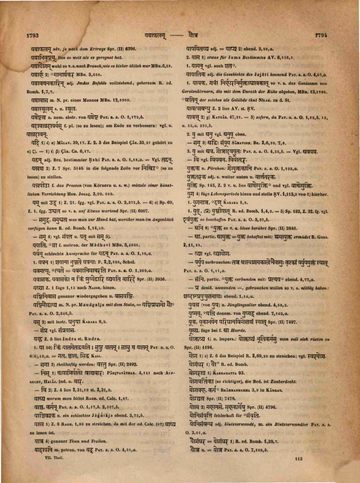
yóga — 1〉 m. (adj. Comp. f. ā) — a〉 das Anschirren. yogo yogaḥ so v. a. angespannt! angespannt! — b〉 Anschirrung, so v. a. Fahrt. — c〉 Gespann, Gefährt, Geschirr Chr. 85,8. — d〉 das Rüsten (eines Heeres). — e〉 das Auflegen (eines Pfeiles) MBH. 6,112,5. — f〉 das Anstellen, Inswerksetzen, Ausführung, Anwendung, Gebrauch, — von (Gen. oder im Comp. vorangehend). — g〉 Anwendung eines Medicaments, Mittel, Kur. — h〉 Mittel überh., — zu (Dat.). schlaues Mittel, Kniff. yogena unter Anwendung eines Mittels, auf eine schlaue Weise; bahubhiryogaiḥ durch verschiedene Mittel. — i〉 ein übernatürliches Mittel, Zauber. — k〉 Betrug; am Anfange eines Comp. so v. a. pseudo —. — l〉 Unternehmen, Werk, Geschäft, That. — m〉 Gelegenheit. — n〉 Verbindung, Vereinigung, das Zusammentreffen, Berührung, — mit (Instr., Instr. mit saha oder im Comp. vorangehend). yogam mit i sich einigen, sich fügen, nachgeben. — o〉 Verbindung verschiedener Stoffe, Mischung, Gemisch. — p〉 Zusammenhang, Beziehung, Relation. ˚yogāt, ˚yogatas und ˚yogena vermittelst, in Folge von, gemäss. — q〉 Verbindung mit (Instr. oder im Comp. vorangehend), so v. a. das Theilhaftwerden. — r〉 Erwerb, Gewinn. — s〉 Zusammenstellung, Reihenfolge, Anordnung. — t〉 Summation, Summe. — u〉 das Passen zu einander, Angemessenheit. yogena und yogatas wie es sich gebührt, auf die richtige Weise. — v〉 Anspannung der Kräfte, Bemühung, Fleiss, Aufmerksamkeit. yogatas mit Anspannung der Kräfte u. s. w. tadyoga Adj. darin geübt, — erfahren ĀPAST. 2,10,10. pūrṇena (auch jalapūrṇena) yogena so v. a. aus vollem Herzen, aus unwiderstehlichem Drange. — w〉 Sammlung —, Concentration der Geistesthätigkeit, feste Richtung der Erkenntniss auf einen Punct, Meditation, Contemplation; die zur Kunstfertigkeit erhobene Contemplation; die systematische Begründung derselben, der Yoga als ein bestimmtes philosophisches System (als Gründer desselben gilt Yājñavalkya). Auch eine einzelne Handlung, welche dem Yoga förderlich ist. Der personificirte Yoga ist ein Sohn Dharmaʼs. — x〉 im Sāmkhya die Einheit der Seele und der Natur. — y〉 bei den Pāśupata die Verbindung der Einzelseele mit Gott oder der Allseele. — z〉 bei den Pāñcarātra Andacht, andächtiges Suchen Gottes. — aa〉 bei den Jaina Berührung mit der Aussenwelt. [Page5-150-b] — bb〉 Etymologie, Ableitung der Bedeutung eines Wortes aus seiner Wurzel, die aus der Etymologie sich ergebende Bedeutung eines Wortes. — cc〉 Abhängigkeit eines Wortes von einem andern, Rection, Construction. — dd〉 eine grammatische Regel. — ee〉 in der Astr. — α〉 Conjunction. — β〉 Constellation. — γ〉 eine best. Zeiteintheilung; es wird eine Gruppe von 27 und eine andere von 28 angenommen — ff〉 ein Anhänger des Yoga-Systems ŚAṂK. zu BĀDAR. 2,1,3. — gg〉 *einer der das Vertrauen missbraucht, Verräther; vgl. 1〉k〉. — hh〉 *Späher. — ii〉 N. pr. eines Autors. — 2〉 f. yogā — a〉 eine best. Śakti. — b〉 Bein. der Pīvarī, einer Tochter der Manen Barhiṣad.
Apte 1890 Substantiv Maskulin
Originaltext · Englisch · Substantiv Maskulin
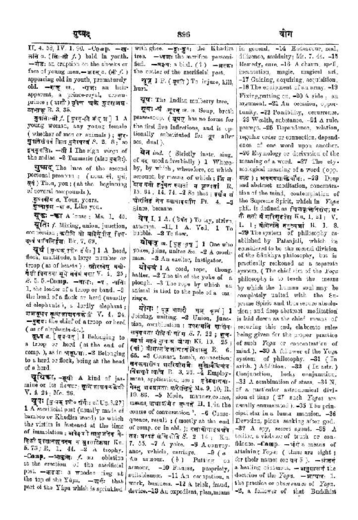
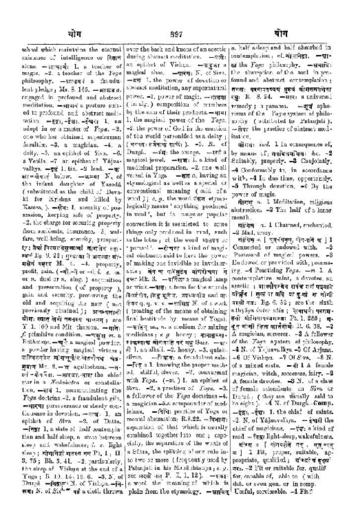
yogaḥ [yuj bhāvādau ghañ kutvaṃ] 1 Joining, uniting. 2 Union, junction, combination; uparāgāṃte śaśinaḥ samupagatā rohiṇī yogaṃ Ś. 7. 22; guṇamahatāṃ mahate guṇāya yogaḥ Ki. 10. 25; (vāṃ) yogastaḍittoyadayorivāstu R. 6. 65. 3 Contact, touch, connection; tamaṃkamāropya śarīrayogajaiḥ sukhairniṣiṃcaṃtamivāmṛtaṃ tvaci R. 3. 26. 4 Employment, application, use; etairupāyayogaistu śakyāstāḥ parirakṣituṃ Ms. 9. 10; R. 10. 86. 5 Mode, manner, course, means, kathāyogena budhyate H. 1. ‘in the course of conversation’. 6 Consequence, result; (mostly at the end of comp. or in abl.); rakṣāyogādayamapi tapaḥ pratyahaṃ saṃcinoti Ś. 2. 14; Ku. 7. 55. 7 A yoke. 8 A conveyance, vehicle, carriage. 9 (a) An armour. (b) Putting on armour. 10 Fitness, propriety, suitableness. 11 An occupation, a work, business. 12 A trick, fraud, device. 13 An expedient, plan, means ([Page 0896-c]) in general. 14 Endeavour, zeal, diligence, assiduity; Ms. 7. 44. 15 Remedy, cure. 16 A charm, spell, incantation, magic, magical art. 17 Gaining, acquiring, acquisition. 18 The equipment of an army. 19 Fixing, putting on. 20 A side; an argument. 21 An occasion, opportunity. 22 Possibility, occurrence. 23 Wealth, substance. 24 A rule, precept. 25 Dependence, relation, regular order or connection, dependence of one word upon another. 26 Etymology or derivation of the meaning of a word. 27 The etymological meaning of a word (opp. rūḍhi); avayavaśaktiryogaḥ. 28 Deep and abstract meditation, concentration of the mind, contemplation of the Supreme Spirit, which in Yoga phil. is defined as cittavṛttinirodha; satī satī yogavisṛṣṭadehā Ku. 1. 21; V. 1. 1; yogenāṃte tanutyajāṃ R. 1. 8. 29 The system of philosophy esablished by Patañjali, which its considered to be the second division of the Sāṃkhya philosophy, but is practically reckoned as a separate system. (The chief aim of the Yoga philosophy is to teach the means by which the human soul may be completely united with the Supreme Spirit and thus secure absolution; and deep abstract meditation is laid down as the chief means of securing this end, elaborate rules being given for the proper practice of such Yoga or concentration of mind). 30 A follower of the Yoga system of philosophy. 31 (In arith.) Addition. 32 (In astr.) Conjunction, lucky conjunction. 33 A combination of stars. 34 N. of a particular astronomical division of time (27 such Yogas are usually enumerated). 35 The principal star in a lunar mansion. 36 Devotion, pious seeking after god. 37 A spy, secret agent. 38 A traitor, a violator of truth or confidence. Comp. — aṃgaṃ a means of attaining Yoga: (these are eight; for their names see yama 5). — aṃjanaṃ a healing ointment. — anuśāsanaṃ the doctrine of the Yoga. — ācāraḥ 1 the practice or observance of Yoga. 2 a follower of that Buddhist ([Page 0897-a]) school which maintains the eternal existence of intelligence or vijñāna alone. — ācāryaḥ 1 a teacher of magic. 2 a teacher of the Yoga philosophy. — ādhamanaṃ a fraudulent pledge; Ms. 8. 165. — ārūḍha a. engaged in profound and abstract meditation. — āsanaṃ a posture suited to profound and abstract meditation. — iṃdraḥ, -īśaḥ, -īśvaraḥ 1 an adept in or a master of Yoga. 2 one who has obtained superhuman faculties. 3 a magician. 4 a deity. 5 an epithet of Śiva. 6 a Vetāla. 7 an epithet of Yājṇavalkya. — iṣṭaṃ 1 tin. 2 lead. — ka kṣā = yogapaṭṭaṃ below. — kanyā N. of the infant daughter of Yaśodā (substituted as the child of Devakī for Kṛṣṇa and killed by Kaṃsa.). — kṣemaḥ 1 security of possession, keeping safe of property. 2 the charge for securing property from accidents, insurance. 3 welfare, well-being, security, prosperity; teṣāṃ nityābhiyuktānāṃ yogakṣemaṃ vahāmyahaṃ Bg. 9. 22: mugdhāyā me jananyā yogakṣemaṃ vahasva M. 4. 4 property, profit, gain. ( — mau, -me or — maṃ, i. e. m. or n. dual or n. sing.) acquisition and preservation (of property), gain and security, preserving the old and acquiring the new (not previously obtained); alabhyalābho yogaḥ syāt kṣemo labdhasya pālanam; see Y. 1. 100 and Mit. thereon. — gatiḥ f. primitive condition. — cakṣus m. a Brāhmaṇa. — cūrṇaṃ a magical powder, a powder having magical virtues; kalpitamanena yogacūrṇāmiśritamauṣadhaṃ caṃdraguptāya Mu. 2. — jaṃ agallochum. — talpaṃ = yoganidrā. — tārakā, -tārā the chief star in a Nakṣatra or constellation. — dānaṃ 1 communicating the Yoga doctrine. 2 a fraudulent gift. — dhāraṇā perseverance or steady continuance in devotion. — nāthaḥ 1 an epithet of Śiva 2 of Datta. — nidrā 1 a state of half contemplation and half sleep, a state between sleep and wakefulness; i. e. light sleep; yoganidrāṃ gatasya mama Pt. 1; H. 3. 75; Bh. 3. 41. 2 particularly, the sleep of Viṣṇu at the end of a Yuga; R. 10. 14; R. 13. 6. 3 N. of Durgā. — nidrāluḥ N. of Viṣṇu. — nilayaḥ N. of Śiva. — paddaṃ a cloth thrown ([Page 0897-b]) over the back and knees of an ascetic during abstract meditation. — patiḥ an epithet of Viṣṇu. — pādukā a magical shoe. — pāraṃgaḥ N. of Śiva. — balaṃ 1 the power of devotion or abstract meditation, any supernatural power. 2 power of magic. — bhāvanā (in alg.) composition of numbers by the sum of their products. — māyā 1 the magical power of the Yoga. 2 the power of God in the creation of the world personified as a deity; (bhagavataḥ sarjanārthā śāktiḥ). 3 N. of Durgā. — raṃgaḥ the orange. — ratnaṃ a magical jewel. — rājaḥ 1 a kind of medicinal preparation. 2 one well versed in Yoga. — rūḍha a. having an etymological as well as a special or conventional meaning (said of a word); e. g. the word paṃkaja etymologically means ‘anything produced in mud’, but in usage or popular convention it is restricted to some things only produced in mud, such as the lotus; cf. the word ātapatra or ‘parasol’. — rocanā a kind of magical ointment said to have the power of making one invisible or invulnerable; tena ca parituṣṭena yogarocanā me dattā Mk. 3. — vartikā a magical lamp or wick. — vāhaḥ a term for the sounds visarjanīya, jihva mūlīya, upadhmānīya and nāsikya q.q. v.v. — vāsiṣṭhaṃ N. of a work (treating of the means of obtaining final beatitude by means of Yoga). — vāhin m., n. a medium for mixing medicines; e. g. honey; nānādravyātmakatvācca yogavāhi paraṃ madhu Suśr. — vāhī 1 an alkali. 2 honey. 3 quicksilver. — vikrayaḥ a fraudulent sale. — vid a. 1 knowing the proper method, skilful, clever. 2 conversant with Yoga. ( — m.) 1 an epithet of Śiva. 2 a practiser of Yoga. 3 a follower of the Yoga doctrines 4 a magician. 5 a compounder of medicines. — vidhiḥ practice of Yoga or mental abstraction; R. 8. 22. — vibhāgaḥ separation of that which is usually combined together into one; especially, the separation of the words of a Sūtra, the splitting of one rule into two or more (frequently used by Patañjali in his Mahābhāṣya; e. g. see adaso māt P. I. 1. 12). — śabdaḥ a word the meaning of which is plain from the etymology. — śāyin ([Page 0897-c]) a. half asleep and half absorbed in contemplation; cf. yoganidrā. — śāstraṃ the Yoga philosophy. — samādhiḥ the absorption of the soul in profound and abstract contemplation; tamasaḥ paramāpadavyayaṃ puruṣaṃ yogasamādhinā raghuḥ R. 8. 24. — sāraḥ a universal remedy; a panacea. — sūtraṃ aphorisms of the Yoga system of philosophy (attributed to Patañjali). — sevā the practice of abstract meditation.
Cappeller 1887 Substantiv Maskulin
Originaltext · Deutsch · Substantiv Maskulin
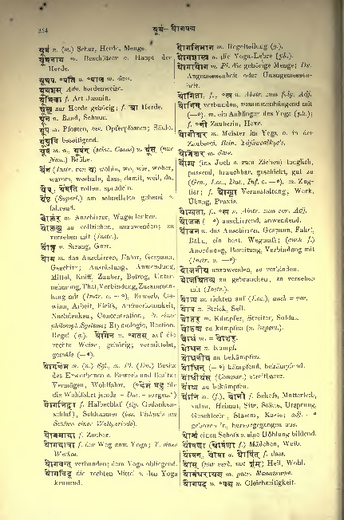
yóga m. das Anschirren, Fahrt, Gespann, Geschirr; Ausrüstung, Anwendung, Mittel, Kniff, Zauber, Betrug, Unter- nehmung, That, Verbindung, Zusammenhang mit (Instr. o.) —˚, Erwerb, Gewinn, Arbeit, Fleiß, Aufmerksamkeit, Nachdenken, Concentration, N. eines philosoph. Systems: Etymologie, Rection, Regel (g.). yogena u. ˚gatas auf die rechte Weise, gehörig; vermittelst, gemäßig (—˚).
Burnouf 1866 Substantiv Maskulin
Originaltext · Französisch · Substantiv Maskulin
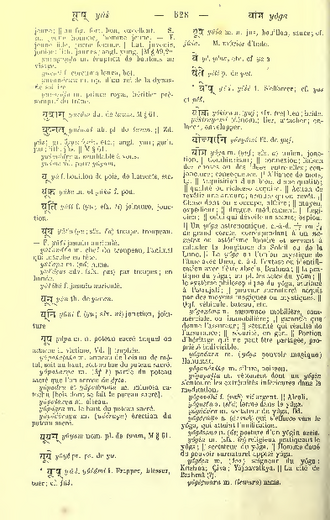
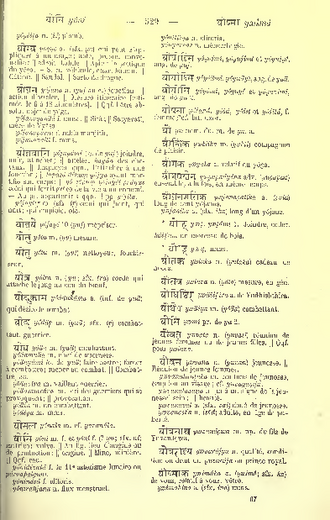
yoga yoga m. (yuj; sfx. a) union, jonction. Combinaison; connexion; liaison des choses ou des idées entre-elles; conjoncture; conséquence. Alliance de mots, tg. Acquisition d'un bien, d'une qualité; qualité ou richesse acquise. Action de revêtir une armure; armure qu'on revêt. Chose dont on s'occupe, affaire; moyen, expédient; drogue, médicament. Logicien; celui qui dévoile un secret; espion. Un yoga astronomique, c-à-d. 1/27 ou 1/28 de grand cercle, correspondant à un nakṣatra ou astérisme lunaire et servant à calculer la longitude du Soleil ou de la Lune. Le yoga ou l'union mystique de l'âme avec Dieu, c-à-d. l'extase ou identification avec l'être absolu, Brahma; la pratique du yoga; au pl. les actes du yoga; le système philosophique du yoga, attribué à Patañjali; pouvoir surnaturel acquis par des moyens magiques ou mystiques. Qqf. véhicule, bateau, etc. yogakṣema n. assurance mobilière, commerciale, ou immobilière; garantie que donne l'assureur; sécurité qui résulte de l'assurance; sécurité, en gén. Portion d'héritage qui ne peut être partagée, propriété indivisible. yogacara m. (yoga pouvoir magique) Hanumat. yoganāvika m. silure, poisson. yogapaṭṭa m. vêtement dont un yogin s'entoure les extrémités inférieures dans la méditation. yogavāhī f. (vah) vif-argent. Alcali. yogastha a. (sthā) ferme dans le yoga. yogācāra m. sectateur du yoga, Bd. yogārūḍha a. (ā; ruh) qui s'efforce vers le yoga, qui atteint l'unification. yogāsana n. (ās) posture d'un yogin assis. yogin m. (sfx. in) religieux pratiquant le yoga; sectateur du yoga. Homme doué du pouvoir surnaturel appelé yoga. yogeśa m. (īca) seigneur du yoga; Kṛṣṇa; Śiva; Yājñavalkya. La cité de Brahmā (?). yogeśvara m. (īśvara) mms. [Page529-1] yogeṣṭa n. (iṣ) plomb.
Abgeleitete Wörter
Quelltextfundstellen (420)
DYS 89 Fundstellen
DYS 1–1*1: Viṣṇu und Nṛsiṃha 2 Fundstellen
Direkt belegt
-
DYS 1 Segment 11
Über Ableitungen belegt
-
DYS 1 Segment 1
DYS 2–8: Suche nach dem Lehrer 3 Fundstellen
Direkt belegt
DYS 9–11: Vier Yogawege 5 Fundstellen
Direkt belegt
DYS 12–14: Mantrayoga 4 Fundstellen
Direkt belegt
Weitere 26 Quelltextseiten
DYS 39–42: Praxis zählt 4 Fundstellen
Direkt belegt
DYS 79–83: Kraft und Bhūcarasiddhi 3 Fundstellen
Über Ableitungen belegt
DYS 112–121: Fünf Elemente 6 Fundstellen
Über Ableitungen belegt
DYS 125–130: Jīvanmukti 2 Fundstellen
Direkt belegt
-
DYS 130 Segment 18
Über Ableitungen belegt
-
DYS 130 Segment 5
DYS 150–153*3: Vajrolī: Geheimlehre 5 Fundstellen
Direkt belegt
Über Ableitungen belegt
DYS 168–179*1: Vajrolī für die Yoginī 10 Fundstellen
Direkt belegt
-
DYS 175 Segment 14
-
DYS 176 Segment 2
-
DYS 177 Segment 4
-
DYS 177 Segment 14
-
DYS 178 Segment 4
-
DYS 178 Segment 12
-
DYS 179 Segment 3
-
DYS 179 Segment 5
-
DYS 179 Segment 13
Über Ableitungen belegt
-
DYS 179*1 Segment 6
DYS 180–183*1: Amarolī und Sahajolī 2 Fundstellen
Direkt belegt
-
DYS 180 Segment 5
Über Ableitungen belegt
-
DYS 183 Segment 12
DYS 184–187: Rājayoga und Niṣpatti 5 Fundstellen
Direkt belegt
Über Ableitungen belegt
-
DYS 186 Segment 15
GoS 9 Fundstellen
GoS 50–63: Drei Verschlüsse 3 Fundstellen
Über Ableitungen belegt
HP 110 Fundstellen
HP 1.4-1.10: Siddha-Linie 4 Fundstellen
Direkt belegt
Über Ableitungen belegt
HP 1.17-1.32: Āsana 2 Fundstellen
Direkt belegt
-
HP 1.22 Segment 11
Über Ableitungen belegt
-
HP 1.18 Segment 8
Weitere 40 Quelltextseiten
HP 1.50–54: Siṃhāsana und Bhadrāsana 2 Fundstellen
Über Ableitungen belegt
-
HP 1.50–52 Segment 40
-
HP 1.53–54 Segment 34
HP 1.55-1.57: Kumbhaka-Übergang 2 Fundstellen
Direkt belegt
-
HP 1.57 Segment 5
Über Ableitungen belegt
-
HP 1.57 Segment 4
HP 2.1-2.6: Prāṇāyāma-Einstieg 3 Fundstellen
Über Ableitungen belegt
HP 2.72-2.78: Kevala-Kumbhaka 5 Fundstellen
Direkt belegt
HP 3.33-3.48*1: Khecarī und Soma 5 Fundstellen
Direkt belegt
-
HP 3.40 Segment 16
Über Ableitungen belegt
-
HP 3.34 Segment 12
-
HP 3.34*1–34*2 Segment 29
-
HP 3.41 Segment 7
-
HP 3.46 Segment 33
HP 3.73-3.78: Viparīta Karaṇī 2 Fundstellen
Direkt belegt
-
HP 3.78 Segment 5
Über Ableitungen belegt
-
HP 3.78 Segment 14
HP 3.87-3.93*7: Sahajolī und Amarolī 9 Fundstellen
Direkt belegt
-
HP 3.89*1 Segment 4
-
HP 3.91*3 Segment 14
-
HP 3.93 Segment 12
-
HP 3.93*1 Segment 5
-
HP 3.93*5 Segment 16
-
HP 3.93*6 Segment 9
Über Ableitungen belegt
HP 3.94-3.102*1: Śakti-Cālana 4 Fundstellen
Über Ableitungen belegt
-
HP 3.96 Segment 4
-
HP 3.100 Segment 11
-
HP 3.101 Segment 5
-
HP 3.101*1 Segment 14
HP 3.103-3.107*2: Mudrā-Abschluss 5 Fundstellen
Direkt belegt
Über Ableitungen belegt
-
HP 3.106 Segment 7
HP 4.0*1-4.0*14: Samādhi und Laya 2 Fundstellen
Direkt belegt
-
HP 4.0*5 Segment 2
Über Ableitungen belegt
-
HP 4.0*8 Segment 8
HP 4.11*5-4.11*14: Khecarī im Raum 3 Fundstellen
Direkt belegt
-
HP 4.11*8 Segment 3
-
HP 4.11*12 Segment 6
-
HP 4.11*12 Segment 10
HP 4.20-4.27: Vier Nāda-Stufen 3 Fundstellen
Direkt belegt
-
HP 4.27 Segment 6
Über Ableitungen belegt
HP 4.27*1-4.35: Rājayoga und Haṭha 6 Fundstellen
Direkt belegt
HP 4.35*1-4.36: Samādhi-Zeichen 5 Fundstellen
Über Ableitungen belegt
HP 4.37-4.46: Nāda-Hören 2 Fundstellen
Direkt belegt
-
HP 4.37 Segment 10
Über Ableitungen belegt
-
HP 4.39 Segment 12
HTK 8 Fundstellen
HTK 10.6*2–9*1: Ujjāyī / Ujjāyikā und Sūryabheda 1 Fundstelle
Über Ableitungen belegt
-
HTK 10.8 Segment 16
HTK 10.17*2–18: Bhrāmarī: Der Klang der Bienen 2 Fundstellen
Direkt belegt
-
HTK 10.18 Segment 16
Über Ableitungen belegt
-
HTK 10.18 Segment 12
HTK 10.19*2–21*1: Plāvanī: Auf dem Wasser getragen 1 Fundstelle
Über Ableitungen belegt
-
HTK 10.20 Segment 13
HTK 10.42–43: Meru: Drei Stufen des Atemanhaltens 2 Fundstellen
Direkt belegt
MAN 1 Fundstelle
PYS 5 Fundstellen
SiSa 186 Fundstellen
SiSa 1.17-1.19: Geheime Yoga-Lehre 2 Fundstellen
Direkt belegt
SiSa 1.20-1.31: Karma und Erkenntnis 2 Fundstellen
Direkt belegt
-
SiSa 1.30 Segment 14
Über Ableitungen belegt
-
SiSa 1.31 Segment 5
Weitere 58 Quelltextseiten
SiSa 2.13-2.20: Suṣumṇā und Citrā 2 Fundstellen
Über Ableitungen belegt
SiSa 3.1-3.10: Herzlotus und Prāṇa 3 Fundstellen
Direkt belegt
Über Ableitungen belegt
-
SiSa 3.10 Segment 11
SiSa 3.17-3.20: Praxisbeginn 3 Fundstellen
Direkt belegt
Über Ableitungen belegt
-
SiSa 3.20 Segment 3
SiSa 3.21-3.31: Nāḍī-Reinigung 7 Fundstellen
Direkt belegt
Über Ableitungen belegt
SiSa 3.32-3.33: Praxis-Hindernisse 3 Fundstellen
Direkt belegt
-
SiSa 3.32 Segment 4
Über Ableitungen belegt
SiSa 3.34-3.38: Förderliche Mittel 3 Fundstellen
Direkt belegt
-
SiSa 3.34 Segment 5
Über Ableitungen belegt
SiSa 3.39-3.40: Kumbhaka-Kraft 4 Fundstellen
Über Ableitungen belegt
SiSa 3.41-3.48: Atemkraft und Hindernisse 6 Fundstellen
Direkt belegt
-
SiSa 3.43 Segment 4
Über Ableitungen belegt
SiSa 3.51-3.54: Prāṇāyāma-Siddhis 2 Fundstellen
Über Ableitungen belegt
SiSa 3.61-3.67: Paricaya und Niṣpatti 6 Fundstellen
Direkt belegt
-
SiSa 3.61 Segment 14
Über Ableitungen belegt
SiSa 3.68-3.80: Vāyusādhana 3 Fundstellen
Über Ableitungen belegt
SiSa 3.95-3.97: Svastikāsana 2 Fundstellen
Über Ableitungen belegt
SiSa 4.9-4.20: Yonimudrā-Geheimnis 3 Fundstellen
Direkt belegt
Über Ableitungen belegt
-
SiSa 4.13 Segment 3
SiSa 4.31-4.36: Mahāmudrā-Wirkung 4 Fundstellen
Direkt belegt
-
SiSa 4.34 Segment 12
Über Ableitungen belegt
SiSa 4.37-4.42: Mahābandha 4 Fundstellen
Über Ableitungen belegt
SiSa 4.43-4.50: Mahāvedha 3 Fundstellen
Über Ableitungen belegt
SiSa 4.64-4.68: Mūlabandha 2 Fundstellen
Über Ableitungen belegt
SiSa 4.72-4.77: Uḍḍyānabandha 3 Fundstellen
Über Ableitungen belegt
SiSa 4.78-4.80: Vajrolī-Weg 4 Fundstellen
Direkt belegt
Über Ableitungen belegt
-
SiSa 4.80 Segment 14
SiSa 4.81-4.90: Bindu-Bewahrung 6 Fundstellen
Direkt belegt
-
SiSa 4.85 Segment 5
Über Ableitungen belegt
SiSa 4.91-4.94: Vajrolī-Siddhi 4 Fundstellen
Direkt belegt
Über Ableitungen belegt
SiSa 4.95-4.100: Sahajolī und Amarolī 4 Fundstellen
Direkt belegt
-
SiSa 4.99 Segment 2
Über Ableitungen belegt
SiSa 4.105-4.111: Śakticālana 2 Fundstellen
Über Ableitungen belegt
-
SiSa 4.107 Segment 12
-
SiSa 4.110 Segment 12
SiSa 5.17-5.20: Madhya und Layayoga 2 Fundstellen
Direkt belegt
SiSa 5.21-5.23: Adhimātra und Haṭhayoga 2 Fundstellen
Direkt belegt
SiSa 5.38-5.47: Nāda-Laya 4 Fundstellen
Direkt belegt
Über Ableitungen belegt
SiSa 5.48-5.71: Innere Meditation 14 Fundstellen
Direkt belegt
Über Ableitungen belegt
SiSa 5.121-5.127: Viśuddha 2 Fundstellen
Über Ableitungen belegt
-
SiSa 5.123 Segment 3
-
SiSa 5.124 Segment 4
SiSa 5.144-5.155: Ājñā und Khecarī 5 Fundstellen
Direkt belegt
-
SiSa 5.144 Segment 15
-
SiSa 5.154 Segment 2
Über Ableitungen belegt
-
SiSa 5.146 Segment 4
-
SiSa 5.148 Segment 3
-
SiSa 5.154 Segment 9
SiSa 5.156-5.181: Sahasrāra 4 Fundstellen
Über Ableitungen belegt
-
SiSa 5.163 Segment 14
-
SiSa 5.174 Segment 14
-
SiSa 5.179 Segment 6
-
SiSa 5.181 Segment 6
SiSa 5.182-5.190: Sahasrāra-Mond 4 Fundstellen
Direkt belegt
-
SiSa 5.190 Segment 3
-
SiSa 5.190 Segment 17
Über Ableitungen belegt
-
SiSa 5.183 Segment 4
-
SiSa 5.190 Segment 21
SiSa 5.191-5.207: Kailāsa und Mahāśūnya 7 Fundstellen
Direkt belegt
-
SiSa 5.193 Segment 17
Über Ableitungen belegt
-
SiSa 5.194 Segment 12
-
SiSa 5.195 Segment 12
-
SiSa 5.196 Segment 11
-
SiSa 5.197 Segment 5
-
SiSa 5.199 Segment 11
-
SiSa 5.200 Segment 6
SiSa 5.208-5.222: Rājayoga 9 Fundstellen
Direkt belegt
-
SiSa 5.208 Segment 2
-
SiSa 5.208 Segment 11
-
SiSa 5.222 Segment 4
-
SiSa 5.222 Segment 6
Über Ableitungen belegt
-
SiSa 5.212 Segment 6
-
SiSa 5.213 Segment 24
-
SiSa 5.215 Segment 10
-
SiSa 5.218 Segment 12
-
SiSa 5.222 Segment 20
SiSa 5.223-5.233: Praxis im Leben 3 Fundstellen
Direkt belegt
-
SiSa 5.231 Segment 5
-
SiSa 5.233 Segment 5
Über Ableitungen belegt
-
SiSa 5.233 Segment 10
SiSa 5.234-5.252: Tripurā-Mantra 3 Fundstellen
Über Ableitungen belegt
-
SiSa 5.236 Segment 13
-
SiSa 5.251 Segment 4
-
SiSa 5.251 Segment 12
SiSa 5.253-5.260: Haushalter-Abschluss 6 Fundstellen
Direkt belegt
-
SiSa 5.255 Segment 9
-
SiSa 5.258 Segment 14
-
SiSa 5.259 Segment 8
-
SiSa 5.260 Segment 11
Über Ableitungen belegt
-
SiSa 5.254 Segment 5
-
SiSa 5.257 Segment 13
SS 1 Fundstelle
SVU 8 Fundstellen
SVU 2.12-2.13: Zeichen des Yogafeuers 3 Fundstellen
Direkt belegt
Mit AYI Free weitermachen
Bildquelle: AYI Archiv.