

nis निस् – out; away; without
adverb · particle · previx · Preposition · verbal root · Word type unspecified
Dictionary sources
AYI dictionary previx
out; away; without
Cappeller 1891 Preposition
Original text · English · Preposition
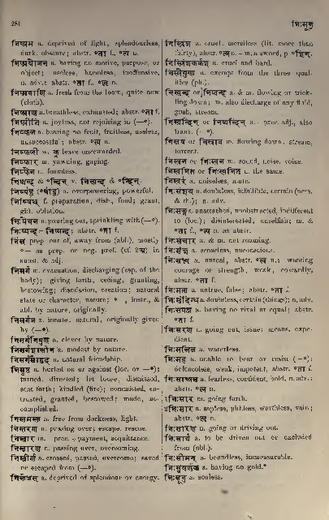
nís ·prep. out of, away from (abl.), mostly °-- as prep. or neg. pref. (cf. a2) in subst. & adj.
Monier-Williams 1872 particle
Original text · English · particle
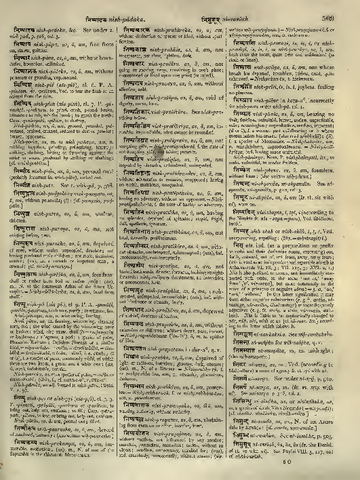
nis nis, ind. (as a preposition or prefix to verbs and their derivative nouns, expressing) out, forth, outward, out of, out from, away, away from; (nis is used as an independent and separable adverb in Atharva-veda VI. 18, 3; VII. 115, 3; XVI. 2, 1.) Nis is also prefixed to nouns, not immediately con- nected with verbs, in the sense ‘out of,’ ‘away from’ [cf. nir-vana], but more commonly in the sense of a privative or negative adverb = 3. a, ‘no,’ ‘not,’ ‘without.’ In this latter signification it may form either negative substantives (e. g. fr. artha, ad- vantage, nir-artha, disadvantage) or more frequently adjectives (e. g. fr. mala, a stain, nir-mala, stain- less). Nis is liable to be euphonically changed to nir, niḥ, niś, niṣ or nī [cf. nī-rasa, &c.] accord- ing to the letter which follows it.
Petersburger 1855 adverb
Original text · German · adverb
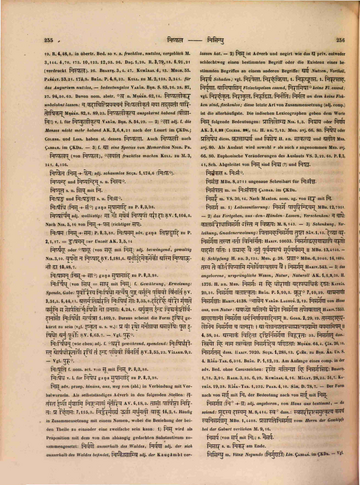
√nis adv. praep. hinaus, aus, weg von (abl.) in Verbindung mit Verhalwurzeln. Als selbstständiges Adverb in den folgenden Stellen: tatàsta ī̱rṣyāṃ mùñcāmi̱ nirū̱ṣmāṇa̱ṃ nṛtèriva AV. 6,18,3. tāsā̱ṃ pāpìṣṭhā̱ṃ niri̱taḥ pra hìṇmaḥ AV. 6,18,7. AV. 6,115,3. nirdùrarma̱ṇyà ū̱rjā madhùmatī̱ vāk AV. 16,2,1. Häufig in Zusammensetzung mit einem Nomen, wobei die Beziehung der beiden Theile zu einander eine zweifache sein kann: 1〉 nis wird als Praposition mit dem von ihm abhängig gedachten Substantivum zusammengesetzt: nirvaṇe ausserhalb des Waldes. nirvaṇa adj. der sich ausserhalb des Waldes befindet. niṣkauśāmbi adj. der Kauśāmbi verlassen hat. — 2〉 nis ist Adverb und negirt wie das a priv. entweder schlechtweg einen bestimmten Begriff oder die Existenz eines bestimmten Begriffes an einem anderen Begriffe: artha Nutzen, Vortheil, nirartha Schaden; vgl. nirapekṣā, nirahaṃkriyā, 1. nirucchvāsa, 1. nirutsāha, nirghṛṇā. āmiṣāśin Fleischspeisen essend, nirāmiṣā˚ keine Fl. essend; vgl. nirahaṃkṛta, nirākula, nirudvigna, nirbhīti; nirmala an dem keine Flecken sind, fleckenlos; diese letzte Art von Zusammensetzung (adj. comp.) ist die allerhäufigste. Die indischen Lexicographen geben dem Worte nis folgende Bedeutungen: prātilomya NIR. 1,3. niścaya oder nirṇaya AK. 3,4,32,14. (COLEBR. 3,4,28,14). H. an. 7,13. MED. avy. 66. MED. avy. 80. niṣedha oder pratiṣedha diess. krāntādyartha und viśeṣa H. an. sākalya und atīta MED. avy. 80. Als Auslaut wird sowohl r als auch s angenommen MED. avy. 66. MED. avy. 80. Euphonische Veränderungen des Auslauts VS. 3,22. VS. 3,68. P. 8,3,41, Sch. Abgeleitet von nis sind niśca (?) und niṣṭya.⫽print_change
Böhtlingk 1879 adverb · particle
Original text · German · adverb · particle
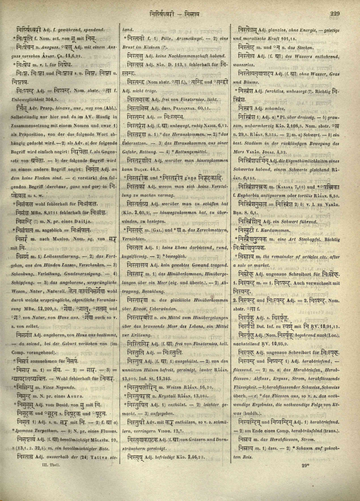
nís Adv. Praep. hinaus, aus, weg von (Abl.). Selbständig nur hier und da im AV. Häufig in Zusammensetzung mit einem Nomen und zwar — 1〉 als Präposition, von der das folgende Wort abhängig gedacht wird. — 2〉 als Adv. — a〉 der folgende Begriff wird einfach negirt: nirapekṣā f. als Gegensatz von apekṣā — b〉 der folgende Begriff wird an einem andern Begriff negirt: nirmala Adj. an dem keine Flecken sind. — c〉 verstärkt den folgenden Begriff (durchaus, ganz und gar) in niṣkevala u. s. w.
Apte 1890 particle
Original text · English · particle
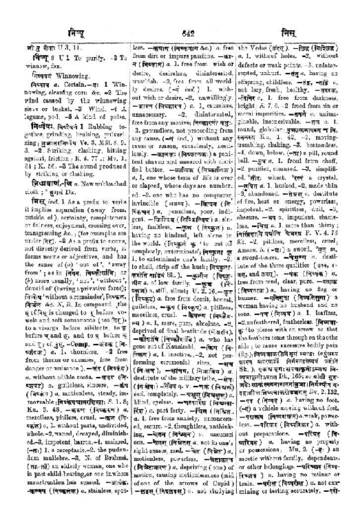
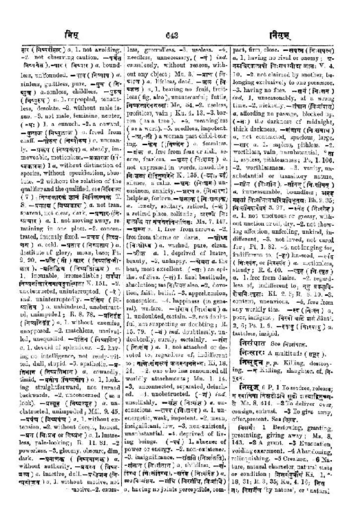
nis ind. 1 As a prefix to verbs it implies separation (away from, outside of), certainty, completeness or fulness, enjoyment, crossing over, transgressing &c.; (for examples see under nir). 2 As a prefix to nouns, not directly derived from verbs, it forms nouns or adjectives, and has the sense of (a) ‘out of’, ‘away from’; as in nirvana, niṣkauśāṃbi; or (b) more usually, ‘not’, ‘without’, devoid of’ (having a privative force); niḥśeṣa ‘without a remainder’; niṣphala, nirjala &c. N. B. In compound the s of nis is changed to r before vowels and soft consonants (see nir), to a visarga before sibilants, to ś before c and ch, and to ṣ before k and p; cf. dus. Comp. — kaṃṭaka ( niṣkaṃṭaka) a. 1 thornless. 2 free from thorns or enemies, free from danger or nuisance. — kaṃda (niṣkaṃda) a. without edible roots. — kapaṭa ( nipkapaṭa) a. guileless, sincere. — kaṃpa (niṣkaṃpa) a. motionless, steady, immovable; niṣkaṃpacāmaraśikhāḥ Ś. 1. 8; Ku. 3. 48. — karuṇa (niṣkaruṇa) a. merciless, pitiless, cruel. — kala ( niṣkaṃla) a. 1 without parts, undivided, whole. 2 waned, decayed, diminished. 3 impotent, barren. 4 maimed. — (laḥ) 1 a receptacle. 2 the pudendum muliebre. 3 N. of Brahmā. (lā, -lī) an elderly woman, one who is past child-bearing, or one in whom menstruation has ceased. — kalaṃka, — kalmaṣa (niṣkalaṃka) a. stainless, ([Page 0642-b]) spotless. — kaṣāya (niṣkaṣāya &c.) a. free from dirt or impure passions. — kāma (niṣkāma) a. 1 free from wish or desire, desireless, disinterested, unselfish. 2 free from all worldly desires. ( — maṃ ind.) 1 without wish or desire. 2 unwillingly. — kāraṇa (niṣkāraṇa) a. 1 causeless, unnecessary. 2 disinterested, free from any motive; niṣkāraṇo baṃdhuḥ. 3 groundless, not proceeding from any cause. ( — ṇaṃ ind.) without any cause or reason, causelessly, needlessly. — kālakaḥ (niṣkālakaḥ) a penitent shaven and smeared with clarified butter. — kālika (niṣkālika) a. 1 one whose term of life is over or elapsed, whose days are numbered. 2 one who has no conqueror, invincible (ajayya). — kiṃcana ( niṣkiṃcana) a. penniless, poor, indigent. — kilviṣa (niṣkilviṣa) a. sinless, faultless. — kula (niṣkula) a. having no kindred, left alone in the world. (niṣkulaṃ kṛ ‘to cut off completely, exterminate’ niṣkulā kṛ 1 to exterminate one's family. 2 to shell, strip off the husk; niṣkulākarāṃti dāḍimaṃ Sk.). — kulīna ( niṣkulīna a.) of low family. — kūja ( niṣkūja) a. still, silent; U. 2. 16. — kūṭa (niṣkūṭa) a. free from deceit, honest, guileless. — kṛpa (niṣkṛpa) a. pitiless, merciless, cruel. — kaivalya ( niṣkaivalya) a. 1 mere, pure, absolute. 2 deprived of final beatitude (mokṣahīna). — kauśāṃbi (niṣkauśāṃbi) a. who has gone out of Kauśāmbī. — kriya ( niṣkriya) a. 1 inactive. 2 not performing ceremonial rites. — kṣatra (niḥkṣatra), — kṣatriya, (niḥkṣatriya) a. destitute of the military tribe. — kṣepaḥ (niḥkṣepaḥ) = nikṣepa q. v. — cakraṃ (niścakraṃ) ind. completely. — cakṣus (niścakṣus) a. blind, eyeless. — catvāriṃśa ( niścatvāriṃśa) a. past forty. — ciṃta (niściṃta) a. 1 free from anxiety, unconcerned, secure. 2 thoughtless, unthinking. — cetana (niścetana) a. unconscious. — cetas (niścetas) a. not in one's right senses, mad. — ceṣṭa (niśceṣṭa) a. motionless, powerless. — ceṣṭākaraṇa (niśceṣṭākaraṇa) a. depriving (one) of motion, causing motionlessness (said of one of the arrows of Cupid) — chaṃdas (niśchaṃdas) a. not studying ([Page 0642-c]) the Vedas (chaṃdas). — chidra (niśchidra) a. 1 without holes. 2 without defects or weak points. 3 uninterrupted, unhurt. — taṃtu a. having no offspring, childless. — taṃdra, -taṃdri a. not lazy, fresh, healthy. — tamaska, timira a. 1 free from darkness, bright; Ś. 7. 6. 2 freed from sin or moral impurities. — tarkya a. unimaginable, inconceivable. — tala a. 1 round, globular; muktākalāpasya ca ni, stalasya Ku. 1. 42. 2 movingtrembling, shaking. 3 bottomless. 4 down, below. — (lā) a pill, round ball. — tuṣa a. 1 freed from chaff. 2 purified, cleansed. 3 simplified. ˚kṣīraḥ wheat. ˚ratnaṃ a crystal. — tuṣita a. 1 husked. 2 made thin 3 abandoned. — tejas a. destitute of fire, heat or energy, powerless, impotent. 2 spiritless, dull. 3 obscure. — trapa a. impudent, shameless. — triṃśa a. 1 more than thirty; nistriṃśāni varṣāṇi caitrasya P. V. 4. 73 Sk. 2 pitiless, merciless, cruel; Amaru. 5. — (śaḥ) a sword ˚bhṛt m. a sword-bearer. — traiguṇya a. destitute of the three qualities (sattva, rajas, and tamas). — paṃka (niṣpaṃka) a. free from mud, clear, pure. — patāka (niṣpatāka) a. having no flag or banner. — patisutā (niṣpatisutā) a woman having no husband and no sons. — patra (niṣpatra) a. 1 leafless. 2 unfeathered, featherless. niṣpatrākṛ ‘to pierce with an arrow so that the feathers come through on the other side; to cause excessive bodily pain (fig.); niṣpatrākaroti mṛgaṃ vyādhaḥ (sapuṃkhasya śarasya aparapārśve nirgamanānniṣpatraṃ karoti Sk.); ekaśca mṛgaḥ sapatrākṛto'nyaśca niṣpatrākṛto'patat Dk. 165; so yāṃtī gurujanaiḥ sākaṃsmayamānānanāṃbujā . tiryaggrīvaṃ yadadrākṣīttanniṣpatrākarojjagat Bv. 2. 132. — pada (niṣpada) a. having no foot. — (daṃ) a vehicle moving without feet. — parākrama (niṣparākrama) a. weak, powerless. — parikara (niṣparikara) a. without preparations. — parigraha ( niṣparigraha) a. having no property or possessions; Mu. 2. — (haḥ) an ascetic without family, dependents, or other belongings — paricchada ( niṣparicchada) a. having no retinue or train. — parīkṣa (niṣparīkṣa) a. not examining or testing accurately. ([Page 0643-a]) — parīhāra (niṣparīhāra) a. 1 not avoiding. 2 not observing caution. — paryaṃta (niṣparyaṃta), — pāra (niṣpāra) a. boundless, unbounded. — pāpa (niṣpāpa) a. sinless, guiltless, pure. — putra ( niṣputra) a. sonless, childless. — puruṣa (niṣpuruṣa) a. 1 unpeopled, tenantless, desolate. 2 without male issue. 3 not male, feminine, neuter. — (ṣaḥ) 1 a eunuch. 2 a coward. — pulāka (niṣpulāka) a. freed from chaff. — pauruṣa (niṣpauruṣa) a. unmanly. — prakaṃpa (niṣprakaṃpa) a steady, immovable, motionless. — prakāraka ( niṣprakāraka) 1 a. without distinction of species, without specification, absolute. 2 without the relation of the qualifier and the qualified, see nirvikalpa (7); niṣprakārakaṃ jñānaṃ nirvikalpakaṃ T. S. — prakāśa (niṣprakāśa) a. not transparent, not clear, dark. — pracāra ( niṣpracāra) a. 1 not moving away, remaining in one place. 2 concentrated, intently fixed. — praṇaya ( niṣpraṇaya) a. cold. — pratāpa (niṣpratāpa) a. destitute of glory, mean, base; Pt. 2. 90. — prati (tī) kāra (niṣprati-tīkāra), -pratikriya (niṣpratikriya) a. 1 incurable, irremediable; sarvathā niṣpratīkāreyamāpadupasthitā K. 151. 2 unobstructed, uninterrupted. — (raṃ) ind. uninterruptedly. — pratigha ( niṣpratigha) a. unhindered, unobstructed, unimpeded; R. 8. 78. — pratidvaṃdva (niṣpratidvaṃdva) a. 1 without enemies, unopposed. 2 matchless, unrivalled, unequalled. — pratibha (niṣpratibha) a. 1 devoid of splendour. 2 having no intelligence, not ready-witted, dull, stupid. 3 apathetic. — pratibhāna (niṣpratibhāna) a. cowardly, timid. — pratīpa (niṣpratīpa) a. 1 looking straightforward, not turned backwards. 2 unconcerned (as a look). — pratyūha (niṣpratyūha) a. unobstructed, unimpeded; Māl. 9. 45. — prapaṃca (niṣprapaṃca) a. 1 without extension. 2 without deceit, honest. — prabha (niḥprabha or niṣprabha) a. 1 lustreless, pale looking; R. 11. 81. 2 powerless. 3 gloomy, obscure, dim, dark. — pramāṇaka (niṣpramāṇaka) a. without authority. — prayatna ( niṣprayatna) a. inactive, dull. — prayojana ( niṣprayojana) a. 1 without motive, not influenced by any motive. 2 ([Page 0643-b]) causeless, groundless. 3 useless. 4 needless, unnecessary. — (naṃ) ind. causelessly, without reason, without any object; Mu. 3. — prāṇa ( niṣpāṇa) a. lifeless, dead. — phala ( niṣphala) a. 1 bearing no fruit, fruitless (fig. also), unsuccessful; futile; niṣphalāraṃbhayatnāḥ Me. 54. 2 useless, profitless, vain; Ku. 4. 13. 3 barren (as a tree). 4 meaningless (as a word). 5 seedless, impotent. — (lā, -lī) a woman past child-bearing. — phena (niṣphena) a. foamless. — śaṃka a. free from fear or risk, secure, fearless. — śabda (niḥśabda) a. not expressed in words, inaudible; niḥśabdaṃ roditumāreme K. 135. — (bdaḥ, bdaṃ) silence, a calm. — śamaḥ (niḥśamaḥ) uncasiness, anxiety. — śaraṇa a. (niḥśaraṇa) helpless, forlorn. — śalāka (niḥśalāka) a. lonely, solitary, retired. — (kaṃ) a retired place, solitude; araṇye niḥ śalāke vā maṃtraṃyadavibhāvitaḥ Ms. 7. 147. — śalya a. 1 free from arrows. 2 free from thorns or darts. — śodhya (niḥśodhya) a. washed, pure, clean. — śrīka a. 1 deprived of lustre, beauty. 2 unhappy. — śreyasa a. the best, most excellent. — (saḥ) an epithet of Śiva. — (saṃ) 1 final beatitude, absolution; see niḥśreyasa also. 2 devotion, faith, belief. 3 apprehension, conception. 4 happiness (in general), welfare. — saṃśaya (niḥsaṃśaya) a. 1 undoubted, certain. 2 not doubtful, not suspecting or doubting; R. 15. 79. — (yaṃ) ind. doubtlessly, undoubtedly, surely, certainly. — saṃga (niḥsaṃga) a. 1 not attached or devoted to, regardless of, indifferent to; yanniḥsaṃgastvaṃ phalasyānatebhyaḥ Ki. 18. 24. 2 one who has renounced all worldly attachments; Mu. 1. 14. 3 unconnected, separated, detached. 4 unobstructed. — (gaṃ) ind. unselfishly. — saṃjña (niḥsaṃjña) a. unconscious. — sattva (niḥsattva) a. 1 unenergetic, weak, impotent. 2 mean, insignificant, low. 3 non-existent, unsubstantial. 4 deprived of living beings. — (ttvaṃ) 1 absence of power or energy. 2 non-existence. 3 insignificance. — saṃtati (niḥsaṃtati), — saṃtāna (niḥsaṃtāna) a. childless. — saṃdigdha (niḥsaṃdigdha), -saṃdeha (niḥsaṃdeha) a. see niḥsaṃśaya. — saṃdhi (nissaṃdhi, niḥsaṃdhi) a. having no joints perceptible, ([Page 0643-c]) compact, firm, close. — sapatna (niḥsapatna) a. 1 having no rival or enemy; ghanarucirakalāpo niḥsapatnodya jātaḥ V. 4. 10. 2 not claimed by another, belonging exclusively to one possessor. 3 having no foes. — samaṃ (niḥsamaṃ) ind. 1 unseasonably, at a wrong time. 2 wickedly. — saṃpāta (niḥsaṃpāta) a. affording no passage, blocked up. — (taḥ) the darkness of midnight, thick darkness. — saṃbādha (niḥsaṃbādha) a. not contracted, spacious, large. — sāra a. 1 sapless, pithless. 2 worthless, vain, unsubstantial. ˚tā 1 sapless, pithlessness; Pt. 1. 106. 2 worthlessness. 3 vanity, unsubstantial or transitory nature. — sīma (niḥsīma), -sīman (niḥsīman) a. immeasurable, boundless; ahaha mahatāṃ niḥsīmānaścaritravibhūtayaḥ Bh. 2. 35; niḥsīmaśarmapradaṃ Bh. 3. 97. — sneha (niḥsneha) a. 1 not unctuous or greasy, without unction or oil, dry. 2 not showing affection, unfeeling, unkind, indifferent. 3 not loved, not cared for; Pt. 1. 82. 4 not longing for, indifferent to. — (hā) lin-seed. — spaṃda (niḥspaṃda, or nisspaṃda) a. motionless, steady; R. 6. 40. — spṛha (niḥspṛha) a. 1 free from desire. 2 regardless of, indifferent to; nanu vaktṛviśeṣaniḥspṛhāḥ Ki. 2. 5; R. 8. 10. 3 content, unenvious. 4 free from any worldly ties. — sva (niḥsva) a. poor, indigent; nisvo vaṣṭi śataṃ Śānti. 2. 6; Pt. 1. 9. — svādu (niḥsvādu) a. tasteless, insipid.
Cappeller 1887 Preposition
Original text · German · Preposition
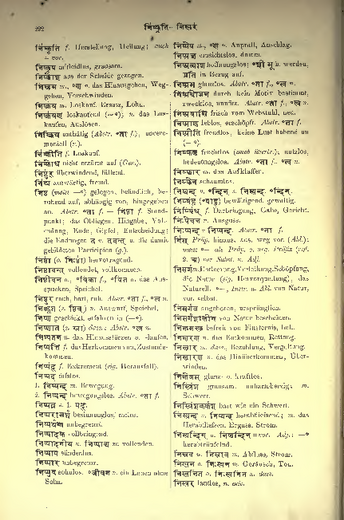
nís Präp. hinaus, aus, weg von (Abl.); meist ˚— als Präp. o. neg. Präfix (vgl. 2. a) vor Subst. u. Adj.
Burnouf 1866 verbal root · Word type unspecified
Original text · French · verbal root
*nis nis, cf. niṃs.
Original text · French · Word type unspecified
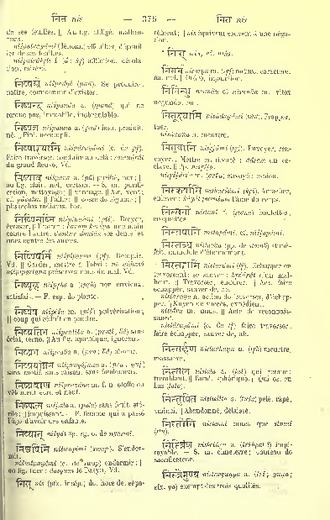
nis nis (pfx. insép.) de, hors de, séparément; [Page375-2] nis équivaut souvent à une négation.
Derived words
More direct derivatives (8)
Occurrences in source texts (68)
DYS 4 occurrences
GoS 1 occurrence
HP 8 occurrences
HTK 1 occurrence
PYS 10 occurrences
4 more source pages
PYS 3.21–22: Invisibility and Time of Death 1 occurrence
Occurrences through derived words
-
PYS 3.22 Segment 2
SiSa 26 occurrences
SiSa 1.10-1.16: Lehrmeinungen 2 occurrences
Direct occurrences
SiSa 1.17-1.19: Geheime Yoga-Lehre 2 occurrences
Direct occurrences
SiSa 2.21-2.24: Ādhāra und Kuṇḍalī 1 occurrence
Occurrences through derived words
-
SiSa 2.24 Segment 5
11 more source pages
SiSa 3.21-3.31: Nāḍī-Reinigung 2 occurrences
Direct occurrences
-
SiSa 3.24 Segment 10
Occurrences through derived words
-
SiSa 3.29 Segment 16
SiSa 3.61-3.67: Paricaya und Niṣpatti 3 occurrences
Occurrences through derived words
SiSa 3.84-3.87: Siddhāsana 2 occurrences
Direct occurrences
-
SiSa 3.85 Segment 18
Occurrences through derived words
-
SiSa 3.86 Segment 6
SiSa 5.144-5.155: Ājñā und Khecarī 2 occurrences
Direct occurrences
-
SiSa 5.144 Segment 14
-
SiSa 5.154 Segment 11
SiSa 5.156-5.181: Sahasrāra 2 occurrences
Direct occurrences
-
SiSa 5.171 Segment 11
-
SiSa 5.178 Segment 12
SiSa 5.223-5.233: Praxis im Leben 2 occurrences
Direct occurrences
-
SiSa 5.229 Segment 2
-
SiSa 5.230 Segment 3
SS 1 occurrence
SS 3.16–3.19: Depth and the Powers of Sound 1 occurrence
Occurrences through derived words
-
SS 3.17 Segment 3
SVU 1 occurrence
VBT 16 occurrences
VBT 75–85: Thresholds and Sky 2 occurrences
Occurrences through derived words
VBT 93–100: Pain and Desire 2 occurrences
Occurrences through derived words
6 more source pages
VBT 121–129: Devotion and Release 2 occurrences
Occurrences through derived words
VBT 130–138: Name and Fourfoldness 2 occurrences
Occurrences through derived words
Continue with AYI Free
Image source: AYI archive.