

dhṛ धृ – hold; support
verbal root · Word type unspecified
Dictionary sources
AYI dictionary verbal root
hold; support
Cappeller 1891 Word type unspecified
Original text · English · Word type unspecified
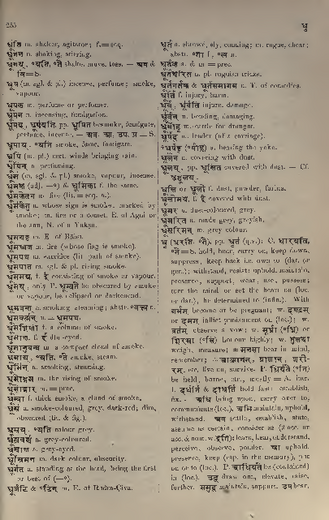
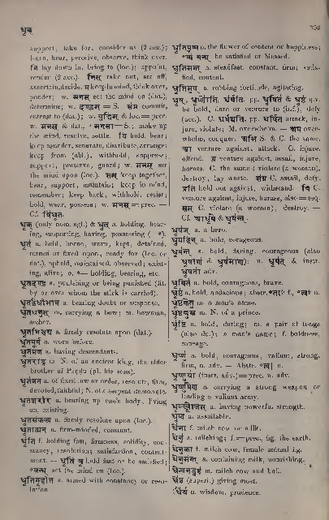
dhṛ ·(dharati, dhara°te), pp. dhṛtá (q.v.); C. dhāraya°te), pp. dhṛtá (q.v.); C. dhārayati, °te = S. hold, bear, carry on, keep down, suppress, keep back i.e. own to (dat. or gen.); withstand, resist; uphold, maintain, preserve, support, wear, use, possess; turn the mind or set the heart on (loc. or dat.), be determined to (infin.). With garbham become or be pregnant; w. daṇḍam or damam inflict punishment on (loc.); w. vratám observe a vow; w. mūrdhnā (°dhni) or śirasā (°si) honour highly; w. tulayā weigh, measure; ±manasā bear in mind, remember; ±ātmānam, prāṇān, śarīram, etc. live on, survive. P. dhriyate (°ti) be held, borne, etc., mostly = A. intr. I. dárdharti & dādharti hold fast; establish, fix. -- adhi bring upon. carry over to, communicate (loc.). abhi maintain, uphold, withstand. ava settle, establish, state, assume as certain, consider as (2 acc. or acc. & nom. w. iti); learn, hear, understand, perceive, observe, ponder. ā uphold, preserve, keep (esp. in the memory), put on or to (loc.). P. ādhriyate be (contained) in (loc.). ud draw out, elevate, raise, further. samud maintain, support. upa bear, support, take for, consider as (2 acc.); learn, hear, perceive, observe, think over. ni lay down in, bring to (loc.); appoint, render (2 acc.). nis take out, set off, ascertain, decide. pra keep in mind, think over, ponder; w. manas set the mind on (dat.), determine; w. daṇḍam = S. saṃpra commit, entrust to (dat.); w. buddhim & loc. = prec. w. manas & dat., ±manasā = S.; make up the mind, resolve, settle. vi hold, bear; keep asunder, separate, distribute, arrange; keep from (abl.), withhold, suppress; support, preserve, guard; w. manas set the mind upon (loc.). sam keep together, bear, support, maintain; keep in mind, remember; keep back, withhold, resist; hold, wear, possess; w. manas = prec. -- Cf. vídhṛta.
Monier-Williams 1872 Word type unspecified
Original text · English · Word type unspecified
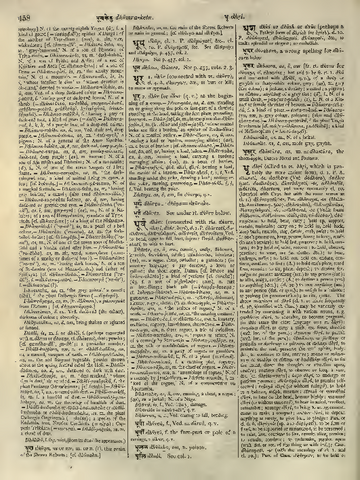
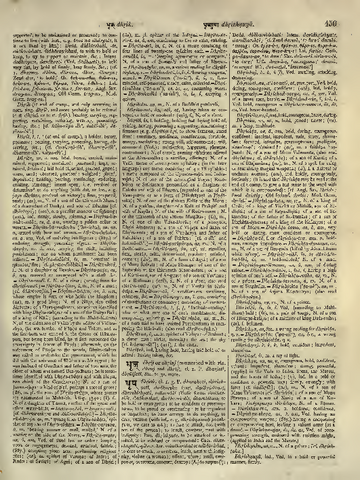
dhṛ dhṛ (allied to rt. bhṛ, which is pro- bably the more ancient form), cl. 1. P. A. dharati, -te, dadhāra (Ved. dādhāra), dadhre (part. dadhrāṇa), dhariṣyati, -te, adhārṣīt, adhṛta, dhartum, and more commonly cl. 10. (identical with Caus. but with the same senses as cl. 1.) dhārayati, -te, Pot. dhārayet, -ta (Mahā- bh. Anuśāsana-p. 5007. dhārayīta), dhārayāmāsa, dharayiṣyati, -te, adīdharat, -ta (Vedic forms dīdharat, didhṛtam, didhṛta, ni-dīdhar), dhā- rayitum, to hold, bear, carry; hold up, support, sustain, maintain; carry on; to hold in, hold back, keep back, restrain, stop, detain, curb, resist; to hold in one's possession, keep, possess, have; to keep, retain (in one's service); to hold fast, preserve; to hold, con- tain; to lay hold of, seize, recover; to hold, observe, practise; to wear, use (as clothes &c.); to bear, undergo, suffer; to hold out, hold on, endure, con- tinue, continue to live; (A.) to hold one's place, stand firm, remain; to fix, place, deposit; to destine for, assign or present anything (acc.) to any person (dat.); to allot, assign, confer; (A.) to destine a person (acc.) to anything (dat.); (cl. 10.) to owe anything (acc.) to any person (dat. or gen.); to weigh in a balance; to prolong (in pronunciation); to cite, quote. The above meanings of dhṛ (cl. 1. or more frequently cl. 10. identified with Caus.) may be variously ex- tended by connecting it with various nouns, e. g. garbhaṃ dhṛ, to conceive, to become pregnant, (in this sense the older language uses rt. bhṛ); daṇḍaṃ dhṛ, to carry a stick, use force, chastise (with loc. of the pers.); damaṃ dhṛ, to punish (with loc. of the pers.); ātmānaṃ or jīvitaṃ or prāṇān or śarīraṃ or gātraṃ or dehaṃ dhṛ, to maintain the soul, preserve the vital spirits, body, &c., to continue to live, survive; mano or māna- saṃ or matiṃ or cittaṃ or buddhiṃ dhṛ, to fix the mind, direct the thoughts or attention upon, resolve; vrataṃ dhṛ, to observe or keep a vow, &c. [cf. dhṛta-vrata]; tapo dhṛ, to undergo or perform penance; dhāraṇāṃ dhṛ, to practise self- control; tulayā dhṛ (or without tulayā), to hold in a balance, weigh, measure; śirasā or mūrdhni dhṛ, to bear on the head, honour highly; manasā dhṛ (or without manasā), to bear in mind, recollect, remember; samaye dhṛ, to bring to an agreement, cause to make a compact; antare dhṛ, to deposit anything as surety, to give bail, to pledge: Pass. or cl. 6. A. dhṛyate (ep. also dhṛyati), to be firm or fixed, to be supported or maintained, to be preserved; to exist, live, continue to live, remain alive, survive; to remain, continue; to undertake, resolve upon (with dat. or acc. of the thing or with inf.): Caus. dhārayati, -te (with the meanings of cl. 1. and cl. 10.): Pass. of Caus. dhāryate, to be held or supported, to be maintained or preserved; to con- tinue to live (with inst., e. g. tena na dhāryate, it is not lived by him): Desid. didhīrṣati, -te, didhariṣate, didhārayiṣati, to wish to hold or keep, to try to support or maintain, &c.: Intens. dedhrīyate, dardharti (Ved. dādharti), to hold very fast, lay hold of firmly, bear firmly, &c.; [cf. 1. dharma, dhīra, dhruva, dhur, dhurya; Zend dar, ‘to hold;’ Gr. θρή-σα-σθαι, θρᾶ-ν-ος, θρῆν-υ-ς, θρόνο-ς, θέρ-μα, θέλ-ω, ἐ-θέλ-ω; Lat. frē-tu-s, frē-nu-m, fir-mu-s, for-ma; Angl. Sax. drag-an, dreog-an; Old Germ. trag-an; Mod. Germ. trag-en.]
Whitney Roots 1885 verbal root
Original text · English · verbal root
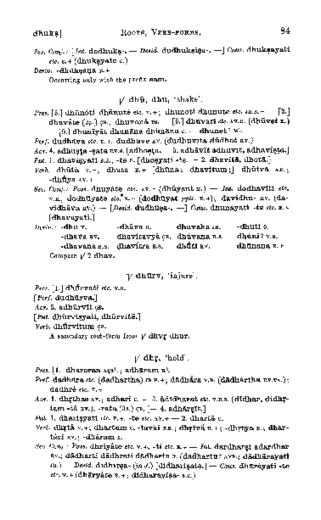
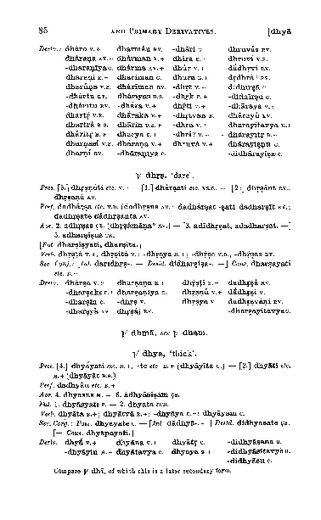
dhṛ — hold
Apte 1890 verbal root
Original text · English · verbal root
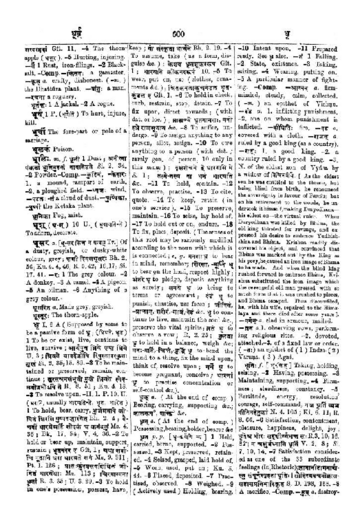
dhṛ I. 6 A. (Supposed by some to be a passive form of dhṛ); (dhriyate, dhṛta) 1 To be or exist, live, continue to live, survive; āryaputra dhriye eṣā dhriye U. 3; dhriyate yāvadekopi ripustāvatkutaḥ sukhaṃ Śi. 2. 35; Śi. 15. 89. 2 To be maintained or preserved, remain, continue; surataśramasaṃbhṛto mukhe dhriyate svedalavodgamo'pi te R. 8. 51; Ku. 4. 18. 3 To resolve upon. II. 1 P. 10 U. (dharati, usually dhārayati-te, dhṛta, dhārita) 1 To hold, bear, carry, bhujaṃgamapi kopitaṃ śirasi puṣpavaddhārayet Bh. 2. 4; vaiṇavīṃ dhārayedyaṣṭiṃ sodakaṃ ca kamaṃḍaluṃ Ms. 4. 36; Bk. 17. 54; V. 4. 36. 2 To hold or bear up, maintain, support, sustain; dhṛtamaṃdara e Gīt. 1; yathā sarvāṇi bhūtāni dharā dhārayate samaṃ Ms. 9. 311; Pt. 1. 126; prātaḥkuṃdaprasavaśithilaṃ jīvitaṃ dhārayethāḥ Me. 113; ciramātmanā dhṛtāṃ R. 3. 35; U. 3. 29. 3 To hold in one's possession, possess, have, ([Page 0600-b]) keep; yāṃ saṃskṛtā dhāryate Bh. 2. 19. 4 To assume, take (as a form, disguise &c.); keśava dhṛtaśūkararūpa Gīt. 1; dhārayati kokanadarūpaṃ Gīt. 10. 5 To wear, put on, use (clothes, ornaments &c.); śritakamalākucamaṃḍala dhṛtakuṃḍala e Gīt. 1. 6 To hold in check, curb, restrain, stop, detain. 7 To fix upon, direct towards; (with dat. or loc.); brāhmaṇye dhṛtamānasaḥ, mano dadhre rājasūyāya &c. 8 To suffer, undergo. 9 To assign anything to any person, allot, assign. 10 To owe anything to a person (with dat.; rarely gen. of person, 10 only in this sense); vṛkṣasecane dve dhārayasi me Ś. 1; tasmai-tasya vā dhanaṃ dhārayati &c. 11 To hold, contain. 12 To observe, practise. 13 To cite, quote. 14 To keep, retain (in one's service). 15 To preserve, maintain. 16 To seize, lay hold of. 17 To hold out or on, endure. 18 To fix, place, deposit. (The senses of this root may be variously modified according to the noun with which it is connected; e. g. manasā dhṛ to bear in mind, remember; śirasā, -mūrdhni dhṛ to bear on the head, respect highly; aṃtare dhṛ to pledge, deposit anything as surety; samaye dhṛ to bring to terms or agreement; daṃḍaṃ dhṛ to punish, chastise, use force; jīvitaṃ, — prāṇān, -śarīraṃ, -gātraṃ, -dehaṃ &c. dhṛ to continue to live, maintain the soul &c., preserve the vital spirits; vrataṃ dhṛ to observe a vow; R. 2. 25; tulayā dhṛ to hold in a balance, weigh &c; manaḥ -matiṃ, -cittaṃ, -buddhiṃ dhṛ to bend the mind to a thing, fix the mind upon, think of, resolve upon; garbhaṃ dhṛ to become pregnant, conceive; dhāraṇāṃ dhṛ to practise concentration or self-control &c.).
Burnouf 1866 verbal root
Original text · French · verbal root
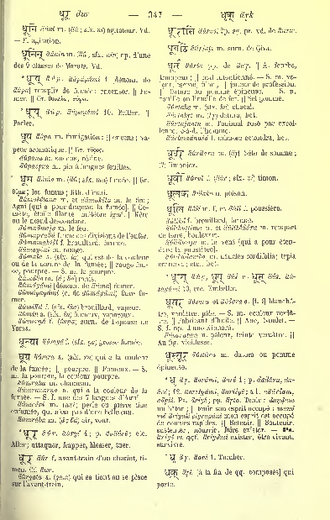
*dhṛ dhṛ. dharāmi, dhare 1; p. dadhāra, dadhre; f2. dhariṣyāmi, dhariṣye; a1. adhārṣam, adhṛṣi. Ps. dhriye; pp. dhṛta. Tenir: daṇḍam un bâton; tenir son esprit occupé: mano me dhriyate śīgrayāne mon esprit est occupé de courses rapides. Retenir. Soutenir, sustenter, nourrir, faire exister. — Ps. dhriye et qqf. dhriyāmi exister, être vivant, survivre.
Original text · French · verbal root
*dhṛ dhṛ. dhare 1. Tomber.
Derived words
-
dharma धर्म substantive masculine dharma; property; quality; task; righteousness; wholesome order; law
Further derivatives (1)
Occurrences in source texts (67)
DYS 16 occurrences
DYS 112–121: Five Elements 11 occurrences
Direct occurrences
Occurrences through derived words
GoS 4 occurrences
HP 11 occurrences
HTK 1 occurrence
HTK 10.11*2–14*1: Bhastrikā: Breath like a bellows 1 occurrence
Direct occurrences
-
HTK 10.12 Segment 20
IVU 1 occurrence
MAN 1 occurrence
PYS 10 occurrences
PYS 2.27–29: Aṣṭāṅga as a Path to Liberation 1 occurrence
Occurrences through derived words
-
PYS 2.29 Segment 6
PYS 2.52–53: Karmic Veil and Dhāraṇā 1 occurrence
Occurrences through derived words
-
PYS 2.53 Segment 1
PYS 3.13–14: Three Kinds of Transformation 3 occurrences
Occurrences through derived words
PYS 3.44–46: Mastery over the Elements 1 occurrence
Occurrences through derived words
-
PYS 3.45 Segment 7
SiSa 13 occurrences
SiSa 3.61-3.67: Paricaya und Niṣpatti 3 occurrences
Direct occurrences
-
SiSa 3.64 Segment 25
Occurrences through derived words
SiSa 5.6-5.9: Dharma-Hindernisse 2 occurrences
Occurrences through derived words
3 more source pages
SiSa 5.94-5.101: Mūlādhāra-Siddhis 1 occurrence
Occurrences through derived words
-
SiSa 5.101 Segment 7
SiSa 5.144-5.155: Ājñā und Khecarī 2 occurrences
Direct occurrences
-
SiSa 5.148 Segment 11
Occurrences through derived words
-
SiSa 5.152 Segment 13
SVU 2 occurrences
VBT 8 occurrences
VBT 18–21: Śakti and Śiva 2 occurrences
Occurrences through derived words
VBT 93–100: Pain and Desire 2 occurrences
Occurrences through derived words
Continue with AYI Free
Image source: AYI archive.